Showing posts with label food. Show all posts

Friday, January 17, 2025

The Reckoning: Taking Back the American Dream

The Greek philosopher, Plato, said in his two famous political works, "The Republic" and "Laws", that unchecked economic inequality was a principal reason for the fall of democracies and the rise of demagogues.

But as History has repeatedly shown it's not only democracies, but nearly every form of government which will eventually collapse under the weight of economic inequality, which typically brings about political failure, from the ancient empires of Sumer and Babylon to Pharaonic Egypt, Rome, and up to modern times.   

Today, economists and political scientists are looking at the strain that climate change, rising prices and taxes, population migration, aging populations, crumbling infrastructures, rising public and private debt, public apathy, and failing school systems as symptoms of an increasingly unstable United States and Western Europe. Even China, India, and other nations along the Pacific Rim are seeing cracks in their economies as monies are diverted more and more to critical services.

The gap in quality of life between the top 20% and the remaining 80% has grown along every measurable statistic for the last 30 years. The cost of an average house has risen approximately 817% between 1970 and 2024, which is higher than the average rate of inflation (4.19% for housing compared to an overall inflation rate of 3.94%), All items, excluding food, rose 627% between 1967 and 2024. 

Using data from the Center For Economic and Policy Research (CEPR), between February 2020 and November 2023, average wages rose 19.4%. For individuals in production and non-supervisory roles, 21.9%, while for high demand non-technical positions such as hotel and restaurant workers, their wage shot up 31.6% (note that these jobs represent 80% of the job market). While an average increase in wages of 19.4% is pretty good, the Consumer Price Index, which measures the overall change of prices, went up 18.8% for the same period. 

Starting with the COVID pandemic in 2020 and continuing through November of the following year, the price of food jumped 24.7%, exceeding the average growth of wages by 5.3%.  So, if you're seeing the content of your grocery cart getting smaller while the amount at the checkout counter getting higher, it's not your imagination or because you're unnecessarily splurging. For instance, the price of a loaf of bread has increased 28.8% since the pandemic while the cost of eggs have jumped 24.7%. 

While the consumption of red meat has been steadily declining, it still remains a staple for many U.S. households. Since COVID-19, the price of beef went up 30.3%, with the highest jump in price occurring in 2020 during the peak of the lockdown. Interestingly, the cost for chicken rose by the same percentage (driven up, in part, by the arrival of the "Bird Flu"). Milk, another staple found in most homes, saw a 20.4% increase per gallon. The good news (if there is any), is that the prices of milk and milk related products (such as cottage cheese, sour cream, and butter) are showing signs of stabilizing and in some instances, even dropping.   

As an aside, most Americans tend to struggle with their weight. Americans are notoriously overweight according to the National Institutes of Health (NIH), which say that one in three Americans are over their optimal weight. Just over one in three men (or about 34.1%) are considered obese while about one in four women (27.5%) are "chubby" while 42.4% of both genders are considered seriously overweight. This, of course, is part of the reason for the explosion in diabetes and heart disease. 

While some individuals are overweight due to genetic or other medical conditions, most are tubby due to their lifestyle. One common recommendation from physicians to deal with our weight problem is a combination of regular exercise and adopting a healthy diet. However, the NIH reports that the cost of many diet suggested foods, such as vegetables, fruits, and oils, have risen in price by an average of 17.9% since the pandemic. Ironically, Unhealthy foods have seen an increase in price of just 9%!  The single exception was the price of fast food, which rose 14.7% between 2019 - 2022.  It should be mentioned too that since 2000, the cost of medical care, including prescriptions, increased by 121.3%. 

Based on data from the United States Department of Agriculture (USDA), the price of fruits increased 9.5% between 2021 and 2022 while the cost of fresh veggies rose by 7.9% over the same period. Even the cost of eating out has jumped in price. On average, restaurant food prices have risen 7.1%. Of course getting to and from the grocery store, local eatery, work or just about anywhere else requires a vehicle of some sort. So, what about the cost of gas?

Under President Donald Trump, the average price of gasoline ranged from a high of $2.81 a gallon in 2018 to a low of 2.26 in 2020 (equaling President Obama's low in 2016). Under President Joe Biden, gas was $3.10 a gallon for regular in 2021 and rose to a high of $4.06 for a gallon in 2022. This is higher than the three previous presidents, Trump, Obama, and George W. Bush. However, in looking at the broader picture, from 2020 through the end of 2023, gas prices have risen by a astonishing 30.4%, thus outpacing wage growth for all but a few.

Despite the increase the cost of living for practically everything, not everyone is feeling the pinch. According to a recent study, conducted on behalf of Bank of America in 2024, roughly 30% of American households are living paycheck to paycheck (a similar study reported by CNN put that percentage at 35%). Another 20% or so percent can't afford to miss anymore than one paycheck before their financial house of cards begin to fold.  

What's meant by the expression "living paycheck to paycheck"? According to the Bank of America study, living "paycheck to paycheck" means spending 90% or more of your income strictly on necessities such as rent/house payments, food, utilities, or medical bills. 27% of all Americans have no money in savings. 27% of those over 50 years of age are in the same boat. On top of that, 40% of Americans have less than $1000 set aside for emergencies according to the American Bankers Association. Of that, 49% have $500 or less available while 36% said they have just $100 for emergencies (and yet, we can afford to send $64.1 billion dollars to prop up the Zelensky regime in Ukraine to fight a war that we encouraged). 

So, while the average American struggles to keep a food on the table and roof over their head (13.7% of Americans are food insecure while 14% of Americans have experienced homelessness at some point), the federal government lets approximately $92 billion dollars in corporate welfare annually slid by. Corporate welfare includes tax credits, give backs, preferable regulatory treatment, no bid contracts and automatic contract renewals, debt write-offs, deep discounts, bailouts, low or no interest loans, public grants, public-private partnerships (public money financed ventures), subsidies, and more.   

 From 1980 through 2021, the level of income for the Top 1% rose by 574%. For the Bottom 20%, it was just a paltry 31%. For the Top 0.01%, their wealth grew 832%. The Top 1%---about 12,000 households--- are 139 times richer the Bottom 20%. According to the Organization of Economic Co-Operative Development (OECD), a international economic and social policy forum, the United States has one of worse levels of income inequality among its 100 nation members. 
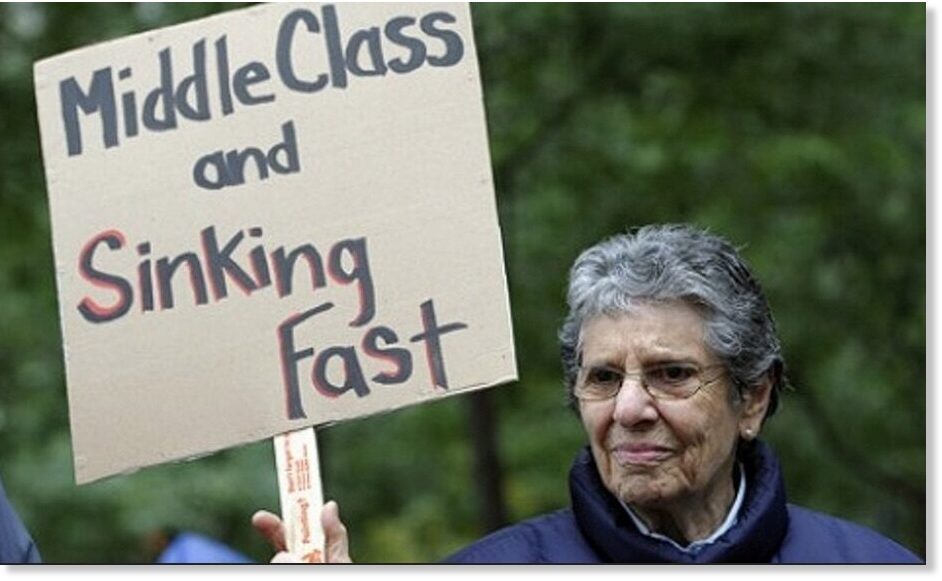
In 1971, 61% of American families made up the Middle Class. Today, that percentage ranges from 46% to 55% and declining. 50 million Americans now fall below the poverty threshold, and yet the federal government is doing little to stop the millions of illegal immigrants, the majority of whom falling into the poverty category, into the United States. Of course, we can't forget that women, on average, still earn just 82% of what men earn despite being mandated by federal legislation. 

One other factor to look at is the wage inequality between CEOs and their employees. In 1965, the average CEO made roughly 21 times that of their employees, which sounds reasonable. As of 2023, that percentage is 290 times more than their employees (there are 58 companies where that ratio is 1000 to one).. To put it another way, between 1978 and 2023, the pay of the average worker (wage and benefits) rose by 24%. Over that same time period, pay and benefits for CEOs and senior officers went up 1085%. The median pay for a CEO in 2023 was $16.3 million dollars according to a report published by the Associated Press (the data was comprised by Equilar). 

Can the United States continue with this level of income inequality? Ever since the decline of organized labor in the late 1950's, the income ratio between the working class and corporate leadership has been expanding, in part because the composition of their compensation package has changed to include more stock options and performance incentives. 

Meanwhile, similar types of incentives for employees have been reduced or cut, not to mention wage and/or benefits through so-called "voluntary give backs" out of fear that their jobs would be eliminated or the facility closed and sent overseas. Is this cost cutting measures to protect the business's profitability or merely a form of extortion? 

Since 1967, the Middle Class has been on a downward spiral, nearly matching the decline in public union membership. This decline of the union rank and file has meant a decline of union and non-union bargaining power and political clout which by extension, has directly affected the Middle Class. A strong working class, union or not, tends to mean a vibrant and financially healthy Middle Class. 

As mentioned at the beginning of this article, economic instability, coupled with public apathy, demagoguery and a well educated citizenry are a greater factor in the fall of democracies as well as empires, second only to severe and sustained climate events, than all other reasons. We have those in spades. 

Right now, we're facing not only extreme income inequality, but a strain on the economic elasticity of our social safety net, made all the worse by an defacto invasion, albeit non-military (at least at this point) of hoards of poor, largely poorly educated people who are interestedly solely in economic opportunities with no desire to contribute to their new homeland .

A people seeking to migrate or seek refuge will adopt to their new homeland's values and traditions. They will adapt to the laws and find ways to contribute. They will pay for public services through taxes. They will learn their adopted country's language.

 An invading army will do none of these things. Their objective is to supplant everything they can by any means available. They'll establish exclusive enclaves, turning them into semi-automatous zones of occupation, daring their hosts to enter. They will pervert the laws of their hosts. They will plead for tolerance when their numbers are small but offer none when there number have grown. 

Distrust in the government and media are at all time highs and have been that way for decades. Mediocrity at all levels of society, especially politics, are accepted as the norm. Excellence is often mocked if not actively discouraged. Herd mentality is the rule. 

The good news to all this is that there's a growing resistance to the ruling Status Quo. People are walking away from the Corporate imposed partisanship.  People are not just questioning so-called "authority", they're challenging it. The scripted narrative is no longer accepted. 69% of the public has little or no trust in the corporate media.

Increasingly, we're waking up to being played by the ruling class. The approval rating of Congress is laughable 17% We're refusing to accept the artificial divisions they want us to play. It's time we stop playing by their rules and start working to build a society which can benefit everyone. Not by mandating equal outcomes, but by ensuring equal opportunities. We need a society that our Founding Fathers would be proud of.   


 Thank you for reading "Another Opinion", the Op/Ed blog page for the "militant middle".  Here at "A/O" we truly value our readers. At A/O we seek the facts as they exist, not partisan talking points.  We hope you found our articles informative and engaging. Comments are welcome, provided they are not vulgar, insulting or demeaning.  Another Opinion is offered without charge and is directed toward all independent and free thinking individuals. We do ask, however, that you be sure to "like" us on whatever site you found us on in order to keep our articles available for others, and that you please pass our post along. Below you will find links to the sources we used in writing this article. Thank you. 


Average Gas Prices Under The Past Four Presidents


Wages and Prices: Who Is Keeping Up with What? 


Healthy Food Prices Increased More Than The Prices of Unhealthy Options during the Covid-19 Pandemic...


Nearly Half Have less than $500 in Savings


Survey: One in Four Americans Have Less than $1000 in Savings


The typical CEO makes nearly 200 times more than their workers


Saturday, November 26, 2022

Thanksgiving: Being Grateful For What We've Had as Americans

 If we look at the present rate of inflation, it was running about 7.7% as of October. It looks like inflation it will be 8.3% for the year, which is a 40 year high. Your general utilities will be just about 17.9% more than it was last year. Food is up 10.9% over last year.

The cost of gas and diesel fuel has been on the rise as we all know. The average increase has been around 6.3%.  We saw a drop in prices toward the end of the election cycle when President Biden freed up some oil and gas from our national reserves. The point of course was to make voters forget, at least temporarily, all the pain they were paying at the pump.

Interest rates on everything from bank loans to credit cards are on the rise. When interest rates start to rise, so does inflation and visa versa. This is because to there is less money in circulation, so the "price" of money, which is based on its availability, goes up. Interest is the price we pay to "rent" the use of money.  

The control of money (and interest rates) is controlled by the Federal Reserve. In order to slow the economy, the Fed increases interest rate, which slows borrowing in order to reduce inflation. By the same token, if the economy slows too much, the Fed lowers the rate of interest in order to encourage more borrowing and thereby stimulate the economy. In general, the Fed likes to keep the overall inflation rate around 2%.

When it comes to stocks and bonds, they tend to operate inversely. As stock prices rise, bond prices drop. When stock prices drop, bond prices tend to rise.  For instance, the interest rate of "I" Series U.S. Treasury Bond are expected to starting dropping from a current rate of 9.62% to an anticipated 6.47% as inflation rises.

The average American spends about 33% of their net income on mortgage or rent payments. With that in mind, real estate prices have risen approximately 17% over last year. The median price of an average home in the United States was $428,700 in the first quarter of 2022. If we go back to 2020, it was $329,000, which is a 30% increase in price. Availability is one determining factor.

If we compare by state, the average cost of a home in Hawaii was $1,038,544 in July 2022. That same home would cost $164,132 in Mississippi. Like California? Get ready to pony up around $816,804 (some parts of California such as San Francisco are actually considered too expensive for some people to move to). Maybe you'd like a little more open spaces instead.

In Montana and North Dakota the average price of a home will set you back $449,723  and  $282,461 respectively.  Not remote enough? Try Alaska. The average price of a home is $337,373.  Of course, you could consider Kentucky or West Virginia where they say weddings are more like family reunions. An average priced home will cost you around  $197,644  and $137,286. 

Any way you slice it, the home prices are forcing more Americans to consider renting. But even that is becoming beyond some people's reach. A single bedroom apartment nationally  rents for an average of $1,326.00 a month (typically with utilities included). A single family house typically rents for $2,018.00 plus utilities.  Of course, as with homes, location is everything.

As with houses, Hawaii has the highest apartment rental prices, followed by California. The average one room apartment goes for $2,399.00 a month in Hawaii and $1,844.00 in California. Washington DC is high when it comes to either buying or renting. The average apartment rents for $1,770.00. Meanwhile, you can rent a nice single bedroom apartment in Kentucky for roughly $920.00 or $905.00 in Iowa.

But, as with everything else, the price of rent is expected to keep rising. Nationally, the U.S. is short between some 2 and 5 million units meaning there's more demand than supply, which drives up prices. Meanwhile, with inflation increasing along with interest rates, the cost to "rent" money to build more units has gone up too. That makes it more expensive to build more units and those higher cost are passed along to the consumer.

Perhaps the most important component here is wages. The average worker receives a wage increase of approximately 3.5 to 5.5% annually. Social Security and other government income recipients receive a annual cost of living increase (called "Cost of Living Adjustments" or "COLAs") of 8.7% at the beginning of the year.   

However, when confronted with the current inflation rate, most individuals go in the hole by the time you add  in all the increases in utilities, fees, credit card interest rates, gas, food, taxes (particularly property and schools taxes), clothes, and so forth. Perhaps if it was just one or two of these, most people could cope, but it's not. It's the commutative effect.    

Meanwhile, the cost of benefits, on which employees depend, continue to increase. Over the last five years, the cost of basic benefits have risen between 5% and 7%, forcing employers to reduce what they offer or requiring employees to pick up more of the tab.

Some small businesses have had no other choice but to drop benefit packages altogether, which forces some employee to seek employment elsewhere (and we all know finding qualified workers has always been tough, but finding individuals willing to work has been next to impossible since COVID). 

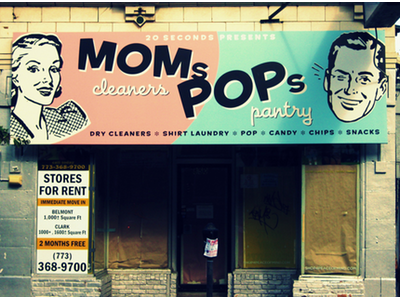
As a result, a lot of smaller "mom and pop" shops have vanished. Bear in mind too that few small businesses receive taxpayer based corporate bailouts. Those seem to be reserved for Wall Street. Let's take a more detailed look at wages since that effects pretty much everything else.

Not surprisingly, wages have failed to keep up with the rate of inflation. In terms of real dollars (dollars adjusted for the rate of inflation), our purchasing power is at a 66 year low. To put it another way, the current minimum wage buys the same as what 75 cents did in 1956.  Individuals on the low level of the pay scale, which includes most entry level jobs, simply can't make it.

A  survey by Bankrate said 55% of those surveyed said their wages weren't keeping up with prices. That includes workers who receive regular salary increases annually and the 39% of employees who do not.

 To add salt to the wound, CEOs and senior executives earn an average of just over $21 million dollars a year. This is more than 400 times the salary of an average employee which is about $51,000 a year. The difference was 20% in 1963. From 1978 to 2020, the salaries of U.S. CEOs increased by over 1,322% while the average employee saw an increase in pay of just 18% for the same period.  

The top three companies with the greatest executive/employee wage inequality are Nike, Walmart, and Amazon. The three companies with the lowest executive/employee wage inequality are Alphabet (the parent of Google), Walt Disney, and Berkshire Hathaway.

To put it another way, an employee at Nike would have to work just under 30 hours to equal one minute of their CEO's salary. It's 20.7 hours at Amazon and 14 hours at JP Morgan Chase Bank. At Starbucks it's 10.7 hours of serving their overpriced coffee to equal one minutes of CEO Kevin Johnson's salary. At Blackrock, which is arguably the world's most influential company, an typical employee has to work 6.2 hours to earn the same amount that their CEO, Larry Fink, earns in 60 seconds.

Income inequality is at its highest level in over 50 years according to the U.S. Census Bureau. The widest pay gaps are in California, Florida, New York, Connecticut, Louisiana. However, Texas, Kansas, Nebraska, New Mexico, New Hampshire, Virginia, and Arkansas aren't far behind.

The Census Bureau also shows (perhaps not surprisingly) that the percentage of poverty in the U.S. was 12.8% in 2021, which is among the highest of any developed nation. That's about 38 million people. In fact, of the top 25 industrial nations in the world, the U.S. ranks dead last.

In 2021, the percentage of child poverty (those under 18 years of age) was 16.9%. For those over age 65, it was 10.3%. In Kentucky, the central South, New Mexico, and Washington DC,  the child poverty rate was over 22%. It was lowest in Utah, North Dakota, Montana, Vermont, and New Hampshire.

For seniors, Washington DC, Louisiana, and Mississippi the poverty rate was 13% or higher. In 12 states, including Kentucky, Nevada, and South Dakota, the poverty rate was between 11% and 12.9%. In the majority of the country it was 8.8% to 9.9% while in four states it was under 8%.  

According to a number of reports, around a half a million Americans are homeless at any given time. About 70% are individuals while the rest are families. 11% of the homeless are military veterans. The rise of inflation and prices in general will likely add to these numbers.

Inflation, increasing home prices, the cost of gas, food, utilities, income inequality, homelessness, and, of course, rising taxes, are symptoms of a failing political and economic system along. There is no questioning our social, economic, and political divide.

 History has shown that radical change tends to come from the bottom up. This is especially true if a middle class supports the bottom tier. In America, our middle class has gone from 61% of the population in 1971 to 50% in 2020 while the percentage of low income has grown from 25% to 29%. Globally the middle class has shrunk by 150 million since 2017. India lost 32% of its middle class while Asia lost 25%.

Along with industrial output, the quality of education and medical care, and other key measurements, the United States is showing all the signs of a irreversible decline. China is now the world's leader in manufacturing. In terms of technology and its innovation, the U.S. ranks number one, but China, Japan, and South Korea are pretty close behind. Germany and Israel are closing in too.

Academically, we rank in the middle of the second tier in science. In reading, we're in the lower half of the second tier, while in mathematics we're just above the third tier.  Overall, we're 17th in the world academically with Asian, Scandinavian, and Europeans dominating the top slots.   

When it comes to healthcare, we spend more money than any other developed nation, and yet, we have among the highest infant mortality rates, the lowest life expectancy, and the fewest number of available beds. Among the top 11 highest income nations, the U.S. healthcare system ranks dead last.

Some predict America will become a second tier economy with a top tier military presence akn to other historic empires like Rome, the Ottomans, and Great Britain.  Others think it will a much harder landing resulting in a broken and fragmented nation.  Certainly the foundations are in place thanks to unchecked illegal immigration and a multiculturalism which discourages integration. Anyway you look at it, you better buckle your seatbelts.  


 If you want to know more, please take a look at the links below. If you enjoyed the article, please consider passing it along to others and don't forget to subscribe. It's free! Lastly please be sure to "like" us on whatever platform you use to read AnotherOpinion.com. It helps with the algorithms and keeps our articles in circulation. Thank you!   


Inflation Calculator


What Is the Relationship between Inflation and Interest Rates


United States House Prices Growth


How Rising Interest Rates and Inflation Impact Real EstateInvestments


Average House Prices by State in 2022


Bureau of Labor Statistics: Employment CostIndex---September 2022


Average Rent by State 2022


CEO vs. Employee Salaries at America's Top Companies


U.S. Poverty Rate Is 12.8% but Varies Significantly by Age Groups


U.S. health-care system ranks last among 11high incomecountries, researchers say


Report: Pandemic Shrunk Global Middle Class by 150 Million


America's Poor Are Worse Than Elsewhere


Saturday, April 16, 2022

Understanding the Real Reason Why Russia Invaded the Ukraine


Contrary to what many people think, the war in the Ukraine did not begin with the invasion in February 2022. In many ways the war started in 1991 when the former Soviet state pulled away from the Russian orbit with the collapse of Soviet Union.  At the time, areas closely aligned with Russia, such as the Crimea and Donbass provinces in the eastern portion of the country, joined with the rest of the Ukraine in its departure.

The reason was largely the anticipation that the Ukraine would be a separate nation, yet remain closely aligned to Russia, which, in fact it did. However, with the Maidan Revolution (also called the "Dignity Revolution") in February 2014, Western Powers supported the removal of what was essentially a corrupt pro-Moscow government and replaced it with equally corrupt pro-Western government.

Following a plebiscite in Crimea where the majority of the citizens voted to reintegrate with Russia, the Russian military moved in with relatively little resistance. Of course, public approval played only a superficial or cover role for the invasion. The Crimea has been a part of the Russia since the days of Czarina Catherine the Great in the 18th Century.

Secondly, the Crimea is home to Russia's Black Sea Fleet at Sevastopol, which is Russia's second largest naval base (the equivalent to Norfolk Virginia in the United States). It is Russia's only year round warm water port. It also provides the Russian Navy access to the Mediterranean Sea, and from there, access to the Atlantic and Suez Canal and into the Indian Ocean.

However, that's not all. The Crimea holds a tremendous amount of oil and gas reserves. Estimates place the amount at 58.6 billion cubic meters of natural gas and 2.53 million tons of crude oil worth somewhere in the neighborhood of $160 billion dollars.  To put it another way, that represents some 10 billion barrels of oil and about 3.8 trillion cubic feet of natural gas.

Prior to the annexation, the Kyiv Government had been quietly negotiating with Western oil companies (notably BP and ExxonMobil) to step in and begin accessing the oil and gas. However, as a result of the annexation, Ukrainian officials estimate that they lost approximately 80% of what's there on the Black Sea shelf. Prior to the war in the Ukraine, some economists were estimating that Russia could provide as much as 90% of Europe's oil and gas; much of which coming from the Black and Avov seas.  

And fear not for the oil companies. Russian oil conglomerates often work in partnership with ExxonMobil, BP, and Royal Dutch Shell in the Arctic and Siberia which, thanks to global warming, has become more accessible. 

Note too that this is oil and gas revenue which could have gone to the Ukraine. To make matters worse, the Nord 2 pipeline, which originally was expected to cut through the Ukraine, providing additional income, has bypassed it instead, in accordance with an agreement between Moscow, Berlin, and Paris. This negatively reduces Kyiv's anticipated revenues by roughly 3% of it GDP.

The Donbass, located  in the eastern portion of the Ukraine, is no exception to being another resource rich region. The Donbass produces vast amounts of coal, despite having been mined for over a century, ranging from lignite (thermal and coking which is used in making steel) to anthracite,  making it 6th in the world in coal production. And if that's not enough to see why Russia is supporting the Donbass separatist, the region is also rich in graphite, mercury, nickel, titanium, manganese, and iron ore.

Meanwhile, the western portion of the Ukraine, which is less populated and more rural, has extremely fertile soil and has long been known as the "wheat basket of Europe". It's the world's leader in the production of sunflower oil, and one of the main exporters of sugar, grain, and, of course, wheat.

Why is this important for us? Simply this. Inflation. While the war in the Ukraine is not solely responsible for our record high rate of inflation (currently 8.5% this quarter, which is the highest in 40 years), it is a strong contributor and reason we're paying obscene prices for oil and gas, which in turn, drives the increasing prices for everything from the cost of electricity, transportation, and the prices we pay at the grocery store and department stores. 

How bad is it? Potentially pretty bad, depending on how much longer the war in the Ukraine continues, and other factors such as the weather and possible wars. One estimate by OxFam International estimates that at the current rate of inflation, some 260 million people worldwide could find themselves living in extreme poverty by year's end. This is especially true in developing countries; many of whom will be forced to default on loans from the International Monetary Fund (IMF).

When that happens, we tend to see an increase in social unrest and destabilized governments, which forces countries to divert diminishing resources to security matters and away from maintaining basic services. It also produces mass immigration to countries which are seen as richer and more likely able to support them (such as what Europe and the United States has been experiencing for decades). This puts additional stress on the national social safety net and increases strife with the existing population.  

So, what does this mean for us?  The war in the Ukraine is not the cause of what's happening in the United States or the world. Rather, it's a symptom. Whether or not various political cliques want to accept global warming, there's is no question that the climate is changing. Whether that's natural or man-made is of little consequence.

The reality is that there is less fertile farm land. Less fresh water, and more demand for natural resources such as fossil fuels and strategic minerals need to keep our economies going.  We are overfishing the oceans and in the process, killing off coral reefs and creating entire "dead spots" in the oceans thanks to pollution. Meanwhile, corporations are making record profits as we are forced to pay more for the basics. We can't keep going on like that.

The war in the Ukraine, like most wars, is about acquiring resources to fuel their economies. In most cases, this war over resources is done on a political and economic level such as what China has being doing globally for decades. However, it sometimes spills over into open hostilities. That's particularly true of weaker nations who get caught between two or more larger and more powerful countries.

As resources become ever more scarce, we can expect to see these types of conflicts spring up more and more. When this happens, the wealthy elites usually revert to the tried and true tactic of rallying the population around some cause. It will demonize "the enemy" (the irony, at least in America's case, is that we likely install the "demon" in the first place). Using force or threat of force is now considered commonplace. It's used as an additional tool of what I call "imperial diplomacy". 

If the usual bribery, kickbacks, and "backslapping" doesn't work, they tend to revert to intimidation and bullying to get the concessions they want, be it access to certain markets, resources, or trade agreements. If that doesn't work (and it usually does), they up the ante with implied threats of military force.

Russia was content with the pre-Maiden government of the Ukraine. There was no pressure to annex the Crimea or Donbass. It was, after all, pro-Moscow. Economically, Moscow and Kyiv got alone pretty well, even with Kyiv warming up to the West. However, after the Western backed "revolution" ousted the government and helped install a government more favorable to the West, that things rapidly soured.

 Never mind the fact that both governments were (or are) just as corrupt as the other or that a change in governments didn't really life for the Ukrainian people.  Why? Because Moscow faced the prospect of losing out on access to the Ukraine's natural resources, which would also potentially be supported by a NATO military presence. 

A similar threat is the case of China and Taiwan. Yes, China has long claimed Taiwan as a rogue province, the fact is that China has grown economically confident, and with that confidence, it has expanded its military. Of late, it's been threatening India's territorial waters and fishing rights, as well as territory on its northwestern border. Seafood is key to the Chinese economy. It consumes 45% of the world's total seafood production (65 million tons out of 144 million tons harvested annually).  

It's been threatening Australia, New Zealand, South Korea, Japan, Indonesia, and the Philippines over fishing rights and territorial waters too (often sending along Chinese warships with Chinese fishing fleets).  Most of all, it's been threatening just about everybody over control of the South China Sea. Control of Taiwan would help reinforce that claim and extend China's military and economic reach.

As an aside, China has been busy acquiring rights to minerals, ores, oil and gas reserves, gold, diamonds, and even fresh water throughout the world. Like in the Ukraine, wars are less likely to be fought over ideology or even religion, and more over control or access to resources regardless of the propaganda spewed by the corporate media. In the case of the Ukraine, the West failed to act quick enough.

Is there any way we can prevent wars like in the Ukraine? Wars are increasingly motivated by corporation expansion, often behind the mask of "spreading democracy" or "protecting a free people" and other such patriotic mush. If Saddam Hussein had agreed to maintain oil prices and provide access to ExxonMobil or Dutch Shell in Kuwait, there would have been a Gulf War?

Suddenly, a regional ally of the United States (and one we helped into power), Hussein became a villain. He was called everything under the sun (including the same things President Biden has been calling Putin). President Bush was calling on the U.S. and world to "liberate" the 'freedom loving" Kuwaiti people (but let's not talk about the strictly non-democratic Kuwait royals who run everything).

Let's face it. The U.S. has historically been very selective about who it helps and why. We have often overthrown legitimately elected governments because they weren't "Wall Street" friendly. All we have to do is look at Iran, Iraq, Mexico, Argentina, Cuba, Paraguay, Chile, South Vietnam, Afghanistan, Angola, East Tumor, and dozens more.

Often these "political restructurings" are done through violent coups and assassinations; the governments are replaced with brutal right wing military juntas which all but eliminate any vestiges of democracy (not to mention the torture, imprisonment, or murder of tens of thousands) But hey, there're corporate friendly and that sells well at the local supermarket, department store and gas pump!

We must stop corporations from dictating our foreign and domestic policies, not to mention allowing their lobbyists to write the legislation which ultimately become laws. We have to eliminate corporate control over both political parties (and for that matter, level the political playing ground to permit third parties and Independents), which means doing away with Citizens United and similar laws.

Corporations deemed "to big to fail" or have a strategic importance to the United States, need strict government oversight. We need to bring manufacturing jobs, which was the backbone of the U.S. economy, back to the United States along with emphasis in trade schools. As an aside, we need to stop rewarding corporations with tax credits for jobs exported and impose a minimum corporate tax.

Globally, there needs to be a serious refocus from oil and gas to alternative energy sources overseen by the government to prevent them from being snuffed out by existing oil and gas companies which has been the case thus far. If oil, gas or coal were eliminated from the equation, there would have been little incentive for Russia to invade the Ukraine. 

Like the era leading up to World War One, we're using outdated policies and modern technology to combat new and evolving problems. In 1914, they used modern weapons of mass destruction and 19th century strategies which resulted in the wholesale slaughter of millions. We're facing a similar situation, but on a much greater scale. 


If you want to know more, please take a look at the links below. If you enjoyed the article, please consider passing it along to others and don't forget to subscribe. It's free! Lastly please be sure to "like" us on whatever platform you use to read A/O. It helps with the algorithms and keeps our articles in circulation. Thank you!


A divided Ukraine could see two radically different statesemerge


Crimea oil and gas will not come easy for Russia


More money, less transparency: A decade under CitizensUnited


United States involved in regime change


China, the global largest seafood market


National Security Archive: NATO Expansion: What Gorbachev Heard


Saturday, January 08, 2022

Who Wants To Play Monopoly?


I'm sure everyone has played the Parker Brothers board game "Monopoly" and tried to dominate all the properties and garner as much of the money as possible, but I'm not talking about board games. I'm talking about real life monopoly where a handful of individuals or corporations own the lion's share of the marketplace. Have you ever wondered who the real life monopoly players were? Well, if so, read on.

As many of you should know, only six corporations own 90%+ of all media. That includes movies, video games, publishers, magazines, newspapers, TV, cable, and practically all news outlets. That means just six corporations whose political and social agendas shape or influence our opinions on nearly every issue. To put it another way, those six corporations call the tune that we are forced to dance to.

While it's possible to find outside sources, most Americans either don't know where to look or they're too tired from work or just to frustrated to bother. Besides, most "go to" sources out there are biased one way or the other. There are too few non-partisan sources, such as this one, to go to. That means many American's turn to various distractions such at TV, videos or video games, movies, and so on; all of which are owned by those very same six corporations and reflect their political agendas.

So, if we weren't going to watch TV or play video games, what are we going to do? How about heading to the refrigerator for something to eat? Well, hate to break it to you, but you have the same problem. Four corporations control just over 50% of the market representing 79% of the groceries we buy. Not only that, just four companies---Walmart, Kroger, Costco, and Ahold Delhaize (the parent of companies like Food Lion, Giant Food, Stop & Shop, and Freshdirect) control 65% of the retail market.

As an aside, farmers receive only 15 cents of every dollar consumers spend on groceries. The rest goes for processing and marketing. Meanwhile, farmers received approximately $424.4 billion dollars in taxpayer subsidies from 1995 to 2020 (that includes $20 billion just under the Trump Administration). However, the majority of that money didn't go to the average small family farm. It went to the largest 15% of corporate owned farms which typically earn a million dollars or more a year.

In terms of meat processing, four companies---JBS, Tyson, Cargill, and  Marfrig---control  85% of the market while three companies, JBS, Tyson, and Hormel, control 66% of the pork market and four companies---JBS, Tyson, Purdue, and Sanderson Farms--- control 51% of the poultry industry. The same report points out that five corporations control 85% of processed pork market in Germany.

JBS alone received $78 million dollars in taxpayer based subsidies as part of a farm bailout during a trade war with China. JBS is 20% owned by the Brazilian Development Bank. In 2017, Brazilian authorities handed out the highest fines ever against JBS officials on corruption charges, including the bribery of 1,900 government officials. 

In terms of agrochemicals, such as fertilizer, four companies----ChemChina, Bayer, BASF, and Corveta own 65.8% of the market. The same companies, plus Limagrain, dominate 53.2 of the commercial seed market. In the world of "animal pharma", which makes veterinary supplies, medicines, and devices for farm and other animals, 58.3% of the market is controlled by only five companies, Zoetis, Elanco, Boehringer, Ingelheim, and Merck.

While Cargill, a global food company, is privately held, most of the other key players are owned by investment firms, banks, and pension funds; investing to the tune of $478 billion dollars in the meat and dairy market from 2015 to 2020. The major investors are Blackrock, Capital Group, Vanguard, and Norway's government pension fund! By the way, thanks to the blunder which is Citizens United, the food industry spent $175 million dollars lobbying government officials and making campaign contributions during the 2020 election cycle.

When it comes to the tech industry, which impacts nearly everything, just five companies virtually dominate the entire industry. Those companies are Google, Apple, Facebook, Amazon, and Microsoft.

Between them, they control or influence around 80% of the technology we use every day. In fact, their combined wealth makes up 15% of the entire S&P 500. I bet no one is laughing at those high school geeks now! Of course, the tech industry, like everything else, needs electricity to operate. So who dominates the energy market?

The three primary sources of energy for the United States is oil, natural gas, and coal, with oil and gas accounting for 60% of all energy produced and used.  Renewable energy such as wind, hydro, and solar makes up a tiny fraction of America's energy source, and if the leading companies controlling the energy market have any say in it (and they do), renewable sources will never be a major player.

The industrial sector makes use of 32% of all energy produced. This is followed by the transportation sector which uses 29%,  which is closely followed by the residential sector which uses around 20%. The commercial sector, which includes businesses, hospitals, schools, etc., consumes 18%.

When it comes to production of all this energy, the largest global company is ExxonMobil, followed by Royal Dutch Shell, Chevron, Total, and British Petroleum. PetroChina and Sinopec make up the sixth and seventh spots. Others in the top 20 producers include a third Chinese company, CNOOC Limited (15th), Italy's Eni (10th), and Halliburton, a U.S. company, in 20th place. Together these 20 companies nearly dominate the entire energy industry.

You may be interested to learn that the oil and gas industry donated around $8,708,787.00 dollars in the 2020 election cycle. Of that Donald Trump received $3,773,155.00. Joe Biden, the only Democrat to receive money among the top five candidates, got a paltry $1,609,976.

The oil and gas industry gave $63.6 million dollars to the Republican Party while the Democrat Party got just $13.3 million dollars during the 1990 to 2020 election cycles. Thus far in the 2021/22 election, the GOP has received $8 million compared to the Democrat's $2.4 million. How's that for influence buying? 

With all that money, it's got to go somewhere! So, who are movers and shakers in the financial industry? The financial industry is highly diverse. It includes everything from banks, to fund managers, to holding companies, insurance companies (commercial and retail), to lenders and collection agencies. 

However, if we're looking at assets held or controlled, there are roughly 30 or so leading companies which dominate the U.S. financial market. The top ten (from tenth to first) are Blackrock, Citigroup, Morgan Stanley, Wells Fargo, Bank of America, PayPal, MasterCard, Visa, JP Morgan Chase, Visa, and Berkshire Hathaway. Also in the top 30 are Travelers (29th), Capital One (23rd), and Goldman Sachs (13th).

Globally, it's a slightly different story. While Berkshire Hathaway is still number one, the next five companies are all Chinese (Ping An Insurance Group, ICBC Banking, China Construction Bank, Agricultural Bank of China, and China Life Insurance). Next is the German company (and the parent of my old company, Euler Hermes) Allianz, which is a financial conglomerate.  

In eighth place is another Chinese company, Bank of China, followed by JP Morgan Chase, and AXA Insurance. Other companies in the top 30 include 12 American companies, eight Chinese, four French, four English, four Japanese, two German, two Canadian, and a smattering of Indian, Italian, Swiss, Spanish, and Dutch. Notably absent are those from Hong Kong, Australia, Brazil, Mexico, or Singapore.

As we all know, nothing happens in Washington without palms getting greased in one fashion or another. As with any other industry, the financial sector made its presence felt in the 2020 election cycle. Wall Street executives, directly, trade associations, PACs, lobbying, and so forth, spent $2.9 billion on the 2020 election cycle. Of that, $1.9 billion went specifically to candidates running for a federal office. 

47% of that $1.9 billion went to Republican candidates while 53% went to Democrats, with $74 million going to Joe Biden. So much for the Democratic Party being one of the working class! If we were to include money coming from the real estate investors and insurance companies, along with the financial industry, the money spent jumps up to $250 million dollars to support Biden.

 Meanwhile, "The Donald", who made his living in real estate investment and development, received only $103 million from those same industries. Five U.S. senators received a combined $300 million, including Lindsey Graham (R-SC) and Mitch McConnell (R-KY).

The same study showed that lobbying efforts by these same industries spent a whooping $932 million dollars for the same election cycle. Who spent the most? Apparently the top spenders were Blackstone, American Bankers Association, Charles Schwab, Susquehanna International, Bain Capital, and Renaissance Technologies. All I can say is that I hope they got what they paid for (well, maybe not).

Some groups and individuals would have you believe that America is "turning socialist" (or Communist. They use the two different ideologies interchangeably). Obviously if that was true, none of the above would be happening since socialism is the ownership of production by the workers and Communism is the ownership of everything by the state.

America is a Corportracy, a form of fascism, meaning a close partnership or even "hand-in-glove" relationship between corporations and government. As you'll note from the above, that's clearly what we have. Like any system, it has managers or overseers. Those managers are the uber wealthy Oligarchs who own or control these corporations. What they want they get, and it's usually at our expense.

Studies have shown that, on average, the wealthiest 10% of American's typically get what they want from government about 65% of the time. When average American's oppose a policy the super wealthy support (like the Wall Street bailout under President Obama), the rich usually win as they did in that instance.  The same argument can be made when it comes to tax cuts, low/no interest federal loans, bailouts, subsidizes, or foreign policy matters.

This isn't the work of would-be "socialists" or Communists. This is the work of an powerful and unbelievably rich Oligarchy where party means absolutely nothing except a means to divide us. They have an agenda and it's not the restoration of our former Republic or furthering the spread of democracy. This is about power and control. As George Carlin once said, "it's a big club and you and I ain't in it".  It's time we had our own club. It's time we stop playing Monopoly by their rules.

If you want to know more, please take a look at the links below. If you enjoyed the article, please consider passing along to others and don't forget to subscribe. It's free! Lastly please be sure to "like" us on Facebook or whatever platform you use to read A/O. It helps with the algorithms and keeps our articles in circulation.


Companies: dominating the market from farm to display case


America's food monopolies and power imbalances


Just a Few Companies Control the Meat Industry. Can a NewApproach Level the Playing Field?


GAFAM: The Big Five Tech Companies Facts


Lobbying spending of oil and gas companies in the UnitedStates


Disturbing data: The rich and powerful get their policiesadopted even if opposed by most voters


The Top 30 largest US financial companies in 2021


List of the largest financial services companies by revenue


Wall Street execs, employees spent $2.9 billion to influenceWashington during the 2020 election, study shows


Saturday, March 21, 2020

What History Can Teach Us About Dealing with a Crisis...and Hoarders


A lot has already been said about this virus, COVID-19. Perhaps too much. Mainstream media, in its never ending search for ratings (which drives revenue), seems to have got caught up in its own feeding frenzy. The same goes with social media. The speculation and nonsense has become as contagious as the virus itself. I would even dare say that the speculation and hype has done more harm than good.

I'm not saying we shouldn't be informed. We should. In fact, it's very important that we take this pandemic seriously and takes steps to mitigate its spread through some simple changes in how we go about our day. Things like washing your hands thoroughly with soap, reducing your trips to the store, avoiding large crowds as much as possible, staying home if you're sick or think you're getting sick. Again, these are common sense steps we can take to minimize exposure and to slow down the spread of the virus. However, that doesn't seem to be the major problem here.

The biggest issue facing us right now is hoarding. I'm not talking about buying a few extra packages of meat or cans of vegetables or even a few extra rolls of paper towels, cleaning supplies, or the ever important toilet paper. During a natural disaster or bad weather, people routinely run out and buy extra loafs of bread, eggs, milk, and munchies. That's to be expected. But that's not what's happening is it?

The answer is, of course, a definite "no". What we are seeing is Americans at their worse instead of their best. We're seeing Americans panic and act of fear brought on by mainstream and social media. I am talking about people overloading their shopping carts with as many rolls of toilet paper, paper towels, hand sanitizers, and food stuffs (especially meats, canned veggies, bread, and frozen foods) as they can. Then, as if that's not bad enough, they come back for more or raid other stores. They go after things like aspirin or other over the counter medicines. Heck, they're even raiding gun stores and hoarding ammo!

The result is that it creates an artificial shortage, which causes others to panic which in turn, triggers more hoarding and panic. It means that other people---people who might be neighbors, friends, or even family---will get nothing. It means that seniors, the disabled, those with serious medical conditions or those who depend on others as their lifeline will do without. Can you imagine how our parents, grandparents or great grandparents---the "Greatest Generation"---would react our behavior?

They experienced the worse economic downturn this country has ever seen, lasting just over 10 years. With the collapse of the Stock Market and bank closures, many Americans lost practically everything they had. There were no credit cards. Savings accounts were rare and retirement accounts were unheard of. Businesses had massive layoffs or closed, leaving people with no or little steady work. Many were evicted from the their homes or farms as banks, in desperate for cash, called in loans early. People depended on the generosity of others as well as on their own ingenuity to survive.

In the 1930's, 85% of Americans lived on farms. However, the "Dust Bowl" destroyed tens of thousands of farms, which ultimately affected every single American, and with the absence of crops to sell, they couldn't pay their mortgages and there was little to buy at the store. As a result farmers were booted off their farms, leaving behind most of their possessions since there was no way to move them or any place to move them to. Many ended up as sharecroppers, the lowest rung on the agricultural ladder. It was a hand-to-mouth existence.

But despite the hardship, hoarding was unheard of. So too was people fighting over who got the last (or most) of some item. People pulled together to help each other. Soup kitchens sprung up just about everywhere. Even Chicago mobster Al Capone opened up soup kitchens throughout Chicago's Southside. People made room..and time...for each other. Still, it wasn't uncommon to see people, even whole families, living in cars, flop houses, or in cardboard boxes (called "Hoovervilles" after President Hoover.

As if the Great Depression and Dust Bowl weren't bad enough, many who weren't much more than pre-teens and young adults at the time, would soon find themselves going off to war; fighting in the Pacific, North Africa, and Europe. Approximately 420,000 of them would die or get wounded. Worldwide some 75 - 80 million would perish in this war.

At home their parents, family, wives, significant others as well as their children, friends, neighbors and even total strangers pulled together to support the war effort and one another. People accepted shortages. They forwent items they wanted, from nylon to rubber to pots and pans, in order to help the war effort. There were ration coupons for meat, gas, and a whole host of items. Even certain types of clothes, spare parts for cars, and medicine were rationed. There was scrap metal drives along side with war bond drives. Nearly everyone played a part.

People of all religions, races, national origin, economic class and political leaning came together as ordinary Americans helping each other. This self absorbed greed mentality which we're see today would have been unheard of and not well received. Following the end of the war in 1945, those who went off to fight came home to a very different America from the one they had left.

Women were firmly entrenched in the economy as workers. Businesses were more streamlined. Unions were stronger than ever. It seemed that innovations were happening everywhere. The millions of men and women returning from the war were still quite young and were well trained, but for the first time ever, they got the opportunity to go back to school thanks to the Servicemen's Readjustment Act of 1944, better known as the "G.I. Bill", and it transformed America. It expanded the Middle Class, created a host of new businesses, the development of suburbia and a hugely successful economy. This was truly our "Greatest Generation", yet they weren't entirely unique.

It was their parents, those who lived through the decades leading up to and after the "war to end all wars", the "Great War" which we commonly refer to as World War One (1914 - 1918) who set the standard. While the U.S. was directly involved for just over a year, Americans wasted no time in coming together to support the war effort, and in doing so, sparked an boom economy known as the "Roaring Twenties".

Women, for the first time in our history, left home not just to become teachers, maids, nurses, secretaries or employed in textile, but to work in the factories building cars, operating drill presses, cranes, driving trucks and so forth . Some took over the businesses their fathers or husbands left behind. This gave them a new found sense of personal freedom and self-confidence their mothers and grandmothers never experienced, not to mention the pride of earning their own paycheck. It was in no small part that this helped to motivate them to achieve the vote (which they did in 1920).

The "Great War" also triggered many new innovations, especially in aviation, automobile manufacturing, industry, roads, communications, and in particular, medicine, which were to be tested in the extreme. Just as the war was showing signs of coming to a close, a new and unexpected enemy emerged. This one would prove to be more widespread and lethal than the one being fought in the air, trenches or at sea.

This unknown enemy soon had a name; a most unusual name. It was called H1N1. It became better known as the "Spanish Flu" and it would kill an estimated 40 million people worldwide, more than those killed or wounded in the "Great War" (as an aside, it struck in two devastating waves between January 1918 and December 1920).

To put it in better perspective, the Spanish Flu killed more people in 24 weeks than HIV/AIDs killed in 24 years. Only the "Black Death" of the 14th Century killed more people with estimates ranging as high as 200 million people (in Europe as much as 60% of the population was affected. It took nearly 200 years for Europe to recover). The Spanish Flu was what our great grandparents faced and it was terrifying. By the time it was over, it had killed more Americans than were lost in both world wars combined.

Our great grandparents had never faced anything like this. They lacked the medicines and treatments that we take for granted. But as frightening and deadly as this was, they found ways to come together as a nation. Americans did what we've always done. We looked out for each other as best as we could. We checked on the elderly to make sure there were okay, even if it meant walking several miles to do so (or, as often as not, hitching up a wagon and bringing them what we thought they might need). We looked in on expecting mothers or on those with young children (back then almost everyone had "young children" since large families were common).

The one thing we don't read much of is mass hysteria. Naturally they were afraid, but they fought through whatever fears they had, and part of that was by depending on each other. I read through several articles about this pandemic and noticed something else which was missing. That was talk about hoarding. Once again, people respected each other to the point where they were willing to share what little they had. Back then that might have meant exchanging canned goods or food stuffs like venison, milk, cheese or perhaps doing something in-kind like making a quilt or fixing a broken chair.

Perhaps this was simply a different America or maybe it was simply a different kind of American. Individuals who were more self-reliant but at the same time more than willing to help a friend, neighbor, or even a stranger. Don't get me wrong. In looking around America today, I see acts of kindness and generosity in abundance. Nevertheless, what I'm also seeing are acts of pure greed, selfishness, and a disregard for others.

I see individuals acting purely out of selfish self-interest; many of whom whose sole intent is to take advantage of others. I fully expect to see all these opportunistic parasites trying to sell their toilet paper, paper towels, cleaning supplies, and can goods online on sites like EBay or in yard sales and flea markets at greatly marked up prices. Meanwhile, others are forced to do without, especially seniors, the handicapped or have serious pre-existing medical conditions and may be limited in their ability to get out and shop; the very individuals who are most vulnerable and afraid.

In many ways these hoarders are nothing more than vultures preying on the weak. They are thieves who have used their greed to steal from all of us. In previous times of revolutionary in places like France, Spain, Germany, and Russia, these types of individuals were often rounded up and shot or hanged by authorities, that is if their fellow citizens didn't beat them to death first. Even in the postwar South, hoarders were viewed little different than were looters...and were often treated the same way.

We need to strongly discourage hoarding. We need to call them out; to publicly shame them. They serve no one but themselves. Stores need to restrict purchases to curtail hoarding. In its place, we need to encourage compassion for others. We need to check in on our senior and those who are sick or disabled. If we can't do it in person or by phone, then ask authorities to do so. We need to be the kind of American we once were and can be again.


How the Horrific 1918 Flu Spread Across America


History: The Great Depression


The Library of Economics and Liberty: Great Depression


Women in the Factories


Saturday, September 28, 2019

Climate Change: Real or Not?


Isn't Greta Thunberg just the cutest little zealot you've ever seen? Don't you just love how this 16 year old Swedish sophomore gives that intense glare and little pout as she lectures members of Congress about global warming? I half expected her to cross her arms and stomp off. But, there she is, all the way from Sweden, which is currently being destroyed by invading so-called "Migrants", chastising politicians (I refuse to call them "leaders" or "representatives" since they are neither) in Washington and at the United Nations about "climate change" complete with her very own "how dare you" sound bite (soon to appear on t-shirts everywhere no doubt). Doesn't she know that these people are literally owned by the same corporations who are busy at polluting this world of ours? Can she be really that naive?

The little sixteen year old has shown some moxie though. After all, she is facing off against Congressmen and Senators who could otherwise be busy "dialing for dollars", playing golf, or enjoying some corporate paid junket somewhere. Of course, they have gotten use to playing the part of a piñata or the "public crusader", at least while the cameras are rolling. In truth, they couldn't begin to care less as long as their corporate owners are happy.

Of course, the topic of climate change isn't new. I remember it from the early 1970's, when President Nixon signed off a variety of bills calling for reducing water and air pollution, imposing fines for littering in public parks and on highways, reducing the use of fossil fuels, ending lead gas, and recycling (including the introduction of biodegradable plastics). Who could ever forget the famous TV commercial featuring Chief Iron Eyes Cody with that single tear rolling down his cheek as someone throws a bag of garbage at this feet? We created "Earth Day" (April 22, 1970). Heck, it was even called the "Ecology Movement" and had its very own flag!

Students from elementary school all the way to high school were expected to do their part by picking up trash, reporting offenders, "adopting" stretches of highways, and, of course, writing their Congressmen and Senators, not to mention local businesses. There were even field trips out to streams to help pick up plastic bottles, papers, check the water quality content and discuss endangered native wildlife (being teenagers, the only "endangered wildlife" most of us were concerned about was our own).

I remember reading books about a pending mini-ice age, mass pandemics, and the "Population Bomb", which would trigger a mass die off since we would be unable to fed this surge in population. It all seemed pretty bleak to those of us who were trying to pay attention to all the "experts". Congressional committees were promised to "study the data". There were hearings as one scientist after another testified about our pending disaster as a species. Washington pretended to get onboard (especially during election time) as well as did various businesses, big and small; that is, until the next "crisis-de jure" came along and the all seeing eye of the media focused its attention elsewhere. I guess, when you think about it, not much has changed.

So is climate change for real? Of course it is! Otherwise, we would be living on a dead planet, which means that we would be well on our way to becoming just a part of another mass extinction event on this planet along with every other living organism. In its 4.5 billion or so year history, our planet has been everything from a "water world" to being pockmarked marked by constant meteor shows and erupting volcanoes filling the caustic air which hot ash. We've gone from being this floating ball of fire to being a frozen ball of ice countless times.

This planet has experienced approximately five global mass extinctions thanks to a host of natural disasters. The worse one was about 250 million years ago. It killed off 96% of all aquatic life and approximately 70% of all life on land. It took millions of years to recover (the last major extinction event was about 66 million years ago, which killed off the dinosaurs, not to mention much of the plant and marine life). This was due to a combination of meteor strikes, triggering dramatic climatic changes thanks in large part to volcanoes eruptions which released massive amounts of Co2 gas into the air.

It just so happens that Mankind has existed within a relatively calm window of time; where the climate has stable and enabled life on this nondescript rock to flourish. Now you can call that divine intervention or just a happy coincidence. The fact is that Mankind has been pretty lucky, at least up to now. Of course, there's been several events which have nearly wiped out Mankind over the millennia (called "bottlenecks"). Perhaps the worse was about 77,000 (which was a few days ago in geological time). This is referred to as the "Toba Super Eruption" and it took place at Lake Toba in Sumatra, Indonesia. It's effect was global and it nearly wiped all life on this planet, including us.

This enormous volcanic explosion created, essentially, a "nuclear winter", dropping the overall surface temperature by nearly 36 degrees! It dropped almost six inches of ash over the whole of Asia and threw up toxic ash which nearly blotted out the sun, killing off massive amount of vegetation, animal and sea life for close to 1000 years. Human life on the planet was reduced to an estimated 20,000 individuals; in some places it was as few as 1000 isolated people desperately trying to survive. But survive we did, and as the earth slowly recovered, so did our numbers.

So, there's no doubt that climate change does happen, often brought on by non-human events such as volcanoes, meteors, shifts in the tectonic plates which cause earthquakes and can trigger tsunamis among other things, changes in weather patterns, and even naturally occurring shifts in the planet's axis---called a "true polar wander"--- affecting the growth or decline of ice sheets at the opposing polar poles (the earth wobbles on its axis at a rate of roughly 1 degree per 1000 years). But what about now? Are we facing another mass extermination event as those like Greta Thunberg would claim?

Species have been vanishing from the earth from the get go. Over the past 100 hundred years, approximately 500 species have gone extinct. That means they're gone forever. There are currently over 3000 species on the endangered list (the Endangered Species Act was passed into law in 1973 under President Nixon). The majority simply couldn't adapt to the ever changing environment which affected their habitat. However, many have vanished as a direct or indirect result of Man, be it over hunting or deforestation, water pollution, or destruction of their ecosystem which impacted their food supply or breeding grounds.

The United Nations' Food and Agriculture Organization (FAO), says we lose some 18 million acres of forests every year (that's about the size of Panama, or to put it another way, 27 soccer field per minute per day). Much of this never replaced; just land stripped of it trees and much of its vegetation, leaving unprotected topsoil. Much is done illegally and on land belonging to indigenous tribes. According to the World Wildlife Federation, 15% of all greenhouse gas (which leads to the warming of the upper layers of the atmosphere and helps increase global temperatures) is a direct result of deforestation. As a result, trees, which absorbs up to 80% of the Co2 emitted, are eliminated from the equation (trees and other vegetation taken in the Co2 animals (including us) give off. In turn, they emit oxygen which we need to breath in a symbiotic relationship between Earth and Man). Without trees (which can store 3000 billion tons of Co2), the buildup of greenhouse gases increases, destroys the protective ozone layer which in turn causes a temperature rise (not to mention decreases the amount of breathable oxygen).

70% of the earth is covered by water. From space, we look like a big blue ball. Our bodies are comprised almost totally of water. Without water we'd die within days, and yet we have access to just over 1% of the earth's fresh water. 60% of our water comes from surface water (water not directly received from the oceans). Most comes from streams, rivers, and water stored deep in the earth. However, 80% of all ocean pollution originates from land sources; mainly waste (much of it toxic) produced by human activity.

The United States alone produces some 34 billion gallons of wastewater (which includes raw sewage) every day! As an aside, while wastewater is typically treated at various plants in and near cities and towns, the EPA estimates that 850 billion gallons still enter the water systems untreated; treatment facilities are overwhelmed. The world's largest polluter of water is, by the way, China.

The UN estimates that around 930 million of China's 1.3 billion population consume at least partly polluted water every day while 20 million ingest water that's radiated; half of the population lacks safe drinking water. 1/3 of all industrial waste and 90% of household sewage enters the waterways completely untreated. India isn't much better. 63% of household waste enters its waterways completely untreated. The result, like in China, is a massive die off of its rivers, stream, ponds, and wells used for drinking water (while India does have laws on the books to prevent its water pollution, corruption has proven to be a major problem).

Air pollution is another serious contributor to the increase in greenhouse gases, as well as health problems which affect not just human life, but animal and plant as well. 91% of the world's population live in or near to an area which exceeds the UN's minimum guidelines for air quality. According to the World Health Organization, the worst offender is China which produces 30% of world's pollution. The United States is second with 15% of world's air pollution, followed by India which contributes 7%. Russia is fourth with 5%.

Rounding out the top five is Japan which produces 4% of the world's air pollution. Despite various national laws and international agreements, the International Energy Agency (IEA) estimates that air pollution with increase by 150% by 2050. Couple this with the growing deforestation taking place in Brazil and elsewhere, and we have a real problem. Meanwhile, the world's ruling Oligarchies, along with the governments they own, are busy undermining alternative energy sources such as solar, wind, hydro, along with other forms of transportation away from oil/gas consumption. By the way, of the top 50 most polluted cities, the majority of them are located in the China, followed by India (which has the top five worst polluted cities), Bangladesh, Pakistan, and the Middle East.

Lastly, arable land; the land which is capable of growing our food. According to the United States Department of Agriculture, demand for food (especially wheat, barley, oats, and rice) has outpaced production 9 of the last 10 years. Approximately 50,000 acres are being lost annually due to overuse, erosion, changes in weather patterns (too much or not enough rain for instance), and development. Too much of what was once farmland has now become subdivisions and shopping centers. The result has been over use of the remaining land, including the increased dependence on man-made chemicals, which create their own toxicity over time. Meanwhile, erosion is occurring at 27 times the natural rate according to the USDA (to put it another way, that's a loss of 11,000 pounds of fertile topsoil per acre compared to the natural rate of 400 pounds per acre).

Globally it's even worse. Scientists have estimated that the world has lost 1/3 of its arable land over the last 40 years. Erosion, globally, is happening at a rate of 100 times the natural rate. Iceland for example is losing 38,800 acres of formerly productive land each year. 30% of available land worldwide is now used to support livestock---cattle, chicken, pigs, etc instead of crops. Meanwhile, with a global population expected to reach 9 billion people by 2050, scientists say we need to increase food production by at least 50% before then, otherwise we can expect worldwide starvation and famine.

So, is Greta Thunberg and others correct? Well, yes and no. Yes in that the earth is changing. That's not just to be expected, but to be encouraged. A planet which doesn't experience climatic and seismic change is one that is dying. What we have to hope for is that those changes occur within a small window in terms of temperature; a "Goldilocks zone" that's not too hot or too cold or we're all in big trouble. There's also no doubt that we are grossly polluting the planet, destroying its ecosystems, and exhausting its ability to support us, but that doesn't necessarily affect the climate does it? That only affects life on the planet.

However, Man's consumption of natural resources is accelerating at a faster rate than Mother Nature can replenish them, such as deforestation. This could result in an increase in greenhouse gases and eventually in a rise in the earth's temperature which potentially could cause a cascading effect. Regardless, we can expect species to vanish at an increasing rate as their habitats and food sources disappear.

Our pollution of the water and air, as well as the loss of arable farming land will make life harder to sustain for the majority of us (the wealthy will do just fine thank you). The oceans will increasingly be less and less able to support us as we overfish and kill off large areas while the polluted air will increase greenhouse gas eat away at the protective ozone layer, trigger rising temperatures, cause all sorts of lung damage and even various forms of cancers. Of course, how quickly this will occur is open to debate. Lastly, we can expect to see more and more wars over access to decreasing natural resources, especially sources of fresh water, and arable land.

In the end, we too may vanish; the result of greed and our failure to replenish Mother Earth. We need to think and act in terms of sustainability. We need to develop sustainable alternative sources of energy, food production, and transportation, not to mention restricting the development or harvesting of virgin land. If that means nationalizing certain industries (such as oil and gas) in order to encourage alternative means of energy, transportation, or restricting their pollution and redirecting their cleanup from taxpayers back to the industry sector itself then so be it. We must become better caretakers of this planet. For now, it's the only home we have. While we may need this old blue and green orb floating all alone in the vastness of the universe, the earth can and will get along quite nicely without us. Think about that.


Deforestation: Facts, Causes, and Effects
https://www.livescience.com/27692-deforestation.html

Water Pollution in China
http://factsanddetails.com/china/cat10/sub66/item391.html

50 most polluted cities in the world, ranked
https://www.cbsnews.com/pictures/the-most-polluted-cities-in-the-world-ranked/11/

World running out of farmland