Home of the Militant Middle, Another Opinion ("A/O") is an Independent oriented "OpEd" blog for those looking for unbiased facts free of partisan drama and who are willing to question the Status Quo.
Wednesday, March 04, 2026
Reforming Kentucky's Broken Primary System
Friday, May 24, 2024
Lincoln's Emancipation Proclamation and the 14th Amendment: Surprising Facts You Didn't Know
Of course, if you know anything about the proclamation then you should be familiar with the 14th Amendment which was passed by Congress in 1868. Well, I'm going to provide you with some interesting and often overlooked facts about both which you probably didn't know. I suspect that it may come as a shock for some of you. So, let's start with Lincoln's famous Emancipation Proclamation first.
Contrary to popular belief, slavery was not the primary or sole reason for the start of the Civil War. However, it was seen as an important issue especially among certain groups, including Quakers, abolitionists, and some evangelical groups. One of the more famous abolitionist was, of course, John Brown, who attempted to spark something of a revolt with his ill-fated raid on a arms depot at Harpers Ferry, Virginia in 1859.
The question of slavery was a serious issue even before the Civil War with a majority of the states wanting to put an end to it, while the South refused, citing its dependence on the use of slaves. During our revolution for independence from the British, it was commonly accepted that without the support of the South the war would be lost (and indeed, the war was ultimately decided in the South), Therefore, the Northern representatives were left with no choice but to except the hated institution...for now.
Shortly after the end of the Revolutionary War in 1783. the importation of slaves into the U.S. was signed into law by President Thomas Jefferson in 1807 (becoming enforced in 1808) again caused a major riff between the industrialized Northern states and the largely agricultural Southern states. The riff came to a head by the early 1800's and the United States came very close to ceasing to be.
However, a solution was reached in 1850 known as the "Great Compromise" dealing with the admission of slave states into the union. It was engineered by Senator John C. Calhoun (D-SC),Senator Henry Clay (Whig-KY), and Senator Daniel Webster (Federalist-MA). Sadly, the "Great Compromise" is often overlooked in most history classes, and while it didn't "save" the nation as such, it did prolong the bloodiest war in U.S. history.The issue of abolition was an important factor leading up the Civil War, thanks to individuals like Brown, Fredrick Douglas, Harriet Beecher Stowe, and John Quincy Adams, it was never the central cause despite what we're taught in our watered down and often distorted history classes in high school (or sometimes, even in college; all of which are intended to fit into a particular political agenda).
The key issues were more about economics and admission of free vs. slave (these are where slavery comes in), tariffs, and ultimately, the supremacy of the Federal government. This was more than interpretation of the Constitution's 10th Amendment. ("...the powers not delegated to the United States by the Constitution, nor prohibited by it to the States, are reserved to the States respectively, or to the people"), it was whether the states or the Federal government would be dominant.
Many Northern senators believed that the Federal government held all power not expressly assigned to the states as mentioned in the Constitution. Most Southern senators said that the states held all governing powers not expressly given to the Federal government. That issue wouldn't be resolved until the final outcome of the Civil War.
Personally, based on my read of statement in question, and knowing how the Founding Fathers loathed a strong Federal government (and government in general), I tend to side with the South on their interpretation of the amendment, but that's just me. It should be noted that the descendants of most of the Founding Fathers also agreed with the South's position. So, what did Abraham Lincoln think about slavery as an issue and how did this affect his Emancipation Proclamation of 1863?
While campaigning for the presidency, Lincoln repeatedly said that he had no intention of trying to end or interfere with slavery as an institution. That may come as a surprise to many people, especially those who've been taught to see Lincoln as a second coming of Moses, however, that wasn't the case, at least in the beginning.Even after winning the election, Lincoln said in his First Inaugural Address to the nation on March 3, 1861 that the Federal government "held no authority to interfere with the institution of slavery where it already exists". He went on to say that, as president, he wouldn't seek to interfere with any state's right to govern the institution.
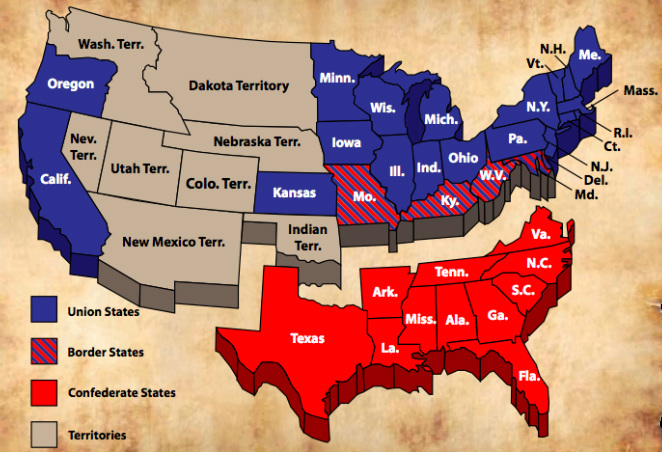
That doesn't mean that Lincoln agreed with slavery as an institution ("I am naturally anti-slavery. If slavery is not wrong, then nothing is wrong"). His first and primary goal was the preservation of the union. Secondly, he wanted to restrict (if not outright ban) the entry of pro- slave territories into the union as new states. Nevertheless, despite his best efforts, he failed. before he even had begun. The first state to secede was South Carolina in November 1860 following Lincoln's election. Other states soon followed until there were 11 in total, forming the Confederate States of America (CSA).
While all of the states were slaveholding, four states that held slaves didn't secede ---Maryland, Kentucky, Delaware, and Missouri (in anticipation of their leaving, Kentucky and Missouri were given stars on the Confederate flag). As an aside, did you know that several Native American tribes sided with the Confederacy? In 1861 the Cherokee, Chickasaw, Choctaw, Seminole, Muscogee (Creek) all signed agreements of support in exchange of being guaranteed title to territories west of the Mississippi River.
The War between the States began (officially) on April 12, 1861 with the assault on Ft. Sumter in Charleston Harbor (with South Carolina having seceded in 1860, the fort was viewed as foreign occupiers on their territory). The war was naively expected by both sides to be over in a matter of weeks. Bull Run, Shiloh, and Antietam soon removed the nation from that illusion.
By the time of Lincoln's Emancipation Proclamation in 1863, the war had gone worse than expected by the North. Unless something dramatic was done to strategically shift the balance of power, the best outcome that could be expected was a draw.As in nearly every conflict down through history, the ability to successfully wage war rests on the economy's ability to sustain the effort. The South's ability to wage war rested on its agriculture. According to the last census before the war in 1860, there were approximately 4 million slaves in the South, making up roughly 30% of its population (compare that to the West Indies where about 85% of the entire population were enslaved).
It should be pointed out that only a few landowning families--mostly large plantations--- owned any slaves. The overwhelming majority of Southerners were too poor to own any slaves at all. Nevertheless, if, somehow, the South's economy could be disrupted, Lincoln thought, then perhaps the war could be brought to a close.
At this point in late 1862, Lincoln had to accept that despite his promises not to interfere with the institution of slavery, the country was at war with itself, men were dying daily (the average was 504 per day), and the abolitionists hadn't gone away. If anything, they had grown in number and become a powerful political force. It was time for Lincoln to play his trump card.
On January 1, 1863 Lincoln delivered the "Emancipation Proclamation". It's often overlooked by nearly everybody that the proclamation didn't end slavery in America as claimed. The proclamation freed those enslave only in the states which had seceded from the union and were now a part of the Confederacy ("...that all persons held as slaves within the rebellious states are, and henceforward are free"). But what about the slaveholding states which remained part of the union?
It meant that those slaveholding states which didn't secede, regardless of their sentiment, were excluded from the proclamation. Thus slavery continued in Kentucky, Maryland, Delaware, West Virginia, and Missouri until the end of the war (the tribes which sided with the South were unaffected. Native American tribes long held slaves of all races before, during, and after the war).The second interesting observation is that despite Lincoln's decree, those states which had legally (at the time) left the union, were now part of a independent and separate nation known as the Confederate States of America with its own president (Jefferson Davis), its own Congress and Constitution, its own legal system and currency. and so forth.
That meant that President Lincoln was attempting to impose a unlawful degree on an defacto independent nation! It would be like a President issuing a decree to Canada or Mexico! The decree therefore had no legal standing, and no doubt Lincoln knew it. But if it could hamper the South's war efforts, it was worth the bluff. and it worked
At first slowly, then in droves as word spread, slaves began to abandon their fields and head north or to the western territories. Even though slavery comprised a small percentage of its population, the effect was cataclysmic for the South. With crops being left to rot in the field and the economy now in turmoil, soldiers began deserting to harvest the crops in order to prevent their families from starving.
This left the South's military further undermanned. In addition there was diminishing food and supplies reaching Confederate troops, whose supply lines were overstretched already. It give the North the edge it needed. By 1865 the war was over and the South lay in ruins. It would be decades before it would recover. In some ways it never has.
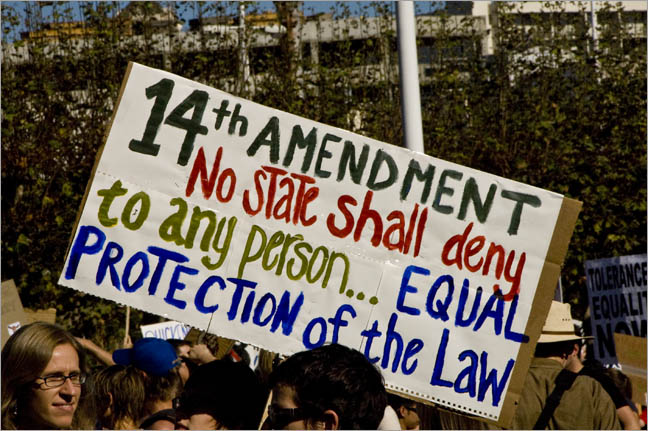
Following the war, the 14th Amendment essentially codified Lincoln's "Emancipation Proclamation", along with the 13th which formally abolished slavery as an institution, was passed in 1868. thus ensuring all those previously held as slaves were now fully U.S. citizens with all the rights which go along with it. The 15th amendment, passed in 1869, provided for the right to vote (it, however, excluded all Native Americans). The trio of amendments prevented (at least on paper) any states from denying equal rights to all those held in slavery.The 14th also forbid any former member of the U.S. government who participated with the "rebellion" from public office and denied any and all compensation incurred by the Confederate government, including loans or contracts (as well as slaveholders, meaning they wouldn't be compensated for the loss of their slaves).
As an aside, Confederate soldiers were eventually allowed compensation for service connected injuries and pensions for Confederate widows as early as 1867 by the state whom they served. The Federal government expanded existing military benefits in two Congressional Acts to cover Confederate soldiers and their widows. One in 1927 and the other in 1957, long after many were dead.
It should be pointed out that 28 of the existing 37 states were needed to ratified the amendment in order for it become law (which they received), but did you know that despite the passage of the 14th Amendment by Congress in 1868, several states didn't ratify it until later (in some cases, much later)? While most states ratified the law in 1868, several notable states held out. The 14th Amendment wasn't ratified by Texas or Mississippi until two years later, in 1870.
Three of the slaveholding border states which didn't secede decided to take their sweet time about it. Delaware ratified it in 1901. Maryland got around to it in 1959 (as did California which had become a state in 1850). But the "winner" was Kentucky. It waited until March 18, 1976, nearly 108 years later! The fourth slaveholding border state, Missouri, was the 17th state to ratify the amendment in 1868 along with West Virginia, another slaveholding border state.
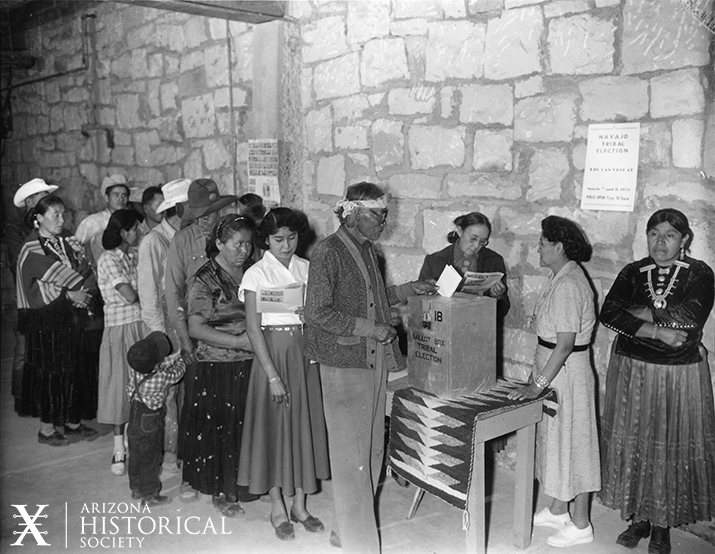
Lastly, I think it's important to point out that while the 14th Amendment provided equal rights and protection under the law to all former slaves as well as children born of foreign parents (legal or illegal), Native Americans weren't granted the same rights until 1924. That's 56 years after the passage of the 14th Amendment. 187 years after America's independence.
The "Indian Citizenship Act of 1924", or the "Snyder Law" as it became known, was signed into law by President Calvin Coolidge (R) on June 2, 1924. It finally gave equal rights and protection under the law to all Native and Alaskan Americans. A sad commentary on "land of the free and home of the brave" don't you think? Never assume your freedoms are necessarily guaranteed or protected by anyone.
If you enjoyed the article, please consider passing it along to others and don't forget to subscribe. It's free! Lastly please be sure to "like" us on whatever platform you use to read anotheropinionblog.com. It helps beat the algorithms and keeps our articles in circulation. Thank you!
National Archives: Emancipation Proclamation
The Roles of State and Federal Government
14th Amendment: Citizenship Rights, Equal Protection,Apportionment, and Civil War Debt
Ratification of Constitutional Amendments
There were 4 million enslaved people counted in the 1860census...
What Is the Snyder Act of 1921 and who does it apply to?
Friday, November 03, 2023
Political Endorsements: Providing the Masses with Bread and Circuses for Fun and Profit
Another Opinion has published an article like this in one form or another every election cycle since 2001 not just as a public service, but as part of the fight to save our Republic. Why? Because we now live in a world where independent thought is no longer considered "politically correct". We're expected to toe the line dictated to us by the Status Quo. America is no longer a Republic. It's a Corporatocracy run via diktat by a super rich Oligarchy.
There are just five of these corporations that control
96+% of all media content---TV, movies, video games, radio, publishing,
newspapers and so on. They have an incredably powerful ability to directly influence your opinions by controlling and spinning
what you watch, read, or hear. They keep
you entertained, distracted, angry, confused, and ignorant of the real issues.
Bread and Circuses. While they your attention, they try to influence your vote through
their so-called "endorsements".
We have a problem with
this. We believe you should make your own decisions based on your own research regardless
of who you ultimately vote for. Independent thought is important for our present if we are to
have a future. Please consider sharing this article. Thank you.
BTW: The opinions expressed here are strictly my own.
Political Endorsements: Providing the Masses with Bread and Circuses for Fun and Profit
There was a time when the news media (particularly newspapers) were the ever vigilant "crusaders" of public morality, albeit self-appointed and as often as not, the creators of their own hype (see "Yellow Journalism"). However, society and technology grew up. Today, we are better informed that at any time in history. We have instant access to information the world over, and with it, the ability to do own investigation of candidates and the issues which are important to us.
The media, especially newspapers, make endorsements to serve their agenda, not yours, although they try to make it sound one and the same. For years, I've campaigned for the release of unedited transcripts of candidate interviews and full disclosure of the interviewer's names and their political affiliations. The public has a right to know exactly what a candidate said and in what context, as well as political leaning of those making the so-called "endorsements".
I've been a community organizer and political activist for well over 40 years. To many times over those years I've come across candidates who were misquoted, misattributed, or instances where the "correct" response was inserted while gaffs were carefully removed on behalf of certain candidates. In fact, I've been a victim of these manipulations. That's deception, whether intentional or not.
Today, a handful of news and other media outlets are making public these interviews unedited and providing the facts behind their research in a timely fashion. They are also providing unbiased information regarding both side of key issues, particularly those that will be appearing on the ballot. To those brave few actual journalists and editors, bravo to you!
However, not all are providing full disclosure of the names and political registration or leaning of the interviewers making the endorsements nor are they disclosing the criteria by which the endorsements are made. That remains hidden behind a false veneer of make believe "integrity"! You-- the voter--have a right to know if an "endorsement" on an issue or candidate is honest and fair or is being made based on a political or economic bias.
As I have done for decades, I'm urging voters to take a few minutes to do their own research in order to make an informed decision before casting their vote. Using a Voter Guide is one such resource for you to consider. You can check out a candidate's or issue's website, or do a general search on the internet. You'll find out a lot more than just reading or listening to a biased review or opinion.As an aside, if you're looking at a political party's website or that of an endorsing organization, bear in mind that they are writing from their point of view. Any endorsements or opinions they make serve their interests, not necessarily yours. Always understand the political slant of any source.
If you find that you happen to be in agreement with a candidate or issue, fine. Support that individual or issue as a volunteer or with a financial contribution, a yard sign, or simply with your vote. But whatever you, do so as an informed voter. Don't let anyone think or decide for you. Never surrender your vote!
I also suggest that candidates or those representing an issue who are interviewed for an endorsement, especially by the news media, to be sure and write down the names of those conducting the interview. Ask if they will be making the endorsement. If not, who will? Also ask when their recommendation will be announced. If you're being recorded for TV or radio, ask when it will be aired.
Finally, when being interviewed for an endorsement, don't be afraid to ask what their political affiliation is. If they refuse to tell you, note that too. You may want to make this public once the interview is over in order to keep everyone "above board" and honest. Keep it factual and to the point. Leave any personal opinions or animosity out of it. If your campaign depends on their recommendations, then you, your supporters and the voters deserve to know what to expect.
The role of the media, regardless of its format, is to present the facts in a impartial, balanced and fair manner. It is not to attempt to manipulate or sway public opinion to suit their political or economic agenda, even if they believe it's "for your own good". Only you can decide what's in your own best interests.Organizations, including business associations and unions, have a specific agenda.They even create a myriad of fake "committees" for this or that to hype their agenda (made all the more powerful by the 2010 "Citizens United" blunder by the not-so-Supreme Court). It's in their economic interests to make these endorsements. They are responsible solely to their board of directors and/or the stakeholders, not the general public.
But it's not the job of the news media, including newspapers, to push any agenda! Their one job should be to provide the public with honest and balanced information free of political bias and let the people decide, wouldn't you agree?
Remember too that endorsements are merely ultimately personal opinions, often based on money and access to power, and those opinions aren't always the most informed! Think for yourself. Do your own research. And then vote! Your community and America are counting on you!
If you enjoyed the article, please consider passing it along to others and don't forget to subscribe. It's free! Lastly please be sure to "like" us on whatever platform you use to read anotheropinionblog.com. It helps with the algorithms and keeps our articles in circulation. Thank you!
Saturday, November 26, 2022
Thanksgiving: Being Grateful For What We've Had as Americans
The cost of gas and diesel fuel has been on the rise as we all know. The average increase has been around 6.3%. We saw a drop in prices toward the end of the election cycle when President Biden freed up some oil and gas from our national reserves. The point of course was to make voters forget, at least temporarily, all the pain they were paying at the pump.
Interest rates on everything from bank loans to credit cards are on the rise. When interest rates start to rise, so does inflation and visa versa. This is because to there is less money in circulation, so the "price" of money, which is based on its availability, goes up. Interest is the price we pay to "rent" the use of money.
The control of money (and interest rates) is controlled by the Federal Reserve. In order to slow the economy, the Fed increases interest rate, which slows borrowing in order to reduce inflation. By the same token, if the economy slows too much, the Fed lowers the rate of interest in order to encourage more borrowing and thereby stimulate the economy. In general, the Fed likes to keep the overall inflation rate around 2%.
When it comes to stocks and bonds, they tend to operate inversely. As stock prices rise, bond prices drop. When stock prices drop, bond prices tend to rise. For instance, the interest rate of "I" Series U.S. Treasury Bond are expected to starting dropping from a current rate of 9.62% to an anticipated 6.47% as inflation rises.
The average American spends about 33% of their net income on mortgage or rent payments. With that in mind, real estate prices have risen approximately 17% over last year. The median price of an average home in the United States was $428,700 in the first quarter of 2022. If we go back to 2020, it was $329,000, which is a 30% increase in price. Availability is one determining factor.If we compare by state, the average cost of a home in Hawaii was $1,038,544 in July 2022. That same home would cost $164,132 in Mississippi. Like California? Get ready to pony up around $816,804 (some parts of California such as San Francisco are actually considered too expensive for some people to move to). Maybe you'd like a little more open spaces instead.
In Montana and North Dakota the average price of a home will set you back $449,723 and $282,461 respectively. Not remote enough? Try Alaska. The average price of a home is $337,373. Of course, you could consider Kentucky or West Virginia where they say weddings are more like family reunions. An average priced home will cost you around $197,644 and $137,286.
Any way you slice it, the home prices are forcing more Americans to consider renting. But even that is becoming beyond some people's reach. A single bedroom apartment nationally rents for an average of $1,326.00 a month (typically with utilities included). A single family house typically rents for $2,018.00 plus utilities. Of course, as with homes, location is everything.
As with houses, Hawaii has the highest apartment rental prices, followed by California. The average one room apartment goes for $2,399.00 a month in Hawaii and $1,844.00 in California. Washington DC is high when it comes to either buying or renting. The average apartment rents for $1,770.00. Meanwhile, you can rent a nice single bedroom apartment in Kentucky for roughly $920.00 or $905.00 in Iowa.
But, as with everything else, the price of rent is expected to keep rising. Nationally, the U.S. is short between some 2 and 5 million units meaning there's more demand than supply, which drives up prices. Meanwhile, with inflation increasing along with interest rates, the cost to "rent" money to build more units has gone up too. That makes it more expensive to build more units and those higher cost are passed along to the consumer.Perhaps the most important component here is wages. The average worker receives a wage increase of approximately 3.5 to 5.5% annually. Social Security and other government income recipients receive a annual cost of living increase (called "Cost of Living Adjustments" or "COLAs") of 8.7% at the beginning of the year.
However, when confronted with the current inflation rate, most individuals go in the hole by the time you add in all the increases in utilities, fees, credit card interest rates, gas, food, taxes (particularly property and schools taxes), clothes, and so forth. Perhaps if it was just one or two of these, most people could cope, but it's not. It's the commutative effect.
Meanwhile, the cost of benefits, on which employees depend, continue to increase. Over the last five years, the cost of basic benefits have risen between 5% and 7%, forcing employers to reduce what they offer or requiring employees to pick up more of the tab.
Some small businesses have had no other choice but to drop benefit packages altogether, which forces some employee to seek employment elsewhere (and we all know finding qualified workers has always been tough, but finding individuals willing to work has been next to impossible since COVID).
As a result, a lot of smaller "mom and pop" shops have vanished. Bear in mind too that few small businesses receive taxpayer based corporate bailouts. Those seem to be reserved for Wall Street. Let's take a more detailed look at wages since that effects pretty much everything else.Not surprisingly, wages have failed to keep up with the rate of inflation. In terms of real dollars (dollars adjusted for the rate of inflation), our purchasing power is at a 66 year low. To put it another way, the current minimum wage buys the same as what 75 cents did in 1956. Individuals on the low level of the pay scale, which includes most entry level jobs, simply can't make it.
A survey by Bankrate said 55% of those surveyed said their wages weren't keeping up with prices. That includes workers who receive regular salary increases annually and the 39% of employees who do not.
To add salt to the wound, CEOs and senior executives earn an average of just over $21 million dollars a year. This is more than 400 times the salary of an average employee which is about $51,000 a year. The difference was 20% in 1963. From 1978 to 2020, the salaries of U.S. CEOs increased by over 1,322% while the average employee saw an increase in pay of just 18% for the same period.
The top three companies with the greatest executive/employee wage inequality are Nike, Walmart, and Amazon. The three companies with the lowest executive/employee wage inequality are Alphabet (the parent of Google), Walt Disney, and Berkshire Hathaway.
To put it another way, an employee at Nike would have to work just under 30 hours to equal one minute of their CEO's salary. It's 20.7 hours at Amazon and 14 hours at JP Morgan Chase Bank. At Starbucks it's 10.7 hours of serving their overpriced coffee to equal one minutes of CEO Kevin Johnson's salary. At Blackrock, which is arguably the world's most influential company, an typical employee has to work 6.2 hours to earn the same amount that their CEO, Larry Fink, earns in 60 seconds.Income inequality is at its highest level in over 50 years according to the U.S. Census Bureau. The widest pay gaps are in California, Florida, New York, Connecticut, Louisiana. However, Texas, Kansas, Nebraska, New Mexico, New Hampshire, Virginia, and Arkansas aren't far behind.
The Census Bureau also shows (perhaps not surprisingly) that the percentage of poverty in the U.S. was 12.8% in 2021, which is among the highest of any developed nation. That's about 38 million people. In fact, of the top 25 industrial nations in the world, the U.S. ranks dead last.
In 2021, the percentage of child poverty (those under 18 years of age) was 16.9%. For those over age 65, it was 10.3%. In Kentucky, the central South, New Mexico, and Washington DC, the child poverty rate was over 22%. It was lowest in Utah, North Dakota, Montana, Vermont, and New Hampshire.
For seniors, Washington DC, Louisiana, and Mississippi the poverty rate was 13% or higher. In 12 states, including Kentucky, Nevada, and South Dakota, the poverty rate was between 11% and 12.9%. In the majority of the country it was 8.8% to 9.9% while in four states it was under 8%.
According to a number of reports, around a half a million Americans are homeless at any given time. About 70% are individuals while the rest are families. 11% of the homeless are military veterans. The rise of inflation and prices in general will likely add to these numbers.Inflation, increasing home prices, the cost of gas, food, utilities, income inequality, homelessness, and, of course, rising taxes, are symptoms of a failing political and economic system along. There is no questioning our social, economic, and political divide.
History has shown that radical change tends to come from the bottom up. This is especially true if a middle class supports the bottom tier. In America, our middle class has gone from 61% of the population in 1971 to 50% in 2020 while the percentage of low income has grown from 25% to 29%. Globally the middle class has shrunk by 150 million since 2017. India lost 32% of its middle class while Asia lost 25%.
Along with industrial output, the quality of education and medical care, and other key measurements, the United States is showing all the signs of a irreversible decline. China is now the world's leader in manufacturing. In terms of technology and its innovation, the U.S. ranks number one, but China, Japan, and South Korea are pretty close behind. Germany and Israel are closing in too.
Academically, we rank in the middle of the second tier in science. In reading, we're in the lower half of the second tier, while in mathematics we're just above the third tier. Overall, we're 17th in the world academically with Asian, Scandinavian, and Europeans dominating the top slots.
When it comes to healthcare, we spend more money than any other developed nation, and yet, we have among the highest infant mortality rates, the lowest life expectancy, and the fewest number of available beds. Among the top 11 highest income nations, the U.S. healthcare system ranks dead last.Some predict America will become a second tier economy with a top tier military presence akn to other historic empires like Rome, the Ottomans, and Great Britain. Others think it will a much harder landing resulting in a broken and fragmented nation. Certainly the foundations are in place thanks to unchecked illegal immigration and a multiculturalism which discourages integration. Anyway you look at it, you better buckle your seatbelts.
If you want to know more, please take a look at the links
below. If you enjoyed the article, please consider passing it along to others
and don't forget to subscribe. It's free! Lastly please be sure to
"like" us on whatever platform you use to read AnotherOpinion.com. It helps with the algorithms and keeps our
articles in circulation. Thank you!
What Is the Relationship between Inflation and Interest Rates
United States House Prices Growth
How Rising Interest Rates and Inflation Impact Real EstateInvestments
Average House Prices by State in 2022
Bureau of Labor Statistics: Employment CostIndex---September 2022
CEO vs. Employee Salaries at America's Top Companies
U.S. Poverty Rate Is 12.8% but Varies Significantly by Age Groups
U.S. health-care system ranks last among 11high incomecountries, researchers say
Report: Pandemic Shrunk Global Middle Class by 150 Million
America's Poor Are Worse Than Elsewhere
Friday, September 02, 2022
The Forgiven and the Damned: Biden's Student Debt Forgiveness Program and Taxpayers
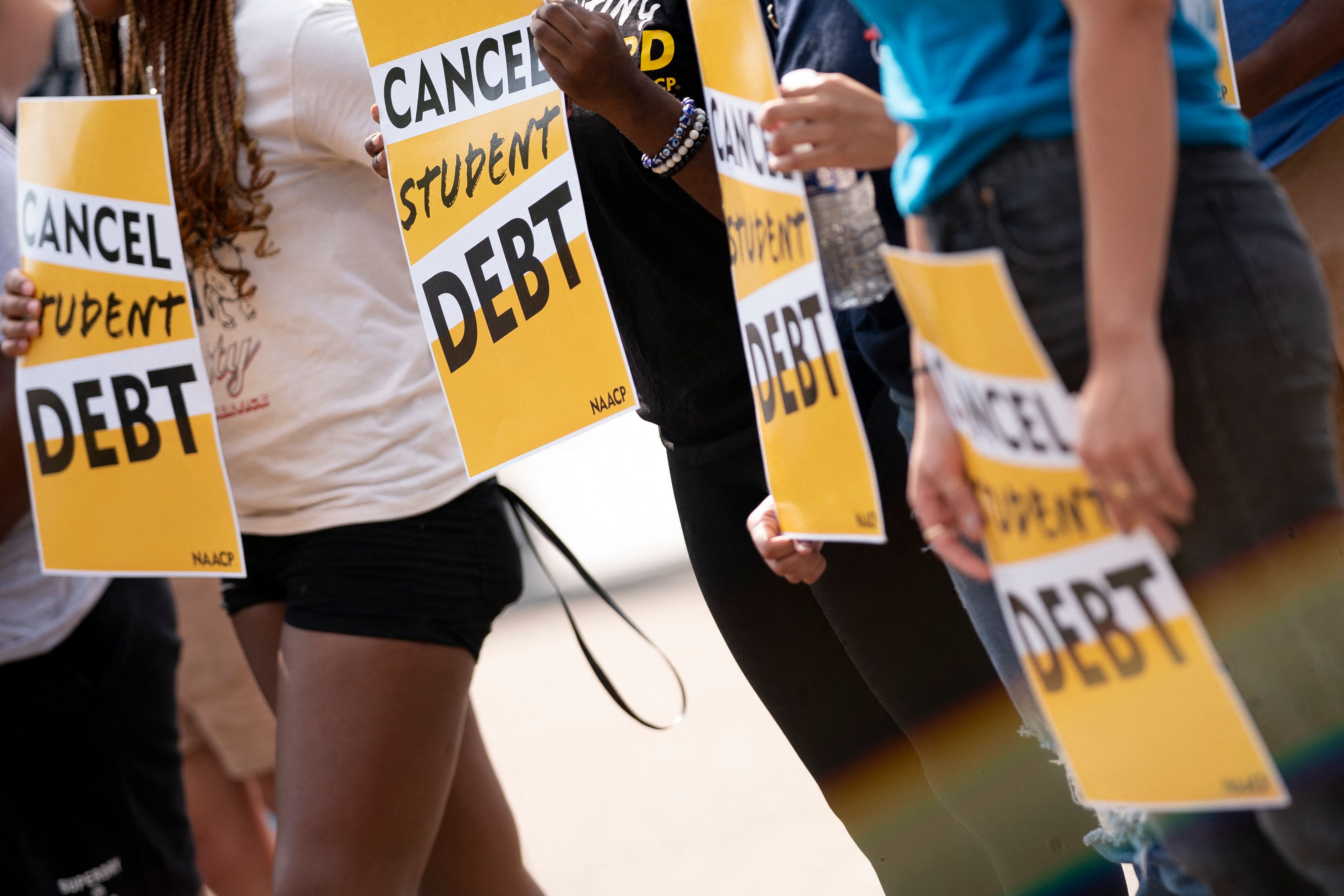
To properly understand Biden's proposal, it's important that we first understand the term Biden uses. So, to begin with, let's get our terms correct. Instead of calling Biden's proposal "debt forgiveness", the more appropriate term we should use is "debt transfer", which is a more accurate description of what it really is. But before we get into the specifics of Biden's "debt transfer" plan, let's take a look at student debt in general.
Loan debt has been the bane of students for decades. Some cite it as the price we pay for higher education. Others call it nothing more than a money generating scheme with naive and often desperate young adults (and their parents) as the "pigeons" to use the old carnie term for unaware victims of con games. After all, since at least the 1980's, we've been told that the only way to succeed is to go to college.
Approximately 45.4 million current and past student have some form of federal loan debt, of which 4.7% was already 90 days in arrears just in the first quarter of 2022. The average monthly payment is about $300, with most loans require the borrower to pay 10% - 20% of their gross income, based on how much they're earn.
55% of graduates with a four year bachelor degree owe, on average, just under $30,000 in student debt regardless of whether they attended a private nonprofit or public college or university. 68% of those graduating a private nonprofit college or university has a debt of $31,450 or more. 66% of those graduating from a public institution owed $26,900. 83% of those graduating from a for-profit college or university with a four year degree had a debt of just under $40,000.
Between 2020 and 2021, students and/or their parents borrowed near $96 billion dollars to cover the cost of education with just 13% of that being private and/or non-federally backed loans. Direct loans amounted to $1.38 trillion dollars shared by 37.2 borrowers. FFEL Loans were the largest, with $225 billion loaned out to a little under ten thousand applicants. Perkins Loans, totally $4.2 billion dollars, went to 1.5 million individuals. The grand total was $1.61 trillion dollars loaned to 43.4 million unique applicants!The above numbers represent just a snapshot of the debt crisis. It doesn't include other forms on loans such as Stafford, Grad PLUS, or money borrowed on insurance plans, 401K and other retirement plans, home mortgages, credit cards, and so forth, which represents tens of billions in principal, interest, fees, and penalties. It's obvious that the student debt situation is out of hand. Some would even say it's critical, and you would find few who disagree. However, before we look at Biden's plan, let's consider a few facts about higher education.
First and perhaps more importantly, not every job needs someone with as BA or BS degree. In decades past, most graduates of high school were adequately equipped academically for the majority of jobs. However, starting the mid 1970's, the quality of high school education took a tremendous nosedive. Students were being graduated who had a 6th or 7th grade math ability or read at an 8th grade level. Their knowledge of grammar and spelling was horrendous, while their grasp of history, ethics, the sciences, or literature were virtually non-existent.
Beginning in primary school, discipline all but vanished along with parent participation. At the same time, a rise in poverty among students meant more kids were showing up hungry. As a result, schools turned increasingly into publicly funded daycares. Critical thinking skills were essentially out the window as the focus turned more on sports to attract and keep students than on academics.
As a result, employers had to resort to remedial education for many of their new hires and the demand for college education began just to have the same intellectual level of an applicant they had just 10 or 20 years earlier. Along with this change, universities and employers began downplaying the need for the trades; those educated to do jobs which required physical and mental skills such as electricians, plumbers, carpenters, or mechanics.Instead, savvy marketing drew new high school graduates to the higher priced colleges with promises of riches in four or six or eight "short years" and away from the less expensive and shorter trade schools. Thus began the rise of sustained student debt as tuition continuously rose and students were "fee" to financial death.
By way of a brief comparison, the cost of a college education is highest in the Northeast and West. It's cheaper in the South, Midwest, and Plains states. The average cost of a four year public college for in-state students is about $21,035 per year (or $84,140 for the full four years plus assorted fees). For a in-state student attending a private four year college, it's about $32,768 (you can roughly double that if you're either a out-of-state student or add another 1/3 if you're going to a for profit college).
If you attend a trade school, the average is about $33,000...for the entire program! Of course, depending on where and what degree, tuition can run $3,800 to $15,000 per year (most programs are two years or less, and in some cases, you can start earning in six to eight months). The figures used here for both college and trade are averages as of 2022. Tuition always changes, and usually upward.
College admissions and academic administrators also starting not just encouraging students to major in degrees with little or no employment demand, they also started creating new degrees with little real world value (such as gender or race studies). Hey, all to keep the money flowing! Meanwhile, for many colleges, the focus turned from critical thinking skills (the hallmark of higher education) to even greater revenue generating sports programs, leaving some academic departments limping along.
President Biden's "debt transfer" proposal is said to "wipe out entirely" the debt of approximately 1/3 of those with federal loan debt. That's about 16 million individuals. The program includes a $10,000 dollar debt "forgiveness" (specifically, the federal government---meaning taxpayers---will pick up the tab).This will apply to those earning $120,000 dollars or less (or a combined household income of $250,000). In addition, the federal government will "forgive" up to $20,000 in Pell Grants. Total costs for taxpayers? About $300 billion dollars. Of course, this assumes Biden's "debt transfer" proposal gets past all the anticipated legal challenges.
By the way, don't expect any "thank you" cards from Millennials or Gen Z's. They have a reputation of self-entitlement. I bet they're going to be surprised to learn that once any type of government welfare goes into effect, it rarely if ever ends, so they expect to be paying off someone else's debt down the road! How's that for a bite in the butt of the two "I love Socialism" generations Capitalist style?
Anyway, assuming that this portion of the Biden plan survives all the legal challenges, the president's staff claim that about 90% of those earning $75,000 a year or less (which is most Americans) will be the prime beneficiaries. The plan also includes changes in the federally based "Income Driven Repayment System" (IDR).
Under the IDR, a student's monthly loan repayments is adjusted based on their income after graduating. Students are currently required to pay between 10% and 20% of their annual income for the first 20 years, after which the balance is "forgiven" (that is, picked up by taxpayers). According to one report, between 2010 and 2020, enrollment in the IDR jumped from roughly 10% of eligible applicants to 32%.
With Biden's plan, participants will now have to pay just 5% any undergraduate debt (and up to 10% on graduate or professional school debt such as law or medical school). This covers a repayment plan over 10 to 20 years, depending on debt size and annual income level. The proposal will also include a change in the amount of income not currently covered.Under the current plan, IDR doesn't include repayment on income up to 150% above the poverty level (based on family size, etc). So if your income is, let's say 155% above the poverty line, your payments would be based on that 5% under the current plan and everything 150% or under is exempt.
The new plan will adjust that up to 250% over the poverty line, meaning the minimum repayment amount is based on less income, thus significantly lowering the size of the amount due. It also removes any accrued interest.
As a result, it encourages individuals to borrow as much as possible rather what they need. I see a lot of parties and beer runs in the near future. But fear not! The new IDR changes also encourage colleges to raise tuition since a greater percentage of debt is now being "forgiven"...and picked up by you and me via the government. So, taxpayers get all the debt of a college education but without all those pesky term papers and dust collecting degrees.
Biden, however, suggested that individuals qualifying under the new IDR wouldn't abuse the opportunity to borrow more money with no interest, have lower monthly payments, and earlier debt termination. Instead, they would use the money saved on the loan payments to invest or spend back into the economy. They could even double up on payments if they wanted too. He also downplayed the likelihood that universities would significantly raise tuition as well. Yeah...right Joe. Wink. Wink.
As another aside, under Biden's plan, there also could be an unintended consequence---money not paid back could be taxable at the state level According to the Tax Foundation, there are 13 states which could treat any debt "forgiven" $10,000 or over as earned income. This includes Kentucky (naturally), Arkansas, Wisconsin, Virginia and West Virginia, Hawaii, Idaho, Minnesota, South Carolina, New York, Pennsylvania, and Massachusetts.The Tax Foundation estimates that amount of tax to be paid could range from $300 up to $1000 or more. To stick the knife in a little deeper, that figure could double if the debt originated from a Pell Grant and is at least $20,000 is "forgiven". So, what's the total damage of Biden's plan to taxpayers?
Well, according to the University of Pennsylvania's famed Wharton's Business School of Business (and President Donald Trump's old alma mater), taxpayers could end up stuck with a final bill of somewhere between $650 billion to $1 trillion dollars, thus proving again the old adage that no good deed goes unpunished. Not even ones designed to improve approval ratings and reelect Democrats in November.
If you want to know more, please take a look at the links below. If you enjoyed the article, please consider passing it along to others and don't forget to subscribe. It's free! Lastly please be sure to "like" us on whatever platform you use to read A/O. It helps with the algorithms and keeps our articles in circulation. Thank you!
A Look at the Shocking Student Loan Debt Statistics for 2022
Biden's student loan forgiveness could be taxable in some states
List of States That Might Tax Student Debt Loans Dwindles
The Value of Trade Schools in Today's Economy
Average Cost of College Textbooks
Friday, July 29, 2022
Two Peas in a Pod: Nancy Pelosi and Mitch McConnell
Nancy Pelosi has been a member of House since 1987, and for much of her time in office, she has held one of the most powerful positions in Congress, Speaker of House (2007 - 2011 and 2019 - Present). She is also one of the wealthiest members of Congress, which is saying something given that Congress is the bastion of millionaires to begin with.
According to Open Secrets, Pelosi is the sixth wealthiest member of Congress. She has an estimated net worth of $135 million dollars. She makes $210,000 from her position in Congress. However, her monthly income from investments brings in $1 million dollars. It's worth noting that her portfolio includes investments in IBM, Johnson & Johnson, Exxon Mobil, Pfizer, Bank of America, and General Electric; all part of the ruling Corporatocracy which pulls Congress's purse strings.
As an aside, Pelosi has been consistently one of the most disliked members of not just the House, but Congress of years. So how does she manage to keep getting reelected? Pelosi's is from San Francisco's 12th District, which covers the entirely of the city itself, and thus is 100% urban; the fertile soil of the Democratic Party. The median income is just under $121,000.
Despite her strict Italian Catholic upbringing, Pelosi represents an extremely liberal district, reflecting its racial and cultural makeup. It is one of the so-called major "sanctuary" cities, offering support to illegal immigrants in violation of federal immigrations laws and still receiving federal dollars, thanks to people like Pelosi.
Racially it's mainly white at 43.5%, followed by Asian with 31.9%, Hispanic 14.3%, black at 5.4%, and mixed race making up 3.9%. Males comprise 51.3% of population while females are 48.7%. With a population of 771,000, it has one of the highest LGBQT concentrations in the country.When it comes to voter registration, just under half of district's residents are either registered to vote (total voter registration is 425,290). With its well earned liberal tradition, it's not surprising the 12th District is overwhelmingly Democrat with 57.50% of the voters. Republicans make up just 6.61%, followed by Independents with 1.65%. Pelosi won her last race in 2020 with a commanding 74% of the vote.
So, the only way Pelosi can lose is if a strong and very wealthy Democratic candidate runs against her, which is unlikely to happen (in addition, Pelosi is very good friends and neighbor with former San Francisco mayor and current senator, Diane Feinstein).
As for Mitch McConnell, he's been a member of what's been called "the most exclusive private club in the world" since 1985; representing Kentucky's 4th Congressional District, which includes upper incomes of eastern Jefferson County, and much of Northern Kentucky extending to the Ft. Thomas, Newport, and Covington (all of which are considered part of the Greater Cincinnati area).
Aside from the wealthy portions of Louisville/Jefferson County, the 4th Congressional District in general is well to do, especially the areas close to Cincinnati. It is also one of the first Congressional districts in Kentucky to become solidly Republican in what was once a hardcore Democrat state (albeit a fairly conservative one).
In terms of registration, the 4th Congressional District has 619,460 registered voters. Of that, 49.50% are Republicans. Democrats make up 38.31%, while Independents and third parties (most notably the growing Libertarian Party) comprise a total of 12.19% of voters.
It's worth nothing that Louisville/Jefferson County, which is Kentucky's largest city and the economic engine of the state, is one of the last Democratic bastions remaining in a de facto red state. While there are pockets of traditionally liberal Democrats (notably in the city's Highlands), most residents tend to lean conservative on the majority of issues.Louisville also has the highest concentration of LGBQT individuals as well, who are known to be very politically active and predominately Democrat. Nevertheless, it appears that the 80 year old senator's base is pretty secure for the foreseeable future. As for his approval rating, that's something altogether different.
Like Rep. Nancy Pelosi, Senator Mitch McConnell is one of the most unpopular individuals in Congress. In a December 2021 Gallup Poll, McConnell came in first place (or should that be last place?) as the most disliked person in Congress with an approval rating of 34%. For what it's worth, Pelosi was second place with 40%. Chief Justice John Roberts was the most favorable with 60%, but that was, of course, before the Roe v. Wade decision.
Even at home, the Senator's disapproval rating hovers around a 53%, and yet despite the best efforts of Democrats, he keeps winning (when I say "best efforts", it's usually political retreads or inept newbies harping on the wrong message). Nationally, it gets worse. In a May 2022 survey, the Senior Senator's approval rating was a mere 28%. To stay in office, despite poor approval ratings, takes a lot of money, and Senator McConnell easily makes bank. Who are his biggest donors?
The majority of McConnell's donations come from Wall Street, especially banks and other financial institutions, including healthcare and real estate investment firms. Other top donors include insurance, energy and technology companies which contributed $6.3 million dollars in 2020.
Some of the top donors include the financially powerful Blackstone Group, Humana, NorPac, and Kindred Health. One of the largest is Kent Companies, a third generation family owned construction company based in Midland Texas. It has donated $6.94 million dollars into McConnell's war chest.Other donors include BlueCross/Blue Shield, AT&T, Goldman Sachs, UPS, Brown-Foreman, Citigroup, General Electric, Peabody Energy, FedEx, and JP Morgan and Chase. With all those "political investors" in Mitch McConnell, just how much money does he have in his war chest?
When combined with the Senate Leadership Fund (a super PAC), One Nation (a political nonprofit fund), McConnell controls just under $90 million dollars (or $87.5 million to be precise) as of January 2022. In 2021, he raised a total of $100 million dollars which he used, in part, to help fellow Republicans in Congress with their re-election efforts. Is it any wonder the Kentucky senator so strongly supported Citizens United?
As for the senator himself, he's done alright personally. According to an article by Forbes, Mitch McConnell earns $200,000 annually as senator. With investments, his monthly income is $900,000. His Wall Street investments exceed approximately $25 million dollars in stocks and bonds. Overall, his net worth is around $150 million dollars, making him the 19th richest member of Congress.
Irrespective of their popularity ratings, Pelosi and McConnell have done quite well in politics. The same can be said for Congress in general where more than half were millionaires going in and practically all are coming out. Compare that to just 8% of the total population who are millionaires, and you'll have to agree that Congress doesn't even begin to represent most Americans. They have little or no concept what the average American goes through on a daily basis just to make ends meet. That's mostly thanks to Citizens United.
That fact that these individuals who make up the House of Representatives and Senate can have a reelection percentage of over 90% despite sustained dismal approval ratings under 30% is due to partisan gerrymandering and (again) Citizens United, not to mention unregulated term limits which allows them to hold office practically forever no matter how poor their performance. Isn't it time for a change?If you want to know more,
please take a look at the links below. If you enjoyed the article, please
consider passing it along to others and don't forget to subscribe. It's
free! Lastly please be sure to "like" us on whatever
platform you use to read A/O. It helps with the algorithms and keeps our
articles in circulation. Thank you!
Justice Roberts Tops Federal Leaders in American Approval
Nancy Pelosi Net Worth 2022: Salary Stock Portfolio Wealth
Favorability of Mitch McConnell among U.S. adults, as of May2022
McConnell-aligned groups build $87.5m war chest to spend onwinning Senate majority
Congressional Stagnation in the United States


:max_bytes(150000):strip_icc()/Great-Triumvirate-3000-3x2gty-56a489b43df78cf77282de84.jpg)