Showing posts with label inflation. Show all posts

Friday, April 11, 2025

Welcome to the New Reality: The Death of the Republic and Rise of the Corporatocracy


As most everyone knows, aside from their role as legislators, one of the key functions of Congress is to act as the keeper of the nation’s wallet. They are the ones who approve and allocate our tax dollars. As President Franklin D. Roosevelt once said, “It is the duty of the President to propose, and it is the privilege of Congress to dispose”, and indeed it is.

What happens when the government has a debit crisis or to use an accounting expression, when our “outflow exceeds our inflow”? In short, the government is spending more than we bringing in? No business can do that for long and stay afloat, and no ordinary household can survive for long before the bill collectors come calling. Government has no mandate like the rest of us to follow a strict budget. So what then? 

In the case of the United States Government, there is no one coming to bail us out.  The government's credit is based on nothing more than its "good faith", which is short for "trust us". Those who own our debt are mostly other countries like Japan ($1.1 trillion), the UK ($690 billion), and China ($749 billion); they're essentially stuck. They have no hard collateral like the Capital Building or Mt. Rushmore to foreclose on and sell off on the steps of the ICC to the highest bidder. The most they can do is ride out the financial storm or throw more money at the problem and hope “we” (that is, the President and Congress) can somehow work it out.

The usual answer is raising interest rates, which increases the cost of borrowing money from the Federal Reserve. This, in turn, typically means a hike in wholesale prices which means, as nearly always, ultimately gets passed on to you and me. As a result, we are the ones who ultimately take the hit for their bad policy decisions and mismanagement.    

Sometimes, war is used to artificially stimulate the economy and reduce high unemployment numbers. But as for Congress itself, there are no real consequences and yet, aren't they ultimately responsible for the problem itself? 

Well, yes, but Congress goes happily on their merry way without having to take responsibility for their actions (or in some cases, inactions).  For decades now, their approval rating has been in preverbal toilet, typically ranging from a low of 9% in 2019 to a high of 29% as of February 2025, but do you think they care? Nope. Not really. Have you ever wondered why that is?

According to Open Secrets, in 2024 Democrats received $1,163,550,563. Of that, $1,187,730 came from political action committees (“PACs”). $1,802,512,049 was from individuals. Republicans raised $637,855,365. PACs were responsible for $1,018,830 while individual contributions made up $581,463,551. The majority of the money came from corporate donors and very wealthy families, and we can thank the 2010 Citizens United ruling by the Supreme Court for that.

Elon Musk, owner of SpaceX and current satrap of DOGE (Department of Government Efficiency), for instance gave $291,482,587, all to the GOP.  Timothy Mellon gave $197,047,200 with the overwhelming majority going to the Republican Party as well. Miriam O. Adelson (owner of the Sands in Las Vegas and the Adelson Drug Clinic) donated $148,304,900, also to the Republicans.

Michael Bloomberg, the former Mayor of New York, gave $60,839,734 to the Democrats and a token $1 million to the Republicans. Dustin Moskovitz, owner of Asana, Inc, dropped $50,671,800 to the Democrats as well.

Steve Swartzman of Blackrock Group contributed $40,178,539 to the GOP while Bob Bigelow, owner of Bigelow Industries, gave them $34,990,500. Reid Garrett Hoffman, owner of LinkedIn, gave the Democrats $28,804,480 and a polite $400,000 to the Republicans.

When it came to corporate donors, SpaceX was again on top with $287,930,952 going to the Republicans. Another $767,131 went to the Democrats. The Fund for Policy Reform contributed $60,000,000 to the Democrats. Ripple, a software developer, gave $15,685,583 to the Democrats as well and $2,970,303 to the GOP.  Building America’s Future donated $33,470,000 to the Republican Party.

These are just a very small sample of the big dollars that went into the elections of 2024. In addition, most of these groups also donated money to smaller outside organizations. For instance, Citadel, Inc., a preeminent multinational hedge fund, amassed $108,669,316 in contributions (making it the fourth largest corporate donor) spent the bulk of its money on Republican groups which included Keystone Renewal PAC, American Patriots PAC, Fix Washington PAC, and the Senate Leadership Fund just to name a few.

Greylock Partners, one of the nation’s oldest venture capital firms, donated $35,900,577, ranking it the 26th largest corporate donor, gave all of it to exclusively Democratic related groups that included WelcomePAC, American Bridge 21st Century, Granite Committee, and Future Forward USA to name just four.

There were quite a number of PACs (some of which were self-funded by members such as the NRA and AARP) which made heavy political contributions as well. Many choose to hedge their bets by contributing to both parties. However, the lion’s share of their money went to incumbents irrespective of party.  The reason is because, thanks to partisan gerrymandering and the absence of term limits, 97% of Congressional incumbents were reelected in 2024. It was the same at the state level. 94% of state executives were reelected as were 92% of state judicial incumbents. Those are better percentage than even the old Soviet Politburo had!

Another reasons Congress couldn’t privately care less about voter opinion is that the majority are millionaires. They don’t need the job. This is basically about acquiring power and making connections, and if you can pick up a few extra million along the way, well so be it. Let’s take a look.

Republican Senator Rick Scott of Florida has a net worth of around $549.91 million dollars. Everyone’s favorite Democrat, Former Speaker of House, Democrat Nancy Pelosi of California is believed to have a net worth of $267.6 million dollars!  In 2023, she listed the value of her household assets at $92 million. Not bad for having a combined salary of $250,000 a year ($174,000 base plus leadership and committee bonuses).

As of 2024, there were 13,043 lobbyists operating in Washington, mostly along “K” Street, which employs roughly 100,000 researchers, analysist, public relations and media specialists, data entry, and others needed to support the influence industry while many of the lobbyists themselves are former legislators or senior staffers.

Despite that number, much of the business is handled by just 300 firms. Most represent corporations, trade associations, and unions.  In that same year---2024---they invested just over $4.43 billion dollars to get their message (and candidate) across the finish line.

 Unfortunately, those that represent ordinary working class Americans are few and far between. Corporate donors, on average, give close to ten dollars for every two unions contribute and, in an election related crunch, they’re quite capable of  ponying up a lot more, further dwarfing anything unions can come up with. 

Lastly, and I want to be clear about this, you can bet your house, your children, or whatever else you hold dear, that money of this magnitude isn't given to be "patriotic" or be seen as being a "responsible citizen". It's an investment like any other. They intend on getting their money's worth and then some from this "investment" and when it (or they) cease to be useful, they'll quickly move on and find another that is.  I suppose you could think of primaries as political search engine of sorts; a way to find the next compatible cog for the machine.  

Another reason voters get a yawn, as noted above, is due to partisan gerrymandering. President John Adams originally said that redistricting should provide an “exact portrait, a miniature” of the nation as whole.  He would be deeply disappointed to see what redistricting has become. Every ten years states are supposed to redraw their legislative and Congressional districts following the results of the census so that voter demographics are properly represented, but that’s not what has happened.

Nowadays, redistricting tends to happen along the lines of majority political party in power, meaning that if the Republicans for instance control the State Legislator, the districts will be redrawn accordingly. Same if the Democrats are in charge while the nation’s largest political demographic, Independents, as well as third parties, are ignored. Thus, you end up with districts which are intended to virtually ensure the dominant political party retains control of those districts. Hardly fair or balanced.

Attempts to reform redistricting has typically run into stone wall erected by both parties in order to protect “their” political turf. A case in point was the 2019 Supreme Court’s Rucho v. Common Cause decision is a great example. Although the Constitution and the Voting Rights Act of 1965 prohibit racial discrimination, the court decided that while partisan gerrymandering was “incompatible with democratic principles”, it could not be addressed at the federal level! That meant returning to the state which was responsible for the situation to begin with and leaving the matter unresolved.

A few states have taken the bold step of taking the power to gerrymander out of the hands of the state legislators and assigned them to non-partisan institutions such as universities and colleges on a rotating basis or independent commissions, but don’t expect to see this spread nationwide until voters stage a ballot box revolt and start automatically voting against the sitting party in that district.   

The absence of term limits is another main reason members of Congress (and the federal judiciary) doesn’t particularly care about voter opinions. Image having a job where no matter how crappy of a job you do, you won’t get fired. Well, that’s Congress and judiciary.  How’s that possible?

Well, thanks to a political system which has been corrupted to the point where vested interests financially underwrite the campaigns of those who are to regulate them, where they fill party coffers, write the legislation which affects them, where districts are redrawn to give one group a perpetual partisan majority over another, make decisions contrary to the interests of the people they’re supposed to represent, and then ensures that they can serve almost indefinitely.  

It bears mentioning that the majority of Americans want to see term limits. According to the Senate Committee on the Judiciary, 82% of Americans want term limits. Of this, 89% were Republicans,  83% were Independents, and 76% were Democrats. Obviously, there’s no ambiguity here.  

Americans want an end to a corrupt system which caps the President to two four year terms while giving Congress unlimited terms and the federal judiciary life appointments.  Even at the individual state level, voters want to see term limits. In Kentucky it’s 84%. In Maine it’s 75%. 84% in Montana. 75% in Utah. 80% in Georgia. 77% in Florida, and 78% in Alaska.

This is the political system we now have. It isn’t the Republic envisioned by the Founders of this country of a limited government or one run by and for “citizen legislators”.  This is the vision of  our new Founders, the ultra-wealthy Oligarchs, and the creation of a neo-fascist corporatocracy, leaving us with a “managed limited democracy” and a surveillance state. President Trump may try to restore the Republic, or what’s lefts of it, but the corruption has become institutionalized,  and both sides benefit from it. The only losers are those for whom the nation was created----its citizens. Welcome to our new reality.


Thank you for reading "Another Opinion", the Op/Ed blog page for the "militant middle".  Here at "A/O" we truly value our readers. At A/O we seek the facts as they exist, not partisan talking points.  We hope you find our articles informative and engaging. Comments are welcome, provided they are not vulgar, insulting or demeaning.  Another Opinion is offered without charge and is directed toward all independent and free-thinking individuals. We ask, however, that you "like" us on whatever platform you found us on in order to keep our articles available for free to others. Lastly, in order to keep costs down, we depend on passive marketing, and therefore, depend on our readers to please forward our posts along. Below you will find links to the sources we used in writing this article. Thank you. 


Lobbying in the United States


Citizens United v. FEC


Lobbying Data Summary


Rucho v. Common Cause 18-422 588 U.S. 684 (2019)


Election results,2024: Incumbents wins by state


Tomboulides Testimony to the Senate Judiciary Committee


Term Limits Polling Results


Friday, October 18, 2024

Some Inconvenient Facts Behind Our Most Important Presidential Election Since Lincoln

We are just under a month away from perhaps the single most important presidential election since Abraham Lincoln vs. Stephen Douglas in 1860 with quite possibly a similar outcome. Of course, it's typical of marketing hyperbole to claim one election or another is more important than any other when, in truth, each election puts the future of our constitutional republic at stake (albeit in name only at this point), but in this case, the claim is not being overstated.

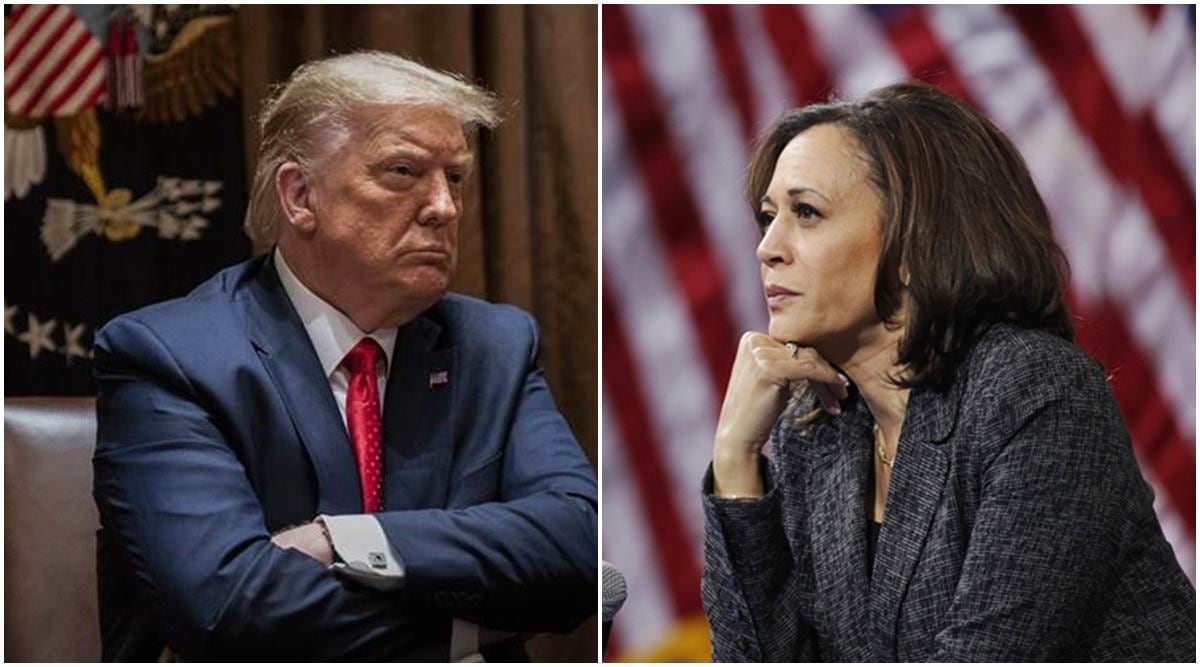
Vice President and Democrat nominee, Kamala Harris, has been speaking about the need to "move America forward" and to "restore the American Dream", which, I think, we can all agree, are worthy (albeit unrealistic) goals. Of course, the underlining message is that former President Donald Trump is somehow personally responsible for throwing the switch that put our "democracy" in peril . Lastly, Ms. Harris has promised a "opportunity economy" for all.

The problem, however, that Ms. Harris is overlooking is that her administration along with President Biden are the one's responsible for whatever track America is on, be it good or bad. After all, they've been in charge of the economy as well as domestic and foreign policy for the last four years. Anything Trump did, good or ill, has been of no real consequence since the Biden/Harris ticket won in 2020. 

So, any complaints or compliments is all theirs. For instance, the rate of inflation (which jumped by 3.24% shortly after Biden took office). It was a frightening 8% in 2022 before eventually settling to 2.4% in September falls squarely on their shoulders, not Trump's. Same goes for prices, from gas and groceries to appliances, cars or houses. 

Since February 2020 to now, overall prices have gone up 21.4%. According to the U.S. Bureau of Labor Statistics, that's far above the national average. According to another economic report, thanks to inflation, what you could buy for ten dollars in 2020 would now cost $11.31 in 2022.

That may not sound like much, but when you look at a the cost of a tank of gas, heating oil, or a week's worth groceries for a family of four, that's quite a hunk of change, forcing the average American to pay more with less purchasing power. 

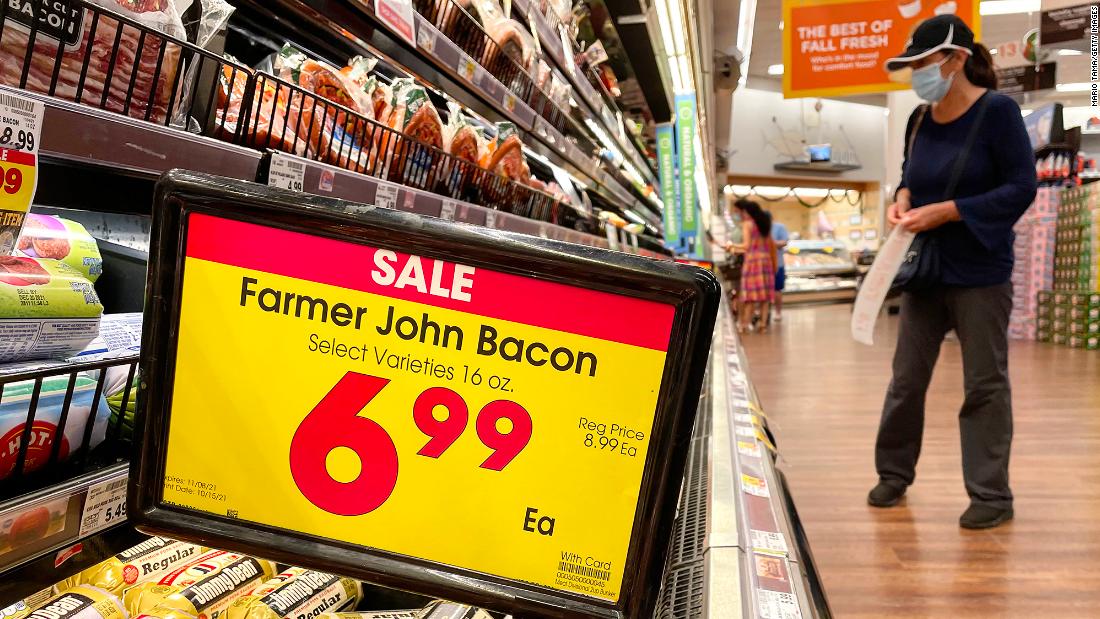
For example, since 2020 the price of margarine, which nearly everyone uses in cooking, has increased 56.8%. Eggs have gone up 40.1%. Sugar and sugar substitutes have seen a 39.1% increase. Meats, depending on type and cut, have seen a increase of between 39.2% and 44.2%. Car insurance raced upward to 47.5% while vehicle repair (already high) went higher to 47.1%. Gasoline prices almost doubled from January 2020 to June 2024; a increase of 89.5%.   

On the other hand, the prices of Smartphones dropped by 53.9%. 22.4% for televisions. Computers and related items went down by 15.9%, while other electronic equipment (like video cameras, microphones, etc.) dropped in price by 14.1%.The costs of non-electronic toys were 7.1% less as of June 2024 compared to January 20202.

Finally, men's clothing (such as suits, coats and jackets, as well as pants and shirts) saw a decline in price of 6.3% (but apparently not where I shop!).  So, while prices on some items cost consumers less, prices on other items cost more, some significantly more. I suppose it's all a matter of perspective. 

What about housing? How much has the cost of keeping a roof over your head changed since 2020? According to a report ResiClub of the Case-Shiller National Home Price Index, since 2020 until present, the cost of homes rose 47.1%, which they said "easily outstripping the gains of recent decades". That apparently includes not just the Trump years, but the Obama and George W. Bush years as well.

Some of the reasons cited for the increase in housing prices are the lack of housing in general (remaining down 34.3% from pre-2020 availability), the upswing in mortgage rates and jump in the price of construction material.  As an aside, a related RedFin report said that house payments are up 11% over 2023 prices. The average house payment is now $2,775.00. I can certainly see what Ms. Harris means by a "opportunity economy". But then, these are numbers based on her and Biden's policies.

While we're speaking about housing, what about the homeless? In 2020, the number of reported homeless was about 580,466. By 2023 that number had jumped to 653,104, up 12%, the highest year-to-year increase and the second highest total since 2007. Of that, 324,854 were white. 243,624 were black.  According to the VA, there was homeless 35,574 veterans as of 2023, representing an increase of 7.4% over 2022. A single homeless veteran is one too many for the nation to tolerate.

The unemployment rate is at 3.7%, which is higher than expected due to the drop in individuals who are no longer self employed. If underemployed and dissatisfied and looking are factored in, that number nearly doubles to 6.7%.  Note too that unemployment rates don't include those who've given up on looking or serving in the military. The Bureau of Labor Statistics said as of August 2024, overall job growth was weaker than anticipated with 818,000 fewer jobs than in March as previously reported.

While much of the job openings were service industry or low income, work hours correspondingly decreased from the traditional 40 hour work week to a current 34.3 hours. Nevertheless, employees are still expected to do the same amount of work as they would in a traditional 40 work week.

In 2022, the most recent year data was available, over 12% of the nation was living at or below the poverty level. 13% were "food insecure", which is a polite way to say they didn't have enough to eat on a regular basis. School provided meals are commonly the only regular nutritional food kids get. Data also indicated that the figures were trending upward, so by 2024 that number is likely to be considerably higher.

Wages have generally done well since 2020, exceeding inflation by roughly 2% overall. In April 2020, wages dropped by 6% but then jumped to a record high of 15.40% by April 2021. In 2014, when Trump took office, wages had been trending upward. Starting in 2014, the average wage was $24.33. In 2016, it was $25.38. By the time Trump left office, the average hourly wage was $28.44. Under Biden, it had increased to $31.63 as of January 2022. By September the average hourly wage was $35.36%. Social Security, disability payments, and other compensation are all tied to the rate of inflation.

It should be noted that the once untouchable Social Security Trust Fund has been repeatedly raided by Congress to the tune of $17.5 billion dollars. The Social Security Administration predicts that the trust fund will be empty by the end of 2034. Starting in 2035, recipients will see a 23% reduction in benefits. 

Although wages have done well in keeping up with inflation, that can't be said of everyone as the percentage of those falling behind has been increasing dramatically. Since 2009, wage inequality become has a serious issue, leaving the U.S. with the dubious distinction of having the worse wage differences of any industrialized country in the world.

 In 2022, despite federal laws to the contrary, women between ages 25 to 34 still earned 92% as much as men of the same age. Between ages 35 and 54, that number drops to 83%.  Finally, those from 55 and over, it's 79%! For minorities it's worse. Is this the "progress" or "change" Kamala Harris is talking about?

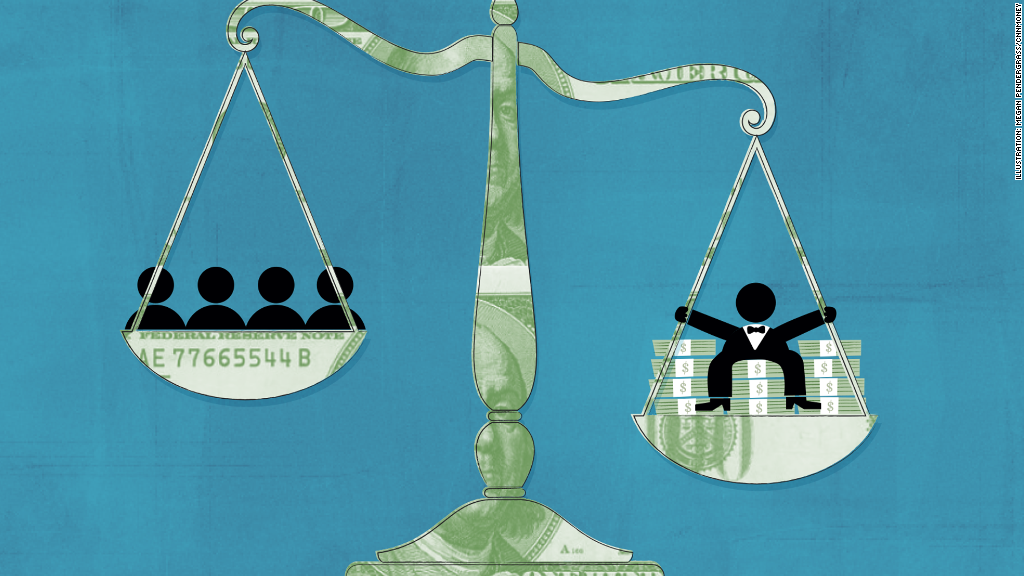
How well do employees do compared to management? Not surprisingly, not very well. For several decades, the incomes of senior corporate officers have far outperformed that of their employees. Ironically, the margin of difference has increased when tracked against the decline in union membership.

In 2021, the median employee to CEO wage gap was 235%, meaning that for every dollar a worker earned, a CEO received $235 dollars. A year earlier,  it was slightly better with a 212:1 ration between CEO and employee. In 2023, that ratio was now 268:1 among S&P 500 Index companies. I guess it really is good to be king!

In 2021, the Top 1% saw their percentage of wealth continue to grow by 9.1% while the bottom 90% saw theirs decrease.  During the same period, the Top 0.1% saw an income growth of 18.5%. The bottom 90% had a drop in real (after tax) income of 0.2% in 2020 and 2021. By the way, the Top 0.1% is what comprises the ruling oligarchy with a individual power index of 882.9 compared to the bottom 90% which has a power index of 1%.

The bottom 90% also saw just 58.6% of all wages earned, the lowest on record (in 1979, it was 69.8%), demonstrating that over time, workers have been losing ground compared to the upper 20%. Those in the rarified air of the Top 1% took in 14.6% of all wages generated (by comparison, in 1979 it was 7.3%).

To put it another way, from 1980 through 2021, the bottom 90% of Americans saw an increase in wages of 28.7%. The upper 1% saw their wealth increase by 206.3% over the same period while the upper 0.1% (aka: the ruling oligarchy) saw their wealth grow by 465.1%. Feeling nauseated yet?

It bears mentioning that Vice President Harris allegedly said Hurricane Helene victims would be eligible for a $750 "loan" from FEMA which would have to be paid back with interest or face a seizure of their property. That's false. FEMA is offering victims up to a $750 dollars onetime payment for baby food, diapers and incidentals., but it's part of a larger relief package.

Another rumor is that illegal immigrants can receive over $2000 from the government. That's also not true. The federal government provides immigrants classified as "asylum seekers" (pending determination) with up to $459 monthly to help with the cost of food, transportation, and shelter for up to 12 months. Still, financially, doesn't it appears these "asylum seekers" are making out better than U.S. citizens in trouble?

Lastly, what about foreign aid? Under President Biden, the U.S. has sent $95 billion dollars overseas in the form of foreign aid. The majority of that money went to Africa, the Middle East (mainly Israel), Taiwan, and to Ukraine, which got the most at $60 billion dollars for weapons and other military aid.

Under President Trump, he attempted to get a 21% cut in foreign aid (including eliminating aid for 27 countries) with a requested foreign aid budget of $44.1 billion. However, Trump was overridden by Congress and much of his proposed cuts were restored. It should be noted that the Joint Chiefs of Staff and practically all of the major defense contractors publicly and privately urged Congress to reinstate Trump's military budget cuts, and why not? War is a very profitable business.

Biden has no such qualms. His continued support for arming Ukraine, Taiwan, NATO, and Israel (despite public hand smackings) assures all that the money will keep on rolling in. Besides, war or the appearance of war is a good thing. Besides, it helps to artificially simulates the economy.

The Defense Industry continues to build, spend and hire which in turn helps numerous peripheral businesses and that trickles out to the rest of the interconnected economy. It reduces the appearance of the unemployment numbers despite a reduction of jobs by enlisting individuals (many of whom are under or unemployed and whose numbers aren't included in employment statistics).  

This is the economic picture Kamala Harris and the mainstream media, in its subtle promotion of Ms. Harris, isn't telling you about. Instead, we're being offered generalities and distortions. While this blog is neither Democrat or Republican and strives to simply provide nonpartisan facts as it find them, it would appear that in the real world Biden/Harris, devoid of the script writers, teleprompters, and cheerleading, things aren't so rosy for the country.

Ms. Harris offers a campaign message of "progress", "opportunity", and "change" for a faltering economy and political state of affairs it helped create. It's like the lookout on the Titanic offering to take the wheel after it struck the iceberg.  Our "ship of state" is already bow down, badly listing and taking on water with its engines open full throttle. Not exactly the right strategy if you can't swim.   

This election is one of the rare occasions where we can look at Trump's past term in office and gage how he will perform if reelect. At the same time, we know what Harris has done and what four more years would like accomplish. Can Trump do better? Maybe. He's previously managed to hold his own while fighting the media, Congress, and the political/economic status quo. It certainly wouldn't hurt!  


Thank you for reading Another Opinion! We hope you enjoyed this article and will pass it along. Please don't forget to subscribe. It's free! Lastly, please "like" us on whatever platform you use to read anotheropinionblog.com. It helps beat the algorithms and keeps our articles in circulation. Please find below the links we consulted in researching this article. 


Eggs, gasoline and car insurance: Where inflation has hitAmericans hardest


US home prices have surged 47% since the start of 2020


Veteran homelessness increased by 7.4% in 2023


The number of homeless people in America grew in 2023 ashigh of living took its toll


Average Hourly Earnings of All Employees, Private


The Enduring Grip of the Gender Pay Gap


Inequality in annual earnings worsens in 2021


AFL-CIO Executive Paywatch


Comparing Biden and Trump's Immigration Policies in 12 Charts


Friday, August 23, 2024

Fried Chicken, Illegal Immigration, and Taxes


I'm just a "Southern boy" at heart. I grew up in the South. I've spent lots of time on working on farms, taking care of cows, pigs, chickens, picking corn and beans, hanging tobacco, stacking hay in the loft, mucking stalls, and everything else that goes with it. I've also lived in big and small cities like San Francisco California, Norfolk Virginia, Memphis Tennessee, Jacksonville Florida, Bowling Green and Glasgow Kentucky, among others.  

I've also lived off and on in the suburbs of a moderate size, sleepy and slightly backwards mid-western town which dons its "Southern" persona for two weeks out of the year, culminating in a overhyped and overpriced two minute horse race, after which it goes snuggly back to sleep and dreams of its former days of prominence.   

As someone with particularly deep Southern roots, I especially enjoy my fried chicken, biscuits and gravy, (no sausage in the gravy please. That's "Yankee" style gravy corporate restaurant chains try to pass off as "Southern" or "country". It ain't, plus they can charge you more). I also love fried apples with cinnamon, and fried white corn. You'll find that in the South almost everything we eat is fried.

That tradition was born of the Scots, Irish, Welsh, and Northern English who settled primarily in the southeastern portion of the country along the Appalachian Mountains, from Kentucky in the north down to Florida and over to Texas, Arkansas, and Missouri which created a culture and tradition uniquely their own, including what we ate. Nevertheless, for some reason many of us don't seem to have our typical "Southern" dinners as often anymore because of the price of everything.

Chicken used to be considered "the poor man's steak" because, next to fish, it was one of the cheapest and healthiest meats one could eat. However, nowadays, chicken is the premier meat as more and more people have turned away for overpriced beef, which is seen by many so-called "health experts" as being unhealthy thanks to pesticides, growth hormones, various drugs and antibodies, and dyes.   

Today, there's hardly any restaurant which doesn't sell chicken. In some cities they even put chicken on their pizzas! Did you know that approximately 70 billion chickens are consumed worldwide every year? That's comes to around 202 million per day or 140,000 chickens per minute. Americans alone bake or fry approximately 9.5 billion chickens every year.  

In 1957, the average weight of a chicken was two pounds. By 1978, with chicken on the verge of overtaking beef and pork, the average chicken weighed in at 4 pounds. As of 2005, the ordinary chicken was a hefty 9 1/4 pounds. Today, it tops out close to 12 pounds! Much of that is enhanced feed. Some of it isn't. It's chemicals like growth hormone.

To turn this around, as of 2020, most people ate roughly 82 pounds of red meat annually. That same year, we ate 127.2 pounds of chicken (to put that in perspective, globally speaking, the average person only consumed 35.7 pounds of chicken, meaning that we're eating about 40% times the recommended amount.

Did you know that Iowa and Ohio are the two largest consumers of chicken? They annually eat 54,957 and 52,690 of those little cluckers respectively. The highest ranking Southern states are Georgia in 5th place and Texas in 6th. Georgians ate 31,641 chickens while the Lone Star State munched down on 30,527.

In 2014, when Trump was elected to office, the average price for a one pound  boneless chicken breast was $3.47 (the previous low, in 2011, when the same one pound boneless breast cost $3.10). By the end of Trump's term, the price for that same one pound chicken breast was $2.94.

In February 2020, just after the start of the Biden Administration, that one pound boneless chicken breast would cost consumers $3.00. Halfway through Biden's term, in September 2022, you'd be shelling out $4.75. As of July 2024, the average cost for that boneless chicken breast was $3.95.

When we look at the price of sugar, it isn't any better.  A pound of white processed sugar (which is essential for the Southern tradition of "sweet tea") was $0.63 in January 2014. In June 2017, it was slightly to $0.66. By April 2020 it had dropped to $0.64 per pound.  

However, starting around May 2020, sugar prices began to climb from $0.65 in May to $0.69 in November 2021. September 2022 saw sugar prices  reach a new plateau high of $0.84. By September 2024, sugar had become "sweet gold" when it hit  $0.97 per pound. As of July 2024, the price of sugar was selling for a whopping $1.00 a pound!

Ground roasted coffee, that staple of civilization, has seen similar hikes in price. Selling at $2.75 a pound in July 2004, it skyrocketed to $5.01 in March 2014. It drop by December 2019 to $4.05. As of April 2021, a average one pound can of "Joe" would run you $4.75.  If that didn't wake you up, the prices by December 2022 sure would when they hit a record $6.47 a pound. By mid-year 2024, that same pound of coffee was  down slightly to $6.31. What about just stopping by "Mickey D's" instead?

According to the U.S. Department of Labor Statistics, the costs of fresh biscuits, muffins, and rolls rose 134.49% in 2024 over 1997 prices. McDonald's "McDouble" sandwich went from $1.19 in 2014 to a fat $3.19.  A medium order of French fries increased from $1.59 to $3.79 over the same time frame. Overall, McDonald's price have doubled over the last ten years.

Overall, the cost of eating out rose 60%, more than double the inflation rates from 2014 to 2024. McDonald's prices rose the most---100%--- over the period from 2014 to 2024 with Subway's rising the least at 39%. Taco Bell's prices increased 81% while Arby's, Wendy's, Burger King, and Chic-fil-A all rose by 55%.

The fact of the matter is that the price of nearly everything has gone up. The inflation rate of food prices was 3.3% in 2014. In 2015 is had dropped to 0.8 %. The following year it was -0.5% (when was the last time you saw food prices actually go down?). By the end of 2019, the inflation rate of food  had risen slightly, to 1.8%.

With the incoming Biden Administration, the food inflation rate jumped to 3.9% in 2020. The very next year, in 2021, the inflation rate for food had risen to 6.3%, but that turned out to be nothing compared to 2022. That year consumers were robbed when the food inflation rate hit a staggering 10.4%!  

The U.S. Department of Labor Statistics reported that August 2022 saw the highest rate of food inflation---11.4%---since May 1979. Things finally cooled off when, by 2023, it had dropped off to 2.7% and then, finally, to 2.2 thus far in 2024 (just in time for an election. Imagine that).

 So, why do economists tell us that we're teetering on a recession but Vice President Kamala Harris says  everything is fine? Why does Ms. Harris have this long list of things she wants to start working on starting "day one" when she and "Slow Joe" have had four years to produce numbers like these? How can Americans afford another four years of prices like these?

When we look at wages, Statista reported in their June 13, 2024 that from April 2021 through April 2023, the average real hourly earnings declined over for 25 consecutive months. Nominal wages grew by 22.7% since 2020. However, consumer prices rose by 21%, meaning that workers just barely beat inflation by 1.7%. So, if you feel you're barely able to tread water, you're not imagining it.

Ms. Harris talks about curtailing illegal immigration to one group of potential voters and turns around and says she's going to create a easier path to citizenship to others, especially for those seeking "asylum". From 2007 through 2019, illegal immigrant numbers in the United States had been decreasing.

However, 2022 marked the beginning of a reversal of that trend when the number of illegal immigrants reached 11 million (which is still below the peak of 12.2 million in 2007).  Still, illegal immigration makes up 3% of our total population and nearly a quarter of the foreign born population in the U.S..

By the way, does Harris realize that most of these illegal migrants aren't coming here for citizenship? Statistics show they're actually coming here for a job. Some may claim it's "amnesty" they're here for but that isn't necessarily so. It's to get a regular paycheck. However, by applying for "asylum", it puts them into a different category and delays their review process thereby allowing them additional time to find a way to stay.  

These individuals  can't openly admit  say they're "job immigrates". The reason is because "job immigration"  is not recognized by the U.S. State Department, the UN, or even Amnesty International as a legitimate reason to seek entry into a country. Besides, international law requires anyone seeking amnesty to apply to the next closest safe country, no apply to the United States first!

Another key factor often mentioned by Kamala Harris is education and debt. Higher education is expensive. It always has been expensive. It's not uncommon for students to carry at least some debt which is why many find part time jobs to help with expenses.

70% of students graduating with a Bachelors degree has some measure of debt.  About 35% of all undergraduates make use of federal and state grants or loans. Those with certain majors such as science, mathematics, computer science/robotics, finance/economics/accounting, and engineering---degrees in high demand. In some cases, employers will help pay off their student debt!

Those with the lowest---or no debt---when they graduate are those attending trade schools. An average of $10,000 in debt for trade schools vs. 36,000 for a BA/BS degree. Getting a degree in one of the trades, such as carpentry, electricity, or plumbing, HVAC are in high demand and  is faster---six months to two years to complete compared to four years for a Bachelor's degree.

 Many start earning while still in school as apprentices, and most have jobs before they graduate. The median income for a trade school graduate is $42,000 compared to $36,000 for a four year undergraduate. Statistically, degrees in the arts, music, gender or racial studies, or philosophy face the lowest prospects of employment and tend to have the largest debt. They also earn less than average.  

So, here's the rub. Students graduating from college, many of whom with degrees that have little demand in the job market that doesn't involve "you want to supersize those fries?" are demanding that taxpayers paid for their poor decision making skills. The Biden/Harris Administration has placed so-called "debt forgiveness" at or near the top of their domestic priorities.

Thus far, Biden has authorized "forgiving" $150 billion dollars which covers about five million students It's worth mentioning that with "debt forgiveness" the debt just doesn't magically disappear with the stroke of a pen. The government assumes the debt, which means taxpayers pick up the tab...as usual.

As Vice President, Harris has supported Biden's efforts to eliminate student debt. She also backed forgiving debt between $10,000 and $20,000 for every borrower. That, however, was shot down by the Supreme Court. It should be pointed out that former President Donald Trump opposes all out debt forgiveness but supports restructuring debt payback such as eliminating interest rates and other fees.

We've come a long way from fried chicken, biscuits and gravy to illegal immigration and student debt, but each of these issues deeply affect every working class American. We face a rising poverty rate as more and more of our fellow citizens are unable to keep up with rising prices (especially medical) and ever increasing taxes (which I believe should be voted on by registered voters as originally intended).  

Illegal immigration serves the interests of Wall Street. It creates a artificial demand for jobs, which drives down wages and benefits (in many cases eliminating benefits altogether). It also increases the demand on our taxpayer funded social safety net. You can bet that if the ruling elite didn't benefit from illegal immigration, it wouldn't still be happening.

It's time we put working class Americans at the top of our national domestic policy. If we continue with the same old smoke and mirrors game of politics, our collective future looks bleak regardless of who occupies the Oval Office or controls Capitol Hill. VP Kamala Harris has not just told us what she wants to do, her actions has shown us what she intends to do. The only real question then is not whether you can live with it, but whether this is what you want for your children and grand children to live with?


 If you enjoyed the article, please consider passing it along to others and don't forget to subscribe. It's free! Lastly please be sure to "like" us on whatever platform you use to read anotheropinionblog.com. It helps beat the algorithms and keeps our articles in circulation. Thank you!


Federal Reserve Bank/St. Louis: Average Price: ChickenBreast, Boneless (Costs per Pound/Grams 453.6 Grams) in U.S. City Average


McDonald's menu prices have increased by over 100% during the last decade: study


Federal Reserve Bank/St. Louis: Average Price: Sugar, White, All Sizes (Costs per Pound/453.6 Grams)  in U.S. City Average


Food Inflation in the United States (1968-2014)


Charted: Inflation Across the U.S. Fast Food Chains (2014 -2024)


Statista: Have Wages Kept Up With Inflation?


What Kamala Harris has said (and done) about student loansduring her career


Friday, March 24, 2023

How the Biden Administration Affected the Implosion of Two Banks and Shook the Financial Industry

We've just seen two major banks fail within days of each other while some financial pundits are alleging that 200 other banks are "vulnerable". What happened? Silicon Valley Bank was the first of the 2023 bank failures it was also the second largest failure in banking history (the largest was Washington Mutual in 2008).

The reason for its failure was due to having a high percentage of its investments in uninsured deposits and risky fixed rate "hold to maturity" bonds or "HTM" bonds (meaning they aren't readily tradable for other higher yield securities).

Silicon Valley Bank (SVB), based in Santa Clara California, represented 50% of the money available to venture capital firms, particularly those with interest in new and emerging technology as well as biogenetics. While it was one of the primary banks to venture capital firms, its total assets were relatively small compared to the major banks like JP Morgan Chase, Citibank, or Bank of America.

According to investigators, 93% of SVB's deposits were uninsured. This means that many of its customers had deposits in excess of $250,000, which exceeds the amount covered by the FDIC. This percentage second highest in the banking industry behind Mellon Bank of New York with 96% of its deposits uninsured. 94.4% of its investments were in long term HTM securities and loans, compared to Mellon's 31.2%, meaning Mellon had more available liquid assets on hand.

Back when technology industry was booming and stock prices were rising, SVB saw its deposits grow from $65 billion in 2019 to $189 billion three years later. ignoring all the warning signs, the inevitable bust came in November of 2021, resulting in many of its corporate investors (especially tech companies) to begin a drawdown of their money, especially in light of rising interest rates and a downturn in the stock market.

To cover all the hefty withdrawals, SVB first blew thru its cash reserves and their convertible short term liquates. They then had to turn to its hold-to-maturity (HTM) bonds, which they were forced to sell at a loss. As the big dollar investors withdrew their money, word eventually spread to the smaller depositors who joined in the feeding frenzy. It wasn't long before SVB was virtually bust.  

The second bank failure of 2023 was the better known Signature Bank. It's failure was primarily the result of a run on the bank by spooked depositors after learning of SVB's collapse (such is the power of mob mentality). However, the underlining reason for its failure was its highly speculative investment in cryptocurrency, resulting in the fourth largest bank failure in the industry's history.

Like SVB, Signature Bank had a similar percentage uninsured deposits at 89% along with 93% of its investments tied up in loans and HTM bonds. While SVB and Signature were the only two banks with investment ratios this high, their implosion sent shock waves through the financial industry. Banks and other financial institutions, both domestic and global, saw their stock prices take a hit amid fears of possible bank runs by depositors and the stability of the financial market in general.

While it's unlikely their will make any more bank runs, the collapse  of SVB and Signature Bank nevertheless reveals an underlining concern by the public and corporate investors alike about rising inflation rates along with rising interests rates amid a shaky U.S. economy and deep concerns about the prospects of a new world war which could quickly go nuclear.

The U.S. economy had been doing rather well, with inflation running from around 1.5% in 2015 to a low of .07% in 2017 under President Obama (the "ideal" rate of inflation is about 2%). When Donald Trump took office in 2017, inflation was still a respectable 2.1% before dropping to 1.4% in 2020. Under President Biden, inflation jumped to 7% in 2021 before dropping slightly to 6.5% in 2022.  It's now hovering at about 6%.

Under President Obama, the economy added 11.6 million new jobs (though the upward trend began under Clinton). Unemployment dropped to 4.7% with the poverty rate declining to .5%.  Median household incomes grew an average of 5.8% over his two terms (by comparison, median household incomes rose an average of 13.9% under President Clinton but dropped to 4.2% under George W Bush). Home prices rose by 20%. The number of uninsured Americans dropped by 15.2 million individuals.

It's worth noting that under Clinton, corporate profits rose 55.2% while under George W. Bush they skyrocketed 118.9% before falling back to 54.9% under Obama (during the Nixon-Ford years, corporate profits rose by a astonishing 125.4%).

During Trump's tenure as President, unemployment rose to 6.3% while 2,876,000 jobs were lost. Nevertheless, the number of job opening rose 25.7%. Poverty continued to decline by 1.3%. The median household income rate grew by 6%. and median home prices rose by 27.5%.

Although food stamp recipients dropped by 1.7%, the consumer price index (the change in consumer prices) rose 7.6%. The number of people without insurance increased to over 3 million individuals, affecting single parent households the most.  Wages for private sector workers, however, rose by 8.7% under President Trump.

Under President Biden, the numbers aren't so rosy. Speaking at the Conference of Mayors, Biden said that thus far under his administration, unemployment had dropped by 16 million. Impressive, but not true. Analysis shows that while unemployment has dropped, the numbers were a much less impressive 5 million.

Biden also claimed to increased the number of new jobs by a record 10 million. Again, not true. Biden's Administration has seen a net loss of 22 million jobs, and while a portion of those jobs have been recovered,  40% remaining unfilled or permanently lost. And, as an aside, President Jimmy Carter grew the largest number of new jobs at 8.4%, not Biden.

President Biden claimed in a Tweet on March 16th that food related prices have dropped. Again, not true.  Data from the Bureau of Labor Statistics shows that over the last year, food prices rose 11.8%. For cereals and bakery goods, overall prices rose 16.1% last year. Dairy and related products (like ice cream, cheese, cottage cheese, etc), prices went up 15.3%.

 Other grocery items such as eggs, fish, chicken and beef saw an increase in prices by 7.7%.  Fruits and veggies had a 8.4% jump in price. Thus far this year, prices are still rising but at a generally slower rate of roughly .03%. Another issue for customers has been the price of gas.

When Biden first took office, the average price of regular gas was $2.39 a gallon. Within a year of taking office, the national average was $5.00 per gallon for regular. Today the average price nationally is about $3.39. Biden falsely claimed in October 2022 that when he took office, the average price of gas was $5.00 and added that his policies were responsible for the decrease. Nevertheless, it our era of under regulated corporate industries, there's not much a president can do on his own about gas prices.

Another factor affecting the mood of the public and depositors alike is the war in Ukraine and rising tensions with Russia and China. The United States spends more on its military---$801 billion---than the next nine nations combined. Russia spends just $300 million on its military, which is less than the UK ($400 million) or India ($500 million), and yet we've allocated over $400 million to Ukraine (the same amount as the entire military budget for the UK!). NATO has contributed roughly $80 billion in military aid with much of that comes indirectly from the U.S..

The result has been a unnecessary prolonging of the war and thousands of needless dead and wounded individuals not to mention billions of dollars in destruction, and yet only China has proposed a peace plan. You would think that the European Union and/or the United States would want to see some sort of peaceful resolution, but nope.

 As a result of continued Western aid, Putin has deployed nuclear ICBM missiles along with threats of using them while various NATO nations (notably Poland) have indicated they might be "forced" to get more directly involved. If Poland does, it could enact Article 5 of the NATO agreement which calls for NATO to come to the aid of another NATO member if attacked. It was this kind of distorted mentality which lead to World War I and we all know how that worked out for Europe.

Beijing has at least put forward a peace proposal as it has strengthened its relationship with Russia, including the shipment of military aid. At the same time it has been aggressively beefing up its military. Having the world's second largest budget, China has already deployed two aircraft carriers and is beginning sea trials on a third. It has enlarged its fleet in everything from amphibious landing crafts and coastal ships to cruisers and destroyers. It has also added shipbuilding yards, bringing the total to six.

Beijing has upgraded its army in terms of training and armament as well as adding troop carriers, tanks, mobile missile launchers, and aircraft. Most notably, it has also enlarged its cyber-military capabilities which not only covers surveillance and communications eavesdropping, but cyber-hacking and electronic jamming capabilities.

To makes matters more intense, China has become much more aggressive in asserting its claim over Taiwan, its border with India, and has challenged the territorial water rights of Japan, South Korea, Philippines, India, Indonesia, and Australia while asserting its own rights over the South and East China Seas.

In terms of trade, China is a major player in the technology market (which directly affected key corporate clients of both Silicon Valley Bank and Signature Bank) dominates the field of electronics. In addition, China is believed to be heavily involved in bitcoin, Ethereum while holding as much as $6 billion in crypto currencies. All factors in the failure of both banks.

China is also a essential trading partner of the U.S.. It makes up 17.48% of our imports. Meanwhile, the United States accounts for just 6.59% of China's imports. Their top import partners are Japan and South Korea who making up  8.44% and 8.36% respectively of its total percentage of imports.

In the era of COVID, China is an essential importer of pharmaceuticals to the U.S. which covers the gambit from medical equipment, vaccines and commonly use drugs. For example, they account for 95% of our ibuprofen, 91% of our hydrocortisone, 70% of our acetaminophen, 45% of our penicillin, and 80% of the active pharmaceutical ingredients used in other drug manufacturing (they even provide the majority of those medical masks we wore during the outbreak of COVID!).

Technology, as stated earlier, is also a major Chinese import, especially in terms of cell phones, electronic chips used in computers, vehicles, televisions, microwaves, military equipment, as well as telecommunication equipment, computers, semiconductors, and various automotive parts.

Lastly, the Chinese have been doing a lot of shopping globally, buying up mineral and water rights, oil and natural gas rights, mines, agricultural (seeds, fertilizer, etc) manufactures, food processing firms, pipelines, concrete manufacturing plants, farmland, forests, and securing exclusive agreements as they go. If they can't conquer the world outright, then they'll buy it bit by bit.  So long Pax Americana!  

These are obvious reasons why big dollar depositors made a run on these two banks. There's plenty for corporate investors and ordinary depositors, as well as the public in general to be scared of as outlined above.  However, that's no excuse. Other banks, financial institutions, and businesses face these same issues and remain solvent.

Management will likely claim they were trying to maximize gains for their shareholders, which may be true,  but it will be the taxpayers who'll end up paying for their mistakes. Ultimately, it comes down to bad judgment and a failure to maintain a proper fiduciary responsibility in an industry which is in need of tighter regulation.   


 If you want to know more about this article's topic, please check out the links below. If you enjoyed the article, please consider passing it along to others and don't forget to subscribe. It's free! Lastly please be sure to "like" us on whatever platform you use to read anotheropinionblog.com. It helps with the algorithms and keeps our articles in circulation. Thank you! 


Why Did Silicon Bank Fail?


Analysis: Why Silicon Valley Bank and Signature Bank failedso fast


Current US Inflation Rates 2000-2023


Obama's Final Numbers


Trump's Final Numbers


Biden's Misleading Unemployment Statistic


Biden's Misleading Claims About the Economic Recovery and Unemployment


Fact Checking: Biden touts falling food prices when they areactually rising


China's Global Shopping Spree


Saturday, November 26, 2022

Thanksgiving: Being Grateful For What We've Had as Americans

 If we look at the present rate of inflation, it was running about 7.7% as of October. It looks like inflation it will be 8.3% for the year, which is a 40 year high. Your general utilities will be just about 17.9% more than it was last year. Food is up 10.9% over last year.

The cost of gas and diesel fuel has been on the rise as we all know. The average increase has been around 6.3%.  We saw a drop in prices toward the end of the election cycle when President Biden freed up some oil and gas from our national reserves. The point of course was to make voters forget, at least temporarily, all the pain they were paying at the pump.

Interest rates on everything from bank loans to credit cards are on the rise. When interest rates start to rise, so does inflation and visa versa. This is because to there is less money in circulation, so the "price" of money, which is based on its availability, goes up. Interest is the price we pay to "rent" the use of money.  

The control of money (and interest rates) is controlled by the Federal Reserve. In order to slow the economy, the Fed increases interest rate, which slows borrowing in order to reduce inflation. By the same token, if the economy slows too much, the Fed lowers the rate of interest in order to encourage more borrowing and thereby stimulate the economy. In general, the Fed likes to keep the overall inflation rate around 2%.

When it comes to stocks and bonds, they tend to operate inversely. As stock prices rise, bond prices drop. When stock prices drop, bond prices tend to rise.  For instance, the interest rate of "I" Series U.S. Treasury Bond are expected to starting dropping from a current rate of 9.62% to an anticipated 6.47% as inflation rises.

The average American spends about 33% of their net income on mortgage or rent payments. With that in mind, real estate prices have risen approximately 17% over last year. The median price of an average home in the United States was $428,700 in the first quarter of 2022. If we go back to 2020, it was $329,000, which is a 30% increase in price. Availability is one determining factor.

If we compare by state, the average cost of a home in Hawaii was $1,038,544 in July 2022. That same home would cost $164,132 in Mississippi. Like California? Get ready to pony up around $816,804 (some parts of California such as San Francisco are actually considered too expensive for some people to move to). Maybe you'd like a little more open spaces instead.

In Montana and North Dakota the average price of a home will set you back $449,723  and  $282,461 respectively.  Not remote enough? Try Alaska. The average price of a home is $337,373.  Of course, you could consider Kentucky or West Virginia where they say weddings are more like family reunions. An average priced home will cost you around  $197,644  and $137,286. 

Any way you slice it, the home prices are forcing more Americans to consider renting. But even that is becoming beyond some people's reach. A single bedroom apartment nationally  rents for an average of $1,326.00 a month (typically with utilities included). A single family house typically rents for $2,018.00 plus utilities.  Of course, as with homes, location is everything.

As with houses, Hawaii has the highest apartment rental prices, followed by California. The average one room apartment goes for $2,399.00 a month in Hawaii and $1,844.00 in California. Washington DC is high when it comes to either buying or renting. The average apartment rents for $1,770.00. Meanwhile, you can rent a nice single bedroom apartment in Kentucky for roughly $920.00 or $905.00 in Iowa.

But, as with everything else, the price of rent is expected to keep rising. Nationally, the U.S. is short between some 2 and 5 million units meaning there's more demand than supply, which drives up prices. Meanwhile, with inflation increasing along with interest rates, the cost to "rent" money to build more units has gone up too. That makes it more expensive to build more units and those higher cost are passed along to the consumer.

Perhaps the most important component here is wages. The average worker receives a wage increase of approximately 3.5 to 5.5% annually. Social Security and other government income recipients receive a annual cost of living increase (called "Cost of Living Adjustments" or "COLAs") of 8.7% at the beginning of the year.   

However, when confronted with the current inflation rate, most individuals go in the hole by the time you add  in all the increases in utilities, fees, credit card interest rates, gas, food, taxes (particularly property and schools taxes), clothes, and so forth. Perhaps if it was just one or two of these, most people could cope, but it's not. It's the commutative effect.    

Meanwhile, the cost of benefits, on which employees depend, continue to increase. Over the last five years, the cost of basic benefits have risen between 5% and 7%, forcing employers to reduce what they offer or requiring employees to pick up more of the tab.

Some small businesses have had no other choice but to drop benefit packages altogether, which forces some employee to seek employment elsewhere (and we all know finding qualified workers has always been tough, but finding individuals willing to work has been next to impossible since COVID). 

As a result, a lot of smaller "mom and pop" shops have vanished. Bear in mind too that few small businesses receive taxpayer based corporate bailouts. Those seem to be reserved for Wall Street. Let's take a more detailed look at wages since that effects pretty much everything else.

Not surprisingly, wages have failed to keep up with the rate of inflation. In terms of real dollars (dollars adjusted for the rate of inflation), our purchasing power is at a 66 year low. To put it another way, the current minimum wage buys the same as what 75 cents did in 1956.  Individuals on the low level of the pay scale, which includes most entry level jobs, simply can't make it.

A  survey by Bankrate said 55% of those surveyed said their wages weren't keeping up with prices. That includes workers who receive regular salary increases annually and the 39% of employees who do not.

 To add salt to the wound, CEOs and senior executives earn an average of just over $21 million dollars a year. This is more than 400 times the salary of an average employee which is about $51,000 a year. The difference was 20% in 1963. From 1978 to 2020, the salaries of U.S. CEOs increased by over 1,322% while the average employee saw an increase in pay of just 18% for the same period.  

The top three companies with the greatest executive/employee wage inequality are Nike, Walmart, and Amazon. The three companies with the lowest executive/employee wage inequality are Alphabet (the parent of Google), Walt Disney, and Berkshire Hathaway.

To put it another way, an employee at Nike would have to work just under 30 hours to equal one minute of their CEO's salary. It's 20.7 hours at Amazon and 14 hours at JP Morgan Chase Bank. At Starbucks it's 10.7 hours of serving their overpriced coffee to equal one minutes of CEO Kevin Johnson's salary. At Blackrock, which is arguably the world's most influential company, an typical employee has to work 6.2 hours to earn the same amount that their CEO, Larry Fink, earns in 60 seconds.

Income inequality is at its highest level in over 50 years according to the U.S. Census Bureau. The widest pay gaps are in California, Florida, New York, Connecticut, Louisiana. However, Texas, Kansas, Nebraska, New Mexico, New Hampshire, Virginia, and Arkansas aren't far behind.

The Census Bureau also shows (perhaps not surprisingly) that the percentage of poverty in the U.S. was 12.8% in 2021, which is among the highest of any developed nation. That's about 38 million people. In fact, of the top 25 industrial nations in the world, the U.S. ranks dead last.

In 2021, the percentage of child poverty (those under 18 years of age) was 16.9%. For those over age 65, it was 10.3%. In Kentucky, the central South, New Mexico, and Washington DC,  the child poverty rate was over 22%. It was lowest in Utah, North Dakota, Montana, Vermont, and New Hampshire.

For seniors, Washington DC, Louisiana, and Mississippi the poverty rate was 13% or higher. In 12 states, including Kentucky, Nevada, and South Dakota, the poverty rate was between 11% and 12.9%. In the majority of the country it was 8.8% to 9.9% while in four states it was under 8%.  

According to a number of reports, around a half a million Americans are homeless at any given time. About 70% are individuals while the rest are families. 11% of the homeless are military veterans. The rise of inflation and prices in general will likely add to these numbers.

Inflation, increasing home prices, the cost of gas, food, utilities, income inequality, homelessness, and, of course, rising taxes, are symptoms of a failing political and economic system along. There is no questioning our social, economic, and political divide.

 History has shown that radical change tends to come from the bottom up. This is especially true if a middle class supports the bottom tier. In America, our middle class has gone from 61% of the population in 1971 to 50% in 2020 while the percentage of low income has grown from 25% to 29%. Globally the middle class has shrunk by 150 million since 2017. India lost 32% of its middle class while Asia lost 25%.

Along with industrial output, the quality of education and medical care, and other key measurements, the United States is showing all the signs of a irreversible decline. China is now the world's leader in manufacturing. In terms of technology and its innovation, the U.S. ranks number one, but China, Japan, and South Korea are pretty close behind. Germany and Israel are closing in too.

Academically, we rank in the middle of the second tier in science. In reading, we're in the lower half of the second tier, while in mathematics we're just above the third tier.  Overall, we're 17th in the world academically with Asian, Scandinavian, and Europeans dominating the top slots.   

When it comes to healthcare, we spend more money than any other developed nation, and yet, we have among the highest infant mortality rates, the lowest life expectancy, and the fewest number of available beds. Among the top 11 highest income nations, the U.S. healthcare system ranks dead last.

Some predict America will become a second tier economy with a top tier military presence akn to other historic empires like Rome, the Ottomans, and Great Britain.  Others think it will a much harder landing resulting in a broken and fragmented nation.  Certainly the foundations are in place thanks to unchecked illegal immigration and a multiculturalism which discourages integration. Anyway you look at it, you better buckle your seatbelts.  


 If you want to know more, please take a look at the links below. If you enjoyed the article, please consider passing it along to others and don't forget to subscribe. It's free! Lastly please be sure to "like" us on whatever platform you use to read AnotherOpinion.com. It helps with the algorithms and keeps our articles in circulation. Thank you!   


Inflation Calculator


What Is the Relationship between Inflation and Interest Rates


United States House Prices Growth


How Rising Interest Rates and Inflation Impact Real EstateInvestments


Average House Prices by State in 2022


Bureau of Labor Statistics: Employment CostIndex---September 2022


Average Rent by State 2022


CEO vs. Employee Salaries at America's Top Companies


U.S. Poverty Rate Is 12.8% but Varies Significantly by Age Groups


U.S. health-care system ranks last among 11high incomecountries, researchers say


Report: Pandemic Shrunk Global Middle Class by 150 Million


America's Poor Are Worse Than Elsewhere