Showing posts with label income gap. Show all posts

Friday, January 17, 2025

The Reckoning: Taking Back the American Dream

The Greek philosopher, Plato, said in his two famous political works, "The Republic" and "Laws", that unchecked economic inequality was a principal reason for the fall of democracies and the rise of demagogues.

But as History has repeatedly shown it's not only democracies, but nearly every form of government which will eventually collapse under the weight of economic inequality, which typically brings about political failure, from the ancient empires of Sumer and Babylon to Pharaonic Egypt, Rome, and up to modern times.   

Today, economists and political scientists are looking at the strain that climate change, rising prices and taxes, population migration, aging populations, crumbling infrastructures, rising public and private debt, public apathy, and failing school systems as symptoms of an increasingly unstable United States and Western Europe. Even China, India, and other nations along the Pacific Rim are seeing cracks in their economies as monies are diverted more and more to critical services.

The gap in quality of life between the top 20% and the remaining 80% has grown along every measurable statistic for the last 30 years. The cost of an average house has risen approximately 817% between 1970 and 2024, which is higher than the average rate of inflation (4.19% for housing compared to an overall inflation rate of 3.94%), All items, excluding food, rose 627% between 1967 and 2024. 

Using data from the Center For Economic and Policy Research (CEPR), between February 2020 and November 2023, average wages rose 19.4%. For individuals in production and non-supervisory roles, 21.9%, while for high demand non-technical positions such as hotel and restaurant workers, their wage shot up 31.6% (note that these jobs represent 80% of the job market). While an average increase in wages of 19.4% is pretty good, the Consumer Price Index, which measures the overall change of prices, went up 18.8% for the same period. 

Starting with the COVID pandemic in 2020 and continuing through November of the following year, the price of food jumped 24.7%, exceeding the average growth of wages by 5.3%.  So, if you're seeing the content of your grocery cart getting smaller while the amount at the checkout counter getting higher, it's not your imagination or because you're unnecessarily splurging. For instance, the price of a loaf of bread has increased 28.8% since the pandemic while the cost of eggs have jumped 24.7%. 

While the consumption of red meat has been steadily declining, it still remains a staple for many U.S. households. Since COVID-19, the price of beef went up 30.3%, with the highest jump in price occurring in 2020 during the peak of the lockdown. Interestingly, the cost for chicken rose by the same percentage (driven up, in part, by the arrival of the "Bird Flu"). Milk, another staple found in most homes, saw a 20.4% increase per gallon. The good news (if there is any), is that the prices of milk and milk related products (such as cottage cheese, sour cream, and butter) are showing signs of stabilizing and in some instances, even dropping.   

As an aside, most Americans tend to struggle with their weight. Americans are notoriously overweight according to the National Institutes of Health (NIH), which say that one in three Americans are over their optimal weight. Just over one in three men (or about 34.1%) are considered obese while about one in four women (27.5%) are "chubby" while 42.4% of both genders are considered seriously overweight. This, of course, is part of the reason for the explosion in diabetes and heart disease. 

While some individuals are overweight due to genetic or other medical conditions, most are tubby due to their lifestyle. One common recommendation from physicians to deal with our weight problem is a combination of regular exercise and adopting a healthy diet. However, the NIH reports that the cost of many diet suggested foods, such as vegetables, fruits, and oils, have risen in price by an average of 17.9% since the pandemic. Ironically, Unhealthy foods have seen an increase in price of just 9%!  The single exception was the price of fast food, which rose 14.7% between 2019 - 2022.  It should be mentioned too that since 2000, the cost of medical care, including prescriptions, increased by 121.3%. 

Based on data from the United States Department of Agriculture (USDA), the price of fruits increased 9.5% between 2021 and 2022 while the cost of fresh veggies rose by 7.9% over the same period. Even the cost of eating out has jumped in price. On average, restaurant food prices have risen 7.1%. Of course getting to and from the grocery store, local eatery, work or just about anywhere else requires a vehicle of some sort. So, what about the cost of gas?

Under President Donald Trump, the average price of gasoline ranged from a high of $2.81 a gallon in 2018 to a low of 2.26 in 2020 (equaling President Obama's low in 2016). Under President Joe Biden, gas was $3.10 a gallon for regular in 2021 and rose to a high of $4.06 for a gallon in 2022. This is higher than the three previous presidents, Trump, Obama, and George W. Bush. However, in looking at the broader picture, from 2020 through the end of 2023, gas prices have risen by a astonishing 30.4%, thus outpacing wage growth for all but a few.

Despite the increase the cost of living for practically everything, not everyone is feeling the pinch. According to a recent study, conducted on behalf of Bank of America in 2024, roughly 30% of American households are living paycheck to paycheck (a similar study reported by CNN put that percentage at 35%). Another 20% or so percent can't afford to miss anymore than one paycheck before their financial house of cards begin to fold.  

What's meant by the expression "living paycheck to paycheck"? According to the Bank of America study, living "paycheck to paycheck" means spending 90% or more of your income strictly on necessities such as rent/house payments, food, utilities, or medical bills. 27% of all Americans have no money in savings. 27% of those over 50 years of age are in the same boat. On top of that, 40% of Americans have less than $1000 set aside for emergencies according to the American Bankers Association. Of that, 49% have $500 or less available while 36% said they have just $100 for emergencies (and yet, we can afford to send $64.1 billion dollars to prop up the Zelensky regime in Ukraine to fight a war that we encouraged). 

So, while the average American struggles to keep a food on the table and roof over their head (13.7% of Americans are food insecure while 14% of Americans have experienced homelessness at some point), the federal government lets approximately $92 billion dollars in corporate welfare annually slid by. Corporate welfare includes tax credits, give backs, preferable regulatory treatment, no bid contracts and automatic contract renewals, debt write-offs, deep discounts, bailouts, low or no interest loans, public grants, public-private partnerships (public money financed ventures), subsidies, and more.   

 From 1980 through 2021, the level of income for the Top 1% rose by 574%. For the Bottom 20%, it was just a paltry 31%. For the Top 0.01%, their wealth grew 832%. The Top 1%---about 12,000 households--- are 139 times richer the Bottom 20%. According to the Organization of Economic Co-Operative Development (OECD), a international economic and social policy forum, the United States has one of worse levels of income inequality among its 100 nation members. 
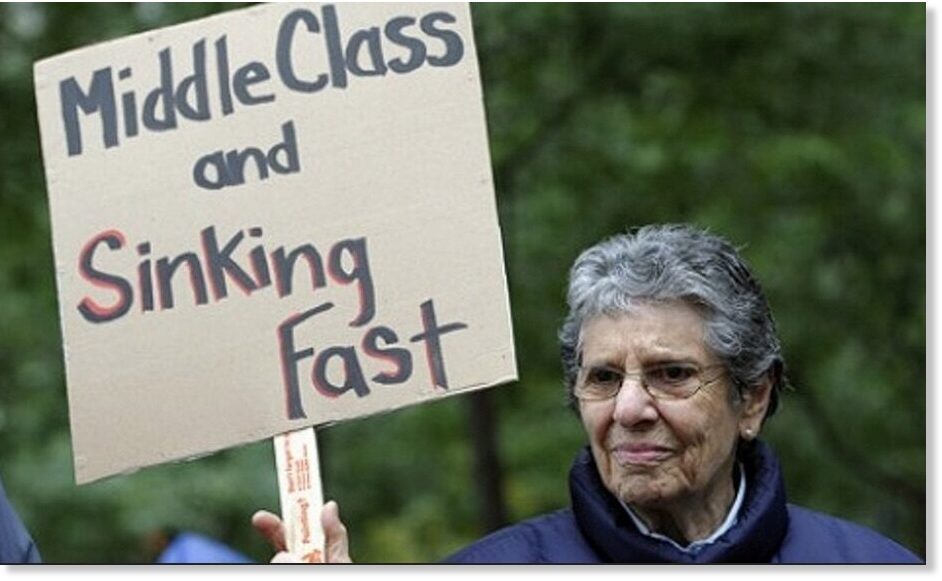
In 1971, 61% of American families made up the Middle Class. Today, that percentage ranges from 46% to 55% and declining. 50 million Americans now fall below the poverty threshold, and yet the federal government is doing little to stop the millions of illegal immigrants, the majority of whom falling into the poverty category, into the United States. Of course, we can't forget that women, on average, still earn just 82% of what men earn despite being mandated by federal legislation. 

One other factor to look at is the wage inequality between CEOs and their employees. In 1965, the average CEO made roughly 21 times that of their employees, which sounds reasonable. As of 2023, that percentage is 290 times more than their employees (there are 58 companies where that ratio is 1000 to one).. To put it another way, between 1978 and 2023, the pay of the average worker (wage and benefits) rose by 24%. Over that same time period, pay and benefits for CEOs and senior officers went up 1085%. The median pay for a CEO in 2023 was $16.3 million dollars according to a report published by the Associated Press (the data was comprised by Equilar). 

Can the United States continue with this level of income inequality? Ever since the decline of organized labor in the late 1950's, the income ratio between the working class and corporate leadership has been expanding, in part because the composition of their compensation package has changed to include more stock options and performance incentives. 

Meanwhile, similar types of incentives for employees have been reduced or cut, not to mention wage and/or benefits through so-called "voluntary give backs" out of fear that their jobs would be eliminated or the facility closed and sent overseas. Is this cost cutting measures to protect the business's profitability or merely a form of extortion? 

Since 1967, the Middle Class has been on a downward spiral, nearly matching the decline in public union membership. This decline of the union rank and file has meant a decline of union and non-union bargaining power and political clout which by extension, has directly affected the Middle Class. A strong working class, union or not, tends to mean a vibrant and financially healthy Middle Class. 

As mentioned at the beginning of this article, economic instability, coupled with public apathy, demagoguery and a well educated citizenry are a greater factor in the fall of democracies as well as empires, second only to severe and sustained climate events, than all other reasons. We have those in spades. 

Right now, we're facing not only extreme income inequality, but a strain on the economic elasticity of our social safety net, made all the worse by an defacto invasion, albeit non-military (at least at this point) of hoards of poor, largely poorly educated people who are interestedly solely in economic opportunities with no desire to contribute to their new homeland .

A people seeking to migrate or seek refuge will adopt to their new homeland's values and traditions. They will adapt to the laws and find ways to contribute. They will pay for public services through taxes. They will learn their adopted country's language.

 An invading army will do none of these things. Their objective is to supplant everything they can by any means available. They'll establish exclusive enclaves, turning them into semi-automatous zones of occupation, daring their hosts to enter. They will pervert the laws of their hosts. They will plead for tolerance when their numbers are small but offer none when there number have grown. 

Distrust in the government and media are at all time highs and have been that way for decades. Mediocrity at all levels of society, especially politics, are accepted as the norm. Excellence is often mocked if not actively discouraged. Herd mentality is the rule. 

The good news to all this is that there's a growing resistance to the ruling Status Quo. People are walking away from the Corporate imposed partisanship.  People are not just questioning so-called "authority", they're challenging it. The scripted narrative is no longer accepted. 69% of the public has little or no trust in the corporate media.

Increasingly, we're waking up to being played by the ruling class. The approval rating of Congress is laughable 17% We're refusing to accept the artificial divisions they want us to play. It's time we stop playing by their rules and start working to build a society which can benefit everyone. Not by mandating equal outcomes, but by ensuring equal opportunities. We need a society that our Founding Fathers would be proud of.   


 Thank you for reading "Another Opinion", the Op/Ed blog page for the "militant middle".  Here at "A/O" we truly value our readers. At A/O we seek the facts as they exist, not partisan talking points.  We hope you found our articles informative and engaging. Comments are welcome, provided they are not vulgar, insulting or demeaning.  Another Opinion is offered without charge and is directed toward all independent and free thinking individuals. We do ask, however, that you be sure to "like" us on whatever site you found us on in order to keep our articles available for others, and that you please pass our post along. Below you will find links to the sources we used in writing this article. Thank you. 


Average Gas Prices Under The Past Four Presidents


Wages and Prices: Who Is Keeping Up with What? 


Healthy Food Prices Increased More Than The Prices of Unhealthy Options during the Covid-19 Pandemic...


Nearly Half Have less than $500 in Savings


Survey: One in Four Americans Have Less than $1000 in Savings


The typical CEO makes nearly 200 times more than their workers


Saturday, October 23, 2021

Where Has Our Middle Class Gone?


When our Founding Father's sat down and tried to create a new country, what they had in mind was a nation of "yeoman farmers and shopkeepers"; basically, a country of the middle class. It's a matter of history and economics that nation's with a strong middle class are the most stable.

These countries have the highest quality of life. Their citizens are typically the happiest and their governments are stable. They are well educated. They are the most innovative. Unlike nations in Latin America, Africa, the Middle East, and parts of Asia which never really developed a strong middle class, those with a large strong middle class are, frankly, the most successful.

The central problem with Communist countries is, ironically, they are all "equal" (some are more "equal" than others). Karl Marx introduced the Communist mantra "Each according to their needs", which implied that everyone would be equal economically. Therefore, the state owned everything and allocated it as it saw fit.What's more "equal" than that?

Under Communism, there's no private property, no Wall Street, no banks, no family run businesses. Nada. The state doles out whatever it said you needed. Which, on one hand, was kinda nice, especially if you were lazy. It meant that you got paid the same as the other bloke without doing all the work.

Everyone gets a similar small apartment, which you typically share with another family (or two), including the bathroom and kitchen. You get the same bare minimum healthcare. You may get lucky and receive the medicine or surgery you need, which is often scarce. And you get to stand in the same lines and stare at the same empty shelves.

Of course, quotas were imposed, but all that did was just produced low quality products. Naturally, those in government got more. They also got better accommodations and access to a slightly better availability and selection of food or other items from government only stores.

The result was a lack of incentive. A lack of motivation. Why try if it doesn't benefit me or my family? Of course, that translates into a lower quality of life for everyone (except the ruling class). It creates a society with a certain dullness; a sterility to society. At least everyone could share the same misery equally.

In non-Communist countries which never developed a vibrant middle class, like those found in parts of Asia, Africa, Middle East or Latin America, were due typically to backward (and often brutal) authoritarian regimes, be they tribal, a monarchy, theocratic, or those with a facade of a democracy.  

The reasons they failed to develop a broad middle class are various, but usually the result of an imposed restriction on who can and can't be educated; high taxes on the masses; a lack of investment in the civil infrastructure; restricted land or business ownership; restrictions in who can or can't vote, and so forth.

As stated above, these are countries which are controlled warlords or autocrats. Many use tribal, religious, or partisan connections to gain and keep power (which is usually maintained through fear and violence).  These countries are almost always as corrupt as they are poor. Not surprising, they are usually dependent on foreign handouts to keep the corruption going, with the citizenry getting literally crumbs.

America, whether by design, fluke, or divine intervention, came into being as mankind's greatest hope to rise above the much of poverty and ignorance which has been the historical norm. Here, you could own property, start a business, get an education, and believe whatever you wanted to believe.

Not even the most progressive country in Europe or Asia could boost of the same opportunities. There was no social, caste, or class restrictions. You didn't have to ascribe to a state religion. Innovation was rewarded. It was even possible to hold elective office. If you were determined and willing to work hard, there was nothing you couldn't accomplish.

All of this was made possible because we were a Constitutional or democratic Republic of "yeoman farmers and shopkeepers". America's success was built on and by its broad middle class. But, what happened? Where is the middle class today?

Beginning in the 1970's, America's middle class has been on the decline. Meanwhile, the nation's wealth has been increasingly concentrated into the hands of fewer and fewer individuals and corporations, whose grasp has spread out across the globe.

The top 1% controls twice the wealth of the bottom 90%.  Just eight billionaires control more wealth than 50% of the world's population. Three of them---Jeff Bezos, Bill Gate and Elon Musk---are wealthier than the bottom 50+ percent of Americans. That's over 160 million Americans.

As most of us already know, we are no longer a Constitutional Republic, though we still pretend to be the way ancient Romans did under the early decades of the Caesarian dictatorships. We are a defacto Corporatocracy, which is a merger or close partnership between government and big business, and tends to be neo-fascist. So close is Big Business and the government that it's sometimes difficult, if not impossible, to see where one stops and the other begins.

This Corporatocracy doesn't exist on its own. Like every governing system, it has managers---very rich manager. These managers are called Oligarchs (though some prefer the name "plutocrats" or "kleptocrats", it's all the same), and they literally own the government. While some members of Congress, the Presidency, the Judicial system, and bureaucracy which keeps things functioning may be a part of the Oligarchy, all of them in some way work for it. It's kind of a modern take on feudalism. 

Hirlings on behalf of the Oligarchs, known as lobbyists, write the laws (which is why there appears to be one set for us and another for the rich). The Oligarchs dictate foreign and domestic policy. They decide on whether we to go to war or not, who are latest ally or enemy is, and they own the media which they use to manipulate our opinions. They provide us with the same "bread and circus" the Caesars of old did, but on a whole other scale.

In fact, almost everyone in Congress is a millionaire. Many are multi-millionaires. The ruling Oligarchs have made it virtually impossible for the average citizen to participate in the political process thanks to Citizens United which allows nearly unlimited corporate donations while capping us; partisan gerrymandering; and the absence of term limits, not to mention a fair amount of nepotism among with super wealthy.

What made America great was its middle class, which has been in decline for the last 50 or so years as I said earlier. A recent report shows that the wealthiest top 10% now owns 70% of all the nation's wealth. That's more than the middle and lower classes combined!

According to the OECD (Organization for Economic Co-Operation and Development), more than half of the world's industrial nations have a larger and more vibrant middle class than the United States. The top 1% own more than at any other time in our nation's history. For that matter, the top 10% has never had it so good either, while the bottom 50% has never owned less or had a higher percentage of debt.

When we look at income inequality, it shows a similar picture. Between 2009 and 2019, the bottom 90% saw their wages increase by just 8.7% while wages for the top 1% increased 20.4%. As an aside, the top .01% saw their incomes increase by 30.2% for the same period. What about working more?

From 1979 to 2019, worker productivity went up by 72%. Nevertheless, hourly wages increased just 17% over the same period, which is almost negligible. The hourly wage ratio between the average employee and CEOs is $830 to $1. Since 1985, Wall Street bonuses increased 1,217% .

It's worth noting that union membership comprises just 6% of the total workforce (it's highest in public sector jobs). Today, union's seem more interested in keeping workers on the production line and off picket line. The days of activism unions, which brought about so many positive changes, are long gone. Unions today largely serve the interests of management, leaving the average employee on their own.

During the last 19 months of the COVID pandemic, the rich got richer. How much richer? 62% richer, or to put it into dollars, they got $2.1 trillion dollars richer. Before the pandemic, there were 614 billionaires. Now there are 745, and practically all of them pay less income tax than the average American.

One of the hallmarks of a strong middle class, and a strong economy is a well educated work force. But, as readers of A/O know from previous articles, America is consistently ranked toward the bottom of industrialized nations when it comes to math and science (which is dominated by mostly Asian countries).

In math, we averaged a score of 478, which was below the OECD average of 489. Countries like Singapore, Macao, Hong Kong, Taiwan, and Japan all made up the top five. In science, we did a little better with a score of 502 compared to a OECD average of 489, but again, failed to crack the top echelon held by Singapore, Macao, Estonia, Japan, and Finland. So why is that a big deal?

Education is the key to not just productivity, but to innovation and future economic growth. A well educated workforce attracts businesses with above average paying jobs. That brings a greater tax base which improves the infrastructure, provides more social services, and attracts more businesses, and so forth. It also encourages innovation, which creates new industries, new businesses, and new jobs.

In terms of healthcare, we were once the world's leading nation. Now we're 27th. We also have one of lower life expectancies of any industrial nation too (26th out of 35 OECD nations).  In terms of quality of life, we are again ranked in the lower tiers, often behind Europe and especially the Scandinavian countries.

 In the area of "social progress", we're 28th. Norway ranks first. In terms of freedom, we're ranked 17th according to the Cato Institute's "Human Freedom Index", and labeled as a "flawed democracy" per the Democracy Index while New Zealand and Switzerland were ranked one and two in the world.

The one thing we do seem to excel at is war. We spent $725 billion dollar in 2020 on national defense, not including what is outsourced, or what we spend on intelligence or national security. We spent more money on just defense than the 11 largest economies...combined, including China and Russia.

Approximately 11% of our national budget goes to the military along with half of all discretionary spending. Remember that the military, industrial, and technology contractors also make up a large portion of the ruling Oligarchy.

However, while that's a lot, we spend the bulk of our nearly $4 trillion dollar budget on social services. 73% to be exact, which includes Social Security, Medicaid and Medicare, Veteran benefits, healthcare, and education. We also spend another 6% to service the interest of our national debt.

So, what can we do about it? Obviously a Corporatocracy run by an Oligarchy isn't what our Founder's had in mind for this country. We must come together again as a united nation. If we don't, we risk splintering into factions, and that will give the ruling Oligarchs the excuse they need to declare martial law and turn our nation into a police state. 

The elites eagerly await the day when they can proclaim "Novus ordo seclorum"---"a new order of the ages", but we must embrace another motto, "E Pluribus Unum"---"out of many one".  We must restore our nation's middle class, and with it, our Republic.  Want to know more? Check out the links below.               

Determining Where U.S. Ranks in Education


The U.S. Education Rankings Are Falling Behind The Rest ofthe World


Income Inequality


The US Is Officially A Banana Republic


U.S. Defense Spending Compared To Other Countries


Announcing the 2020 Social Progress Index


Saturday, February 01, 2020

The Tax Man Cometh: How Much Longer Can We Sustain the Increasing National Debt?


With April 15th just around the corner, I thought now would be a good time to look at the state of our national finances. America is currently in debt to the tune of approximately $24 trillion dollars. That means each taxpayer owes about $161,000...plus interest. Our debt-to-GDP (Gross Domestic Product) ratio is 106%. So, for every $100 dollars we take, we pay out $106. That's a recipe for disaster.

At present, 51% of our nation's taxes come from personal income tax---$1.65 billion dollars. Another 25% or $1.15 billion comes from Social Security taxes. Meanwhile corporations pay just $320 billion or about 6% of the federal revenue. Estate or inheritance tax, typically paid by the wealthy, makes up just $23 billion, while the balance, $260 billion, is paid through other forms of taxes and fees.

That represents our nation's revenue. Now, how about what we spend the money on? 26% goes to Medicare, Medicaid, ACA, CHIP, and marketplace subsidies; of this, Medicare gets three-fifths of the money. 24% or $940 billion goes to Social Security, while the military gets 15% or $611 billion dollars. Safety net programs such as unemployment , school meals, low income housing assistance get 9% or around $357 billion. 7% pays interest on the national debt. The balance goes to federal and veteran retirees (8%), transportation and infrastructure (2%), science and medical R&D (2%) with non-international security getting 1%. The remainder goes to miscellaneous programs including education related programs.

Think that's all there is to it? Consider that this doesn't include $125 trillion dollars is allocated for unfunded liabilities. It also doesn't cover the military's or various intelligence agencies' unreported "black budget" programs which are estimated to be over $80 billion. According to the nonpartisan Congressional Budget Office, about 65% of the national debt is held by the public. By 2028 it will 100%. That means all of our taxes will go just to service the national debt.

Another interesting factoid is that only nine countries have worse debt-to-GDP ratios than we do. Unfortunately many are on the news and are tittering on economic collapse such as Greece, Italy, Bhutan, Mozambique, and Portugal. Worse still is that the United States ranks just above Djibouti in East Africa, Jamaica, Cyprus, Belgium (which has been overrun by the so-called "migrants"), and the Congo. It would take the combined economies of China, India, and Japan to pay off our national debt.

It might be worth noting that foreign governments currently own just under 30% of our national debt (the two largest are Japan and China which own 1.15 trillion and $1.11 trillion respectively or about 15% combined). Next is the U.K with about $334 billion in U.S. debt and Brazil which owns just under $300 billion. Ireland and Switzerland round out the top five with $285.6 and $263.3 billion.

You don't have to be a CPA, a political scientist or economist (which I was educated as) to understand that this is insane. There will be a breaking point. There's only so much road that the proverbial "can" can be kicked down, and we've about reached it. Most economists put the "end of the road" at around 2025 or 2030. As the "game" is now being played, the only solution is dramatically increase taxes, be it by increasing existing taxes or finding new and more "obscure" revenue streams.

The problem is that the middle class, which had historically been this nation's backbone and shouldered the bulk of the taxes is not just dead broke, it barely exists anymore. The middle class has been declining every year since 1970, from a high of 62% to a current low of about 45%. Adjusted for inflation, income for the middle class has remained nearly stagnate while the top 10% has seen exceptional growth. Of course, the American economy has transitioned from mainly middle class manufacturing jobs to lower income service jobs in the name of bigger profits.

We also have to remember that for the last 20+ years the U.S. economy has been on a defacto war footing, thanks to our involvement in Afghanistan, Iraq, and Syria; a hollow stimulation of the economy. This has had the illusion of artificially reducing unemployment by draining off "excess" workers to the war effort while keeping the economy operating at a steady capacity.

America is also experiencing the highest rate of income inequality in the last 50 years (if not longer). In 2012 for instance, the top 10% took home 50% of total income. The top 1% got 20% of that! The top 10% owns more than 1000% more than the middle class remnant. Meanwhile, the top 1% now owns more than the bottom 90%. Since 2000, the number of Americans living in poverty has continued to increase, mainly from the middle class (which has resulted in more Americans applying for aid through our economic safety net which only the fifth most funded portion of the budget).

From 2000 through 2006 for instance, worker salaries increased a total of just 15% while corporate profit increased 13% per year. From 1979 to 2007, the top 1% saw an increase in their household income of 275%. It rose 65% for the top 1/5. Yet for the bottom 1/5, their household income increased a mere 18%.

Breaking it down by states, those with the highest income inequality were the District of Columbia, New York, Louisiana, Connecticut, California, Florida, Alabama, Mississippi, Georgia, and Kentucky. The top states with the least income disparity? Utah, Alaska, New Hampshire, Wyoming, Hawaii, Iowa, Nebraska, South Dakota, Minnesota, and Wisconsin. Indiana was 15th while Ohio was 26th and Illinois was 40th.

Globally speaking, the United States ranked ninth among the countries with the highest income gap. Not what you'd expect from the "bastion of capitalism" is it? We were just behind (that is, worse than) South Korea, the UK, Russia, New Zealand, the Baltic states of Lithuania, Estonia and Latvia. Some of the countries worse off than the U.S. included Turkey, Chile, Brazil, China, Mexico, Costa Rico, and India. The nation with the worse income gap in the world was South Africa.

So what does this mean for the United States and what, if anything, can we do to stave off disaster? Well, consider this. In 2016, U.S. billionaire Warren Buffett announced that he actually paid less in taxes than his secretary and other employees. He went on to say that his tax rate was just 17.4%. In 2018, U.S. billionaires paid, on average, at a tax rate of 23% while the bottom half paid an average tax rate of 24.2%. In 2018, the average CEO made 287 times more than the average employee. We have corporations whose profits are more than the GDP of many countries, but they pay little to no taxes.

The Institute of Taxation and Economic Policy reported in 2019 sixty Fortune 500 companies which paid zero federal taxes on their collective profit of $79 billion dollars. We're talking Amazon, Goodyear, Eli Lilly, Chevron, Halliburton, Netflix, Delta Airlines, IBM, Gannet, Honeywell, Prudential Financial, Molson Coors, Apple, ATT, and Duke Energy as an example. Others, like Exxon, Pitney Bowes, U.S. Steel, Starbucks, and many other Wall Street corporations paid virtually nothing. Of note is that IBM, which paid no federal taxes, actually got a refund of $342 million. Amazon got back $182 million, while Molson Coors earned a "cold filtered" refund of $22.9 million.

Sound fair? Hardly. But that's how things function under an Oligarchy. Corporations, lobbyists, politicians, and professional bureaucrats all working hand-in-glove to serve each other's interests while taxpayers---you and me---get the bill. The government is living top dollar on our nickel and dime income. This has only one possible outcome. Perhaps that's the reason for the increase in government surveillance, the fake news, the increased militarization of the police, the manufactured conflicts between groups, the crackdown on owning guns as well as freedom of speech and assembly.

Those in the top 25% income bracket need to be taxed at a much higher fixed percentage so that a minimum tax is always paid. CEO's earning 287% more than the average employee? Great, let them pay at a 287% tax rate. In some countries, CEO's are capped at how much they can earn. In the UK it's 22% the amount of their lowest paid employee. In France, it's 15%, and in Germany it's 12%. Why can't we?

What we need is a complete tax code overhaul. We need to go to some form of consumption tax; a tax on which you pay only if you buy. You control your tax rate by controlling your purchases. You don't have to worry about keeping receipts, filling tax returns, or anything else. A tax code for ordinary citizens would be virtually obsolete.

Secondly, corporations need to pay a minimum tax equal to 15% of their gross profits. If U.S. manufacture products overseas and sent them back, then a special import tax needs to be added. It needs to be cheaper to manufacture here in the U.S. than to close an American plant, lay off workers, ship the job overseas, and then send it back here to be sold.

There was once more of an equilibrium between blue collar and white collar pay back when you had stronger unions. Unions, for all their flaws, at least gave employees a voice in the workplace and a means to fight back. That's all but gone. However, there needs to be the adoption of employee associations to pick up where unions left off. Employees need to be guaranteed a voice at the table---literally. Employees should be allowed to elected representatives to the board of directors on a rotating basis equal to 1/3 of the total board.

To reclaim our Republic from the Oligarchy we need to eliminate the nefarious "Citizens United" which gave corporations "personhood" and unlimited financial "free speech", thus eliminating the impact of the voters. We need to impose term limits and end partisan gerrymandering in order to give back some of the elective power to the people. We need to implement voter referendums too. Lastly, citizens must have the final say in any tax or rate increase. Regulatory boards and governments can and should advise; they can even recommend, but we--the taxpayers---must have the final say. We know what's at stake. It's up to us to incur that risk, be it increase in property tax, school tax, sewer rate hike, or increasing the salary of elected officials...or not.

We need to reevaluate whether those with no children in public schools should have to pay school tax at the same rate as those with children in school...or any tax at all. We need to reconsider whether those on fix incomes should have to pay a property tax or whether those who use bikes on public roads should be required to buy a license and pay a tax like anyone else who uses public roads.

Too often elected officials think the only option is to increase the tax burden on its citizens. They fail to take into consideration the accumulative effect of the increases, along with the increases in other services such as cable, water, gas, or electricity. It's always "just a few pennies" to hear them tell it, but it never is. Politicians, like water, will always take the path of least resistance. Right now that's you and me. We need to change that, and quickly, while there's still time.


18 Facts on the U.S. National Debt That Are Almost Too Hard to Believe


Trading Economics: Government Debt to GDP

Fiscal Indicatiors

Who Owns the U.S. National Debt?


These 15 countries have the widest gaps between rich and poor


Sunday, August 30, 2015

Mister Pot meet Mister Skillet: Defining America


I was listening to a friend of mine's radio show recently. He was talking about the latest misadventures of the Mayor; the Metro Council, and our "once great" newspaper; all of whom seem to coordinate efforts their misuse of the public's trust in his opinion. Truthfully, I was amused by his litany of adjectives in describing each---always with added emphasis on certain key words. However, it was in those descriptions that I noticed a continuation of a trend common in most conservative talk shows, news shows and mailings sent out from various associations and groups.

I noticed their rather loose use of the terms "socialist", "Leftist", "Communist" (or the more purgative word "Commie"), "Progressive" and "Liberal". They seem to throw these terms around indiscriminately or use them interchangeably as if they meant one and the same. Of course, they don't. Nevertheless, this got me to thinking---what does government behave like? It certainly doesn't behave as "socialist". This would imply that control would rest with the people; that there would be no Wallstreet, private banks, income gap, and so forth for instance. Socialism means the common ownership of the means of production with an eye toward equality---social, political and economic---for all the citizens. On the Authoritarian Scale, Socialism rates relatively low though it is strongly centralized. Communism means that the State owns everything and the people work for the State. That means little or no private ownership of property, businesses, banks, or anything else. As expected, a centralized government of this nature would rate very high on the Authoritarian Scale. Does either of these sound like the government you know?

Now, how about the other side of the coin, Nazism and Fascism? We often hear the Left refer to everything done by the Right as being one or the other, but is it really? Nazism (derived from the German term for National Socialist German Workers Party or NSDAP), was originally a small Rightwing discussion group known as the German Workers Party or "DAP", co-founded by Anton Drexler (the "socialism" in the title pertained to Germany as a community of communities and not to the unusual meaning of the word). Later, it evolved into the NSDAP under the leadership of key individuals, including brothers Gregor and Otto Strasser, Hermann Goring, Joseph Goebbels and, of course, Adolf Hitler. Nazism is often described as a Right wing ideology, however in actuality it was center-right in that it derived its policies from both the Left and Right (in terms of economic policy for instance it was Keynesian and included expansive social programs, common at the time, and operated on a four year economic plan). Hitler opposed unregulated Capitalism as much as he detested Communism. It also incorporated a expansionist foreign policy (again, common at the time) and a racial purity policy, which made it somewhat unique as well as nationalistic and militaristic.
Under Nazism, which is a form of Fascism, the government was highly centralized, often operating under a dual governing system whereby government appointed department heads would often be in direct competition with party officials who were operating under similar authority. The idea was to foster internal competition and, thereby, creating a more innovative and efficient system (this rarely happened and often resulted in conflicting policy directives). The government was overseen by a single leader---Der Fuehrer---while departments operated more or less autonomously. Under Nazism, individual unions were disbanded and replaced by a single national union---the German Labor Front or DAF--- while many of the earlier union demands were made into law. Nazism rated high on the Authoritarian Scale.

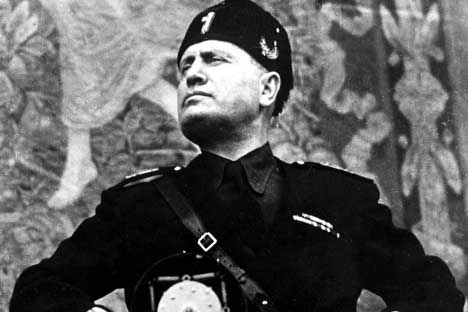
Fascism was the brainchild of former Italian Socialist activist and newspaper editor Benito Mussolini who abandoned the precepts of socialism in favor of nationalism following his experiences in World War One. According to "ll Duce", Fascism is best described as "corporatism" in which government is run much like a corporation and in close partnership with the business world. Unlike any of the above, Mussolini was President of a governing committee of ministers (and near war's end, was voted off the committee, and thus out of power). While considered a Rightwing ideology, Fascism actually draws from the Left and Right though it strongly favors corporate dominance. As stated by Italian historian Gaetano Salvemini in 1936, Fascism makes taxpayer bear the costs of corporate failures and added that "profit is private and individual while loss is public and social".

That means there could be an increase in certain social programs (typically Left) while decreasing corporate regulation and increased cooperation with the wealthy while taxpayers paid for bad business decisions or business related expenses. It is high in terms of centralization and is often accompanied by a police state along with a strong Executive. Like Nazism, Fascism is also highly martial, meaning a strong military and an influential military industrial complex. Under Fascism there is typically a large gap between the wealthy and everyone else. Unions, under Fascism, were largely co-opted into supporting corporate dictates or banned and outlawed. Fascism rates moderately high to high on the Authoritarian Scale.

Lastly, let's briefly discuss Libertarianism. Libertarianism essentially embraces the concept of "self-government" and voluntary cooperation or participation although there are numerous variations covering the political spectrum from Anarcho-Capitalism and Left Libertarianism to Anarchy and Ayn Rand's Objectivism. As such, Libertarianism doesn't fit neatly on the Left/Right Political Spectrum., but it usually endorses only the bare minimum amount of government needed to maintain the social order and promote trade with emphasis on individual and political freedom. As odd as that may seem to us today, several of the Founding Fathers were strong advocates of this form of government; most notably Thomas Jefferson and Thomas Paine. Libertarianism prefers a laissez-faire economy, which is defined as self-regulating with minimal or no government or outside control beyond the marketplace itself. Unions are permitted, if, however, participation is voluntary and remains off limits from the government interference. Many, however, doubt that given the complexity of today's society that Libertarianism would be practical. Nevertheless, it remains a active and popular political ideology.

There you have it. Now, after you've had an opportunity to review each, which one do you think we have today? Are we the emerging "socialist" or Communist nation that those on the Right claim? Is the Left destroying Wallstreet and eliminating corporate influence over government? Or do you see corporate power over government as the central problem? Is Wallstreet exerting too much power over the direction of US domestic and foreign policy? Is the military industrial complex more or less influential? What do you think about the power of unions---have they become stronger or have they largely been co-opted by big business or even made ineffectual?
What's your opinion about individual freedom---is personal freedom expanding or are we "under the microscope" more today? What about government regulation of business, wages and the income gap, quality of life, the Middle Class, social programs, and personal opportunities? Are they growing or contracting in relation to yourself and other individuals?

I think most of you will agree that our current social, political, and economic situations doesn't favor ordinary individuals. Wages, in terms of buying power, has been on the decline since the late 1970's. Individual freedoms have also decreased since 9/11 while there's been a marked increase in government surveillance by various national security agencies as well as serious infringements on the Constitution and Bill of Rights---all for our own protections naturally---not to mention the militarization of the police. Taxes and job security certainly don't favor the Middle Class (or what's left of it).
Unions, which have been on the decline since the early 1960's, have become impotent. Most survive by being the water boy of the corporations they're supposed to be protecting the employees from.

As I often mention, we are no longer the democratic government of our Founding Fathers. The 2014 study by Martin Gilens of Princeton University and Ben Page of Northwestern University confirmed what the majority of Americans intuitively knew---we've become an oligarchy. The government is no longer "our" government. It serves the interests of the 1% , which includes a handful of corporations. There's one more thing I should mention about Fascism, and that's it tendency to demonize what it fears the most. By demonizing socialism or certain individuals or countries, it is attempting to implant a negative image in your mind in order to build up an automatic rejection. Fascism was successful with that tactic in Germany, Italy, Spain, Argentina, Romania and elsewhere. There's no reason to think it won't be successful here. So, the next time someone claims America is becoming "socialist" or "Communist", be sure to point out their mistake.


The 10 Planks of the Communist Manifesto
http://laissez-fairerepublic.com/tenplanks.html


14 Defining Characteristics of Fascism
http://www.rense.com/general37/fascism.htm


Socialist Party USA Principles
http://socialistparty-usa.net/principles.html


The Socialist International Declaration of Principles
http://www.socialistinternational.org/viewArticle.cfm?ArticleID=31


The Transformation of American Democracy to Oligarchy
http://www.huffingtonpost.com/akbar-ganji/the-transformation-of-ame_1_b_7945040.html


The Libertarian Party Platform
https://www.lp.org/platform


Saturday, March 21, 2015

Do You Have a Right to Work?


Let's say that you like working on cars. Cars are your life. There never has been any question of where you wanted to work---the local auto plant in town. The money and benefits are great, and what's better, they're hiring. So you fill out an application. After a few days, you get a phone from the plant's human resource department and set up an interview. She wants to hire you. An appointment is made to come down and see the company physician for a quick physical. The human resources manager asks you to come back in for an orientation.

At the orientation, you go over the various procedures like safety issues, clocking in and out. Then comes the shocker. You're told that you are required to join a union in order to work there, but you're not interested in joining a union. You're told that the plant is a "closed shop", meaning that in order to secure employment there, you have to join the union. You tell her you're not interested in a union; you just want to work on the car or truck assembly line. At that point, a union representative is brought in to talk with you.

You politely listen as she explains that the union has been in place since the 1950's; that the union would protect your job in case something should happen; that they would provide you with a shop steward in the event of performance issues or any hearings; the union would negotiate on your behalf---collectively---pay raises, health and other benefits, your hours, and job safety issues. All you need do is sign the union card and agree to have the union dues automatically deducted from your salary. Easy peasy.

After the union representative finishes speaking, you politely explain that you don't have any interest in joining a union. You are aware of your responsibilities, and as an adult, take full responsibility for your actions. Furthermore, you are quite capable of speaking for your self should you get into any trouble. The representative explains that without their steward, you could run the risk of being taken advantage of (implying that you couldn't trust the company).

The union representative reminds you that unions have been at the forefront of child labor laws, women's suffrage, job safety, voter
registration, and even the Civil Rights movement. Those were all powerful and important issues, but each has been addressed by the federal government and are now laws. What about wages and benefits? Unions have been out in front in protecting wages, limiting hours, and securing benefits for their members. That's true, however, those too have been largely addressed by various federal laws. As for negotiating wages, over the past decade or so, unions across the country, have negotiated away much of benefits they had fought for over years, which has also included pay cuts, reductions in worker seniority and are only just now getting some of those back. Besides, the company has offered a retirement package before the company unionized, and offers a similar package at its non-union plant.

At this point that the union representative is getting agitated. She adds that the union also has a political education committee which would act on your behalf by endorsing candidates and making political contributions. Where does that money came from you ask, and she says that it is automatically deducted from your paycheck. Ok then, who selects which candidate or issues your money gets directed to? As it turns out, it isn't you. The committee would make that decision for you. What about the candidates they endorse, do you get a say? Not directly, but you do get a vote. However, the final decision is made by the committee. In some cases, only the political election committe makes the decision and in others, only the union president decides. But, you explain, you aren't partial to either of the two parties, but who were some of the candidates they endorsed in the past?

As it turns out, all were of a specific political party, and few if any of them, support the same issues as you. Accordingly, you point out that it made more sense if you donated to whom you wanted rather than have a portion of your salary going to individuals you didn't agree with. Besides, it didn't make any sense to dig deeper into your pocket to donate to those candidates you agree with; it was like you were working against yourself.

After a few polite closing remarks, you're informed that either you sign the union card or don't get the job. At that point she leaves. Funny, you think, wasn't that the company's decision to make? You could see her speaking with the HR manager outside the door. A few minutes later, the HR manager enters and asks if you have any questions, otherwise you were free to leave. You told you can start as soon as you turn in the signed union card. You mention that you did have a couple of questions.

How is it that you answered a company job announcement; filed out an company application; interviewed with company personnel; went to a company doctor; but in order to accept a job that you really wanted--- that you had studied hard for in school---spending countless hours after and before school; that would hopefully be your life's work---you had to join an organization that you weren't the least bit interested in, not to mention an organization which would not support your views politically in order to work there? In fact, you're told that they, not the company, decides who works there based on whether you sign the union card or not. Two words---closed shop. A closed shop means simply that in order to work there, you had to join the union whether you wanted to or not, and you have to abide by their rules and pay their dues.

Closed shops came about during the heyday of union membership---the late 1940's and early 1950's. Within the past few decades, many companies have sought to circumvent closed shops by moving the company to either states which had "right-to-work" laws, meaning that individuals can't be compelled to join unions, or the plants were closed and work shipped off to countries where workers are paid sweat shop wages with no benefits and they had little or no rights whatsoever.

So there you have it folks. Although the story was entirely fictional, the situation is real. Is it better to join the union, where the jobs of everyone is more or less protected, or take a chance? Some can certainly fight back or negotiate their own pay, but many can't. In some cases the costs of wages, benefits, and protecting unproductive workers have proven to be too much and companies have closed or moved. Unions essentially negotiated themselves out of a job. Many companies have retirement or 401k programs. Much of what unions championed down through the years are now laws, with workers having recourse through OSHEA (including its "Whistleblower Program"), the Labor Department's Wage and Hour division, the Equal Employment and Opportunity Commission (EEOC), plus various State and local agencies.

On the political side, instead of looking for themselves, unions have been in bed with one political party since the 1930's instead of playing each party off each other. Also, instead of supporting the best candidate for the rank and file, they nearly automatically endorse just the one party's candidate even if that particular individual doesn't even support unions! And let's not forget that in many cases, the member doesn't even have any say so where their money goes, which is often on issues or individuals they completely disagree with, meaning they have to dig deeper in their pockets to support the cause or candidate they want, and heaven help them if they actively support then non-union endorsed candidate or even put out their yard sign! Currently, some unions are pushing for amnesty for illegal immigrants since many are employed in mow skill and mostly unionized jobs. Amnesty would open the door for them to join the unions, and thus add desperately needed dues to the union's coffers. However, the influx would create more demand for jobs than there are available jobs, thus driving down wages and benefits while driving up unemployment.

What do you think? As corporations have become more feudalistic and some, like banks and oil companies, have essentially taken over governments like ours, have unions become passé? Have they outlasted their usefulness? Certainly big business would like for to think so. Unions have traditionally balanced the scale of power. Of course, unions aren't perfect. Some became corrupt through their Mafia involvement while for others, it became hard to distinguish union management from corporate management, especially when looking at their salaries! Unions have been at the apex in many social issues that we now take for granted. They were responsible for a vibrant middle class and growing economy, and as unions have declined, so as the middle class and so has America overall; so much that we face the largest disparity in income since just before the Great Depression, but then this isn't 1929 and the American economy is no longer the largest or strongest.

There are of course alternatives to unions, such as worker owned companies (co-ops), employee associations, employee-managements boards where employees and management elected representatives to a special board on a rotating membership basis which deals with employee related issues such as work conditions, complaints, and worker innovations. In addition, there's been a trend in business to create a more horizontal hierarchy and empowering employees, not to mention occasional outings, ongoing surveys, and workshops. I served as an employee liaison with management at several companies where I worked, including in an Assistant Vice President role working on projects to improve morale, productivity, and efficiency; a happy workplace is a productive workplace, at least that was the idea.

Right now, certain groups (primarily conservative and pro-business) are pushing for "Right to Work" laws, with Wisconsin having just recently enacted such a law. Proponents claim that "Right to Work" makes companies more competitive and gives workers more options, which they cite as being critical in today's global marketplace. Opponents, however, refer to the effort as "Right to Work for Less" and claim that without union representation, workers will be taken advantage of, have less job security, and will eventually be forced to take cuts in pay and benefits without any recourse except walking out and trying to find another job when jobs are hard to come by. In addition, unions point out that in "Right to Work" states, they'll be forced to cover non-union employees which they can't financially afford to do; such a move could ultimately bankrupt many unions. Unions are already having to compete, directly and indirectly, with companies and workers overseas who aren't unionized and earn pennies on the dollars and often without any benefits or even basic health and safety regulations while management and Wallstreet investors pocket the difference. Proponents, however, cite lower costs of living standards which justify the lower wages and benefits aren't something workers don't deemed as important.

Many on the political Right look at unions as "communist" or "socialist" (their two favorite terms) and champion the idealistic individual concept of popular Americana myth, while those on the Left see unions as an entre into the middle class, a better life for themselves and their children, along with the possibility of a college education. This is especially true among minorities. They see unions as a means to having good health care and providing for a decent retirement while working in a safe environment. Some of the principal goals unions have fought for, such as safe jobs or a means to fight against employer harassment or discrimination, are now federal laws and give workers some legal recourse. Certainly popular opinion has swung against unions in recent decades. Historically, union participation peaked in the early 1950's and has been in a steady decline ever since with only 11.3% of the workforce being unionized (about 6.6% of private employees and approximately 35.9% of public employees). Running near parallel, the purchasing power of the middle class has declined as union membership has dropped.

So, what do you think dear reader? Do you have an unobstructed "right to work" or is their strength in numbers? In which direction does the future look brightest for ordinary individuals amid the global marketplace and increasing competition for fewer jobs, Citizens United and the demise of our democratic republic, the 1% oligarchy versus a declining middle class and the widening income disparity?


Unionfacts.com
https://www.unionfacts.com/cuf/vitals

Saturday, February 07, 2015

The Income Gap


We've all heard the expression that "the rich get richer while the poor get poorer". Well there's a great deal of truth in that old adage--the rich are indeed richer---much richer, and the poor are incredibly more poor while the middle class as we've known it has all but disappeared into the ranks of the emerging Struggling Class as I call it. The last time there was such a broad wage gap between the rich and poor were the years just prior to the Great Depression in 1929. In fact, not only do we have a greater disparity between the rich and everyone else, the chiasm is actually deeper too than it was in 1929. The top 1% controls 40% of the total wealth while the bottom 80% controls just 7% of the wealth. They own 50% of all investments, from stocks to mutual funds. To put it another way, in 2012, 24% of the total take home pay went to the top 10%. In 1976, it was just 9%.

As a few Americans know, the United States fell from first to second place behind China as the world's largest economy in 2014. What
some may not know was that the American middle class dropped from the world's most "affluent" to second place, behind Canada and is continuing to drop. Academically, America high school students rank, on average, 14th in world. In terms of economic freedom, the US is ranked 12th by the Heritage Foundation. Regarding personal freedom, we are 21st, between Portugal and Spain. In terms of democratic freedom, the US was ranked 15th in the world according to Global Democracy Ranking. This ties into the most telling story from 2014, a study confirming that the United States was no longer a democratic republic as established by our Founding Fathers. We have, in fact, become an oligarchy---rule by a small elite and blindingly rich group of individuals. Combine this with the "Citizen's United" misruling by the Supreme Court five years ago, and one can begin to see why. "How's that?" you may wonder. The typically story line is that "we're going socialist", so how can we be get more "socialist" if corporations are becoming more richer and powerful?

Well, that's the rub isn't it? You see, "socialism" has never actually existed. Yes, we've had countries call themselves that because that was the goal they were attempting to reach. Russia wanted to achieve a socialism based on the teachings of Karl Marx and Fredrick Engels, however in his efforts to bring this about, Lenin "corrected" Marx to use his expression to make the rules fit with his reality. His expressed goal, however, was to shrink government to the size of the local Post Office and maximize individual freedom, that it, after the transition from capitalism through the "dictatorship of the proletariat". Stalin, who succeeded Lenin, was never all that interested in socialism in any form and as far as he was concerned, the dictatorship would remain in place. Stalin's interest was in power. So through forced collectivization and the use of a Police State and its gulags, converted Russia from a backward agricultural nation to a modern industrial fascist-like State with the State owning the corporations; not exactly what Marx had in mind. Hitler too used the term "socialism", but it didn't have the same meaning as we normally think of it. To him and the Nazi elite, the word meant more of community of likeminded individuals. Thus "National Socialism" meant a community of Germanic People who shared a common culture and origin, yet corporations worked in partnership with the government.

As for fascism itself, its founder, Benito Mussolini, envisioned it a working partnership between the big corporations and the
government; the two would be interwoven. In fact, Mussolini, was actually elected to his position (and later voted out) just like a corporate board. Fascism not only borrows from both the political Left and Right, it also can vary from country to country based on its culture and traditions. In other words, fascism adapts and it appearance can be very deceiving.

A precursor to fascism is typically an oligarchy, which is basically rule by a small elite (often rich and powerful) group. In our case, we morphing into a fascist State where corporations will have more of a leading role rather than a equal partnership. Another feature of fascism is a tendency toward militarism, which our never-ending "war on terrorism" conveniently provides, and a increased militarized mindset of law enforcement, State controlled or influenced media or propaganda, increased surveillance and a "divide and conquer mentality" of the population, not to mention a shifting of the wealth (and power) toward the ruling elite. Does any of this sound familiar? And that dreaded "socialism" I was speaking about earlier? Well that means the equality or at least a parity of wealth among everyone and common ownership of most things. Corporations would essentially be employee owned and operated with employees electing board members (one employee/one vote), so there would be no need for a Wallstreet. Banks, if they existed, would look more like credit unions. Utilities and energy sources would be nationalized. Taxes would be high, but then things like housing and groceries would be subsidized while education, medicine and medical care, with the emphasis more on prevention than treatment most likely, would be free. The closest examples I can think of would be found in Holland and Scandinavia before the big influx of immigration.

Another old saw says that "it takes money to make money". Well, there's still truth in that, except the money is less spent and more "invested"; invested in the corridors of power that is. Not only did Citizens United essentially give corporations--these man-made legal fictions---the same rights as you and I, but actually certain rights which exceeded those of the average citizen, at least when it comes to making political contributions. Combine this with what's known as "regulatory capture", and you can see we are in a serious jam. Oh, what's "regulatory capture" you ask? Simply this, it puts foxes in charge of the chicken coup, or more accurately, it gives the keys to the bank to the crooks. Regulatory capture basically puts those being regulated, such as financial institutions, in charge of the regulatory process by either allowing them to help draft the regulations themselves and/or managing the agency in charge through the process of appointment. Considering that many of those elected to Congress pal around with these individuals or at the least are a beneficiary of their largesse, it's little wonder that there's constantly a "loop hole" of some sort in the various laws. Many of those called upon to help draft regulations are the very lobbyist paid to represent that industry's interests, and those appointed are often the ones recommended by these very same individuals! Now you see what I mean by the fox and the chicken coop.

So where does that leave us? I'm afraid not very well off. Adjusted for inflation, real wages, which peaked in the early 1970's, stagnated, and has been in decline ever since. Part of the reason has to be the off shoring of mostly middle income jobs and with it, many of the peripheral businesses (not to mention the rise of so-called box stores and decline in "Mom and Pop" local stores). In addition, we have the decline in private sector unions; down to around 6.7%. When you include public sector unions, the number rises to only 11.3%, which, interestingly, are the lowest numbers since the Great Depression. Like them or not, unions have been not just the mainstay of middle class jobs but also served as a counter weight to the influence of corporations. In additional, US workers suddenly found themselves competing with workers continents away for the same job but a fraction of the costs. Average hourly wages, adjusted for inflation, rose 75% between 1947 and 1972 during the heyday of unions. Since then, it's risen only 9%. From 1947 through 1979, all income grew at approximately the same average rate with lower income wages actually leading the pack which created a large middle class and smaller class proportions at either ends of the scale. Between 1979 and 2012, real incomes increased 74.9% for the top 1% while the bottom 1/5th actually saw a decrease of just over 12%.

Real consumption spending by the top 5% increased by 17% since 2009 but only 1% by the remaining 95%. Globally, it also means that globally 41% of all wealth is in the hands of just 1%. Those with incomes below USD $10,000.00 represent 69% of the world's population. That's just 3% of the total global wealth. Upper end net worth is 70x that of those in the lower income bracket. That's the highest disparity in 30 years according to a Pew Report from 2015. In 1979, pre- tax income among the 1% received 8.9%. By 2012, that number reached almost 23%. Average real wages (adjusted for inflation) has increased by an annual rate of just 1% or 1/2 the productivity growth rate since 1980. However, the highest percentage was reserved for the top 10%, with CEOs earning, on average 380% more than the salary of their average employee.

Anyway, you slice it, the figures simply don't look good for 95% of Americans or the majority of world populations for that matter. So what can be done? A number of thing actually such as removing individuals in the same industry to draft its own regulation; ending gerrymandering to allow for fresh ideas and at least make it more difficult for lobbyists to buy politicians; end direct and indirect subsidies (corporate welfare) to large corporations and focus on small and medium businesses; restrict present Congressional members and staffers from working with or for special interests companies or lobbying firms for at least 10 years, including serving as a "consultant". Make public all contact with lobbyists. Revoke "Citizen's United" and prohibit corporate donations to political campaigns.

Finally, restore the American Dream by cutting red tape that restricts competition, especially from small and medium size companies. Meanwhile, you and I can shop as often as possible at locally owned stores or farmer markets, and we can support independent and third party candidates; We can become citizen activists and use our social networks to spread the message, attend meetings and speaking out; We can write letters and send emails to those elected to represent us, be it in City Hall or Congress. Remember that in the long run the only true power any of them have is our obedience.


Income Inequality
http://inequality.org/income-inequality/

Wealth inequality in America: It's worse than you think
http://fortune.com/2014/10/31/inequality-wealth-income-us/

Income Inequality Is a problem
http://reason.com/archives/2015/01/22/income-inequality-is-a-problemwhen-cause

The Rising Cost of U.S. Income Inequality
http://www.huffingtonpost.com/laura-tyson/us-income-inequality-costs_b_6249904.html

Income Inequality
http://www.pewresearch.org/topics/income-inequality/

Global Democracy Ranking
http://democracyranking.org/?page_id=738

Tuesday, December 23, 2014

'Tis the Season


It's Christmas time again. It seems like it keeps coming around earlier and earlier every year. Sales galore, complete with ruder than usual motorists, crowded stores and mall, not to mention some amazingly nasty bargain hunters who could put Army's Rangers to shame. I think I saw my first Christmas commercial this year just before Halloween; of course that doesn't include the perennial "Christmas in July" sales. Nothing says "Christmas" better than a good sale on appliances or a new car. As for me, I was never much of a Christmas person. Yeah, I know..."Scrooge"...."Grinch". I've heard it all before believe me.

At Christmas, people go into hock to buy the latest gizmos or the most popular toys, which everyone knows will either be outdated or fade with the next "big thing" within the next two or three months. America, despite its failing government and political influence globally, is still a land of plenty. Yes, our quality of life is in decline. No question about it. This present generation is the first in history not to equal or exceed its parents, and the next generation is expected to do worse. We have no one to blame but ourselves....and Washington which has consistently ignored the people with its debt prone policies and bailouts of the uber-rich ruling class which comprises the oligarchy under which we now all live. But, I digress.

America is still the land most people want to come to. We're not the most popular nation in the world. That honor falls to Germany. No, we are not the freest people on the planet. Far from it. That honor goes to tiny Estonia on the Baltic. In fact, America isn't even in the top ten freest nations. When Obama took office, the US was ranked tenth. Now, we're ranked 12th. That means there are 11 other countries with more personal and economic freedom than we have in the good ole US of A (kinda scary isn't it?). In terms of academics, we don't fare much better. We're 17th in the world in academic performance, yet we spend more money per student than most of the 16 countries above. In math, we're a dismal 25th; 17th in science, and a pathetic 14th in reading.

So, who's on top? That would be Finland, South Korea, Hong Kong, Japan, and Singapore. Latvia, Chile, and Brazil are making academic gains at three times the rate of US students while countries like Slovenia, Columbia, Poland, and Portugal are making academic gains at twice the rate of the average US student. At this rate, it's a good thing Velcro has caught on. Shoelaces may soon prove to be too much. Meanwhile, the US spends the second highest on children's toys, with an average of $371.00 per child. Wahoo! The Brits win honors for spending the most on the little tikes at a whopping $438.00 each. France comes in third at $338.00 each on their little Napoleons and Josephines. Spain came in last. They only spend $176.00 on their little ninos y ninas.

Of course, the other side of the coin, while American's spend an elf's ransom on Christmas toys, we're nowhere near the top when it comes to spending money for Christmas. Americans tend to spend up to 5% on their annual income, the Greeks and Russians will drop 6% of their income, but even they aren't first. So, who's number one? Well, as hard as it is to believe, the "Christmas Consumer Award" goes to the South Africans who spend an insane 15% of their annual income (adjusted to US dollars) on Christmas. No wonder Nelson Mandela was always smiling in all those pictures!

Yet, despite all this spending, America still has a poverty rates comparable to any third or second world nation. The bad news is that our national poverty is 14.5%, the good news is that it's down for 15% from 2013. The poverty rate for children is down by two million to 19.9%, or about 14 million children from a previous high of 21.8%. However, with Obama's attempt, apparently unconstitutionally, to grant executive amnesty to some 5 to 6 million of the 12 million illegal immigrants currently in this county, the poverty rate will likely increase as those individuals will now officially be counted (many had previously avoided the census in years past) and struggle to find work openly.

The backbone of this county, the middle class, has also seen its number decline with the average income level remaining steady despite annual inflation growth (adjusted for inflation, the average purchasing power for the middle class is equal to 1975 rates). The one group that's done well is of course the elites; the top 5 percent, whose numbers include the oligarchy that is now America. Their incomes have increase 14% since 1995 (since 1979, the top 1% have seen their incomes grow by 200% compared to the middle class, which has seen a growth of 67% while the bottom 20% has seen a growth of just 47%). If we forget about just income and look at overall wealth, we'll find that the top 3% controls 54% of the wealth in this country, and it's growing. So much for the economic "diamond" model most of us learned in school which showed a small group of poor and rich at the bottom and top and a large middle class in the center.

So what does any of this have to do with Christmas? Well, first is that we should be grateful for what we do have. While there are some who are doing way better than us, there are many more doing a lot worse. We need to reach out to those who are in need and not give them a handout as much as we should give them a hand up. We must find ways to return America to the land of opportunity it once was. Everyone of us has needed some help at some time or another. That's fine. There's nothing wrong with that, nor is there anything wrong with offering a helping hand. If anything, that's about as "American" as it gets, but so it helping someone get back on their feet so they can get on with life.

Christmas should be about helping others, not going overboard with toys and gadgets. Maybe it's time to make a point of adopting a star off of an "Angle Tree", making a donation, or volunteering somewhere a family tradition. Maybe too we should loudly demand those in our state capitols and in Washington start listening to us for a change. Let's penalize companies that ship jobs overseas yet continue to get tax breaks. Let's end corporate welfare and cut red tape for small businesses so they can hire more local workers.Let's make sure the super rich pay their fair share of taxes, and speaking of taxes, let's overhaul this outdated tax code to make it more fair for the poor and working poor, which includes what was once known as the middle class. Let's take money out of politics, especially corporate money so that our votes actually count for something. And let's get politics out of the classroom and get back to teaching students what they need to know to be productive citizens, and that includes civics, volunteerism as well as restoring discipline, and while we're at it, we need to invest in trade schools again. Not every job requires a college education and not everyone is cut out to go to college. That concept seems to have worked pretty for Germany, Japan, and South Korea. By investing in our children's education, we're investing in America's future. What better Christmas wish could there be than a stronger and compassionate America?

Happy Chanukah and Merry Christmas from Another Opinion.


U.S. Drops From Top 10 Freest Countries in 2014
http://www.nationalreview.com/corner/368410/us-drops-top-ten-freest-countries-2014-index-economic-freedom-alec-torres

Best Education in the World
http://www.huffingtonpost.com/2012/11/27/best-education-in-the-wor_n_2199795.html

Amount Spent on Toys by Country
http://www.statista.com/statistics/194424/amount-spent-on-toys-per-child-by-country-since-2009/

Christmas spending gone global
http://www.usatoday.com/story/money/business/2014/12/12/ozy-christmas-spending-gone-global/20281179/