Showing posts with label small businesses. Show all posts

Saturday, July 22, 2023

Living the (Broken) American Dream: Rebuilding the Middle Class

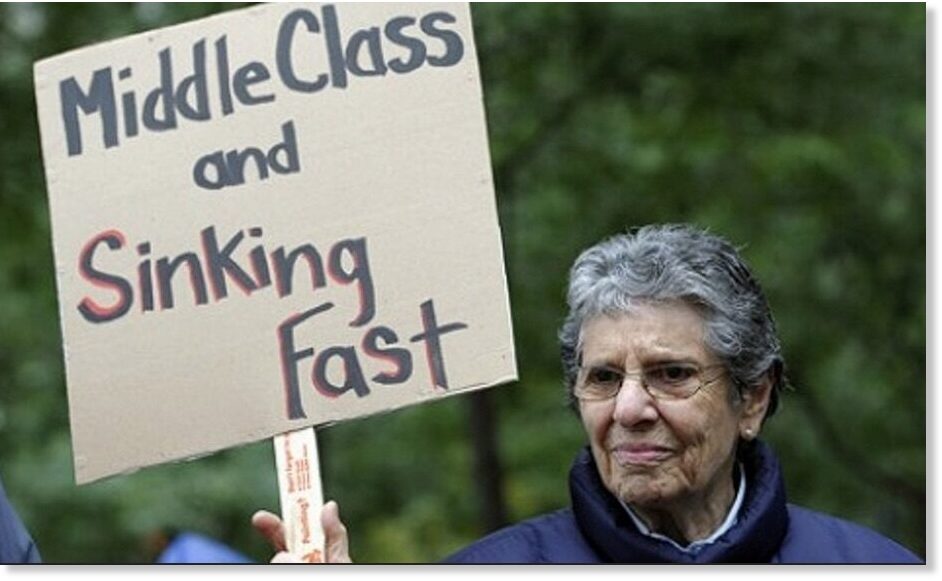
The middle class in the United States is in serious trouble. The aggregate earnings of the middle class has been in decline since 1970. The same goes for those at the lower end of the economic ladder while the upper 10% have seen a steady rise in their wealth. Even with 59.8% of two parent families both holding down full time jobs, it's not enough.

It used to be that a high school education was enough to guarantee you a comfortable living, usually in some blue collar job, a high school diploma nowadays would barely get you  beyond an entry level position somewhere. Even a four year college degree is no assurance of middle class lifestyle.

Of course, most of the good paying blue collar jobs have been exported overseas where corporations can exploit the need for jobs at any price while avoiding those pesky unions and OSHA requirements. Where for every opening there are literally thousands waiting in line to be hired.

It doesn't help that the quality of public schools have significantly declined over the decades to the point where many graduates have the academic equivalent of an eighth grade education.  America was ranked 11th of 79 countries in science.  While we ranked 30th in math,  the top five ranked countries in math were all Asian. But, we're still tops when it comes to basketball!

A typical college graduate with four year bachelor degree hit the street looking for a job with an average debt of over 30,000. For a professional degree, like from medical or law school, the average debt is around $250,000 and $160,000 respectively.  It takes the average college graduate 21 years to pay off their college loan debt. 
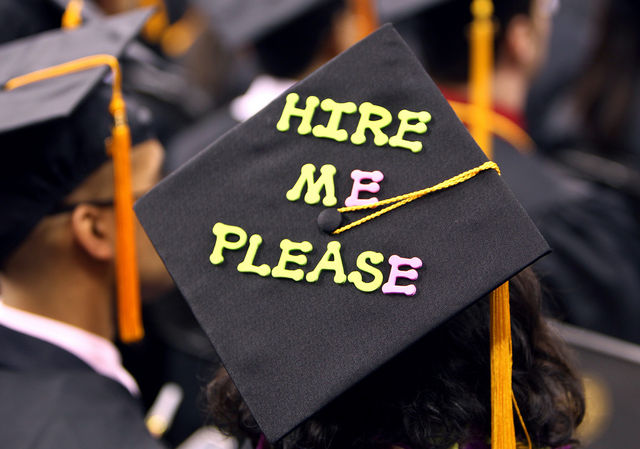
The downside is that a substantial minority chose majors with little or no job demand, leaving them stuck with a huge financial burden and no way to pay it off. These and other graduates are now wanting taxpayers to pick up the tab  under the misleading term of "forgiving" or "canceling" their academic debt. Why? We didn't pick their major. We didn't sign their loan papers or accept responsibility for their debt. That's their responsibility. It's called being an adult. 

But it doesn't end there. With all the additional expenses of simply "living"  amid rising prices and stagnate wages, the average American household debt is $101,915 as of the end of 2022. The total national household debt is $17 trillion dollars as of the end of the first quarter of 2023. That effectively makes the majority of Americans literally indentured serfs. They are literally working to pay off a debt owed to someone else, which is almost always a corporation.

As an aside, 60% of Americans are living from paycheck to paycheck, including 49% of those with an income of over $100,000 along with 70% of millennials, and it looks like Gen Z is trending the same way.  30% of Americans have enough money in savings to cover an emergency for no more than 30 days. 22% have no financial safety net which includes 27% of those 59 and older. 

Once they find a job, it's worth noting that wage inequality between genders remains a problem. Women are still earning, on average, just 82% of every dollar their male counterpart earns, which makes me curious about those who "identify" as transgender in the workplace. I wonder if they're going to be satisfied with their reality of their smaller paychecks?

Meanwhile, those at the top of the corporate ladder seem to be doing just fine. The CEO-to-worker compensation ratio was 399-to-1 as of 2021. That means that for every dollar a average employee earns, a top executive will get $399.  From 2010 through 2021, wages grew by 31%, which sounds pretty good. However, thanks to the rate of inflation, wages have lost on average 4.5% of their purchasing power.

As if that's not bad enough, the top richest 1% own twice as much as the bottom 99% of the entire world's population! To put it another way, they've acquired over half of all the new wealth created over the last decade while the poorest half own just 0.75% of the wealth.  

In the United States, the top 1% own over one third of the nation's total wealth. Did I hear someone say "let them eat McDonalds"? Meanwhile the bottom 90% control just 30.2% of the wealth. In 2021, the top one percent's wealth grew by $6.5 trillion dollars...just in that one year! Their total stock portfolios were worth $23 trillion dollars.

As wealth increasingly becomes concentrated in the hands of fewer and fewer individuals and their corporations, so too does their political power. There have already been several academic studies showing America's shift to a government of, by, and for the oligarchy (or kleptocracy if you prefer). Wall Street's mega corporations now so controls Washington that we've become a defacto neo-fascist corporatocracy. 

It shouldn't need pointing out, but we've also become a surveillance state thanks to the knee jerk reaction of Congress following 9/11 and its failure to read or comprehend the "Patriot Act" in 2001. We need wonder no more how or why the Germans succumbed to Hitler and the Nazis following the passage of the "Enabling Act" by members of the Reichstag on the heels of Reichstag fire in 1933.  

Thanks to the Supreme Court's 2010 "Citizens United" blunder, Big Money literally owns the Democratic and Republican parties. They not only underwrite the two parties and their political candidates, they've pushed the cost of running for office almost entirely out of reach of the average citizen, thus making politics the virtual domain of the very rich.

Congress isn't about "the business of the people" as Speaker Nancy Pelosi so caustically said following the January 6th protest, as corporate lobbyists now routinely write or help draft legislation and advise legislators on how to vote on which bills.

Consider this too. Millionaires, who make up just three percent of the total U.S. population, overwhelmingly control all three branches of government, including the Presidency, regardless of party affiliation. Middle and working class office holders have never dominated any branch of the federal government and are increasingly becoming rare at the state level.

Members of the Supreme Court together are worth an estimated $24 million dollars, and at least six of the nine Justices are multimillionaires. Even most federal judge positions are occupied by individuals who are at least in the top 5% financially. Of course, these positions come with their wealthy and powerful connections, making it even more difficult for the ordinary American to get a fair shake.

So, regardless of whether you vote Democrat or Republican, the wealthy win. It's just a matter of whether it's the blue corporate clique and their agenda or the red corporate clique and their agenda.

So, where does all this leave us? Historically, it's been the middle class which has held democracies together. The Founders  envisioned  the United States as a nation of  yeomen farmers and small businessmen. Ideally, a democratic society should be shaped like two inverted diamonds---narrow at the top and bottom and wide in the center with a relatively few at the top and bottom with the majority of individuals located somewhere in the middle.

Of course, that's not what we have today. The United States used to be a majority middle class country. In 1971, over 61% of the nation was middle class. Today, just under half are. The lower middle class comprise approximately 25% of the population with another 25% making up the working poor and perpetual unemployed. In 2022 just 11.3% of workers were unionized. In 1960 it was almost one third of the country--31.9%. By 1975 it was 26.3% as technology replaced some workers and employers began sending other jobs overseas.  

America also used to be the place where someone could start from scratch, start a business, and through hard work make their way up into the middle class. It was part of the "American Dream". It's what many newly arrived immigrants hoped for. According to the U.S. Bureau of Labor Statistics, the "American Dream" may now be just that---a dream.

 20% of all new businesses fail within their first two years of operation. 45% within their first five years, and 65% within ten years. Just 25% survive beyond that. The main reasons? A lack of cash flow, poor management, a lack of organization, and inadequate marketing.   

When a society's economic system becomes unbalanced and where wealth and power are concentrated in the hands of small minority, social unrest is almost always the result, be it revolutions, civil wars, coups, or whatever. This is especially true when approval levels drop below 55% for any length of time, again, such as in the United States. 

Currently, Congress has an approval rating of just 20%, or to put it another way, a disapproval rating of 76% with 4% having no opinion. In fact, the last time Congress had a positive approval rating over 50% was 2001---22 years ago!

As an aside, 77% of those surveyed said that the current members of Congress should not be reelected again, and yet thanks to corporate funding and partisan gerrymandering, some 95% of them will be reelected.  The Supreme Court has an approval rating of roughly 40% and 66% of Americans have little or no confidence in the mainstream media to provide fair, honest and balanced news.

This is what a broken political  and economic system looks like, especially if you're one of few Americans clinging on to their middle class status. Rising prices, stagnant wages, the widest income disparity of any industrialized nation, poor healthcare (we're ranked 21st in the world with the highest infant mortality rating of any developed nation), a underperforming educational system.

 At 76, our life expectancy is among the worse of any industrialized nation, coming in 40th in the world. In Japan it's 84. We have the world's highest national debt rate at $31.4 trillion. To put it another way, our national debt exceeds the next four countries---China, Japan, France, and Italy---combined, which as most economist will agree, is unsustainable, and yet we spend more on the military than the next ten nations combined.

Is there anything the American middle class can do? Maybe. Although the United States is in decline, perhaps terminally, we can still alter the existing political system to make it more responsive to the needs of its citizens and get corporate money and control out of politics.

We can bring jobs sent overseas back home or penalize those who don't. Let's make it more expensive to ship jobs overseas than to build it here. We can raise the tax rates on the wealthiest individuals and impose a minimum tax on big businesses. No more mega corporations earning more than some countries paying zero federal taxes or billionaires paying less taxes than fast food store manager.

We can increase our investment in R&D projects and cut the red tape on new businesses, especially in the area of technology. We can---and must---improve our education and healthcare. We need to reduce our military budget to free up more money for social services and infrastructure.  We need to put focus on all Americans, not just an elite few, and that means rebuilding the middle class once again.


If you enjoyed the article, please consider passing it along to others and don't forget to subscribe. It's free! Lastly please be sure to "like" us on whatever platform you use to read anotheropinionblog.com. It helps with the algorithms and keeps our articles in circulation. Thank you! 


Average American Household Debt in 2023: Facts and Figures


Average Student Loan Debt


U.S. Education Rankings Are Falling Behind the Rest of theWorld


Two Working Parent Households 2023: A Look at the Statistics


How the American Middle Class Has Changed in the Past FiveDecades


At Least 6 Supreme Court Justices Are Multimillionaires,Report Reveils


These 19 Fortune 100 Companies Paid Next To Nothing---orNothing At All---in Taxes in 2021


Saturday, November 26, 2022

Thanksgiving: Being Grateful For What We've Had as Americans

 If we look at the present rate of inflation, it was running about 7.7% as of October. It looks like inflation it will be 8.3% for the year, which is a 40 year high. Your general utilities will be just about 17.9% more than it was last year. Food is up 10.9% over last year.

The cost of gas and diesel fuel has been on the rise as we all know. The average increase has been around 6.3%.  We saw a drop in prices toward the end of the election cycle when President Biden freed up some oil and gas from our national reserves. The point of course was to make voters forget, at least temporarily, all the pain they were paying at the pump.

Interest rates on everything from bank loans to credit cards are on the rise. When interest rates start to rise, so does inflation and visa versa. This is because to there is less money in circulation, so the "price" of money, which is based on its availability, goes up. Interest is the price we pay to "rent" the use of money.  

The control of money (and interest rates) is controlled by the Federal Reserve. In order to slow the economy, the Fed increases interest rate, which slows borrowing in order to reduce inflation. By the same token, if the economy slows too much, the Fed lowers the rate of interest in order to encourage more borrowing and thereby stimulate the economy. In general, the Fed likes to keep the overall inflation rate around 2%.

When it comes to stocks and bonds, they tend to operate inversely. As stock prices rise, bond prices drop. When stock prices drop, bond prices tend to rise.  For instance, the interest rate of "I" Series U.S. Treasury Bond are expected to starting dropping from a current rate of 9.62% to an anticipated 6.47% as inflation rises.

The average American spends about 33% of their net income on mortgage or rent payments. With that in mind, real estate prices have risen approximately 17% over last year. The median price of an average home in the United States was $428,700 in the first quarter of 2022. If we go back to 2020, it was $329,000, which is a 30% increase in price. Availability is one determining factor.

If we compare by state, the average cost of a home in Hawaii was $1,038,544 in July 2022. That same home would cost $164,132 in Mississippi. Like California? Get ready to pony up around $816,804 (some parts of California such as San Francisco are actually considered too expensive for some people to move to). Maybe you'd like a little more open spaces instead.

In Montana and North Dakota the average price of a home will set you back $449,723  and  $282,461 respectively.  Not remote enough? Try Alaska. The average price of a home is $337,373.  Of course, you could consider Kentucky or West Virginia where they say weddings are more like family reunions. An average priced home will cost you around  $197,644  and $137,286. 

Any way you slice it, the home prices are forcing more Americans to consider renting. But even that is becoming beyond some people's reach. A single bedroom apartment nationally  rents for an average of $1,326.00 a month (typically with utilities included). A single family house typically rents for $2,018.00 plus utilities.  Of course, as with homes, location is everything.

As with houses, Hawaii has the highest apartment rental prices, followed by California. The average one room apartment goes for $2,399.00 a month in Hawaii and $1,844.00 in California. Washington DC is high when it comes to either buying or renting. The average apartment rents for $1,770.00. Meanwhile, you can rent a nice single bedroom apartment in Kentucky for roughly $920.00 or $905.00 in Iowa.

But, as with everything else, the price of rent is expected to keep rising. Nationally, the U.S. is short between some 2 and 5 million units meaning there's more demand than supply, which drives up prices. Meanwhile, with inflation increasing along with interest rates, the cost to "rent" money to build more units has gone up too. That makes it more expensive to build more units and those higher cost are passed along to the consumer.

Perhaps the most important component here is wages. The average worker receives a wage increase of approximately 3.5 to 5.5% annually. Social Security and other government income recipients receive a annual cost of living increase (called "Cost of Living Adjustments" or "COLAs") of 8.7% at the beginning of the year.   

However, when confronted with the current inflation rate, most individuals go in the hole by the time you add  in all the increases in utilities, fees, credit card interest rates, gas, food, taxes (particularly property and schools taxes), clothes, and so forth. Perhaps if it was just one or two of these, most people could cope, but it's not. It's the commutative effect.    

Meanwhile, the cost of benefits, on which employees depend, continue to increase. Over the last five years, the cost of basic benefits have risen between 5% and 7%, forcing employers to reduce what they offer or requiring employees to pick up more of the tab.

Some small businesses have had no other choice but to drop benefit packages altogether, which forces some employee to seek employment elsewhere (and we all know finding qualified workers has always been tough, but finding individuals willing to work has been next to impossible since COVID). 

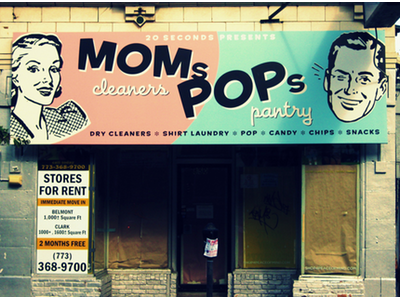
As a result, a lot of smaller "mom and pop" shops have vanished. Bear in mind too that few small businesses receive taxpayer based corporate bailouts. Those seem to be reserved for Wall Street. Let's take a more detailed look at wages since that effects pretty much everything else.

Not surprisingly, wages have failed to keep up with the rate of inflation. In terms of real dollars (dollars adjusted for the rate of inflation), our purchasing power is at a 66 year low. To put it another way, the current minimum wage buys the same as what 75 cents did in 1956.  Individuals on the low level of the pay scale, which includes most entry level jobs, simply can't make it.

A  survey by Bankrate said 55% of those surveyed said their wages weren't keeping up with prices. That includes workers who receive regular salary increases annually and the 39% of employees who do not.

 To add salt to the wound, CEOs and senior executives earn an average of just over $21 million dollars a year. This is more than 400 times the salary of an average employee which is about $51,000 a year. The difference was 20% in 1963. From 1978 to 2020, the salaries of U.S. CEOs increased by over 1,322% while the average employee saw an increase in pay of just 18% for the same period.  

The top three companies with the greatest executive/employee wage inequality are Nike, Walmart, and Amazon. The three companies with the lowest executive/employee wage inequality are Alphabet (the parent of Google), Walt Disney, and Berkshire Hathaway.

To put it another way, an employee at Nike would have to work just under 30 hours to equal one minute of their CEO's salary. It's 20.7 hours at Amazon and 14 hours at JP Morgan Chase Bank. At Starbucks it's 10.7 hours of serving their overpriced coffee to equal one minutes of CEO Kevin Johnson's salary. At Blackrock, which is arguably the world's most influential company, an typical employee has to work 6.2 hours to earn the same amount that their CEO, Larry Fink, earns in 60 seconds.

Income inequality is at its highest level in over 50 years according to the U.S. Census Bureau. The widest pay gaps are in California, Florida, New York, Connecticut, Louisiana. However, Texas, Kansas, Nebraska, New Mexico, New Hampshire, Virginia, and Arkansas aren't far behind.

The Census Bureau also shows (perhaps not surprisingly) that the percentage of poverty in the U.S. was 12.8% in 2021, which is among the highest of any developed nation. That's about 38 million people. In fact, of the top 25 industrial nations in the world, the U.S. ranks dead last.

In 2021, the percentage of child poverty (those under 18 years of age) was 16.9%. For those over age 65, it was 10.3%. In Kentucky, the central South, New Mexico, and Washington DC,  the child poverty rate was over 22%. It was lowest in Utah, North Dakota, Montana, Vermont, and New Hampshire.

For seniors, Washington DC, Louisiana, and Mississippi the poverty rate was 13% or higher. In 12 states, including Kentucky, Nevada, and South Dakota, the poverty rate was between 11% and 12.9%. In the majority of the country it was 8.8% to 9.9% while in four states it was under 8%.  

According to a number of reports, around a half a million Americans are homeless at any given time. About 70% are individuals while the rest are families. 11% of the homeless are military veterans. The rise of inflation and prices in general will likely add to these numbers.

Inflation, increasing home prices, the cost of gas, food, utilities, income inequality, homelessness, and, of course, rising taxes, are symptoms of a failing political and economic system along. There is no questioning our social, economic, and political divide.

 History has shown that radical change tends to come from the bottom up. This is especially true if a middle class supports the bottom tier. In America, our middle class has gone from 61% of the population in 1971 to 50% in 2020 while the percentage of low income has grown from 25% to 29%. Globally the middle class has shrunk by 150 million since 2017. India lost 32% of its middle class while Asia lost 25%.

Along with industrial output, the quality of education and medical care, and other key measurements, the United States is showing all the signs of a irreversible decline. China is now the world's leader in manufacturing. In terms of technology and its innovation, the U.S. ranks number one, but China, Japan, and South Korea are pretty close behind. Germany and Israel are closing in too.

Academically, we rank in the middle of the second tier in science. In reading, we're in the lower half of the second tier, while in mathematics we're just above the third tier.  Overall, we're 17th in the world academically with Asian, Scandinavian, and Europeans dominating the top slots.   

When it comes to healthcare, we spend more money than any other developed nation, and yet, we have among the highest infant mortality rates, the lowest life expectancy, and the fewest number of available beds. Among the top 11 highest income nations, the U.S. healthcare system ranks dead last.

Some predict America will become a second tier economy with a top tier military presence akn to other historic empires like Rome, the Ottomans, and Great Britain.  Others think it will a much harder landing resulting in a broken and fragmented nation.  Certainly the foundations are in place thanks to unchecked illegal immigration and a multiculturalism which discourages integration. Anyway you look at it, you better buckle your seatbelts.  


 If you want to know more, please take a look at the links below. If you enjoyed the article, please consider passing it along to others and don't forget to subscribe. It's free! Lastly please be sure to "like" us on whatever platform you use to read AnotherOpinion.com. It helps with the algorithms and keeps our articles in circulation. Thank you!   


Inflation Calculator


What Is the Relationship between Inflation and Interest Rates


United States House Prices Growth


How Rising Interest Rates and Inflation Impact Real EstateInvestments


Average House Prices by State in 2022


Bureau of Labor Statistics: Employment CostIndex---September 2022


Average Rent by State 2022


CEO vs. Employee Salaries at America's Top Companies


U.S. Poverty Rate Is 12.8% but Varies Significantly by Age Groups


U.S. health-care system ranks last among 11high incomecountries, researchers say


Report: Pandemic Shrunk Global Middle Class by 150 Million


America's Poor Are Worse Than Elsewhere