Showing posts with label Economy. Show all posts

Friday, April 11, 2025

Welcome to the New Reality: The Death of the Republic and Rise of the Corporatocracy


As most everyone knows, aside from their role as legislators, one of the key functions of Congress is to act as the keeper of the nation’s wallet. They are the ones who approve and allocate our tax dollars. As President Franklin D. Roosevelt once said, “It is the duty of the President to propose, and it is the privilege of Congress to dispose”, and indeed it is.

What happens when the government has a debit crisis or to use an accounting expression, when our “outflow exceeds our inflow”? In short, the government is spending more than we bringing in? No business can do that for long and stay afloat, and no ordinary household can survive for long before the bill collectors come calling. Government has no mandate like the rest of us to follow a strict budget. So what then? 

In the case of the United States Government, there is no one coming to bail us out.  The government's credit is based on nothing more than its "good faith", which is short for "trust us". Those who own our debt are mostly other countries like Japan ($1.1 trillion), the UK ($690 billion), and China ($749 billion); they're essentially stuck. They have no hard collateral like the Capital Building or Mt. Rushmore to foreclose on and sell off on the steps of the ICC to the highest bidder. The most they can do is ride out the financial storm or throw more money at the problem and hope “we” (that is, the President and Congress) can somehow work it out.

The usual answer is raising interest rates, which increases the cost of borrowing money from the Federal Reserve. This, in turn, typically means a hike in wholesale prices which means, as nearly always, ultimately gets passed on to you and me. As a result, we are the ones who ultimately take the hit for their bad policy decisions and mismanagement.    

Sometimes, war is used to artificially stimulate the economy and reduce high unemployment numbers. But as for Congress itself, there are no real consequences and yet, aren't they ultimately responsible for the problem itself? 

Well, yes, but Congress goes happily on their merry way without having to take responsibility for their actions (or in some cases, inactions).  For decades now, their approval rating has been in preverbal toilet, typically ranging from a low of 9% in 2019 to a high of 29% as of February 2025, but do you think they care? Nope. Not really. Have you ever wondered why that is?

According to Open Secrets, in 2024 Democrats received $1,163,550,563. Of that, $1,187,730 came from political action committees (“PACs”). $1,802,512,049 was from individuals. Republicans raised $637,855,365. PACs were responsible for $1,018,830 while individual contributions made up $581,463,551. The majority of the money came from corporate donors and very wealthy families, and we can thank the 2010 Citizens United ruling by the Supreme Court for that.

Elon Musk, owner of SpaceX and current satrap of DOGE (Department of Government Efficiency), for instance gave $291,482,587, all to the GOP.  Timothy Mellon gave $197,047,200 with the overwhelming majority going to the Republican Party as well. Miriam O. Adelson (owner of the Sands in Las Vegas and the Adelson Drug Clinic) donated $148,304,900, also to the Republicans.

Michael Bloomberg, the former Mayor of New York, gave $60,839,734 to the Democrats and a token $1 million to the Republicans. Dustin Moskovitz, owner of Asana, Inc, dropped $50,671,800 to the Democrats as well.

Steve Swartzman of Blackrock Group contributed $40,178,539 to the GOP while Bob Bigelow, owner of Bigelow Industries, gave them $34,990,500. Reid Garrett Hoffman, owner of LinkedIn, gave the Democrats $28,804,480 and a polite $400,000 to the Republicans.

When it came to corporate donors, SpaceX was again on top with $287,930,952 going to the Republicans. Another $767,131 went to the Democrats. The Fund for Policy Reform contributed $60,000,000 to the Democrats. Ripple, a software developer, gave $15,685,583 to the Democrats as well and $2,970,303 to the GOP.  Building America’s Future donated $33,470,000 to the Republican Party.

These are just a very small sample of the big dollars that went into the elections of 2024. In addition, most of these groups also donated money to smaller outside organizations. For instance, Citadel, Inc., a preeminent multinational hedge fund, amassed $108,669,316 in contributions (making it the fourth largest corporate donor) spent the bulk of its money on Republican groups which included Keystone Renewal PAC, American Patriots PAC, Fix Washington PAC, and the Senate Leadership Fund just to name a few.

Greylock Partners, one of the nation’s oldest venture capital firms, donated $35,900,577, ranking it the 26th largest corporate donor, gave all of it to exclusively Democratic related groups that included WelcomePAC, American Bridge 21st Century, Granite Committee, and Future Forward USA to name just four.

There were quite a number of PACs (some of which were self-funded by members such as the NRA and AARP) which made heavy political contributions as well. Many choose to hedge their bets by contributing to both parties. However, the lion’s share of their money went to incumbents irrespective of party.  The reason is because, thanks to partisan gerrymandering and the absence of term limits, 97% of Congressional incumbents were reelected in 2024. It was the same at the state level. 94% of state executives were reelected as were 92% of state judicial incumbents. Those are better percentage than even the old Soviet Politburo had!

Another reasons Congress couldn’t privately care less about voter opinion is that the majority are millionaires. They don’t need the job. This is basically about acquiring power and making connections, and if you can pick up a few extra million along the way, well so be it. Let’s take a look.

Republican Senator Rick Scott of Florida has a net worth of around $549.91 million dollars. Everyone’s favorite Democrat, Former Speaker of House, Democrat Nancy Pelosi of California is believed to have a net worth of $267.6 million dollars!  In 2023, she listed the value of her household assets at $92 million. Not bad for having a combined salary of $250,000 a year ($174,000 base plus leadership and committee bonuses).

As of 2024, there were 13,043 lobbyists operating in Washington, mostly along “K” Street, which employs roughly 100,000 researchers, analysist, public relations and media specialists, data entry, and others needed to support the influence industry while many of the lobbyists themselves are former legislators or senior staffers.

Despite that number, much of the business is handled by just 300 firms. Most represent corporations, trade associations, and unions.  In that same year---2024---they invested just over $4.43 billion dollars to get their message (and candidate) across the finish line.

 Unfortunately, those that represent ordinary working class Americans are few and far between. Corporate donors, on average, give close to ten dollars for every two unions contribute and, in an election related crunch, they’re quite capable of  ponying up a lot more, further dwarfing anything unions can come up with. 

Lastly, and I want to be clear about this, you can bet your house, your children, or whatever else you hold dear, that money of this magnitude isn't given to be "patriotic" or be seen as being a "responsible citizen". It's an investment like any other. They intend on getting their money's worth and then some from this "investment" and when it (or they) cease to be useful, they'll quickly move on and find another that is.  I suppose you could think of primaries as political search engine of sorts; a way to find the next compatible cog for the machine.  

Another reason voters get a yawn, as noted above, is due to partisan gerrymandering. President John Adams originally said that redistricting should provide an “exact portrait, a miniature” of the nation as whole.  He would be deeply disappointed to see what redistricting has become. Every ten years states are supposed to redraw their legislative and Congressional districts following the results of the census so that voter demographics are properly represented, but that’s not what has happened.

Nowadays, redistricting tends to happen along the lines of majority political party in power, meaning that if the Republicans for instance control the State Legislator, the districts will be redrawn accordingly. Same if the Democrats are in charge while the nation’s largest political demographic, Independents, as well as third parties, are ignored. Thus, you end up with districts which are intended to virtually ensure the dominant political party retains control of those districts. Hardly fair or balanced.

Attempts to reform redistricting has typically run into stone wall erected by both parties in order to protect “their” political turf. A case in point was the 2019 Supreme Court’s Rucho v. Common Cause decision is a great example. Although the Constitution and the Voting Rights Act of 1965 prohibit racial discrimination, the court decided that while partisan gerrymandering was “incompatible with democratic principles”, it could not be addressed at the federal level! That meant returning to the state which was responsible for the situation to begin with and leaving the matter unresolved.

A few states have taken the bold step of taking the power to gerrymander out of the hands of the state legislators and assigned them to non-partisan institutions such as universities and colleges on a rotating basis or independent commissions, but don’t expect to see this spread nationwide until voters stage a ballot box revolt and start automatically voting against the sitting party in that district.   

The absence of term limits is another main reason members of Congress (and the federal judiciary) doesn’t particularly care about voter opinions. Image having a job where no matter how crappy of a job you do, you won’t get fired. Well, that’s Congress and judiciary.  How’s that possible?

Well, thanks to a political system which has been corrupted to the point where vested interests financially underwrite the campaigns of those who are to regulate them, where they fill party coffers, write the legislation which affects them, where districts are redrawn to give one group a perpetual partisan majority over another, make decisions contrary to the interests of the people they’re supposed to represent, and then ensures that they can serve almost indefinitely.  

It bears mentioning that the majority of Americans want to see term limits. According to the Senate Committee on the Judiciary, 82% of Americans want term limits. Of this, 89% were Republicans,  83% were Independents, and 76% were Democrats. Obviously, there’s no ambiguity here.  

Americans want an end to a corrupt system which caps the President to two four year terms while giving Congress unlimited terms and the federal judiciary life appointments.  Even at the individual state level, voters want to see term limits. In Kentucky it’s 84%. In Maine it’s 75%. 84% in Montana. 75% in Utah. 80% in Georgia. 77% in Florida, and 78% in Alaska.

This is the political system we now have. It isn’t the Republic envisioned by the Founders of this country of a limited government or one run by and for “citizen legislators”.  This is the vision of  our new Founders, the ultra-wealthy Oligarchs, and the creation of a neo-fascist corporatocracy, leaving us with a “managed limited democracy” and a surveillance state. President Trump may try to restore the Republic, or what’s lefts of it, but the corruption has become institutionalized,  and both sides benefit from it. The only losers are those for whom the nation was created----its citizens. Welcome to our new reality.


Thank you for reading "Another Opinion", the Op/Ed blog page for the "militant middle".  Here at "A/O" we truly value our readers. At A/O we seek the facts as they exist, not partisan talking points.  We hope you find our articles informative and engaging. Comments are welcome, provided they are not vulgar, insulting or demeaning.  Another Opinion is offered without charge and is directed toward all independent and free-thinking individuals. We ask, however, that you "like" us on whatever platform you found us on in order to keep our articles available for free to others. Lastly, in order to keep costs down, we depend on passive marketing, and therefore, depend on our readers to please forward our posts along. Below you will find links to the sources we used in writing this article. Thank you. 


Lobbying in the United States


Citizens United v. FEC


Lobbying Data Summary


Rucho v. Common Cause 18-422 588 U.S. 684 (2019)


Election results,2024: Incumbents wins by state


Tomboulides Testimony to the Senate Judiciary Committee


Term Limits Polling Results


Thursday, March 13, 2025

Trump’s First 50 Days: How is He Doing?


With just over 50 days into office, Donald Trump’s approval rating stands at 47% as of March 11, 2025, a slight drop of 2% from his first 30 days, while his disapproval rating is currently 45%, which is up 4% from January according to an Emerson College Polling Survey. Compare that to President Obama’s job approval rating 50 days into his second term which stood at 41%. His disapproval rating was 53%.

Just for the record, incoming President John F. Kennedy had the highest approval rating with 72% (1961) followed by President Jimmy Carter in 1977 with 71%.  Dwight “Ike” Eisenhower, who had 67% in 1953. The worse approval rating for an incoming president was Donald Trump in 2017 with a 40% approval rating. These are all, of course, first terms.

Additionally, 40% of those polled thought that President Trump was doing a better job than expected thus far in his second term, with over 70 signed executive orders, more than any president in their first 100 days in 40 years. 35%  of those surveyed said he was actually doing worse than they originally thought he would and 25% thought he was doing as they thought he would. Overall, 51% of the population is giving Trump an overall thumbs up. Nevertheless, 49% disagree. So, it would appear that all in all, “The Donald” is off to a good start, or is he?

When it comes to the economy, public support isn’t where it should be with just 35% approving of Trump’s handling of the economy. 48% said they disapprove of how the economy is going under Trump. For reference purposes, Obama’s disapproval rating of the economy was 65% at the point in his second term.

53% of those polled said that tariffs are going to hurt the economy. 46% believe that Trump’s economy policies in general are hurting the economy while only 28% actually approve of his handling of the economy and 26% are either unsure at this point or don’t  think his policies will have a serious immediate impact.

However, 48% are happy with his handling of illegal immigration while 40% oppose his rounding up and ouster of illegal residents and tighter immigration standards. According to a Gallup Poll taken two weeks earlier, 46% was happy with Trump’s handling of the illegal immigration issue.

With respect to the economy, his approval rating was 42% two weeks ago according to Gallup. Foreign trade, which takes into consideration the tariffs Trump has imposed, has a disapproval rating of 53% with 5% unsure. 

When it came to foreign affairs, the Gallup poll reported that Trump’s handling of the situation in the Middle East between Israel and Hamas (as well as the Palestinians) polled a 51% disapproval rating with 9% not sure. As for the ongoing war between Ukraine and Russia, his approval percentage stood at 40% with a whooping 14% “unsure”, which statistically is a rather large number given that his disapproval rating was just 6 percentage points higher.

On a slightly unrelated matter, the same Gallup poll said that 93% of Republicans approved of Trump’s job performance thus far. On the other hand, only 4% of Democrats were happy with President Trump. Among the nation’s largest voting bloc, Independents, Trump had an approval rating of 37%. 

It bears mentioning that the 89% gap between Republican and Democrat approval rating is the largest Gallup has ever recorded for any president at any time. That dear readers is history making.

On single issues alone, Republican approval was 92% on immigration. Foreign affairs and the economy was 90% each. President Trump’s Foreign trade policies scored 89% with 80% of Republicans gave Trump a thumb’s up on his handling of the Ukraine/Russian War and the situation in the Middle East involving Israel.

On the same issues, Democrats gave the president an approval rating of 6% on immigration and foreign trade (tariffs being the biggest concern). When it came to foreign affairs, just 4% of Democrats approved of Trump’s policies while 5% like his handling of the economy (again, tariffs are a major factor). Trump polled the highest on his dealings with Ukraine/Russia and with the Middle East with a respective approval rating of 9% and 8%.

When the nation’s largest voting bloc, Independents, were asked, President Trump did a much better. With a 37% overall approval rate, Trump had a 40% positive rating on his handling of the illegal immigration issue. 37% like his handling of foreign affairs. However, when it came to foreign trade, the Middle East, and the Ukraine/Russian war, Trump managed only 33% each. His worse poll number was the economy with 31%.

As an aside, the Gallup Poll had some encouraging news for Congress. The approval rating for the “Millionaire’s Club” went from a pathetic 13% in May 2024 to a dismal 29% at the end of February 2025. Way to go folks! You need another raise.

A CNN Poll conducted on March 5th,  just after President Trump’s tariffs against China, Canada, and Mexico went into effect resulted in a drop of 1300 points in the Dow Jones Industrial Average. The S&P 500 fell 1.2% while the Nasdaq  saw a drop of  0.35% as the markets braced for the inevitable retaliatory response from America’s biggest importers.

Tariffs of 25% were imposed on imports from Canada and Mexico while an additional 10% tariff was added onto China’s already 10% tariff bringing the total tariffs on Chinese imports to 20%.

President Trump’s first address to Congress (which ran a record setting one hour and 40 minutes) was received well according to a poll conducted by a CBS poll. According to the results, 69% of viewers approved of the speech. A YouGov poll put the approval numbers higher at 76%. 

According to the CBS poll, the majority of the 37 million who watched Trump’s speech were Republicans, 51%, while 27% were Independents and 20% were Democrats. 74% thought Trump’s presentation was “presidential” as well as “entertaining” while 71% said they were “inspired” by the speech.

 63% of those surveyed said Trump focused on topics that mattered the most to them, especially eliminating government waste and cutting back on unnecessary spending (77%) which is being led by Elon Musk’s “DOGE” or Department of Government Efficiency program. Equally, 77% approved of President Trump’s plans for reducing illegal immigration and reforming our immigration system. Imposing tariffs on China, Canada, and Mexico as well as his comments regarding the Ukraine/Russian war also received strong approval numbers.

Meanwhile, Congressional Democrats received a wave of negative backlash to their “protest” of the president’s speech, most notably Trump’s introduction of 13 year old cancer survivor Devarjay “DJ” Danie (“DJ” has been fighting brain cancer). The most common response about the Democrat’s refusal to acknowledge the young man was “heartless” and “cruel”. It certainly wasn’t their best moment. In addition to be honored by the president, “DJ” was made an honorary Secret Service agent by Steve Curran, the new director of the Secret Service.

Rep. Al Green (D-Texas) heckling of the president got him booted from the chamber and censured by House leadership as other Democratic lawmakers sat in silence, played video games on their Smart phones, held signs on ping pong paddles, while others walked out at key moments of the speech. All in all, the strategy by Democratic leadership greatly backfired.  

Finally, where is President Trump falling down? According to a new CNN poll released March 12th, healthcare is really hurting the president. Just 48% of Americans approve of the president’s policies toward updating healthcare, which may mean reducing benefits (especially for seniors), higher premiums to offset promises of lower prescription costs on certain medications.

The poll also shows Trump’s tariff measures are increasingly unpopular with a 61% disapproval as was his management of government with just a 48% approval rating. In fact, out of eight key issues, the new poll showed Trump has positive numbers on just one---his handling of illegal immigration.

With every incoming administration there is a so-called “honeymoon” period, also known as the “100 days”. Few presidents anymore get the 100 days of their predecessors, and as for “The Donald”, it looks like the honeymoon period, if there really ever was one, is over and we’re headed for a rocky marriage at best.

So, where does that leave us?  Most of the mainstream media, with laughable façade of  “impartiality”, has long ago accused and indicted Trump while excusing the sins and treason of others, so don’t expect any objectivity. The partisan divide in America is perhaps too wide and too deep for Donald Trump, or any future president for that matter, to overcome.

The demonized conservative Right will in all likelihood laud his actions, no matter how austere, until they hit home while the ideological exhausted Left has already lit his effigy on the pyre of political wokeness. I suspect the only thing which can save the nation is some outside threat, which may explain America’s penchant for overthrowing governments and antagonizing nations.

 War has long been our more profitable export. It’s unaffected by tariffs or quotas.  It artificially stimulates the economy and rids us of “excess” human capital, reducing official unemployment numbers, while ensuring the empire expands. But is that what we really need or want?

What America needs is a strong leader who can redirect the economy to industrial and technological expansion, but that often means leaving people at the lowest rung of the ladder aside. That’s where trade and technical schools can help. A college education is not for everyone. However, equal opportunities doesn't always mean equal outcomes. Success comes with a lot of hard work and setbacks. Creating a level global playing field is another. Fair and balanced competition is good for all participants.

President Donald Trump is a “for profit” businessman attempting to manage a non-profit governmental system. The last “for profit” businessman to occupy the White House was “Silent” Cal Coolidge during the 1920’s. His famous maxim was “the business of America is business”, yet his policies in the long run helped set the stage for the Great Depression under Hoover’s watch. That led to FDR's "New Deal" and ultimately WWII. These are no less dangerous times for America.  There’s an old expression, made popular in 1929, “when America sneezes the rest of the world catches a cold” and there’s a strong cold wind blowing.


Thank you for reading "Another Opinion", the Op/Ed blog page for the "militant middle".  Here at "A/O" we truly value our readers. At A/O we seek the facts as they exist, not partisan talking points.  We hope you find our articles informative and engaging. Comments are welcome, provided they are not vulgar, insulting or demeaning.  Another Opinion is offered without charge and is directed toward all independent and free-thinking individuals. We ask, however, that you "like" us on whatever platform you found us on in order to keep our articles available for free to others. Lastly, in order to keep costs down, we depend on passive marketing, and therefore, depend on our readers to please forward our posts along. Below you will find links to the sources we used in writing this article. Thank you. 


Trump’s approval dips amid concerns over the economy: Poll


Dow Drops 1300 Points in Two Days Amid Trump’s Trade War


DJ Daniel, 13 year old cancer survivor, honored by Trump,has plenty to say about Al Green, Elon Musk, Rachel Maddow


New CNN poll: Americans are negative on Trump’s handling ofeconomy


Donald Trump Approval Rating: March 12 Update as Unease OverEconomy Grows


50 Wins In 50 Days: President Trump Delivers for the Americans 


Friday, January 10, 2025

The Rise of the Chinese Dragon and Decline of the United States

Somehow its seems appropriate that the Chinese astrological symbol for 2025 is the Snake, specifically the wooden snake, The Snake is sometimes referred to as the "Little Dragon" which follows the Dragon symbol in the Chinese astrology, and is associated with Earth (it's also occasionally called the "Serpent") and is the sixth of the twelve zodiac signs. The Snake, it is said, is intelligent, cunning, and patient. At the same time it can be narrow minded, judgmental, vain, sneaky, and petty. Why is that significant?

Well, in the world of mythology, which not so surprisingly, still exerts a influence, albeit mostly symbolic, on our lives. We name pieces of technology, procedures, and even name planets after mythological gods and goddesses. Many of us still read our horoscope with at least a passing curiosity. Even when we go out on dates we often get asked "what's your sign" in the hopes that it will reveal a possible compatibility. 

As anyone who follows politics, economics, or current events should know, China has become a major economic power. In 2022, we imported $536.3 billion dollars worth of goods from China. That represents 16.5% of all U.S. imports. Most of that ranges from cheap toys, tools, and miscellaneous items to sophisticated technical hardware, computer chips and processors, computers, batteries (especially lithium), display monitors, and video games. 

Meanwhile, we ship some $195.5 billion dollars in goods back to China, accounting for 7.5% of China's total imports.  We are indebted to China to the tune of just over $1 trillion dollars. That's roughly 7% of our national debt. Still, the United States still has the largest economy in the world, larger than China's by nearly a third. However, among the top industrial nations, China has the fastest growing economy, and may surpass the U.S. in ten or so years.

 Our Gross Domestic Product (GDP) is currently $30.4 trillion compared to China's with $19.6 trillion. While much is made of Chinese ownership of U.S. farmland, in fact China owns just under 1% of American farmland (Canada owns the most). That accounts for about 380,000 acres.  

However, there's another key factor to be considered. Along with having the fastest growing economy in the world among the top industrialized nations, China is also rapidly expanding its economic reach. China has been aggressively buying up control of natural resources around the world, exceeding that of the United States. 

China has been acquiring rights not just to farmland, but mineral rights as well, especially strategic minerals used in computer and missile technology like cobalt and platinum.  However, perhaps one of the most essential of resources, potable water, has been high on China's "buy" list. With 20% of the world's population, it has just 6% of its drinking water. In addition, because of its rapid "hellbent" economic growth, minimizing pollution has not been high on the government's list of things to do. 

According to a study done by the Lowy Institute, somewhere around 85% of China's groundwater is not fit for consumption (over 40% of the groundwater in Beijing is unusable). Worse still, nearly half of China's groundwater isn't safe to be used in the production of crops. On the upside (if there is one) is that China's water pollution isn't the worse. India's is.  What this means is that the two most populous countries on the planet have critical need for scarce usable water, making it perhaps the single most critical natural resource. Many military strategists believe that useable water may become valuable than gold or oil, and thus making its control of primary importance, especially given climate change. What cannot be bought or bartered for will be taken by force as a matter of national survival.   

Another serious factor has been China's growing aggressiveness over control of the South China Sea, which has traditionally been used as a international shipping lane. However, China is now claiming territorial control of the channel, and threatening to use force to hinder or stop all international shipping, including the passage of U.S. military ships. China has even threatened to fire on or seized any vessels traversing the channel. Why the sudden interest in control of a waterway which has long be seen as open?

One possible explanation could be China's recent growth in its navy and its ability to protect whatever it claims. By the end of 2025, China is expected to have 395 ships, including three aircraft carriers, and 435 by 2030. as of 2024, China possessed 234 warships compared to 219 belonging to the U.S. Navy, which makes the Chinese navy this largest---and most modern---in the world. It's should be noted that not only are China's navy newer, it has more shipyards and drydocks than the U.S.. In addition, several recent wargame scenarios have shown China's navy as the victor. This is due to both the newness and quantity of their ships (meaning China's navy can afford to lose more than the U.S. can). 

China has been making use of its new found naval power not only in the South China Sea, but also reenforcing its claim of expanded territorial fishing rights in areas once considered international waters, as well as impinging on waters now claimed by South Korea, Japan, Philippines, Indonesia, and even India. China has also been stepping up it claim of national sovereignty over the island nation of Taiwan in addition to strengthening its ties with North Korea and Iran. 

A Pentagon report on U.S. military readiness didn't help. According to the report provided to the Department of Defense, the United States military was in serious need of a general overhaul, running the gambit from rifles and bullets to tanks, personnel carriers, artillery to aircraft, combat and support ships. In its present condition, according to the Pentagon, the military wasn't capable of fighting a sustained conflict on multiple fronts. 

Thanks to the 20 year war in Afghanistan and Iraq, as well as propping up the Zelensky regime in Ukraine and U.S. support of Israel, the U.S. military is also running critically low levels on spare parts, and technicians to maintain and operate various systems. This is due to the massive hemorrhage of personnel getting out of the military (many of whom have done numerous deployments). For instance, in 2022, the Army missed its infantry recruitment goal by 50%. 

Since 2013, the number of males enlisting has dropped 38%. Enlistment from 1980 through 2020 dropped 59%. To make matters worse, according to the DoD, 77% of individuals of military age (17 - 24) are unfit to serve due to issues like obesity, drug use, mental or other physical reasons. As of November 2023, the Navy was 20% of it annual recruitment goal. The Army was 23% short, and the Air Force was 11% shy of its recruitment goal. Only the Marines and Space Force reached their recruitment numbers.  

Another issue facing the military is the Defense industry's focus on weapon systems that are either not wanted or needed. Following Nazi Germany's example toward the end of WWII, many of the weapons systems have become overly complex and prohibitively expensive (the Wehrmacht adopted equipment which were so complex, they were difficult to maintain such as the "King Tiger" tank or V2 rocket, plus the expense resulted in the production of relatively few numbers).

Per the "2024 Index of U.S. Military Strength"  published by the Heritage Foundation, China is listed as a "formable" threat in Asia  along with Russia. North Korea is considered worth watching. So, how does our military stack up? Again, according to the "Index", the U.S. Army's capacity for waging war is categorized as "weak".   Its capability is listed as "marginal", while its readiness is excellent. Overall, it's rated as "marginal". The Air Force faces similar problems. Its capacity and capability are both "marginal" while its readiness is "very weak" as is its overall rating. 

The U.S. Navy, facing reduction in the number of ships and shipyards, had a capacity rating of "very weak". It capability is rating is "marginal". As for its readiness and overall ratings, both are "weak". As an aside, its projected that with the growth of the Chinese navy, the U.S. Navy will likely not recover its previous naval dominance for at least the next decade. The Marine Corps has a  "weak" capacity rating, while capacity, readiness, and overall score were all "strong".  

The newest member of the military services, the U.S. Space Force, is still looking for its mission. It has yet to establish its fighting credentials (perhaps if aliens invade...). Nevertheless, it maintains satellites, drones, and related technology which are still emerging as unique military systems. But, they're not quite there yet. The U.S. Space Force was rated "marginal" across the board.   Next is our nuclear abilities. In terms of stockpile, delivery modernization, and "allied assurance" the rating was "very strong". 

When it came to delivery platform reliability, warhead modernization (heck, slap a coat of paint on there. Truth me, it won't matter), lab technicians, and weapons complex, the score was "marginal" as was the overall rating.  So, when we add it all up, the U.S. military came out with a overall score of "weak". The question then, is this good enough of a deterrent to stop China, North Korea, Iran, Russia, or a outside player, such as ISIS or Al Qaeda?   

There's no question China is playing the long game. While its economy is growing rapidly, it has also been promoting the Yuan as the alternative currency to the U.S. dollar (or even a possible replacement) which is unlikely, at least in the near future. It has joined Russia, India, South Africa, and Brazil as one of the principal members of "BRICS", which is poised to become a serious competitor to the U.S. dominated "New World Order". While BRICS has aways to go yet, its already showing promise as the number of applicants, especially among less developed countries, continues to grow.  

China's military, like its economy, has been growing and exerting its influence ever wider. With a weakening United States internally and externally, there is a quiet but growing question starting to be asked in serious but hushed tones throughout the nations of Asia, Africa, and even South America, and that question is whether they should continue to place all their political and economic eggs into one "Made in America" basket or is it time to accept the new role of the Chinese "Dragon" as we being the year of "Snake", or as it's also known, the "Little Dragon"?  


 Thank you for reading "Another Opinion", the Op/Ed blog page for the "militant middle".  Here at "A/O" we truly value our readers. At A/O we seek the facts as they exist, not partisan talking points.  We hope you found our articles informative and engaging. Comments are welcome, provided they are not vulgar, insulting or demeaning.  Another Opinion is offered without charge and is directed toward all independent and free thinking individuals. We do ask, however, that you be sure to "like" us on whatever site you found us on in order to keep our articles available for others, and that you please pass our post along. Below you will find links to the sources we used in writing this article. Thank you. 


China's Ownership of US Federal Debt


China's dominance of strategic resources


How Much U.S. Farmland Does China Really Own? More Than Bill Gates ---And Less Than 17 Other Countries


The Top Ten Largest Economies in the World in 2025


The Global Impact of China's Water and Related Environmental Problems


How Does Water Security Affect China's Development? 


Executive Summary of the 2024 Index of  U.S. Military Strength


CFR: What Is the BRICS Group and Why Is It Expanding?


Is military enlistment down?


Our Military Is in a Dangerous Decline and This Is the Reason Why


Friday, October 18, 2024

Some Inconvenient Facts Behind Our Most Important Presidential Election Since Lincoln

We are just under a month away from perhaps the single most important presidential election since Abraham Lincoln vs. Stephen Douglas in 1860 with quite possibly a similar outcome. Of course, it's typical of marketing hyperbole to claim one election or another is more important than any other when, in truth, each election puts the future of our constitutional republic at stake (albeit in name only at this point), but in this case, the claim is not being overstated.

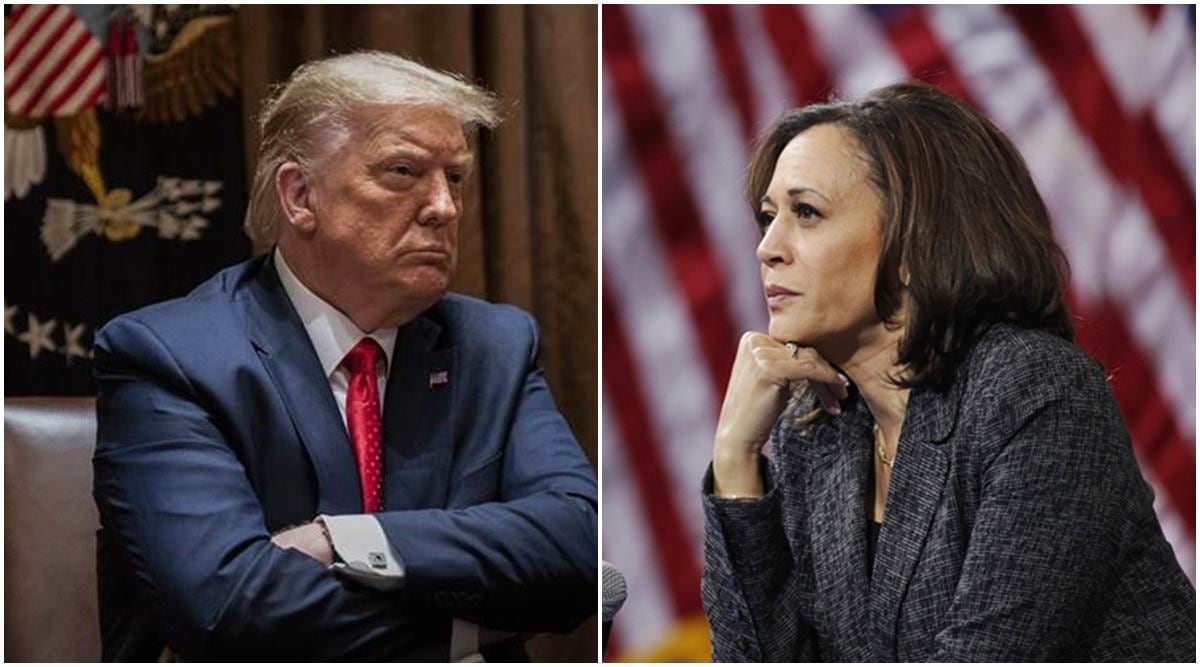
Vice President and Democrat nominee, Kamala Harris, has been speaking about the need to "move America forward" and to "restore the American Dream", which, I think, we can all agree, are worthy (albeit unrealistic) goals. Of course, the underlining message is that former President Donald Trump is somehow personally responsible for throwing the switch that put our "democracy" in peril . Lastly, Ms. Harris has promised a "opportunity economy" for all.

The problem, however, that Ms. Harris is overlooking is that her administration along with President Biden are the one's responsible for whatever track America is on, be it good or bad. After all, they've been in charge of the economy as well as domestic and foreign policy for the last four years. Anything Trump did, good or ill, has been of no real consequence since the Biden/Harris ticket won in 2020. 

So, any complaints or compliments is all theirs. For instance, the rate of inflation (which jumped by 3.24% shortly after Biden took office). It was a frightening 8% in 2022 before eventually settling to 2.4% in September falls squarely on their shoulders, not Trump's. Same goes for prices, from gas and groceries to appliances, cars or houses. 

Since February 2020 to now, overall prices have gone up 21.4%. According to the U.S. Bureau of Labor Statistics, that's far above the national average. According to another economic report, thanks to inflation, what you could buy for ten dollars in 2020 would now cost $11.31 in 2022.

That may not sound like much, but when you look at a the cost of a tank of gas, heating oil, or a week's worth groceries for a family of four, that's quite a hunk of change, forcing the average American to pay more with less purchasing power. 

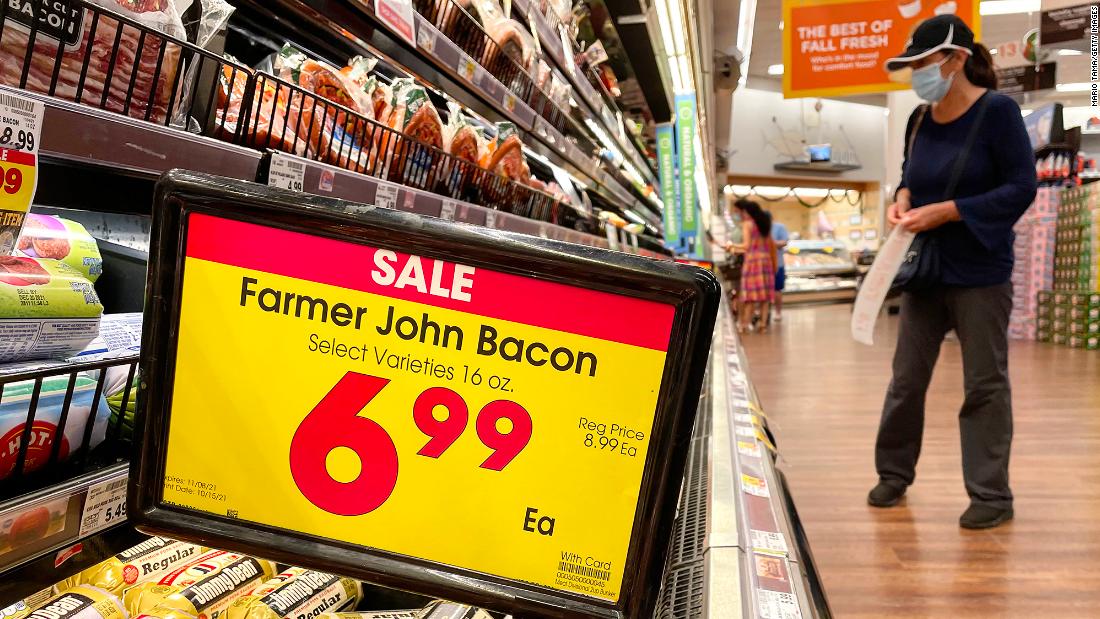
For example, since 2020 the price of margarine, which nearly everyone uses in cooking, has increased 56.8%. Eggs have gone up 40.1%. Sugar and sugar substitutes have seen a 39.1% increase. Meats, depending on type and cut, have seen a increase of between 39.2% and 44.2%. Car insurance raced upward to 47.5% while vehicle repair (already high) went higher to 47.1%. Gasoline prices almost doubled from January 2020 to June 2024; a increase of 89.5%.   

On the other hand, the prices of Smartphones dropped by 53.9%. 22.4% for televisions. Computers and related items went down by 15.9%, while other electronic equipment (like video cameras, microphones, etc.) dropped in price by 14.1%.The costs of non-electronic toys were 7.1% less as of June 2024 compared to January 20202.

Finally, men's clothing (such as suits, coats and jackets, as well as pants and shirts) saw a decline in price of 6.3% (but apparently not where I shop!).  So, while prices on some items cost consumers less, prices on other items cost more, some significantly more. I suppose it's all a matter of perspective. 

What about housing? How much has the cost of keeping a roof over your head changed since 2020? According to a report ResiClub of the Case-Shiller National Home Price Index, since 2020 until present, the cost of homes rose 47.1%, which they said "easily outstripping the gains of recent decades". That apparently includes not just the Trump years, but the Obama and George W. Bush years as well.

Some of the reasons cited for the increase in housing prices are the lack of housing in general (remaining down 34.3% from pre-2020 availability), the upswing in mortgage rates and jump in the price of construction material.  As an aside, a related RedFin report said that house payments are up 11% over 2023 prices. The average house payment is now $2,775.00. I can certainly see what Ms. Harris means by a "opportunity economy". But then, these are numbers based on her and Biden's policies.

While we're speaking about housing, what about the homeless? In 2020, the number of reported homeless was about 580,466. By 2023 that number had jumped to 653,104, up 12%, the highest year-to-year increase and the second highest total since 2007. Of that, 324,854 were white. 243,624 were black.  According to the VA, there was homeless 35,574 veterans as of 2023, representing an increase of 7.4% over 2022. A single homeless veteran is one too many for the nation to tolerate.

The unemployment rate is at 3.7%, which is higher than expected due to the drop in individuals who are no longer self employed. If underemployed and dissatisfied and looking are factored in, that number nearly doubles to 6.7%.  Note too that unemployment rates don't include those who've given up on looking or serving in the military. The Bureau of Labor Statistics said as of August 2024, overall job growth was weaker than anticipated with 818,000 fewer jobs than in March as previously reported.

While much of the job openings were service industry or low income, work hours correspondingly decreased from the traditional 40 hour work week to a current 34.3 hours. Nevertheless, employees are still expected to do the same amount of work as they would in a traditional 40 work week.

In 2022, the most recent year data was available, over 12% of the nation was living at or below the poverty level. 13% were "food insecure", which is a polite way to say they didn't have enough to eat on a regular basis. School provided meals are commonly the only regular nutritional food kids get. Data also indicated that the figures were trending upward, so by 2024 that number is likely to be considerably higher.

Wages have generally done well since 2020, exceeding inflation by roughly 2% overall. In April 2020, wages dropped by 6% but then jumped to a record high of 15.40% by April 2021. In 2014, when Trump took office, wages had been trending upward. Starting in 2014, the average wage was $24.33. In 2016, it was $25.38. By the time Trump left office, the average hourly wage was $28.44. Under Biden, it had increased to $31.63 as of January 2022. By September the average hourly wage was $35.36%. Social Security, disability payments, and other compensation are all tied to the rate of inflation.

It should be noted that the once untouchable Social Security Trust Fund has been repeatedly raided by Congress to the tune of $17.5 billion dollars. The Social Security Administration predicts that the trust fund will be empty by the end of 2034. Starting in 2035, recipients will see a 23% reduction in benefits. 

Although wages have done well in keeping up with inflation, that can't be said of everyone as the percentage of those falling behind has been increasing dramatically. Since 2009, wage inequality become has a serious issue, leaving the U.S. with the dubious distinction of having the worse wage differences of any industrialized country in the world.

 In 2022, despite federal laws to the contrary, women between ages 25 to 34 still earned 92% as much as men of the same age. Between ages 35 and 54, that number drops to 83%.  Finally, those from 55 and over, it's 79%! For minorities it's worse. Is this the "progress" or "change" Kamala Harris is talking about?

How well do employees do compared to management? Not surprisingly, not very well. For several decades, the incomes of senior corporate officers have far outperformed that of their employees. Ironically, the margin of difference has increased when tracked against the decline in union membership.

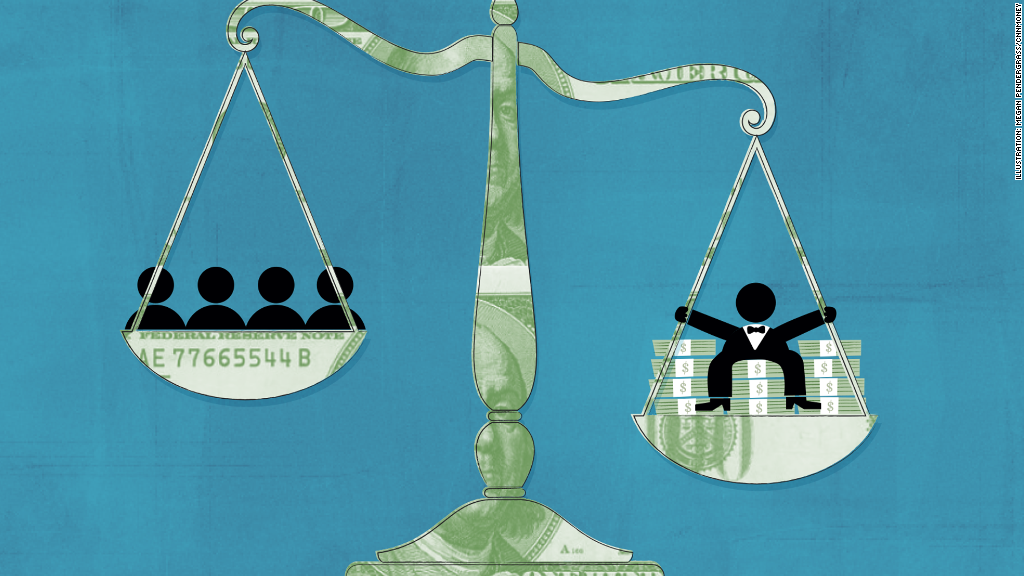
In 2021, the median employee to CEO wage gap was 235%, meaning that for every dollar a worker earned, a CEO received $235 dollars. A year earlier,  it was slightly better with a 212:1 ration between CEO and employee. In 2023, that ratio was now 268:1 among S&P 500 Index companies. I guess it really is good to be king!

In 2021, the Top 1% saw their percentage of wealth continue to grow by 9.1% while the bottom 90% saw theirs decrease.  During the same period, the Top 0.1% saw an income growth of 18.5%. The bottom 90% had a drop in real (after tax) income of 0.2% in 2020 and 2021. By the way, the Top 0.1% is what comprises the ruling oligarchy with a individual power index of 882.9 compared to the bottom 90% which has a power index of 1%.

The bottom 90% also saw just 58.6% of all wages earned, the lowest on record (in 1979, it was 69.8%), demonstrating that over time, workers have been losing ground compared to the upper 20%. Those in the rarified air of the Top 1% took in 14.6% of all wages generated (by comparison, in 1979 it was 7.3%).

To put it another way, from 1980 through 2021, the bottom 90% of Americans saw an increase in wages of 28.7%. The upper 1% saw their wealth increase by 206.3% over the same period while the upper 0.1% (aka: the ruling oligarchy) saw their wealth grow by 465.1%. Feeling nauseated yet?

It bears mentioning that Vice President Harris allegedly said Hurricane Helene victims would be eligible for a $750 "loan" from FEMA which would have to be paid back with interest or face a seizure of their property. That's false. FEMA is offering victims up to a $750 dollars onetime payment for baby food, diapers and incidentals., but it's part of a larger relief package.

Another rumor is that illegal immigrants can receive over $2000 from the government. That's also not true. The federal government provides immigrants classified as "asylum seekers" (pending determination) with up to $459 monthly to help with the cost of food, transportation, and shelter for up to 12 months. Still, financially, doesn't it appears these "asylum seekers" are making out better than U.S. citizens in trouble?

Lastly, what about foreign aid? Under President Biden, the U.S. has sent $95 billion dollars overseas in the form of foreign aid. The majority of that money went to Africa, the Middle East (mainly Israel), Taiwan, and to Ukraine, which got the most at $60 billion dollars for weapons and other military aid.

Under President Trump, he attempted to get a 21% cut in foreign aid (including eliminating aid for 27 countries) with a requested foreign aid budget of $44.1 billion. However, Trump was overridden by Congress and much of his proposed cuts were restored. It should be noted that the Joint Chiefs of Staff and practically all of the major defense contractors publicly and privately urged Congress to reinstate Trump's military budget cuts, and why not? War is a very profitable business.

Biden has no such qualms. His continued support for arming Ukraine, Taiwan, NATO, and Israel (despite public hand smackings) assures all that the money will keep on rolling in. Besides, war or the appearance of war is a good thing. Besides, it helps to artificially simulates the economy.

The Defense Industry continues to build, spend and hire which in turn helps numerous peripheral businesses and that trickles out to the rest of the interconnected economy. It reduces the appearance of the unemployment numbers despite a reduction of jobs by enlisting individuals (many of whom are under or unemployed and whose numbers aren't included in employment statistics).  

This is the economic picture Kamala Harris and the mainstream media, in its subtle promotion of Ms. Harris, isn't telling you about. Instead, we're being offered generalities and distortions. While this blog is neither Democrat or Republican and strives to simply provide nonpartisan facts as it find them, it would appear that in the real world Biden/Harris, devoid of the script writers, teleprompters, and cheerleading, things aren't so rosy for the country.

Ms. Harris offers a campaign message of "progress", "opportunity", and "change" for a faltering economy and political state of affairs it helped create. It's like the lookout on the Titanic offering to take the wheel after it struck the iceberg.  Our "ship of state" is already bow down, badly listing and taking on water with its engines open full throttle. Not exactly the right strategy if you can't swim.   

This election is one of the rare occasions where we can look at Trump's past term in office and gage how he will perform if reelect. At the same time, we know what Harris has done and what four more years would like accomplish. Can Trump do better? Maybe. He's previously managed to hold his own while fighting the media, Congress, and the political/economic status quo. It certainly wouldn't hurt!  


Thank you for reading Another Opinion! We hope you enjoyed this article and will pass it along. Please don't forget to subscribe. It's free! Lastly, please "like" us on whatever platform you use to read anotheropinionblog.com. It helps beat the algorithms and keeps our articles in circulation. Please find below the links we consulted in researching this article. 


Eggs, gasoline and car insurance: Where inflation has hitAmericans hardest


US home prices have surged 47% since the start of 2020


Veteran homelessness increased by 7.4% in 2023


The number of homeless people in America grew in 2023 ashigh of living took its toll


Average Hourly Earnings of All Employees, Private


The Enduring Grip of the Gender Pay Gap


Inequality in annual earnings worsens in 2021


AFL-CIO Executive Paywatch


Comparing Biden and Trump's Immigration Policies in 12 Charts


Friday, September 06, 2024

What are some of contributing factors for the decline of the United States? An Observation from the Center


America, as you know, is no longer a “Republic” although it still likes to pretend it is (much like Rome did under the early Caesars). While purely speculative, as all such predictive analysis are, our decline is not one or two things, but a series of events external and internal, all connected directly or indirectly, which, in the moments of our daily existence, barely warrants our notice. Some appear benign, hardly noticeable, while others glare back at us like Fredrick Nietzsche's abyss. 

First is the assumption that the world wants to be America, or at least like America. America is first and foremost a capitalistic pseudo-democracy. We tend to export “American” ideals and values along with our Levi's, Fords, soybeans and television shows whether they're wanted or not. We try to imprint our society on everyone, especially through consumerism to created a world of "mini me's".  

We create mostly unrealistic dreams, from what to eat, what to wear "what's in and what's passe'" (an artificial construct to sell clothes), TV shows to watch, what we should drive to look sexy or "cool", or what we should look like (especially applies to young girls and women), and even what we should think and what should be considered "important".  Doesn't it make you wonder where we would be without them to think for us?

The corporate media, after all, manufactures the narrative (remember, only five corporations control 96+% of media in all its forms). They tell what's important and not just as they tell us how we're to think or feel. But even that is all about selling "eye time". The higher the viewership the higher the price they can sell a particular commercial slot or print space for.

Another way we sell American ideals is by removing governments we don’t like because they negatively impact our (that is, Wall Street's) financial interest.  This is typically euphemistically referred to as "regime change".  It doesn't matter if the individual or party are chosen by the people, if it interferes with profits, it goes.

During the Cold War with Soviet Russia (1946 - 1991), the U.S. has been involved with the overthrow of roughly 12 governments (euphemistically referred to as "restoring democracy" or "supporting the will of the people"). We've also been directly involved in several hundred political assassinations such as Ngo Dinh Diem, the South Vietnamese President in 1963 or  President Salvadore Allende of Chile in 1973. During the same time span, we've been involved at varying capacities in some 23 proxy wars and 285 armed conflicts. According to one survey, the U.S. was responsible for 81% of the world's armed conflicts from 1945 to 2001

Overwhelmingly, each of these were either directly or indirectly the result of pressure by Wall Street since the individual leader or their government is a threat to their bottom line. In their place, we have typically installed a puppet government, but not just any ole puppet government popular with the people. No siree bob!  These are almost always far Right military juntas headed by such charming individuals like Generals Augusto Pinchot, Gregorio Conrado Alvarez, Alfredo Stroessner, and Jorge Rafael Videla.

Under "Operation Condor", which lasted from 1973 to 1983, we were active in the kidnapping, torturing, murder, or "disappearance" of some 60,000 individuals along with over 400,000 imprisoned. Many of them being Communist, democratic socialists, or simply vocal Left-leaning  activists. Some were union organizers, teachers, pastors, nuns, community leaders, and students.  Naturally, the government likes to say we acted in conjunction with our allies as sort of a soothing balm for our collective conscience.  Still, it kinda brings into question that notion of "leader of the free world" doesn't it?

As an aside, in researching this and similar articles over the decades, I've noted that we've never tried a to elect a non-partisan centrist or someone without strong financial ties to Wall Street. Rarely we elect someone without a military background  Given that we're no longer a democratic or constitutional Republic, having become a Oligarchy led corporatocracy years ago, if we were to have some sort of coup or civil war, what's in store for us? Based on our history, perhaps this is a hint. After all, we have so much experience at it.

Following wars, conflicts, or police actions, the next step is often what's called "nation building" (it should be more properly labeled "national building in our image"). This is where dozens (or more) government contractors engage in the lucrative business of, well, the literal business of physically rebuilding countries we had just bombed back to the Stone Age while the State Department helps restore their government to something acceptable to Wall Street.

Speaking of "nation building", Brown University announced the results on one of its projects concerning U.S. and its "War on Terror", that states over the last 20 years, Washington has spent $8 trillion dollars and came out empty handed with the Taliban still in charge and Al Qaeda still in business despite the loss of some leaders. Why isn't the American Taxpayer furious?

 In addition, over those 20 years, around 900,000 people have been killed. The U.S. Department of Defense confirmed that over those same 20 years, the American taxpayer has shelled out $145 billion dollars just to rebuild Afghanistan. I'm sure Al Qaeda and the Taliban are quite grateful, not to mention  thankful for the millions of dollars in state-of-the art military equipment we so graciously abandoned when we skedaddled out of Kabul.  

It's worth noting that despite spending billions on nation building since 1946, not a single country has opted to adopt our form of government. Not a single one. The dozens of countries we've helped rebuild like Humpty Dumpty tend to adopt the inclusive British proportional representative government.

Instead, they tend to choose the British “parliamentary” or proportional system where each party is basically guaranteed a seat, depending on the percentage of the vote they get, meaning everyone has a voice in government. This is in lieu of America's "winner take all" system where the voters on the losing side are unrepresented for the term of that office.

Another serious factor in our decline is our educational system. We’ve dumbed it down so as not to “offend” underachievers. We're ranked in the lower tier among industrial nation. How will we compete globally? We’ve accepted the idea of “equal outcomes over equal opportunities”. Everyone gets “participation trophies” just for showing up. Everyone isn't a “winner”.

We’ve developed the notion that certain individuals or groups are somehow "due" something by society simply because they exist. An extension of that is the mistaken presumption that we're “owed” something--- aka "reparations"--- because your ancestors experienced an injustice or other burden. Well, that may be reprehensible, but try naming one group on this planet who hasn't experienced injustice somewhere in their collective history (which speaks volumes about the state of humanity more than it does anything). 

Every race or ethnic group has at one time or another been the slave or the master. But it's all in the distant past. We can't change or undo what happened. They sacrificed for our future. Take from it the lessons they taught us  and move on. The only person ultimately responsible for your success or failure is you. Not the government, not your fellow citizens, and sure as hell not your ancestors.

America has lost its way. We no longer value life or show respect for others or their things. We covet what others have more than we value our own lives. That's how some people end up dead. We're told we're all victims. So now we've developed a victim mentality where others are responsible for our failures, but why not our successes? We're told it's okay to be "offended" if others won't play along with our "pronoun pity party". Guess what? You can "self-identify" as the "Cheshire Cat" if that's what you want, but that doesn't mean everyone has to play long Alice.

We no longer discuss opposing ideas in a civil manner. We don’t want to be presented with anything outside our “bubble”. We want nothing that would distort our view of the world. To do otherwise triggers a intellectual breakdown, requiring a "safe space" and "comfort blanket".

Our partisan politics is a reflection of that. Its’ developed a enemy-like “us vs. them” mentality where the “us” part doesn’t include the average voter. Rather than producing, society now based on consumption of everything without replacing it. Capitalist democracy requires that we  constantly expand and consume ever faster to survive. It’s appetite is insatiable. It’s fueled by greed for “more” of whatever is there.

When capitalist democracy can no longer expand, it begins to metastasize. It starts to consume itself. As it does so, it increasingly seeks to control and manipulate its environment. The economic class which feeds it is put under increasing pressure to provide more and more while it starves. That’s the stage we're now at by the way.

We've arrived at the point where there are no absolutes. Right from wrong is merely shades of gray. Much is often promised, especially by our so-called “leaders”, but no one actually expects those promises to be kept. We've discovered we can invade the coffers expecting them to always be filled but that's increasing not the case.

Facts are now seen as ambiguous. Truth is now a matter of perspective rather than accepted norms mutually agreed upon by society. They're conveniently assumed to be a lie to be discarded if we disagree with them. Perhaps worse is when no one is held accountable for the lie. Let's take a quick look at the nation and the lie we were loosely modeled on---Rome.

"Rome the Eternal", like countless nations before and after, fell because of an over extended and undersupplied military. It was no longer able to impose Roman values on the unruly barbarian tribes. Even its military became less “Roman” as more and more foreigners filled its ranks, who had no vested interest in the empire due to a decline in Rome's  birthrate.  

Originally, the title (and it was a “title”) of “Roman Citizen” carried great weight.  It was bestowed rarely and often with great fanfare. Eventually, it all but lost its mystique. Foreigner didn't settle in order to become a “Roman Citizen”. They came for the economic opportunities Rome could provide.  Eventually, didn’t they even bother to learn the lingua franca of the empire--- Latin---or follow its laws, traditions and adopt its values.  Sound familiar?

Internally, Rome had always been corrupt, but it was the degree of corruptness which changed. It became a cancer and spread everywhere. Citizens were distracted  with “bread and circuses”, that is, games and monthly bread rations, all paid for by the working class---the Plebeians or "Plebs"--- until it eventually collapsed from over taxation.

Taxes and goods from client states also dried up. They developed their own trade alliances and bypassed the Roman “middlemen”. They even lost their fear of Roman might. Why? Not because it was no longer formable, but because Rome could no longer financially sustain a war. Again, sound familiar?

Eventually, there arose an outsider, Julius Caesar, who pledge that “in order to save the Republic I must destroy the Republic”, which was a true enough observation. The Republic could no longer reform itself out of it situation. The dependent classes lacked the means and will. It couldn’t appease all the special interests groups which controlled it. Rome must be founded again.

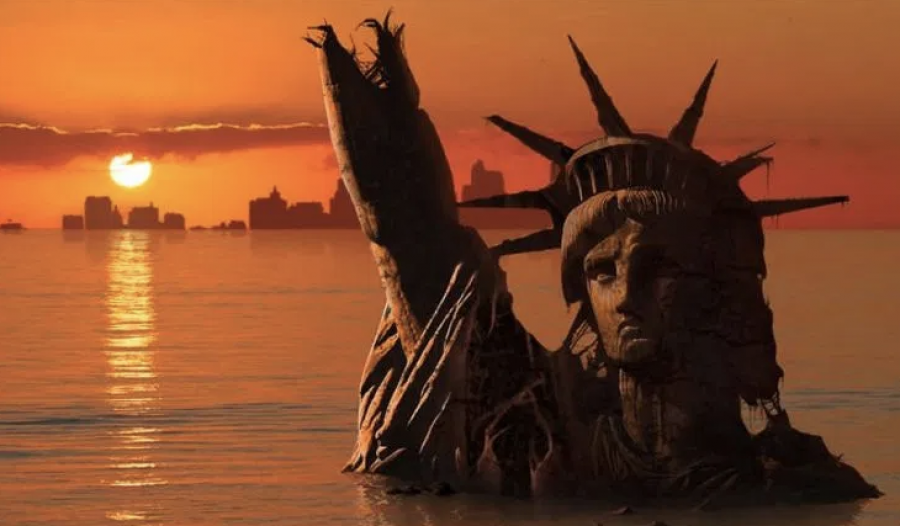
However, Caesar failed and paid with his life. What followed was a series of internal civil wars, When they were over, Rome had order. It also had a dictatorship. Can we be that far aways from our own Caesar? That’s a question many Americans are asking themselves. We are now a defacto neo-fascist corporatocracy; a surveillance state with all the tools for a full blown police state already in place. All that’s missing is a crisis—-real or manufactured.

We likely won’t have a military junta (although the military is the only institution which has kept a positive approval rating), but rather someone like a board president or chairman. And why not? After all, Wall Street runs the show. Why shouldn’t they step center stage and claim the crown?


 If you enjoyed the article, please consider passing it along to others and don't forget to subscribe. It's free! Lastly please be sure to "like" us on whatever platform you use to read anotheropinionblog.com. It helps beat the algorithms and keeps our articles in circulation. Thank you!


United States involvement in regimechange in Latin America


Operation Condor


Parliamentary system


US initiated 81% of global armedconflicts from 1945 to 2001   


Cold War Coups and Proxy Wars


Costs of the 20-year war onterror: $8 trillion dollars and 900,000 deaths


DoD: What We Need To Learn:Lessons From Twenty Years of Afghanistan Reconstruction