Showing posts with label debt forgiveness. Show all posts

Friday, August 23, 2024

Fried Chicken, Illegal Immigration, and Taxes


I'm just a "Southern boy" at heart. I grew up in the South. I've spent lots of time on working on farms, taking care of cows, pigs, chickens, picking corn and beans, hanging tobacco, stacking hay in the loft, mucking stalls, and everything else that goes with it. I've also lived in big and small cities like San Francisco California, Norfolk Virginia, Memphis Tennessee, Jacksonville Florida, Bowling Green and Glasgow Kentucky, among others.  

I've also lived off and on in the suburbs of a moderate size, sleepy and slightly backwards mid-western town which dons its "Southern" persona for two weeks out of the year, culminating in a overhyped and overpriced two minute horse race, after which it goes snuggly back to sleep and dreams of its former days of prominence.   

As someone with particularly deep Southern roots, I especially enjoy my fried chicken, biscuits and gravy, (no sausage in the gravy please. That's "Yankee" style gravy corporate restaurant chains try to pass off as "Southern" or "country". It ain't, plus they can charge you more). I also love fried apples with cinnamon, and fried white corn. You'll find that in the South almost everything we eat is fried.

That tradition was born of the Scots, Irish, Welsh, and Northern English who settled primarily in the southeastern portion of the country along the Appalachian Mountains, from Kentucky in the north down to Florida and over to Texas, Arkansas, and Missouri which created a culture and tradition uniquely their own, including what we ate. Nevertheless, for some reason many of us don't seem to have our typical "Southern" dinners as often anymore because of the price of everything.

Chicken used to be considered "the poor man's steak" because, next to fish, it was one of the cheapest and healthiest meats one could eat. However, nowadays, chicken is the premier meat as more and more people have turned away for overpriced beef, which is seen by many so-called "health experts" as being unhealthy thanks to pesticides, growth hormones, various drugs and antibodies, and dyes.   
Today, there's hardly any restaurant which doesn't sell chicken. In some cities they even put chicken on their pizzas! Did you know that approximately 70 billion chickens are consumed worldwide every year? That's comes to around 202 million per day or 140,000 chickens per minute. Americans alone bake or fry approximately 9.5 billion chickens every year.  

In 1957, the average weight of a chicken was two pounds. By 1978, with chicken on the verge of overtaking beef and pork, the average chicken weighed in at 4 pounds. As of 2005, the ordinary chicken was a hefty 9 1/4 pounds. Today, it tops out close to 12 pounds! Much of that is enhanced feed. Some of it isn't. It's chemicals like growth hormone.

To turn this around, as of 2020, most people ate roughly 82 pounds of red meat annually. That same year, we ate 127.2 pounds of chicken (to put that in perspective, globally speaking, the average person only consumed 35.7 pounds of chicken, meaning that we're eating about 40% times the recommended amount.

Did you know that Iowa and Ohio are the two largest consumers of chicken? They annually eat 54,957 and 52,690 of those little cluckers respectively. The highest ranking Southern states are Georgia in 5th place and Texas in 6th. Georgians ate 31,641 chickens while the Lone Star State munched down on 30,527.

In 2014, when Trump was elected to office, the average price for a one pound  boneless chicken breast was $3.47 (the previous low, in 2011, when the same one pound boneless breast cost $3.10). By the end of Trump's term, the price for that same one pound chicken breast was $2.94.
In February 2020, just after the start of the Biden Administration, that one pound boneless chicken breast would cost consumers $3.00. Halfway through Biden's term, in September 2022, you'd be shelling out $4.75. As of July 2024, the average cost for that boneless chicken breast was $3.95.

When we look at the price of sugar, it isn't any better.  A pound of white processed sugar (which is essential for the Southern tradition of "sweet tea") was $0.63 in January 2014. In June 2017, it was slightly to $0.66. By April 2020 it had dropped to $0.64 per pound.  

However, starting around May 2020, sugar prices began to climb from $0.65 in May to $0.69 in November 2021. September 2022 saw sugar prices  reach a new plateau high of $0.84. By September 2024, sugar had become "sweet gold" when it hit  $0.97 per pound. As of July 2024, the price of sugar was selling for a whopping $1.00 a pound!

Ground roasted coffee, that staple of civilization, has seen similar hikes in price. Selling at $2.75 a pound in July 2004, it skyrocketed to $5.01 in March 2014. It drop by December 2019 to $4.05. As of April 2021, a average one pound can of "Joe" would run you $4.75.  If that didn't wake you up, the prices by December 2022 sure would when they hit a record $6.47 a pound. By mid-year 2024, that same pound of coffee was  down slightly to $6.31. What about just stopping by "Mickey D's" instead?

According to the U.S. Department of Labor Statistics, the costs of fresh biscuits, muffins, and rolls rose 134.49% in 2024 over 1997 prices. McDonald's "McDouble" sandwich went from $1.19 in 2014 to a fat $3.19.  A medium order of French fries increased from $1.59 to $3.79 over the same time frame. Overall, McDonald's price have doubled over the last ten years.
Overall, the cost of eating out rose 60%, more than double the inflation rates from 2014 to 2024. McDonald's prices rose the most---100%--- over the period from 2014 to 2024 with Subway's rising the least at 39%. Taco Bell's prices increased 81% while Arby's, Wendy's, Burger King, and Chic-fil-A all rose by 55%.

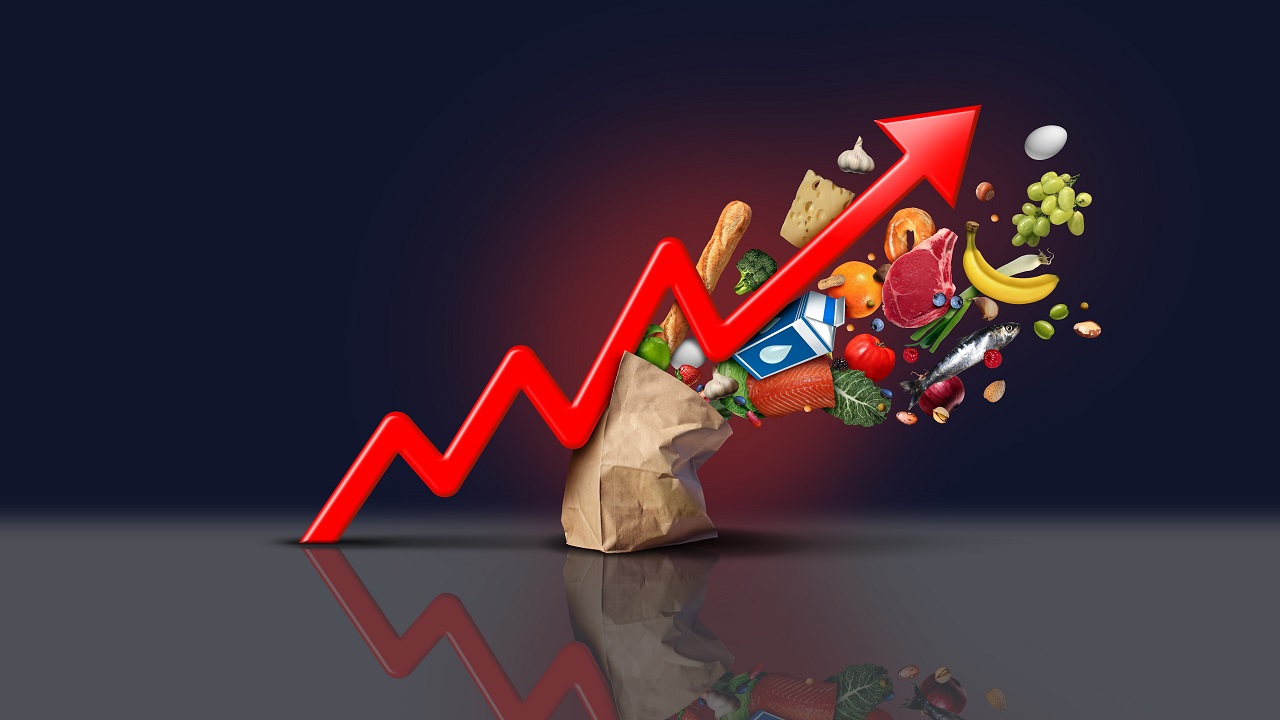
The fact of the matter is that the price of nearly everything has gone up. The inflation rate of food prices was 3.3% in 2014. In 2015 is had dropped to 0.8 %. The following year it was -0.5% (when was the last time you saw food prices actually go down?). By the end of 2019, the inflation rate of food  had risen slightly, to 1.8%.

With the incoming Biden Administration, the food inflation rate jumped to 3.9% in 2020. The very next year, in 2021, the inflation rate for food had risen to 6.3%, but that turned out to be nothing compared to 2022. That year consumers were robbed when the food inflation rate hit a staggering 10.4%!  

The U.S. Department of Labor Statistics reported that August 2022 saw the highest rate of food inflation---11.4%---since May 1979. Things finally cooled off when, by 2023, it had dropped off to 2.7% and then, finally, to 2.2 thus far in 2024 (just in time for an election. Imagine that).

 So, why do economists tell us that we're teetering on a recession but Vice President Kamala Harris says  everything is fine? Why does Ms. Harris have this long list of things she wants to start working on starting "day one" when she and "Slow Joe" have had four years to produce numbers like these? How can Americans afford another four years of prices like these?
When we look at wages, Statista reported in their June 13, 2024 that from April 2021 through April 2023, the average real hourly earnings declined over for 25 consecutive months. Nominal wages grew by 22.7% since 2020. However, consumer prices rose by 21%, meaning that workers just barely beat inflation by 1.7%. So, if you feel you're barely able to tread water, you're not imagining it.

Ms. Harris talks about curtailing illegal immigration to one group of potential voters and turns around and says she's going to create a easier path to citizenship to others, especially for those seeking "asylum". From 2007 through 2019, illegal immigrant numbers in the United States had been decreasing.

However, 2022 marked the beginning of a reversal of that trend when the number of illegal immigrants reached 11 million (which is still below the peak of 12.2 million in 2007).  Still, illegal immigration makes up 3% of our total population and nearly a quarter of the foreign born population in the U.S..

By the way, does Harris realize that most of these illegal migrants aren't coming here for citizenship? Statistics show they're actually coming here for a job. Some may claim it's "amnesty" they're here for but that isn't necessarily so. It's to get a regular paycheck. However, by applying for "asylum", it puts them into a different category and delays their review process thereby allowing them additional time to find a way to stay.  

These individuals  can't openly admit  say they're "job immigrates". The reason is because "job immigration"  is not recognized by the U.S. State Department, the UN, or even Amnesty International as a legitimate reason to seek entry into a country. Besides, international law requires anyone seeking amnesty to apply to the next closest safe country, no apply to the United States first!
Another key factor often mentioned by Kamala Harris is education and debt. Higher education is expensive. It always has been expensive. It's not uncommon for students to carry at least some debt which is why many find part time jobs to help with expenses.

70% of students graduating with a Bachelors degree has some measure of debt.  About 35% of all undergraduates make use of federal and state grants or loans. Those with certain majors such as science, mathematics, computer science/robotics, finance/economics/accounting, and engineering---degrees in high demand. In some cases, employers will help pay off their student debt!

Those with the lowest---or no debt---when they graduate are those attending trade schools. An average of $10,000 in debt for trade schools vs. 36,000 for a BA/BS degree. Getting a degree in one of the trades, such as carpentry, electricity, or plumbing, HVAC are in high demand and  is faster---six months to two years to complete compared to four years for a Bachelor's degree.

 Many start earning while still in school as apprentices, and most have jobs before they graduate. The median income for a trade school graduate is $42,000 compared to $36,000 for a four year undergraduate. Statistically, degrees in the arts, music, gender or racial studies, or philosophy face the lowest prospects of employment and tend to have the largest debt. They also earn less than average.  

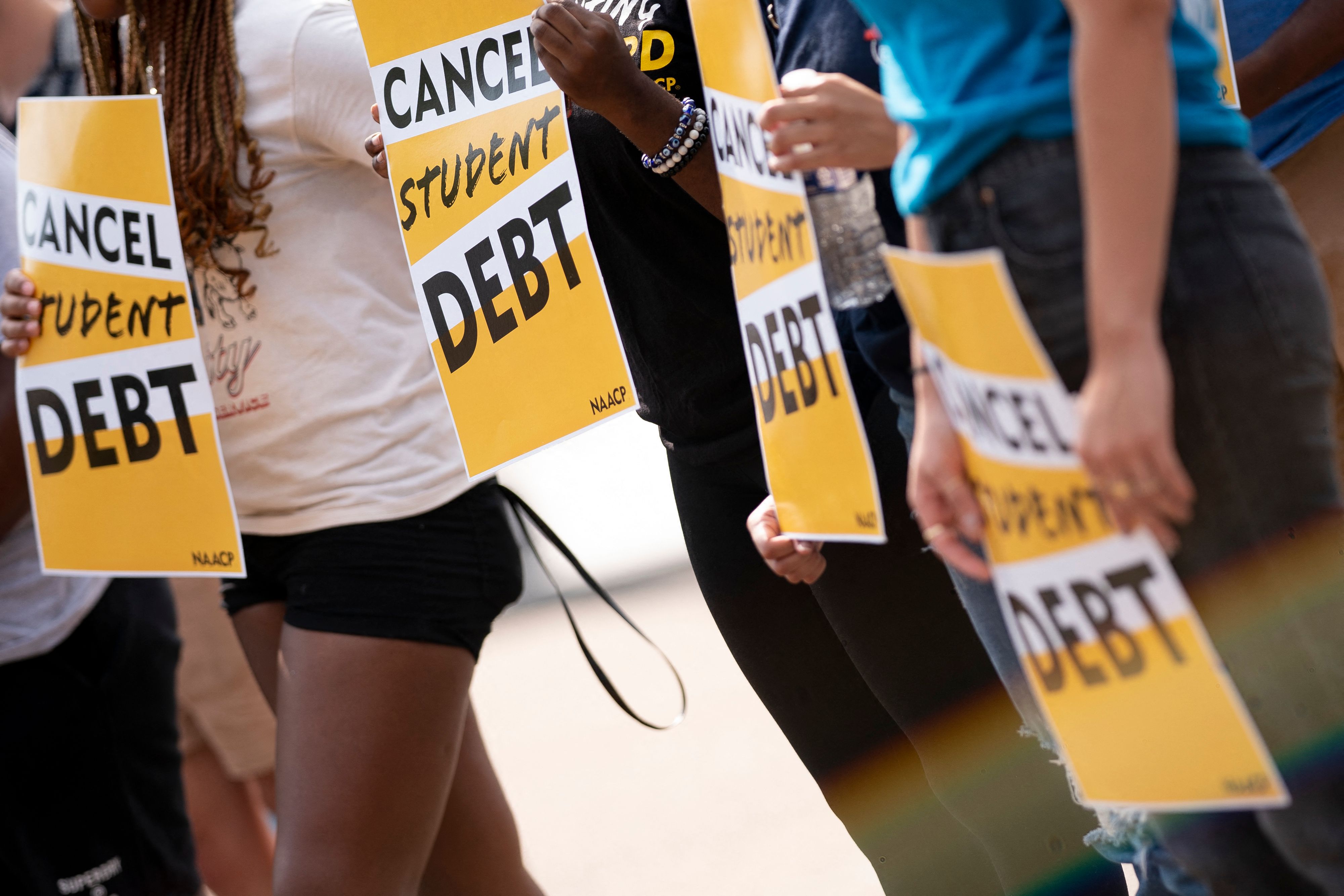
So, here's the rub. Students graduating from college, many of whom with degrees that have little demand in the job market that doesn't involve "you want to supersize those fries?" are demanding that taxpayers paid for their poor decision making skills. The Biden/Harris Administration has placed so-called "debt forgiveness" at or near the top of their domestic priorities.

Thus far, Biden has authorized "forgiving" $150 billion dollars which covers about five million students It's worth mentioning that with "debt forgiveness" the debt just doesn't magically disappear with the stroke of a pen. The government assumes the debt, which means taxpayers pick up the tab...as usual.

As Vice President, Harris has supported Biden's efforts to eliminate student debt. She also backed forgiving debt between $10,000 and $20,000 for every borrower. That, however, was shot down by the Supreme Court. It should be pointed out that former President Donald Trump opposes all out debt forgiveness but supports restructuring debt payback such as eliminating interest rates and other fees.

We've come a long way from fried chicken, biscuits and gravy to illegal immigration and student debt, but each of these issues deeply affect every working class American. We face a rising poverty rate as more and more of our fellow citizens are unable to keep up with rising prices (especially medical) and ever increasing taxes (which I believe should be voted on by registered voters as originally intended).  

Illegal immigration serves the interests of Wall Street. It creates a artificial demand for jobs, which drives down wages and benefits (in many cases eliminating benefits altogether). It also increases the demand on our taxpayer funded social safety net. You can bet that if the ruling elite didn't benefit from illegal immigration, it wouldn't still be happening.

It's time we put working class Americans at the top of our national domestic policy. If we continue with the same old smoke and mirrors game of politics, our collective future looks bleak regardless of who occupies the Oval Office or controls Capitol Hill. VP Kamala Harris has not just told us what she wants to do, her actions has shown us what she intends to do. The only real question then is not whether you can live with it, but whether this is what you want for your children and grand children to live with?


 If you enjoyed the article, please consider passing it along to others and don't forget to subscribe. It's free! Lastly please be sure to "like" us on whatever platform you use to read anotheropinionblog.com. It helps beat the algorithms and keeps our articles in circulation. Thank you!


Federal Reserve Bank/St. Louis: Average Price: ChickenBreast, Boneless (Costs per Pound/Grams 453.6 Grams) in U.S. City Average


McDonald's menu prices have increased by over 100% during the last decade: study


Federal Reserve Bank/St. Louis: Average Price: Sugar, White, All Sizes (Costs per Pound/453.6 Grams)  in U.S. City Average


Food Inflation in the United States (1968-2014)


Charted: Inflation Across the U.S. Fast Food Chains (2014 -2024)


Statista: Have Wages Kept Up With Inflation?


What Kamala Harris has said (and done) about student loansduring her career


Saturday, July 22, 2023

Living the (Broken) American Dream: Rebuilding the Middle Class

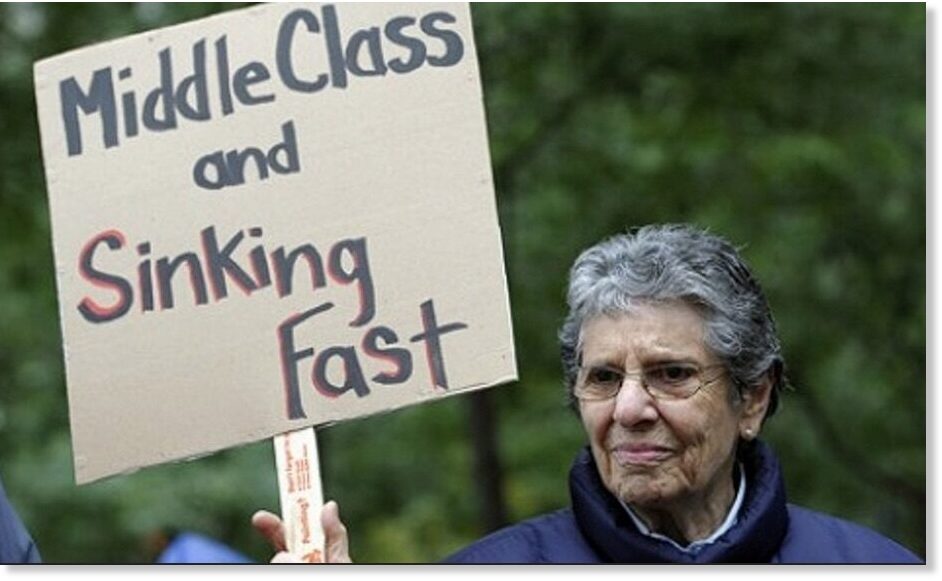
The middle class in the United States is in serious trouble. The aggregate earnings of the middle class has been in decline since 1970. The same goes for those at the lower end of the economic ladder while the upper 10% have seen a steady rise in their wealth. Even with 59.8% of two parent families both holding down full time jobs, it's not enough.

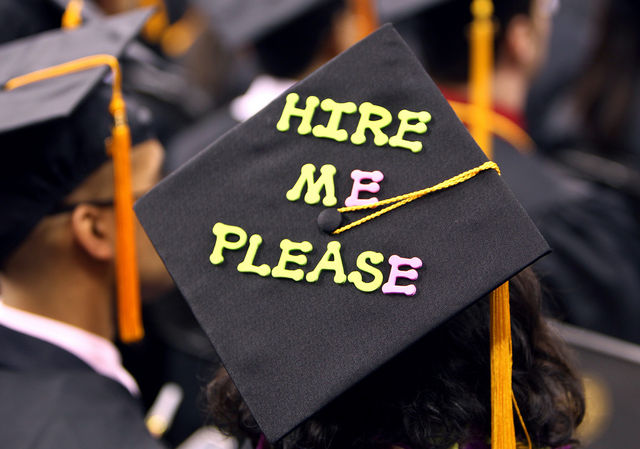
It used to be that a high school education was enough to guarantee you a comfortable living, usually in some blue collar job, a high school diploma nowadays would barely get you  beyond an entry level position somewhere. Even a four year college degree is no assurance of middle class lifestyle.

Of course, most of the good paying blue collar jobs have been exported overseas where corporations can exploit the need for jobs at any price while avoiding those pesky unions and OSHA requirements. Where for every opening there are literally thousands waiting in line to be hired.

It doesn't help that the quality of public schools have significantly declined over the decades to the point where many graduates have the academic equivalent of an eighth grade education.  America was ranked 11th of 79 countries in science.  While we ranked 30th in math,  the top five ranked countries in math were all Asian. But, we're still tops when it comes to basketball!

A typical college graduate with four year bachelor degree hit the street looking for a job with an average debt of over 30,000. For a professional degree, like from medical or law school, the average debt is around $250,000 and $160,000 respectively.  It takes the average college graduate 21 years to pay off their college loan debt. 

The downside is that a substantial minority chose majors with little or no job demand, leaving them stuck with a huge financial burden and no way to pay it off. These and other graduates are now wanting taxpayers to pick up the tab  under the misleading term of "forgiving" or "canceling" their academic debt. Why? We didn't pick their major. We didn't sign their loan papers or accept responsibility for their debt. That's their responsibility. It's called being an adult. 

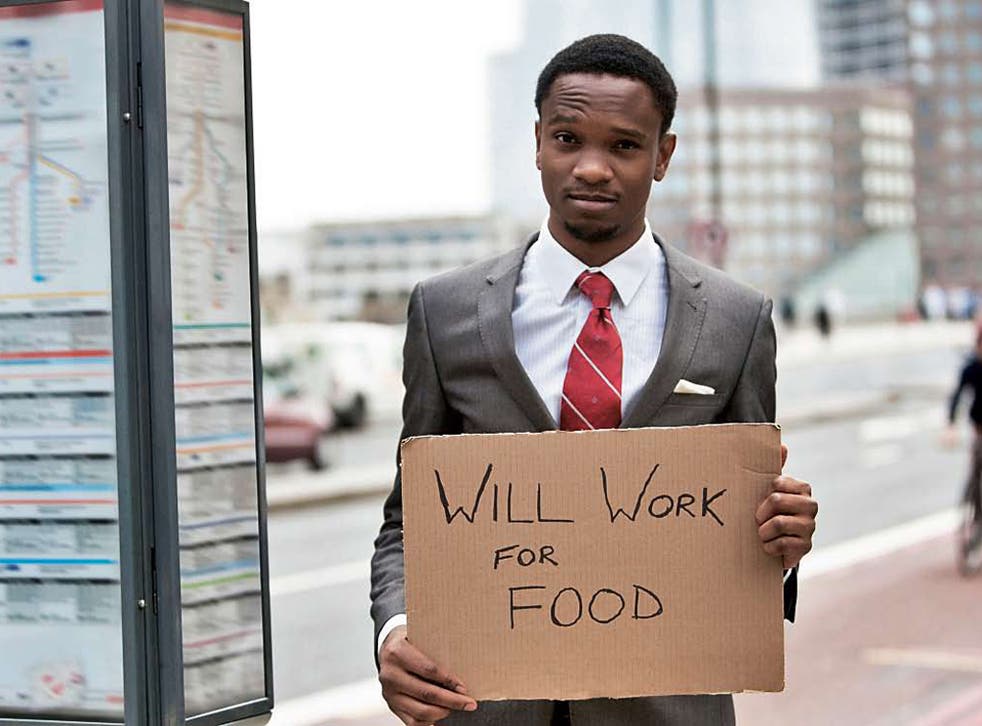
But it doesn't end there. With all the additional expenses of simply "living"  amid rising prices and stagnate wages, the average American household debt is $101,915 as of the end of 2022. The total national household debt is $17 trillion dollars as of the end of the first quarter of 2023. That effectively makes the majority of Americans literally indentured serfs. They are literally working to pay off a debt owed to someone else, which is almost always a corporation.

As an aside, 60% of Americans are living from paycheck to paycheck, including 49% of those with an income of over $100,000 along with 70% of millennials, and it looks like Gen Z is trending the same way.  30% of Americans have enough money in savings to cover an emergency for no more than 30 days. 22% have no financial safety net which includes 27% of those 59 and older. 

Once they find a job, it's worth noting that wage inequality between genders remains a problem. Women are still earning, on average, just 82% of every dollar their male counterpart earns, which makes me curious about those who "identify" as transgender in the workplace. I wonder if they're going to be satisfied with their reality of their smaller paychecks?

Meanwhile, those at the top of the corporate ladder seem to be doing just fine. The CEO-to-worker compensation ratio was 399-to-1 as of 2021. That means that for every dollar a average employee earns, a top executive will get $399.  From 2010 through 2021, wages grew by 31%, which sounds pretty good. However, thanks to the rate of inflation, wages have lost on average 4.5% of their purchasing power.

As if that's not bad enough, the top richest 1% own twice as much as the bottom 99% of the entire world's population! To put it another way, they've acquired over half of all the new wealth created over the last decade while the poorest half own just 0.75% of the wealth.  

In the United States, the top 1% own over one third of the nation's total wealth. Did I hear someone say "let them eat McDonalds"? Meanwhile the bottom 90% control just 30.2% of the wealth. In 2021, the top one percent's wealth grew by $6.5 trillion dollars...just in that one year! Their total stock portfolios were worth $23 trillion dollars.

As wealth increasingly becomes concentrated in the hands of fewer and fewer individuals and their corporations, so too does their political power. There have already been several academic studies showing America's shift to a government of, by, and for the oligarchy (or kleptocracy if you prefer). Wall Street's mega corporations now so controls Washington that we've become a defacto neo-fascist corporatocracy. 

It shouldn't need pointing out, but we've also become a surveillance state thanks to the knee jerk reaction of Congress following 9/11 and its failure to read or comprehend the "Patriot Act" in 2001. We need wonder no more how or why the Germans succumbed to Hitler and the Nazis following the passage of the "Enabling Act" by members of the Reichstag on the heels of Reichstag fire in 1933.  

Thanks to the Supreme Court's 2010 "Citizens United" blunder, Big Money literally owns the Democratic and Republican parties. They not only underwrite the two parties and their political candidates, they've pushed the cost of running for office almost entirely out of reach of the average citizen, thus making politics the virtual domain of the very rich.

Congress isn't about "the business of the people" as Speaker Nancy Pelosi so caustically said following the January 6th protest, as corporate lobbyists now routinely write or help draft legislation and advise legislators on how to vote on which bills.

Consider this too. Millionaires, who make up just three percent of the total U.S. population, overwhelmingly control all three branches of government, including the Presidency, regardless of party affiliation. Middle and working class office holders have never dominated any branch of the federal government and are increasingly becoming rare at the state level.

Members of the Supreme Court together are worth an estimated $24 million dollars, and at least six of the nine Justices are multimillionaires. Even most federal judge positions are occupied by individuals who are at least in the top 5% financially. Of course, these positions come with their wealthy and powerful connections, making it even more difficult for the ordinary American to get a fair shake.

So, regardless of whether you vote Democrat or Republican, the wealthy win. It's just a matter of whether it's the blue corporate clique and their agenda or the red corporate clique and their agenda.

So, where does all this leave us? Historically, it's been the middle class which has held democracies together. The Founders  envisioned  the United States as a nation of  yeomen farmers and small businessmen. Ideally, a democratic society should be shaped like two inverted diamonds---narrow at the top and bottom and wide in the center with a relatively few at the top and bottom with the majority of individuals located somewhere in the middle.

Of course, that's not what we have today. The United States used to be a majority middle class country. In 1971, over 61% of the nation was middle class. Today, just under half are. The lower middle class comprise approximately 25% of the population with another 25% making up the working poor and perpetual unemployed. In 2022 just 11.3% of workers were unionized. In 1960 it was almost one third of the country--31.9%. By 1975 it was 26.3% as technology replaced some workers and employers began sending other jobs overseas.  

America also used to be the place where someone could start from scratch, start a business, and through hard work make their way up into the middle class. It was part of the "American Dream". It's what many newly arrived immigrants hoped for. According to the U.S. Bureau of Labor Statistics, the "American Dream" may now be just that---a dream.

 20% of all new businesses fail within their first two years of operation. 45% within their first five years, and 65% within ten years. Just 25% survive beyond that. The main reasons? A lack of cash flow, poor management, a lack of organization, and inadequate marketing.   

When a society's economic system becomes unbalanced and where wealth and power are concentrated in the hands of small minority, social unrest is almost always the result, be it revolutions, civil wars, coups, or whatever. This is especially true when approval levels drop below 55% for any length of time, again, such as in the United States. 

Currently, Congress has an approval rating of just 20%, or to put it another way, a disapproval rating of 76% with 4% having no opinion. In fact, the last time Congress had a positive approval rating over 50% was 2001---22 years ago!

As an aside, 77% of those surveyed said that the current members of Congress should not be reelected again, and yet thanks to corporate funding and partisan gerrymandering, some 95% of them will be reelected.  The Supreme Court has an approval rating of roughly 40% and 66% of Americans have little or no confidence in the mainstream media to provide fair, honest and balanced news.

This is what a broken political  and economic system looks like, especially if you're one of few Americans clinging on to their middle class status. Rising prices, stagnant wages, the widest income disparity of any industrialized nation, poor healthcare (we're ranked 21st in the world with the highest infant mortality rating of any developed nation), a underperforming educational system.

 At 76, our life expectancy is among the worse of any industrialized nation, coming in 40th in the world. In Japan it's 84. We have the world's highest national debt rate at $31.4 trillion. To put it another way, our national debt exceeds the next four countries---China, Japan, France, and Italy---combined, which as most economist will agree, is unsustainable, and yet we spend more on the military than the next ten nations combined.

Is there anything the American middle class can do? Maybe. Although the United States is in decline, perhaps terminally, we can still alter the existing political system to make it more responsive to the needs of its citizens and get corporate money and control out of politics.

We can bring jobs sent overseas back home or penalize those who don't. Let's make it more expensive to ship jobs overseas than to build it here. We can raise the tax rates on the wealthiest individuals and impose a minimum tax on big businesses. No more mega corporations earning more than some countries paying zero federal taxes or billionaires paying less taxes than fast food store manager.

We can increase our investment in R&D projects and cut the red tape on new businesses, especially in the area of technology. We can---and must---improve our education and healthcare. We need to reduce our military budget to free up more money for social services and infrastructure.  We need to put focus on all Americans, not just an elite few, and that means rebuilding the middle class once again.


If you enjoyed the article, please consider passing it along to others and don't forget to subscribe. It's free! Lastly please be sure to "like" us on whatever platform you use to read anotheropinionblog.com. It helps with the algorithms and keeps our articles in circulation. Thank you! 


Average American Household Debt in 2023: Facts and Figures


Average Student Loan Debt


U.S. Education Rankings Are Falling Behind the Rest of theWorld


Two Working Parent Households 2023: A Look at the Statistics


How the American Middle Class Has Changed in the Past FiveDecades


At Least 6 Supreme Court Justices Are Multimillionaires,Report Reveils


These 19 Fortune 100 Companies Paid Next To Nothing---orNothing At All---in Taxes in 2021


Friday, September 02, 2022

The Forgiven and the Damned: Biden's Student Debt Forgiveness Program and Taxpayers


President Biden caused quite a stir recently, fulfilling a long standing promise to end student debt. As typical with many of Biden's proposal, it appears he didn't think this one through particularly well. The end result will be a much needed, albeit limited financial relief for the estimated 48 million current and former students with $1.75 trillion dollars owned.

To properly understand Biden's proposal, it's important that we first understand the term Biden uses. So, to begin with, let's get our terms correct.  Instead of calling Biden's proposal "debt forgiveness", the more appropriate term we should use is "debt transfer", which is a more accurate description of what it really is. But before we get into the specifics of Biden's "debt transfer" plan, let's take a look at student debt in general.

Loan debt has been the bane of students for decades. Some cite it as the price we pay for higher education. Others call it nothing more than a money generating scheme with naive and often desperate young adults (and their parents) as the "pigeons" to use the old carnie term for unaware victims of con games. After all, since at least the 1980's, we've been told that the only way to succeed is to go to college.

Approximately 45.4 million current and past student have some form of federal loan debt, of which 4.7% was already 90 days in arrears just in the first quarter of 2022. The average monthly payment is about $300, with most loans require the borrower to pay 10% - 20% of their gross income, based on how much they're earn.

 55% of graduates with a four year bachelor degree owe, on average, just under $30,000 in student debt regardless of whether they attended a private nonprofit or public college or university. 68% of those graduating a private nonprofit college or university has a debt of $31,450 or more. 66% of those graduating from a public institution owed $26,900. 83% of those graduating from a for-profit college or university with a four year degree had a debt of just under $40,000.

Between 2020 and 2021, students and/or their parents borrowed near $96 billion dollars to cover the cost of education with just 13% of that being private and/or non-federally backed loans. Direct loans amounted to $1.38 trillion dollars shared by 37.2 borrowers. FFEL Loans were the largest, with $225 billion loaned out to a little under ten thousand applicants. Perkins Loans, totally $4.2 billion dollars,  went to 1.5 million individuals. The grand total was $1.61 trillion dollars loaned to 43.4 million unique applicants!

The above numbers represent just a snapshot of the debt crisis. It doesn't include other forms on loans such as Stafford, Grad PLUS, or money borrowed on insurance plans, 401K and other retirement plans, home mortgages, credit cards, and so forth, which represents tens of billions in principal, interest, fees, and penalties.  It's obvious that the student debt situation is out of hand. Some would even say it's critical, and you would find few who disagree. However, before we look at Biden's plan, let's consider a few facts about higher education.

First and perhaps more importantly, not every job needs someone with as BA or BS degree. In decades past, most graduates of high school were adequately equipped academically for the majority of jobs. However, starting the mid 1970's, the quality of high school education took a tremendous nosedive. Students were being graduated who had a 6th or 7th grade math ability or read at an 8th grade level. Their knowledge of grammar and spelling was horrendous, while their grasp of history, ethics, the sciences, or literature were virtually non-existent.

Beginning in primary school, discipline all but vanished along with parent participation. At the same time, a rise in poverty among students meant more kids were showing up hungry. As a result, schools turned increasingly into publicly funded daycares. Critical thinking skills were essentially out the window as the focus turned more on sports to attract and keep students than on academics.

As a result, employers had to resort to remedial education for many of their new hires and the demand for college education began just to have the same intellectual level of an applicant they had just 10 or 20 years earlier. Along with this change, universities and employers began downplaying the need for the trades; those educated to do jobs which required physical and mental skills such as electricians, plumbers, carpenters, or mechanics.

Instead, savvy marketing drew new high school graduates to the higher priced colleges with promises of riches in four or six or eight "short years" and away from the less expensive and shorter trade schools. Thus began the rise of sustained student debt as tuition continuously rose and students were "fee" to financial death.

By way of a brief comparison, the cost of a college education is highest in the Northeast and West. It's cheaper in the South, Midwest, and Plains states. The average cost of a four year public college for in-state students is about $21,035 per year (or $84,140 for the full four years plus assorted fees). For a in-state student attending a private four year college, it's about $32,768 (you can roughly double that if you're either a out-of-state student or add another 1/3 if you're going to a for profit college).

If you attend a trade school, the average is about $33,000...for the entire program! Of course, depending on where and what degree, tuition can run $3,800 to $15,000 per year (most programs are two years or less, and in some cases, you can start earning in six to eight months). The figures used here for both college and trade are averages as of 2022. Tuition always changes, and usually upward.

 College admissions and academic administrators also starting not just encouraging students to major in degrees with little or no employment demand, they also started creating new degrees with little real world value (such as gender or race studies). Hey, all to keep the money flowing! Meanwhile, for many colleges, the focus turned from critical thinking skills (the hallmark of higher education) to even greater revenue generating sports programs, leaving some academic departments limping along.

President Biden's "debt transfer" proposal is said to "wipe out entirely" the debt of approximately 1/3 of those with federal loan debt. That's about 16 million individuals. The program includes a $10,000 dollar debt "forgiveness" (specifically, the federal government---meaning taxpayers---will pick up the tab).

This will apply to those earning $120,000 dollars or less (or a combined household income of $250,000). In addition, the federal government will "forgive" up to $20,000 in Pell Grants. Total costs for taxpayers? About $300 billion dollars. Of course, this assumes Biden's "debt transfer" proposal gets past all the anticipated legal challenges.  

By the way, don't expect any "thank you" cards from Millennials or Gen Z's. They have a reputation of self-entitlement. I bet they're going to be surprised to learn that once any type of government welfare goes into effect, it rarely if ever ends, so they expect to be paying off someone else's debt down the road! How's that for a bite in the butt of the two "I love Socialism" generations Capitalist style? 

Anyway, assuming that this portion of the Biden plan survives all the legal challenges, the president's staff claim that about 90% of those earning $75,000 a year or less (which is most Americans) will be the prime beneficiaries. The plan also includes changes in the federally based "Income Driven Repayment System" (IDR).  

Under the IDR, a student's monthly loan repayments is adjusted based on their income after graduating. Students are currently required to pay between 10% and 20% of their annual income for the first 20 years, after which the balance is "forgiven" (that is, picked up by taxpayers). According to one report, between 2010 and 2020, enrollment in the IDR jumped from roughly 10% of eligible applicants to 32%.

With Biden's plan, participants will now have to pay just 5% any undergraduate debt (and up to 10% on graduate or professional school debt such as law or medical school). This covers a repayment plan over 10 to 20 years, depending on debt size and annual income level. The proposal will also include a change in the amount of income not currently covered.

Under the current plan, IDR doesn't include repayment on income up to 150% above the poverty level (based on family size, etc). So if your income is, let's say 155% above the poverty line, your payments would be based on that 5% under the current plan and everything 150% or under is exempt.  

The new plan will adjust that up to 250% over the poverty line, meaning the minimum repayment amount is based on less income, thus significantly lowering the size of the amount due.  It also removes any accrued interest.

As a result, it encourages individuals to borrow as much as possible rather what they need. I see a lot of parties and beer runs in the near future. But fear not! The new IDR changes also encourage colleges to raise tuition since a greater percentage of debt is now being "forgiven"...and picked up by you and me via the government. So, taxpayers get all the debt of a college education but without all those pesky term papers and dust collecting degrees. 

Biden, however, suggested that individuals qualifying under the new IDR wouldn't abuse the opportunity to borrow more money with no interest, have lower monthly payments, and earlier debt termination. Instead, they would use the money saved on the loan payments to invest or spend back into the economy. They could even double up on payments if they wanted too. He also downplayed the likelihood that universities would significantly raise tuition as well.  Yeah...right Joe. Wink. Wink.

As another aside, under Biden's plan, there also could be an unintended consequence---money not paid back could be taxable at the state level  According to the Tax Foundation, there are 13 states which could treat any debt "forgiven" $10,000 or over as earned income. This includes Kentucky (naturally), Arkansas, Wisconsin, Virginia and West Virginia, Hawaii, Idaho, Minnesota, South Carolina, New York, Pennsylvania, and Massachusetts.

The Tax Foundation estimates that amount of tax to be paid could range from $300 up to $1000 or more.  To stick the knife in a little deeper, that figure could double if the debt originated from a Pell Grant and is at least $20,000 is "forgiven". So, what's the total damage of Biden's plan to taxpayers?

Well, according to the University of Pennsylvania's famed Wharton's Business School of Business (and President Donald Trump's old alma mater), taxpayers could end up stuck with a final bill of somewhere between $650 billion to $1 trillion dollars, thus proving again the old adage that no good deed goes unpunished. Not even ones designed to improve approval ratings and reelect Democrats in November. 


If you want to know more, please take a look at the links below. If you enjoyed the article, please consider passing it along to others and don't forget to subscribe. It's free! Lastly please be sure to "like" us on whatever platform you use to read A/O. It helps with the algorithms and keeps our articles in circulation. Thank you! 


A Look at the Shocking Student Loan Debt Statistics for 2022


There's a giant loophole in Biden's student debt relief that could make college even more expensive. Here's how it works


Biden's student loan forgiveness could be taxable in some states


List of States That Might Tax Student Debt Loans Dwindles


The Value of Trade Schools in Today's Economy


Average Cost of College Textbooks