Everybody knows at least the basics of what Abraham
Lincoln's "Emancipation Proclamation" was about. Once upon a time
(before the dumbing down of public education), students everyone in the U.S.
had to memorize at least a portion of it. In some schools, all of it, along
with the Preamble of the Constitution. and the Gettysburg Address. It was part
of the Civics program which went hand-in-hand with our history classes (which
have also largely gone by the wayside).
Of course, if you know anything about the proclamation then
you should be familiar with the 14th Amendment which was passed by Congress in
1868. Well, I'm going to provide you with some interesting and often overlooked
facts about both which you probably didn't know. I suspect that it may come as a shock for some
of you. So, let's start with Lincoln's famous Emancipation Proclamation first.
Contrary to popular belief, slavery was not the primary or
sole reason for the start of the Civil War. However, it was seen as an
important issue especially among certain groups, including Quakers, abolitionists,
and some evangelical groups. One of the more famous abolitionist was, of
course, John Brown, who attempted to spark something of a revolt with his
ill-fated raid on a arms depot at Harpers Ferry, Virginia in 1859.
The question of slavery was a serious issue even before the
Civil War with a majority of the states wanting to put an end to it, while the
South refused, citing its dependence on the use of slaves. During our revolution for independence from the
British, it was commonly accepted that without the support of the South the war
would be lost (and indeed, the war was ultimately decided in the South), Therefore,
the Northern representatives were left with no choice but to except the hated
institution...for now.
Shortly after the end of the Revolutionary War in 1783. the
importation of slaves into the U.S. was signed into law by President Thomas
Jefferson in 1807 (becoming enforced in 1808) again caused a major riff between
the industrialized Northern states and the largely agricultural Southern
states. The riff came to a head by the
early 1800's and the United States came very close to ceasing to be.
However, a solution was reached in 1850 known as the
"Great Compromise"
dealing
with the admission of slave states into the union. It was engineered by Senator
John C. Calhoun (D-SC),Senator Henry Clay (Whig-KY), and Senator Daniel Webster
(Federalist-MA). Sadly, the "Great Compromise" is often overlooked in
most history classes, and while it didn't "save" the nation as such,
it did prolong the bloodiest war in U.S. history.
The issue of abolition was an important factor leading up
the Civil War, thanks to individuals like Brown, Fredrick Douglas, Harriet
Beecher Stowe, and John Quincy Adams, it was never the central cause despite what
we're taught in our watered down and often distorted history classes in high
school (or sometimes, even in college; all of which are intended to fit into a particular political agenda).
The key issues were more about economics and admission of
free vs. slave (these are where slavery comes in), tariffs, and ultimately, the
supremacy of the Federal government. This was more than interpretation of the
Constitution's 10th Amendment. ("...the powers not delegated to the United
States by the Constitution, nor prohibited by it to the States, are reserved to
the States respectively, or to the people"), it was whether the states or
the Federal government would be dominant.
Many Northern senators believed that the Federal government
held all power not expressly assigned to the states as mentioned in the
Constitution. Most Southern senators said
that the states held all governing powers not expressly given to the Federal
government. That issue wouldn't be resolved until the final outcome of the
Civil War.
Personally, based on my read of statement in question, and
knowing how the Founding Fathers loathed a strong Federal government (and
government in general), I tend to side with the South on their interpretation
of the amendment, but that's just me. It should be noted that the descendants
of most of the Founding Fathers also agreed with the South's position. So, what
did Abraham Lincoln think about slavery as an issue and how did this affect his
Emancipation Proclamation of 1863?
While campaigning for the presidency, Lincoln repeatedly
said that he had no intention of trying to end
or interfere with slavery as an institution. That may come as a surprise
to many people, especially those who've been taught to see Lincoln as a second
coming of Moses, however, that wasn't the case, at least in the beginning.
Even after winning the election, Lincoln said in his First
Inaugural Address to the nation on March 3, 1861 that the Federal government
"held no authority to interfere with the institution of slavery where it already exists". He went
on to say that, as president, he wouldn't seek to interfere with any state's
right to govern the institution.
That doesn't mean that Lincoln agreed with slavery as an
institution ("I am naturally anti-slavery. If slavery is not wrong, then nothing
is wrong"). His first and primary goal was the preservation of the union.
Secondly, he wanted to restrict (if not outright ban) the entry of pro- slave territories
into the union as new states. Nevertheless, despite his best efforts, he
failed. before he even had begun. The first state to secede was South Carolina
in November 1860 following Lincoln's election. Other states soon followed until
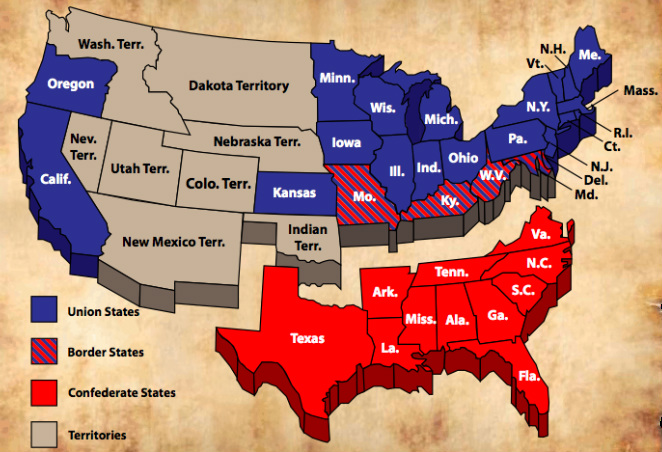
there were 11 in total, forming the Confederate States of America (CSA).
While all of the states were slaveholding, four states that
held slaves didn't secede ---Maryland, Kentucky, Delaware, and Missouri (in
anticipation of their leaving, Kentucky and Missouri were given stars on the
Confederate flag). As an aside, did you know that several Native American
tribes sided with the Confederacy? In 1861 the Cherokee, Chickasaw, Choctaw,
Seminole, Muscogee (Creek) all signed agreements of support in exchange of
being guaranteed title to territories west of the Mississippi River.
The War between the States
began (officially) on April 12, 1861 with the assault on Ft. Sumter in
Charleston Harbor (with South Carolina having seceded in 1860, the fort was
viewed as foreign occupiers on their territory). The war was naively expected
by both sides to be over in a matter of weeks. Bull Run, Shiloh, and Antietam
soon removed the nation from that illusion.
By the time of Lincoln's Emancipation Proclamation in 1863,
the war had gone worse than expected by the North. Unless something dramatic
was done to strategically shift the balance of power, the best outcome that
could be expected was a draw.
As in nearly every conflict down through history, the
ability to successfully wage war rests on the economy's ability to sustain the
effort. The South's ability to wage war rested on its agriculture. According to
the last census before the war in 1860, there were approximately 4 million
slaves in the South, making up roughly 30% of its population (compare that to
the West Indies where about 85% of the entire population were enslaved).
It should be pointed out that only a few landowning families--mostly
large plantations--- owned any slaves. The overwhelming majority of Southerners were too poor to own any slaves at all. Nevertheless, if,
somehow, the South's economy could be disrupted, Lincoln thought, then perhaps
the war could be brought to a close.
At this point in late 1862, Lincoln had to accept that
despite his promises not to interfere with the institution of slavery, the
country was at war with itself, men were
dying daily (the average was 504 per day), and the abolitionists hadn't gone
away. If anything, they had grown in number and become a powerful political force.
It was time for Lincoln to play his trump card.
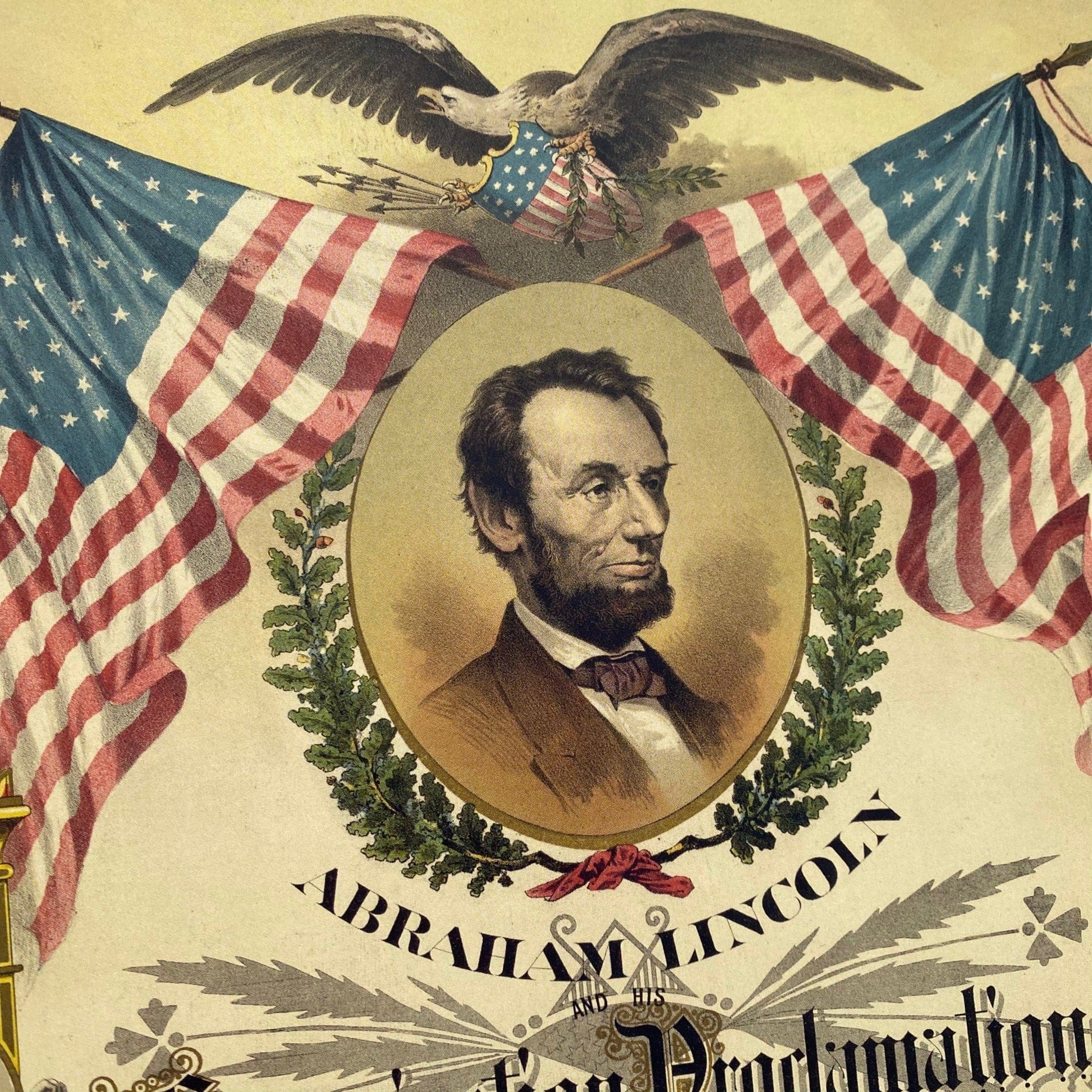
On January 1, 1863 Lincoln delivered the "Emancipation
Proclamation". It's often overlooked by nearly everybody that the
proclamation didn't end slavery in America as claimed. The proclamation freed
those enslave only in the states which had seceded from the union and were
now a part of the Confederacy ("...that all persons held as slaves within
the rebellious states are, and henceforward are free"). But what about the slaveholding states which
remained part of the union?
It meant that those slaveholding states which didn't secede,
regardless of their sentiment, were excluded from the proclamation. Thus
slavery continued in Kentucky, Maryland, Delaware, West Virginia, and Missouri until
the end of the war (the tribes which sided with the South were unaffected.
Native American tribes long held slaves of all races
before, during, and after the war).
The second interesting observation is that despite Lincoln's
decree, those states which had legally (at the time) left the union, were now
part of a independent and separate nation known as the Confederate States of
America with its own president (Jefferson Davis), its own Congress and
Constitution, its own legal system and currency. and so forth.
That meant that President Lincoln was attempting to impose a
unlawful degree on an defacto independent nation! It would be like a President
issuing a decree to Canada or Mexico! The decree therefore had no legal
standing, and no doubt Lincoln knew it. But if it could hamper the South's war
efforts, it was worth the bluff. and it worked
At first slowly, then in droves as word spread, slaves began
to abandon their fields and head north or to the western territories. Even
though slavery comprised a small percentage of its population, the effect was
cataclysmic for the South. With crops being left to rot in the field and the
economy now in turmoil, soldiers began deserting to harvest the crops in order
to prevent their families from starving.
This left the South's military further undermanned. In
addition there was diminishing food and supplies reaching Confederate troops, whose supply lines were overstretched
already. It give the North the edge it needed.
By 1865 the war was over and the South lay in ruins. It would be decades
before it would recover. In some ways it never has.
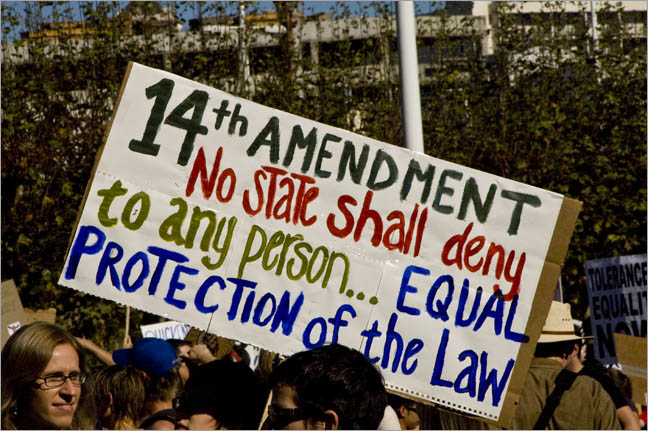
Following the war, the 14th Amendment essentially codified
Lincoln's "Emancipation Proclamation",
along with the 13th which formally abolished
slavery as an institution, was passed in 1868.
thus ensuring all those previously held as
slaves were now fully U.S. citizens with all the rights which go along with it.
The 15th amendment, passed in 1869, provided for the right to vote (it,
however, excluded all Native Americans).
The trio of amendments prevented (at least on
paper) any states from denying equal rights to all those held in slavery.
The 14th also forbid any former member of the U.S.
government who participated with the "rebellion" from public office
and denied any and all compensation incurred by the Confederate government,
including loans or contracts (as well as slaveholders, meaning they wouldn't be
compensated for the loss of their slaves).
As an aside, Confederate soldiers were eventually allowed
compensation for service connected injuries and pensions for Confederate widows
as early as 1867 by the state whom they served. The Federal government expanded
existing military benefits in two Congressional Acts to cover Confederate
soldiers and their widows. One in 1927 and the other in 1957, long after many
were dead.
It should be pointed out that 28 of the existing 37 states were needed to ratified the amendment in order
for it become law (which they received), but did you know that despite the passage of the 14th
Amendment by Congress in 1868, several states didn't ratify it until later (in
some cases, much later)? While most states ratified the law in 1868, several
notable states held out. The 14th Amendment wasn't ratified by Texas or
Mississippi until two years later, in 1870.
Three of the slaveholding border states which didn't
secede decided to take their sweet time
about it. Delaware ratified it in 1901. Maryland got
around to it in 1959 (as did California which had become a state in 1850). But the "winner" was Kentucky. It
waited until March 18, 1976, nearly 108 years later! The fourth slaveholding border state, Missouri, was the 17th state to ratify the amendment in 1868 along with West Virginia, another slaveholding border state.
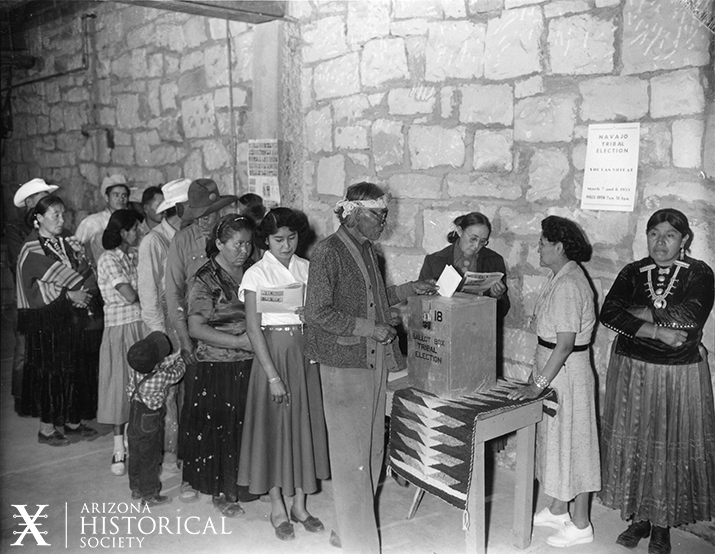
Lastly, I think it's important to point out that while the
14th Amendment provided equal rights and protection under the law to all former
slaves as well as children born of foreign parents (legal or illegal), Native
Americans weren't granted the same rights until 1924. That's 56 years after the
passage of the 14th Amendment. 187 years after America's independence.
The "Indian Citizenship
Act of 1924", or the "Snyder Law" as it became known, was signed
into law by President Calvin Coolidge (R) on June 2, 1924. It finally gave
equal rights and protection under the law to all Native and Alaskan Americans.
A sad commentary on "land of the free and home of the brave" don't
you think? Never assume your freedoms are necessarily guaranteed or protected by anyone.
If you enjoyed
the article, please consider passing it along to others and don't forget to
subscribe. It's free! Lastly please be sure to "like" us on
whatever platform you use to read anotheropinionblog.com. It helps beat the algorithms and
keeps our articles in circulation. Thank you!
National Archives: Emancipation Proclamation
The Roles of State and Federal Government
Kentucky's Abraham Lincoln
14th Amendment: Citizenship Rights, Equal Protection,Apportionment, and Civil War Debt
Ratification of Constitutional Amendments
There were 4 million enslaved people counted in the 1860census...
What Is the Snyder Act of 1921 and who does it apply to?


:max_bytes(150000):strip_icc()/Great-Triumvirate-3000-3x2gty-56a489b43df78cf77282de84.jpg)