Showing posts with label college sports. Show all posts

Friday, September 02, 2022

The Forgiven and the Damned: Biden's Student Debt Forgiveness Program and Taxpayers


President Biden caused quite a stir recently, fulfilling a long standing promise to end student debt. As typical with many of Biden's proposal, it appears he didn't think this one through particularly well. The end result will be a much needed, albeit limited financial relief for the estimated 48 million current and former students with $1.75 trillion dollars owned.

To properly understand Biden's proposal, it's important that we first understand the term Biden uses. So, to begin with, let's get our terms correct.  Instead of calling Biden's proposal "debt forgiveness", the more appropriate term we should use is "debt transfer", which is a more accurate description of what it really is. But before we get into the specifics of Biden's "debt transfer" plan, let's take a look at student debt in general.

Loan debt has been the bane of students for decades. Some cite it as the price we pay for higher education. Others call it nothing more than a money generating scheme with naive and often desperate young adults (and their parents) as the "pigeons" to use the old carnie term for unaware victims of con games. After all, since at least the 1980's, we've been told that the only way to succeed is to go to college.

Approximately 45.4 million current and past student have some form of federal loan debt, of which 4.7% was already 90 days in arrears just in the first quarter of 2022. The average monthly payment is about $300, with most loans require the borrower to pay 10% - 20% of their gross income, based on how much they're earn.

 55% of graduates with a four year bachelor degree owe, on average, just under $30,000 in student debt regardless of whether they attended a private nonprofit or public college or university. 68% of those graduating a private nonprofit college or university has a debt of $31,450 or more. 66% of those graduating from a public institution owed $26,900. 83% of those graduating from a for-profit college or university with a four year degree had a debt of just under $40,000.
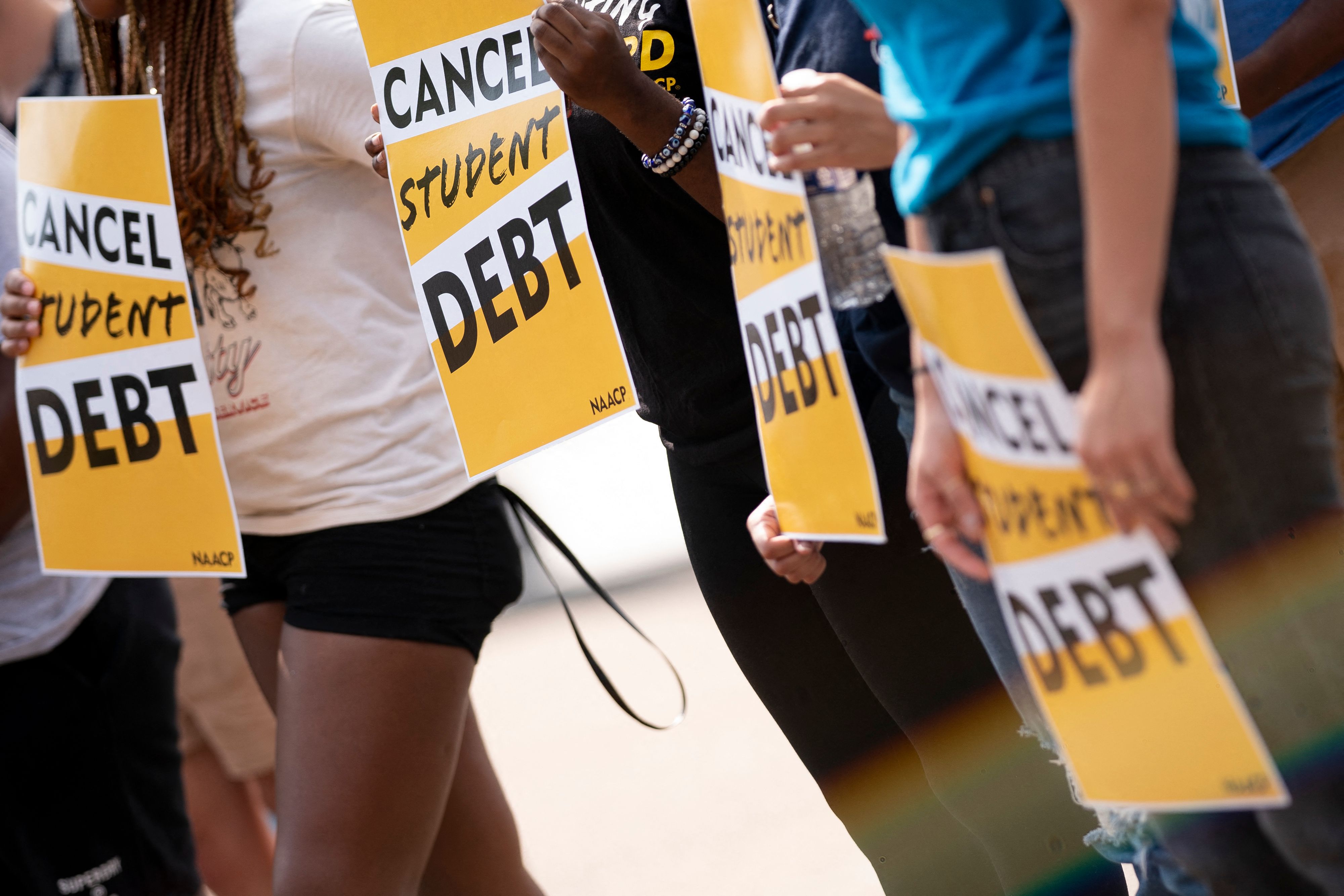
Between 2020 and 2021, students and/or their parents borrowed near $96 billion dollars to cover the cost of education with just 13% of that being private and/or non-federally backed loans. Direct loans amounted to $1.38 trillion dollars shared by 37.2 borrowers. FFEL Loans were the largest, with $225 billion loaned out to a little under ten thousand applicants. Perkins Loans, totally $4.2 billion dollars,  went to 1.5 million individuals. The grand total was $1.61 trillion dollars loaned to 43.4 million unique applicants!

The above numbers represent just a snapshot of the debt crisis. It doesn't include other forms on loans such as Stafford, Grad PLUS, or money borrowed on insurance plans, 401K and other retirement plans, home mortgages, credit cards, and so forth, which represents tens of billions in principal, interest, fees, and penalties.  It's obvious that the student debt situation is out of hand. Some would even say it's critical, and you would find few who disagree. However, before we look at Biden's plan, let's consider a few facts about higher education.

First and perhaps more importantly, not every job needs someone with as BA or BS degree. In decades past, most graduates of high school were adequately equipped academically for the majority of jobs. However, starting the mid 1970's, the quality of high school education took a tremendous nosedive. Students were being graduated who had a 6th or 7th grade math ability or read at an 8th grade level. Their knowledge of grammar and spelling was horrendous, while their grasp of history, ethics, the sciences, or literature were virtually non-existent.

Beginning in primary school, discipline all but vanished along with parent participation. At the same time, a rise in poverty among students meant more kids were showing up hungry. As a result, schools turned increasingly into publicly funded daycares. Critical thinking skills were essentially out the window as the focus turned more on sports to attract and keep students than on academics.

As a result, employers had to resort to remedial education for many of their new hires and the demand for college education began just to have the same intellectual level of an applicant they had just 10 or 20 years earlier. Along with this change, universities and employers began downplaying the need for the trades; those educated to do jobs which required physical and mental skills such as electricians, plumbers, carpenters, or mechanics.

Instead, savvy marketing drew new high school graduates to the higher priced colleges with promises of riches in four or six or eight "short years" and away from the less expensive and shorter trade schools. Thus began the rise of sustained student debt as tuition continuously rose and students were "fee" to financial death.

By way of a brief comparison, the cost of a college education is highest in the Northeast and West. It's cheaper in the South, Midwest, and Plains states. The average cost of a four year public college for in-state students is about $21,035 per year (or $84,140 for the full four years plus assorted fees). For a in-state student attending a private four year college, it's about $32,768 (you can roughly double that if you're either a out-of-state student or add another 1/3 if you're going to a for profit college).

If you attend a trade school, the average is about $33,000...for the entire program! Of course, depending on where and what degree, tuition can run $3,800 to $15,000 per year (most programs are two years or less, and in some cases, you can start earning in six to eight months). The figures used here for both college and trade are averages as of 2022. Tuition always changes, and usually upward.

 College admissions and academic administrators also starting not just encouraging students to major in degrees with little or no employment demand, they also started creating new degrees with little real world value (such as gender or race studies). Hey, all to keep the money flowing! Meanwhile, for many colleges, the focus turned from critical thinking skills (the hallmark of higher education) to even greater revenue generating sports programs, leaving some academic departments limping along.
President Biden's "debt transfer" proposal is said to "wipe out entirely" the debt of approximately 1/3 of those with federal loan debt. That's about 16 million individuals. The program includes a $10,000 dollar debt "forgiveness" (specifically, the federal government---meaning taxpayers---will pick up the tab).

This will apply to those earning $120,000 dollars or less (or a combined household income of $250,000). In addition, the federal government will "forgive" up to $20,000 in Pell Grants. Total costs for taxpayers? About $300 billion dollars. Of course, this assumes Biden's "debt transfer" proposal gets past all the anticipated legal challenges.  

By the way, don't expect any "thank you" cards from Millennials or Gen Z's. They have a reputation of self-entitlement. I bet they're going to be surprised to learn that once any type of government welfare goes into effect, it rarely if ever ends, so they expect to be paying off someone else's debt down the road! How's that for a bite in the butt of the two "I love Socialism" generations Capitalist style? 

Anyway, assuming that this portion of the Biden plan survives all the legal challenges, the president's staff claim that about 90% of those earning $75,000 a year or less (which is most Americans) will be the prime beneficiaries. The plan also includes changes in the federally based "Income Driven Repayment System" (IDR).  

Under the IDR, a student's monthly loan repayments is adjusted based on their income after graduating. Students are currently required to pay between 10% and 20% of their annual income for the first 20 years, after which the balance is "forgiven" (that is, picked up by taxpayers). According to one report, between 2010 and 2020, enrollment in the IDR jumped from roughly 10% of eligible applicants to 32%.
With Biden's plan, participants will now have to pay just 5% any undergraduate debt (and up to 10% on graduate or professional school debt such as law or medical school). This covers a repayment plan over 10 to 20 years, depending on debt size and annual income level. The proposal will also include a change in the amount of income not currently covered.

Under the current plan, IDR doesn't include repayment on income up to 150% above the poverty level (based on family size, etc). So if your income is, let's say 155% above the poverty line, your payments would be based on that 5% under the current plan and everything 150% or under is exempt.  

The new plan will adjust that up to 250% over the poverty line, meaning the minimum repayment amount is based on less income, thus significantly lowering the size of the amount due.  It also removes any accrued interest.

As a result, it encourages individuals to borrow as much as possible rather what they need. I see a lot of parties and beer runs in the near future. But fear not! The new IDR changes also encourage colleges to raise tuition since a greater percentage of debt is now being "forgiven"...and picked up by you and me via the government. So, taxpayers get all the debt of a college education but without all those pesky term papers and dust collecting degrees. 

Biden, however, suggested that individuals qualifying under the new IDR wouldn't abuse the opportunity to borrow more money with no interest, have lower monthly payments, and earlier debt termination. Instead, they would use the money saved on the loan payments to invest or spend back into the economy. They could even double up on payments if they wanted too. He also downplayed the likelihood that universities would significantly raise tuition as well.  Yeah...right Joe. Wink. Wink.

As another aside, under Biden's plan, there also could be an unintended consequence---money not paid back could be taxable at the state level  According to the Tax Foundation, there are 13 states which could treat any debt "forgiven" $10,000 or over as earned income. This includes Kentucky (naturally), Arkansas, Wisconsin, Virginia and West Virginia, Hawaii, Idaho, Minnesota, South Carolina, New York, Pennsylvania, and Massachusetts.

The Tax Foundation estimates that amount of tax to be paid could range from $300 up to $1000 or more.  To stick the knife in a little deeper, that figure could double if the debt originated from a Pell Grant and is at least $20,000 is "forgiven". So, what's the total damage of Biden's plan to taxpayers?

Well, according to the University of Pennsylvania's famed Wharton's Business School of Business (and President Donald Trump's old alma mater), taxpayers could end up stuck with a final bill of somewhere between $650 billion to $1 trillion dollars, thus proving again the old adage that no good deed goes unpunished. Not even ones designed to improve approval ratings and reelect Democrats in November. 


If you want to know more, please take a look at the links below. If you enjoyed the article, please consider passing it along to others and don't forget to subscribe. It's free! Lastly please be sure to "like" us on whatever platform you use to read A/O. It helps with the algorithms and keeps our articles in circulation. Thank you! 


A Look at the Shocking Student Loan Debt Statistics for 2022


There's a giant loophole in Biden's student debt relief that could make college even more expensive. Here's how it works


Biden's student loan forgiveness could be taxable in some states


List of States That Might Tax Student Debt Loans Dwindles


The Value of Trade Schools in Today's Economy


Average Cost of College Textbooks


Saturday, May 05, 2018

The State of America's Education System: How Low Can You Go?


I've always been a strong proponent of education. Education, as far as I'm concerned, is the linchpin to society. An educated populace is a productive populace; capable of doing a vast variety of work. This attracts businesses which generates taxes (both direct and indirect), as well as attracts other peripheral businesses, and so it continues. The result is often a community which offer a wide range of amenities, such as parks, museums, restaurants, as well as a strong social and structural infrastructure, from up-to-date sewer systems, electrical grids, clean water to adequate and well trained police, EMS, and firefighters. It should also include not just well paid teachers, but teachers who are as well respected and appreciated as some sports coach.

Without a strong educational foundation, nothing in society works (or at least very well). If you have a well educated population, you should have a society of individuals capable of critical thinking skills, an understanding of history, geography, political science and Civics; who have a general appreciation of world literature as well as the ability to perform basic mathematical computations, the sciences, and diagram sentences in order to write and speak properly. 

I would add that a well rounded graduate of high school should have completed an art or art appreciation, music class, or theater class. Kids that take what they want, without being intellectually challenged leave school underserved by not just the teachers, but the entire school system as well. Many are simply "flunked through" because of pressure by parents and the school system not to hold students back out of concern that it will "damage their self-esteem", not to mention how it makes the school system look to voters.

As a result, both the student and society often end up paying the price. The student-now-adult often finds that their nonchalant attitude in school now makes them virtually unemployable. Many take low paying and unrewarding jobs. Some end up in criminal gangs, which eventually leads to prison and/or the cemetery. 

 For the girls, they often end up pregnant and more often than not, on their own since their boyfriends end up being more immature and irresponsible "boys" than men. Either way, an significant portion end up on public assistance (tax supported charity in truth). The same goes with those who just want to concentrate on sports. Fewer than 1 in a 1000 every actually make it into professional sports and make the obscenely big money. That's some pretty poor odds.

Those who do succeed need more than athletic ability. They need the intellectual ability to think critically, to hold a reasonably intelligent (and intelligible) conversation. Most of all, they need to be able to properly interact with others; non-jocks like lawyers, financial advisors, team agents, owners, managers, the media, and other players. Far too often we see student-jocks coming out of high school (or even college) who aren't smart enough to do basic manual labor.

One of America's big failures in terms of education, has been "dumbing down" the academic expectations of students (this is a big problem in some communities where academic success is seen as a "betrayal" of one's race or cultural identity). 

The idea has been that create some misplace notion of "parity", as if all students are somehow intellectually equal, or that one group may fail disproportionately to another group. As a result, everyone gets punished. 

 Instead, students should be allowed to advance based on their own ability. Meanwhile, slower students should be allowed to progress at their own pace. Perhaps more advanced students could serve as teaching aides and help individual students in exchange for extra credit.

Another big problem in many school systems are those who cause discipline problems. Typically these are academic failing students, many of whom are insecure emotionally, who are determined to cover up their shortcomings by trying to keep other students from learning. I guess that somehow makes them feel better about themselves. 

In recent years, we've seen an increase in students attacking teachers. Hand-in-glove with this, we've seen an attempt by public schools to engage in a form of appeasement by allowing students to take what classes they want, lowering standards and grading requirements, providing "cooling off" rooms, etc.

Meanwhile, teachers aren't suppose to strike back or defend themselves. At best, the student might be suspended for a brief period. In a few cases, the student might be arrested, but there is usually a lot of pressure brought to bear not to press charges out of concern that it may have a negative impact on the student. 

We certainly don't want to see them forced to take responsibility for their bad behavior now would we? As for suspended students, they end up getting what they want---out of school and free to go do whatever they want, which eventually turns out bad for them and occasionally for society too. Students with a repeating pattern of this type of behavior need to be dealt with in specific manner.

Instead of suspending these students, they need to be placed in special schools designed to modify their behavior. Here the rules have to be different. Emphasis has to be on engaging the student directly, and if necessary, responding to violent outbreaks with appropriate responses.

 Bullies (and these often tend to be bullies who haven't been taken down a pig or two previously), need to be confronted. In addition, these individuals need to be assigned to these type of schools for a minimum of a month---24/7. Their personal behavior and academic performance dictates the length of their stay. 

Parents and selected friends can visit, but they can't leave. It can be a tough punishment, but their behavior brought it on themselves and it's better that they learn to take responsibility for their action now than down the road and end up in prison or dead (as an aside, America leads the world by far in terms of percentage of imprisoned population).

Speaking of school, I also want to stress that while there is a strong emphasis on going to college, college is not only not for everyone, it's really not necessary for most jobs (especially if high school had properly prepared the individual for life after school). Not every manager or supervisor needs a four or six year degree. Trade and vocational schools are often a much better option than college. 

First off, they prepare individuals for entry into the workplace much faster than college. They are also far cheaper so you don't rack up the massive school debt, and you often can start working in the field of your choice while still in school. They pay is generally excellent, as are the benefits. For experienced individuals, it's usually a short step to go into business for yourself.

For those who do decided to go to college, it's important to think realistically about what you want to major in. It's nice (or idealistic) to think about getting a degree in gender or racial culture studies, or in some other obscure topic, but will it give you a job when you graduate? Will taking a course in "Star Wars vs Star Trek" actually help you land a job? Is the degree you end up with enough to pay off a $100,000+ school debt? You have to think in practical terms.

College is about learning to think more critically. It's about learning to appreciate different opinions without not necessarily having to agree with or feel threatened by those opinions. It's about being able to express your ideas in a well thought out and reasoned manner. It's about using reason and logic to analysis an argument or situation. 

College is not about shouting down those you disagree with. It's not about forcing them off the stage or destroying property when you don't get your way. It's not about having a "safe space", nor is it about getting coddled or trying to make everyone happy. It about making an informed and well reasoned argument in a respectful manner using critical thinking skills. If you can't do that, then you need to consider what you need to do grow up emotionally. Perhaps you should consider a stint in the military. I guarantee you'll grow up there in a hurry.

So, with that said, how does America stack up academically compared with the rest of the world? According to the site "Ranking America", their latest study from 2015 ranks American public schools 14th overall academically in the world. South Korea, Japan, Singapore, Hong Kong, and Finland, in that order, make up the top five. 

The best performing school systems in America, Vermont and Massachusetts, can't compete with students in countries like Taiwan, South Korea, Hong Kong, or Singapore in subjects like math and science.

Speaking of science, the school systems in Alabama and Mississippi are closer in academic performance to countries like Kazakhstan and Uzbekistan, while the school system in the District of Columbia is the academic equivalent of Bahrain. Overall, America's academic performance among its public school resemble those of third world countries. 

Countries like China, India, Pakistan, and Japan far out produce the US in graduates with medicine, engineering, robotics, and computer science degrees, especially at the masters and PhD levels. Ironically, the US spends more on education than most countries--6% of its gross domestic product---which is on par with countries like Ghana, New Zealand, Saudi Arabia, and Morocco. Interestingly, it's also far more than countries like Korea, Taiwan, and Japan, who outperform us, spend.

Finally, in terms of teacher pay, apparently US teachers are about average in terms of pay with an average of $43,600 per year for a primary school years with 15 years of experience compared to an average of around $39,000 for other teachers in economically developed nations with the same experience. 

Thus, American school teachers are paid roughly equivalent to teachers in the UK, Australia, and Holland. As an aside, the highest paid teachers are those in countries like Luxembourg, South Korea, Switzerland, and Germany.

However, American school teachers spend a lot more time teaching compared to other teachers around the world. US teachers spend, on average, 1089 hours teaching compared to 794 hours in primary education, 709 hours in lower secondary education, and 653 hours in upper secondary education. 

Thus, it appears that while US teachers spend more time actually teaching, they aren't equally compensated for the time they spend in the classroom. Of course, I should point that it's not uncommon for teachers to pay for school supplies out of their own pockets to make up for shortfalls in schools budgets (which often ends up in the salaries of administrators, who tend to be to numerous for most school systems).

So, there you have it. This is the state of American schools, where bright students often find themselves held back in underperforming schools; where even average students find the academic process disruptive and their academic opportunities short changed. In college, students aren't properly taught critical thinking skills and instead of being taught the true meaning of liberal arts, they become narrow minded and provincial. 

 Our teachers aren't paid bad, but neither are they paid for the work they actually do. We are continuing with our downward trend academically compared to the rest of the world, which may soon render us just another second tier nation with large swath with more in common with third world nations than not; a faded world power like so many who came before us. Meanwhile, America's military budget, at the direction of the ruling Oligarchy, continues to expand at the expense of our infrastructure, and ultimately, our children. The only real question is what are we going to do about it?


 If you enjoyed the article, please consider passing it along to others and don't forget to subscribe. It's free! Lastly please be sure to "like" us on whatever platform you use to read anotheropinionblog.com. It helps with the algorithms and keeps our articles in circulation. Thank you!