Showing posts with label oil and gas. Show all posts

Thursday, March 06, 2025

Trump Getting Real with Zelensky: Find Peace with Russia or No More Money


Much has already been made of the heated meeting between President Vladmir Zelensky of Ukraine and President Donald Trump and Vice President  JD Vance.  President Trump, in effect, told Zelensky to make peace with Putin or he was taking away the keys to Ukraine’s war machine…and put a damn tie on where he’s at it!

Zelensky seems to believe that with U.S. financial backing, he will be able to stalemate Putin virtually indefinitely, perhaps even in the long run, obtain NATO membership. That’s something Trump opposes. Putin has attempted several overtures at peace, which Zelensky has essentially blown off like, and why not? He’s got the biggest bully in the world in his court, the United States.     

Trump used the meeting to make a very public statement to Zelensky, the people of Ukraine, to Putin, and to the world---no more money, no more armament and no mineral deal until Zelensky puts on his big boy pants and can set down for a serious discussion about peace with Russia, otherwise we walk, and he can deal with one very angry Russian bear.

 NATO, which also heavily depends on the US, can do as it pleases, but the US needs to set this one out thank you very much should they continue to poke the bear (and kudos to Italy’s Prime Minister, Georgia Meloni, for rejecting UK-French plan to send European troops to Ukraine). It’s one thing to come to the aid of ally being attacked, but when they bring it on themselves, maybe a lesson in “told-you-so” diplomacy is in order.

Putin, on the other hand, has committed much of his military to what amounts to a slow bleed of Ukraine’s economy and military. His has activated antiquated weapon systems (such as outdated tanks) and even employed North Korean troops in what amounts to a ”fight for food” deal for the bankrupt Communist state.

The only sensible reason for Putin to do this is one of taking a measured stance against Ukraine. Putin didn’t start the war. Zelensky and NATO did (with a little help from a former president’s son looking to score a big financial payday). Putin has been consistent his insistence that NATO missiles and armament will not be deployed along his border with Ukraine. Zelensky and NATO thought that by playing the U.S. card, Putin could be intimidated. That wasn’t going to happen

Putin is not a spineless leader of the sort that Europe has produced in abundance lately (for an example, look at their immigration disaster and its effect on crime and their culture). Putin is very intelligent. He was a senior KGB officer. He doesn’t bluff. Unlike European leaders, he doesn’t care if you call him names.  However, since the fall of the USSR and Soviet Russia, their leaders, starting with Mikhail Gorbachev, have tried  once again to build bridges to the West.

Ever since the days of Peter the Great, Russia has wanted to join with the West and act as a bridge between East and West. At one point,  they even asked to join NATO and was rejected out of hand and perhaps justifiably so. With the end of the Cold War, there had been a lot of talk about dismantling NATO.

Therefore, NATO’s justification for its continued existence depended on having a bad guy and that bad guy is Putin. It’s also why many neo-cons and policy gamers are anxious to start a new Cold War. War is profitable---cold or hot. It bears mentioning that the establishment of the Warsaw Pact came about only after the creation of NATO and then with the intention of being a defensive deterrent, presumably against the same military and industrial complex President Eisenhower spoke of in his 1961 “Farewell Address to the Nation”.   

In 1990, as the Warsaw Pact nations began to fall, Secretary of State James Baker informed Soviet Foreign Minister Edward Shevardnadze (in the presence of Gorbachev) that once the unification of Germany was complete, NATO had no intention of advancing “one inch to the east”, and yet within ten years, that’s exactly what happened. Gorbachev saw it as a time to restart and one of openness or as he called it, “Perestroika”. As Gorbachev said at the time, “we are duty bound to learn to live in peace”.

One by one, the former Warsaw Pact countries of Poland (1999),  Hungary (1999), Romania (2004), Czechia (1999), Bulgaria (2004), the Baltic states (2004), and so forth were admitted into NATO, and each time Russian leaders protested through all the proper international channels and were ignored.

At first, the Russians were assured there would be no more, until there was. But each time a country joined, NATO missiles were deployed all along their border. As a result, Russia was slowly helmed in. It would be like Russian missiles being deployed along our southern border, first in the numerous Caribbean islands one by one, until finally, in Mexico along the Rio Grande.

What if the Russians started deploying missiles along the Canadian border just like what happened after Norway and Denmark joined NATO in 1949, Finland in 2023, or Sweden in 2024.   How would you expect Washington would react?

Actually, you don’t even have to imagine. That was what the 1962 Cuban Missile Crisis was all about. It was Russia’s response to U.S. nuclear tipped intermediate range “Jupiter” missiles previously being deployed in Turkey (which had joined NATO in 1952).

Amusingly, then Soviet Premier Khrushchev would walk visitors to his vacation home on the Black Sea to the balcony and hand them  a pair of binoculars, asking “what do you see?”. They typically replied, “I see the sky” or “I see the water”. He would then look through the binoculars and bellow “I see American missiles in Turkey aimed at my dacha!”.

It seems that everyone knew that a NATO presence in Ukraine would be the straw to break the bear’s back, yet they expected Putin to do nothing but grouse and saber rattle like the West does, but that didn’t happen. Putin secured the Crimea, which has been a Russian possession since 1783 when it was annexed by Catherine the Great. It has a majority Russian population. Strategically, the Crimea is the home of the Russian Black Sea Fleet, at Sebastopol, which is their version of our naval base in San Diego.

Russian is taught in its schools and it’s the common language of its people. It was followed by a plebiscite, asking the citizens whether they wanted to remain apart of Russia or the Ukraine. The overwhelming majority said “Russia”.

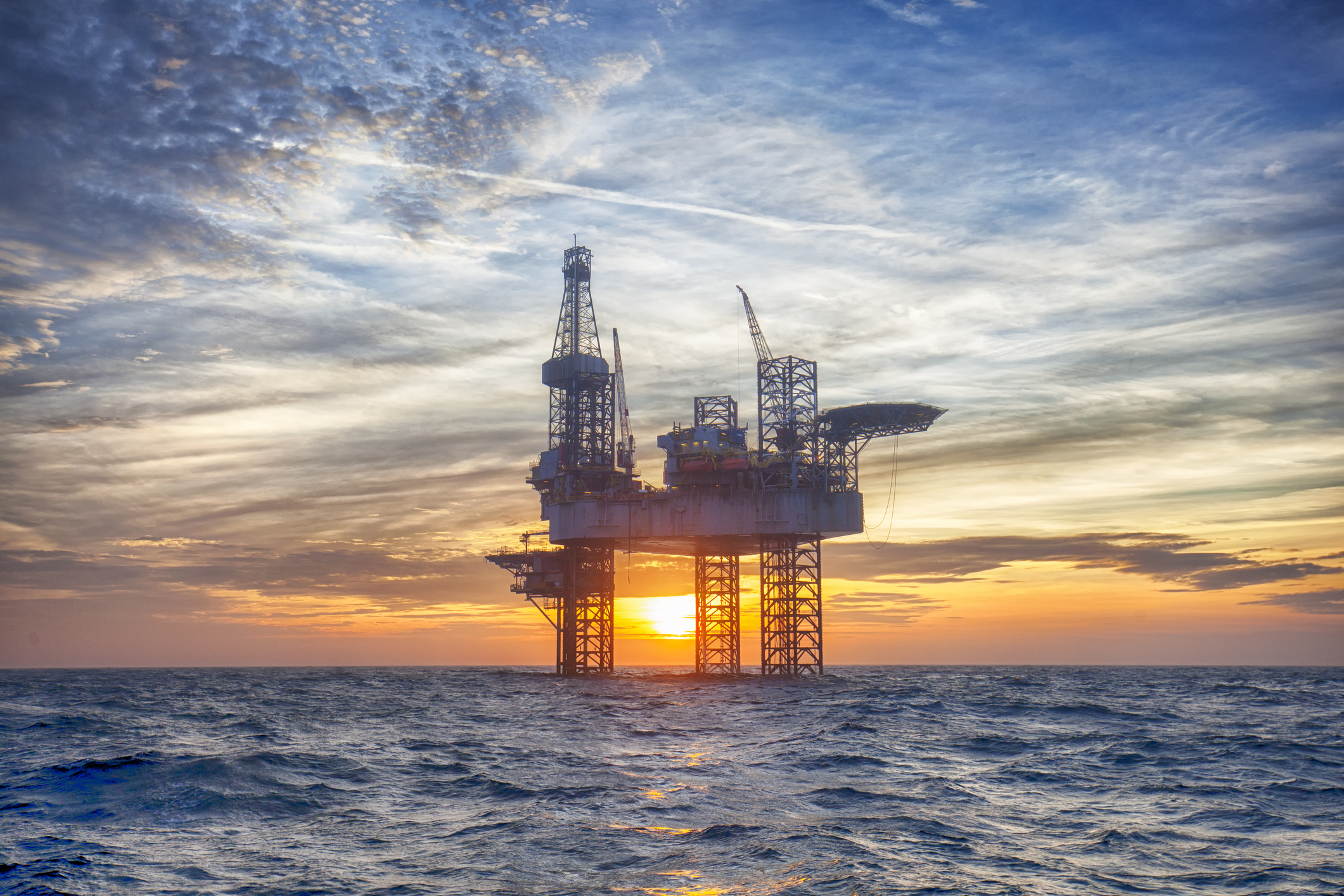
But this had nothing to do with the history of the region, the will of the people, national sovereignty, or even the long standing presence of the Russian military in and around Sebastopol. This was about oil and gas, which had been discovered in abundance in the Black Sea, and western oil companies wanted it.

In addition to large reserves of oil and gas, the Ukraine has vast deposits of key minerals, much of it in the disputed Donbas Region which is occupied by Russian troops. The deal President Trump was willing to sign with President Zelensky would have allowed a U.S. presence in the Donbas (technically still belonging to Ukraine) to mine for deposits valuable minerals, with each country splitting the processes 50/50. It would enable the Ukraine to begin paying the U.S. back some of the billions it owes us in aid, retain Ukrainian soil, and help Ukraine to rebuild its infrastructure.

In addition, it would be an incentive for Putin’s troops to either withdraw from the areas being explored and mined, or perhaps even pull back altogether. After all, Putin doesn’t want to kill or injure U.S. civilians at any cost. It would serve as a de facto “economic buffer zone” without the need for a single pair of U.S. military boots on the ground and each side wins.

However, Zelensky needed to agree to a peace talks with Russia, and that’s where he has repeatedly dropped the ball. When it comes to power politics, Zelensky is out of his league. He’s a standup comedian turned politician unlike others who are politicians turned fools.  Accordingly, he got a dressing down in his meeting with Trump and Vice President Vance. He was put on notice that the U.S. would not finance his war with Russia indefinitely or for free.

Even during the early stages of WWII, before the U.S. was directly involved, Prime Minister Churchill gave the U.S. 99 year leases to bases on their island possessions in the Caribbean as a “down payment” and “thank you “ to all the war material and economic support we provided to England under the Lend Lease Act of 1941 (the act also extended to the Republic of China, France, the Soviet Union and other allied nations).   As of 2024, we have given Ukraine $174.2 billion dollars in aid (military and otherwise) while the European Union has given about $18 billion.

President Trump announced during his speech to Congress on March 4th, that he had received a letter from Zelensky finally agreeing to sit down with Putin and hammer out some sort of peace deal. It may not be entirely to Zelensky’s liking, or that of Putin’s, but it will mean no more killing on either side and ending the destruction of Ukrainian cities and villages.

In addition, President Zelensky said in his letter to President Trump that he was still willing to sign the minerals agreement, which would be a good thing for the Ukrainian economy. Ukraine is a country with vast untapped economic potential, from the oil and gas reserves it does control, to its timber and mineral wealth, and it possesses the most fertile soil in Europe and quite possibly the world. (hence the moniker “breadbasket of Europe”).

This was also an education of sorts for Zelensky about what Otto von Bismarck called “Realpolitik”. Never disrespect your benefactor or take them for granted. By that, don’t show up in casual slacks and t-shirt and “knock-around” boots to meet the leader of a world power and expect to be given a virtual blank check for a never-ending war without a plan to pay them back.  America isn’t your ATM. Show some humility. Even Churchill arrived dressed to the nines with hat in hand and he offered at least island leases!  


Thank you for reading "Another Opinion", the Op/Ed blog page for the "militant middle".  Here at "A/O" we truly value our readers. At A/O we seek the facts as they exist, not partisan talking points.  We hope you find our articles informative and engaging. Comments are welcome, provided they are not vulgar, insulting or demeaning.  Another Opinion is offered without charge and is directed toward all independent and free-thinking individuals. We ask, however, that you "like" us on whatever platform you found us on in order to keep our articles available for free to others. Lastly, in order to keep costs down, we depend on passive marketing, and therefore, depend on our readers to please forward our posts along. Below you will find links to the sources we used in writing this article. Thank you. 


  Zelensky vows to ‘make things right’ with Trump and negotiate peace


How Gorbachev was misled over assurances against NATO expansion


4 Lessons to be learned from Zelensky’s White House Meeting


What they said: Trump, Zelenskyy and Vance’s heated argumentin the Oval Office


NATO Members


Russo-Ukrainian War  


Controversy regarding the legitimacy of eastward NATOexpansion


Lend Lease Act


EU Assistance to Ukraine (in U.S. Dollars)


No suit, no lunch, no respect: Zelenskyy-Trump feud startwith a fashion dig


Friday, December 06, 2024

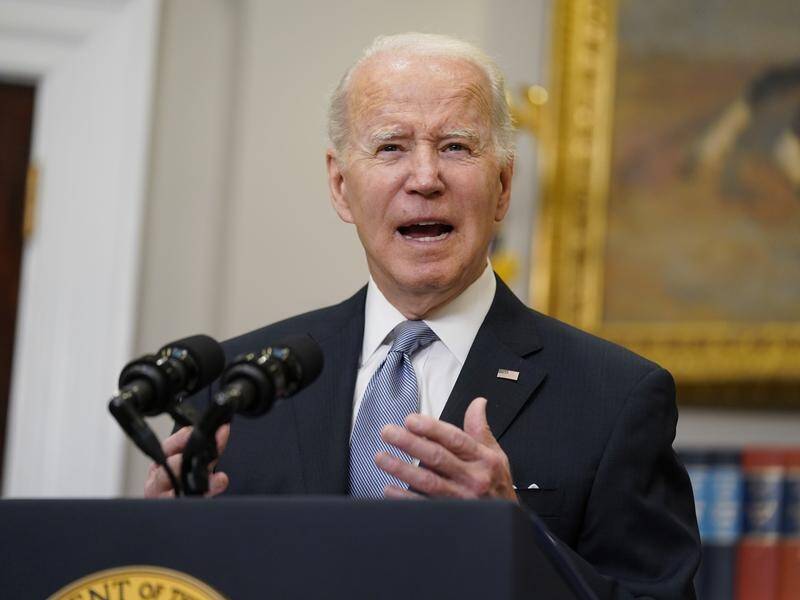
President Biden pardon son, Hunter, despite "No One is Above the Law" promises

Merry Christmas to Hunter Biden!  His dad, outgoing President Joe Biden, has reloaded Hunter's "Get out of Jail" card, thus ensuring junior will skirt around the U.S. legal system once more.  Hunter's pardon  proves again to the American People and the world what we've known all along, that the United States has a dual legal system, one for the wealthy elites and one for the rest of us.

The then candidate President Joe Biden promised the American People on several occasions that his son, Hunter, would not be receiving a pardon from him, citing his trust in the U.S. justice system and Hunter's innocence (apparently he's not feeling so confident any more). If convicted, Hunter would be the first child of a president to face a possible prison sentence for felony criminal charges.

Hunter has been in repeated trouble for years including charges of cocaine possession (some have speculated that he may been the one who brought a stash of  "coke" into the White House, bypassing security. Something a ordinary visitor wouldn't be able to do), tax evasion, illegal gun possession to name but a few. There's been allegation that Hunter spent time on Jeffrey Epstein's "Pedophile Island" (who was actually there is still a matter of some dispute).  

Some believe his businesses dealings with Ukrainian oligarchs and politicians was a factor behind the current war between Ukraine and Russia. The war has caused the loss of thousands of lives and billions of dollars in damage, threatened Europe with war, ruined U.S. and Russia's relationship, and all over a  deal with oligarchs in the Ukrainian government involving oil and gas rights in the Black Sea in exchange for NATO protection (and supposedly guaranteed by then Vice President Joe Biden).

Of course, Trump supporters are giddy about President Biden's Christmas gift to Hunter since this appears to be a gift which just keeps on giving.  Thanks to Hunter's pardon, conservatives now see an opportunity for President Trump at being able to pardon all those facing possible jail time and/or fines for their part in the so-called "January 6th Insurrection" using the same legal argument.

If, as it's argued, Hunter can skip away untouched for all his misdeeds, then the "J6 political prisoners" as they're called, should be able to walk away too. If you think about it, it's hard to believe how far America has slipped. After all, the legal system, of all our branches of government, was expected to be the one branch  least affected by partisan politics and corruption, but here we are!  What happened?

Born in 1970, Hunter's life has been rife with trouble. Although his father doesn't drink, Hunter has more than made up for it. He's also had a long history of cocaine abuse dating back to his time in college and has been in and out of rehab centers (he attended Georgetown College and Yale's law school).

Shortly after graduating, Hunter was hired as a consultant by MBNA America, a holding bank with close tie to his father, Joe Biden, and one of his top political contributors. As Hunter quickly rose through the ranks to executive vice president, Joe was busy supporting a bankruptcy reform through Congress, which, as an aside, would aid certain financial institutions. You know, like MBNA America (which was eventually acquired by Bank of America).

In 2013, Hunter decided he wanted to join the U.S. Navy Reserves. And so following a swearing in ceremony at the White House under the  beaming gaze of his then Vice President father, Hunter was ordered to report to his first duty station...and was promptly discharged shortly after arriving for testing positive for cocaine. I guess he forgot having  read (and signed) the Navy's zero tolerance policy statement about drug use.

The death of his older brother, Beau,  from a brain tumor in 2015, sent Hunter back down the bottle again. He reputedly would never leave his house for days at a time unless it was for a trip to the liquor store! According to Kathleen Buhle, his ex-wife, that when they were going through their divorce, Hunter was consuming "massive" amounts of drugs and alcohol while spending a great amount of time and money on hookers, at strip clubs and with other women to the point where the family had no money left to pay their bills. 

A 2019 DNA test confirmed he was the father of child with a woman who had been employed as "exotic dancer". In a 2021 memoir, Hunter admitted that it was the unbridled infidelity that drove his wife away. As an aside, while the divorce with Kathleen was still pending, Hunter hooked up with Hallie Biden, the wife of his deceased brother Beau. Given that Hunter and Beau was considered inseparable, doing nearly everything together, perhaps this isn't too surprising.   The affair lasted about two years.

Despite being an addict and alcoholic, Hunter purchased a pistol in 2018, following another stint (this time for 60 days) in rehab. Allegedly, Hunter lied on the gun purchase application by saying that he was not a addict at that time. Hallie said that she found the gun and ammo in Hunter's car while she was removing drug paraphernalia.

Hallie went on to say that she put the gun in a old grocery bag and pitched it into dumpster. Hunter and Hallie split in 2019 just as Joe Biden announced another bid for the White House, this time against sitting President, Donald Trump.

Hunter didn't morn the breakup for long. Just about a month later, he met and married Melissa Cohen, documentary producer and social activist from Johannesburg, South Africa  following a six day "romance" on May 19, 2019. Shortly afterwards she became a naturalized citizen U.S. She is 16 years his junior.

By this point, while still employed by MBNA Bank, Hunter started a lobbying firm (no potential conflicts there). Politico Magazine reported that many of his early clients were in industries overseen by Joe Biden's committees in the Senate. In 2008, Hunter, along with another family member, acquired a hedge fund group, Paradigm Global Advisors just as Senator Biden resumed his chairmanship of  the Foreign Relations Committee (both Joe and Hunter have denied any collusion or wrong doings).

The Foreign Relations Committee is the only Senate committee to oversee, debate, and report on treaties directly to the president as they pertain to national security issues, including war powers, foreign aid programs, treaties, military deployment, executive agreements with foreign powers or agencies,  arms control, sales, and training matters, global economic policies, holding confirmation hearings for high level positions within the State Department, oversight of the U.S. Agency for International Development, as well as monitoring all American embassies, diplomats, and international posts.

By 2013, Hunter finally made it into the majors. He took a founding board seat with the Chinese private equity firm, BHR. Originally, he was apparently there as a unpaid consultant. Later, however, apparently because of his vast knowledge of foreign affairs, he was given a 10% equity stake in the company.

Much has been made in the media of a official trip by Vice President Biden, accompanied by his son, Hunter, to China for a simple "meet and greet" with Chinese government officials and various business leaders, including BHR's chief executive. Hunter described the meeting as merely stopping by for a "cup of coffee".  Shortly afterwards, BHR was registered in Shanghai, often called China's  "economic and technological crown jewel".

According to the Internal Revenue Service and the Department of Justice, during this same time frame (between 2016 and 2020), Hunter knowingly and willingly set out to defraud the government. Officials  estimated that Biden filed to pay some $1.4 million dollars in taxes.  When he did finally file his tax returns, he included false business expenses in order to reduce his tax liability, misrepresented payroll and other deductions among other allegations.  

In 2017, Hunter joined with Chinese businessman, Ye Jianming, founder and former chairman of CEFC China Energy Company Limited, in a deal to acquire natural gas rights in Louisiana (Ye was also an economic advisor to Czech president, Milos Zeman). However, before the deal could take off, Ye was picked up by Chinese security on charges of bribery and other "economic crimes".  As of March 2018, Ye hasn't been seen.

In 2014, Hunter Biden joined the board of Burisma Holdings, a Ukrainian energy holding company headquartered in Kyiv involved in exploration and production. The company was owned by Russian oligarch, businessman, and politician, Mykola Zlochevsky, through his private company, Brociti Investments Limited.  For his participation on the board, Hunter was paid $1.2 million dollars a year.

 Later, through investigation by Ukrainian authorities, it was determined that oligarch, Ihor Kolomoisky, was the real owner behind Burisma.  Kolomoisky, a Ukrainian born Israeli businessman and billionaire, was at one time considered to be Ukraine's most powerful oligarch.  It bears mentioning that  Hunter's presidential pardon by Biden extends back to the start of his dealings with Burisma Holdings in 2014.

At the same time, Vice President Biden promoted the investigation of the Ukraine's leading legal prosecutor, Viktor Shokin, who was being accused of corruption. By pure happenstance, Shokin, the Prosecutor General of the Ukraine (equivalent to our U.S. Attorney General), was investigating alleged corruption between government officials and Burisma Holdings and its board members.

Now, why should a U.S. Vice President concern himself with a clearly internal legal matter in the Ukraine? Claims of collusion was denied by the White House and Democratic members of the House Committee on Oversight and Accountability.  In 2016, the Ukrainian parliament voted to remove Shokin from his office. Not surprisingly, Viktor Shokin maintains his removal was due to his investigation of Burisma.      

Nevertheless, an FBI informant claimed that Joe and Hunter Biden were paid $5 million dollars each by Burisma executives for helping stop the investigation. The claim proved later proved to be false  (apparently you just can't trust FBI informants despite what they say on those TV shows). Meanwhile, one of Hunter's reputed business partners said that Joe Biden was part of conference calls with Hunter and other contacts, implying that Hunter had the support of his father.

A laptop belonging to Hunter was left with a repair shop in Wilmington, Delaware eventually found its way into the hands of the FBI. An examination of its hard drive was said to hold evidence of Hunter's dealings in China and Ukraine as well as his extensive use of drugs and booze.

Just exactly what was on the hard drive remains unknown, although since the revelation of the hard drive's possession by the FBI, the media has repeatedly implied that it proved Hunter's shady dealings which may have affected our national security, proof of bribery and corruption, or Joe Biden's direct or indirect involvement.

Republican members of the House Judiciary Committee and its Select Subcommittee on the Weaponization of the Federal Government and the Permanent Select Committee on Intelligence release a report which proposes that 51 CIA subcontractors, including then CIA Director, Gina Haspel, aided the Biden presidential campaign in misleading the public about President Biden and the contents on the laptop's hard drive. If the report is accurate, it would further damn Biden's political legacy not to mention the already crumbing credibility of the U.S. government and the power of the Deep State.  

On September 5, 2024, Hunter Biden was found guilty of tax evasion pertaining to a nine count complaint. Biden was found guilty on three felonies and six tax related misdemeanors. The Justice Department said that there was no plea deal made with Hunter. On December 16th, Hunter is scheduled to appear for sentencing, which carries a maximum 17 year prison sentence. On the gun possession charges, Hunter could face up to 25 years of prison time.

Although whatever was on the hard drive was enough for federal prosecutors to bring a criminal investigation against Hunter. But with Hunter's blanket pardon, the issue is moot. Hunter gets to walk away virtually unscathed despite President Biden's statement that "no one is above the law", well, except apparently his son, Hunter.

The U.S. Constitution grants the president the authority to issue a pardon, amnesty, reprieve, or commutation. A commutation reduces a sentence without completely setting it aside. A reprieve is a temporary delay or suspension of a sentence. A pardon absolves the person of all criminal charges as well as restore all civil rights while an amnesty is the same as a pardon but applies to multiple individuals or groups.

It's doubtful the American public will ever know the full contents for sure.  Nevertheless, the whole nefarious episode demonstrates to all just how broken society has become and how just much value we place on money, power and prestige, even if it means destroying our own lives or the lives of others. It also shows that those with money or hold power don't face the same rules or outcomes as does the common citizen. This is truly a nation of two separate and unequal legal systems.


Thank you for reading Another Opinion! We hope you enjoyed this article and will pass it along. Please don't forget to subscribe. It's free! Lastly, please "like" us on whatever platform you use to read anotheropinionblog.com. It helps beat the algorithms and keeps our articles in circulation. Please find below the links we consulted in researching this article.


Biden, Inc.


The Bidens' Influence Peddling Timeline


From laptop to pardon: The Hunter Biden story explained


Joe Biden pardons son Hunter: What it means and why itmatters


Melissa Cohen Biden


Burisma


Mykola Zlochevsky


Ihor Kolomoyski


Committee on Oversight and Accountability (Democrats)


Hunter Biden laptop controversy


New Information Shows CIA Contractors Colluded with theBiden Campaign to Discredit Hunter Biden Laptop Story


Robert Hunter Biden Convicted on Three Felony Tax Offensesand Six Misdemeanor Tax Offenses


Friday, May 05, 2023

Taming the Golden Dragon: Facing Down China's Growing Military and Economic Influence

While military spending is important to maintaining a strong defense, it's only part of the picture. There are numerous other factors to consider, which brings me to the Lowy Institute Asia Power Index for 2023.

Founded in 2003 by Frank Lowy, the Lowy Institute is a independent Australian think tank. The institute's role is to provide original policy oriented research pertaining to political, economic, and strategic issues from a global perspective with an emphasis on Asia in this case.

The Asia Power Index examines a myriad of factors such as GDP, technological connectivity, resource availability, internal stability and military capabilities in to order to access the overall political clout each of the 26 Asian nations.

For brevity sake, we will focus on a handful of countries with an emphasis on China, Russia, and the United States who are considered the current key global players and some of the key factors affecting the standing. If you'd like to delve into the index more deeply (and we encourage you to do so), we've provided a link below. I'm sure you'll find it as intriguing as we did.

In terms of Gross Domestic Product (GDP), China was the largest. Alone of the top five, which included the U.S., India, Japan and Russia, its GDP showed signs of sustained growth. It's worth mentioning that sixth placed Indonesia's GDP was growing, making it 9th out of the 26 Asian nations in overall power.

When it came to productivity, the U.S. scored a perfect 100, followed by Australia, Singapore, Japan, New Zealand, and Taiwan. Russia ranked 9th while China was 11th. India, Philippines and Indonesia ranked lower.

The United States was first under the heading of "International Leverage". This can be defined as global clout based on available financial, legal, sanctioning (and enforcement) capabilities.  China was second with its leverage showing sign of growth. Third place Japan, however, saw its influence declining, whereas India, Singapore, South Korea, and Russia all experiencing growth in their global clout.

Technology seems to be the byword for prosperity these days, which was puzzling as each of the top 10 nations associated with technological innovation all showed decline, including top ranked United States, China, and Japan. To find any country whose technology capabilities were growing, we have to drop down to Myanmar in 22nd place on the Index.

However, when it comes to high tech exports, the leading countries were Russia, Brunei, Cambodia, and Indonesia. The United States and China were in fourth and fifth place respectively. 

Under the heading of "Resilience", we come to resource security or the ability to protect and preserve national resources.  In looking at energy self-sufficiency, which would be essential in the event of a global natural disaster or world war, we had some surprising finds.

Each of the top ten countries, starting with Australia, Brunei, Indonesia, Laos, and Malaysia, scored 100, as did Russia and the United States.  China was 12th with a energy self-sufficiency  score of 79.6.

Another key factor was fuel security. Not unexpectedly, China, Russia, and the U.S. all scored 100, as did India, South Korea, and Thailand. However, only Brunei and Malaysia showed signs of growth. In terms of net fuel exportation of refined petroleum, China showed growth while Russia, the U.S. as well as India had a decline in their net fuel exportation.  

In today's high tech world, access to rare earth metals are critical. These minerals are used in everything from computer chips and digital cameras to cell phones, batteries (especially like those used in electric cars), flat screen TVs to refining equipment used in processing oil and gas.  

Ranked first, China was the only country with a score of 100. Second was the United States with a score  25.6, though production of rare earth minerals by tonnage was declining. It's worth noting that the U.S. imports 78% of it rare earth metals from China. In addition, China has roughly 90% of all known rare earth minerals in ground.  Fourth was Australia which has been increasing its share of mined rare earth metals. 6th ranked India and 7th ranked Russia were both reducing their percentages of tons mined.  

Perhaps one of the most overlooked but critical factors is that of internal security.  The U.S. was ranked 8th among the 26 Asian nation with its internal stability in decline, which isn't surprising. For five straight years the Economic Intelligence Unit's "Democracy Index" has rated the U.S. as a "flawed democracy" and ranked us 26th out of 167 countries, putting us between Chile and Estonia.  Other studies have shown the United States as no longer a Republic, but a Corportracy and an Oligarchy.

China was ranked tenth in over internal security, but also declining. This likely due to the rising tensions in China's Xinjiang Province among its Muslim population which makes up about 2% of China's total population. In addition, there has been a surge in China's Pro-democracy movement, principally around Hong Kong, and opposition to one party rule.

15th ranked Russia also faces declining internal stability. This appears due to several factors such as frustration with Putin's control over the country, a decline in democratic freedoms, the ongoing war with Ukraine and  its effect on the Russian economy, and rising militancy among its Muslim population.

Another related factor is political stability. Singapore and New Zealand are considered the most politically stable of the 26 Asian nations with scores of 98.5 and 98.0 respectively. Nevertheless, the United States was ranked 11th with a score of just 44.8. While the Index showed increasing stability, this may be a bit deceiving.

The two primary political parties have become dominated by corporate special interests and there has been less diversity of opinion from mainstream news sources, resulting in a drop in trust according to the major polling services.  Meanwhile, voters have been abandoning both parties enmasse, resulting in a 49% majority of voters registering as Independent.  

China, ranked 16th, too is showing as what passes for "political stability" as the CCP has exerted tighter control over the government amid the growing tensions with the United States and the West, and rising internal troubles. The same can be said for 20th placed Russia and Putin's tightening grip given the war with Ukraine and frosting of relations with the West, and particularly the United States.   

America was alone among all developed industrial nations in continuing seeing a rise in infant mortality along with a decline in life expectancy and general quality of life. In 2020, it ranked 50th of 147 countries. The U.S. ranks 47th in life expectancy, putting it between Albania and Estonia.

As an aside, it's worth noting the United States ranks last among the seven largest high income economies in terms of healthcare. The metrics used include quality of overall care, number of and access to hospital beds, quality of life, access to care, and efficiency despite having the most expensive healthcare system of any country. So who's the best? Norway, followed by the Netherlands, Australia, the U.K., and Germany.

Now we turn to the military.  In terms of sheer manpower, with 2.8 million men and women in uniform and another 500,000 reservists, China should be the largest military in world. However, according to the Index, India has taken over that honor with just over 3 million active duty military personnel. The Index also shows that China has decreased the number of active duty military while India's has increased.

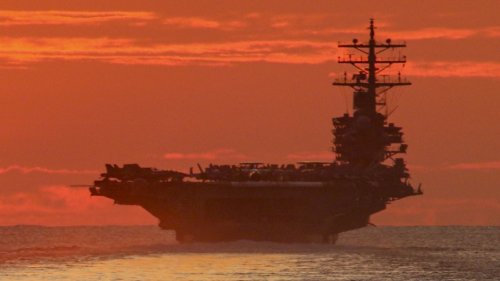
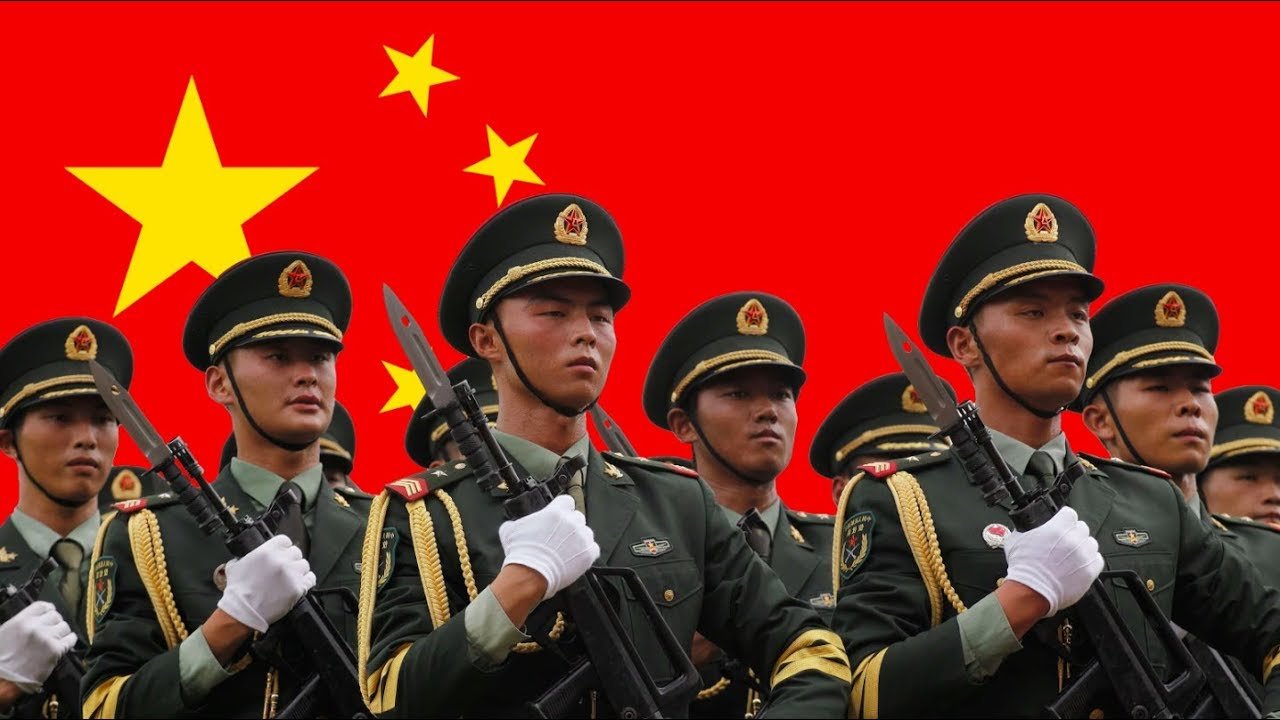
China has, however, been on a building spree to increase the size of its navy which includes aircraft carriers--- one operational, one nearing completion, and another on the drawing board. It has increased the number of its cruisers, destroyers, and landing craft of various sides. It's chief problem at this time is a lack of trained carrier based pilots and that takes time. Russia was ranked fourth with roughly 1.4 million in uniform. The U.S. ranked 5th with 1,495,000 men and women serving in the armed forces.

In a related area, the Index still gives the U.S. the nod when it comes to long range naval force projection, though its ability has declined in recent years. China has been quickly rising from its number two ranking position and may overtake the U.S. in the Pacific within the next few years. However, for now, the U.S. remains first in naval deployment capabilities.

Both Russia and the U.S. have seen a decrease in the effective of their respective militaries. In the case of Russia, it's been the reduction in overall preparedness since the fall of the Soviet Russia in 1991. When it came to rapid deployment, China was ranked first thanks to a new emphasis on its naval development. Russia was a close second. The U.S. was fourth and trending down.

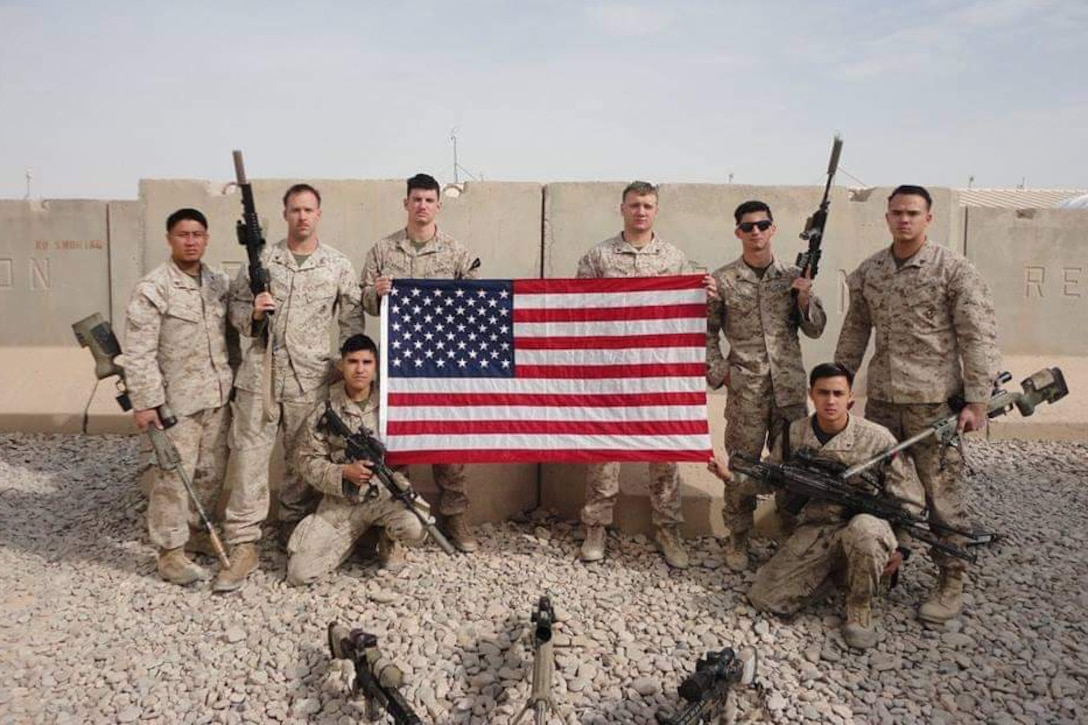
In America's case, this is due largely to the 20 year misadventure in Iraq and Afghanistan which has left the military understaffed and in need to a complete overhaul of nearly everything. Several defense report suggest that the only branch now capable of a full engagement was the Marines.

Other reports point out that the U.S. military, while able to quickly put boots on the ground anywhere in the world, would not be capable of sustaining a two front war as it was in the past. Still, U.S. troops remain the best trained and equipped of any in the world. The Index ranked the U.S. first followed by Russia and Australia.

The Index gave the U.S. a rating of 100 when it came to military platforms, though it acknowledged American military decline. Meanwhile, at  number two, China military capabilities are increasing, especially its naval power as mentioned above. Russia and India remained ranked third and fourth.

As an aside, China was ranked first in ground based missile launchers while the U.S. was out in front when it came to "boomers" or ballistic missile submarines. In terms of area deniability, which covers intelligence gathering (including recon and monitoring), air firepower, and naval capabilities, the U.S. remained first although those capabilities have dropped while second ranked Russia and third placed China saw their capabilities increase. 

When it came to airpower, the U.S. remained ranked first, however, China, India, and Russia were expanding their abilities to contest the battle from above. Meanwhile, Russia and China were expanding their drone and AWACS presence as the U.S. has been forced to cut back due to retirement, aircraft overhauls (along with facing shortages of spare parts and adequately trained personnel), and updates. All three superpowers face a reduction in cyber capabilities as well according to the Index.

Lastly were the nukes. The country with the most nuclear weapons was by far Russia. It's currently estimated that Russia has 5,977 nuclear warheads, mostly mounted on ground based mobile units. The United States has roughly 5,428 nukes spread throughout it naval, air, and land based forces. The Chinese have about 350 nuclear warheads.

So, where does this leave us? Based on the Index, the United States remains number one overall among the 26 Asian nations examined. However, while the U.S. remains strong in key areas, it's apparent that its overall capabilities, while still strong, are showing indication of decline. America remains vulnerable in key areas such as strategic or rare earth metals and outdated shipping facilities. It should be pointed that America's communication grid continues to be vulnerable to cyber or terrorist attack.

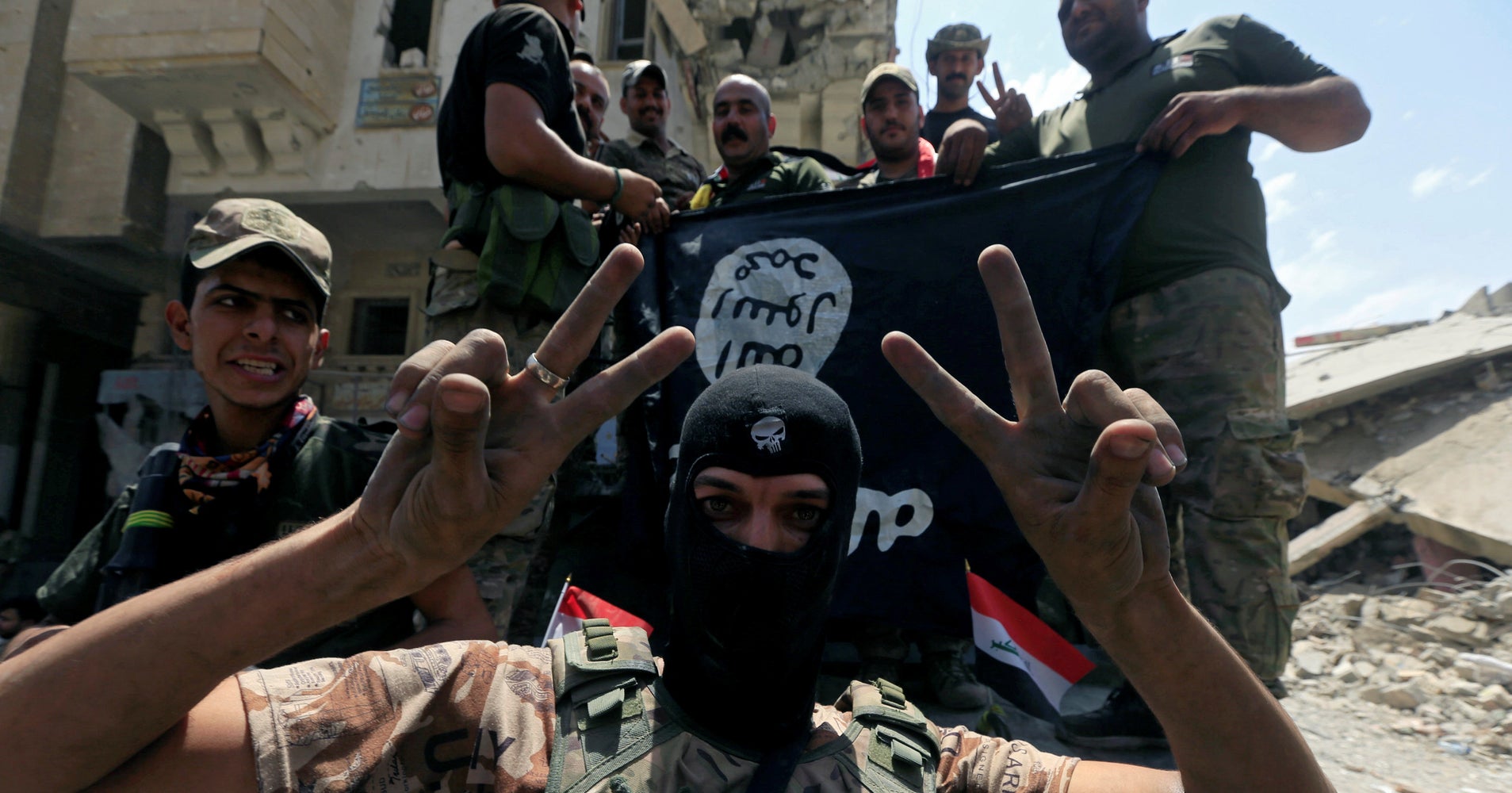
Finally, the U.S. military is badly worn down thanks to a badly conceived invasion and occupation of Iraq and Afghanistan and an equally worse withdrawal. The final result was a defacto military defeat which left the Taliban and ISIS back in charge and in possession of billions in U.S. military equipment.

The military is in critical need of a total overhaul or replacement of everything from tanks to aircraft to ships to leadership while the country needs a clearly defined foreign policy base on new realities, not those of a Cold War that ended over two decades ago. Since the end of the war, the military is facing a serious shortages of qualified personnel as thousands grab their DD214's and get out.

America's healthcare system, which is vital in the event of a major war, natural disaster or another scare like that of COVID, is woefully inadequate. The political system of the U.S. is deeply fractured, which has greatly increased its internal stability, leading many to project "when", not "if" as revolution or civil war isn't far off. The stability of the U.S. financial system is shaky at best, forcing deepening cut backs in public services, which only worsens the economic and social divide.

Meanwhile, China has double down on its economic and military growth despite warning signs of overheating or even collapse. It has been busy buying up resources and making inroads throughout the world, especially in Africa and Latin America, as well as among America's enemies (most notably Iran). China controls many of the natural resources the U.S. needs to remain competitive globally. It also dominates American trade imports so much so that sanctions, an embargo or war with China would cripple the economy.

There's no question the winds of global power have shifted east. It growth in naval power will ensure its power projection throughout the Pacific. The Yuan is posed to replaced the dollar as the "go to" currency for international trade. It's developing economic and military power has many Asian leaders contemplating whether their best interests lay with Beijing rather than Washington.

Russia too is on the rise. Although Moscow has always tried to look westward to a future with Europe, the current war in Ukraine, brought on by an aggressive U.S. backed NATO, which has included economic sanctions, has forced Russia to turn again eastward where the bulk of its landmass and resources lay. The warming of the climate will allow Russia access to trillions in natural resources.

The cross-nation BRICS economic alliance, consisting of Brazil, Russia, India, China, and South Africa, has allowed emerging growth nations the ability to bypass the Machiavellian policies of the West (and U.S. led sanctions), and create an essentially post-America future.

As Bob Dylan sang back in 1960's while the Cold War raged, "times are a-changing" . Indeed they have, and it appears the winds of change are getting stronger. Perhaps it's time we pull our collars up and dig our hands a little deeper into our pockets. It seems the eastward blowing winds are getting colder too.


If you want to know more about this article's topic, please check out the links below. If you enjoyed the article, please consider passing it along to others and don't forget to subscribe. It's free! Lastly please be sure to "like" us on whatever platform you use to read anotheropinionblog.com. It helps with the algorithms and keeps our articles in circulation. Thank you! 


The Lowy Institute Asian Power Index 2023


PH 51st on the lists of world's most powerful militaries


U.S. remains a 'flawed democracy' in annual rankings


World Data: Life Expectancy


AJMC: U.S. Has Highest Infant Maternal Mortality RatesDespite the Most Healthcare Spending


Mirror Mirror 2021: Reflecting Poorly


JAMA: US Health System Ranks Last Among High-IncomeCountries


US defense industry isn't prepared for a war with China, report says


Friday, March 17, 2023

Reading America's Fortune Cookie: Is War with China Likely?

Let's face it. The war in Ukraine isn't going well for anyone. Putin's military advisors anticipated a brief invasion followed by a ceasefire and talks about how to guarantee Ukraine's sovereignty without a NATO presence on Ukrainian soil and protecting Russian national security. But that didn't happen.

Instead, the U.S. and its European surrogate, NATO, immediately began pumping billions of dollars in weapons into Ukraine, not to mention providing intelligence about Russian troop movement. The Western media went into full propaganda mode to condemn not just the invasion (rightly so), but also to spin U.S. and NATO involvement and the reasons for the invasion in the first place.

The result has been a stalemate measured in dead civilians, massive destruction of towns and cities and the growing specter of nuclear war. Without U.S. and NATO involvement, the invasion would likely have been over with a few months at best with a practical compromise the likely result. But then again, had Russia not been forced to invade to protect its national security from an encirclement of NATO missiles on its western front, there would have been to need for anyone's involvement and nobody would be dead.  

The only nation to present a peace proposal thus far has been China, which the United States and its allies dismissed out of hand. The primary reason is that China is a ally of Russia, and besides, it has recently started providing military support to Russian troops operating in Ukraine.  You would think that after a year of war, the United Nations or someone would have stepped forward to offer a solution to stop the war, but apparently not. Why?

The most likely reason is pressure from Washington. Washington has long seen Russia a potential threat to its military and economic primacy, well, that is until the collapse of the USSR in 1989 and implosion of Soviet Russia in 1991.  Since then, the United States has sought to impose a "Pax Americana" and the global integration of economies under the auspices of a U.S. led "New World Order".  However, not everyone wants to play along.

Russia, along a few other countries such as Cuba, Brazil, Iran, and China, have been able to go about their merry way outside of this American hegemony. A few have formed their own economic solution, such as Brazil, Russia, India, and China, which formed "BRIC" in 2009. Subsequently, the name has been changed to "BRICS" with the addition of South Africa in 2010. 

There have been other economic blocs formed outside the sphere of American influence such as "The Regional Comprehensive Economic Partnership" (RCEP), which was signed into being in 2020 and took effect in 2022. RCEP is now the largest economic partnership in the world.

At its head is China, and it includes Vietnam, Australia, Brunei, Japan, Cambodia, Laos, Singapore, New Zealand, and Thailand. It doesn't not include the United States. RCEP accounts for some 30% of the world's economy, 30% of the world's population, and will have an economic reach of at least 2.2 billion potential customers.  

China has established itself not just as the world's second largest economy with a GDP of $17.73 billion dollars(compared to the U.S. with a GDP of $23.32 billion), but is expected to surpass the U.S. by 2035. By 2075 or sooner, India will also pass the U.S., leaving the U.S. as the third largest global economy.

China seeks to do more than just wrestle economic control of the Pacific Rim from the United States. It intends to back up with military might, with a particular focus on its navy.  The Chinese have embarked on the largest military upgrade of any nation since WWII although the United States still spends more on its military budget than the next nine nations combined including China.

In 2022, China spent roughly $293 billion dollars, or 13.9% of its GDP upgrading its military while the United States spent $801 billion dollars or 37.9% of the GDP on its military. Together, China and the U.S. make up 50% of all military expenditures with a combined $1.1 trillion dollars. 

By comparison, Russia spent just 3.1% of its GDP, or $65.9 billion on its military. The UK spent slightly more, or about $68.4 billion dollars. It's worth nothing that China's military expenditures have increased 27 years in a row. The result is that China now has the newest and largest navy in the world by tonnage.

Meanwhile, the U.S. military is still the best trained and equipped, it's suffering from combat fatigue. After 20 years in Afghanistan, the United States left with virtually nothing to show for it. Yes, it took out Al Qaeda's top leadership including Osama bin Laden, but Al Qaeda barely skipped a beat, replacing leaders almost immediately and continuing with its operations. The same goes for the Taliban. In fact, the Taliban were already back in charge before the last U.S. military planes had left Kabul.  

To make matters worse, following the withdrawal, the U.S. military saw a rapid exodus of its highly skilled men and women (most of whom having served at least four tours of combat duty) with replacement proving to be slow and time consuming. In addition, the military is woefully in need of a total overhaul or replacement of practically everything from ships to tanks to aircraft.

During the course of the war, the United States flew 55,150 sorties and dropped over 337,000 bombs and missiles (including some 13,000 precision guided munitions) in Afghanistan. That works out to be an average of about 49 bombs per day every day. In 2019 alone, a record number of 7,423 bombs were dropped on Afghanistan.  The result was a severe shortage in our stockpile of practically everything from bombs to bullets, not to mention spare parts particularly for aircraft.

As an aside, while we were busy blowing up Afghanistan, we were also busy rebuilding it back in our image. U.S. taxpayers shelled out $145,000 billion dollars over the 20 years in rebuilding its infrastructure, schools, hospitals and office buildings, its electrical grid as well as training and equipping its security forces, stabilizing its government, and propping up its economy...and the Taliban got it all, not to mention billions in military equipment and hardware we left behind.

Starting between now and 2035, the U.S. military is expected to undergo a major overhauls of its ships (combat and auxiliary), aircraft, tanks, trucks, artillery, and so forth. If it moves or shoots, it's getting a makeover.  Some ships, however, are beyond the makeover phase. The Pentagon confirmed in late 2022 that 26 ships will be decommissioned, leaving the Navy shorthanded with just 276 active ships (300 is considered its minimal effective force)

However, over the next ten years the Navy is expected to be back up to its fighting weight with the addition of eight new "deep water" combat ships and a projected fleet of 500 ships by 2040; most of whom are destined for the Pacific (by comparison, the British Royal Navy, once the world's dominate naval power, has just 76 combat ships while Australia has a mere 44).

The problem is that China is already at or near its fighting weight. China currently has 355 combat ready ships, including two aircraft carriers and a third, the Fujian, preparing for sea trials. Analysts predict that by 2030, China will have five aircraft carriers and ten new submarines capable of carrying nuclear ballistic missiles. However, China still lacks adequately trained carrier based pilots. Nevertheless,  projections show that if China continues to build its fleet at the same rate it has over the past 27 years, it will have a whooping 425 warships by 2030.

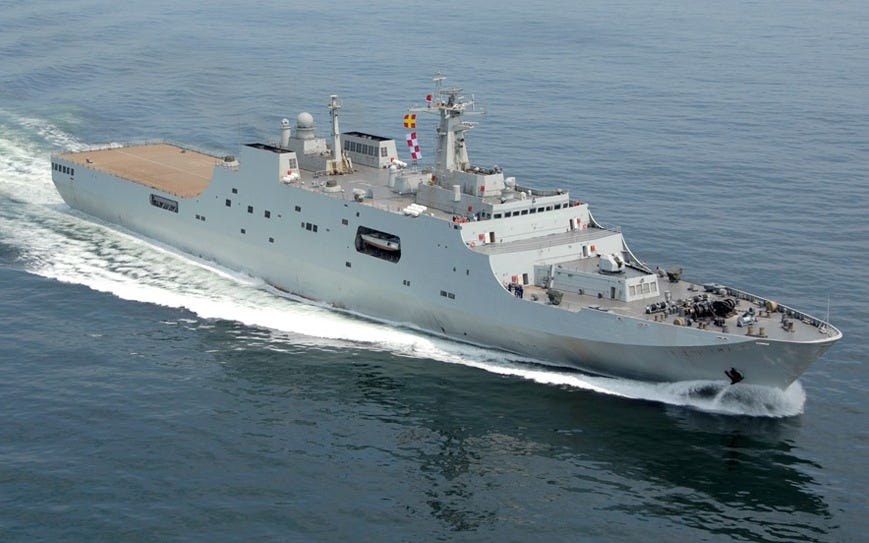
China is also increasing the number of missile carrying destroyers, cruisers and landing craft as well.  China's new Type 075 amphibious assault landing ship will come in at 40,000 metric tons with the capability of carrying 30 helicopters along with landing craft and just over 1000 assault troops.  The Type 075 replaces the Type 071 by 15,000 tons. There are now 32 Type 075's combat ready.

The Type 071 is another, albeit slightly smaller, amphibious land ship. Displacing 20,000 metric tons, it has capacity to carry four helicopters and roughly 800 combat troops. There are currently six known Type 071 ships in service at this time.

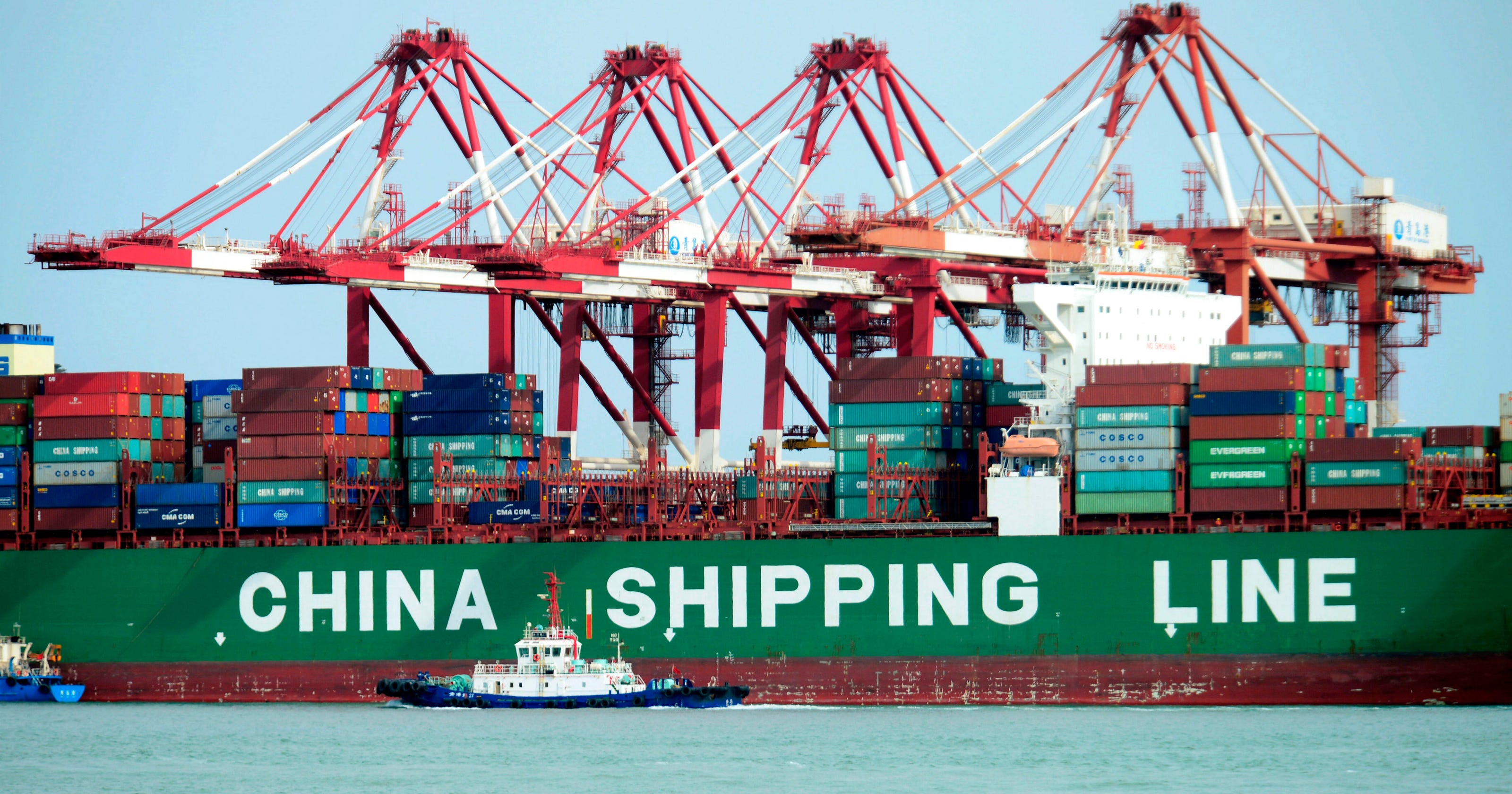
In addition to its combat fleet, China has greatly expanded its merchant fleet as well. Something you would expect with a growing economy. China now has 40.3% of the world's merchant shipbuilding market. Compare that to South Korea and Japan which has a 31.5% and a 22.2% share respectively.

China now has the second largest fleet of ships with 5,600, of which approximately 800 merchant ships. Greece has the largest, with 20.4% of the world's tonnage while China has 14.4% and Japan is third with 13% of the world's tonnage. China also has completed or updated the number of ship building facilities to six.

So, bringing this all together, what does it mean for the United States? The United States is still capable of projecting its military might around the world on a moment's notice. However, the question is whether it is still capable of maintaining that projection against a determined foe like Russia or China.

According to a report by the Heritage Foundation entitled "Index of U.S. Military Strength", only the Marines were rated at "strong" while the Navy and Space Force were categorized as "weak". The Air Force was rated as "very weak" and the Army was "marginal".  

Our stockpile of munitions and spare parts were badly depleted by our 20 year misadventure in Afghanistan, and much of what we were able to build back has found its way to Kyiv. The U.S. Navy, our principal tool in the projection of our foreign policy, is currently undergoing a phased overhaul and updating which isn't expected to be completed before 2035. The other branches are also undergoing their own updating which will take several years to complete.

Meanwhile, China is already at or near its ideal fighting weight, with the development of many of its ships progressing ahead of schedule. China's economy, while slowed, is still doing well while ours remains sluggish thanks to rising inflation and lingering effects of COVID on the economy.  Meanwhile, China has become much more aggressive.

It has claimed both the East and South China Seas as its own, and warned other nations to stay away. It has declared some of the territorial waters around South Korea, Japan, the Philippines, Indonesia, Australia, and India are in fact international waters, and thus has asserted its fishing rights there. China is also involved in a "warm war" with India along its mutual border in the Himalayas.

The creation of the Regional Comprehensive Economic Partnership (RCEP) may have a severe impact of America's ability to protect its interests in the Pacific, especially in light of China's growing economy, its expanded merchant fleet, along with a modernized navy capable and apparently ready to defend its economic interests.

For allies like Taiwan, the future doesn't look bright. Over the next seven to ten years, Taiwan will be particularly vulnerable. China has the means and ability to block off the South and East China Seas, and from there launch as rapid air and sea invasion of the island nation before the United States or anyone else has an opportunity to do anything.

This is especially true given our current preoccupation with Ukraine (and doubly so should we make the mistake up upping the ante and forcing Putin into some direct action against NATO. To make matters more interesting, China's ally, North Korea, could start something with South Korea which would further divert the attention a weakened U.S. military (some military analysts have states that given our current situation, we are unlikely to be able to operate effectively on two fronts). 

Of course, there's the economic angle. The U.S. is heavily dependent on Chinese imports, especially on electronics and computer chips. We depend on China for textiles, batteries, and machinery needed  in industry and even the military such as Neodymium which powers magnets used in hard drives or Praseodymium in the manufacture of aircraft engines which are "rare earth" metals.  

The U.S. doesn't manufacture these and other rare earth metals in abundance, but China does. In fact, they control 90% of the world's rare earth market. Heck, most of our cell phones---72%---are made in China!

 90% of our antibiotics come from China. 80% of the ingredients used in our medicines come from China. They also control 90% of the nine critical vitamins, 70% of acetaminophen, and 50% of the anti-coagulant Heparin.  Most of the medical devises we commonly use are of Chinese origin. 

Where does that leave us? The short answer is between a rock and a hard place. Internally we are increasingly unstable socially, economically, and politically. We can no longer afford to be arrogant about the supposed superiority of American capitalism or invincible military might as Vietnam, Iraq, and Afghanistan have shown.

We can't forget that China also owns about 20% or $1 billion dollars of our debt. They can call the tune economically with their influence on our domestic market, and even their growing economy and military power, they are likely to exert de facto regional control over the Pacific Rim and eventually they may surpass us as the world's most power nation. From all appearances, China has outfoxed the fox.    


 If you want to know more about this article's topic, please check out the links below. If you enjoyed the article, please consider passing it along to others and don't forget to subscribe. It's free! Lastly please be sure to "like" us on whatever platform you use to read anotheropinionblog.com. It helps with the algorithms and keeps our articles in circulation. Thank you! 


Asia forms world's biggest trade bloc, a China-backed group excluding U.S.


Ranked: Top Ten Countries by Military Spending


How is China Modernizing its Navy?


China's Navy Could Have 5 Aircraft Carriers, 10 ballistic Missile Submarines by 2030 Say CSBA Report


US military in decline, threats from China "formable" , report says


Executive Summary of the 2023 Index of U.S. MilitaryStrength


U.S. Dependent on China forVital Ingredients


We're Too Dependent on China For Too Many Critical Goods, Especially Medicine


Preparing for War with China, 2025-2032


What Will Drive China to War?


U.S. General's Prediction of War with China 'in 2025' Risks Turning Worse Fears Into Reality


Thursday, March 02, 2023

Is the U.S. Egging on the War in Ukraine?

What do you think about the United States getting more deeply involved with the Russian-Ukraine War? The U.S. and NATO have been fanning the conflict by dumping increasing levels of military material in Ukraine and promising even more aid. In fact, President Biden recently flew to Kyiv to personally tell Ukrainian President Zelenskyy that the U.S. will be sending some $500 million dollars worth of military hardware. In January 2023, the Department of Defense proposed a $3 billion dollar package in military aid to Ukraine. 

If we go back to January 2022, we'll find that $3 billion dollars in of your money is just a drop in bucket. Starting in January 2022 through January of this year, you and I have paid for $78.8 billion dollars in aid to Zelenskyy. 31% of that (or about $23.5 billion) was exclusively for military hardware. Another 6% (or $4.7 billion) in the form of grants and loan guarantees for military purposes just in case they want to buy from one of our allies or something.

On top of that, American taxpayers have ponied up $18.3 billion in "security assistance". This covers logistic support, training, and incidentals like boots, belts, uniforms, winter/summer uniforms, rations and whatever else that's not covered previously. In short, the DOD is that one stop shopping that despots, tyrants, and warmongers the world over have come to count on. I wouldn't be surprised if each purchase didn't come with a gold "skull and crossbones" stick pin.

So, the total package just for military related items comes to $46.6% billion dollars, or 61% of $78.8 billion dollars in aid we've given so far.  As they say on television infomercials..."but wait, there's more!", and indeed there is. We've given $26.4 billion in financial aid. This is suppose to cover rebuilding Ukraine's infrastructure, ranging from rebuilding buildings and bridges to schools, roads, and general clean up.

So, what about the people of Ukraine? You know, the women and children that Biden briefly mentioned in his press conference with President Zelenskyy? Well, out of the $78.8 billion dollars, they were slated to receive $3.9 billion in aid. This was to cover temporary shelter, food assistance (including baby formula), as well as medical treatment and medicine. That amounts to just 5% of the 78.8% we provided on last year (and that doesn't cover the additional money that Biden just promised).  

It's worth noting that U.S. military aid to Ukraine has far exceed the amount of aid we've provide any other country, including our closest allies such as Israel which has received a beggarly $3.3 billion. Jordan has receives a mere $504 million dollars in military aid. For the record, prior to the war, Ukraine received just $284 million in American military hardware. 

As an aside, it's worth noting that while President Biden is being so generous with your money, he made no mention of trying to find a way to bring this war to end. You would think that in addition to spreading all that money around a little more fairly, especially on the humanitarian aid side, he would want to see a peaceful and fair resolution to this war.

Accurate reports are hard to come by, but it has been reported that at least 8,000 civilians have been killed with over 13,000 others injured. Many experts are saying that the number of civilian deaths have likely been grossly underreported and added that perhaps as many as 100,000 civilians are possibly dead and buried under unexplored rubble. Military deaths on both sides have lost far in excess of 100,000 each with some estimates putting the number of Russian troops killed as high as 200,000.

Here at home, we have a failing infrastructure system (we are rated a "C-" by the American Society of Civil Engineers). The World Economic Forum's of global infrastructure rankings placed the U.S. 13th in the world out of 141 countries, behind the United Arab Emirates and ahead of Belgium for 2019.  

We have a school system which consistently fails to measure up to international standards (we're 14th overall). A healthcare system which is just as bad (the U.S is 11th, which dead last among the leading industrialized nations). We are faced with rising food and gas prices, as well as rising taxes and stagnate wages amid an inflation rate of 6.4% (last year the inflation rate ranged from 7.480% to 9.060% with the majority being around 8.5%).

Our general quality of life has been on the decline for several years. Globally, we are ranked in the second tier at the 21st. Among the top countries ranked above us include Scandinavia, Germany, the UK, Ireland, the Netherlands, Australia and New Zealand, Italy and Portugal. We even have one of lowest life expectancies of any developed nation---in 46th place!

We have the highest income disparity of any developed nation. Top tier incomes among the one percent make more than 84% more than the bottom 20%. The top 20% earned more than half---52.2%---of all U.S. income in 2020.  CEO's average incomes that are more than 399% more than that of the average employee.  Despite laws to the contrary, women still earn on 82 cents for every dollar her male co-worker earns (the disparity is worse among female minorities).

What about the U.S. military? There's no question that after fighting a 20 year war, the U.S. military was pretty exhausted. Much of our equipment, including tanks, planes, and ships, were in desperate need of some intense maintenance. We were starting to run shortages in everything from bombs and ammunition to spare parts.  We've also experienced a drop in enlistments as service members decided to get out (it's worth noting that during our 20 year misadventure in Afghanistan and Iraq, service members did more tours of duty than at any point in U.S. military history. Much of that was under combat conditions).

According to a report published by Defense News, a detailed report by the Heritage Foundation showed that the U.S. military was weaker than it was in 2022. The "Index of U.S. Military Strength" focuses on the need for the U.S. to be prepared to be able to engage in two wars simultaneously or a major regional confrontation. 

The report goes to say that the U.S. military fails to meet that objective, and currently would struggle in a single front confrontation. The article goes on to state that the military is still capable of "projecting" its strength around the world (meaning we can be anywhere at any time), our fighting capabilities are greatly diminished.

Of all the various branches, only the Marines were still rated as "strong" (hooyah "Devil Dogs"!). The Army was rated as "marginal" while the Navy was "weak" and the Air Force was "very weak". The Space Force was also listed as "weak", citing slow updating of ageing technological platforms.

The Navy's score was based on a lack of combat fit ships (most are in need of overhaul) and an inadequate number of additional "manned" ships. The Air Force lacks adequately trained pilots and the pilots they do have are logging in less than satisfactory flight time (same for the Navy). Nevertheless, we seem to have enough "surplus" military hardware to send to Ukraine but not to satisfy our own needs. To me that just doesn't make sense.

Finally, the reports identifies China as our primary military adversary due to its expanding military capabilities, technology, and growing aggressiveness. China was followed by Russia with its large nuclear capability. North Korea was mention as low threat along with various countries in the Middle East including Iran.

So, where does that leave us? At present the United States is still trying to be the world's policeman and arbiter of events. However, things are rapidly changing. China is now the world's largest economy according to some experts Where it can continue at its present pace is another question. Countries like India and Brazil are on the ascent economically too.

The U.S. is showing serious cracks in almost every area, especially the most important ones of education, technology, and global competitiveness.  It's political system has morphed from a Republic into a neo-fascist Corporatocracy; a surveillance state born out of fear thanks to 9/11. We have a social and political divide unlike anything since the decade preceding the Civil War, not to mention a growing economic divide brought on in part by our "outsourcing" of good paying production jobs.

We are unwilling to stop the hemorrhage of illegal immigration. Worse yet, politicians no longer have the decency to lie to us about trying to stop it!  They just ignore and keep on doing as they please. And so, those who encourage them to come over and those who hire them, often turning these individuals into serf labor, go unpunished.

Meanwhile, we maintain the highest prison population in the world; much of which is based on uneven sentencing. We focus on "doing time" rather than rehabilitation for those convicted of non-violent crimes. We even fine and convict individuals for possession of what grows naturally. Tell me corporation self-interest isn't behind this.

I think our chief problem stems from our failure to take a stand and then stand by our decision. We're too afraid of "offending" someone or being called a name than speaking the truth. We don't want to take responsibility for our actions. Instead, we find someone or something else to blame. There are consequences to our actions and we need to step up and own them---good or bad. 

 When it comes to the government we keep falling into the same ole trap that somehow, magically, the "next time it will be different". We allow ourselves to be seduced by the lies. Politicians, the two corporate owned political parties and their corporate owners are counting on it. It won't change. Why? Because we fail to remember the adage that what we allow to happen will continue to happen.

Lastly, we have a bad habit of sticking our noses where they don't belong globally. It's not our place to decide what government or leader another country should have. Did you know that since the end of WWII in 1945, the U.S. has been involved in the overthrown or attempted overthrow of 57 countries, including the predecessor of Ukrainian President Zelenskyy? 

We need to accept the decision of a people freely voting in their own country for the government they want whether we like it or not and then to find ways to work with those governments if we really want to promote democracy. Besides, we wouldn't tolerate it, why should anyone else?

Not everyone wants to be America's "mini-me". In fact, of all 96 democracies in the world, not a single one has emulated the United States. Not one. Instead, they prefer the parliamentary system of the UK where everyone is represented in lieu of our "winner-take-all" two corporate party system.

Americans are, by and large, a very generous people. We've come to the world's rescue every time disaster has struck. In the case of Ukraine, we should continue to help the people of Ukraine with humanitarian aid while stopping to egg on a war aimed at: A: Antagonizing Putin, B: Securing Right to the oil and gas, C: Securing rights to coal and other natural resources, D: Threatening Russia's national security with NATO/U.S. missiles on Russia's border. Our focus should be on stopping a war which could have and should have been avoided.


 If you want to know more about this article's topic, please check out the links below. If you enjoyed the article, please consider passing it along to others and don't forget to subscribe. It's free! Lastly please be sure to "like" us on whatever platform you use to read anotheropinionblog.com. It helps with the algorithms and keeps our articles in circulation. Thank you! 


How Much Aide Has the U.S. Sent Ukraine? Here Are Six Charts


Soaring Death Total Gives Grim Insight Into Russian Tactics


U.S. Health System Ranks Last Among 11 High-Income Countries


The Quality of Life


US military in decline, threats from China "formable" , report says


Executive Summary of the 2023 Index of U.S. MilitaryStrength