Showing posts with label Al Qaeda. Show all posts

Friday, January 03, 2025

2024: A Year in Review and a Look Ahead

There's no question that 2024 was one of the most pivotal years in recent history. It seems that practically everything was happening all at the same time, and the ripples it left with be felt for weeks, months, and even decades from now. In writing this week's article, it was difficult to decide what to include and what to leave out. Much of what we will witness over the upcoming 12 months and beyond have their roots in what we've jointly experienced. Here, then, are our top choices for the most significant events of 2024. 

Hamas and Israel

Perhaps one of the most noteworthy event of 2024 has been the war between Israel and Hamas. Since its founding in 1948, Israel has been involved in 19 wars and conflicts. Beginning with its War of Independence, Israel has faced the combined military might of the Arab world (with Russian and Chinese aid) or financially.   In every encounter (with the exception of one, which was a preemptive strike), Israel has been attacked with little or no prior notice by members of the Arab League. Each time it has prevailed thanks to the support of  the West, and most notably the United States.

On October 7th, members of the Iranian backed terrorist group, Hamas, secretly attacked a group of mostly civilian men, women, and children who had turned out for a concert and family oriented events. The attack was a brutal as it was sudden with over 1700 Israelis viciously murdered. Some were shot in cold blood, while others were raped before being burned alive. Others were taken captive. Beaten and repeatedly rape, they were to be used as bargaining chips to avoid repercussions against Hamas leadership. 

Since then, the Israelis have been relentless in the retaliation, which many have called "justifiable". However, while the Israelis have been winning in ruble of Gaza, they've been losing the public relations war. Hamas and their supporters have been able to portray Israel as the aggressor and guilty of genocide against Palestinian people while Hamas characteristically uses them as human shields and routinely attacking or hijacking relief trucks carrying medicine, food, and fresh water, which they often sell on the black market.  

Israel has seen a serious loss of support globally, and most notably in Europe and among NATO, which has historically backed the Israelis. The situation is so serious that Turkey has subtlety threatening to intervene to prevent the ongoing "genocide" of the Palestinians in Gaza. If that were to happen, how would it affect NATO? Besides having the second most powerful military in NATO behind the U.S., it also serves as a major bulwark, preventing hundreds of thousands of "migrants" from invading. Such a influx could collapse the European economy, which is already teetering on failure. 

Of late, Turkey's President, Recep Tayyip Erdogan, hasn't been shy about threats to throw open its doors to these migrants should NATO or the EU impose any sanctions for its actions against Israel, the Kurds, or Syria. A threat by the way which has all the earmarks of political and economic blackmail. How would a greatly weakened U.S. military and NATO react should Turkey decide to intervene?

Syria, Iran and U.S. Foreign Policy: A Deadly Game of  Political Chess 

Iran, which is behind Hamas as well as Hezbollah in Lebanon, Al Qaeda, the Taliban, and other terrorists groups, has made it crystal clear that it will "wipe Israel off the map" at the first opportunity even if it meant the complete destruction of Iran and all its people. It's no secret that Iran has aggressively been working on a nuclear bomb with the intent of hitting Israel even if it meant that Israel responded in kind. The major stumbling block for Iran has been a delivery platform and defeating Israel's famed "Iron Dome". The fall of Syria may have helped alleviate one portion of that problem.  

It's no secret that U.S. foreign policy has been the control of Middle Eastern oil and gas and transportation lanes as well as destabilizing Russian regional interests and removing Iran as a regional and possible global threat (we've never gotten over the humiliating 1979 "hostage crisis"). Our principal allies, like the Saudi and Kuwaiti royal families, are very nervous about the spread of Iran's radical religious extremism and its threats to destabilize or even topple their governments. 

As a result, Neocons in the U.S. State Department, in conjunction with the Pentagon and intelligence agencies, carefully laid out plans to reshape the Middle East in their image several years ago by first going after Afghanistan, then Iraq, Syria, Lebanon, and lastly, the cherry on top---Iran (of course, the Pentagon and intelligence agencies are all in for any war or conflict. Besides, it's good for business).

Unfortunately, we didn't do so well in Iraq. Not because of any military defeat, but for not properly planning for a post-war government.  In Afghanistan, we lost because our arrogance and failure to learn from history. Everyone from King Cyrus the Great and Alexander to the British Empire and the USSR has failed to conquer Afghanistan. The result, after 20 years of fighting, was a stronger and better armed Taliban, an intact Al Qaeda, and a PR disaster for the Biden Administration.

 Meanwhile, the U.S. has been trying to overthrow the Assad government since 1971 when Hafez al-Assad became president.  His son, President Bashar al-Assad has never been a friend of terrorists and opposed Iran's radical form of Islam. Syria has been the nemesis of our NATO ally, Turkey and our trading partner, Saudi Arabia, yet it was also a buffer to Iranian expansion. 

Most importantly, is that Syria has been a close ally of Russia going back to the early 1950's. The fall of Bashar al-Assad was been on the State Department's and CIA's. "things to do" list for a very long time. During the Syrian civil war, U.S. intelligence agencies have been aiding the Al Qaeda affiliated militia, HTS, and other paramilitary groups in destabilizing Assad's government as part of the efforts. 

Now with Assad out of the way, a number of different militias are poised to battle for the control of Syria, or at least large swaths of it, including ISIS, which stands to benefit greatly from the instability. The leader of the U.S. backed HTS, a spin off of Al Qaeda, Abu Mohmmad al-Jolani, is now downplaying his anti-Western terrorist past in the hope that U.S. aid will buy him a place at the table when it comes time to divide Syria up (either by pen or bullet).  

Meanwhile, as mentioned earlier, Iranian backed militias are now securely in Syria (most notably ISIS). This will allow Iran to extend its influence further, not to mention its missile launchers. ISIS has already launched several rocket and missiles at targets inside Israel. While the fall of Assad benefits U.S. foreign policy interest, at least for the moment, it puts Israel at greater risk. Israel has moved troops pass the Golan Heights buffer zone into Syria while Turkey has extended its reach deeper into northern Syrian territory, pushing the embattled Kurds further into the surrounding hills. Of course, all this sets the stage for even more "migrants" to invade Europe via Lebanon and bypassing Turkey. 2025 should prove very interesting as this situation continues to play out. 

Russia and Ukraine: A Game of Nuclear Chicken

Another event to keep a close eye on is the situation between Ukraine and Russia. The war, which began in February 2014, was thought by most political and military observers, to be over in a matter of months at best, given the easy in which Russia forces seized control of the Crimea. Yet, ten years later and both sides are still slugging it out. For Ukraine, its ability to holdout is due to being heavily supported by the U.S. and NATO members, who are also augmenting American aid with equipment and material of their own.  

Since February 2024, the U.S. has provide Kyiv with some $61.4 billion dollars in military aid according to the U.S. State Department. When other forms of aid are added in, including money to prop up Zelensky's government, American taxpayers have ponied up $106 billion dollars without so much as having say about it. Many analysts believe the goal is to bleed Russia dry militarily, thus removing or at least decreasing its super power status military, and maybe with some luck, even destabilize Putin's government. 

Some former Warsaw pact nations like Poland have become increasingly belligerent toward Russia and are threatening more direct assistance to Ukraine (Poland and Russia have a long and antagonistic history with each other). Putin has urged the Poles and others to seriously rethink their positions and tone down their rhetoric. There has also been hints by the Russians that any such intervention could result in a military response up to and including the use of nukes. 

In a bit of a surprise, North Korea has begun sending troops to support the Russians in exchange for desperately needed economic aid (it must be serious, Kim Jong-Un looks like he's losing some weight). It should be noted that the North Korean soldiers have proven to be mediocre at best. Nevertheless, even as cannon fodder, you can't fault their commitment. Many have chosen suicide to being captured.  

It's unlikely that Putin will allow this drain on his military or economy to continue much longer, That doesn't mean Putin may throw in the towel. Far from it. Putin may go all in, including the possible use of limited tactical nukes in key areas. If so, what then? Will the U.S. and NATO react in-kind or with a all out ground invasion of their own? Sanctions against Russia have proven to be of little use, especially given the rapid growth of BRICs. Since China, a Russia ally and our largest trading partner, is a member of BRICS, sanctions against the U.S. and the EU would have a more profound impact.

The Pentagon has already stated that, following the debacle in Afghanistan, the U.S. military was unable to conduct an effective war on multiple fronts, and with the situation in the Middle East spinning out of control, the rise of the Chinese military and its economic clout, that doesn't leave many options. If we get occupied in the Middle East, that could open door for a Chinese takeover of Taiwan or a North Korean invasion of the South for instance. 

Incoming President, Donald Trump claims to have a good working relationship with Putin, which could result in a ceasefire until a compromise is reached (NATO membership for Ukraine will likely remain off the table). Trump has made similar claims about Israeli President Benjamin Netanyahu and North Korean President, Kim Jong-Un, but is that just ego talking or can he pull it off? 2025 will likely reveal the reality behind the rhetoric.

 Artificial Intelligence and Humanity: Will the Creation Replace its Creator? 

Another huge development in 2024 is the "sudden" rise of artificial intelligence. Many tech heads hail "AI" as the greatest thing since the invention of the abacus. Others see it as the creation of the golem. What was once found only in the pages of Azimov, Herbert, Clarke, and Le Guin, we now have machines capable of analyzing and manipulating genetic conditions, altering manufacturing, serving as our surrogate on far away planets or deep in the ocean. They can manage not just our businesses, but our lives. In many ways I'm remined of movies like "Total Recall", "Blade Runner", and "I, Robot".

We have technology that can monitor and regulate, if needed, practically everything from diabetes, the heart, and kidney functions. We can now grow not just new skin, but organs! Individuals previously unable to walk, can do so now.  Technology can help us overcome a wide myriad of diseases and disorders. Some have proposed linking humans with technology, thus creating real life "Borg".  There are those already proposing that we turn over governments (especially the judicial system) to AI since it presumably could manage society better than we can.  

A few have experimented with linking the human brain with the internet in order to provide near unlimited knowledge. We can strap on exoskeletons which gives us 10x times the strength of the average human.  A growing number of AI developers are promoting the addition of chips into the human body to monitor things like blood pressure or sugar levels, but these chips could also contain our personal information; everything from our employment and medical history to our financial information and credit score. Yes, it could potentially cut down on identity theft, but is it really a good thing for us? 

Banks and other financial institutions are pushing hard to do away with cash. As it is, practically everything can be done electronically, from work to shopping to doctor appointments to banking and paying bills. In fact, businesses are increasingly urging automatically deducted payments. Think about it. You can run your home electronically. You can work from home, get paid automatically directly to your bank account and pay your bills automatically. You can buy your groceries and shop online, and even have them automatically delivered to your door. Plus, while personal information was once private, now everything is stored in the "cloud" and practically any financial institution---or government agency---can gain access to it.

Technology can provide you with all the "adventure" you'd want with highly realistic programs taking you everywhere and allowing you to interact! You'll be able to sense heat, cold, smell, or taste. Games, music, or books, they can already be downloaded to your computer, iPad, or Smartphone. Thanks to AI, and with the level of existing technology, the need for human contact is all but passe'.

Today, the United States has become a virtual surveillance state. Privacy is nowadays a rare commodity and talk about "escaping from the grid" is nearly impossible. You are already watched, monitored, and analyzed nearly everywhere you go. A feature like a chip would simply be one more way to track you. 

However, while chips could be used track us, they could be used to find  children prone to getting loss or adults with diseases like Alzheimer's of mental disabilities who tend to wonder off, especially those in need of special medication. It could be used to monitor former felons on parole. No more "ankle bracelets". Thanks to retina scans, facial and voice recognition software, and the ubiquitous security cameras,  you can be found no matter where you are.  Even drones can be used to find you. Heck, you car even has a tracking device! 

We're developing robots which are nearly indistinguishable from humans in appearance and mannerisms. We have video games which are so accurate they could pass for the real thing.  There are even operational protypes of sexbots! Our military is heavily dependent of AI or related technology to our fight wars in order to minimize human loss and injuries on the battlefield. Yet, without the experiencing the horrors of war, where are the incentives to prevent them?

In the United States and in much of the world, people have become essentially "chained" to their Smartphones. Businesses, like doctor offices or hospitals, expect to be able to text or leave a message for you on your phone. In some countries, such as China, its mandatory that they carry their Smartphones with them at all times. We are increasingly turning over our lives to technology to the point where the line between "master" and "servant" has become almost so blurred as to nearly indistinguishable between the two.

Scientists predict that human level Artificial Intelligence will reach "singularity" or self awareness sometime around 2040. It will exceed human level intelligence within ten years after that and continue to grow exponentially.  Within 20 years following singularity we will have as much in common with AI as we do now with a worm. The question is then what? Will AI seek to serve us or enslave us (for our  safety of course), but  later, seeing us as hopelessly inferior and unwilling or able to change, will it simply replace us? It wouldn't be hard. Will the creator be replaced by its creation? The growth of  AI will be an important issue to watch closely in 2025.

The MAGA Revolution: The Election of Donald Trump

I thought about entitling this section "The Messiahship of 'The Donald' ", but I thought that might be taking it a bit too far. Nevertheless, there's no question that some diehard "Trumpeters" out there  who wouldn't object.  For over ten years, Donald Trump had endured nearly every from of attack the Status Quo could throw at him. They've attacked his character, his businesses, members of his family, and even his friends. They've publicly maligned him at every turn. 

They've tried to break him financially with countless bogus lawsuits, and all without success. Finally, they've managed to create a public atmosphere so poisonous that there have been attempts on life. Never, in the history of our country, has there been a person as loathed by the ruling class as Donald Trump. But who can really blame them? After all, Trump has not only promised publicly to rid the country of the controlling oligarchs, he's promised to restore the Republic and end the neo-fascist corporatocracy. In fact, in his previous term, he tried to back up his words with action. 

However, Trump found out that "draining the swamp" was a lot harder than it first appeared. Our Republic had previously undergone a quiet coup, having been taken over by Wall Street in a approach known as "gradualism". It was slow, happening piecemeal, but it was no less insidious as any other putsch.  It was also through in every detail. It included both political parties, every government agencies and departments, NGOs, and especially the media. 

Nothing was left to chance. What could not be controlled, was made impotent. Those who challenged it was ignored, ridiculed, humiliated, and if necessary, destroyed. What made it worse was the fact that it has been going on for decades. So much so that the corruption has become institutionalized. 

The corruption was given veneer of civility and the weight of law. Wars and conflicts were fought for noble sounding goals just when in truth they were waged for profit. Treaties were nothing more than business contracts designed to benefit the few. Government no longer represented the people. It serves the interests of the controlling elite to the degree where they line separating them has blurred beyond recognition. 

Many consider Trump to be a ego-driven blowhard. Others consider him pompous and volatile, while some even believe him to be dangerous. There is no question that Trump has, at least, some of these qualities, and quiet likely much more than some would consider disagreeable. However, Trump is not part of the Status Quo which we've been made so comfortable with. We've been made afraid of freedom to the point where comfortable servitude is preferable to independence.  

In many ways Donald trump reminds be of Julius Caesar. Caesar was a successful general while Trump is a successful businessman. Both appeared at the end of their respective Republics. Like Caesar, Trump is a political outsider. Caesar sought to restore the Republic, which had become hopelessly corrupt and ineffectually. The Roman Senate promised much but delivered little except bread and distraction in order to buy off its citizens.  

Any real attempts at reform were brutally crushed such as with Tiberius Gracchus and his attempt at land reform around 133 BC as was his brother, Gaius's efforts at agarin reform in 123 BC., and, of course, the Three Servile Wars, made famous by Spartacus in the third war, to end servitude in its many forms. Like the U.S., Rome faced a massive influx of migrants which threatened the stability of the Republic. Efforts to curtail it were half hearted at best. But, as those with a basic knowledge of history should know, each of these individuals were killed in order to preserve the Status Quo. 

Caesar was awarded the title of "dictator" in the hopes that he could be appeased with the title and would leave the rotting Republic and its Senators alone. It failed. Caesar, it's claimed, said that in order to save the Republic, he would have to destroy the Republic, meaning that reversing the level of institutionalized corruption to restore the Republic would take a thorough and unpleasant bit of housecleaning. 

We generally choose to call it "draining the swamp", which is something Donald Trump has repeatedly promised to do. In just a few weeks, he will be sworn in and his second term will begin and then we shall see what his intentions truly are. One thing is for sure, the Status Quo will fight him every step of the way.

As we head into our 20th year, we here at Another Opinion would like to thank each of you, our dear readers, for all your support, encouragement, and comments over the past 12 months. We are deeply appreciative. The articles above are but a small glimpse onto the many exciting and tragic events of 2024 and whose ripples we will feel for weeks, months, and even years to come. No doubt this coming year will be no less eventful. We hope you all have a happy, healthy, and safe 2025.  


Thank you for reading "Another Opinion", the Op/Ed blog page for the "militant middle".  Here at "A/O" we truly value our readers. At A/O we seek the facts as they exist, not partisan talking points.  We hope you found our articles informative and engaging. Comments are welcome, provided they are not vulgar, insulting or demeaning.  Another Opinion is offered without charge and is directed toward all independent and free thinking individuals. We do ask, however, that you be sure to "like" us on whatever site you found us on in order to keep our articles available for others, and that you please pass our post along. Below you will find links to the sources we used in writing this article. Thank you. 


From Syrian jihadist leader to Syrian politician:  How Abu Mohmmad al-Jolani reinvented himself 


Who are the Syrian rebels that have toppled Assad and taken Damascus? 


US sends more troops to the Middle East as violence rises between Israel and Hezbollah


Russia-Ukraine War


U.S. Security Cooperation with Ukraine


Technological singularity 


The new surveillance state


The Trump agenda: Here's what to expect from his second term


The reform movement of the Gracchi (133 - 122 BC)  


Friday, December 13, 2024

The Fall of Assad and Syria What does it mean for the U.S., Israel and the West?

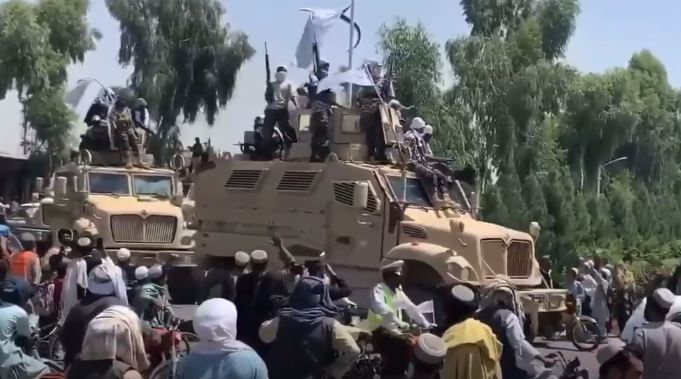
 The U.S. withdrawal from Afghanistan was an embarrassment of monumental proportions. It not only left the Taliban back in charge of the government and the people (especially the women) worst off, Al Qaeda was still militarily and politically operational. We left so much military equipment behind, that Afghanistan went from being a country of no military significance to being one of the most powerful countries in the region!    

To add insult to injury, it now appears that Al Qaida will emerge as the controlling power in post Assad Syria. It's worth mentioning, that while we were battling Al Qaeda in Afghanistan for 20 years, following the cowardly attack on 9/11, the U.S. was arming and supporting Al Qaida's efforts, albeit under the names "Jabhat al-Nusra Front" and "Hay'at Tahrir al-Sham'  (aka"HTS" ) in Syria to overthrow President Bashar Assad.

Of course, ISIS/ISIL is back. They've already reoccupied the Syrian city of Homs and look to further expand. To give you an idea as to their intentions, all one needs to do is look at their name--- the Islamic State of Iraq and Syria. On September 24, 2014, the Obama Administration officially announced they would be more "hands on" in Syria in order to oust ISIS.  

At about the same time, the CIA began using Syria as one of its base of operations, starting from the mid-1990s and extending well into the 2000's, for its "extraordinary renditions" (aka "unofficial kidnappings") of so-called "ghost detainees" (ISIS and Al Qaeda fighters, cleric, and supporters) for the purpose of extreme interrogation methods.

In 2008, the CIA formed the "Damascus Community School" to lure anti-Assad groups, officials, and civilians (such as teachers and professors) away from the pro-Soviet orbit. They also started funded and training various paramilitary units to oppose Assad, as well as pro-Iranian terrorist organizations. It should be mentioned that the CIA has been active in Syria since 1949 when it helped plan the March Coup of 1949. Syria was the CIA's first "test case" for overthrowing governments not seen as favorable to U.S. national interests.

Using the code name "Operation Inherent Resolve" (my how they do love their secret code names), the U.S. vowed to fight ISIS through the Syrian Free Army (aka "Revolutionary Commando Army" or "RCA") and the Kurdish led Syrian Democratic Front, led by the Kurdish "Popular Protection Units", which are regarded as a terrorist organization by Qatar and Turkey (one nation's terrorists is another nation's liberators). Other groups involved in the fighting include Syrian National Army and the Turkish Armed Forces.

Now, why would we underwrite groups to overthrow the government of President Bashar Assad? The answer is really simply. Syria has been Russia's regional ally for decades. Syria is to Russia what Israel is to the United States. Of course, the U.S. made the usual allegations about the people fighting for their democracy and so forth, the truth was to simply remove the pro-Russian Assad Government, secure access to Syrian oil and gas, and further isolate Iran.

Iran is the center piece in this regional game of chess. The neocons goal all along has been to take control of Iraq and Afghanistan, and destabilize Syria.  Then, with our Arab allies, isolate and ultimately strangle the Iranian government. Well, Iraq is free of Saddam but it's far from stable. However, like the Russians before us,  we were handed our eviction notice by the Taliban and Al Qaeda in Afghanistan while Iran remains still standing.  

In fact, Iran is hard at work developing a nuclear bomb and delivery system to "wipe Israel off the map, even at the cost of Iran being vaporized.  In addition, the Iranians have helped to underwrite and arm terrorist groups like the Taliban and Al Qaeda, but Hezbollah in Lebanon, Hamas in Gaza, Boko Harem in Africa, and terrorist organizations in Yemen, Libya, Sudan, and elsewhere. 

The only glimmer about the Assad Government's fall is that Russia is without its primary regional ally. The problem is that Al Qaeda, which has already launched rockets at Israel while fighting the Syrian military, will now be that much closer to Israel and will have another shot at a Islamic State.

Israel has used the chaos in the aftermath of President Bashar Assad's departure, to expand its presence from the 1973 UN imposed buffer zone with Syria by redeploying its troops from the top of the Golan Heights to new positions just a few miles on the other side of the Golan mountains, thus pushing Al Qaeda's Iranian supplied missiles a little further back. 

Not unexpectedly, the rest of the Arab world, including some of its nominal "friends" like Jordan and Egypt, to object, claiming that Israel is attempting to permanently occupy Syrian territory.  Of course, it didn't help that Israeli Prime Minister Benjamin Netanyahu said precisely that was Israel's intent. 

Although Russia has been engaged in a protracted war with Ukraine, designed to keep it bogged down, deplete its military and economy, and (hopefully) weaken Putin's hold on the government, Russia did make a attempt to aid their old comrade, Assad, despite a chorus from the West (led by the U.S. State Department) alleging "interference". Why is it that the U.S. and West can aid allies but nobody else can?

While Assad wasn't necessarily a good guy, at least as far as U.S. interests were concerned, he did provide a stabilizing presence. Much like Saddam Hussein had done in Iraq (even after having his wings clipped following "Operation Desert Storm",  Saddam provided Iraq and the region with political and military stability while keeping the religious extremists in check albeit under his iron fist. Hussein's removal and U.S. failure to have a post-Saddam plan in place, ultimately resulted in a backlash against U.S. occupation and its puppet government, the suppression of the majority Shiite, and radical Islam. 

For those unfamiliar with the political situation in Iraq and why a majority religious group would be held in check, it's because Saddam Hussein was part of the Sunni minority. Saddam ensured that Sunni tribal chieftains and members of his family (including uncles and cousins) were given positions of power while key members of the government and military were also Sunnis.  

The suppressed Shiites were often brutally treated (as were the Kurdish and Christian populations). It's worth mentioning that Saddam had only one Christian as part of his secular administration, Tariq Aziz, who was Deputy prime Minister. Aziz was a member of the Chaldean Catholic Church, a sect of the Eastern Orthodox Church. The Kurds and Yazidis had no one in Saddam's government.

Like Hussein, Assad managed to keep religious fanatics  at bay and limit Iran's influence (he also throttled Turkey's expansionist ambitions. However, like the Turks, he was no friend of Kurds and only tolerated the Yazidi as well as the Christians).  Now, that's all changed thanks in large part to neo-con arrogance and a shortsighted U.S. foreign policy. So, what happens next?

As with most events of this sort, there will likely be a prolonged and bloody battle for final control of the country. Syria will, no doubt, end up divided with two dominant players jockeying for position behind the scenes.  The first will of course be the U.S. and its proxy, Israel. The other will be Iran and its puppet terrorists organizations, and behind it Russia and China. The trouble, I think, is that the neo-cons and Iranians are playing two very different and dangerous games.

The U.S. is, as always, thinking in terms of regime change. Its objective is the ultimate control of Iran's ample oil and gas production, and control of the region. China is playing a similar game by buying up rights to resources all over the world. It knows that whoever controls key resources such as fresh water, farmland, and strategic minerals needed for technology, wins. We are banking that the control of oil and gas will ultimately trump China's objectives.

Iran, however, is less interested in who among the non-believers control what. It's outlook is strictly religious. It sees as its sole objective to restore or impose a strict global Islamic Caliphate, to aid in the coming of the 12th Imam (a messiah or prophet of sorts) and the destruction of Israel at any cost, even that of its own survival.

The thing about religious zealotry is that you can only bargain with it in the short term, You can never compromise with it over the long term. Why? Because from its perspective, it is God's sole arbiter on Earth. How can God be negotiated with or bought off? There is only submit or perish.

President Assad's departure will create a void more severe than did Saddam Hussein's by creating a similar strategy as to the neocon's, but in reverse. It's mortal enemy, Iraq, is no longer a threat. The Shiites are now in charge, which is good for Iran. After 20 years of war, Afghanistan remains. The Taliban is still in charge. The "Great Satan"---the United States---has been defeated in their eyes, and our unorganized departure has left them stronger than they were in the beginning.

 Despite the decimation of its leadership, Al Qaida remains , and now it's on the verge of controlling a large swath of Syria. ISIS/ISIL too presents a serious threat.  Iran's proxies are closer to Israel than ever, and therefore Iran's missiles won't require the development and deployment of a long range delivery system. In fact, Al Qaida has already shown that it can easily hit Israel's Galilee area from their positions in northern Syria.

Israel's occupation of the far side of the Golan Heights, which has been demilitarized since the Syrian defeat in the 1973 Yom Kipper War, is understandable from a military security perspective. Additionally, there is some bad blood between many of the rebels now in control of Syria. How that will play out remains a serious question with the very real possibility of a renewed civil war.

It provides a badly needed extra buffer zone, but at what cost? The ire of the Arab world, including its tentative friends? Even its historic allies in the West, principally the EU/NATO and even the U.S., have accused the Israelis of deliberate "genocide" of the Gazians  (although Hamas has done far worse to them, and bear in mind, Hamas started this fight with a massacre of 1200+ Israeli civilians on October 7, 2024).

Now, Turkey, a major power of the EU and NATO, has hinted at intervention if Israel doesn't back off. If that happens, what then? The prime directive of NATO is "an attack on one is an attack on all". Could little ole Israel find itself facing NATO and the Arab world, and if so, what about the United States? It's the linchpin of NATO. Meanwhile, the various factions will duke it out for greater control and old scores will be settled as it always tends to happen in a power vacuum.  This is what's at stake now that Assad's government has fallen and U.S. foreign policy continues to blunder forward with outdated objectives.


Thank you for reading "Another Opinion", the Op/Ed blog page for the "militant middle".  Here at "A/O" we truly value our readers. At A/O we seek the facts as they exist, not partisan talking points.  We hope you found our articles informative and engaging. Comments are welcome, provided they are not vulgar, insulting or demeaning.  Another Opinion is offered without charge and is directed toward all independent and free thinking individuals. We do ask, however, that you "like" us on whatever site you found us on, and that you please pass our post along. Below you will find links to the sources we used in writing this article. Thank you. 


Who are the rebels in Syria?


Hay'at Tahrir al-Sham (HTS)


5 things to watch as Syria confronts a new future


Islamic State


Syrian Democratic Forces


US intervention in the Syrian civil war


Revolutionary Commando Army


CIA activities in Syria


Friday, March 17, 2023

Reading America's Fortune Cookie: Is War with China Likely?

Let's face it. The war in Ukraine isn't going well for anyone. Putin's military advisors anticipated a brief invasion followed by a ceasefire and talks about how to guarantee Ukraine's sovereignty without a NATO presence on Ukrainian soil and protecting Russian national security. But that didn't happen.

Instead, the U.S. and its European surrogate, NATO, immediately began pumping billions of dollars in weapons into Ukraine, not to mention providing intelligence about Russian troop movement. The Western media went into full propaganda mode to condemn not just the invasion (rightly so), but also to spin U.S. and NATO involvement and the reasons for the invasion in the first place.

The result has been a stalemate measured in dead civilians, massive destruction of towns and cities and the growing specter of nuclear war. Without U.S. and NATO involvement, the invasion would likely have been over with a few months at best with a practical compromise the likely result. But then again, had Russia not been forced to invade to protect its national security from an encirclement of NATO missiles on its western front, there would have been to need for anyone's involvement and nobody would be dead.  

The only nation to present a peace proposal thus far has been China, which the United States and its allies dismissed out of hand. The primary reason is that China is a ally of Russia, and besides, it has recently started providing military support to Russian troops operating in Ukraine.  You would think that after a year of war, the United Nations or someone would have stepped forward to offer a solution to stop the war, but apparently not. Why?

The most likely reason is pressure from Washington. Washington has long seen Russia a potential threat to its military and economic primacy, well, that is until the collapse of the USSR in 1989 and implosion of Soviet Russia in 1991.  Since then, the United States has sought to impose a "Pax Americana" and the global integration of economies under the auspices of a U.S. led "New World Order".  However, not everyone wants to play along.

Russia, along a few other countries such as Cuba, Brazil, Iran, and China, have been able to go about their merry way outside of this American hegemony. A few have formed their own economic solution, such as Brazil, Russia, India, and China, which formed "BRIC" in 2009. Subsequently, the name has been changed to "BRICS" with the addition of South Africa in 2010. 

There have been other economic blocs formed outside the sphere of American influence such as "The Regional Comprehensive Economic Partnership" (RCEP), which was signed into being in 2020 and took effect in 2022. RCEP is now the largest economic partnership in the world.

At its head is China, and it includes Vietnam, Australia, Brunei, Japan, Cambodia, Laos, Singapore, New Zealand, and Thailand. It doesn't not include the United States. RCEP accounts for some 30% of the world's economy, 30% of the world's population, and will have an economic reach of at least 2.2 billion potential customers.  

China has established itself not just as the world's second largest economy with a GDP of $17.73 billion dollars(compared to the U.S. with a GDP of $23.32 billion), but is expected to surpass the U.S. by 2035. By 2075 or sooner, India will also pass the U.S., leaving the U.S. as the third largest global economy.

China seeks to do more than just wrestle economic control of the Pacific Rim from the United States. It intends to back up with military might, with a particular focus on its navy.  The Chinese have embarked on the largest military upgrade of any nation since WWII although the United States still spends more on its military budget than the next nine nations combined including China.

In 2022, China spent roughly $293 billion dollars, or 13.9% of its GDP upgrading its military while the United States spent $801 billion dollars or 37.9% of the GDP on its military. Together, China and the U.S. make up 50% of all military expenditures with a combined $1.1 trillion dollars. 

By comparison, Russia spent just 3.1% of its GDP, or $65.9 billion on its military. The UK spent slightly more, or about $68.4 billion dollars. It's worth nothing that China's military expenditures have increased 27 years in a row. The result is that China now has the newest and largest navy in the world by tonnage.

Meanwhile, the U.S. military is still the best trained and equipped, it's suffering from combat fatigue. After 20 years in Afghanistan, the United States left with virtually nothing to show for it. Yes, it took out Al Qaeda's top leadership including Osama bin Laden, but Al Qaeda barely skipped a beat, replacing leaders almost immediately and continuing with its operations. The same goes for the Taliban. In fact, the Taliban were already back in charge before the last U.S. military planes had left Kabul.  

To make matters worse, following the withdrawal, the U.S. military saw a rapid exodus of its highly skilled men and women (most of whom having served at least four tours of combat duty) with replacement proving to be slow and time consuming. In addition, the military is woefully in need of a total overhaul or replacement of practically everything from ships to tanks to aircraft.

During the course of the war, the United States flew 55,150 sorties and dropped over 337,000 bombs and missiles (including some 13,000 precision guided munitions) in Afghanistan. That works out to be an average of about 49 bombs per day every day. In 2019 alone, a record number of 7,423 bombs were dropped on Afghanistan.  The result was a severe shortage in our stockpile of practically everything from bombs to bullets, not to mention spare parts particularly for aircraft.

As an aside, while we were busy blowing up Afghanistan, we were also busy rebuilding it back in our image. U.S. taxpayers shelled out $145,000 billion dollars over the 20 years in rebuilding its infrastructure, schools, hospitals and office buildings, its electrical grid as well as training and equipping its security forces, stabilizing its government, and propping up its economy...and the Taliban got it all, not to mention billions in military equipment and hardware we left behind.

Starting between now and 2035, the U.S. military is expected to undergo a major overhauls of its ships (combat and auxiliary), aircraft, tanks, trucks, artillery, and so forth. If it moves or shoots, it's getting a makeover.  Some ships, however, are beyond the makeover phase. The Pentagon confirmed in late 2022 that 26 ships will be decommissioned, leaving the Navy shorthanded with just 276 active ships (300 is considered its minimal effective force)

However, over the next ten years the Navy is expected to be back up to its fighting weight with the addition of eight new "deep water" combat ships and a projected fleet of 500 ships by 2040; most of whom are destined for the Pacific (by comparison, the British Royal Navy, once the world's dominate naval power, has just 76 combat ships while Australia has a mere 44).

The problem is that China is already at or near its fighting weight. China currently has 355 combat ready ships, including two aircraft carriers and a third, the Fujian, preparing for sea trials. Analysts predict that by 2030, China will have five aircraft carriers and ten new submarines capable of carrying nuclear ballistic missiles. However, China still lacks adequately trained carrier based pilots. Nevertheless,  projections show that if China continues to build its fleet at the same rate it has over the past 27 years, it will have a whooping 425 warships by 2030.

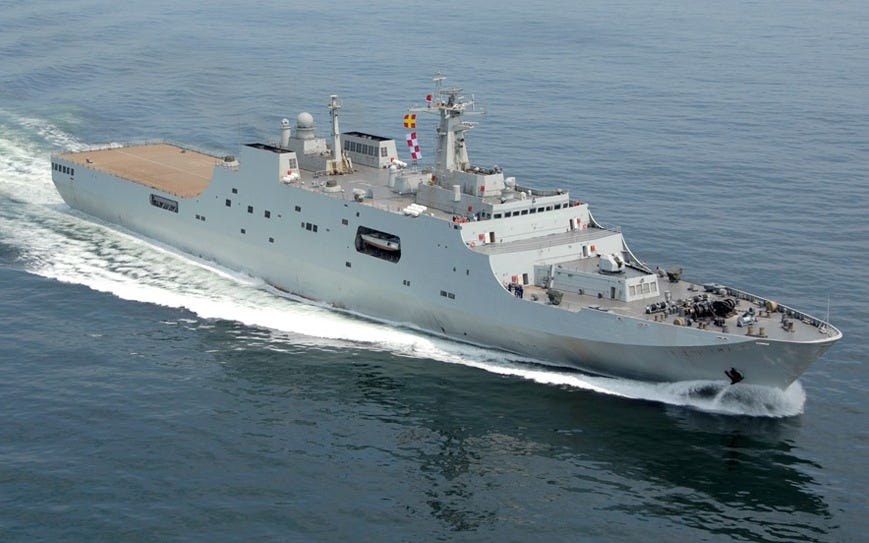
China is also increasing the number of missile carrying destroyers, cruisers and landing craft as well.  China's new Type 075 amphibious assault landing ship will come in at 40,000 metric tons with the capability of carrying 30 helicopters along with landing craft and just over 1000 assault troops.  The Type 075 replaces the Type 071 by 15,000 tons. There are now 32 Type 075's combat ready.

The Type 071 is another, albeit slightly smaller, amphibious land ship. Displacing 20,000 metric tons, it has capacity to carry four helicopters and roughly 800 combat troops. There are currently six known Type 071 ships in service at this time.

In addition to its combat fleet, China has greatly expanded its merchant fleet as well. Something you would expect with a growing economy. China now has 40.3% of the world's merchant shipbuilding market. Compare that to South Korea and Japan which has a 31.5% and a 22.2% share respectively.

China now has the second largest fleet of ships with 5,600, of which approximately 800 merchant ships. Greece has the largest, with 20.4% of the world's tonnage while China has 14.4% and Japan is third with 13% of the world's tonnage. China also has completed or updated the number of ship building facilities to six.

So, bringing this all together, what does it mean for the United States? The United States is still capable of projecting its military might around the world on a moment's notice. However, the question is whether it is still capable of maintaining that projection against a determined foe like Russia or China.

According to a report by the Heritage Foundation entitled "Index of U.S. Military Strength", only the Marines were rated at "strong" while the Navy and Space Force were categorized as "weak". The Air Force was rated as "very weak" and the Army was "marginal".  

Our stockpile of munitions and spare parts were badly depleted by our 20 year misadventure in Afghanistan, and much of what we were able to build back has found its way to Kyiv. The U.S. Navy, our principal tool in the projection of our foreign policy, is currently undergoing a phased overhaul and updating which isn't expected to be completed before 2035. The other branches are also undergoing their own updating which will take several years to complete.

Meanwhile, China is already at or near its ideal fighting weight, with the development of many of its ships progressing ahead of schedule. China's economy, while slowed, is still doing well while ours remains sluggish thanks to rising inflation and lingering effects of COVID on the economy.  Meanwhile, China has become much more aggressive.

It has claimed both the East and South China Seas as its own, and warned other nations to stay away. It has declared some of the territorial waters around South Korea, Japan, the Philippines, Indonesia, Australia, and India are in fact international waters, and thus has asserted its fishing rights there. China is also involved in a "warm war" with India along its mutual border in the Himalayas.

The creation of the Regional Comprehensive Economic Partnership (RCEP) may have a severe impact of America's ability to protect its interests in the Pacific, especially in light of China's growing economy, its expanded merchant fleet, along with a modernized navy capable and apparently ready to defend its economic interests.

For allies like Taiwan, the future doesn't look bright. Over the next seven to ten years, Taiwan will be particularly vulnerable. China has the means and ability to block off the South and East China Seas, and from there launch as rapid air and sea invasion of the island nation before the United States or anyone else has an opportunity to do anything.

This is especially true given our current preoccupation with Ukraine (and doubly so should we make the mistake up upping the ante and forcing Putin into some direct action against NATO. To make matters more interesting, China's ally, North Korea, could start something with South Korea which would further divert the attention a weakened U.S. military (some military analysts have states that given our current situation, we are unlikely to be able to operate effectively on two fronts). 

Of course, there's the economic angle. The U.S. is heavily dependent on Chinese imports, especially on electronics and computer chips. We depend on China for textiles, batteries, and machinery needed  in industry and even the military such as Neodymium which powers magnets used in hard drives or Praseodymium in the manufacture of aircraft engines which are "rare earth" metals.  

The U.S. doesn't manufacture these and other rare earth metals in abundance, but China does. In fact, they control 90% of the world's rare earth market. Heck, most of our cell phones---72%---are made in China!

 90% of our antibiotics come from China. 80% of the ingredients used in our medicines come from China. They also control 90% of the nine critical vitamins, 70% of acetaminophen, and 50% of the anti-coagulant Heparin.  Most of the medical devises we commonly use are of Chinese origin. 

Where does that leave us? The short answer is between a rock and a hard place. Internally we are increasingly unstable socially, economically, and politically. We can no longer afford to be arrogant about the supposed superiority of American capitalism or invincible military might as Vietnam, Iraq, and Afghanistan have shown.

We can't forget that China also owns about 20% or $1 billion dollars of our debt. They can call the tune economically with their influence on our domestic market, and even their growing economy and military power, they are likely to exert de facto regional control over the Pacific Rim and eventually they may surpass us as the world's most power nation. From all appearances, China has outfoxed the fox.    


 If you want to know more about this article's topic, please check out the links below. If you enjoyed the article, please consider passing it along to others and don't forget to subscribe. It's free! Lastly please be sure to "like" us on whatever platform you use to read anotheropinionblog.com. It helps with the algorithms and keeps our articles in circulation. Thank you! 


Asia forms world's biggest trade bloc, a China-backed group excluding U.S.


Ranked: Top Ten Countries by Military Spending


How is China Modernizing its Navy?


China's Navy Could Have 5 Aircraft Carriers, 10 ballistic Missile Submarines by 2030 Say CSBA Report


US military in decline, threats from China "formable" , report says


Executive Summary of the 2023 Index of U.S. MilitaryStrength


U.S. Dependent on China forVital Ingredients


We're Too Dependent on China For Too Many Critical Goods, Especially Medicine


Preparing for War with China, 2025-2032


What Will Drive China to War?


U.S. General's Prediction of War with China 'in 2025' Risks Turning Worse Fears Into Reality


Friday, February 03, 2023

The War in Afghanistan: Who Benefited? Who Didn't?

Here's something you likely won't hear from the corporate media. Although we spent 20 years in Afghanistan, we left it largely the same way we found it---backwards, corrupt, and in the hands of the Taliban. So, who benefited and who didn't?

We were told that the ones responsible for 9/11 were in Afghanistan, and the Taliban run government was aiding and abiding them. Well, that was true...to a point. U.S. and Western intelligence identified Osama bin Laden as the mastermind, which was likely. This son of a wealthy and well connected Saudi family had previously "declared war" on the United States, although no one seemed to notice or care.

Al Qaeda launched several attacks on U.S. and Western targets, mostly in Africa and low security targets in Europe such as a disco in Berlin which was frequented by American servicemen and women. When that failed to adequately get our attention, he changed tactics. This time he focused on a high profile target in the United States---the Twin Towers

Bin Laden recruited 15 fellow Saudis, 2 from the UAR, and one each from Lebanon and Egypt for the mission, and sent them off into the belly of "the Great Satan" where our overconfidence became their best weapon. It's also where 2,996 innocent people going about their daily business people died. In their place, a blind and deaf patriotism was born along with about a dozen conspiracy theories (by the way, that just because it's called a "conspiracy theory" doesn't mean it isn't true).

Saved from a failing presidency, George "Dubya" Bush went from an approval rating low somewhere in the subterranean sewers of Washington DC to calls for another face to be added to Mt. Rushmore. In all the vengeful anger and patriotic fever of the moment, we allowed the so-called "Patriot Act" to take hold; a document about as "patriotic" as the Enabling Act of 1933 following the Reichstag Fire (and just as spontaneous too).

Over the next 20 years the United States and its aid dependent allies delivered Hell from above and below. An estimated 243,000 Afghani and Pakistanis died as death was delivered with UPS efficiency from above and below. 70,000 men, women and children died as a direct result. The bad guys lost at least 53,000, but that's only a guess. Apparently "holy warriors" don't keep statistics, or at least make them public.

On the other side, U.S. and coalition forces lost at least 70,600 with about 22,773 wounded. 2,356 of these were America's future. God only knows how many bear scars you can't see.  Of the 70,600 total, 65,596 were part of the Afghan Security Forces, with an additional 16,500 wounded.

By comparisons, Russia lost over 15,000 of its sons and daughters during the course of its 10 year war in Afghanistan with thousands more wounded. Russian military personnel managed to kill an estimated 90,000 Mujahedeen fighters which were heavily supported by the U.S., (it's said this was partly in revenge for Soviet support of the NVA and Viet Cong during the Vietnam War. Knowing the NeoCons, it probably was).

At the same time, over one million Afghan civilians were killed, not including those killed in the subsequent civil war which followed the Soviet withdrawal in 1989 though the takeover by the Taliban in 1996.

Not to be outdone by the Western "crusaders", the Taliban is believed to have destroyed approximately $500 million dollars worth if infrastructure affecting 13 million people in 116 districts. It left 92% of population "food insecure" and some 3 million children facing severe malnutrition. Take that infidels! 

Just since our withdrawal in May 2021, some 400+ has been murdered by the Taliban (is it still "murder" if the Taliban claims it was acting on orders from God? Guess to the dead or their families it doesn't really matter does it?). Of course, there's always the billions in U.S. military equipment left behind which suddenly made the Taliban the fifth largest military in the world. Who should the Taliban thank for that little "gift"?

Ironically, despite the majority of Americans demanding an end to war in Afghanistan (54%) by 2021, nearly half---46%--- now believe the takeover of Afghanistan by the Taliban's new and improved "We-Say-So" government represents a threat to U.S. national security.  Ah the fickle masses!

Meanwhile, women are being regulated back to their pre-infidel invasion third class status as school for women and girls is cancelled and women are fired from their jobs. Those who own businesses face closure. Those who speak out risk public beatings, acid thrown in their faces, or stoning to death. If only the Taliban could reach the same level of  Iran's enlightenment (sarcasm intended).

What about the American People? Aside for the deaths and injuries whose cost are beyond measure, most don't realize that our 20 year long fiasco in Afghanistan and Iraq was paid for solely on credit. Can you guess who is picking up the tab? 

Best estimates put the damage to U.S. taxpayers at around $2.2 trillion dollars (or $300 million per day). With interest, some estimates put the cost at $6.2 trillion dollars by 2050 (good luck with that Millennials and Gen Z). You might be interested to know that during the Korean War, President Harry Truman temporarily raised the top end tax rate on the rich to 92%. During Vietnam, Lyndon Johnson raised it to 77%. So what did ole "Dubya" do? President George Bush lowered the tax rate on America's richest to 8%.

So, who benefited from the 20 years we spent in Afghanistan? Well, it's hard to say. The Afghani people certainly didn't. They suffered mightily under the Soviet invasion and its nine year occupation. They suffered under the Taliban's occupation.

America's invasion and occupation was almost as bad, except there was a measure of gender equality while we were there.  Women and girls could go to school. They could work, own property, and do other things females get to do in the modern world; you know, like they were ordinary people and stuff

In addition, women and other Afghanis could also freely vote, although the Taliban and other Islamic extremists did their best to try and prevent it. Nevertheless, there was a measure of democratic freedom which is rare in the Middle East.  Unfortunately after we left (or rather, as we left), democracy came to quick end and the 10th Century returned in all its ugliness as the Taliban picked up where it left off.

The American People didn't really benefit. Sure, we were given a target to vent our anger on following the cowardly attacks of 9/11. But along the way, we were betrayed by some of our regional "allies" (I'm talking about Pakistan's Inter-Services Intelligence Agency and its Prime Minister, Imran Khan) and various tribal chiefs (most had to be bribed to show any measure of loyalty).

We could have had bin Laden and many more of his key commanders much sooner had those in Imran Khan's government not help finance, arm, train, hide, and provide intelligence to the Taliban and Al Qaeda, which would have saved a lot of innocent lives on all sides. It's a shame how some individuals put their greed for personal power and wealth before the wellbeing of their own people. But, at the same time it exposes their moral weakness for all the world to see.

While extracting our revenge, we failed to notice the underhandedness happening here at home. Sure, we came together as a people. We closed ranks. We hung out flags.We cheered at the playing of our national anthem. Patriotism was back in vogue again. We hadn't been this united since December 8, 1941, the day after another cowardly attack which caught us with our pants down and our cockiness up.

Perhaps it was this unity which concerned certain individuals and groups. After all, a united America was something they didn't want. They had spent lots of time, effort, and money to keep Americans divided. After all, divided, frustrated, and confused was how to control us. United and we were suddenly dangerous. United and we just might focus our manufactured anger away from each other and on those who sought to destroy our Republic and turn it into a neo-fascist corporatocracy.

So, without even completely reading it, a document that had been drafted primarily by corporate lobbyists was rushed through Congress and passed. It was given a euphemistically optimistic sounding name of "the Patriot Act" as if questioning what it was or what was in it was somehow unpatriotic.  A few lone voices in the political wilderness tried to warn us but were quickly silenced. The surveillance state was born.

The "Patriot Act" effectively declared a never-ending war based on a loosely defined term--- "terrorism" where rights for individuals cease to exist under the pretext of national security. Gone too were all the usual checks and balances we've come to expect such as accountability, limits on search and seizure or judicial oversight.

The enemy was now whoever the State said it was. Those arrested under "FISA" can essentially disappear. Under "FISA" you have the right to absolutely nothing whatsoever. It combined all the elements of McCarthyism's "Red Scare" with aspects of the KGB's early morning knocks on the doors and George Orwell's dystopian novel "1984". 

Obviously, the American People didn't benefit, so again, who did?  Wall Street benefited. The Pentagon spent $14 trillion dollars, with roughly half that going to defense contractors (according to one report, since 2001, payments made to defense contractors have risen 164%). The majority of money spent went to just five corporations---Lockheed Martin, General Dynamics, Raytheon, Northrop-Grumman, and Boeing, but other companies such as General Electric and Halburton made out alright too.  

Thanks to our new "surveillance state", spy agencies saw their budgets balloon, particularly the Central Intelligence Agency (CIA), the Department of Homeland Security (DHS), the National Security Agency (NSA), as well as the FBI, the Defense Intelligence Agency, the National Reconnaissance Agency (NRC), the National Geospatial-Intelligence Agency (NGA), along with the various intelligence arms of the various U.S. military branches. Naturally, off the book budgets, the so-called "black budgets", likely were increased. Much of this was used to fund various covert research/development and operations carried out by "independent" contractors. 

Meanwhile, Congress and other government officials benefited. Defense contractors reportedly spent over $2.5 billion dollars over the past 20 years and employed over 700 lobbyists. On average, members of Congress had three lobbyists each just from Defense industry. We the People had none. This is the "free speech" Senator Mitch McConnell (R-KY) talks about when defending Citizens United.

So, if you want to know who benefited from our 20 year venture in Afghanistan and Iraq, now you know. It wasn't the Afghani People or the American People. The ones who benefited from the war which claimed tens of thousands killed or wounded, and billions of dollars in destruction were defense contractors and their de facto "employees" in Congress. This is just one relatively small example of the power and control Wall Street has over government. 


If you want to know more about this article's topic, please check out the links below. If you enjoyed the article, please consider passing it along to others and don't forget to subscribe. It's free! Lastly please be sure to "like" us on whatever platform you use to read anotheropinionblog.com. It helps with the algorithms and keeps our articles in circulation. Thank you! 


Timeline: Major attacks by al Qaeda


Hijackers in the September 11 attacks


Taliban Destroyed, Damaged Infrastructure in 116 Districts:IARCS


A year later, a look back at public opinion about the U.S.military exit from Afghanistan


The cost of the Afghanistan war, in lives and dollars


CFR: Pakistan's Support For the Taliban: What To Know


ACLU: Surveillance under the USA/Patriot Act


Watson Institute: Costs of War