Showing posts with label Right to Work. Show all posts

Thursday, August 28, 2025

Why Is There A Labor Day?


Welcome to the last “official” long weekend holiday of the summer!  It typically marks the closing of pools, the beginning of the school year, and the last quick vacation. But what is Labor Day really? Simply a day marking the end of summer or something more?

 Labor Day was established on June 28, 1894 and reluctantly signed into law by President Grover Cleveland, making the first Monday of each September a federal day set aside to celebrate the efforts of organized labor and the gains---financial and social--- it has made on behalf of  organized labor and the working class. Before then, there was something of  a “unofficial” day set by various unions, the date varying from place to place.

 It bears mentioning that organized labor, and those pushing for a day of recognition for organized labor were regarded as “socialist”, and indeed, they were. Most of those who belonged to labor unions were affiliated with various socialist political parties including the Socialist Party of America. Also, unions tended to become popular in jobs sectors with a history of abusing its employees such as mining, the auto industry, the garment industry, and shipping (train and cargo ships) and employed mostly immigrants and minorities.

 Later on, various other laws such as Social Security, minimum wage, 40 hour work week, child labor laws, women’s right to vote, job safety and the creation of OSHA, worker’s compensation, unemployment, and welfare were all labeled as “socialist” (or even “communist”) and vigorously opposed by Big Business.

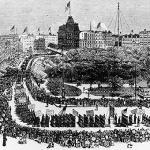
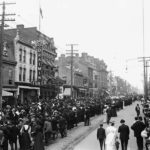
Not long after the first Labor Day parade was held on September 5, 1882 in New York City, the New York State legislature began work to introduce a bill to formally recognize organized labor. However, it was Oregon which was first sign into law a bill establishing a day honoring labor on February 27, 1887.  Later that same year, four other states, New Jersey, Massachusetts, Colorado, and New York signed into law bills which not just acknowledged organized labor but also established them as state recognized holidays.

By 1890, Nebraska, Pennsylvania, and Connecticut join the growing list of states to celebrate organized labor. Four years later, 23 states  passed laws to honor working men and women. Finally, on June 28, 1894, Congress decided to get on the act, thus establishing Labor Day as an official federal holiday.

While this was a major victory for the working class, who was the first person to propose a day recognizing labor? Not surprisingly, the answer isn’t so clear cut. However, there are two individuals most often cited. The earliest records show that in 1882, Peter J. McGuire, the son of poor Irish Catholic immigrants and general secretary for the United Brotherhood of Carpenters and Joiners as well as the co-founder of the American Federation of Labor (“AFL”) first suggested setting aside a day to honor the working class.

The other contender was Matthew Maguire, another child of Irish immigrant parents. Maguire was the secretary of Local 344 of the International Association of Machinists and Blacksmiths located in Paterson, New Jersey. He made the proposal in 1882 while serving as the recording secretary of the Central Labor Union in New York. Maguire was also a New York alderman.

Additionally, the New Jersey Historical Society reported that according to an editorial in the Paterson Morning Call newspaper, “Alderman Maguire” President Cleveland should give Maguire a ”souvenir pen”.  As an aside, in 1896, Maguire ran as the vice presidential candidate for the Socialist Labor Party of America alongside the presidential candidate, Charles H. Matchett.

 Labor membership continued to growing, reaching almost 1/3 of the workforce by the end of the 1950’s, although in terms of actual numbers, it reached its highest point in 1979, hitting 29 million dues paying members. Nevertheless, union membership began its decline in the 1960s, accelerating in the 1980’s under President Ronald Reagan as companies began closing plants and exporting jobs overseas.

The once powerful public sector unions have also lost much of their clout following the infamous 1981 strike by the Professional Air Traffic Controllers Organization (PATCO) which resulted in the firing of some 11,000 striking air traffic controllers over pay, hours, and job safety issues by President Reagan, which, among other things, prohibits public unions from striking.  

 Another reason for the decline of union membership is growing trend of “Right to Work” legislation., which stems from Section14(b) of the 1947 Taft-Harley Act which gives state the authority to prohibit mandatory union membership even in a closed (or union) shop. Under “Right to Work”, employees may elect not to join a union and thus are not required to pay union dues.

 However, these employees still benefit from any and all collective bargaining agreements, including the use of a shop steward to assist them with any employment issue. The result is a drain on union resources. Currently there are 27 "Right to Work" states which include Kentucky, Texas, Florida, Alabama, Georgia, and Indiana. 

 Today, organized labor makes up roughly 10% of the workforce or about 14.3 million workers, with public unions comprising the bulk of union membership (33%) compared to just 6% who belong to private unions. The states with the highest union membership is Hawaii with 26.5% of its workforce belonging to a union. Hawaii is followed by New York with 20% and Alaska with 17.7%.

 Education and protective services such as teachers, police, EMS, and fire have the highest percentage of union membership. Black employees are most likely to belong to a union, more so than Hispanics, Whites, Asians, or Native Americans.  Meanwhile, men are slightly more likely to belong to a union than women (10.5% to 9.5% respectively).

I guess I've always tended to support unions, employee owned workplaces. and employee initiatives. Most of my relatives belonged to unions, especially mining and railroad. I've worked primarily for several non-union companies. Most were decent, but some seriously "used and abused" their employees. 

This resulted in high employee turnover, sloppy work, very low morale, heated outbursts, and hostile work conditions amid poor management skills. In fact, they were so bad, I used them as examples in the undergraduate and graduate classes I taught. Amusingly, few of my students believed the examples were from a real---albeit unnamed---company!  

In every place I worked, I was asked by fellow employees to serve as the employee representative. I'm not sure why I was repeatedly chosen. Perhaps they thought I'd be fair and balanced or perhaps it was because I wasn't bashful about challenging authority figures. Regardless, I was always honored by the trust and confidence my fellow employees had in me to take on management.

My last position before retiring was that of "Special Coordinator to the President for Special Projects". Basically, this was an assistant vice president position which functioned similar to my previous roles as an employee/management liaison (some saw it as a “non-union shop steward”). I provided a comprehensive report to the company president and the Regional Vice President with recommendations for the improvement of company morale and productivity (in addition to my role as Senior Legal Manager).

In addition to serving on several non-profit boards, I was appointed state chairperson of a national writers union (UAW/NWU 1981) where I served for 11 years. I handled state based issues and served on the local labor council. I was elected as the National Vice Chairperson of the At Large Chapter and served on several national committees. I also liaised with several labor oriented organizations and served on the Greater Louisville Central Labor Council.

Equality and fairness in the workplace has always been a historically important union issue. Unions backed social causes like the Women's Suffrage Movement, Civil Rights, and the Chicano Movement of migrant farm workers and sharecroppers for fair wages, not to mention the Family Medical Leave Act,  and the Uniformed Services Employment and Reemployment Rights Act (USERRA) which guaranteed returning military personal their old job back or paid training for a similar job in the event their earlier job or place of employment was gone. Many also unions opposed President Clinton's "NAFTA", which turned out to be a disaster for many American businesses as well as the working class.

Unions are said to have created the middle class, which may very well be true, but it's not been all wine and roses. If you look at countries with no or weak unions, you tend to find a weak middle class and widespread poverty. Of course, that isn’t to say unions are the answer to every social or economic problem, nor are unions always applicable to every job sector, but they aren’t the villain they are often made out to be by Big Business.

Additionally, unions have faced a lot of problems over the years, externally and internally. One of which is their refusal to think outside of the box, or to be more accurate, outside of the hip pocket of the Democratic Party which, like the Republicans, greedily serves Wall Street, leaving unions to “manage” the employees on behalf of management rather than represent them.

Union leadership has consistently failed to protect the best interests of its members by not making the major parties or candidates compete for their support. Labor must look elsewhere, even if it means forming its own political party (did you know that we're the only industrial nation---and one of the few nations period--- without a Labor party?) or face eventual extinction. It’s not a question of “if”, but “when”.

So, as you and yours do whatever you do on this last long weekend of the summer, take a moment to remember what Labor Day is all about---the working class of America.


Thank you for reading "Another Opinion", the Op/Ed blog page for the "militant middle".  Here at "A/O" we truly value our readers. At A/O we seek the facts as they exist, not partisan talking points.  We hope you find our articles informative and engaging. Comments are welcome, provided they are not vulgar, insulting or demeaning.  Another Opinion is offered without charge and is directed toward all independent and free-thinking individuals. We ask, however, that you "like" us on whatever platform you found us on in order to keep our articles available for free to others. Lastly, in order to keep costs down, we depend on passive marketing, and therefore, depend on our readers to please forward our posts along. Below you will find links to the sources we used in writing this article. Thank you. 


Labor Day


History of Labor Day


Right To Work—What It Is And More Importantly, What It Isn’t?


Labor unions in the United States


Unions, Workers, And Wages At The Peak Of The AmericanLabor Movement


US labor union membership slips in 2024 to record low


Right to Work


The Consequences Of Reagan Breaking The 1981 Air TrafficControllers Strike


Matthew Maguire


Charles H. Matchett


Peter J. McGuire


AFL-CIO: Peter J. McGuire


Socialist Labor Party of America


Sunday, November 03, 2019

The 2019 Kentucky Election: The Main Event---Attorney General and the Governorship


The second most important political office in Kentucky is Attorney General. Although it's officially a "law enforcement" office, it's typically been used as the "Anti-Governor" office, depending on the political allegiance of the other occupant. It's also the office best suited for a future run for Governor. Again, this is another open seat. The two candidates are Daniel Cameron (R) and Greg Stumbo (R). Both candidates are, as required, lawyers; having both graduated from University of Louisville's Brandeis School of Law, but that ends the similarities.

Daniel Cameron is basically a political newbie. He clerked for Federal Judge Greg van Tatenhove in Eastern Kentucky for two years. He then served as Senator Mitch McConnell's general counsel, and is generally regarded as being McConnell's political protégé. Cameron regards himself as a strict Constitutionalist and says that he will try and "depoliticize" the office. He also says that he will work closely with "Trump-appointed" federal prosecutors, especially in going after drug traffickers (a major problem in Eastern Kentucky). He does not support expanded gaming and is strongly "Pro-Life". Finally, he cites having strong Christian beliefs and believes in active political engagement by fellow Christians.

Greg Stumbo is the quintessential Kentucky "good ole boy" in every way. A dyed-in-the-wool Democrat and icon of the state's backward status quo image. He's what Kentuckians call a political "retread". He has served as State Representative, State Senator (including Speaker of the House), and previously as the Attorney General opponent of Republican Governor Ernie Fletcher (the first GOP governor since 1969. Stumbo did everything in his power to challenge and derail Fletcher. As an aside, he had also served as AG under the previous governor, Steve Beshear).

He cites his 40 years as a trial advocate and prior experience as his best qualifications. Though he cites the importance of family values, it's worth nothing that Stumbo fathered a child out of wedlock, denied paternity, and was successfully sued for back child support. Stumbo is known to be very cunning; even devious, making him a tough opponent. According to Stumbo, he will focus on the opioid crisis, consumer scams, and Medicaid fraud. Although he acknowledges that the AG office has no role in expanding gaming, he's a supporter.

There's no doubt that Greg Stumbo knows the job. He knows it in ways that only an insider could. Stumbo is part of what's wrong with Kentucky in every sense of the word. While no political office should be "politicized", this is especially true of Attorney General, which should be a non-partisan office to begin along with most of the other Constitutional offices. Greg Stumbo, in my opinion, needs to be consigned to the Kentucky's "dustbin of history"; a product of a bygone and soon-to-be forgotten era. Nevertheless, despite Cameron's association with McConnell, his fresh approach may just be what Kentucky needs.

Matt Bevin is the least popular governor in America, at least according to a Morning Consult poll. In July 2019, his disapproval rating was 56%. He's now the second least popular governor. Massachusetts' Charlie Baker has that honor. As an aside, Mitch McConnell was the least liked US Senator. Still, Governor Bevin has brought Kentucky into the 21st Century, albeit kicking, screaming, and biting the whole way.

The Colorado born and New Hampshire raised governor is a businessman by profession. He earned a BA Degree in East Asian Studies from Washington and Lee University in Virginia on a ROTC scholarship, becoming fluent in Japanese. Bevin is also former military, having risen to the rank of Captain. Matt has been around the political block so to speak a few times at well.

In 2011 he considered a run against incumbent Representative John Yarmuth (D), but backed off after determining that partisan gerrymandering had made a run all but impossible to win (Bevin claimed that Senator Mitch McConnell had recruited him to run. McConnell's office denied it). In 2014 he challenged Senator McConnell for his seat and lost with 35.42% of the vote. As an aside, McConnell and Bevin haven't exactly been best of pals since.

In 2015, Bevin ran for governor, but unlike his opponents in the primary and general elections, focused on economic rather than social issues. He won, narrowing beating James Comer (R) in the primary by 30.90% to 30.87% (or 43 votes). He later beat Jack Conway (D), the state's Attorney General in the general election by successfully linking him with the hugely unpopular President Barack Obama.

There's been a lot of controversy during Bevin's tenure in office; some of it real while much of it smoke and mirrors by the local media such as over the delinquent taxes and a "sweetheart" sale of a house. However, Bevin did gut Kynect, the state's insurance exchange, cut Medicaid dental and vision coverage for about 460,000 Kentuckians (a computer glitch accidently included some children, disabled adults and pregnant women which made it worse). He also issued a cease and desist order to Planned Parenthood in Louisville, claiming that they lacked proper licenses and had "illegally" performed 23 abortions, although Governor Beshear's inspector general had just authorized their performance of the procedures prior to leaving office. Matt also caught a lot of flak by replacing his popular Lt. Governor, Jenean Hampton with Ralph Alvarado, a state senator with alleged ties to Senator McConnell.

Lastly, the teacher's strike. The Kentucky Education Association and the Jefferson County Teacher's Association are perhaps the state's most powerful unions. Bevin faced off with both over pension funding. For years , the pension system was grossly underfunded under Democratic administrations (and one Republican). Fed up, the teachers staged a series of "sick outs" and protests in Frankfort. Despite this, Governor Bevin was able, through the legislature, to fully fund the state's contribution portion, but you'd never know it by the response the unions and local media gave. Bevin has promised to continue work for long term sustainability of state pensions. He also increased individual funding per student to the highest amount in the state's history.

Perhaps the cold shoulder was because Bevin moved to make Kentucky a "Right to Work". Kentucky has always been a blue collar state, and while it was never exactly a "pro-union" state, it did have quite a few strong unions. However, those faded as the state lost many of its manufacturing companies and railroads, but it remains very much "working class". He has lower personal and corporate taxes by 17%, at least according to his website. Bevin also declared that Kentucky would not permit any so-called "sanctuary" cities or communities; this despite attempts by certain mayors. Lastly, Matt Bevin has tied his coattails to the President Trump as I pointed out earlier. Given the decline in the president's popularity, this may prove to be a curse more than a blessing.

Andy Beshear (D) is the son of the former governor, Steve Beshear. Like Matt, Andy sees education as a key issue in this election. He promises to increase teacher pay and further increase funding for schools. How? He doesn't say, but I suspect it will mean a tax increase for somebody. He also promises to reduce class sizes, which means we'll need more teachers and classrooms.

Beshear also promises to reduce drug costs for seniors, aggressively pursue the opioid crisis, stop robocalls and scammers, increase funding for the Seniors Health Insurance Program, restore voting rights for felons who've served their time, reduce the costs of attending public universities and technical schools, expand gaming, support medical marijuana, end "Right to Work", promote marriage equality (ie: gay marriage), and attract more decent jobs. Finally, Andy Beshear is on the record as being pro-choice.

I couldn't find any specific details about how he intends to accomplish any of these, which will obviously require the support of the legislature (the Kentucky Senate is controlled by the Republicans and the democrats narrowly control the House). It will also require a great deal of money, and that means tax increases. Kentucky is ranked 24th in highest taxes (23rd for businesses). You can't attract businesses by raising corporate taxes. That means personal and consumption taxes---gas, property, sales, and a myriad of others. Kentucky's infrastructure is ranked 34th in the nation while its quality of its healthcare and financial stability are ranked 44th and 45th respectively (the state is ranked 40th overall).

Beshear's choice for Lt. Governor is Jackie Coleman, a teacher and current assistant principal from Mercer County. She is also founder of Lead Kentucky, a non-profit which helps women in college obtain leaderships positions both on and off campus. She is also a participant of Emerge Kentucky which trains Democratic women to seek public office.

Finally, we come to the third candidate in the governor's race. Libertarian John Hicks. John is a Vietnam Era Army veteran, a former school teacher, and currently an IT consultant. He has a BA Degree in Political Science and History. He has never held political office, but ran previously for State Representative (District 43) in 2018. John is pro-life and believes government should stay out of personal issues.

John supports the legalization of marijuana, expanded gaming, and the development of hemp as sources of additional state revenue (better than raising taxes!). He also believes that the best way to compensate for budget shortfalls is to reduce the size of government and streamlining operations. Additionally, John Hicks supports election reform; specifically by introducing run-offs, using ranked choice voting, proportional representation, multi member districts which would end partisan gerrymandering.

On education, Hicks supports expanding education and, as he says, "removing any barriers" to obtaining access to education. Thus, he supports expanding work-visa programs for immigrants wanting to study at state schools. Regarding illegal immigration, he believes the current immigration system is "absurd" and those here illegally should be treated with "respect and humanity". He is also pro-Second Amendment, and stresses the need for individual liberty as well as limited government. His choice for Lt Governor is Ann Cormican, a factory employee. She has a BS Degree in Agricultural Economics from the University of Wyoming. She previously ran for State Representative (District 72) in 2018.

So, there you have it. I've met Governor Bevin on several occasions. I like him. He's interesting to listen to and has the necessary acumen of a successful businessman (and the same learning curve when it comes to politics). I agree with many of things Bevin has done as governor. However, there are also several things I disagree with (specifically his handling of the insurance crisis, dropping Jenean Compton, and his opposition to legalized medical marijuana).
As for Andy Beshear, I'm not impressed (I wasn't impressed with his father either). He talks a lot about what he opposes but not much about what he supports and how he's going to pay for it. That's something I'd like to know before casting my vote. His failure to provide details makes me nervous. I don't want to pay more taxes. I'm sure other Kentuckians don't either.

I do agree with Andy's positions on some issues (such as legalized marijuana) and expanded gaming (provided it doesn't all go to Churchill Downs). I think that gaming reform could be a major boon for increased tax revenue if it's done right. Same with legalized marijuana, which would also go a long way to ending the state's opioid problem. I've never met Andy, but the impression he creates is one of a privileged brat. He's depending heavily on his daddy's name (and he wasn't all that popular). I don't care for the negatively of either individual's campaigns, but understand that if the other side throws dirt, you throw manure. That's politics.

I do like John Hicks. Like him, I'm big on keeping government out of my personal life. In theory, I support a small government, but in practice believe government should be more elastic, depending on the economy. I am pro-Second Amendment, and I believe Kentucky has to do much more in terms of education. Employers are attracted by low tax rate, but they are equally attracted to a educated and trained workforce. Until we can provide that, the good paying jobs aren't coming. Kentucky need serious government, election, and tax reforms too. John's biggest flaw, as I see it, is his support of illegal immigration (which is a federal issue), and the fact that he's woefully underfunded. The fact that the media has all but ignored him doesn't help.

Lastly, I want to remind you that the local newspapers will be doing their "endorsements". I urge to completely ignore these. The media should be in the business of reporting the news fairly, honestly, and balanced, not trying to manipulate public opinion and influence elections in support of their agenda. Do your own research and make your own decisions. Don't let someone else---even a newspaper---decide for you. Voting is too important.


Stumbo's family values theme is plain phony


Matt Bevin no longer most unpopular governor in America in latest survey


USA News and World Report: Best States Ranked

Saturday, September 02, 2017

Is Labor Day Still Relevant Aside From Being A Three Day Weekend?

Labor Day. The (more or less) official day marking the end of Summer the same way Memorial Day marks the beginning of Summer. Typically, we use these days as sort of "markers" to plan our vacations and DIY outside jobs like painting the house or building a new deck, plus it provides the exclamation point to a three day weekend. Of course, it's always a time for sales! But, what is Labor Day besides a seasonal placeholder? Have you ever wondered way Labor Day even exists?

Well, as the name implies, Labor Day was set aside to celebrate or recognize "Working Class America". It is a tribute to the ordinary men and women who've made this country so successful; to the innovations everyday individuals have made to and for the collective good of us all. Whereas holidays like Memorial Day honor those brave men and women who have given their lives in the protection of this nation and its freedoms, Labor Day honors the collective "us", be it coal miners, teachers, first responders, truck drives, factory workers, garbage workers, and so on. It is "our" day.

I've often thought that the symbolic placement of Labor Day was somewhat appropriate. After all, when the work is finally done, only then does the worker have an opportunity to set and appreciate the joys of his or her labors. Thus, Labor Day falls at the end of the Summer, and all the hard work has been completed. In the same sense, Memorial Day comes at the beginning, and as such, we first honor those who've come before us and laid down their lives for our sakes.

Labor Day was, historically, primarily a localize event throughout the latter half of the 19th century. The First State to make Labor Day a state holiday was Oregon, which did so on February 1, 1887. The reason was primarily to attract skilled labor from the East Coast to work in its mining and lumber industry. Within the same year, others states passed their own legislation to make Labor Day a state holiday. Among these, were New York, which had been the center of the labor movement as a result of mass influx of immigrants from Europe; many of whom had been exposed to the ideas of worker rights thanks to mainly to the Socialist and democratic political groups . Other states included Colorado, New Jersey, and Massachusetts. By the close of the century, 23 states had proposed and adopted a day to honor workers. On June 28, 1894, Congress voted to make the first Monday of September a national holiday throughout the nation, its territories, and the District of Columbia.

The first actual celebration of Labor Day was in New York City on September 5, 1882 in conjunction with the Central Labor Union which encouraged other unions as well as businesses to participate. By 1884, Labor Day was seen as a celebration of workers complete with festivals, displays, speeches by politicians and community leaders, labor representatives, and parades designed to promote the comradeship of the various trade and labor unions. In addition, the American Federation of Labor (the AFL), introduced a proposal in 1909 that the preceding Sunday was to be dedicated to educational training such as the history of the union movement, how to organize, and the various objectives of the Labor Movement like gender equality, improving working conditions, child labor laws, 40 hour work week, the right to collectively bargain and organize, women's right to vote, and so forth. Many of these would eventually become federal laws. Workers were also taught about the Socialist Movement, which organized labor had, at least partially, had sprung.

Over time, many of goals proposed by organized labor became law. Federal agencies were created to protect workers---union or non-union---such as the Department of Wage and Hour, Occupational Safety and Health Agency (OSHA), the Department of Labor, the Department of Health, Education, and Welfare, the Department of Health and Human Services, and Department of Housing and Human Services, the creation of a Labor Relations Board to mention a few. Meanwhile, various laws were enacted such as the Fair Labor Standards Act of 1938 (which was amended in 1963 to include the Equal Pay Act of 1963), the Civil Acts Act of 1964, the Age Discrimination in Employment Act of 1967, as well as various acts to prevent discrimination based disability, gender, sexual orientation, religion, ethnic heritage, or race.

Some have wondered if we really need to continue to celebrate Labor Day. After all, many of their original aims have been accomplished through federal legislation. Some unions, such as the AFL-CIO, are reduced to promoting so-called "amnesty" for the approximately 11 million illegal immigrants currently in the US. However, they're not promoting amnesty and allowing some 11 million individuals to skip to the head of the line out of the pure kindness. The majority of these illegal immigrants work in low income service or manual jobs; jobs which have a union unit such as for unskilled labor, hotel housekeeping, horse and dog track workers, and various trades such as roofing and carpenters. Today, the number of union members are declining rapidly (as of 2016, only 6.4% of private industry employees belonged to a union. Union membership peaked at 35% in the early 1950's), along with the coffers of these union. Unions would like to see the Federal Government turn a blind eye to illegal immigration in order to sign up these individuals. It would not just boost their numbers, but the dues paid would greatly enlarge their bottom line.

While union employees tend to earn more on the hour along with better benefit packages than their non-union compatriots, many companies have opted to move, be it to another state or out of the country, in order to avoid paying the higher union salaries and employment packages; thus increasing their bottom-line---even when factoring in shipping (union employees earn, on average 20% more than non-union employees). In addition, close to 35% of public employees belong to a union with teachers and librarians, trainers, those engaged in protective services having the highest overall rate of unionization. Men tend to more likely to belong to a union (based on historical employment in factories) at slightly above 11%, women still make up just over 10% of union membership. Based on race, black workers make up the greatest percentage of union members; greater than whites, Hispanics, or Asians. By age, the majority of union members are over 45 years of age and older. So those most greatly affect by the decline of union membership as a result of business relocation, closure, acquisition or passage of "At-Will" and "Right to Work" legislation tend to be older black males along with white males and females.

Before I go further, I think that I should explain "At-Will" employment since some of you may not have heard of it before or might be unclear as to what it is. At-Will means that you are hired by an employer "at will"; that is, you may be let go for pretty much any reason other than those which would violate existing federal laws such as race, religion, gender, and so forth. At the same time, you may accept, reject, or leave a job at your discretion. Therefore, employment is by mutual agreement between both parties---the employer and the potential employee. In a "Closed Shop" environment, if hired, you must join the union at that location. You have no alternative if you want the job. Membership is mandatory. However, you get the benefit of the union such as better wage and benefit package, restrictions on mandatory overtime, guidelines for promotions, terminations, and shift or job changes. You also have the benefit of having to a union steward in the event of a dispute or harassment by another employee or member of management. There are additional perks, depending on the industry and union.

Right to Work laws, which are an extension of the 1947 Taft-Hartley Act which prohibited employers to hire only union employees, are similar to At-Will laws. Right to Work assumes that, like At-Will, in that you were offered and accepted an offer of employment. However, you are not required to join a union if one exists at your place of employment. In most cases, unions are still required to protect your interests even if you aren't a dues paying member. Many say this is unfair in that an employee who opted out of union membership would be entitled to union benefits since it costs the union both time and money. At the same time, Right to Work laws hurt the bargaining power of unions since it not just reduces the number of dues paying members, but in the event of a strike, it would still leave employees working. At present there are 28 Right to Work states.

Personally, if this is the wave of representation, I think it should be modified to where a non-union employee is exempt from any union benefit, including representation by a steward, salary and/or benefit negotiations, and so forth. Hiring salary should be based on industry and state average, and not necessarily what the union negotiated If, as an employee, you think you can do better without a union, great. Have at it. However, you're on your own when comes to protecting your shift, specific job, work schedule, benefits, wages, and so on. You will also have to fight your own battles--- with no shop steward or union help unless you want to pay for it.

I'm not being critical of the individual who opts out of a union. That's their right, but I don't think the union should be under any obligation to assist them in any way. By the same token, I think unions have a duty to make employees want to join a union based on what it actively does. I've seen a lot of unions which were absolutely worthless when it came to protecting or helping its employees. The only things they were good at was being the company's "bagman", rubber stamping contracts, and trying to bully employees. I think too that unions should be active and visible in the community like the old activist unions of the 30's and 40's through the late 60's and early 70's.

Lastly, unions shouldn't be a "one trick pony" and operate as the cash cow for the Democratic Party. I've personally witnessed politicians make fun of unions as "ignorant" and still get endorsed. I've seen them not use any union "bugs" on their campaign literature or support legislation which would clearly hurt unions and they still get their endorsements, along with PAC money and volunteers. I've watched politicians who've never been a union member or who have worked against unions, get endorsed. At the same time, I've seen some very pro-labor Republicans or other party, who are shop stewards, union officers, or active union members, not get a second look let along any campaign contributions or endorsements. Then you see these same union officials whine about a lack of representation. You think?

Unions need friends on both sides of the aisle; they need to reach across party lines. In fact, they need to reach outside of party lines to Independents (Indies are the largest political demographic and growing) and Libertarians or the Green Party (who are the third and fourth largest political parties respectively). Better yet, organized labor should seriously consider forming its own Labor Party. The U.S. is the only industrial nation which does not have a political party dedicated to Labor. Even many second and third world nations have a Labor Party, and who is to argue that America's two parties aren't bought and paid for by the ruling Oligarchy? We just get to pick between the red "Kool-Aide" or the blue "Kool-Aide".

So there you have it friends. That's the brief history of Labor Day and the state of organized Labor. Most of its original goals have been met; they are now federal laws, with the majority being backed up with state and local laws, regulations and ordinances. Unions have been devastated by the shift from an industrial based nation to a service based nation. Kids are encouraged by" guidance councilors", teachers, and others to go to college where many wind up with a useless degree and a lifetime of debt when they would be better off going to a trade or technical school. At least there, they earn a skill where there is a real demand---some have a critical shortage---at a fraction of the time and cost. In fact, most graduates of trade schools will earn more than their college bound classmates over their lifetime. In Europe, especially Germany, technical and trade schools are looked upon with the same respect as a four year degree. In fact, all German unions provide additional education and a work-study program complete with On-The-Job-Training (OJT). Many, if not a majority, are hired straight out of the program.

I think there is still a place for unions. In fact, I think there is still a critical need for unions. However, they have to adapt and change; something they've often failed to do. I've provided some suggestions above. I hope some union member reads this and takes it to heart. Unions have given this nation so much. Without them, there's a good chance of going backwards in terms of employee rights, job safety, wages and benefits, especially since we are now an Oligarchy whose sole interest is control, be it resources, assets, governments, or us. Happy Labor Day everyone!


Department of Labor: History of Labor Day


Bureau of Labor Statistics: Union Members Summary


50 Years of Shrinking Union Membership In One Map


Right-To-Work Laws: Myths vs. Facts


Saturday, March 21, 2015

Do You Have a Right to Work?


Let's say that you like working on cars. Cars are your life. There never has been any question of where you wanted to work---the local auto plant in town. The money and benefits are great, and what's better, they're hiring. So you fill out an application. After a few days, you get a phone from the plant's human resource department and set up an interview. She wants to hire you. An appointment is made to come down and see the company physician for a quick physical. The human resources manager asks you to come back in for an orientation.

At the orientation, you go over the various procedures like safety issues, clocking in and out. Then comes the shocker. You're told that you are required to join a union in order to work there, but you're not interested in joining a union. You're told that the plant is a "closed shop", meaning that in order to secure employment there, you have to join the union. You tell her you're not interested in a union; you just want to work on the car or truck assembly line. At that point, a union representative is brought in to talk with you.

You politely listen as she explains that the union has been in place since the 1950's; that the union would protect your job in case something should happen; that they would provide you with a shop steward in the event of performance issues or any hearings; the union would negotiate on your behalf---collectively---pay raises, health and other benefits, your hours, and job safety issues. All you need do is sign the union card and agree to have the union dues automatically deducted from your salary. Easy peasy.

After the union representative finishes speaking, you politely explain that you don't have any interest in joining a union. You are aware of your responsibilities, and as an adult, take full responsibility for your actions. Furthermore, you are quite capable of speaking for your self should you get into any trouble. The representative explains that without their steward, you could run the risk of being taken advantage of (implying that you couldn't trust the company).

The union representative reminds you that unions have been at the forefront of child labor laws, women's suffrage, job safety, voter
registration, and even the Civil Rights movement. Those were all powerful and important issues, but each has been addressed by the federal government and are now laws. What about wages and benefits? Unions have been out in front in protecting wages, limiting hours, and securing benefits for their members. That's true, however, those too have been largely addressed by various federal laws. As for negotiating wages, over the past decade or so, unions across the country, have negotiated away much of benefits they had fought for over years, which has also included pay cuts, reductions in worker seniority and are only just now getting some of those back. Besides, the company has offered a retirement package before the company unionized, and offers a similar package at its non-union plant.

At this point that the union representative is getting agitated. She adds that the union also has a political education committee which would act on your behalf by endorsing candidates and making political contributions. Where does that money came from you ask, and she says that it is automatically deducted from your paycheck. Ok then, who selects which candidate or issues your money gets directed to? As it turns out, it isn't you. The committee would make that decision for you. What about the candidates they endorse, do you get a say? Not directly, but you do get a vote. However, the final decision is made by the committee. In some cases, only the political election committe makes the decision and in others, only the union president decides. But, you explain, you aren't partial to either of the two parties, but who were some of the candidates they endorsed in the past?

As it turns out, all were of a specific political party, and few if any of them, support the same issues as you. Accordingly, you point out that it made more sense if you donated to whom you wanted rather than have a portion of your salary going to individuals you didn't agree with. Besides, it didn't make any sense to dig deeper into your pocket to donate to those candidates you agree with; it was like you were working against yourself.

After a few polite closing remarks, you're informed that either you sign the union card or don't get the job. At that point she leaves. Funny, you think, wasn't that the company's decision to make? You could see her speaking with the HR manager outside the door. A few minutes later, the HR manager enters and asks if you have any questions, otherwise you were free to leave. You told you can start as soon as you turn in the signed union card. You mention that you did have a couple of questions.

How is it that you answered a company job announcement; filed out an company application; interviewed with company personnel; went to a company doctor; but in order to accept a job that you really wanted--- that you had studied hard for in school---spending countless hours after and before school; that would hopefully be your life's work---you had to join an organization that you weren't the least bit interested in, not to mention an organization which would not support your views politically in order to work there? In fact, you're told that they, not the company, decides who works there based on whether you sign the union card or not. Two words---closed shop. A closed shop means simply that in order to work there, you had to join the union whether you wanted to or not, and you have to abide by their rules and pay their dues.

Closed shops came about during the heyday of union membership---the late 1940's and early 1950's. Within the past few decades, many companies have sought to circumvent closed shops by moving the company to either states which had "right-to-work" laws, meaning that individuals can't be compelled to join unions, or the plants were closed and work shipped off to countries where workers are paid sweat shop wages with no benefits and they had little or no rights whatsoever.

So there you have it folks. Although the story was entirely fictional, the situation is real. Is it better to join the union, where the jobs of everyone is more or less protected, or take a chance? Some can certainly fight back or negotiate their own pay, but many can't. In some cases the costs of wages, benefits, and protecting unproductive workers have proven to be too much and companies have closed or moved. Unions essentially negotiated themselves out of a job. Many companies have retirement or 401k programs. Much of what unions championed down through the years are now laws, with workers having recourse through OSHEA (including its "Whistleblower Program"), the Labor Department's Wage and Hour division, the Equal Employment and Opportunity Commission (EEOC), plus various State and local agencies.

On the political side, instead of looking for themselves, unions have been in bed with one political party since the 1930's instead of playing each party off each other. Also, instead of supporting the best candidate for the rank and file, they nearly automatically endorse just the one party's candidate even if that particular individual doesn't even support unions! And let's not forget that in many cases, the member doesn't even have any say so where their money goes, which is often on issues or individuals they completely disagree with, meaning they have to dig deeper in their pockets to support the cause or candidate they want, and heaven help them if they actively support then non-union endorsed candidate or even put out their yard sign! Currently, some unions are pushing for amnesty for illegal immigrants since many are employed in mow skill and mostly unionized jobs. Amnesty would open the door for them to join the unions, and thus add desperately needed dues to the union's coffers. However, the influx would create more demand for jobs than there are available jobs, thus driving down wages and benefits while driving up unemployment.

What do you think? As corporations have become more feudalistic and some, like banks and oil companies, have essentially taken over governments like ours, have unions become passé? Have they outlasted their usefulness? Certainly big business would like for to think so. Unions have traditionally balanced the scale of power. Of course, unions aren't perfect. Some became corrupt through their Mafia involvement while for others, it became hard to distinguish union management from corporate management, especially when looking at their salaries! Unions have been at the apex in many social issues that we now take for granted. They were responsible for a vibrant middle class and growing economy, and as unions have declined, so as the middle class and so has America overall; so much that we face the largest disparity in income since just before the Great Depression, but then this isn't 1929 and the American economy is no longer the largest or strongest.

There are of course alternatives to unions, such as worker owned companies (co-ops), employee associations, employee-managements boards where employees and management elected representatives to a special board on a rotating membership basis which deals with employee related issues such as work conditions, complaints, and worker innovations. In addition, there's been a trend in business to create a more horizontal hierarchy and empowering employees, not to mention occasional outings, ongoing surveys, and workshops. I served as an employee liaison with management at several companies where I worked, including in an Assistant Vice President role working on projects to improve morale, productivity, and efficiency; a happy workplace is a productive workplace, at least that was the idea.

Right now, certain groups (primarily conservative and pro-business) are pushing for "Right to Work" laws, with Wisconsin having just recently enacted such a law. Proponents claim that "Right to Work" makes companies more competitive and gives workers more options, which they cite as being critical in today's global marketplace. Opponents, however, refer to the effort as "Right to Work for Less" and claim that without union representation, workers will be taken advantage of, have less job security, and will eventually be forced to take cuts in pay and benefits without any recourse except walking out and trying to find another job when jobs are hard to come by. In addition, unions point out that in "Right to Work" states, they'll be forced to cover non-union employees which they can't financially afford to do; such a move could ultimately bankrupt many unions. Unions are already having to compete, directly and indirectly, with companies and workers overseas who aren't unionized and earn pennies on the dollars and often without any benefits or even basic health and safety regulations while management and Wallstreet investors pocket the difference. Proponents, however, cite lower costs of living standards which justify the lower wages and benefits aren't something workers don't deemed as important.

Many on the political Right look at unions as "communist" or "socialist" (their two favorite terms) and champion the idealistic individual concept of popular Americana myth, while those on the Left see unions as an entre into the middle class, a better life for themselves and their children, along with the possibility of a college education. This is especially true among minorities. They see unions as a means to having good health care and providing for a decent retirement while working in a safe environment. Some of the principal goals unions have fought for, such as safe jobs or a means to fight against employer harassment or discrimination, are now federal laws and give workers some legal recourse. Certainly popular opinion has swung against unions in recent decades. Historically, union participation peaked in the early 1950's and has been in a steady decline ever since with only 11.3% of the workforce being unionized (about 6.6% of private employees and approximately 35.9% of public employees). Running near parallel, the purchasing power of the middle class has declined as union membership has dropped.

So, what do you think dear reader? Do you have an unobstructed "right to work" or is their strength in numbers? In which direction does the future look brightest for ordinary individuals amid the global marketplace and increasing competition for fewer jobs, Citizens United and the demise of our democratic republic, the 1% oligarchy versus a declining middle class and the widening income disparity?


Unionfacts.com
https://www.unionfacts.com/cuf/vitals

Friday, October 31, 2014

Elections

Election Day will soon be upon us. I don't know if it's just me or not, but some of the TV and radio commercials (and more than a few of the mailers) seem to keep hitting new lows and I'm getting tired of it . I don't know how they do it but each election cycles they seem to find new ways sling dirt. I heard a radio spot about a friend of mine a few days ago. By the time the ad was over and they were back to my favorite classic rock tunes, I was ready to tar and feather the guy! Of course, I knew none of the comments made by the announcer with the faux Southern sounding voice were true, despite all the "we" and "us" inserted in the commercial to make it sound like he was some work buddy divulging secret insider information. I heard several more similar commercials on the way back to the house. That night I noticed just how many TV commercials had a similar vein. If these individuals were somehow single handedly stifling social security or were secret in cahoots with business to destroy unions or export my job or cut my salary and/or benefits or supporting illegal immigration or making shady financial deals while the economy went down the tubes or some other nefarious scheme, how, I wondered, had they managed to avoid prison time or getting the sweet bejeezus beat out of them each time they stepped out of the house? Heck, I half expected to hear next that they kick puppies or throw rocks at the squirrels the low life bastards!

The truth, of course, is that most of what you see and hear is mostly made up. It's part fact, carefully cherry picked and phrased to sound as bad as it possibly can, combined with some outright fiction as part of the set up. If we're lucky enough to either read about it on a mailer or see it on television, it may include some grainy distorted black and white picture of the intended target taken out of context; all, of course, to create the most negative impression possible. Somewhere, Joseph Goebbels has to be grinning all over himself.

Now before we go off on the individual's opponent, we need to give a pause here. Some of mailers and ads do indeed come from the
opposing camp. However, more and more come from outside groups---mostly based in Washington and support some cause or another that the intended "victim" may or may not even agree with. The fact is that either their party's so-called "leadership" or it principal financial backers oppose it is what matters here. In speaking with several candidates on both sides, most didn't even know about the "hit pieces" being put out against their opponents, which, if you think about it, is a shame.

No one wants to have their name, or that of their family or friends, dragged through the mud. I know of no one who wants to hear their loved ones berated so brutally and so publically, especially when they know it's not true. But when the hit piece isn't coming from the opponent or even someone local, but from a some organization created especially for this election cycle and hundreds or even thousands of mile away with no real knowledge of the candidates involved or the local issues at stakes, it makes you mad. Some will tell you it's the nature of politics today. And I suppose that's true. To hear candidates actually discuss the issues in a factual "adult" manner is almost unheard of, and let's be honest, a civil discourse doesn't generate ratings and that's what the media is all about. If there's isn't something which can be twisted or exploited, then it's likely to generate little or any coverage.

Have you ever tried to watch some of the talking heads on "news" shows, like the kind you see on Fox, CNN, or MSNBC? They actually encourage everyone to talk over the other person as if there's no one else there. Now, I understand TV time is limited and it's tough to get your message out in the 1 or 2 minutes allotted, but if that's the case why not either allot more time for the guest to speak or restrict response times? Ask a question and give each individual so many seconds to respond and cut off their mike---and make sure they know it! If they're setting together, lay down the rules about professionalism and common decorum, and if they won't follow them, ask them to leave on camera and don't invite them back. Nothing like a little public embarrassment to get their attention. You know, I may not agree with your position and as hard as it is to imagine, you may not agree with mine, but I will at least have the courtesy and professionalism to listen to your argument. Who knows, we each might learn something new! Refusing to listen and talking over each other will not solve this nation's problems.

Issues

I can certainly say that while my core values have rarely changed over the years (and it would take some strong evidence to do so), my opinion on issues have. Things change. New facts emerge. We acquire new experiences. We intellectually evolve. I would never dream of voting for someone who tells me they've never changed their stance on issues. That tells me this person is intellectually isolated; they're not growing as a person and I don't want that kind of individual representing me. I want someone who sees things as they are now, not what they once were. I don't think we need someone in office who is determined to hold onto the past. I want someone who understands the past and has the ability to draw lessons from it. Equally important, I want someone with critical thinking skills; someone who understands what's happening now and can make projections about the future. Too often we see politicians who act completely surprised when something we all see to know blows up in their collective faces.

Perhaps it's because they are conditioned to think short term. After all, we've become a instant gratification society---we want whatever it is we want now. We've seem to have lost patience with ourselves or the ability to savor the moment. With politicians, they are always thinking about the next election cycle; always trying to find ways to kick the problems down the road; to deflect the issue so that someone else has to take the responsibility (and the blame). The trouble is that we've done that for so long there are no "easy" problems left.

It's that kind of thinking which has put us in the political and economic situation we're in now. Maybe it's time we starting taking time to demand politicians focus on the core reasons for the problems rather than the quick and dirty band-aid approach. I'll leave you with a quote from Buddha on that point. Once one of his disciples was wanting to do something very important to them, but kept putting it off and putting it off time and again. Finally, one day, they died and the task of such importance for so long was never completed. When asked by his other disciples what they meant, Buddha replied, "The trouble is that you think you have time". Don't let that be us dear readers.


Poll Results are In!

First, I want to thank everyone who took time to answer our three brief questions. The purpose of the questions was ensure that A/O remained on track with providing you all with the type of articles you are most interested in. So, without further ado, here's the results.

On the question as to the length of the articles, no one said they wanted one single long article. 7% of you said you'd like a single short article. 38% said they'd like a couple short articles. However, the big winner with 53% of the vote, said to mix it up.
Regarding topics, taxes was the least most requested subject with 38% of the vote. We had a three way tie for second with global, illegal immigration, and constitutional issues each getting 46% of the vote. We had a tie for first place---national and social commentary, each with 61% (multiple selections were allowed).

Lastly, you were asked to share your political leanings. 1% said they were politically Left while 9% said they leaned Left. 18% considered themselves moderate or centrist. 9% leaned to the Right, while the majority---54%---identified as Right.

Thanks so much everyone for voting. Please sure to go to the polls on Tuesday, November 4th and cast your vote as well! Remember----America and your community are counting on you!

Sunday, August 03, 2008

Unionfacts.com or Fiction?

Have you seen the Unionfacts.com commercials? If you haven’t, you’re in for a surprise. One segment of the commercial shows an “average” blue-collar cashier thanking union bosses for the “privilege” of paying union dues just to have a job. Another segment shows a factory worker thanking union bosses for giving money to candidates he doesn’t support. The next segment has a hospital employee thanking unions for working harder and getting paid less because she doesn’t have seniority. The last segment has a clerical employee thanking union bosses for harassing employees into joining a union.

The commercial invites readers to visit their webpage at Unionfacts.com, so I decided to do just that. The well designed site has some enticing pages, such as “Hijacking Elections”, “Union Profiles”, “When Voting Isn’t Private”, a “Fact” page, plus a section relating to the media and their ads. All very well written I might add. There was also a blog about Senator Orin Hatch on the Employee Free Choice Act. However, what interested me most was the “About Us” page.

Unionfacts.com is the product of the cerebral sounding Center for Union Facts, located in Washington, DC. They describe themselves a non-profit 501c (3) organization “supported by foundations, businesses, union members, and the general public”. Dedicated, they proclaim, to showing Americans about union leadership. They claim to be non-partisan and not anti-union. I suspect they must have looked at the Teamsters for A Democratic Union model (http://www.tdu.org/), which is dedicated to promote open and honest elections as well as responsible accounting of union financing (that isn’t to say that this organization isn’t without a certain amount of controversy too. Some union members accuse them of being front for anti-union groups). While the “About Us” page is informative, especially the FAQ, what was more interesting is that none of the officers were mentioned. So I decided to do a little online sleuthing.

Unionfacts.com was created by Washington business lobbyist Rick Berman of Richard Berman and Company. Mr. Berman’s claim to fame has been developing an ad campaigns against groups like Mothers Against Drunk Driving (MADD) on behalf of the liquor industry. He has lobbied on of behalf pro-tobacco interests groups against the Center for Disease Control, and been involved in campaigns against the American Medical Association and EarthSave International just to mention a couple (consumerdeception.com). He was a large contributor to Newt Gingrich’s GOPAC (sourcewatch.org.). He has also been a long time active member of the pro-business US Chamber of Commerce. Not exactly a stellar resume for the founder of what is portrayed as a “non-partisan” organization bent on spreading the “truth” (and I presume the “American Way”) about organized labor.

Now before I proceed any further, here’s the “disclaimer” portion of this article. I am a member of a writer’s union, which is part of both the UAW and the AFL-CIO, as well as the past state chairman of this union. I have also been a delegate to the Greater Louisville Central Labor Council. My grandfather was a member of the Order of Railroad Conductors and Brakemen (and yes, a Republican, which wasn’t as mutually exclusive in those days). My wife is a retired Teamster (Local 89), and her father (also a Republican by the way) was a member of IUE-CWA Local 761 at Louisville’s Appliance Park, owned by General Electric. I’ve been employed in “white collar” jobs my entire working career. I also teach business management and human resource management classes at the undergraduate and graduate level. I count as friends both labor and business leaders. I believe in a balanced playing field. My personal philosophy is that both groups have to work together. One can not dominate the other and expect to remain in business or employed for long.

Labor has done a lot for this country. It has given us established work hours, the 40 hour work week, health and education, benefits, vacations, child protections laws, safe working conditions, and the right to bargain just to mention a few. Business has given us more product diversity and a higher standard of living than any other nation in history. They have done this through intensive research and capital investment. It’s also true that most states have “right to work” laws, meaning that businesses are free to hire and fire you with no or little notice. But on the other hand, you’re free to accept, decline, or quit anytime you want. There are also “open” and “closed” shops, meaning that union membership isn’t available or required (“open”) or by accepting an offer, you are required to also join the union (“closed”).

Is this fair? I guess that depends on your perspective. The reason there is a union in the first place is that at one point in time, employees felt threatened (I’ve always said that the chief reason for unions was bad management). If you don’t want to join the union, don’t accept the job. But what if you want the job but not the union? At a closed shop you don’t have any choice. I’ve thought that instead of having an open or closed shop, that the company have two pay rates (after all, they already have exempted and non-exempted classifications) with corresponding benefit packages. In other words, give the perspective employee a reason to want to join the union—better pay and benefits along with job protection. Alternatively, the non-union employee would not be subject to seniority or other job restrictions.

When it comes to politics, I have to agree with the commercial---sort of. I don’t think anyone, union or not, should be required to give to political action funds. I think employees should be able to opt out of having their union dues or pay going to a particular candidate or party. Why? Because it’s my money and I’ll decide who I’ll donate it to. Unions long ago defaulted on the ability to strengthen their position by blindly supporting just one political party---the Democrats. Nowadays, unions are seen as little more than the party’s cash cows. Instead, unions should (as they did once upon a time) support the best candidates for office regardless of party. That ensures a balance on both sides of aisle and increases the likelihood of favorable legislation. Think it doesn’t work? Look at business. They back individuals in both parties and have done quite well at it thank you. When I ran for state representative against an incumbent Democrat, all of my 30 or so volunteers were either active or retired union members. They knew I could do a better job and the letter behind my name didn’t matter one hoot. Not all Democrats are blue collar working stiffs and not all Republicans are rich.

Let’s take another look at the commercials and website. Both are interesting for what they say and don’t say as I’ve already stated. But, you may be wondering, why run the commercials now? There’s no pending labor or business legislation coming up. The answer is deceptively simple. This is a presidential election year. Money that Labor would be spending on Democrats is now going to have to be diverted to defend unions against these ads. Labor put all its eggs in one basket so to speak, while business bought the whole chicken coop. So, thank you Unionfacts.com for bringing this object lesson to light.


(Americans have had enough of high gas prices. We’re tired of being the pawns of oil companies and Arab Sheiks. Well, that’s been the argument so far. But one thing is for sure. The debate over global warming and energy is just getting started. I thought you might enjoy this article by Jay Hakes. Mr. Hakes is the author of “A Declaration of Energy Independence”. You can also check out a recent interview of Jay at http://www.wwltv.com/video/news-index.html?nvid=267393 which discuses Mr. Pickens’ energy plan).

Boone Pickens’ Energy Crusade:
Prophet or Con Man?

T. Boone Pickens has broadcast his way right into the middle of a presidential election debate about United States energy policy. Americans are upset about $4 a gallon gasoline, and the iconoclastic oilman has bought a lot of air time to tell us what he thinks about the situation.

Pickens’ views have injected some fresh air into the public dialogue, and most of his ideas stand up pretty well to the scrutiny of serious energy analysis. But we must be careful not to replace one set of problems with another.

His ads and web site warn about the money sucked out of the American economy by its negative balance of trade in energy. Pickens has identified a problem as least as big as high prices at the pump. The energy trade deficit is larger than our trade imbalance with China and far more costly than the war in Iraq. Moreover, much of the money ends up in the hands of America’s enemies. Though some laissez-faire economists find this situation acceptable, it’s hard to argue that our dependence on foreign oil can be sustained at current levels over the long haul without further damage to the dollar and the general U.S. economy.

A vigorous American Petroleum Institute advertising campaign, President Bush, and presidential candidate John McCain imply we can drill our way out of our dependence on foreign oil. Pickens disagrees. Again, score one for the man living in our television screens. Offshore oil drilling is expensive and unlikely to lower oil prices or have a dramatic impact on the world oil market. We shouldn’t rule out some carefully monitored expansion of lands available for exploration and development. But opening up more offshore areas in a country that has been drilling away since 1859 won’t be a game changer in an expanding world oil market.

Pickens emphasizes renewable energy, particularly wind power, as a solution to our energy predicament. Wind supplies a significant share of energy in some European countries and is growing here. We should expand the role it plays in electric generation.
But overemphasis on wind can distract attention from solar power and biofuels (not derived from food products), which offer greater potential for further technical development.

The idea that we should use government subsidies to get wind and other renewables into the market overlooks a big problem. The amount of fuel we consume is so large that subsidies will have unacceptable budget impacts for any fuel that achieves broad usage. The key policy here is making sure the fossil fuels pay their own way for external costs related to national security and the environment.

We should also adopt a national renewable electric generation standard that mandates a greater share for these clean and domestic sources, as many states have already done. Last year, the U.S. Senate came very close to breaking a filibuster against such a standard. After what has transpired since that vote, the Congress should quickly adopt the standard next year with tougher provisions than in the 2007 version.

Pickens correctly points out that expanded use of wind and solar, while intermittent, can save significant amounts of natural gas, the most environmentally benign of our fossil fuels and largely available from domestic sources. He then advocates that natural gas resulting from this displacement be used to power America’s vehicles. This would cut the need for foreign oil, reduce pollution and has been technically doable for a long time.

But this is the fork in the road where Pickens makes the wrong turn. Until we figure out how to sequester the carbon emissions from coal-based electricity or add significantly to the number of nuclear plants, we face a critical need for natural gas to reduce the use of coal. After having ignored the problems of greenhouse gases and global warming for decades, our nation cannot add more coal plants without risking great damage to our climate. There’s not enough gas to take on bigger roles for both transportation and electricity.

Fortunately, there are other alternatives for powering our cars and trucks that will work as well or better than natural gas. First and foremost, we need to demand more efficient vehicles. The Energy Independence and Security Act passed last year mandates that the 25 miles per gallon currently required for cars and light trucks be raised to 35 mpg by the year 2020. But we should not have much trouble raising the standard by a mile and a half a year. That get’s us to 40 mpg by 2020 and 55 mpg by 2040.

Ethanol produced from corn kernels is not worth the federal subsidies currently provided. But we should be utilizing liquid fuels from other plant sources, such as corn stover (the waste materials left over), bagasse from sugar cane, wood chips, and switchgrass. Even more exciting, but perhaps further down the road, is biofuel produced from algae. We also have the option of plug-in electric hybrid vehicles, which are very attractive economically, especially if recharging takes place at night when the demand on the electric grid is low. In other words, we can take the bold action Pickens calls for and still reserve natural gas for electric generation.

The Texan who wants to end our addiction to foreign oil may not have every detail right, but we should be grateful that he’s calling for some mighty big solutions to some mighty big problems.

From 1993 to 2000, Jay Hakes headed the Energy Information Administration, the data and analytic arm of the U.S. Department of Energy. He has just published A Declaration of Energy Independence: How Freedom from Foreign Oil Can Improve National Security, Our Economy, and the Environment (John Wiley & Sons, 2008).
http://www.wiley.com/WileyCDA/WileyTitle/productCd-0470267631.html


Poll Results

I asked if you thought candidates only were “fair game” when it came to politics, or if their families were subject to the same scrutiny. Interestingly, half of you said that the whole family was subject to the same level of public review as the candidate. The rest of you said that only children under 18 should be exempt. Wow, you all are a tough crowd!