Labor Day. The (more or less) official day marking the end of Summer the same way Memorial Day marks the beginning of Summer. Typically, we use these days as sort of "markers" to plan our vacations and DIY outside jobs like painting the house or building a new deck, plus it provides the exclamation point to a three day weekend. Of course, it's always a time for sales! But, what is Labor Day besides a seasonal placeholder? Have you ever wondered way Labor Day even exists?

Well, as the name implies, Labor Day was set aside to celebrate or recognize "Working Class America". It is a tribute to the ordinary men and women who've made this country so successful; to the innovations everyday individuals have made to and for the collective good of us all. Whereas holidays like Memorial Day honor those brave men and women who have given their lives in the protection of this nation and its freedoms, Labor Day honors the collective "us", be it coal miners, teachers, first responders, truck drives, factory workers, garbage workers, and so on. It is "our" day.

I've often thought that the symbolic placement of Labor Day was somewhat appropriate. After all, when the work is finally done, only then does the worker have an opportunity to set and appreciate the joys of his or her labors. Thus, Labor Day falls at the end of the Summer, and all the hard work has been completed. In the same sense, Memorial Day comes at the beginning, and as such, we first honor those who've come before us and laid down their lives for our sakes.

Labor Day was, historically, primarily a localize event throughout the latter half of the 19th century. The First State to make Labor Day a state holiday was Oregon, which did so on February 1, 1887. The reason was primarily to attract skilled labor from the East Coast to work in its mining and lumber industry. Within the same year, others states passed their own legislation to make Labor Day a state holiday. Among these, were New York, which had been the center of the labor movement as a result of mass influx of immigrants from Europe; many of whom had been exposed to the ideas of worker rights thanks to mainly to the Socialist and democratic political groups . Other states included Colorado, New Jersey, and Massachusetts. By the close of the century, 23 states had proposed and adopted a day to honor workers. On June 28, 1894, Congress voted to make the first Monday of September a national holiday throughout the nation, its territories, and the District of Columbia.

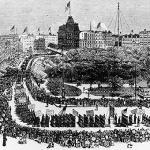
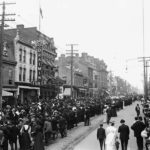
The first actual celebration of Labor Day was in New York City on September 5, 1882 in conjunction with the Central Labor Union which encouraged other unions as well as businesses to participate. By 1884, Labor Day was seen as a celebration of workers complete with festivals, displays, speeches by politicians and community leaders, labor representatives, and parades designed to promote the comradeship of the various trade and labor unions. In addition, the American Federation of Labor (the AFL), introduced a proposal in 1909 that the preceding Sunday was to be dedicated to educational training such as the history of the union movement, how to organize, and the various objectives of the Labor Movement like gender equality, improving working conditions, child labor laws, 40 hour work week, the right to collectively bargain and organize, women's right to vote, and so forth. Many of these would eventually become federal laws. Workers were also taught about the Socialist Movement, which organized labor had, at least partially, had sprung.

Over time, many of goals proposed by organized labor became law. Federal agencies were created to protect workers---union or non-union---such as the Department of Wage and Hour, Occupational Safety and Health Agency (OSHA), the Department of Labor, the Department of Health, Education, and Welfare, the Department of Health and Human Services, and Department of Housing and Human Services, the creation of a Labor Relations Board to mention a few. Meanwhile, various laws were enacted such as the Fair Labor Standards Act of 1938 (which was amended in 1963 to include the Equal Pay Act of 1963), the Civil Acts Act of 1964, the Age Discrimination in Employment Act of 1967, as well as various acts to prevent discrimination based disability, gender, sexual orientation, religion, ethnic heritage, or race.

Some have wondered if we really need to continue to celebrate Labor Day. After all, many of their original aims have been accomplished through federal legislation. Some unions, such as the AFL-CIO, are reduced to promoting so-called "amnesty" for the approximately 11 million illegal immigrants currently in the US. However, they're not promoting amnesty and allowing some 11 million individuals to skip to the head of the line out of the pure kindness. The majority of these illegal immigrants work in low income service or manual jobs; jobs which have a union unit such as for unskilled labor, hotel housekeeping, horse and dog track workers, and various trades such as roofing and carpenters. Today, the number of union members are declining rapidly (as of 2016, only 6.4% of private industry employees belonged to a union. Union membership peaked at 35% in the early 1950's), along with the coffers of these union. Unions would like to see the Federal Government turn a blind eye to illegal immigration in order to sign up these individuals. It would not just boost their numbers, but the dues paid would greatly enlarge their bottom line.

While union employees tend to earn more on the hour along with better benefit packages than their non-union compatriots, many companies have opted to move, be it to another state or out of the country, in order to avoid paying the higher union salaries and employment packages; thus increasing their bottom-line---even when factoring in shipping (union employees earn, on average 20% more than non-union employees). In addition, close to 35% of public employees belong to a union with teachers and librarians, trainers, those engaged in protective services having the highest overall rate of unionization. Men tend to more likely to belong to a union (based on historical employment in factories) at slightly above 11%, women still make up just over 10% of union membership. Based on race, black workers make up the greatest percentage of union members; greater than whites, Hispanics, or Asians. By age, the majority of union members are over 45 years of age and older. So those most greatly affect by the decline of union membership as a result of business relocation, closure, acquisition or passage of "At-Will" and "Right to Work" legislation tend to be older black males along with white males and females.
Before I go further, I think that I should explain "At-Will" employment since some of you may not have heard of it before or might be unclear as to what it is. At-Will means that you are hired by an employer "at will"; that is, you may be let go for pretty much any reason other than those which would violate existing federal laws such as race, religion, gender, and so forth. At the same time, you may accept, reject, or leave a job at your discretion. Therefore, employment is by mutual agreement between both parties---the employer and the potential employee. In a "Closed Shop" environment, if hired, you must join the union at that location. You have no alternative if you want the job. Membership is mandatory. However, you get the benefit of the union such as better wage and benefit package, restrictions on mandatory overtime, guidelines for promotions, terminations, and shift or job changes. You also have the benefit of having to a union steward in the event of a dispute or harassment by another employee or member of management. There are additional perks, depending on the industry and union.

Right to Work laws, which are an extension of the 1947 Taft-Hartley Act which prohibited employers to hire only union employees, are similar to At-Will laws. Right to Work assumes that, like At-Will, in that you were offered and accepted an offer of employment. However, you are not required to join a union if one exists at your place of employment. In most cases, unions are still required to protect your interests even if you aren't a dues paying member. Many say this is unfair in that an employee who opted out of union membership would be entitled to union benefits since it costs the union both time and money. At the same time, Right to Work laws hurt the bargaining power of unions since it not just reduces the number of dues paying members, but in the event of a strike, it would still leave employees working. At present there are 28 Right to Work states.

Personally, if this is the wave of representation, I think it should be modified to where a non-union employee is exempt from any union benefit, including representation by a steward, salary and/or benefit negotiations, and so forth. Hiring salary should be based on industry and state average, and not necessarily what the union negotiated If, as an employee, you think you can do better without a union, great. Have at it. However, you're on your own when comes to protecting your shift, specific job, work schedule, benefits, wages, and so on. You will also have to fight your own battles--- with no shop steward or union help unless you want to pay for it.
I'm not being critical of the individual who opts out of a union. That's their right, but I don't think the union should be under any obligation to assist them in any way. By the same token, I think unions have a duty to make employees want to join a union based on what it actively does. I've seen a lot of unions which were absolutely worthless when it came to protecting or helping its employees. The only things they were good at was being the company's "bagman", rubber stamping contracts, and trying to bully employees. I think too that unions should be active and visible in the community like the old activist unions of the 30's and 40's through the late 60's and early 70's.

Lastly, unions shouldn't be a "one trick pony" and operate as the cash cow for the Democratic Party. I've personally witnessed politicians make fun of unions as "ignorant" and still get endorsed. I've seen them not use any union "bugs" on their campaign literature or support legislation which would clearly hurt unions and they still get their endorsements, along with PAC money and volunteers. I've watched politicians who've never been a union member or who have worked against unions, get endorsed. At the same time, I've seen some very pro-labor Republicans or other party, who are shop stewards, union officers, or active union members, not get a second look let along any campaign contributions or endorsements. Then you see these same union officials whine about a lack of representation. You think?
Unions need friends on both sides of the aisle; they need to reach across party lines. In fact, they need to reach outside of party lines to Independents (Indies are the largest political demographic and growing) and Libertarians or the Green Party (who are the third and fourth largest political parties respectively). Better yet, organized labor should seriously consider forming its own Labor Party. The U.S. is the only industrial nation which does not have a political party dedicated to Labor. Even many second and third world nations have a Labor Party, and who is to argue that America's two parties aren't bought and paid for by the ruling Oligarchy? We just get to pick between the red "Kool-Aide" or the blue "Kool-Aide".

So there you have it friends. That's the brief history of Labor Day and the state of organized Labor. Most of its original goals have been met; they are now federal laws, with the majority being backed up with state and local laws, regulations and ordinances. Unions have been devastated by the shift from an industrial based nation to a service based nation. Kids are encouraged by" guidance councilors", teachers, and others to go to college where many wind up with a useless degree and a lifetime of debt when they would be better off going to a trade or technical school. At least there, they earn a skill where there is a real demand---some have a critical shortage---at a fraction of the time and cost. In fact, most graduates of trade schools will earn more than their college bound classmates over their lifetime. In Europe, especially Germany, technical and trade schools are looked upon with the same respect as a four year degree. In fact, all German unions provide additional education and a work-study program complete with On-The-Job-Training (OJT). Many, if not a majority, are hired straight out of the program.

I think there is still a place for unions. In fact, I think there is still a critical need for unions. However, they have to adapt and change; something they've often failed to do. I've provided some suggestions above. I hope some union member reads this and takes it to heart. Unions have given this nation so much. Without them, there's a good chance of going backwards in terms of employee rights, job safety, wages and benefits, especially since we are now an Oligarchy whose sole interest is control, be it resources, assets, governments, or us. Happy Labor Day everyone!
Department of Labor: History of Labor Day
Bureau of Labor Statistics: Union Members Summary
50 Years of Shrinking Union Membership In One Map
Right-To-Work Laws: Myths vs. Facts