Showing posts with label science. Show all posts

Thursday, September 04, 2025

Education in America: Sowing the Winds of Our Future


Here in the United States, Labor Day marks the “official” end of summer, although you’d hardly notice. The public pools are closed. The leaves on trees gradually turn their vibrant reds, yellows, and oranges. There’s the faint crunch of the few which have already fallen; soon to be a chorus in just a few more months. The nights are becoming a little cooler and rain is becoming a little more frequent than before. You occasionally have to pause to decide whether you need a jacket, but the warmth summer’s days remains, at least for now.

Labor Day is when states, especially in the South, have their state capstone fairs with venders hawking their wares and rides from practically everywhere. You can sign up to get your blood pressure tested, a mammogram, buy shoe inserts, and buy new gutters all within just a few feet of each other.

 It’s where you’ll find an abundance of friendly (mostly) competition for the best porch whistlers, dancers, cake bakers, quiltmakers, best quality livestock, and where hundreds will come out to watch the well-heeled bid phenomenal amounts of money for best cured ham…all for charity of course (the top ham sold for $10 million dollars this year).  Communities have the first of their local craft and art fairs. But for many Labor Day weekend means just one thing---the end of summer vacation and the start of a new school year which is the subject of this week’s article.  

Education is typically the best barometer to measure a nation’s future potential, after all, the students they graduate are the nation’s economic, technological, political, and cultural future. They are the ones who will develop the newest medicines, the next generation in technology, our new engineers, and will be the makers and enforcers of laws. Many say this represents the new battleground for global domination. So, how does America rank?

When determining where a country ranks, be in education, military spending, medical care, and so forth, they are measure against a bar  or standard. This “standard” is the average of 38 members of  the Organization for Economic Co-Operation and Development (aka the “OECD”). The OCED, which is comprised of developed or “first tier” nations, who work together to promote economic growth and cooperation, sustainability, establish standards, and common policies.

According to OCED, Luxembourg, Norway, and the United States spend the most money per student of any nation (in that order) along with South Korea and Switzerland (especially at the secondary school level).  In terms of percentage of their Gross National Product (“GDP”), top honors go to the Marshall Islands and the nations of Oceania, followed by the U.S., France, and Austria.

U.S. protectorate of American Samoa for instance spends 14.7% of its GDP on education.  Compare that to Cuba, which is one of the few countries with a near 100% literacy rate, which spends about 9.4% of its GDP on education or Sweden, which ranks near to top in nearly every positive measure. It spends approximately 7.6% (the same as Bolivia) while the nation of Batswana spends roughly 8.1%.

As an aside, the World Population Review, which uses a slightly different set of metrics, have some different, albeit similar numbers. According to the WPR, the United States spends 5.4% on education in general while it’s neighbors, Canada and Mexico, spend 4.1% and 4.2% respectively. America’s top economic competitor, China, spends 4% while Russia invests 4.1% on education. Germany spends 4.5% while France does a bit better at 5.4%.

Who then spends the most on the nation’s education? The African nation of Namibia spends a whooping 9% of its GDP on education. Neighboring Botswana invests 8.!%. Bolivia and Sweden both spend 7.6% on education. Iran only spend 2.9% on education, but then again, they only educate half of their population. India invests 4.1% on its future. The tiny nation of Bhutan spends 5.8%. Turkey invests just 2.9% in its future compared to 3.2% for Japan and 5.8 for the mini-nation of Tajikistan.

Pew Research posted a report in April of 2024 which showed that the U.S. was 28th out the 37 OCED countries. Japan was the highest along with several other Asian countries placing near the top along with Finland. The lowest score went to Columbia. In science, the U.S. place 12th out of the 37 OCED nations tested. Again, Japan ranked first while Mexico was last.

However, a more recent study from May 2025 conducted by Data Panda, indicates that the Iceland has the best educational system in the world. It’s followed by Germany, Norway, and the United Kingdom. Next in line was Denmark in fifth place. New Zealand and Finland were tied for sixth. Then came Switzerland, Sweden and Australia were tied. The U.S. was 15th,  just behind the island nation of Palau and ahead of Canada. Hong Kong was 18th.  Ireland was 22nd. Singapore and Austria were tied for 30th while Japan was 35th.

Another test from 2025, based on OCED scores, showed that in terms of literacy, the U.S. far outperformed the OCED average, 504 to 476. While that’s impressive, drilling a little deeper in the scoring indicated that while 14% of those tested outperformed the average, they were a majority of White students while the balance, mostly minority students, significantly underperformed with strong indications that they may require remedial instruction.

In terms of math and science, which are essential for medical and technological innovation and advancement (part of the “STEM” or science, technology, engineering, and mathematics curriculum), the U.S. seriously underperformed. 465 to the OCED average of 472, with several Asian and European nations far out scoring the American students. Once again, the scores reveled major failures among 15th years, especially minorities with over 1/3 being underperformers and just 7% representing top scorers.

 Once again, Asia had the top academic performers. It was noted that this may be indictive of a potential decline in America’s leadership in the area of technology and related fields unless immediate and significant improvements in the educational system aren’t made.

In terms of science, the U.S. did a bit better. The U.S. was 16th of the 37 national participants, scoring 499 against the OCED average of 485. Asia nations, including Japan, Singapore, Hong Kong, and Macau, made up the majority of those outperforming nations. However, while the U.S. did well, it was due primarily to just 11% of its top scoring students while 22% did poorly.

It's also worth nothing that in terms of the best educated populations, Ireland has the highest number of individuals was a bachelor’s degree based on percentage of population at 54.4%. Switzerland and Singapore are next with 45.6% and 45% respectively. Belgium and the UK complete the top five with 44.1% and 43.5%. The United States is 12th with 40% and just beating out Australia with 39.8%.  

Of the Middle East, Israel ranks the highest with 39.7%. Argentina, Chile, and Brazil are the top three in South America with 23.7%, 22.9%, and 21.5% respectively. China and India are among the lowest with 6.9% and 14.2%. There were no African countries out of the top 36 nations.

What does all this mean? The United States ranks third globally in what it spends per student, however, we’re toward the middle of the pack when it comes what we spend on education in general based on our GDP. In terms of what we are getting for our money is definitely no bargain. In terms of math scores, are well below average. Our collective science scores are good, but not great. With regards to literacy (reading and comprehension), we are doing well.

The problem, however, is that our achievements overall aren’t evenly distributed. It seems that where we we’re doing well is reliant on primarily private schools and a white student population. Meanwhile, public schools are generally underperforming, especially in schools where the majority student population are comprised of minorities.   

This is particularly a problem in terms of the future as the high achieving White student population continues to shrink and America heads for “majority minority” status. Our current immigration is only making matters worse more quickly with new immigrates coming from countries with a history of underperforming academics. 46% of arriving adults have no education beyond high school---if that! Only around 41% have a bachelor’s degree while few are certified in the trades.

Additionally, those from Latin America and Africa are less likely to possess a high school degree or equivalent whereas those from Europe, Asia, and Oceania are more likely to possess at least a bachelor’s degree. Those entering with a technical or trade certification face stringent hurdles to get their credentials approved which, given the critical shortage of plumbers, electricians, and so forth, needs to change.

Lastly, unless something is done now, such as changing our focus on immigration and focus our school curriculums more on STEM courses and less on “sports” and low/no demand degrees, we are likely to lose our lead in the sciences, medicine, and technology, making increasingly dependent on other nations, particularly in Asia, or to put it another way, we will reap what we’ve sown.


Thank you for reading "Another Opinion", the Op/Ed blog page for the "militant middle".  Here at "A/O" we truly value our readers. At A/O we seek the facts as they exist, not partisan talking points.  We hope you find our articles informative and engaging. Comments are welcome, provided they are not vulgar, insulting or demeaning.  Another Opinion is offered without charge and is directed toward all independent and free-thinking individuals. We ask, however, that you "like" us on whatever platform you found us on in order to keep our articles available for free to others. Lastly, in order to keep costs down, we depend on passive marketing, and therefore, depend on our readers to please forward our posts along. Below you will find links to the sources we used in writing this article. Thank you. 


OCED


WPR: Education Spending By Country 2025


Data Panda: Education Rankings By Country


U.S. Education Rankings: Global Comparison Performance


Charted: The World’s Educated Countries


Friday, August 01, 2025

What Do You Believe? The Future of Religion in the World


I don’t know about you, but of late my news feed has been inundated with stories about religion of all varieties, but especially expansion of radical Islam (now being called “Islamic Imperialism”). Typically, my focus is on politics, economics, and history. Topics such as religion are a little outside of my usual bailiwick despite coming from a very long line of minsters, theologians, reformers, founders, crusaders, and so on. Nevertheless, with all the posts I've been receiving, it's made me curious about the trend of religion throughout the world. 

Since the end of World War II religion (particularly the militant kind) has increasingly with politics and affected global trade, war, climate change (when discussing oil and gas), population replacement, and what some are calling the “conquest with babies” of the West and Asia. What is the current state of organized religion in the world and in the United States, and what does the future look like?

In America’s post WWII “golden years”, the economy was booming. Suburbia  was booming. Everyone had a good paying job (and only dad had to work. Mom got to stay home and run things there. Housing, food, electricity, and medical care was affordable. If you lived downtown, as many Americans did, public transportation was plentiful and cheap.

If you lived out in one of the new sprawling suburbs, everyone had at least on car, although most had access to a bus line. It seems that nearly everyone could afford to take a vacation to some state or national park. And over half of every household attended religious services on a regular basis.

This was the American Dream that many of us remember or have heard stories about. We could still trust the news and government. Television was entertaining and never contained overt violence, sex, or foul language. Even cartoons were funny and didn't require parental supervision.

From the start of the 1950’s, church attendance accounted for 57% of the population and rose to 63.3% by 1960 (prior to WWII, just 37% of households attended church on a regular basis (as a disclaimer, when I discuss topics such as attending “church”, I am not specifically referencing Christianity. I am referring to any organized religious service be it Protestant, Catholic, Jewish, or other).

All that changed on a sunny afternoon in Dallas Texas on November 22, 1963, in a place named Daley Plaza at 12:30 PM. If there was a demarcation or transition point in society, that was it. It’s where our confidence and trust in the media and government was first called into question. It was the day “America’s Camelot” came to an end. It was the day when President John F. Kennedy was murdered and the coverup began.

November 7, 1963 marked the beginning of the turbulent 1960s, with the mass protests,  some violent and some not. It marked the beginning of fundamental changes in society from the civil rights movement, the “Freedom Riders”, boycotts, desegregation,  the murders of Rev. Martin Luther King Jr and Bobby Kennedy, the Vietnam War, Women’s liberation, the decline of unions, and so much more. It also marked the beginning organized religion’s decline in America.

By the late 1960’s, weekly attendance had dropped from 63.3% in 1960 to 39% by the start of the 1970’s. It also saw the rise of so-called “alternative” religious and spiritual movements such as the "Moonies", Buddhism, yoga, Transcendental meditation blossomed along with  the "Flower Power" generation. There was a return to Native America spirituality and nature based religions of old. Today, roughly 40% of U.S. households attend services on a regular basis. 

So, what is the health of religion today? What does religion look like globally and in America? What faith is growing and what’s not, and what might it look like just a few decades down the road? To answer those questions, we need to look at how many people identify with some sort of religion.

According to most polls, roughly 84% of the world’s population claim to identify with one or more religion or faith. Of that 84%, approximately 77% self-identify as a Christian, Muslim, Hindu, or Buddhist. Out of that 77%, the largest organized religion in the world is Christianity (which includes Western with Protestantism and Catholicism as well as Eastern with denominations such as Orthodox and Coptic) represents 31% of the world’s religiously affiliated. As of 2020, there were roughly 2.3 billion Christians in the world, an increase of 121.6 million from 2010.

Christianity’s largest growth is now to be found in Sub Saharan Africa who has grown by 30.7% from 2010 to 2020. In Latin America, it has declined slightly, from 24.8% to 24.1% over the same period, and in Europe it’s dropped from 25.8% in 2010 to 22.3% ten years later. In Asia and the Pacific Rim, Christianity has remained the same with 11.8% while here at home in North America, its dropped from 12.4% to 10.5% as of 2020.

Islam, with its various sects, is the second largest with about 2 billion followers as of 2020, which represents an increase of 346.8 million since 2010, making it the fastest growing religion in the world and is nearly a quarter of the world’s population at 25%. It’s fastest growing areas are mainly in the Middle East.

Hindus are the next largest organized religion with 1.2 billion adherents, up 126.3 million from ten years earlier. That’s 15% of global population. Incidentally, India, the home of the majority of the world’s Hindus, also has the world’s largest population, having recently surpassing China.

Next on the list is Buddhism with 7% of world’s population. They make up just 0.3 million believers. Since 2010, their numbers have dropped18.6 million. Judaism comprises just 0.2% of the global population with about 14.8 million, an increase of 1 million since 2010.  Other religions such as Zoroastrianism, Taoism, Sikhs, Baha, and Shintoism comprise roughly 0.9 billion believers, which as grown 18.1 million over the previous decade.  So, is that it? Well, no, it isn’t.

While the survey looked at those who were religiously affiliated, it also examined a new and growing trend. Snuggled in between Islam and Hinduism is another group, those who fall outside of established norms. This group doesn’t identify with any particular faith or follow some deity. It’s the “unaffiliated” and according to the survey, there’s 1.9 billion of them and they’ve seen the second largest growth---270.1 million---of any group.

Who are the “unaffiliated”? They are individuals who’ve chosen different paths away from organized religion. Many say they are “spiritual”. They may dabble at being Wiccans, pantheists, or pagans. They may explore traditional paths such as shamanism (such as the Asian “Tengrism”), ethno-centric such as Celtic, Slavic, Norse, as well as African based (like Afro-Caribbean Voodoo and Hoodoo), or Native American type spirituality. They may have created their own paths such as through meditation and/or yoga (bear in mind that often these “unaffiliated” individuals are sometimes grouped into a “other” category as well just as Independents are sometimes mislabeled as "leaning" Democrat or Republican).

However, the largest segment of “unaffiliated” are simply those with no religious attachments (often saying they're “nothing in particular”). They may be agnostics or even atheist. Regardless of how they describe themselves, they aren't buying what organized religion is selling no matter how many times they change the packaging. Nevertheless, whatever path they’ve chosen to follow, they are the third largest group in numbers and the second fastest growing group. Keep them in mind, we’ll come back to them shortly.

So, let’s dig a little deeper into the unaffiliated. As pointed out above, the majority say they don’t belong to any specific religion. The largest number of unaffiliated are those who have left Christianity for some reason. Some may claim some form of spirituality, while most claim to be agnostic or atheist. China has the largest number of unaffiliated with 1.3 billion so self-identifying though they have their own private beliefs. This is roughly 90% of China’s population. The large number could be due to China’s long policy of discrediting religion since the Communist came to power under Mao in 1949.

The United States, which doesn’t have any similar policy, has the second largest number of unaffiliated---101 million---with the largest number coming from Christianity (due to the fact that Christianity is the nation’s largest religion).  Various projections show that by the year 2070, the U.S. could have 46% to 41% majority Christian to unaffiliated or a reverse of 48% to 39% unaffiliated to Christian ratio while other religions (most notably Islam)  reaches 12% of the population, mostly in large cities and among minorities.

 Aside from the United States, people moving from Christianity to unaffiliated is happening worldwide. As of 2020, they are no longer the majority in the UK (49%), Australia (47%), France (46%), or Uruguay (44%). Note too that both France and Uruguay were once heavily Catholic. In addition, Uruguay now has a majority unaffiliated population (52%). 

Netherlands now has an unaffiliated majority of 54%. In New Zealand, 51% identify as unaffiliated. Other countries with an unaffiliated majority (aside from China), include North Korea and Vietnam (which have a similar “no religion” policy), the Czech Republic, Macao, and Japan with the fastest growing number of individuals adopting the “none of the above”, which I find both interesting and a bit sad given its long history of Shintoism and devotion to ancestors. In countries where Islam, Hinduism, Buddhism, or Judaism were the majority, there were no changes in their majority positions.

So, globally speaking, what does this mean? The short answer is that Christianity is losing numbers to those who seek answers outside of the religious Status Quo. They no longer want inner guidance from those with a vested interest in the answer, especially without historical proof. Religious intermediaries no longer need apply. 

 While Islam is growing (particularly outside the U.S.) the number of “none of the above” are growing rapidly everywhere around the world while Islam is growing only in certain areas. Islam will not be able to keep pace. It will, of course, try to enforce adherence, especially through intimidation and violence as it historically has done, but as long as they are unable to control what people think or feel, they’re facing a losing battle. I will add that, in my opinion, any system, secular or religious, which demands absolute obedience through fear and intimidation cannot be divinely inspired and therefore acts out of moral weakness.

Hinduism may face a similar fate as Christianity in that it will find itself confronted with the very same science based rational used by the much of the unaffiliated that it has embraced to save its economy.  This is more so when you consider that people will turn more and more to AI for their social, political, economic, and perhaps ultimately, spiritual answers.

Buddhism, as a religion, is losing numbers. That trend is likely to continue, however, Buddhism is unique in that it can be applied as either a religion or as a philosophy, and it is in the latter that it may find its own redemption since it can be applied unilaterally to the religious, spiritual, or unaffiliated akin to the teachings of Chinese philosopher, Lao Tzu or that of Confucius. Meanwhile, the growth of other non-traditional belief systems will also likely continue to grow as people turn from outside sources to more internal way of spiritual growth.


Thank you for reading "Another Opinion", the Op/Ed blog page for the "militant middle".  Here at "A/O" we truly value our readers. At A/O we seek the facts as they exist, not partisan talking points.  We hope you find our articles informative and engaging. Comments are welcome, provided they are not vulgar, insulting or demeaning.  Another Opinion is offered without charge and is directed toward all independent and free-thinking individuals. We ask, however, that you "like" us on whatever platform you found us on in order to keep our articles available for free to others. Lastly, in order to keep costs down, we depend on passive marketing, and therefore, depend on our readers to please forward our posts along. Below you will find links to the sources we used in writing this article. Thank you. 


The Four Largest Religions


How the Global Religious Landscape Changed From 2010 to 2020


How U.S. Religious Composition Has Changed in Recent Decades


Projecting U.S. religious groups’ population shares by 2070


Modeling the Future of Religion in America


Church Attendance Has Declined in Most U.S. Religious Groups


Friday, July 25, 2025

Ours is Bigger Than Yours: The World's Military and the Ultimate Outcome

There’s no question that the Untied States spends more on its military---$886 billion---than the next nine nations combined. That includes China ($296B), Russia ($109B), India ($84B), the UK ($75B), France ($61B), and Germany ($67B). That’s 40% of all military related expenditures in the world by just one country---the U.S.. But is it the largest military?

America has 1.328 million men and women in uniform. India has 1.455 million active duty personnel. Russia has 1.13 million. North Korea has 1.28 million active duty personnel. Nevertheless, the largest military in the world belongs to China. Their Peoples Liberation Army has 2.04 million.

However, these numbers are a bit deceiving. Although China has the largest number of active duty troops, when reservists and paramilitary are included, China has only the fourth largest military in the world  with a grand total of 3,045,000. India’s military jumps up to third place with 4,246,000 which includes 1,155,000 reservists and 1,616,050 paramilitary units (compared to China’s 510,000 reservists and 500,000 paramilitary).

Russia has a total of 3,203,000 under arms including 1,500,000 reservists and another 569.000 paramilitary. As an aside, Ukraine has only 990,000 individuals in uniform of which 730,000 are regular military with no reservists and 260,000 paramilitary (not including those forcibly conscripted).

The world’s largest military is actually North Korea which has essentially militarized its entire military age population! It has 1,280,000 regular troops, 600,000 reservists, and a whopping 5,7 million paramilitary personnel, bring its total to 7,580,000 men and women under arms. By comparison, South Korea has 3,100,000 reservists and 3,013,000 to augment its regular military of 500,000, bringing its total to 6,613,000, making it the second largest.  

As for the United States, we have 1,315,000 active duty personnel in addition to 797,200 reservists, bringing our total up to 2,112,00 individuals in uniform. While the U.S. doesn’t officially have a “paramilitary”, we just might have something a little bit better and that’s the millions of U.S. citizens who come packing.

There’s an old expression that America could never be invaded because behind every rock, tree, and bush, will be someone with gun. Although there are no official numbers,  estimates are that approximately 32% of Americans own at least one gun. That’s about 82 million gun toting Americans.

Of those, some 14.4 million classify themselves as active hunters, meaning they’re probably a pretty good shot (additionally, some 25.87 million Americans has hunted at least once and those numbers don’t included the number of individuals who shot skeet, target shoot, and enjoy “plinking”  (shooting homemade targets like garbage can lids, bottles, cans, and the occasional speed limit sign).  

Broken down by individual household, guns can be found in 44% of households. While other countries, like Switzerland and Serbia, have high gun ownership, no other nation even comes close to the U.S. in terms of gun ownership.

As an aside, Montana has the largest percentage of gun owners of any state with 66.3% of residents owning at least one firearms followed by Wyoming with 66.2%. It’s 60% in Idaho and 59% in West Virginia, while around the Ozarks, it averages 56% of households. In Kentucky, it’s just over half with 54.6% of the population owning at least one firearm. Texas is surprisingly low, with just 46% of the population own a gun, which is less than in Maine where 47%  and Vermont at 51% owning a firearm.

In New York, despite its reputation for gun related violence, just 20% of the population legally own a pistol or rifle while in nearby Connecticut it’s 24%.  In California, 28% of it residents legally own a gun, matching Illinois. New Jersey and Massachusetts has the least with about 14.9% of the population own a gun. Finally, despite being a “Southern” state, gun ownership in Florida is only 35%. It must be due to all those Yankee carpetbaggers.

Another factor to consider, like it or not, is that guns are a part of the American persona. They go hand-in-hand with freedom and independence.  It’s just not part of our history, it’s part of our culture and our collective American mythology as a nation from the frontiersmen and “mountain men” to the Wild West and our very founding as a nation.

Firearms and the notion of self-defense from a tyrannical government was seen as so important, ownership of firearms was built into our Constitution.  As long as Americans own firearms, this country will never be invaded. But there is more to national defense than just pistols and rifles.

Who has the largest air force? In terms of most modern and powerful, that goes hands down to the United States with roughly 14,486 manned and unmanned aircraft. Russia is ranked second in the world with approximately 4,211 aircraft while China possesses 3,304. Next on the list comes India with 2,296, Japan with 1,459, and Pakistan following closely behind with 1,434. South Korea has 1,171 aircraft compared to North Korea which possesses just 951.

 It bears mentioning that the individual branches of the U.S. military have more airplanes, helicopters, and drones than the entire air forces of most countries!  For example, the U.S. Army has some 5,714 aircraft compared to entire Russia military which has a total number of planes and helicopters of 4,211. Of course, being former Navy, I have to mention that the best pilots in the world are U.S. Navy pilots.

Speaking of the Navy, who has the world’s largest seagoing fleet? In terms of numbers, the largest fleet belongs to Russia. Once virtually landlocked due to a lack of warm water ports, Russia now has a fleet of some 781 ships. It’s worth noting too that Russia built the largest submarine ever as part of “Project 941---Akula”, a nuclear powered Typhoon class “boomer” with a displacement of 48,000 tons and a length of 574 feet and a width of 75 feet, it is truly a leviathan.   

 China is second with 730 deep water ships, including two operational aircraft carriers (and a third on the drawing board) along with three helicopter carriers. As an aside, China also has the most modern military navy in the world, turning out more new ships than any nation. 70% of its ships were built after 2010 compared to just 25% of the U.S. Navy.

Third place belongs to North Korea with 505 ships, though analysis question their operational status given shortages of replacement parts. North Korea also doesn’t possess any aircraft or helicopter support ships (South Korea has 200 military ships). Next, in fourth place, is the United States Navy with 11 aircraft carriers and nine support helicopter carrier ships.  

The U.S. Department of Defense published a report in 2024 noting that the Navy was badly in need of a total fleet overhaul; everything from drydocking its fleet for a refit to retiring some of its submarines, destroyers, and even a carrier or two (the DoD was also critical of the wartime capabilities of the U.S. Air Force and U.S. Army. Only the Marines were said to be a proper fighting strength).

Following the U.S. is Sweden, which has traditionally been a seagoing nation for centuries. Sweden currently has 353 deep water naval vessels, followed by Indonesia with 333 military ships. Italy has 309 while India and Thailand have 294 and 293 respectively. The largest navy in South America is Columbia which stands at 237 followed by Mexico with 194. In Africa, Algeria has the continent’s largest navy with 213 ships. Egypt is second with 140 ships.

Speaking of submarines, at 70, all nuclear, submarines, the U.S. Navy possesses the world’s largest submarine fleet. Second place belongs to Russia with 63 nuclear and conventional submarines. The Chinese have 61, which includes nuclear and electric diesel. Their emphasis is primarily the Indian and Pacific oceans.  

In fourth place is Iran which operates 25 conventional attack and miniature submarines throughout the Persian Gulf.  Egypt has the largest submarine fleet in Africa with eight Type 209  conventional subs it acquired from Germany (who know a few things about submarines). Algeria has six and South Africa has three, also Type 209.

Lastly, nukes. What nation has the most? Russia is believed to have 5,500 nuclear tipped missiles in various stages of readiness. The U.S has some 5,000 nuclear armed missiles, also in varying stages of readiness. China too has nuclear missiles  (around 600) as does France (290), the UK (225), India (180), Pakistan (170), and Israel (90).

North Korea claims to have around 50 while Iran is desperately trying to become the newest member of “global damnation club”.  It deserves mentioning that in terms of missiles in general, Russia is also thought to possess the largest number of missiles, especially Intercontinental Ballistic Missiles or “ICBMs”, both nuclear and conventional. China is also busily expanding its missile capabilities. 

All told,  there are approximately 12,331 nuclear weapons at play, down from about 70,000 during the Cold War. These range from so-called “tactic”  or low yield warheads which have a explosive capability 20 times that of what was used as Hiroshima and Nagasaki up to a three stage thermonuclear warhead (the Soviet era “Tsar Bomba”) whose explosive output is 1,570 times that which was used on the two Japanese cities. Anyway, you look at it, in a nuclear exchange only cockroaches would survive.

Other missiles systems being made operational include hypersonic missiles which travel at Mac 5 or five times the speed of sound (and thus may be able to evade various anti-missile defense systems) as well as GBU 7a/b “bunker buster” which can penetrate 200 feet into the earth or through 20 feet of solid concrete. The EMP” of electro-magnetic pulse bomb which disrupts or destroys anything electronic or electrical  such as power grids, communication systems, computer systems, electrical circuits, and so forth.

In the final analysis, we seem to be pretty good at developing ways to kill each other. In a world where poverty, hunger, and disease is on the rise, and budgets funding social safety nets are being cut, the budget for the “defense” is virtually unlimited. We kill to gain access to and protect resources or global markets. Besides, war is profitable.

War artificially stimulate economies and reduces unemployment and regulates “excess” populations. Most of our scientific and medical advances are byproducts of weapons research (but then, so are many of our new diseases). It pits us against each other in order to protect the “haves” from the “have nots”. Hell, we’ll even kill each other over whose god or prophet is the most benign. Many of us pray for a divine or even alien intervention to put a stop to our species based insanity. But the sad truth is that no one or nothing is coming from the sky or anywhere else to save us. We’re on our own babies.


Thank you for reading "Another Opinion", the Op/Ed blog page for the "militant middle".  Here at "A/O" we truly value our readers. At A/O we seek the facts as they exist, not partisan talking points.  We hope you find our articles informative and engaging. Comments are welcome, provided they are not vulgar, insulting or demeaning.  Another Opinion is offered without charge and is directed toward all independent and free-thinking individuals. We ask, however, that you "like" us on whatever platform you found us on in order to keep our articles available for free to others. Lastly, in order to keep costs down, we depend on passive marketing, and therefore, depend on our readers to please forward our posts along. Below you will find links to the sources we used in writing this article. Thank you. 


The World’s Largest Armies


Mapped: US States With The Most Guns


Largest Air Forces in the World


U.S. Military Working on Rebuild Readiness and Modernize


Military Readiness


Why the U.S. Military is in Serious Trouble


Top 10 countries with the largest submarine fleets in 2025


Project 941 submarine


Which countries have nuclear weapons?


Saturday, July 15, 2023

Humanity and Artificial Intelligence: Building The Perfect Beast?


I've often wonder about our future as a species. In fact, I would dare say that it is almost an obsession of mine. Certainly, if you step back and look at what's happening around us---poverty, pollution, wars for profit, intolerance, terrorism, and so on, it doesn't give you a "warm and fuzzy feeling" does it?  We seem to limp from one crisis to another.

Despite being in the first half of the 21st Century, we still struggle with global famine and poverty, a lack of and access to fresh water, decent minimum healthcare for everyone, as well as the availability of a basic education for those who want it (along with facing off with those who believe that education should be available to just one gender, or race, or class).

In many countries people still live on the streets in cardboard boxes.  Children and adults scrounge around garbage dumps for their next meal and you can forget about any type of healthcare. It looms over us like one of those old apocalyptic movies like Metropolis, Blade Runner, Logan's Run, or 1984, but it's all too real.

We still find ourselves fighting and murdering over whose god is more loving and merciful, while some spend less time praying for seniors, the disabled, or children and more time preying on seniors, the disabled and children. Meanwhile, they oppose any kind of birth control, knowing full well that those who are most likely to have more children are those who can afford them the least, thus leading to more poverty. Where's the righteous in that?

Many of today's faiths follow the letter of their scriptures but not its spirit; trying to apply what was written hundreds or even thousands of years ago, for a different time and place to a world as removed from those days as Mankind is from the sun. To me is reeks of self-importance and ignorance.  I can't imagine that the original founders of today's religions being pleased with what's done in their name.  We've evolved from the days where we once thought that the sky was nothing more than fabric and pinholes.

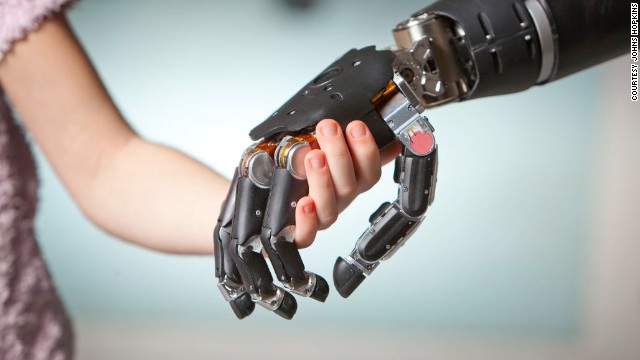
Certainly we have the technology to take us to the next level in our evolution. We can do things in terms of medicine that were only dreamt of a few years ago, from the  quality of prosthetics to manipulating genes and growing new organs. Every one of us has the sum total of Man's knowledge at their fingertips via the internet. Practically everything that is known is available to us in an instant while the  the world's cumulative knowledge grows not just daily or even hourly, but in terms of nanoseconds.   We have the ability to shape our future in ways that would have been impossible a few decades ago. But are we ready for that?

Let's take politics. What if we downloaded everything we know about politics into a supercomputer, including civil and religious laws, history, philosophy, economics, sociology, taxation, and even tradition and values, then ask the "all knowing" supercomputer to create the perfect political (and by extension, economic and social) system for us to live by? After all, we've downloaded pretty much the sum total of Mankind's knowledge into this computer which is capable of making  200 quadrillion calculation per second, so how hard could it be? 

Is it possible that this piece of super advanced  technology could figure out the best form of government for not just Americans but the best government for all of Humanity to live under? Could it do what eons of philosophers, economists, kings, revolutionaries, and statesmen have failed to do?  Perhaps this supercomputer could even work out a system whereby our societies could evolve at a certain pace while at the same time operating in unison.  Creating our new "god" in the image of the beast---Man. 

What sort of political, economic and social system would it come up with I wonder? Although I can hardly imagine it would, but what if it came recommended a modern feudalistic form of government much like our current Oligarchy whereby ordinary people are beholden to a few elites? On the other hand, it could come back with something similar to a democratic socialist system by which everyone is required to contribute in order to eat, be provided with housing or medical care. It could also recommend anarchy as the best form of government, whereby people either cooperate voluntarily in ad hoc groups or simply function on their own and making the best of whatever opportunity presents itself.

I wonder if we, as either a nation or as species would pay any heed to its recommendations? If it came up with something we already had some preconceived bias against, would we reject it out of hand or would be willing to give it go?  My guess is that, knowing Man's historical arrogance and failure to learn from past mistakes,  we would walk away from it.  

No doubt our "cyber-savior" would recommend that we relinquish complete control over all tools for war, both offensive and defensive as well as control over the economy and our resources in order to provide a more equitable distribution. I can't see the arms merchants of the world going along with that just as I can't see the financial powerbrokers giving up their control over the world's economies.

As an aside, I wonder how ordinary people would feel about being required to surrender all their weapons? Mankind is a violent species. We've been making and using weapons of all sorts since we fell out of the trees on some primeval savannah all those millennia ago and we're pretty darn good at it!

Obviously there's no way our benefactor will allow us to keep our guns, especially if it takes control of the world's weapon systems. Of course, it could simply stop manufacturing spare parts and ammo knowing that we'll eventually run out and our guns will become useless. However, I suspect most will be seized used existing data bases of known owners, although a few might slip through. 

What do you think this supercomputer, full of everything we have about religion, from ancient Sumer to today; every sect, every law or commandment, as well as every philosophy would do about a moralistic system? I wonder if it would select one faith over another, or whether it would create some sort of composite religion and/or philosophy. Besides, religion has been responsible the deaths of billions. it obviously has to be controlled. 

Perhaps it would, when comparing what it knows about science (which obviously must be included in its calculations), religion and philosophy would come up with something we've never thought of. I just might tell us that religion has no place in the world of science and technology, however, I somehow doubt that.  Why?

Mankind, as long as we've existed as cognitive or self-aware species, has always require some sort of moral guide. Although common sense should tell us (and perhaps it does) that doing certain things aren't good for us, we've always required a moral authority to be obeyed. Usually these were put forth by a king or queen. However, they lack longevity thanks to wars, coups, and revolutions. As soon as one king dies, another set of moral guidelines are usually imposed. 

However, if the guidelines are said to come from some divine entity and our failure to obey them would result in some dire divine retribution, we tend to take them a little more seriously. Of course, these  moralistic laws usually came with the some proviso like a king or religious institution as the sole arbiter of these divine laws, meaning you have to obey the king and/or priest in this world to stay on the god's good side in the next (but if you think about it logically, how would they know? Perhaps they're merely using the threat of eternal damnation or eternal reward as a tool to maintain control and order in the here and now).

Therefore, would our supercomputer make the pronouncement "Here are the rules by which you'll live by. Failure to comply will result in the suspension or deletion of your bank account, health benefits or food card for your good, the good of society and social order"? Certainly, any system it created or recommend would have to have a penalty clause in it otherwise what use is it? Perhaps too, it would include some form of reward system too. For instance, if you go six months without a social demerit of some sort, you'll get extra health benefits or bonus points on your food card.

That's something else about us humans. We work best when there are rewards and punishments involved. Again, you would think it was common sense for us to act in our own best interest, either as an individual or society, but we just haven't managed to get that down yet.  That's why we just don't have religious pronouncements, but civil ones too which include fines and imprisonment (or even the possibility of death).  Naturally, this would bring up a whole other issue, could our "HAL" (to borrow from the movie, "2001: A Space Odyssey"), also redesign our justice system?

If our supercomputer master is to create a new political/social/economic system, then it logically follows that a judicial system would have to be included.  What would it look like? Would it be incentive based like it is now or would it be more proactive and attempt to deter criminal behavior starting at or near infancy?

Perhaps we would be monitored in such a way as it would insure that certain "markers" are deleted from our DNA or from a environment. to improve the species otr make it more adaptable. I wonder if it would impose any type of physical punishment; maybe something like jail time or even the death penalty (after all, it would have to know about both the history of civil as well as religious forms of punishment since both have been incorporated into our modern judicial system, and some countries still follow religious guidelines as their civil punishment).

Another possible plus would be that this system would cut down on long trial delays, prolonged appeals, and perhaps even improper sentencing. The statistical facts of the accused could be entered such as age, education, race, gender, religion, orientation, as well as profession and/or social class. Both sides could still plead their case.  Since every form of the legal system---secular and religious---from around the world and down through history would have been inputted, the AI would be able to quickly hear proceeding, automatically delete any evidence not applicable, and render a impartial verdict which would equivalent to the defendant's peers in a way which isn't possible today.

Thus, we shouldn't be too surprised if we find that chopping off fingers or hands are back on the table (so to speak) or we're back to the rack and public hangings. Once more, Man has been a slow learner and nothing gets out attention like an example. Besides, these forms of punishments have been use by nearly every society throughout history and so there's commonality to them which could easily be applied. However, it has the added benefit of providing an incentive to follow the law.

So, what would you think of a future whereby we rely on artificial intelligence to set our political, economic, social, judicial, and perhaps even religious/philosophical boundaries? Do you think we, as human beings, would be capable of following the recommendations handed down by a  "gurgling and beeping" machine? After all, it's only processing our information, both historical and individual. It's not making up its own facts. It's using the information that we've created as a society. Are we capable of following its guidelines?  I can honestly say that I don't know, but my gut tells me no, we can't...or won't.

As a society, we've struggled to follow "laws" supposedly handed down to us by some omnipotent entity allegedly responsible for the creation of the cosmos, what makes us think we'll follow the pronouncements of some machine made by IBM or Apple? We've defied kings and queens who've claimed divine providence just as we've defied populists presidents and strong arm dictators.  Surely they represent the level of authority worthy of obeying; at least for the majority of us. So, what would be different about an overgrown calculating machine?

Well, I imagine any system created by this AI, in whatever form it takes, would dictate that everything be electronic. It's simple, fast and efficient. What's not to like? However, it also means that every one of us would be bound by our own personal zeros and ones. Failure to comply could result in being denied just about anything--- or everything. There would be no one to appeal to; no one to take pity on us. Computers aren't capable of that. They just "follow orders" so to speak.

Same goes when discussing religion or the judicial system. It will show absolutely no compassion. It knows only positive or negative. Zeros or ones. Those will be the chains which bind us. Our ability to shown understanding and compassion is what sets us aside as a species; that and our imagination.  The only way a system like the one described above would have to have built in an failsafe which involves human beings who are capable of showing pity or making exceptions, however, those may be exactly the very things which would make any system designed by a computer fail just as they have helped us survive all these millennia.

Artificial intelligence makes for a good servant, but it must never be allowed to become our master. However, as we become increasingly depended on it to organize and run our lives, it will increasingly come to be our masters. No doubt too that we'll start integrating with our technology. In many ways we already have; LASIK, artificial joints, bioartificial organs, tissue engineering, and regenerative medicine. That's simply the nature of the relationship with technology and it will continue to grow and evolve. Perhaps, in time, we will become Borg. Resistance may be less futile and perhaps more irresistible. 

Meanwhile, artificial intelligence can and should advise us. They can make excellent unbiased recommendations, free from personal biases or emotions, but they should never make unchecked decisions for us.  They are no substitute for what we, as human beings, bring to the conversation. However, as our society and our problems become increasingly complex and grows exponentially, we will find ourselves relying on the beast we've created in our image. But it must never be allowed to be the final arbiter of Humanity.   

  If you enjoyed the article, please consider passing it along to others and don't forget to subscribe. It's free! Lastly please be sure to "like" us on whatever platform you use to read anotheropinionblog.com. It helps with the algorithms and keeps our articles in circulation. Thank you!