Showing posts with label Internet. Show all posts

Saturday, July 15, 2023

Humanity and Artificial Intelligence: Building The Perfect Beast?


I've often wonder about our future as a species. In fact, I would dare say that it is almost an obsession of mine. Certainly, if you step back and look at what's happening around us---poverty, pollution, wars for profit, intolerance, terrorism, and so on, it doesn't give you a "warm and fuzzy feeling" does it?  We seem to limp from one crisis to another.

Despite being in the first half of the 21st Century, we still struggle with global famine and poverty, a lack of and access to fresh water, decent minimum healthcare for everyone, as well as the availability of a basic education for those who want it (along with facing off with those who believe that education should be available to just one gender, or race, or class).

In many countries people still live on the streets in cardboard boxes.  Children and adults scrounge around garbage dumps for their next meal and you can forget about any type of healthcare. It looms over us like one of those old apocalyptic movies like Metropolis, Blade Runner, Logan's Run, or 1984, but it's all too real.

We still find ourselves fighting and murdering over whose god is more loving and merciful, while some spend less time praying for seniors, the disabled, or children and more time preying on seniors, the disabled and children. Meanwhile, they oppose any kind of birth control, knowing full well that those who are most likely to have more children are those who can afford them the least, thus leading to more poverty. Where's the righteous in that?

Many of today's faiths follow the letter of their scriptures but not its spirit; trying to apply what was written hundreds or even thousands of years ago, for a different time and place to a world as removed from those days as Mankind is from the sun. To me is reeks of self-importance and ignorance.  I can't imagine that the original founders of today's religions being pleased with what's done in their name.  We've evolved from the days where we once thought that the sky was nothing more than fabric and pinholes.
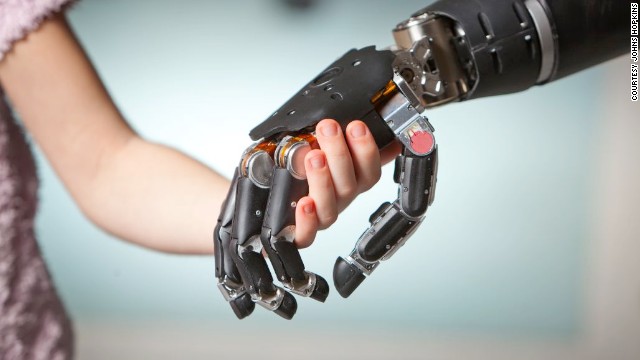
Certainly we have the technology to take us to the next level in our evolution. We can do things in terms of medicine that were only dreamt of a few years ago, from the  quality of prosthetics to manipulating genes and growing new organs. Every one of us has the sum total of Man's knowledge at their fingertips via the internet. Practically everything that is known is available to us in an instant while the  the world's cumulative knowledge grows not just daily or even hourly, but in terms of nanoseconds.   We have the ability to shape our future in ways that would have been impossible a few decades ago. But are we ready for that?

Let's take politics. What if we downloaded everything we know about politics into a supercomputer, including civil and religious laws, history, philosophy, economics, sociology, taxation, and even tradition and values, then ask the "all knowing" supercomputer to create the perfect political (and by extension, economic and social) system for us to live by? After all, we've downloaded pretty much the sum total of Mankind's knowledge into this computer which is capable of making  200 quadrillion calculation per second, so how hard could it be? 

Is it possible that this piece of super advanced  technology could figure out the best form of government for not just Americans but the best government for all of Humanity to live under? Could it do what eons of philosophers, economists, kings, revolutionaries, and statesmen have failed to do?  Perhaps this supercomputer could even work out a system whereby our societies could evolve at a certain pace while at the same time operating in unison.  Creating our new "god" in the image of the beast---Man. 

What sort of political, economic and social system would it come up with I wonder? Although I can hardly imagine it would, but what if it came recommended a modern feudalistic form of government much like our current Oligarchy whereby ordinary people are beholden to a few elites? On the other hand, it could come back with something similar to a democratic socialist system by which everyone is required to contribute in order to eat, be provided with housing or medical care. It could also recommend anarchy as the best form of government, whereby people either cooperate voluntarily in ad hoc groups or simply function on their own and making the best of whatever opportunity presents itself.

I wonder if we, as either a nation or as species would pay any heed to its recommendations? If it came up with something we already had some preconceived bias against, would we reject it out of hand or would be willing to give it go?  My guess is that, knowing Man's historical arrogance and failure to learn from past mistakes,  we would walk away from it.  

No doubt our "cyber-savior" would recommend that we relinquish complete control over all tools for war, both offensive and defensive as well as control over the economy and our resources in order to provide a more equitable distribution. I can't see the arms merchants of the world going along with that just as I can't see the financial powerbrokers giving up their control over the world's economies.

As an aside, I wonder how ordinary people would feel about being required to surrender all their weapons? Mankind is a violent species. We've been making and using weapons of all sorts since we fell out of the trees on some primeval savannah all those millennia ago and we're pretty darn good at it!

Obviously there's no way our benefactor will allow us to keep our guns, especially if it takes control of the world's weapon systems. Of course, it could simply stop manufacturing spare parts and ammo knowing that we'll eventually run out and our guns will become useless. However, I suspect most will be seized used existing data bases of known owners, although a few might slip through. 

What do you think this supercomputer, full of everything we have about religion, from ancient Sumer to today; every sect, every law or commandment, as well as every philosophy would do about a moralistic system? I wonder if it would select one faith over another, or whether it would create some sort of composite religion and/or philosophy. Besides, religion has been responsible the deaths of billions. it obviously has to be controlled. 

Perhaps it would, when comparing what it knows about science (which obviously must be included in its calculations), religion and philosophy would come up with something we've never thought of. I just might tell us that religion has no place in the world of science and technology, however, I somehow doubt that.  Why?
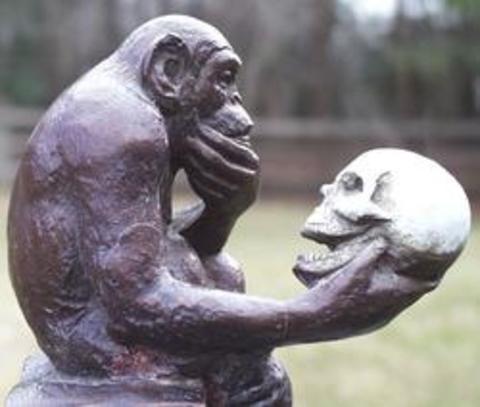
Mankind, as long as we've existed as cognitive or self-aware species, has always require some sort of moral guide. Although common sense should tell us (and perhaps it does) that doing certain things aren't good for us, we've always required a moral authority to be obeyed. Usually these were put forth by a king or queen. However, they lack longevity thanks to wars, coups, and revolutions. As soon as one king dies, another set of moral guidelines are usually imposed. 

However, if the guidelines are said to come from some divine entity and our failure to obey them would result in some dire divine retribution, we tend to take them a little more seriously. Of course, these  moralistic laws usually came with the some proviso like a king or religious institution as the sole arbiter of these divine laws, meaning you have to obey the king and/or priest in this world to stay on the god's good side in the next (but if you think about it logically, how would they know? Perhaps they're merely using the threat of eternal damnation or eternal reward as a tool to maintain control and order in the here and now).

Therefore, would our supercomputer make the pronouncement "Here are the rules by which you'll live by. Failure to comply will result in the suspension or deletion of your bank account, health benefits or food card for your good, the good of society and social order"? Certainly, any system it created or recommend would have to have a penalty clause in it otherwise what use is it? Perhaps too, it would include some form of reward system too. For instance, if you go six months without a social demerit of some sort, you'll get extra health benefits or bonus points on your food card.

That's something else about us humans. We work best when there are rewards and punishments involved. Again, you would think it was common sense for us to act in our own best interest, either as an individual or society, but we just haven't managed to get that down yet.  That's why we just don't have religious pronouncements, but civil ones too which include fines and imprisonment (or even the possibility of death).  Naturally, this would bring up a whole other issue, could our "HAL" (to borrow from the movie, "2001: A Space Odyssey"), also redesign our justice system?

If our supercomputer master is to create a new political/social/economic system, then it logically follows that a judicial system would have to be included.  What would it look like? Would it be incentive based like it is now or would it be more proactive and attempt to deter criminal behavior starting at or near infancy?
Perhaps we would be monitored in such a way as it would insure that certain "markers" are deleted from our DNA or from a environment. to improve the species otr make it more adaptable. I wonder if it would impose any type of physical punishment; maybe something like jail time or even the death penalty (after all, it would have to know about both the history of civil as well as religious forms of punishment since both have been incorporated into our modern judicial system, and some countries still follow religious guidelines as their civil punishment).

Another possible plus would be that this system would cut down on long trial delays, prolonged appeals, and perhaps even improper sentencing. The statistical facts of the accused could be entered such as age, education, race, gender, religion, orientation, as well as profession and/or social class. Both sides could still plead their case.  Since every form of the legal system---secular and religious---from around the world and down through history would have been inputted, the AI would be able to quickly hear proceeding, automatically delete any evidence not applicable, and render a impartial verdict which would equivalent to the defendant's peers in a way which isn't possible today.

Thus, we shouldn't be too surprised if we find that chopping off fingers or hands are back on the table (so to speak) or we're back to the rack and public hangings. Once more, Man has been a slow learner and nothing gets out attention like an example. Besides, these forms of punishments have been use by nearly every society throughout history and so there's commonality to them which could easily be applied. However, it has the added benefit of providing an incentive to follow the law.

So, what would you think of a future whereby we rely on artificial intelligence to set our political, economic, social, judicial, and perhaps even religious/philosophical boundaries? Do you think we, as human beings, would be capable of following the recommendations handed down by a  "gurgling and beeping" machine? After all, it's only processing our information, both historical and individual. It's not making up its own facts. It's using the information that we've created as a society. Are we capable of following its guidelines?  I can honestly say that I don't know, but my gut tells me no, we can't...or won't.

As a society, we've struggled to follow "laws" supposedly handed down to us by some omnipotent entity allegedly responsible for the creation of the cosmos, what makes us think we'll follow the pronouncements of some machine made by IBM or Apple? We've defied kings and queens who've claimed divine providence just as we've defied populists presidents and strong arm dictators.  Surely they represent the level of authority worthy of obeying; at least for the majority of us. So, what would be different about an overgrown calculating machine?
Well, I imagine any system created by this AI, in whatever form it takes, would dictate that everything be electronic. It's simple, fast and efficient. What's not to like? However, it also means that every one of us would be bound by our own personal zeros and ones. Failure to comply could result in being denied just about anything--- or everything. There would be no one to appeal to; no one to take pity on us. Computers aren't capable of that. They just "follow orders" so to speak.

Same goes when discussing religion or the judicial system. It will show absolutely no compassion. It knows only positive or negative. Zeros or ones. Those will be the chains which bind us. Our ability to shown understanding and compassion is what sets us aside as a species; that and our imagination.  The only way a system like the one described above would have to have built in an failsafe which involves human beings who are capable of showing pity or making exceptions, however, those may be exactly the very things which would make any system designed by a computer fail just as they have helped us survive all these millennia.

Artificial intelligence makes for a good servant, but it must never be allowed to become our master. However, as we become increasingly depended on it to organize and run our lives, it will increasingly come to be our masters. No doubt too that we'll start integrating with our technology. In many ways we already have; LASIK, artificial joints, bioartificial organs, tissue engineering, and regenerative medicine. That's simply the nature of the relationship with technology and it will continue to grow and evolve. Perhaps, in time, we will become Borg. Resistance may be less futile and perhaps more irresistible. 

Meanwhile, artificial intelligence can and should advise us. They can make excellent unbiased recommendations, free from personal biases or emotions, but they should never make unchecked decisions for us.  They are no substitute for what we, as human beings, bring to the conversation. However, as our society and our problems become increasingly complex and grows exponentially, we will find ourselves relying on the beast we've created in our image. But it must never be allowed to be the final arbiter of Humanity.   

  If you enjoyed the article, please consider passing it along to others and don't forget to subscribe. It's free! Lastly please be sure to "like" us on whatever platform you use to read anotheropinionblog.com. It helps with the algorithms and keeps our articles in circulation. Thank you!  


Saturday, June 17, 2023

The Big Five: The Five Corporations Who Control What You Think


As I've often written, we are no longer a Constitutional republic. We are an oligarchy. We are given the illusion of choice. Our "choice" is largely determined by mainstream media. When you think about it, we're bombarded by the media constantly every day and in nearly every way. It's what we read, what we hear, and what we see. It tells us what to wear, what to eat, what to buy, and when it comes to politics, what to think. Nazi propagandist genius Joseph Goebbels could only dream of such power!

Today, just five corporations determine what we perspective on the world. They decide what's important for us to know and what we should ignore. These five corporations are part of the Corportracy which has replaced our republic, but ultimately it comes down to a relatively small group of very wealthy and powerful individuals---the oligarchy (some call them a kleptocracy, but it's all the same).  They literally own the two political parties. They determine our domestic and foreign policies. They run the economy. They are the stage managers which creates our illusion of "freedom".

This short video (10:02 minutes) by Second Thought provides a great introduction to this control of information which impacts how we think about the world, our country, and each other. We hope you will find it very informative.  


Click Here:

Capitalism And Monopolies: How Five Companies Control All US Media 


If you enjoyed the article, please consider passing it along to others and don't forget to subscribe. It's free! Lastly please be sure to "like" us on whatever platform you use to read anotheropinionblog.com. It helps with the algorithms and keeps our articles in circulation. Thank you! 


Thursday, May 11, 2023

Media and Print Endorsements: Providing Bread and Circus Coverage for Fun and Profit

 Another Opinion has published this article in one form or another  every election cycle since 2001 as a public service. Why? Because we now live in a world where independent thought is no longer considered "politically correct". We're expected to toe the line dictated to us by the Status Quo. America is no longer a Republic. It's a Corporatocracy run a super rich Oligarchy.

There are just 5 of these corporations that control 96+% of all media content---TV, movies, video games, radio, publishing, newspapers and so on.  This means they have the ability to directly influence your opinions by controlling and spinning what you watch, read, or hear.  They keep you entertained, distracted, and confused. Bread and Circuses. They also try to influence who you vote for by their so-called "endorsements".

We have a problem with this. We believe you should make your own decisions based on your own research regardless of who you ultimately vote for. Independent thought  is important for our present if we are to have a future. Please consider sharing this article. Thank you.

Disclaimer: The opinions expressed here are strictly my own.


Media and Print Endorsements: Providing Bread and Circus Coverage for Fun and Profit

There was a time when the news media (particularly newspapers) were the ever vigilant "crusaders" of public interest, albeit self-appointed and as often as not, the creators of their own hype (see "Yellow Journalism"). However, society and technology grew up. Today, we have instant access to information the world over, and with it, the ability to do own investigation of candidates and the issues which are important to us.

For years, I campaigned for the release of unedited transcripts of candidate interviews  and full disclosure of the interviewer's names and their political affiliations especially when it came to newspaper "endorsements".  The public has a right to know exactly what a candidate said and in what context, what their positions are, as well as the identity of those making the "endorsement" and their  political leaning.

I've been a community organizer and political activist for over 40 years.  Too many times over those years I've come across candidates who were misquoted, misattributed,  or instances  where the "correct" answer  was inserted while gaffs were  removed on behalf of certain individuals. In fact, I've been a victim of these manipulations.  

 Today, a relatively small handful of news outlets are recording and making public these interviews unedited and providing the facts behind their research in a timely fashion. They are also providing unbiased information regarding both side of key issues, particularly those that will be appearing on the ballot. To those brave few actual journalists and editors, bravo to you!  

However, not all are providing full disclosure of the names and political registration or leaning of the interviewers making the endorsements nor are they disclosing the criteria by which the endorsements are made. Those remains hidden behind a false veneer of make believe "integrity".  You, the voter, have a right to know if an "endorsement" on an issue or candidate is honest and fair or is being made with a political or economic bias.  

As I have done for decades, I've urge all voters to take a few minutes to do their own research and make their own decision before casting their vote. Using a Voter Guide is one such resource for you to consider.  You can check out a candidate's or issue's website, or do a general search on the internet. You'll find out a lot more than just reading or listening to a biased review or opinion.

As an aside, if you're looking at a political party's website or that of an endorsing organization, bear in mind that they are writing from their point of view. Any endorsements or opinion they make are to serve their interests, not necessarily yours.  Always understand the political slant of any source.

If you find that you happen to be in agreement with a candidate or issue, fine. Then support that individual or issue as a volunteer,  or with a financial contribution, or simply with your vote. But whatever you, do so as an informed voter. Don't let anyone think or decide for you. Never surrender your vote.

I would also suggest that candidates or those representing an issue who are being interviewed for  an endorsement, and especially by the news media, to be sure and write down the names of those conducting the interview. Ask if they will be making the endorsement. If not, who will?  Also ask when their endorsement is expected to be announced. If you're being recorded for TV or radio, ask when it will be aired.

 Finally, when being interviewed for an endorsement, don't be afraid to ask for their stance on any issue they ask you about or what their political affiliation is. If they refuse to tell you, note that too. You may want to make all this public once the interview is over in order to keep everyone "above board" and honest. Keep it factual and to the point. Leave any personal opinions or animosity out it. If your campaign depends on their recommendations, then you, your supporters and the voters deserve to know what to expect.

The role of the media, regardless of its format, is to present the facts in a impartial, balanced and fair manner. It is not to attempt to manipulate or sway public opinion to suit its own political or economic  agenda, even if they think it's "for your own good".  Only you can decide what's in your own best interests.  

Organizations, including business associations and unions, have a specific agenda. It's in their interests to make endorsements. It is not the job of the media. It should have no agenda. Remember  too that endorsements are merely personal opinions and not always the most informed ones at that! Think for yourself. Do your own research.  And then vote.  America is counting on you to help keep it free.


 If you enjoyed the article, please consider passing it along to others and don't forget to subscribe. It's free! Lastly please be sure to "like" us on whatever platform you use to read anotheropinionblog.com. It helps with the algorithms and keeps our articles in circulation. Thank you! 


Friday, September 30, 2022

A Nation Adrift

We've long known that America is adrift. I'm not sure about when it dawned on you or for that matter, most Americans, but for me the first indication that the proverbial "train was leaving the rails" was back in the mid 1970's and Jimmy Carter. Ole Jimmy was a likeable sort. He was elected as the "anti-candidate" or the "anti-insider" from Plains Georgia following a disastrous war in Vietnam, the Civil Rights Movement, the great betrayal that was Watergate, and the farce of Jerry Ford.

Of course, Carter was no better. In many ways he was worse. With Jimmy, we had a high inflation and unemployment, the OPEC oil embargo, gas shortages, high taxes, the Iranian hostage crisis and the grossly botched rescue attempt. America, it seemed, was trapped in kind of a malaise; a state of shock and exhaustion. Heck, we turned to disco and polyester suits for Pete's sakes. That's how bad it was!

We have witnessed our nation go from the heights of the "Greatest Generation" to the quagmire we see around us now, You can blame Trump, Biden, Obama, Hillary or fill in the blank. They aren't the cause. They are merely the misshapen symptoms of society.

We have transformed from a democratic or constitutional Republic into a Corporate Republic (better known as a neo-fascist Corporatocracy managed by an ultra rich oligarchy) which thrives on taxpayer money and tax exemptions.  Alternative solutions are routinely denounced, villainized, and ridiculed while "corporate socialism" is held up as the apex of capitalism.  

Laws are written by corporate lobbyists for the benefit of their corporate masters. The two political parties are literally bought and paid for by the same corporate paymasters. Thanks to Citizens United, they don't even pretend to hide it, except, perhaps, during election time, but even that's doubtful. It's all about lining pockets and giving voters the illusion of choice.

Partisan gerrymandering of districts all but assures indefinite partisan party control. Unlimited political terms play their part by ensuring special interests are not just protected,  but that the scam perpetuated on the public continues while both are rewarded at the public's expense. 

The media, which we could once count on for objectivity and honesty, is the defacto propaganda arm of the ruling political class. It manipulates our opinions, manufactures divisions and distractions to keep us from focusing on the real source of our troubles---the ruling elite.  It has been that way for decades now.

The internet was originally hailed as a way to bypass the myopic vision of a media controlled by the ruling elite by allowing a free flow exchange of information about what was really happening around the world, not just what the media wanted us to think was happening or why. It also held out the possibility that these ideas offered the prospect of new possibilities that would enable mankind to live better.

Such a promise as this frighten the ruling elites who saw this version of the internet as a threat to their vision of a benevolent authoritarianism they wanted us to accept as the only hope for Mankind.  The internet presented the possibility of making the global political class and emerging Corporatocracy obsolete.

At the very least, it made possible the exposure of their corruption, lies, greed, and opposition to democracy for all to see, and that must naturally not be allowed. Enter "community standards" and the "fact finder" who acts as gatekeeper and arbiter of what's acceptable and what's not.

Today, we joke about these arbiters of truth or being sent to a cyber "jail". We envision them as geeks out of "Revenge of the Nerds". Yet, is so far fetched as not to imagine something more sinister in the not too distant future should the neo-fascist Corporatocracy which has usurped our Republic continue to grow and tighten its grip unchecked? 

The internet is the greatest medium for the exchange of information the world has ever seen. It is said to contain the sum total of all human knowledge, and it's constantly ungraded every moment of every day. If there ever was the "Giant Brain" of science fiction lore, surely the internet is it. 

Thus, is any way the ruling elite would allow this to go unchecked given that they already control and manipulate nearly every aspect of our means of communication? Would they permit the unregulated exchange of ideas to freely take place without their direct control over the content?

Today, they shadow block, censor, ridicule, demonetize, twist, and delete what they perceive as threats to their control. Perhaps in the not too distant future, these "fact checkers" will serve as something akin to the "Thought Police" in Orwell's prophetic book "1984" where we are literally sent to "reeducation classes" or "disappeared" into the void of some cyber gulag where all our electronic connections---personal, financial and professional---are suspended or even deleted.

Imagine no form of electronic communication based on your "wrong think". No internet. No telephone. No way for you to connect with or by anyone.  No bank access, including the debt card you use to buy gas, food, or pay bills. No medical treatment or prescriptions refilled. Electronic deposits would be suspended (understand now what they're pushing for a cashless society?). No access to work done online since your ID wouldn't be accepted, etc.  In a increasingly electronically connected world, that's as good as a brick and steel prison.

Poll after poll reconfirm that our confidence in not just the political system is gone, but so too is our trust of the very institutions which serve as the foundation of this nation, especially the media.

According to a June 2022 Gallup Poll, 53% of those who responded said they had little or no trust in television reporting at all. 35% had only "some" faith in television reporting. That's a combined 88% of individuals who have little or no confidence in the truthfulness on television based reporting!

When it came to newspapers and the print media (which are both a rapidly dying medium), 46% had little or no faith in what was being reported. Another 37% had only "some" truth in what they were reading. But, again, that's a whopping 83% who just don't trust the print media. 

When it comes to partisanship, the distrust was across the board. For TV news, only 8% of Republicans trusted what they saw and heard. It's 8% for Independents and only 20% for Democrats. When we look at the newspapers and the print media, it's not much better. 5% of Republicans believed what they read compared to 12% of Independents and 35% of Democrats. In short, regardless of political ideology, the overwhelming majority of us know we're being lied to, which is actually a good thing.

America is a country adrift. Repeated polls upon polls have shown that we have no confidence in the political system or our institutions. Many of us try hard not to scoff loudly at political commercials or so-called "non-partisan" media endorsements just as we try to suppress our outrage for patriotic sounding wars overseas when we know they're simply for the benefit of the elites. We're tired of bleeding and dying for greater market shares.

Multiculturalism was originally based on the belief that individuals of differing cultures and religions were welcome to come to America where their culture and traditions would be added to the "melting pot" that was America in order to recreate a stronger and more vibrant nation.

But now multiculturalism has been corrupted into creating defacto enclaves within the U.S. which include traditions not compatible with the freedoms we value or even the democracy this country was based on. In many cases, they are encouraged to retain their own customs and languages with native born Americans expected to adapt to them!

Some come here with the expectation that they would be welcomed with open arms and given free housing, free medical care, and other taxpayer based assistance. They are told they didn't have to abide by our immigration laws; that if they could cross the border they would enter a world virtually paved with gold (sadly, it's been certain religious groups do the encouraging and even helping to circumvent laws and evade law enforcement).

At the same time, our education system has failed miserably. Children and young adults are no longer taught to be critical thinkers or encouraged to be self-sufficient and responsible adults. They are taught to believe in a grossly distorted version of America.

President John Kennedy asked us, at the beginning of the 1960's, "not to ask what America can do for you, but what can you do for America". He asked us to become a nation of servant leaders; to bear responsibility for making this a better America and better world for everyone. Somewhere along the way, that vision became corrupted.

Nowadays the youth and young adults shirk responsibility and demand entitlement. They are "offended" if someone disagrees with them. They refuse to hear ideas which might cause them to rethink ideas or shout down anyone who challenges their "Weltanschauung" or worldview, even if that means censoring free speech or expression. Again, shades of the "Thought Police" and conformity.

America, as a nation, cannot continue down this road. Many, and especially our foes, see us as empire in decline, and perhaps we are. All empires fade in time. We are no different. We no longer can or are willing to talk with each other. Instead, we talk at each other if we "talk" at all. We've lost faith in our institutions, yet we have nothing to replace them.

Some think they're "entitled" to something as a result of what may or may not have happened to their ancestors without considering that it was not the result of a single "guilty" people at a singular point in time or that it was their own people who placed them in that situation to begin with.

They also ignore the fact that it was the "guilty" people who not just removed them from the bondage forced on them by their own people, but removed all from bondage just as they ignored the historical fact that this construct has existed since the beginning of civilization and has affected all people, not just theirs.

The "entitlement" they've been told they were entitled to by certain groups has already been given to them. It was paid for with the lives who fought and often died for it. It's right there in front of them. It's name is "freedom", but they refuse to take it, expecting handouts instead. Their anger has been manufactured and manipulated.

We are divided not just along political lines, but along ideological lines. We are just as divided across economic class, as well as racial, urban vs. rural, cultural, and increasingly religious lines too. We don't even speak the same language, in some cases, literally. We've become unmoored as a nation with nothing to cling to.

The last time we were this deeply divided as a nation was in the 1850's, the decade preceding the Civil War. However, we don't have the vision and leadership of a Henry Clay, John C. Calhoun or Daniel Webster (collectively known as "The Great Triumvirate") to come and save us this time.

We are witnessing the balkanization of America. We need to pray that we aren't witnessing its permanent breakup too.  If we're to be saved, it must be the people of this country to do it. Partisanship can't. Washington can't and neither can Wall Street. They are in fact the cause, not the solution.  We must put aside our imaginary differences and come together. We must acknowledge the real enemy and act. If we can do that, we cannot just save our nation, but make it truly great once again.  


If you want to know more, please take a look at the links below. If you enjoyed the article, please consider passing it along to others and don't forget to subscribe. It's free! Lastly please be sure to "like" us on whatever platform you use to read A/O. It helps with the algorithms and keeps our articles in circulation. Thank you! 


Americans' Confidence in Media Falls to Record Lows, Poll Finds


Media Confidence Ratings at Record Lows


Saturday, May 09, 2020

Our Brave New World: Life Post-COVID-19


As we slowly start to return to life after being confined to our homes these past many weeks, I've wondered what our world will be like post-virus. What will change and what will remain the same? Many states and cities remain on lockdown while a few others are slowly coming around, much like flora in the spring, but will they ever fully blossom again?

The federal government has largely left governors and mayors to decide how quickly or slowly they can reopen. Some recommendations have been suggested such as maintaining "social distancing" of at least six feet, wearing protective masks, regular hand washing or using hand sanitizers, which all sound sensible, but how will it play out in practical daily application? Before we address this and other questions about our "brave new world" (to borrow from Aldous Huxley), perhaps we should take a look at what changes took place following the 1918 Spanish Influenza pandemic.

As you may know, the 1918 influenza outbreak (better known as the Spanish Flu), a strain of the H1N1 virus, first appeared just as World War One was waning. No one knows for sure where it originated. It acquired its infamous name from a Madrid newspaper article which had reported on some of the first cases, including their king, Alfonso XIII, but stated that the virus had originated in France. Meanwhile, American doctors first noted patients with the all too familiar symptoms months earlier at a Kansas army base (many of the patients had been stationed in Europe as well as in Asia).

Unlike the current viral strain, the Spanish Flu was truly a mass killer. More people died due to the flu than died in the war (about 50 million compared to around 20 million war dead). At present just over 264,000 worldwide have died due to COVID-19 with about 4 million infected. Compare that to the 500 million or one-third of the world's population being infected by the Spanish Flu. At the time there were no vaccines. Doctors were at a complete loss. They lacked the high tech specialized labs that we have today or computers capable of running millions of calculations a second. It was all slow trial and error experimentation and knowledge gleaned from each death.

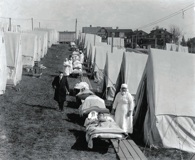
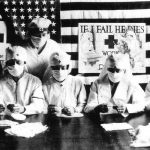
Without a proven vaccine, the best solution was to ask citizens to cover their nose and mouth with whatever they could (most used handkerchiefs or scarves while others used homemade masks). Like today, schools and businesses were closed as were churches, saloons, theaters, and other places where people tended to congregate. Even libraries were closed while mail delivery and garbage pickup became sporadic. Since it was thought that the virus was spread by human contact, some staggering business hours in order to minimize crowds.

Meanwhile, as hospitals quickly filled up with the sick and dying, officials began to covert empty buildings, homes, and gymnasiums. With a lack of available doctors and nurses, medical students were pressed into service to treat the less severe patients, who, as an aside, were often treated with nothing more than common aspirin, then a relatively new "wonder drug" (the German company Bayer held the patent and Germany was an enemy combatant, making the drug hard to come by). And like today, entire communities were quarantined. Those who violated the quarantine were issued a citation ("disturbing the peace") by the local police. Repeated violators were fined or even arrested!

The death rates were so high that funeral homes were filled beyond capacity. Many used ice houses to store the bodies until they could be buried. In rural parts of the country (which at the time made up 49% of the nation), families had "parlor" funerals in their living rooms while graves were dug by family members or friends with the departed buried on the property (it wasn't unusual in the country to have small family cemeteries). Their names and date of death were reported when they could, which could be weeks or months after their death. Some were never reported.

So how did the Spanish Flu change the America? America in 1918 was still in the midst of "The Great War". Industry had been geared up to support the war effort while young men (and a few women) volunteered to go "over there" as the popular battle cry implied. In some ways that was a good thing. It meant much of America's youth were overseas at the height of outbreak.

It also meant that our resources (especially medicine and medical supplies) had to be balanced to support the war effort and flu outbreak "over there" and increasingly at home. Bear in mind too that many of the country's recently graduated medical doctors and nurses, feeling patriotic, had volunteered for military service. Thus, medical students were co-opted to take care of the sick on the home front.

Like today, the flu took its greatest toll on the old , the sick or those with serious underlying medical conditions like cancer, diabetes, heart or lung disease. Another killer at the time which claimed thousands of lives was tuberculosis. "TB" as it's typically called ran rampant in poorer regions of the country like the deep South or in the slums of large cities like New York and Chicago.

Thanks in part to the devastation of the flu and TB among other diseases of the time like the measles, there was calls to eradicate the slums, access to clean water, improved nutrition, particularly for children, and demands for mandatory vaccinations (again, mainly for the children). Hospitals and universities began dedicating more money to the treatment and prevention of these diseases.

By 1920 overall healthcare had improved dramatically. This was due, in part by the lessons learned by the war in the care and treatment of not just the wounded or treatment of the flu, but also mental illness such as "shell shock" or PTSD as we call it today, and other diseases experienced by those who fought in the filth of the trenches. One major improvements was in sanitation.

After the war much of this changed. There was an emphasis on cleanliness. Even hospital food improved (well, relatively. At least they now got healthier meals). Standardized treatment of individuals now became commonplace with added emphasis in prevention. Because more money was going into research, there was more or improved medicines, treatments and vaccines becoming available.

In society in general, there was a new emphasis in cleanliness, be it in restaurants, saloons, or the neighborhood grocery store, which focused on insuring that its vegetables, fruits, and meats were fresh. It became common to wash your hands before dinner and to take regular baths---with soap! It was far from what we would consider acceptable these days, but it was a huge improvement, and it helped jump start movements to improved the quality of life such as water lines to bring clean water to every home, and stronger health codes for better quality control of meat and food processing.

What will the post-COVID-19 world be like? It's hard to say at this point just as it was all but impossible to predict in the waning months of the Spanish Flu pandemic. At first, I expect there will be a lot of "overkill" of precaution. As in 1918, officials are terrified of being accused of doing too much as they are of not doing enough. We'll see some demand everyone wear masks until the impractically of it finally dawns on them or society refuses to comply. Social distancing will likely remain, at least for awhile, but that will soon fade. Humans are social animals. We tend to congregate. It's our nature.

Whereas in 1918/19 there were no "take out" dinners per se, I think we'll see more people doing just that. The result may be fewer restaurants, especially those whose menus don't easily accommodate to pickups. Businesses which deliver food will likely do well along with those who pick up and deliver office supplies, groceries, and fulfill similar needs. We'll see an increase in online shopping across the board. In fact, anything that can be done electronically will do quite well.

There are some things which has to be done in person such as visiting the doctor. Well, maybe. This pandemic took a relatively new technology, "telemedicine", and brought it into the mainstream of healthcare. It allows the doctor or their staff to connect visually over the internet and conduct a virtual office visit. Of course, there are practical limits, but it does allow the physician to actually see and speak with their patient and ascertain their general health and any issues which may necessitate a office visit or trip to the ER. Now, if we can only figure out how to use this in lieu of dentist visits!

Naturally, the patient can provide their weight, temperature, and blood pressure too if they have the equipment at home. Physicians can already check on a number of medical conditions remotely such as heart monitors and CPACS through the use of the internet or electronic transponders. We may also see the increase in doctor directed robots making the rounds in hospitals or nursing homes.

Speaking of robotics, expect to see an increase in automation not just in manufacturing, but also in warehousing and fast food restaurants. The virus pandemic and reliance on "essential" employees has proven to be too unreliable, operationally costly, and increased the risk of a potential infection which would affect not just staffing but insurance costs.

Banks, which are operating mainly through drive-thru tellers, could potentially eliminate inside banking altogether except for appointments, reducing cost and improving security. They could have a dedicated drive-up window to handle investment services or loan applications. What all this means is less demand for low skill/entry level employees. By the way, there's a growing case being made to all but eliminate cash, which some claim is susceptible of carrying germs and viruses.

The result would be the use of credit and debit cards for the majority of transactions. But why stop there? Why not encode a card to include your credit, work, insurance, criminal, and medical histories plus your driver's license and voter ID ? By the way, expect that your vaccination history to be included, which is more likely going to mandatory and less an option. In short, your entire life on one plastic card! You would have just have one card to worry about, but we can do even better than that!

What if, instead of a plastic card to carry around, they could simply implant a microchip in your hand or arm with all your data on it? Just a wave of your hand (or arm as the case may be), and that's all. No more "dirty" money. No more cards to carry or pin numbers to remember. Less risk of ID theft or stick ups! Maybe it could be encoded to unlock your home or car (or even start it!). Well don't laugh, microchips are already being tried in places like Sweden and the trend is growing. Now it's being promoted as a way to cut back on interpersonal contact and reduce the spread of viruses.

Unlike 1918, we have far greater technology available to us. But scientific achievement doesn't translate to moral wisdom, which sadly often lags decades behind. Sometimes longer. In our rush and fear to avoid the next pandemic, let's pause for a moment and reflect on what it is we really want as a society and what price we are willing to pay for it. Remember, earlier Republics and democracies often failed as a result fearful citizens willingness to trade their freedom for security, and ultimately, obtaining neither.


The Influenza Pandemic of 1918


Diseases In The Trenches


Five Bold Predictions For The Post COVID-19 World


Telehealth


Why You're Probably Getting A Microchip Implant Someday


Saturday, November 24, 2018

Willful Ignorance or Intentional Manipulation? Making Sense of All the Political "Noise" on Social Media


Have you noticed that social media seems to be exploding with posts from so-called "experts" or academic sounding groups all claiming that we are on the verge of being overrun by "socialists" or Communists" or maybe even Nazis? They all seem to say the same thing; that the Left has been taken over by covert socialists or closet Communists who've been lurking the whole time under Barack Obama's bed or Nancy Pelosi's secret closet, or in Maxine Water's belfry. As the same time, we hear about how Donald Trump has suddenly morphed into Adolf Hitler or how the Tea Party is a secret group of neo-Nazis intent on taking control of the Republican Party and world domination.

To make matters worse, I read some of the comments about how the Democratic Party is now the new Communist Party (but better dressed). But, as if to make the situation all that more absurd, are those either spewing out these pieces of nonsense or agreeing via the comment section that socialism, Communism, and Nazism are essentially interchangeable terms for the same thing like a bunch of bobble heads. Seriously, are people just that uneducated or is this just willful ignorance?

I guess, for me at least, all this would be knee slapping funny if it wasn't so dangerous as in a "don't-touch-that-it's-hot" sort of way. First off, socialism, Communism, and especially Nazism aren't the same, and secondly, we aren't headed in that direction no matter how many self-serving pseudo-intellectual sounding emails or posts we get on social media. It ain't gonna happen friends, and I'm going to tell you why. So, let's start off with understanding some terms. (I promise this won't use a economic or political science class definition and to keep it brief).

First, "socialism". Just what is it? Well, most people, especially in the US, have been taught that socialism is a bad thing. Some see it as being synonymous with Communism, or the very least, Marxist-Lite. Well, not exactly. Socialism, as defined by Merriam -Webster is "any of various economic and political theories advocating collective or governmental ownership and administration of the means of production and distribution of goods; a system of society or group living in which there is no private property; a system or condition of society in which the means of production are owned and controlled by the state; a stage of society in Marxist theory transitional between Capitalism and Communism and distinguished by unequal distribution of goods and pay according to work done.

So, in short, there are varieties of socialism. What Scandinavia has for instance is democratic socialism and it's worked quite well thank you very much while Venezuela has a more Marxian form which has proven to be dismal at best. However, corporations are heavily regulated under democratic socialism and state controlled under Marxian socialism. There are also multiple political parties, strong unions and employee associations under the former and, as usual, state control under the latter with a single political party.

Communism, as again defined by Merriam-Webster is "a system in which goods are owned in common and are available to all as needed; a theory advocating elimination of private property. Capitalized, a doctrine based on revolutionary Marxian socialism and Marxism-Leninism that was the official ideology of the U.S.S.R.; a totalitarian system of government in which a single authoritarian party controls state-owned means of production; a final stage of society in Marxist theory in which the state has withered away and economic goods are distributed equitably; communist systems collectively. Pretty straight forward. State control of everything. No Capitalism. Private ownership of nothing. No independent unions. One state political party.

Now, Nazism ("Nazi" stands for National Socialist German Workers Party. As an aside, it's the second word, "Socialism", which throws people for a loop and confuses the daylights out of them). So, what does Merriam-Webster say about Nazism? They define it as "the body of political and economic doctrines held and put into effect by the Nazis in Germany from 1933 to 1945 including the totalitarian principle of government, predominance of especially Germanic groups assumed to be racially superior, and supremacy of the Fuehrer. Helpful, but not entirely clear is it? Let's try the ever popular Encyclopedia Britannica.

According to them, Nazism is "totalitarian movement led by Adolf Hitler as head of the Nazi Party in Germany. In its intense nationalism, mass appeal, and dictatorial rule, Nazism shared many elements with Italian Fascism. However, Nazism was far more extreme both in its ideas and in its practice. In almost every respect it was an anti-intellectual and a theoretical movement, emphasizing the will of the charismatic dictator as the sole source of inspiration of a people and a nation, as well as a vision of annihilation of all enemies of the Aryan Volk as the one and only goal of Nazi policy. Well, that's a little better, but it really doesn't quite answer our question.

One key reason is that Nazism was a one-off political movement; that is, it happened only once and was unique to a particular people, place and time. Our attempt to place this 70+ year old ideology on our current but antiquated Left/Right political spectrum fails to do it proper justice. Nevertheless, Nazism, which was variant of Fascism, was first and foremost a nationalistic movement more so than a typical political party. Secondly, it had a particularly unique racial component to it. It was an ideology designed for and aimed at the "Aryan" or Germanic People. Lastly, it was a totalitarian form of government (as is Communism and the Marxian form of socialism).

Under Nazism there was no infringement on private property. Unions were merged into a State run union ("DAF" or German Labor Front). Capitalism continued to independently exist, though certain industries served the State's military needs via government contracts and financial rewards. Under Nazism, there was one official political party and elections, while continuing to exist, were basically meaningless. So what about the name? Well, originally, the name was the German Workers Party, which was basically a small working class debate club which meet at a local beer hall (where the best political and sports discussions often happen).

After Hitler was elected (or, as some insist, appointed) head of the "party" in 1921, the name was changed to National Socialist German Workers Party (NSDAP) by Hitler himself. The name was chosen with a specific intent in mind. At the time, there were numerous political parties and special interest groups across the political spectrum. The largest on the Left was the Social Democrats (SPD), who had controlled the Wiemar government since its creation in 1919, following WWI. Secondly, also on the Left, was the German Communist Party (KPD). In the middle there was the large Catholic dominated Center Party. Finally, on the Right there was the "DNVP" or German Nationalist People's Party.

There were also several smaller parties like the Peasant Party which represented farmers and tradesmen, the Middle Party which was monarchist, the National Liberal Party, and the German Democratic Party; all of which represented middle and upper middle class, mostly conservative individuals. In addition, there was the Patriot Movement which was nationalistic and tended to represent veterans. Then there was the Racist Movement (yes, an actual separate Pan-Germanic movement which was anti-Jewish, Slavic, Asian, African, Gypsy, etc. It also was nationalist) and the Peasants and Middlestand League which was focused on economic issues. The trick was how to attract people from these various groups.

The answer was to offer everyone something. "National" appealed to the various veteran and Pan-Germanic groups. "Socialist" was aimed at the unionists, but also those the Pan-Germanic groups with the idea of creating a Germanic community while "Worker" was aimed at the smaller working class parties as well as groups focused on economics. As an aside, under Marx, "socialism" was seen as international and post-national whereas Hitler saw it as strictly nationalistic and for the benefit of the Germanic Peoples. So, same word but entirely different meanings.

Now, that brings us to present day USA. While groups like Antifa and BLM among others may proclaim what they believe to be a "socialist" or even Communist message, it ain't gonna happen. Same goes with any groups on the Right who espouse a neo-Nazi position. The reason is that those funding these groups have absolutely no intention whatsoever of giving up their power, control, and most certainly their wealth. Wallstreet isn't going anywhere. Agree? America is, sadly, no longer the Constitutional Republic it was founded. America is in fact an Oligarchy; a plutocracy. What do I mean by those terms? Simply that the US and its government are controlled by a small elite group of every wealthy individuals and their corporations. Not even academic disagrees on that point.

This "partnership" is a defacto form of Fascism (sorry to throw another term at you). Modern Fascism was created by Italian dictator Benito Mussolini. Mussolini, who had been raised a "socialist" by his parents, conceived of the idea during and just after World War One, after what he saw as the failure of socialism, as a partnership between government and big business with government basically as the senior partner in that relationship (he later said that a better description would be "Corporatism"). It would be corporate capitalism bolstered by the power of the government for the mutual benefit of both.

Under his Fascism, little would appear to change. There would still be private property, freedom of religion and so forth. It did not, for instance, prohibit other political parties. Mussolini adopted a classical economic liberal (laisser-faire) policy along the lines of John Maynard Keyes, which later expanded into specific intervention of certain areas as he deemed necessary. During the Depression, he did engage in public works programs as did pretty every other country did including Germany and the US for instance. For awhile, it seemed like Mussolini and his Fascism could do no wrong.

Under our present day Oligarchy, America is faced with a "creeping" Fascism, which unlike its earlier incarnation, has government more of a junior partner; basically a manager or caretaker protecting the privileges of the ruling elites. It advanced here, retreats when it encounters strong resistance but always probing for weakness. The current political turmoil that America is in is not, as we're led to believe, one of "socialism" (or Communism) vs. neo-Nazism, but of a softer Left oriented version of Fascism as opposed to a stricter Right oriented form of Fascism (Fascism borrows from both the Left and Right). Both see the need to destroy unions and employee associations. Both see the need to perpetuate wars (even if it means rekindling the Cold War) or manufacture enemies because wars, after all, are profitable. The threat of military intervention is how corporations either force open markets or obtain favorable deals. Wars "bleed" off excess population, which reduce unemployment numbers and artificially stimulates the economy creating more jobs, which make politicians look good and make obscene profits for business executives.

Another aspect of "creeping" Fascism (or "Friendly Fascism" as the late great Dr. Bertram Gross called it in his book by the same name) is that it doesn't really care about borders or even national sovereignty, at least in the traditional sense. Countries are "passé". Instead, they see economic blocks with each government serving as its middleman; its manager if you will. Some are temporarily cooperate (alliances) while others are directly competing (conflicts). In lieu of nationalistic citizens there are merely consumers and workers whose values are largely determined by their credit ratings. No more. No less.

Lastly, both support opening the borders to allow more individuals in, but for slightly different reasons (be they legal or illegal). First, more individuals means more competition for jobs. That drives down wages and reduces benefits. Both sides agree on that. However, the Democrats also see it as a way to pad their registration numbers since they believe that most of these immigrants would register as Democrat (that's because of the perception that the Democrats will "give" them "free stuff"). Meanwhile, both sides support exporting of jobs, lower corporate tax, corporate welfare, and keeping the revolving door (and gravy train) between the corporate world and governments flowing.

So, while these race oriented and anarchist groups may think they're protesting for one thing, they're being maneuvered into doing another (Lenin called these type of people "useful idiots"). What needs to happen, be it for the Left or Right oriented Fascists, is total control because that allows them to establish order, and order improves profit margins. How to do that? Simply by doing what's actually counter-intuitive---create chaos. By promoting as much division, instability, violence, fear, and confusion as possible, the public will sooner or later demand that the government "do something" to restore order. It's not a new idea. It's been tried and applied since the Late Rome Republic if not earlier. Once we feel we are no longer safe, the economy is to erratic, and the pressure from outside (manufactured or real) threats, the American People will insist that the government intervene, and trust me, they will but not in the way we expect.

America is already a surveillance State. There's no questioning that. We have the means that past totalitarian regimes could only dream about. We have militarized the police forces across the country. The Oligarchy already controls 90+% of all media, which means they control what we hear, see and watch,. They spin it and manipulate our perceptions. If they say a certain individual or group are the bad guys, they will spin the story to make us believe it and visa versa. If there is something happening they don't want us to know about, you can bet we won't, or if we do, it will be spun in such a way to create whatever impression they want. They control how we're entertained, be it sports, TV shows, movies or video games, which in turn affects how we perceive events and keeps us distracted (the ancient Romans referred to this technique as "bread and circuses").

I hope this helps clarify some of the "noise" you're getting on both social and local media. Whenever you feel the need to respond, feel free to copy and post this article. Perhaps it will help someone else too. Meanwhile, remember that the narrative of much of what you hear, read, and see is from these groups, the establishment media, and these so-called "experts" or "authorities" is aimed at steering you into a particular direction in order that you come to the conclusion they want you to. You need to always ask yourself "what are they wanting me to believe and why?", and never take it at face value.


The U.S. is an Oligarchy? The Research, Explained


Is America an Oligarchy?


America's super rich: six things to know


Nazism, socialism and the falsification of history


Hitler, Nazism, Socialism, and Rightwing Propaganda


Was Hitler a Socialist?

Sunday, August 12, 2018

A Matter of Trust: America's Declining Distrust of the Media


Readers of Another Opinion and other sites where I am a semi-regular commentator, have often noticed that I occasionally make mention of the fact that approximately 96% of all media outlets are owned by just six corporations (some estimates put that number a little lower, at 90%). It's hard to imagine that in a country which prides itself on entrepreneurship and innovation has its media dominated by mere half a dozen corporations, especially in this age of technology. Sadly, it's true, and it says a lot about the state of decline we're in.

So, before we get into the reasons why this is such a bad idea, let's take a look at who is on this list. First of the "Dirty half dozen" is National Amusements, which owns Viacom, CBS, BET, Showtime, MTV, Paramount and Paramount Home Media Distribution, Showcase, TV Land, and VH1. The owner of NA is Summer Redstone, whose net worth is estimated to be around 4.6 billion (give or take a few million). Next comes Disney. They own ABC, LucusFilms, ESPN, A+E Networks, Marvel Studios, Industrial Light and Magic, Touchstone Pictures, Pixar, and Walt Disney Studios (wouldn't ole Walt be surprised?). Disney also owns the video gaming company, GameStar as well as approximately 20 print media companies The CEO, Bob Iger, brings in right at $45 million.

Time-Warner is next on the list. Time Warner owns CNN, Castlerock Entertainment, Global Media Group, the CW, HBO, DC Entertainment, New Line Cinema, TBS, TCM, the Turner Network, TNT, Warner Brothers and all their affiliates, Hulu, and Cinemax. In addition, Time-Warner owns DC, Time, Life and Time-Life. It owns seven video companies, including Rocksteady and Monolith. In the world of music Time-Warner own Warner and Watertower Records as well as investments in 25 other media companies. Finally, Time-Warner owns Time-Warner Cable. The president of Time-Warner is Jeff Bewkes, whose annual income is around $32.5 million dollars. Time, Inc was acquired in November 2017 by Meredith Corporation for $2.8 billion dollars after being spun off in 2014. The deal was concluded in January 2018.

Comcast, whose CEO, Brian L. Robert, earns a cool $40.8 million a year, owns corporations like NBC Networks which includes CNBC, MSNBC, NBS Sports, and NBC Universal News Group, along with NBC Universal, "E" Channel, the Weather Channel, SyFy, NHL Channel, NBL Channel, Bravo, DreamWorks Entertainment, Esquire, Fandango, Gramercy, Telemundo, and the USA Networks. In terms of the internet, Comcast owns Xfinity, which is the world's top internet provider, and, of course, Comcast. It also has a strong financial stake in 62 other media companies including Vox Media, Tripwire, and TiVo.

The next corporation on our list is the News Corporation, which may be the least known, but its owner is certainly very well known, the very colorful Mr. Rupert Murdoch. News Corp as it's commonly called, owns FOX and all its affiliates, 20th Century Fox, FX Network, National Geographic Network, BlueSky, Sun Sports, MYTV, FXM, and FSN Sports. It owns Fox Music and the Wireless Group LLC. In terms of print, which has been at the heart of Murdoch's media empire, in addition to News Corp, it owns Barrons, the Wall Street Journal, Smart Money, the New York Post, Harper-Collins Publishers, Financial News, Harlequin, Market Watch, Smart Source, Down Jones Newswires, and Courier Life, plus several more. Surprisingly, Forbes Media isn't owned by Murdoch. The company is owned by International Whale Media Corporation, with a minority share owned by the Forbes family.

Finally, Sony rounds out the "Dirty half dozen". Of course, everyone is familiar with Sony Electronics and its numerous subsidiaries including Sony Pictures, but the company owns far more than that including TriStar Pictures, True Channels and its affiliates, Triumph Pictures, Imageworks, Cine Sony Television, Animax, Screen Gems, Starz, Left Bank Pictures, CSC Media Group, and Destination Films. When it comes to music, Sony dominates the other five with, of course, Sony Music, EMI, Epic, and about 11 other music related corporations. In terms of the internet, is owns So-Net Entertainment which serves primarily the Asian market. Sony also has expanded into the non-media market to include Sony Bank, Sony Life, Sony Financial Holdings, and Sony Creative Software. It also has holdings in Olympus and FelCia, which is a RCIF smart card system used in electronic money cards. The president and CEO of Sony is Kazuo Hirai. I'm sure he uses his smart card to deposit his $4.9 million dollar salary.

I want to be clear that the various subsidiaries and affiliates I've mentioned aren't assumed to all of the holdings owned by these companies. They're not. They are just a sampling of their vast holdings. Also, there are other, individual companies, which may own are larger share in a given market, such as Pearson LLC of the UK, which is ranked as the largest publishing company in the world while the Woodbridge Company, owner of Thomas-Reuters is the third largest (Apollo Global Management, which owns McGraw-Hill, is the largest in the US, is ranked 8th). While Comcast Xfinity is the world's largest ISP with over 110 million subscribers, other leading internet providers include AT&T Internet, Charter Spectrum, Version Fios, HughesNet, and about 15 others.

In addition to these six corporations, there are other industries which have a lock on their particular market niche. For instance, just four corporations the aircraft industry (Boeing, Airbus, Embraer, and Bombardier). 80% of cars are manufactured by just six companies, Toyota, GM, Ford, Honda, Nissan, and the Chrysler Group. Five companies control 90% of the cell phone market, namely Apple (which controls the lion's share), Samsung, HTC, Huawei, and Motorola. Only two companies, iOS and Android control 98% of the operating systems market. Meanwhile, only four sites, Twitter, YouTube (which is owned by Google), Facebook, and Reddit, control 76% of their market. Lastly, only five corporations dominate the private intelligence industry on which the US Government depends. They happen to be CACI International, SAIC, CSRA, Booz Allen Industries, and Leidos. These are the companies that the NSA, CIA, DIA, and other intelligence agencies farm our their work to, and these five companies get 80% of it.

So, while these six corporations I've detailed may not be dominate in every aspect of the media, their individual and collective dominance of the market makes them impossible to ignore. Their collective revenues, $430 billion dollars, is more than the Gross Domestic Product (GDP) of 1/4 of world's countries. But what's key here is the absolute influence they have over every single American as well as anyone else whoever watches movies, television shows, reads newspapers, uses the internet, or listens to the radio in the world, which I suppose is one benefit of being a transnational corporation. Nevertheless, these six media companies have the ability, which they use on a regular basis, to determine what is and isn't news, how it's spun, and influence what we think.

As a result, these six corporations have both a direct influence on government policy through their direct financial contributions to candidates and their campaign, but also a indirect influence by how a candidate or issue if presented (if it's presented at all). In addition, to deciding what story is picked up, they decide how it's presented and through innuendo or images, manipulate our opinions, our actions, and in many cases, whether we should support this or that issue or politician. If there's any doubt, one need look no further than how the 2016 Presidential race was presented.

If the media presented a balanced approach to its news, that is just the facts without any political bias, I think most Americans could make up their own minds. However, these days finds the media not just controlling content, but also spinning it with a decidedly Left tilt (compare this with the late 1940's,the 1950's and early 1960's in which the media had noticeable Right leaning tilt). We can catch a glimpse of this by examining several polls which asks for our opinions regarding the media. One Pew Poll noted that Americans are divided as to how much they trust the media. Not surprisingly, they divide largely fall along political lines. 89% of those who identify as Democrats trust the media to keep politicians of both corporate parties in line, but only 42% of Republicans did (this, by the way, was the largest divide ever measured by Pew Research on this question of trust in the media).

On a related question, when asked how biased the media was toward or against their particular party,72% of Americans overall felt that the media was politically biased. When broken down along party lines, 87% of Republicans thought the media was biased; 53% of Democrats agreed. When asked if they thought the national news services were trustworthy, only 11% of Republicans agree along with just 34% of Democrats. When asked if they trusted the media "a lot", the numbers were expectedly dismal.34% of Democrats said yes compared to just 11% of Republicans. As an aside, only 33% of Americans trust social media in providing accurate news. 52% said they had "some" trusted national news organizations. 60% said they trusted local media "some", while most trusted family and friends with 61% (which is probably why the local media tries to create that "one of the family" image and likes to use phrases like "honest", "trust", and "confidence" in their advertising). Perhaps more telling of the public's attitude toward the media is that a pitiful 1/5 of adults thought the media did "a very good job".

Once upon a time, newspaper declared that they were the sole arbitrators of what was "right" or moral; that they were the public's "watchdog", which gave birth to activist newspaper writers and editors ("crusaders" they liked to call themselves). This in turn led to editors "endorsing" various issues and candidates. Perhaps their hearts were in the right place, but many quickly used their position to try and influence specific pieces of legislation or help friends and associates get elected. Some simply and brazenly got bought off, while others engaged in the practice of "Yellow Journalism" which relied on hype, misleading quotes or stories, and outright lies; a practice which still continues. Fortunately, the majority of Americans no longer pay any attention to these partisan "endorsements". The public is demanding more transparency, such as the names and political registrations of those on these editorial boards, complete and unedited copies of the interviews, or better yet, release of unedited video of the interview process.

So, what we are seeing here through the use of polls is that even despite the partisan divide, the public doesn't trust the media to present an honest and balanced picture. This disconnect, of course, isn't unexpected. Congress, the Presidency, and the Supreme Court have suffered through decades of low (sometimes single digit) approval ratings regardless of which party is in the majority. Sadly, Americans are more widely and more deeply divided across a myriad of issues. Many academics cite that, as a nations, weren't even this divided in the decade preceding the Civil War. That's scary folks. Most Americans feel they have no institution and certainly no party, group or individual they can trust to look after their interests.

America now has just six mega corporations controlling (or maybe "managing" would be a better word) what we see, hear, and watch. It has a major impact on our entertainment, be it sports, TV shows, movies, video games, or internet content. It even contributes to what we buy...and when! Nazi Propaganda minister Joseph Goebbels could only dream of such power. It reminds of the movie "Matrix" by its insidious worming into our lives. Of course, thanks to the Supreme Court's two egregious misrulings (Citizens United and McCutcheon) corporations now openly buy and sell candidates and completely own both the Democratic and Republican parties, while ensuring that third parties and Independents (the nation's largest voting bloc) are denied participation in debates, funding and endorsements, and outright ballot access, and these six corporations are nose deep in it. It's no wonder that we've lost our treasured democratic republic and have now become a defacto Oligarchy; a plutocracy if you will.

Trust, once lost, is something very hard to regain in the best of circumstances. In today's political and social environment, trust of the government and public officials has long been at the level where in other countries there were would be very serious concerns of revolution. The corporate media, whose very credibility is based on trust, has now found itself on the outside, along with ambulance chasers, used car salesmen, bill collectors, and politicians.


The 6 Companies That Own (Almost) All Media


The World's 54 Largest Publishers 2017


20 Top Internet Service Providers


Americans Attitudes About the News Media Deeply Divided Along Partisan Lines


Do Six Corporations Control 90% of the Media?