Showing posts with label Missiles. Show all posts

Friday, July 25, 2025

Ours is Bigger Than Yours: The World's Military and the Ultimate Outcome

There’s no question that the Untied States spends more on its military---$886 billion---than the next nine nations combined. That includes China ($296B), Russia ($109B), India ($84B), the UK ($75B), France ($61B), and Germany ($67B). That’s 40% of all military related expenditures in the world by just one country---the U.S.. But is it the largest military?

America has 1.328 million men and women in uniform. India has 1.455 million active duty personnel. Russia has 1.13 million. North Korea has 1.28 million active duty personnel. Nevertheless, the largest military in the world belongs to China. Their Peoples Liberation Army has 2.04 million.

However, these numbers are a bit deceiving. Although China has the largest number of active duty troops, when reservists and paramilitary are included, China has only the fourth largest military in the world  with a grand total of 3,045,000. India’s military jumps up to third place with 4,246,000 which includes 1,155,000 reservists and 1,616,050 paramilitary units (compared to China’s 510,000 reservists and 500,000 paramilitary).

Russia has a total of 3,203,000 under arms including 1,500,000 reservists and another 569.000 paramilitary. As an aside, Ukraine has only 990,000 individuals in uniform of which 730,000 are regular military with no reservists and 260,000 paramilitary (not including those forcibly conscripted).

The world’s largest military is actually North Korea which has essentially militarized its entire military age population! It has 1,280,000 regular troops, 600,000 reservists, and a whopping 5,7 million paramilitary personnel, bring its total to 7,580,000 men and women under arms. By comparison, South Korea has 3,100,000 reservists and 3,013,000 to augment its regular military of 500,000, bringing its total to 6,613,000, making it the second largest.  

As for the United States, we have 1,315,000 active duty personnel in addition to 797,200 reservists, bringing our total up to 2,112,00 individuals in uniform. While the U.S. doesn’t officially have a “paramilitary”, we just might have something a little bit better and that’s the millions of U.S. citizens who come packing.

There’s an old expression that America could never be invaded because behind every rock, tree, and bush, will be someone with gun. Although there are no official numbers,  estimates are that approximately 32% of Americans own at least one gun. That’s about 82 million gun toting Americans.

Of those, some 14.4 million classify themselves as active hunters, meaning they’re probably a pretty good shot (additionally, some 25.87 million Americans has hunted at least once and those numbers don’t included the number of individuals who shot skeet, target shoot, and enjoy “plinking”  (shooting homemade targets like garbage can lids, bottles, cans, and the occasional speed limit sign).  

Broken down by individual household, guns can be found in 44% of households. While other countries, like Switzerland and Serbia, have high gun ownership, no other nation even comes close to the U.S. in terms of gun ownership.

As an aside, Montana has the largest percentage of gun owners of any state with 66.3% of residents owning at least one firearms followed by Wyoming with 66.2%. It’s 60% in Idaho and 59% in West Virginia, while around the Ozarks, it averages 56% of households. In Kentucky, it’s just over half with 54.6% of the population owning at least one firearm. Texas is surprisingly low, with just 46% of the population own a gun, which is less than in Maine where 47%  and Vermont at 51% owning a firearm.

In New York, despite its reputation for gun related violence, just 20% of the population legally own a pistol or rifle while in nearby Connecticut it’s 24%.  In California, 28% of it residents legally own a gun, matching Illinois. New Jersey and Massachusetts has the least with about 14.9% of the population own a gun. Finally, despite being a “Southern” state, gun ownership in Florida is only 35%. It must be due to all those Yankee carpetbaggers.

Another factor to consider, like it or not, is that guns are a part of the American persona. They go hand-in-hand with freedom and independence.  It’s just not part of our history, it’s part of our culture and our collective American mythology as a nation from the frontiersmen and “mountain men” to the Wild West and our very founding as a nation.

Firearms and the notion of self-defense from a tyrannical government was seen as so important, ownership of firearms was built into our Constitution.  As long as Americans own firearms, this country will never be invaded. But there is more to national defense than just pistols and rifles.

Who has the largest air force? In terms of most modern and powerful, that goes hands down to the United States with roughly 14,486 manned and unmanned aircraft. Russia is ranked second in the world with approximately 4,211 aircraft while China possesses 3,304. Next on the list comes India with 2,296, Japan with 1,459, and Pakistan following closely behind with 1,434. South Korea has 1,171 aircraft compared to North Korea which possesses just 951.

 It bears mentioning that the individual branches of the U.S. military have more airplanes, helicopters, and drones than the entire air forces of most countries!  For example, the U.S. Army has some 5,714 aircraft compared to entire Russia military which has a total number of planes and helicopters of 4,211. Of course, being former Navy, I have to mention that the best pilots in the world are U.S. Navy pilots.

Speaking of the Navy, who has the world’s largest seagoing fleet? In terms of numbers, the largest fleet belongs to Russia. Once virtually landlocked due to a lack of warm water ports, Russia now has a fleet of some 781 ships. It’s worth noting too that Russia built the largest submarine ever as part of “Project 941---Akula”, a nuclear powered Typhoon class “boomer” with a displacement of 48,000 tons and a length of 574 feet and a width of 75 feet, it is truly a leviathan.   

 China is second with 730 deep water ships, including two operational aircraft carriers (and a third on the drawing board) along with three helicopter carriers. As an aside, China also has the most modern military navy in the world, turning out more new ships than any nation. 70% of its ships were built after 2010 compared to just 25% of the U.S. Navy.

Third place belongs to North Korea with 505 ships, though analysis question their operational status given shortages of replacement parts. North Korea also doesn’t possess any aircraft or helicopter support ships (South Korea has 200 military ships). Next, in fourth place, is the United States Navy with 11 aircraft carriers and nine support helicopter carrier ships.  

The U.S. Department of Defense published a report in 2024 noting that the Navy was badly in need of a total fleet overhaul; everything from drydocking its fleet for a refit to retiring some of its submarines, destroyers, and even a carrier or two (the DoD was also critical of the wartime capabilities of the U.S. Air Force and U.S. Army. Only the Marines were said to be a proper fighting strength).

Following the U.S. is Sweden, which has traditionally been a seagoing nation for centuries. Sweden currently has 353 deep water naval vessels, followed by Indonesia with 333 military ships. Italy has 309 while India and Thailand have 294 and 293 respectively. The largest navy in South America is Columbia which stands at 237 followed by Mexico with 194. In Africa, Algeria has the continent’s largest navy with 213 ships. Egypt is second with 140 ships.

Speaking of submarines, at 70, all nuclear, submarines, the U.S. Navy possesses the world’s largest submarine fleet. Second place belongs to Russia with 63 nuclear and conventional submarines. The Chinese have 61, which includes nuclear and electric diesel. Their emphasis is primarily the Indian and Pacific oceans.  

In fourth place is Iran which operates 25 conventional attack and miniature submarines throughout the Persian Gulf.  Egypt has the largest submarine fleet in Africa with eight Type 209  conventional subs it acquired from Germany (who know a few things about submarines). Algeria has six and South Africa has three, also Type 209.

Lastly, nukes. What nation has the most? Russia is believed to have 5,500 nuclear tipped missiles in various stages of readiness. The U.S has some 5,000 nuclear armed missiles, also in varying stages of readiness. China too has nuclear missiles  (around 600) as does France (290), the UK (225), India (180), Pakistan (170), and Israel (90).

North Korea claims to have around 50 while Iran is desperately trying to become the newest member of “global damnation club”.  It deserves mentioning that in terms of missiles in general, Russia is also thought to possess the largest number of missiles, especially Intercontinental Ballistic Missiles or “ICBMs”, both nuclear and conventional. China is also busily expanding its missile capabilities. 

All told,  there are approximately 12,331 nuclear weapons at play, down from about 70,000 during the Cold War. These range from so-called “tactic”  or low yield warheads which have a explosive capability 20 times that of what was used as Hiroshima and Nagasaki up to a three stage thermonuclear warhead (the Soviet era “Tsar Bomba”) whose explosive output is 1,570 times that which was used on the two Japanese cities. Anyway, you look at it, in a nuclear exchange only cockroaches would survive.

Other missiles systems being made operational include hypersonic missiles which travel at Mac 5 or five times the speed of sound (and thus may be able to evade various anti-missile defense systems) as well as GBU 7a/b “bunker buster” which can penetrate 200 feet into the earth or through 20 feet of solid concrete. The EMP” of electro-magnetic pulse bomb which disrupts or destroys anything electronic or electrical  such as power grids, communication systems, computer systems, electrical circuits, and so forth.

In the final analysis, we seem to be pretty good at developing ways to kill each other. In a world where poverty, hunger, and disease is on the rise, and budgets funding social safety nets are being cut, the budget for the “defense” is virtually unlimited. We kill to gain access to and protect resources or global markets. Besides, war is profitable.

War artificially stimulate economies and reduces unemployment and regulates “excess” populations. Most of our scientific and medical advances are byproducts of weapons research (but then, so are many of our new diseases). It pits us against each other in order to protect the “haves” from the “have nots”. Hell, we’ll even kill each other over whose god or prophet is the most benign. Many of us pray for a divine or even alien intervention to put a stop to our species based insanity. But the sad truth is that no one or nothing is coming from the sky or anywhere else to save us. We’re on our own babies.


Thank you for reading "Another Opinion", the Op/Ed blog page for the "militant middle".  Here at "A/O" we truly value our readers. At A/O we seek the facts as they exist, not partisan talking points.  We hope you find our articles informative and engaging. Comments are welcome, provided they are not vulgar, insulting or demeaning.  Another Opinion is offered without charge and is directed toward all independent and free-thinking individuals. We ask, however, that you "like" us on whatever platform you found us on in order to keep our articles available for free to others. Lastly, in order to keep costs down, we depend on passive marketing, and therefore, depend on our readers to please forward our posts along. Below you will find links to the sources we used in writing this article. Thank you. 


The World’s Largest Armies


Mapped: US States With The Most Guns


Largest Air Forces in the World


U.S. Military Working on Rebuild Readiness and Modernize


Military Readiness


Why the U.S. Military is in Serious Trouble


Top 10 countries with the largest submarine fleets in 2025


Project 941 submarine


Which countries have nuclear weapons?


Thursday, December 07, 2023

The War in Gaza: A Prelude to WWIII?

On December 3, 2023, a seven hour long attack on three commercial ship and the guided missile destroyer, the USS Carney, took place in the Red Sea as the U.S. warship patrolled the area. The attack by ballistic missiles came from Yemen in four separate waves. The Pentagon claimed the attack was the work of Iran, through which the terrorist Houthi organization carried it out. The Pentagon went on to claim that the USS Carney shot down three of the attacking missiles.

The U.S. Navy ship detected a "anti-ship ballistic missile" launched from an area controlled by the Muslim terrorist group directed toward the "M/V Unity Explorer", a 656 foot general bulk cargo ship built in 2016 sailing under Bahamas registration. Weighing in at 61,000 tons fully loaded, she recently departed Port Said in Egypt bound for Singapore. At the time of the attack, the Unity Explorer was carrying grain from U.S. based Cargill.  She is owned and managed by Ray Shipping of Tel Aviv Israel.

The "Number 9", also came under attack. Built in 2007, the cargo container sails under Panamanian registration.  Ironically, the 856 foot ship was sailing from Singapore and bound for Port of As Suways (Suez Port) in Egypt. The ship is owned by Number 9 Ltd/Cargo Harbor of England and managed by Bernhard Schulte Shipmanagement out of Newcastle-upon-Tyne in Northeast England.

A third ship, the bulk carrier "M/V AOM Sophie II", was also attacked by the Houthi missiles. Like the "Number 9", the AOM Sophie II, built in 2021, sails under Panamanian registration. At 751 feet, she has a 43,500  gross tonnage. Her registered owners are Kyowa Kisen Company, Ltd and Green Spanker Shipping S.A. while she is under the management of Cleanseas Shipmanagement, Inc., located in Manila, Philippines.  

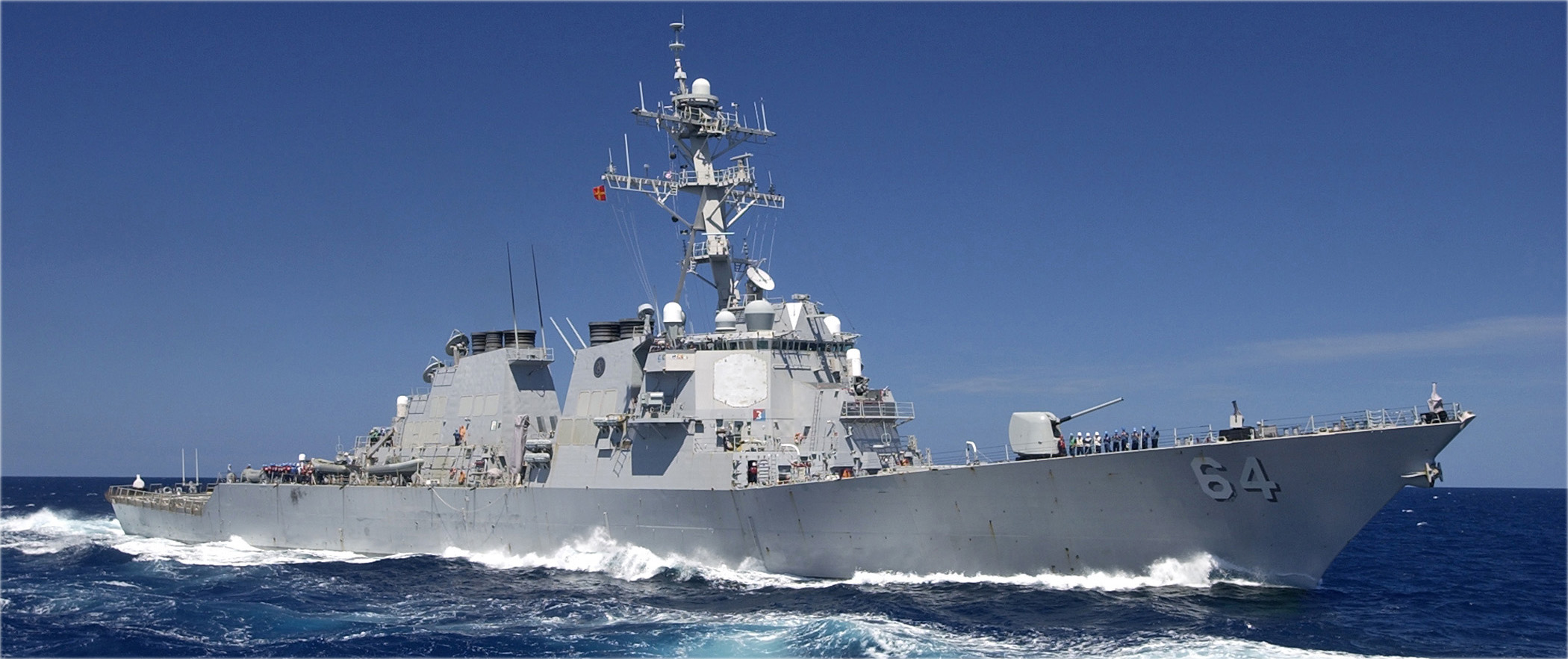
The USS Carney (DDG-64), a heavily armed Arliegh-Burke guided missile destroyer, is part of the USS Gerald R. Ford Carrier Strike Group operating in the region as part of a two prong U.S. naval carrier strike force which includes the USS Dwight D. Eisenhower. Each strike force consists of approximately eight warships plus one aircraft carrier and eight squadrons of attack aircraft plus one squadron of support planes and helicopters.  That's a helluva lot of firepower.

In addition, there is likely increased submarine activity, not to mention spy planes, drones, and dedicated satellites as well as communications monitoring.  The British also sent a carrier based strike group to the area along with a detachment of Royal Marines, as part of a coordinated military show of force as well as to provide air and naval support for Israel.              

Perhaps the key reason for the attack, other than its proximity to the war zone, is its ownership by Ray Shipping of Tel Aviv Israel. The sinking of cargo ship would have serious consequences for global shipping in the region since it could block all traffic going through the Red Sea. The Red Sea accounts for 30% of the world's cargo traffic.

However, Houthi military command in Yemen, while acknowledging the attacks, stated that their intelligence indicated the three commercial ships had ties to Israel. As indicated above, only one of the cargo ships has Israeli ties. The Houthi have previously sent guided missiles from Yemen up the Red Sea toward Israel settlements in the south. These missile attacks were successfully intercepted.

The Pentagon went on to say that it would pursue all appropriate responses in coordination with its allies and partners, which presumably means Great Britain, which has a carrier strike force offshore at Gaza, and the Israeli military, which is currently conducting military operations in Gaza. By the way, if Yemen sounds familiar, it might be because in 2000, Al Qaeda was almost successful in sinking the USS Cole while it was docked in Yemen's Aden harbor. 17 sailors were killed and 37 were injured.

Meanwhile, it should be noted that the International Criminal Court ("ICC") has initiated a criminal investigation for alleged war crimes against Israel under Article 31 of the Geneva Convention for the deaths of civilians in Gaza and the West Bank dating back to 2014.

These deaths result from not just military attacks, but also the alleged deliberate withholding of water, food, medicine, and electricity according to  the Chief Prosecutor for the ICC, Karim Khan. Mr. Khan, a British attorney, claims that some 2.3 million people have been affected.

The Israeli-Palestinian crisis, contrary to popular opinion, didn't start with Israel's 1948 Declaration of Independence. The situation actually dates back to the early 1900's when various Zionist organizations began lobbying in earnest for a Jewish homeland due to the centuries long progroms,  Many progroms restricted Jewish ownership of property, limited job opportunities and access to higher education, and resulted in numerous murders, rapes, and physical attacks.  The most notable of the Zionist Movements were led by Max Nordau, Chaim Weizmann, and Theodore Herzl.

Control of what was then called the Palestinian or British Mandate came about after the fall of the Ottoman Empire in 1918 and the seizure of lands by the British and French empires (between 1920 and 1948, the Levant was known as "Mandatory Palestine" per the League of Nations Mandate for Palestine). The earlier Balfour Declaration of 1917 guaranteed British support for the creation of Jewish homeland in Mandatory Palestine, but didn't say when.  

This was followed by the creation of the Zionist Commission for Palestine under Chaim Weizmann, president of the British Zionist Federation, in 1918 which aggressively promoted Zionist activities in the region such as smuggling Jews into Palestine to build up the numbers and give Jews a stronger voice for statehood. They also actively fundraised to raise money for Zionist programs.  While the British continued to drag their feet on the issue, World War II brought the matter to a head.

Capitalizing of the horrors of the Holocaust amid the Nuremberg Trials and an unrelenting public relations campaign by various Zionist organizations plus global support (especially from Hollywood, Wall Street, and other financial institutions), the British finally relented and agreed to the creation of a two part state known as the 1947 United Nations Partition with Jerusalem falling under a UN trusteeship.

While the proposal was rejected by the Arabs, David ben Gurion, the head of the Jewish Agency for Israel since 1935 and part of the World Zionist Organization, declared independence for the new State of Israel on May 14, 1948. Ironically, some leaders at the time joked that had it not been for Hitler and the Nazis, it's likely there wouldn't have been ample support of the creation of a Jewish state, and thus Hitler should be credited as the step-father of Israel.

Immediately following the declaration, armies from Egypt, Jordan, Iraq, Syria, Yemen, Saudi Arabia, Lebanon, along with a composite of "volunteers" from Libya, Morocco, Iran, the UAE, and other Arab nations known as the Arab Liberation Army, invaded. Fighting with weapons scrounged from every corner of the world, including German WWII surplus, Israel bitterly fought back. 

Following a nearly ten month long war, a ceasefire was arranged. Israel retained all its land plus captured 60% of the land originally designated as part of the State of Palestine. The West Bank and East Jerusalem fell under the administration of Jordan and Gaza fell to Egyptian occupation. But the real losers were the Palestinians.

Approximately 700,000 Palestinians were either evicted or forced to flee from their homes in what became known as the "Nakba" (the "catastrophe"). Meanwhile, 260,000 Jews were evicted from various Arab nations with another 100,000 were trapped in Jerusalem.   Approximately 7000 Arabs were killed and 13,000 civilian (mostly Palestinians) perished. The Israelis lost 4,200 fighters and 2000 civilians.

This became the first of a long series of wars and terrorist attacks in which Arab nations have sought to "push the Jews into the sea" as former Egyptian President Gamal Abdul Nasser once said, and yet while the damage and loss of life has been tremendous on all side, Israel remains.

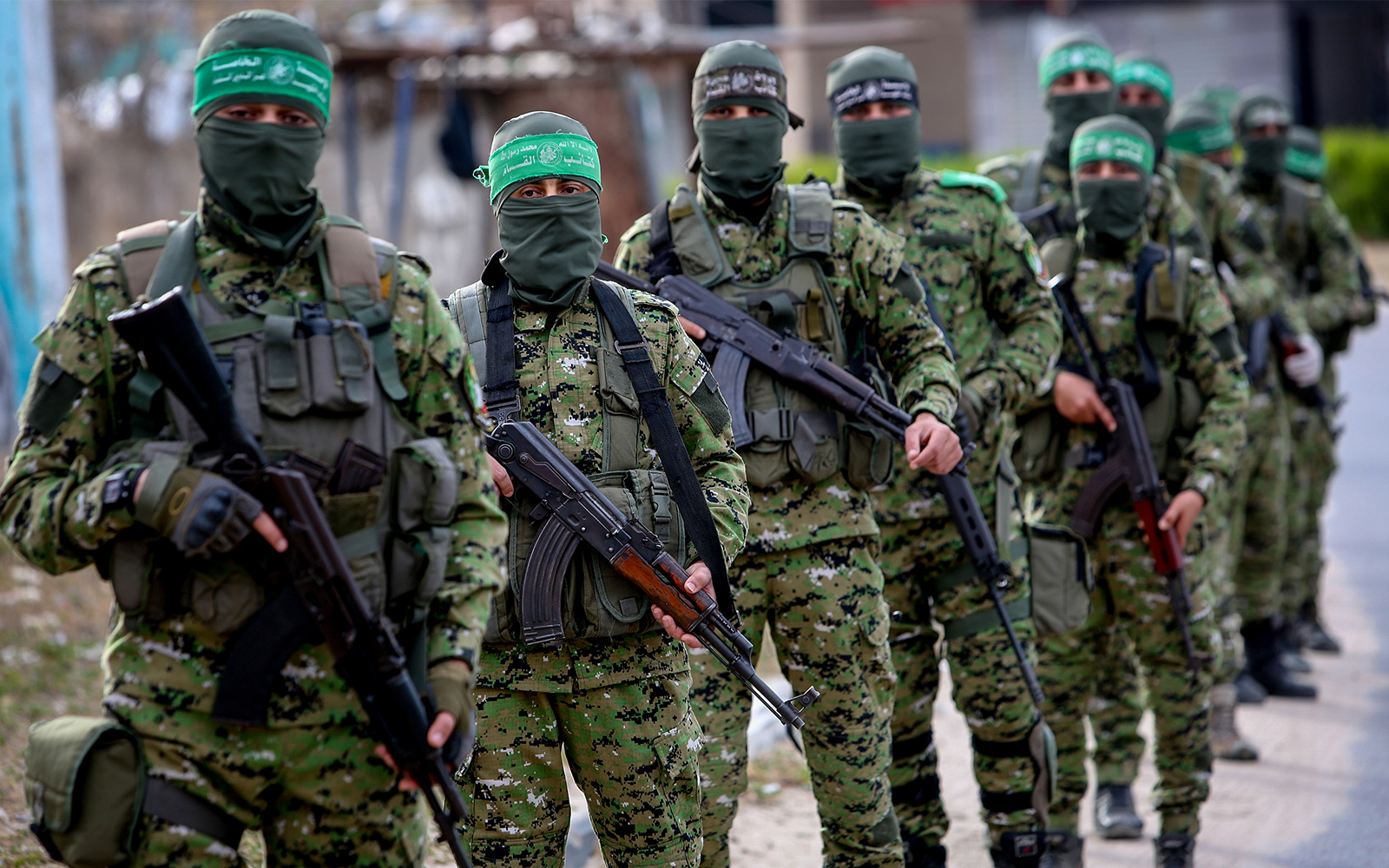
Today, Israel still faces a number of enemies hell bent on its total annihilation, including Hamas in Gaza, Hezbollah in Southern Lebanon, the Houthi in Yemen, Boko Haram in Nigeria, the Taliban in Afghanistan, ISIS/ISIL in Iraq and Syria,  Al Qaeda in Saudi Arabia, the Al-Nusrah Front in Syria, along with dozens of others scattered around the world.  

However, the most threatening is the Islamic Republic of Iran, a extremist state if there ever was one. The Islamic government has repeatedly vowed to "wipe Israel off the map" by any and every means possible, including nuclear, even if it meant its own total destruction.

Iran regularly underwrites, trains, and arms the majority of these terrorist groups, including Hamas and Hezbollah (they refer to the Israel and the United States as "Little Satan" and "Big Satan"). And while the people of Gaza are regularly sent billions in global aide (the U.S. alone has sent $5.2 billion dollars), much of it is sidetracked by Hamas which it uses for its own purposes.

How is Hamas able to do this you ask? Simple. Hamas is the elected government in Gaza. In 2006, Hamas won the Palestinian legislative election for Gaza and the West Bank. In 2007, they militarily defeated Fatah, a secular nationalist political party which once dominated the governing Palestine National Authority. Politically, Hamas controls 44.45% of the legislative seats while Fatah has 41.43% of the seats. The balance are a hodgepodge of various, mostly Marxist, socialist, or theocratic oriented parties.      

So, where does this leave us? The United States has been itching to get at Iran ever since the hostage crisis in 1979 when 52 Americans were held hostage for a year. Attempts by the Carter Administration to free them failed, and in one particular case, horrendously. The fact that Iranian aided terrorist groups also helped bring about the defeat of U.S. and coalition occupation forces in Afghanistan and Iraq as well as flustered U.S. plans in Syria hasn't helped the situation.

The U.S. sees the situation in Gaza as another attempt by Iran to spread its influence (especially at the expense of U.S. regional allies like Saudi Arabia) and encircle Israel. There's no question the U.S. will do whatever it can to destabilize the Islamic State or that our naval presence is, in truth, little more than bait with a B1 bomber attached.  Whether Iran takes the bait remains to be seen.

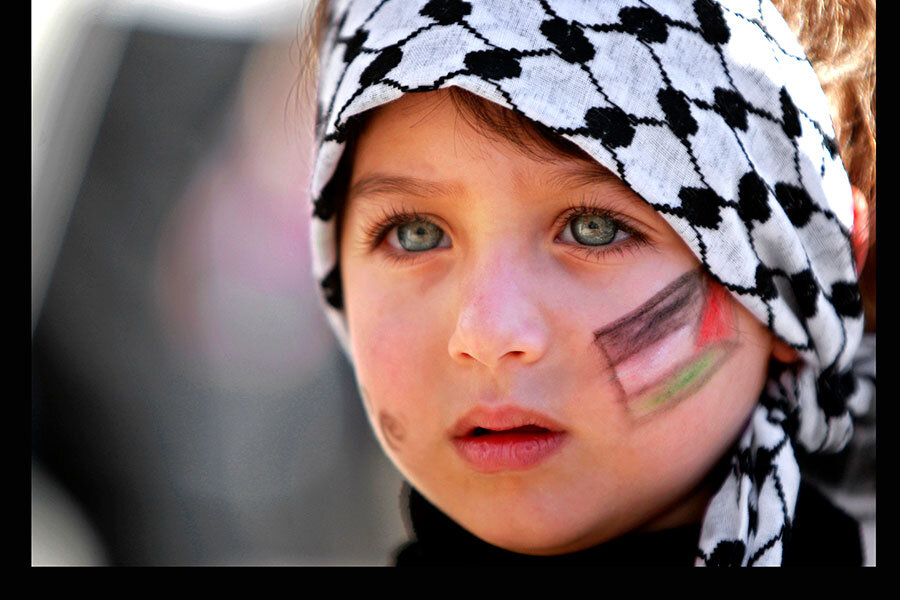
But what about the Palestinians? They been used for decades as global pawns for an agenda which no longer belongs to them, and what do they have to show for it?  Tens of thousands are dead, maimed, disabled with millions living a Diaspora, and despite rhetoric to the contrary, they live under the iron boot of a military state. It's poverty rate is 31.9% and a quarter of the population are unemployed.

Meanwhile, Hamas get rich on the misery of their own people. It has an investment portfolio, including real estate, valued at over $500 million and a military budget of $300 million. Yet more Palestinians will die due to starvation, lack of medicine and medical care, potable water, or disease than the war. Why? Many blame Israel, but what about Hamas? Surely by now the time has come to beat swords into plowshares. If not, then when?


If you enjoyed the article, please consider passing it along to others and don't forget to subscribe. It's free! Lastly please be sure to "like" us on whatever platform you use to read anotheropinionblog.com. It helps beat the algorithms and keeps our articles in circulation. Thank you!


Gaza War: US, British Marines 'Train for Action'; 2nd US Carrier Reported Near West of Cyprus


Total Causalities, Arab-Israeli Conflicts: 1860 - Present


Israeli Casualties of War


ODNI: Terrorists Groups


Gaza is plagued by poverty, but Hamas has no shortage ofcash. Where does it come from?


'Hell on earth': Israel unrest spotlights dire conditions in Gaza


International aid to Palestinians


Where Hamas gets its money and why it's so hard to stop, even as the U.S. steps up efforts


Monday, December 27, 2021

America's Dangerous Game: Russia, China, and the Economy

America is playing a dangerous game with Russia. At stake is America's hegemony. President Biden recently warned Russian President Vladimir Putin that any provocative actions with regard to the Ukraine could result in serious political, economic, and even military action by the United States and possibly NATO.

President Biden's warning came as a result of intelligence reports from American and foreign intelligence agencies  indicating that Russia may be planning to invade the Ukraine. The reason is the Ukraine's application and possible acceptance into NATO, which Putin finds as unacceptable.

Since the fall of the USSR, several of the former Warsaw Pact nations (which had provided Russia with a defensive buffer between Germany and the rest of Europe) has joined NATO, including Poland, the Baltic States of Estonia, Latvia, and Lithuania, the Czech and Slovak Republics, Romania, Hungary, and states comprising the former Yugoslavia. With Greece and Turkey already members, Russia is almost entirely encircled.

Many in the West has been encouraging closer connections with Ukraine, especially given its large agricultural basin as well as oil and gas reserves. It was those oil and gas reserves which some claim was the reason for the covert invasion of the Crimea by Russian troops in early March 2014 amid intelligence leaks of secret deals between the Ukrainian government and oil companies in the West.

Russia, on the other hand, denied that there had been an invasion and referred to their occupation as an "annexation" based on historical claims, which has historical merit. The Crimea has been part of the Russian Empire since 1783. It's main port, Sevastopol, on the Black Sea, has often been called "Russia's Norfolk" after the U.S. Naval installation in Norfolk Virginia, which is the world's largest naval facility. 

Sevastopol is home of Russia's Black Fleet Navy, various air wings, submarines, support ships, long range radar and communications facilities, and troops. The port provides the Black Fleet with all weather access to the Mediterranean Sea and the Atlantic through the Bosporus Straits. Of course, with Greece and Turkey as members of NATO, it also affords NATO with perfect advantage points to monitor all traffic going into and out of the Black Sea.

Russia's main concern, however, is the Ukraine and its pending application to join NATO. The U.S. and Western leaders have argued that as an independent country, the Ukraine has a legal right to join or leave any international association its chooses. While Russia doesn't argue the Ukraine's sovereign rights, it does view the installation of NATO troops, tanks, and especially missiles as being almost literally in its backyard, which they find to be totally unacceptable and a direct threat to Russia's security.

As some may remember, the Cuban Missile Crisis in 1962 resulted from a similar situation. At that time, the USSR had shipped and was installing intermediate range ballistic nuclear missiles in Castro's Cuba along with stationing medium range bombers in Cuba, provoking a serious crisis between Moscow and Washington. 

President John Kennedy, after confirming from air reconnaissance photos, demanded that Premier Khrushchev remove the missiles. Meanwhile, the U.S. deployed a military air and sea blockade (which Kennedy called a "quarantine") of Cuba and placing U.S. military forces at DEFON 2, which means war was imminent.  

The confrontation reached a peak as inbound Soviets ships carrying additional missiles, and escorted by a Soviet "Foxtrot" or fast attack submarine carrying nuclear torpedoes. On Khrushchev's orders, the ships turned around and returned to the USSR.  However, that was only the public side of the story.

Behind the scenes, both leaders (and the world) were concerned that the confrontation, if not quickly resolved, would result in a all out nuclear exchange between the two superpowers. The U.S. had previously helped stage the failed "Bay of Pigs" invasion of Cuba in conjunction with CIA trained Cuban exiles and Mafia money in order to oust Castro and his revolutionary government.

Castro had overthrown the corrupt dictator and U.S. puppet, Fulgencio Batista. Castro also nationalized 166 American own companies in retaliation of the abuse of local workers and land owners. Castro, who wasn't yet a Communist, had feared a possible American led invasion and had started warming up with the Soviet Union. Following the invasion's failure, Castro announced that he would become a Communist and sought an alliance with the USSR. If you're a tiny nation taking on a superpower, it's good to a have another superpower in your corner.

Khrushchev saw this as an opportunity to extend Soviet influence in the West just as the U.S. had done in the East. Meanwhile, the U.S. had stationed medium range Minuteman ballistic missiles, capable of carrying nuclear warheads, in Turkey along with listening installations. Khrushchev saw his placing of missiles in Cuba as a "tit-for-tat" move.

As a result, Kennedy secretly agreed to remove the missiles from Turkey in exchange for Khrushchev removing the missiles and bombers from Cuba, which outraged Castro, who was left out of the secret negotiations. Nevertheless, the listening installations in Turkey remained while the Soviets installed their own in Cuba, which were jointly operated by Soviet and Cuban troops. The situation with the Ukraine is similar.  If NATO deploys offenses weapons, we could have a similar showdown. However, it's unlikely Putin will blink.

Russia and the Ukraine have a long "history" between them dating back to the 10th century. Following the fall of the Czar in 1917 and Russia's subsequent revolution, a civil war erupted and spilled over into the Ukraine. By 1922, the Ukraine was the first of the Soviet Republics.

During WWII, the German military invaded the Soviet Union under "Operation Barbarossa".  Much of the Ukrainian population welcomed the invading Germans as liberators due to the harsh treatment received under Stalin. While the bemused Germans accepted their role as "liberators" from Stalin, the Ukrainians soon felt the full weight of the German boot.

Nevertheless, about 82,000  Ukrainians volunteered to join the German Wehrmacht as the 14th Waffen SS Grenadier Division. Meanwhile, many young Ukrainian women and children were brought back into the German Reich and integrated into the German society due to their "Aryan" appearance.

Following the end of the war, as many of these individuals as possible, including whoever could be rounded up from the Ukrainian SS Division, were returned to the USSR per Stalin's "request". Not surprisingly, most were shot outright while the others were sent to the Siberian gulags where they were worked to death in a penal system reminiscent of the Nazi concentration camps.  The Ukraine remained a uneasy part of the USSR until it's collapse in 1990. Obviously there's little love between the two.

America's haphazard withdrawal from Afghanistan in 2021 and failure to destroy the Taliban or ISIS, has done little to inspire confidence by her allies. Additionally, the 20 year war left America's military depleted and in serious need of retooling and replenishing. It also left the American military in short supply of personnel as many left the service as quickly as possible, not to mention turning some against the military and political establishment the way it had following Vietnam.

In the East, there is another dangerous situation with an increasingly aggressive China, where its leader, Xi Jinping, has been doing more than just saber rattling.  Chinese fishing fleets, accompanied by warships, have been challenging its neighbors over access to major fishing areas, including invading territorial waters. In addition, it has been having a cold stare down with India not just over territorial water rights, but also along India's northwestern border which has sometimes become hot.

China has felt confident enough to warned the U.S. and other nations to stay out of the South China Sea, which it now regards as its own (it's gone as far as to threaten military action against any ships entering South China Strait, including the U.S.). China has also stepped up its rhetoric against Taiwan and hinted that it may invade the island nation at any time.

Given America's dependence on Chinese imports, particularly technological, the U.S. might not fair to well. China, which has a previously secret unit (PLA 61398) dedicated to hacking and cyber attacks, has already made periodic cyber attacks on America's electrical and electronic grid with some success.

Lastly, China has formed closer alliances with some of America's enemies and "frenemies" like Iran, Pakistan, Afghanistan, and Iraq. It has also been on a buying spree of natural resources all over the planet, with huge Chinese run facilities popping up in Africa, the Middle East, and Latin America.

As a result, some of China's neighbors, fearful that they might not be able to depend on a fully capable America, have sought out alliances to protect territorial fishing rights as well as Taiwan's sovereignty. Those nations include Japan, South Korea (which may be attacked by the North if China invades Taiwan, using the latter's invasion as strategic cover), the Philippines, India, Australia, and Indonesia.

Then there's the Middle East. With the U.S. all but out of the picture and the "defeated" Taliban back in charge, ISIS, Al Qaeda, and other terrorists are back in business, and appear to be spreading outside the region into parts of Africa and even Latin America.

There has already been reports of suspected terrorists arrested trying to cross into the U.S.. Perhaps the scariest part of that is that they were doing so with the support of some of the drug cartels! Ruthless terrorist and ruthless drug dealers. A partnership made in Hell.

Finally, the dangerous situation at home. While Biden haphazardly tries to deal with the Covid Pandemic and the latest virus incarnation, Omicron, the economy continues to struggle. Employers are desperate for employees, who, for the most part, have stayed away due to government and employers mandates to get vaccinated. 

America's supply chain system is crippled, leaving ships by the hundreds unable to offload cargo or transportation hubs able to move badly need products to the stores. That, in turn, has left shelves sparse or bare just as inflation has slowly taken hold.

As if this wasn't bad enough, the Democrats and Republicans in Congress are still engaged in childish playground games stemming from the Trump Era instead of getting their heads out of their collective butts and dealing with the situation.

Meanwhile, states and cities are dealing with the aftermath of increasingly volatile weather, out of control crime, illegal immigration, a crumbling infrastructure, and growing social divisions egged on by the corporate media's 24/7 acidic news cycle.

This is what partisan politics has brought us. This is why Americans must put aside these manufactured differences created on behalf of the ruling Oligarchy. The only solution to these problems domestically are going to be those created by us, with or without Washington's cooperation. We need to solve our problems as much as possible locally without any regards to petty partisanship.

While the Ukraine has a right to join NATO, having a "right" doesn't mean it's the right thing to do. NATO can guarantee the Ukraine's sovereignty without putting missiles or hardware on its soil. In fact, with the range and destructive potential of missiles already deployed, there's really no practical reason. However, that doesn't eliminate the possibly of a covert third party sparking a conflict which must be prevented by all parties concerned.

I would even go as far as to say the same thing about the Baltic countries. However, if NATO does accept the Ukraine, then shouldn't Russia have every right to deploy troops and equivalent amount missiles in the Western Hemisphere as matter of self defense? How would we feel I wonder with tanks, troops, artillery, and missiles on our borders? Tit-for-tat. 

In the East, we need to match China with the same assertiveness, and encourage the creation of a NATO-like collection of nations to counter China. We must also accept that we are not the world's policeman or it's uncle with deep pockets, and whether we like it not, every country has a right to pick the government it wants, so we need to start butting out.

Domestically, we need to get our house in order. We need to get people back to work, repair our failing infrastructure and supply chain. We must stop depending on China and other countries for key technological components and develop them ourselves. Inflation has to be brought under control and quickly. Despite decades of broken promises, we desperately need energy independence.

Our election system is in critical need of overhaul. It's way beyond reforming. We need a firm "partisan proof" plan to end illegal immigration. We can't do any of these things while Washington and others play petty partisan games. Those days are long past.

If you want to know more, please take a look at the links below. If you enjoyed the article, please consider subscribing. It's free! Lastly please be sure to ""like" us on Facebook or whatever platform you use to read A/O. It helps with the algorithms and keeps our articles in circulation.


The Cuban Missile Crisis, October 1962


The Cuban Nationalization of US property in 1960: TheHistorical and Global Context


To Understand China's Aggressive Foreign Policy, Look At Its Domestic Policy


China's aggressive behavior on the global stage is an 'immense danger', says analyst


The Return of the Taliban


Saturday, August 12, 2017

An Old Fashion Show Down: Will Trump or Kim Blink First?

You know, I just don't get it. It makes absolutely no sense to me. What am I talking about? North Korea. Kim Jong Un. Donald Trump. Congress. For decades now, it seems that every time there is a new president, the North Korean government has to go and poke the bear as they say. They have to say or do something that's completely over the top just to gage a reaction. In the past, the North Koreans were simply content with making overtures about invading South Korea. They'd call up their military and conduct maneuvers near the border. They'd do flyovers into South Korean airspace and scurry back across. Every now and again, a tunnel will be found with its exit in some house or warehouse after conducting seismic scans based on noise detection monitors.

Apparently the entrance was in some North Korean building large enough to shelter a small advance force of maybe 100 or so individuals. Of course, they'd never actually catch anyone in one of these tunnels. These scans bounce sound waves into the ground. If what's below the surface hasn't been disturbed, the sound waves return with a solid wave image. However, if what's below the surface has been disturbed in some ways, the sound wave bounces back with a wider signal. This can not only confirm a disturbance under the surface, but also an approximate depth. By following along the path of the abnormality, a possible pattern may appear. This "pattern" or image can indicate that something is possibly amiss below the surface. That's when bulldozers, picks and shovel, and old fashion hard work and sweat comes into play. If there's something there, it's explored---allegedly up to the border with North Korea---mapped, and then destroyed. The Israelis have become experts at doing this. South Korea isn't too far behind.

However, more recently, North Korea's government has discovered a new way to annoy the US, Seoul, and their allies. For several decades now, North Korea has been "threatening" to develop nuclear weapons at just about every step of the way. At the same time, the West (and the US in particular) demand that research or whatever stage has been allegedly reached, stop. After the usual saber rattling by both sides, North Korea agrees to stop whatever its currently doing in exchange for massive amounts of crops, materials or billions in credit, which it can use for additional purchases, be it for agricultural products or technology. Meanwhile, it continues to received economic assistance China and Russia (assistance from Russia has been reduced since the collapse of the USSR). As just about any casual observer would likely note, North Korea's foreign policy is closely tied to its domestic economic policy which consists of pushing the West's buttons and using extortion to prop up its economy, and by extension, its government.

The latest move by North Korea's "dictator-in-short-pants", Kim Jong Un, has been to proclaim that its military has developed a few nuclear warheads along with a delivery system that's capable of delivering them. At first, Kim threatened South Korea as expected. When that failed to provide the desired reaction, a series of threats were leveled at Japan. Japan, as some of you may know, does not have any nukes of its own. In fact, Japan has the dubious distinction of being the only country to have been on the receiving end of a nuclear attack (which resulted in Japan's surrender and bringing World War II to an end). In addition, Japan does not have a military. Instead of its once mighty navy, it adopted a much smaller coastal defense naval force. In lieu of and despite a brilliant military tradition, Japan now has what passes for a home or national guard which act more in the capacity of safety monitor in the event of earthquakes, tsunami, or exceptionally large radiated reptiles and flying moth-like creatures.

Although that did stir up a hornets' nest with their historical enemy, that too didn't provoke the response Kim wanted. Besides, China was already challenging Japan for possession of several small islands and deep sea fishing areas which were also claimed by South Korea and the Philippines (which, apparently has decided that the best part of valor was to kiss up to the biggest bully on the block, which is China. Maybe they will throw some crumbs their way). So, what's a tin pan tyrant to do for attention? Well, apparently Kim decided that the best way to get the attention of the US, was to threaten the US itself, but not in a generic way as it had done in the past. Nope. No sir-ree! This time, instead of sending missiles in the direction of Japan or its nemesis, South Korea, Kim decided to send..not one...not two...but four Hwasong-12 missiles over Japanese airspace (where's Rodan when you need him? Oh well, there are still dozens of US bases throughout Japan) and have them splashdown near (18 to 24 miles) the island of Guam, which is a protectorate of the US as well as strategic navy base. What's more, these four missiles will (allegedly) be each tipped with a small nuclear warhead have a distance of 2,796 miles; well within range of Guam.

As an aside, Guam, which is the largest island in the Mariana Island chain at 210 square miles, was acquired from the Spanish in 1898 during the Spanish-American War. During WWII, it was attacked and captured by the Japanese just after the attacks on Pearl Harbor and the Philippines on December 8, 1941. It was finally liberated in July of 1944 (the Battle of Guam lasted from July 10, 1944 to August 10, 1944). Currently there is approximately 162,000 people on the island, included some 7000 Naval and Marine personnel, along with Air Force B52 bombers, fighter jets, and support personnel. Recently, the US Army added a long range missile defense system. This system , named "THAAD", stands for Terminal High Altitude Area Defense. THAAD is designed to shoot down all manner of short, intermediate, and long range ballistic missiles. Guam also is also home to four nuclear powered fast attack submarines and two submarine tenders.

From a military perspective, it's likely that any launch by North Korea toward US bases or allies would be shot down and crash harmlessly in the Pacific. In some ways, I can understand Kim. First, he's has seen how his grandfather, Kim ll Sung and father, Kim Jong ll, were able to manipulate the leaders of other nations simply by threatening to rekindle the war with its neighbor to the south. Most people don't realize that the Korean War is still technically still on. All of the nations involved signed a temporary cease fire in order to continue with peace talks. Over the years, this cease fire has become more or less accepted as a "peace", though the North clearly doesn't see it this way and hence its justification for its actions.

Since taking power following the death of his father, Kim Jong Un has continued with the same strategy, and it has largely worked to date, but that may be changing. In dealing with George W. Bush, and especially Barrack Obama, Kim has had little trouble getting what he wanted and in actuality, risking little. It seems that a little "saber rattling" combined with the offer of a nuclear scale back "carrot" was all it took to get the groceries he needed to prop up his regime for a bit longer. Now he has to deal with Trump, who considers himself a non-bluffing master of the "Art of the Deal". Besides, with the corporate controlled media routinely going after him, and members of his own party challenging him at every turn, Trump could use an opportunity to flex his muscles, especially when his predecessors usually failed when it came to North Korea "stick and carrot" foreign policy tactics.

If Kim thinks Trump will blink first like everyone else had, he's in for a rude surprise. In fact, it looks like Kim's best friends right now might just be the US media and members of the US Congress. Why? The corporate media sees Trump as a usurper; as someone who denied Hillary Clinton her coronation, and more importantly, as someone who wasn't properly vetted and would play the game. Trump is a true outsider and will act on his own (when Trump said "fire and fury" would descend on Kim, his National Security Adviser quipped to some in the media that Trump was not "pre-approved" to make that statement, which give you an idea as to how things happen in Washington and how the government actually functions now that we're an Oligarchy.

While Trump has refused to blink thus far, I suspect Kim is hoping that enough pressure can be brought to bear on Trump to persuade him to back down and simply payoff Kim as everyone else has done. But what if they don't? What if they fail and Trump stands his ground? I wonder what would happen then---would the military ignore his order? Would Congress seek to remove Trump from office on grounds that Trump is mentally unbalanced? There are already calls to impeach Trump, although he really hasn't done anything impeachable (besides, how could anyone serious want to impeach Trump while Hillary Clinton is still free? She is guilty of numerous felony crimes). Would Trump's key cabinet members all resign at the same time, creating a domestic crisis? Trump and several key Republicans aren't exactly friends such as John McCain, Mitch McConnell, or Paul Ryan.

There are a lot of possibilities to consider. What if his comments about Kim and North Korea are to be taken at face value? Given the Trump "hate-fest", the corporate media, and members of his own party as well as the Democratic Party and others have painted Trump into a corner. That's a place where "The Donald" does not perform particularly well (nor do most people, including yours truly). Thus, Trump can be expected to come out swinging. He has to. Trump has been harassed, berated, insulted and ignored from the get-go. He has been made to feel that he has no place in the White House; that he is a fluke or aberration. Others want him just to show up with his pre-written speeches, kiss some babies, and leave; let the professionals handling everything else (as McConnell implied just a few days ago).

Nevertheless, if Trump continues to be "The Donald", he will hit North Korea hard. As soon as a missile launch is detected, Seoul's military along with Japan's Self-Defense Force will be notified. At the same instant, US military senior command in both countries and Guam will go on immediate high alert. I suspect that senior operation commanders have been given pre-approval launch missile interceptors as soon as they've received confirmation of the launch and missile type, and verified that they are cleared of all population centers. Guam will also be put in high alert and scramble their fighters and readied their anti-missile system (the THAAD system mentioned above). My guess would be that they'd be engaged as soon as they've passed safely over Japan. Meanwhile, air traffic control would be rerouting commercial and private flights away from the area while commercial ships will be ordered away from the area. After the missiles are successfully intercepted and the threat is removed, what will Trump do next? That's the billion dollar question. Will he "lay waste" to North Korea? Maybe, but then there's China to consider. They has the largest military in the world and one of the most modern fleets and aircraft out there. In addition, it has a lot of missiles of their own, not to mention nukes. They are also close allies with North Korea, although of late that relationship seems a bit strained. Russia, while an ally, isn't especially close to Kim or Korea.

Recently, Vladimir Putin said the Kim is bluffing. They have no nukes. He claims that Kim is just putting on a show like he's done in the past, except that he has overreached this time. I think that if we strike first, China will come to Kim's aid. Russia may if it looks like Kim's government is about to fall. If Kim acts first, China will do what it did in 1954. They will intervene if US or its allies get too close to its border (During the Korean War, China repeatedly warned the US led coalition to stay well south of its border with North Korea. When the US failed to do so, China responded aggressively and overran all US and allied positions before withdrawing). Finally, there's one other factor that needs to be mentioned.

North Korea, along with China and Russia have military and economic packages with Pakistan and Iran. Pakistan is supposed to be an ally, don't forget that they protected Ben Laden and his cadre of leaders. The fact that we caught Pakistan in a case of betrayal and lies, they don't exactly like us much. In addition, Pakistan's military and to an extent, its government, are increasingly coming under the influence of strict Islamists. The situation with Iran really doesn't need any explanation. I think they would use the occasion to order its two proxies, Hezbollah in Lebanon and Hamas in Gaza, to attack Israel. How much support they get will depend heavily on whether Kim or Trump blinks first. I guess it comes down to who feels lucky.


Guam: America's military base in the western Pacific


North Korea threatens strike on Guam


Trump's Threat to North Korea Was Improvised


Wednesday, September 04, 2013

Staying Out of Syria


It's interesting that Obama said there was a "red line" in sand concerning the use of chemical weapons. If Syria's President Assad crossed it, there would be serious consequences (presumably military action). Well, chemical weapons were used, but there's been no consequences. Now Obama is claiming there never was a "red line" (he had made the statement at a press conference on August 19, 2013). The only red line he said on September 4th was actually set by the international community. Not because there was chemical weapons uses, but because it doesn't appear the Syrian government forces were the ones which used them. You will also note that Obama said Assad would face these consequences, wherever those happened to be, but he didn't say what he'd do if it was determined that the rebels were the ones who used them. Curious. I wonder why that is.

Here's what we know. Chemical weapons were used, killing some 1429 people, including 426 children. The gas impacted a neighborhood on the outskirts of Damascus recently recaptured by Syrian troops from the rebels. Most of those killed or affected were pro-government. Also killed, but not widely reported by US media, were government troops. Thus far, no known rebels are believed to be among the dead. Reverse trajectory would appear to indicate the sarin gas, was delivered by rockets from an area controlled by rebels soldiers. The Russians, who've long been supporters of the Assad regime, has sold the country most of its military hard and software, including sarin and mustard gas.

Russian scientists have examined the gas residue and indicated that while it appears to be sarin, it does not appear to be either the compounds manufactured by the Russians, nor does it appear to be weapons grade. In fact, it looked to be homemade. UN inspectors have not verified the statements of the Russians per se, but have indicated that it's quality didn't appear to be weapons grade. Even Turkey, which has never exactly been a friend of Syria and would love nothing more than an excuse to strike Assad, also has been unable to establish sufficient proof to act militarily. Even our old ally, Great Britain, has declined to approve a military strike. Only France at this point seems willing to join the US in a possible military operation.

Internationally, the White House is worried about Obama's image as a world leader given the current global economic summit in St. Petersburg. To that, I have to say there isn't anything to worry about, it's still in the preverbal dumpster where it's been since the Benghazi debacle and cover-up. After all, here's someone who received a Nobel "Peace Prize" for essentially doing nothing (and in the process, tarnished forever the one time prestigious award); who has lacked any backbone in dealing with our principal enemies or for that matter, in standing behind our allies. Obama has failed to develop any type of comprehensive US foreign policy. He so lacks the backing of the American People, that he has to govern by Executive Order. Not exactly a role model for democratic leadership.

The Senate Foreign Relations Committee voted on September 4th to approve a military strike by a margin of 10 to 7. Committee Chairman Robert Menendez (D-N.J.), along with ranking member Sen. Bob Corker (R-Tenn.) and Sens. Jeanne Shaheen (D-N.H.), Dick Durbin (D-Ill.), Barbara Boxer (D-Calif.), Ben Cardin (D-Md.), Chris Coons (D-Del.), John McCain (R-Ariz.), Jeff Flake (R-Ariz.) and Tim Kaine (D-Va.) voted in favor of the resolution. Sens. Rand Paul (R-Ky.), John Barrasso (R-Wyo.), James Risch (R-Idaho), Chris Murphy (D-Conn.), Tom Udall (D-N.M.), Marco Rubio (R-Fla.), and Ron Johnson (R-Wis.) voted against the authorization, while Sen. Ed Markey (D-Mass.) took the spineless way out by voting present.

American public opinion is largely opposed to any military strike, no matter how "narrow" or limited Obama promises it to be. According to a recent Reuters Poll, approximately 56% of Americans were not in favor of military action. According to an ABC /Washington Post poll, that number rises to 60% opposed. Congress, whose poll numbers hovers around the 14% mark, seems equally divided, knowing that the majority of the electorate are opposed while their largest purse holders---defense contractors, are pushing for a strike. The US military, interestingly enough, is also among those opposed to any type of punitive action against Syria. However, we being told that US intelligence, along with that of Germany and France (and Israel?), that there was some evidence approximately 3 to 5 days earlier that Syrian government troops were moving sarin stockpiles. But were they moving it to use or were they moving it away from forward rebels positions to avoid possible capture?

With US forces already over stretched, overcommitted, and facing possible budgetary cutbacks, could we see a possible munity by rank and file soldiers, sailors, and airmen? The Pentagon certainly doesn't appear happy with adding Syria to its "things to do" list, the generals and admirals will obey their orders, albeit with a lot of grumbling under their breath. As for the enlisted personnel, I have no doubt there will be individual grousing, I don't foresee any large scale refusal. Like soldiers, sailors, and airmen everywhere, they will do their jobs no matter their personal feelings.

So, in the final analysis, what does Assad or the rebels gain out of all this? First, Assad. Let's first agree to accept that while he's somewhat Western oriented, Assad's rule, like that of his father's, is that of a dictatorship, although Assad is much more benevolent as Middle Eastern strong men go (and certainly more so than his father). This war has been going on for about 5 years and shows no signs of abating anytime soon. While the tide of war seems to ebb and flow to each side, the government is weaker but not near a collapse. The economy has been severely affected as one might expect, but it's still functioning. Assad's military remains strong and well supplied; his general staff appear to remain loyal and he remains popular with a majority of the people. Internationally, he still has credibility.

Publically, Assad claims not to fear either the US or Western powers. Privately, he has to be nervous. So, what's gained by using sarin gas on the Syrian People? Assad would lose credibility internationally, which would likely have an impact on his standing (maintaining one's "face" is very important in the Middle East) by increasing international pressure to negotiate a settlement on less than favorable terms. It could have a negative effect on trade as countries suspend further trading as long as either him or his government remains in power. This too could affect his borrowing credentials with the World Bank or IMF. A military strike could hurt his short term ability to wage war (like hitting air fields). It could turn public opinion (and support) against him at home. What does Assad gain by using chemical weapons? Nothing really. Since this is a wide scale civil war, his use of sarin on one small block in the sprawling city of Damascus make no tactical or strategic sense. No key rebels leaders were killed. It would have no effect in shorting the war. In short, Assad stand to lose more than he'd gain. But what about the rebels?

The rebels don't seem to have a shortage of manpower. Islamic extremists have shown an impressive willingness to travel and engage in foreign military campaigns. Religion has always be a powerful weapon. However, as with most guerrilla operations, supplies are always short. The nice thing about "martyrs" is that they are usually cost effective since they use very little in the way of resources and have a high effect ratio. However, the worse enemy of any guerilla operation is time, which is always on the side of the government. As it drags on, the government will only grow stronger. Therefore, in a war that's become essentially stalemated, what do the rebels gain by using chemical weapons?

First, it inspires fear. Fear is always a powerful motivator in reducing opposition (though it usually results in few converts or additional supporters). Secondly, it telescopes a powerful message that nothing is off limits; that one is willing win at all costs and humanity means nothing. A secondary message can often be seen as one of desperation, and a desperate enemy is an especially dangerous enemy. It also is a low cost weapon in terms of costs vs. effectiveness, which is important if preserving resources is now a factor for some reason. Look at the use of mustard gas by the Germans toward the end of WWI for example.

If the delivery can be done in such as way as to make your opponent appear to be the perpetrator , you can gain international support while condemning your opponent in the world court of public opinion, and with that, gain greater access to resources ,including medical supplies, cash, credit, volunteers, and even more importantly, legitimacy. If you're lucky, you might provoke either direct or indirect military action from sympathetic nations acting under international law (which you reject anyway) . This could damage your opponent sufficiently to mount a strong reprisal. Coupled with international pressure, this could hamper your opponents ability to respond by force of arms (plus it could affect the fighting capability of your opponent psychologically through the "fear factor" of the weapon being used again be it on them or their families). It could also turn domestic opinion in your favor, which could, again, increase your military effectiveness. Lastly, if it was determined that you, in fact, were the one to use chemical weapons, your international credibility would decline, but it would likely remain strong (or actually increase) among the more extreme elements who now see you as totally committed to the cause. Secondly, the likelihood of determining who issued the order and/or facing a possible war crimes tribunal is slim at best. So, the downside is slight.

When added up together, the government almost always has the advantage in a straight on civil war. However, it faces the greatest prospect of defeat brought on from outside groups should the war become too brutal, or not fought within the confines of international law. Rebels groups, on the other hand, have the most to lose by engaging government troops on their terms, while actually facing little negative consequences by stepping outside basic rules of conduct, especially if they can transfer any blame.


U.S. public opposes Syria intervention as Obama press Congress
http://www.reuters.com/article/2013/09/03/us-syria-crisis-usa-idUSBRE97T0NB20130903

Six in 10 oppose US- Only Strike on Syria
http://www.langerresearch.com/uploads/1144a26Syria.pdf

How Syria's Neighbors View a Possible Military Strike
http://www.npr.org/blogs/parallels/2013/09/04/218860305/how-syrias-neighbors-view-a-possible-military-strike

Russia Say Study Suggest Syria Rebels Used Sarin
http://www.nytimes.com/2013/07/10/world/middleeast/russia-says-study-suggests-syria-rebels-used-sarin.html?_r=0

Russia Says it has evidence Syrian rebels used sarin gas
http://www.abc.net.au/news/2013-07-10/russia-says-it-has-evidence-syrian-rebels-used-sarin-gas/4810508

Turkey finds sarin gas in homes of Al Qaeda linked Syrian Islamists
http://patdollard.com/2013/09/flashback-turkey-finds-sarin-gas-in-homes-of-al-qaeda-linked-syrian-islamists/

Who really used sarin gas in Syria?
http://www.libertynewsonline.com/article_401_33852.php

Sunday, April 14, 2013

The Jong-Un on the Block: What will North Korea Do?

There's an old expression that the only difference between men and little boys is the price of their toys. Well, that seems to be true, at least in North Korea with Kim Jong Un playing with his adult sized model rockets. Yelp, the miniature tyrant wanna be is putting on an impressive temper tantrum by threatening South Korea, the United States, the various Pacific islands nations, especially Japan with nuclear oblivion (if only those darn rockets actually work this time).

Kim (which is his family name) is the son and grandson of North Korea's despotic dynasty which has lead the Stalinist nation since the Korean War and totally bankrupt the nation--economically, socially, and intellectually. In fact, North Korea has all but closed many of its universities and sent the students to the countryside to work in the fields. The rest have forced either into the North's massive, but largely antiquated military (although I have to say they march pretty and while we get to see nice shiny pieces of Chinese and Russian made hardware, what we don't see are rows of rusty and broken equipment). While the military seems to be well fed, the majority of the population is starving, so much so that the average North Korean is actually two inches shorter due to malnutrition than their Southern counterpart. The Northern population is still subject to mandatory cult like worship of the "great leader", complete with manufactured tears of adulation and hysteria bordering on psychotic the likes of which Stalin, Mussolini, Hirohito, and Hitler could only dream of (not to mention a few politicians in Washington and here locally I could think of). So, when with all the crocodile tears, what's all the hubbub about?

Well, there's several reasons for the current display of machismo. For instance, the "great leader" is untested. From what we know, he's well educated. He attended college under an alias and appeared to limited his contact with students, but those who knew him commented that while he appeared intelligent, he was obviously serious spoiled and used to getting his way. I would have therefore assume he grew something up like the sons of Saddam Hussein---arrogant, pampered, vain, and not used to being told "no". He has no military experience, so he has to prove himself as a military leader. By brazenly taunting their arch enemies---South Korea, Japan, and especially the US--Kim hopes to establish a reputation globally and especially at home as being someone who can command the world's attention and isn't to be trifled with.

It is highly doubtful the Kim will make any serious or even half hearted changed to North Korea's economy (if you still want to call it that), which brings me to my next point. Going back to at least Kim's father, threats have used to extort badly needed food, medicine, money in the form of loans (usually "forgiven"), and technology from the West. Their only international friend, China, has cut back economic ties with its kooky neighbor. Even the Russians seem to have little interest in propping up the Kim regime. So, will Kim order a nuclear strike on South Korea, the US, and even Japan, which he's declared to be his first target?

In a word, no. While Kim's military is formable in terms of numbers with 1.2 million under arms, it's not a military with long staying power. It would have to depend heavily on captured weapons, and especially ammunition captured from the South, which it could only do in a successful blitzkrieg style attack (note, South Korea's very capable military has uncovered and destroy numerous tunnels leading into the south over the years, which may give some inkling as to how the North would initiate an attack using it 120,000 man special ops units). The North's air force should more accurately be referred to as an air farce though it has a small but capable navy. Its armored units are aged and many are rusty or not operational. Yes, they do have missiles. Most are short to moderate range which may be able to hit places Guam (sorry Guam).

Can it launch nukes? Good question. The general consensus is "maybe". For years, most in the West thought the North was still years away from developing a nuclear bombs (they're saying the same thing about Iran), but some acknowledge that the North has enough fissionable material for as many as five small nukes with the destructive power as used on Nagasaki (sorry..again Japan). The big dollar question is whether they've developed a way to deliver it. My guess is that they have simply because so many "experts" in the West don't so (and say they say the same thing about Iran), and given their track record so far, I'm betting against the house. Now, they next key question is well they?

I think the answer here is much more clear. No they won't. Why? Well, Kim may be the new kid on the block, but I don't think he's stupid. A nuclear attack on anyone would result in massive retaliation and South Korea would become an island overnight. I'm sure Kim's generals and ranking officers would skip across the border to China, but would the Chinese want to harbor such war criminals? World pressure would be so enormous, they'd either have to give them up for a Nuremberg type trial with a Nuremburg type outcome (hanging in case you missed that particular history class) or shoot them their selves, and that would include Kim Jong Un, in the unlikely event he survived. I suspect one of his generals or other officers would likely put a cap in him long before then. As I said earlier, a conventional attack would be disastrous. The only real question is how far the South Koreans could push into the North before China would say "stop". A third option would be a pre-emptive strike by China. As I've said, China has had about enough of being North Korea's meal ticket and isn't about to risk facing nuclear fallout or an invading army near its border.

So, what does Kim expect to get out of this? What's the endgame? Actually, it's not that complicated. North Korea, as everyone knows, is stone cold broke. Even its facade as a military power is wearing thin as...well...its military. Therefore, with so little known about him, Kim is trying to create the image of a "wild and crazy guy" (with apologies to Steve Martin) with nothing to lose, which would go a long way with extorting the West and his Asian neighbors for desperately needed capital, medicine, technology and most of all, food. After all, it's been extortion that has kept North Korea afloat since the 1950's, so why stop now?

The solution, I think, would be to call his bluff. Go for it. It's always been the best way to deal with a bully, even a short fat bully with goofy haircut. One of three things is going to happen. The little snot is going jump and get the butt whooping he should have gotten as a child, which would free the North Koreans from decades of tyrannical abuse and solve China's problem as well the region's. Second, he'll shut up and be grateful for any more handouts he gets, which brings to the third and most interesting option. A coup. I'm sure the North Korean General Staff are a bright and politically savvy bunch, especially the Junior Staff who are patiently waiting their turn while privately hoping there will still be a North Korea and a North Korean military to lord over. The one way to make sure that happens, is to end this comedic farce once and for all and then set about to rebuild the North and bring it back into the community of nations. That would call for a true "great leader".


North Korean Military "Very Credible Conventional Force"
http://www.defense.gov/News/NewsArticle.aspx?ID=27769

North Korean Army Tanks
http://www.militaryfactory.com/armor/north-korean-army.asp

South Korean Military Strength
http://www.globalfirepower.com/country-military-strength-detail.asp?country_id=South-Korea

North Korean Army Split over Kim Jong-un
http://planet.infowars.com/worldnews/north-korean-army-split-over-kim-jong-un