Showing posts with label workers. Show all posts

Friday, August 30, 2024

Labor Day: A Day for the American Worker


Labor Day was established in 1894 and signed into law by president Grover Cleveland  to make the first Monday of each September a federal day set aside to celebrate the efforts of organized labor and the gains---financial and social--- it has made on behalf of all workers, union and non-union.

I guess I've always tended to support unions, employee owned workplaces. and employee initiatives. From the time I got out of the Navy in 1979 to when I retired at the ripe old age of 55 in 2013, I've worked for several non-union companies. Most were decent, but some seriously "used and abused" their employees and left much to be desired. This resulted in a lot of employee turnovers, sloppy work, very low morale, hostile outbursts, and some unnecessary tense work conditions.

In every place I worked, I was asked by fellow employees to be the employee representative. I'm not sure why I was repeatedly chosen. Maybe they thought I'd be fair and balanced or perhaps it was because I wasn't bashful about challenging authority figures! Regardless, I was always honored by the trust and confidence my fellow employees had in me to take on the role of employee/management liaison.

My last position before retiring was that of "Special Coordinator to the President for Special Projects". Basically this was a assistant vice president position which functioned similar to my previous roles as a employee/management liaison. I was to provide a comprehensive report to the company president and the Regional Vice President along with recommendations for the improvement of company morale and productivity (in addition to my role as Senior Legal Manager, where I oversaw around 30 contract attorneys and managed a receivables portfolio of some $15 million dollars).

In addition to serving on several non-profit boards, I was appointed state chairperson of a national writers union (NWU 1918) where I served for 11 years. I handled state based issues and served on the local labor council. I was elected as the National Vice Chairperson of the At Large Chapter and served on several national committees. I also liaised with several worker oriented organizations.

Did you know organized labor has been chiefly responsible for establishing the 40 hour work week, health and other benefits, paid vacations and personal time, job safety (resulting in the creation of OSHA), an end to child labor (children as young as 8 years old were often working in mines),  fiscal accountability of hours worked and wages earned? They promoted Social Security, unemployment insurance and worker's compensation for work related injuries.

Equality and fairness in the workplace has always been a historically important union issue. Unions backed social causes like the Women's Suffrage Movement, Civil Rights, and the Chicano Movement of migrant farm workers and sharecroppers for fair wages, not to mention the Family Medical Leave Act,  and the Uniformed Services Employment and Reemployment Rights Act (USERRA) which guaranteed returning military personal their old job back or paid training for a similar job in the event their earlier job or place of employment was gone. But these gains didn't come easy. They opposed President Clinton's "NAFTA", which was a disaster for American industries and blue collar workers.

It's estimated that at least 1100 individuals died fighting for worker rights (many murdered by "enforcers" hired by company bosses). Thousands more were injured. Some badly. Others permanently. Companies used every form of intimidation imaginable, from reducing hours for hourly employees (or overloading them with hours and no breaks or rest time), ostracizing employees (and anyone who associated with them) to outright firing them. A lot of blood was spilled for these "concessions".

Since the advent of the modern Industrial Age, countless workers, mostly women, worked for low wages in the textile industry, often in hot and unsafe conditions. Many were maimed or killed. With no daycare, the women often brought their children with them, tucking infants and small children under chairs or beside their machines. Not surprisingly injuries or some other mishap wasn't uncommon among the children, such as lung disease, hearing loss, or the loss of a finger.

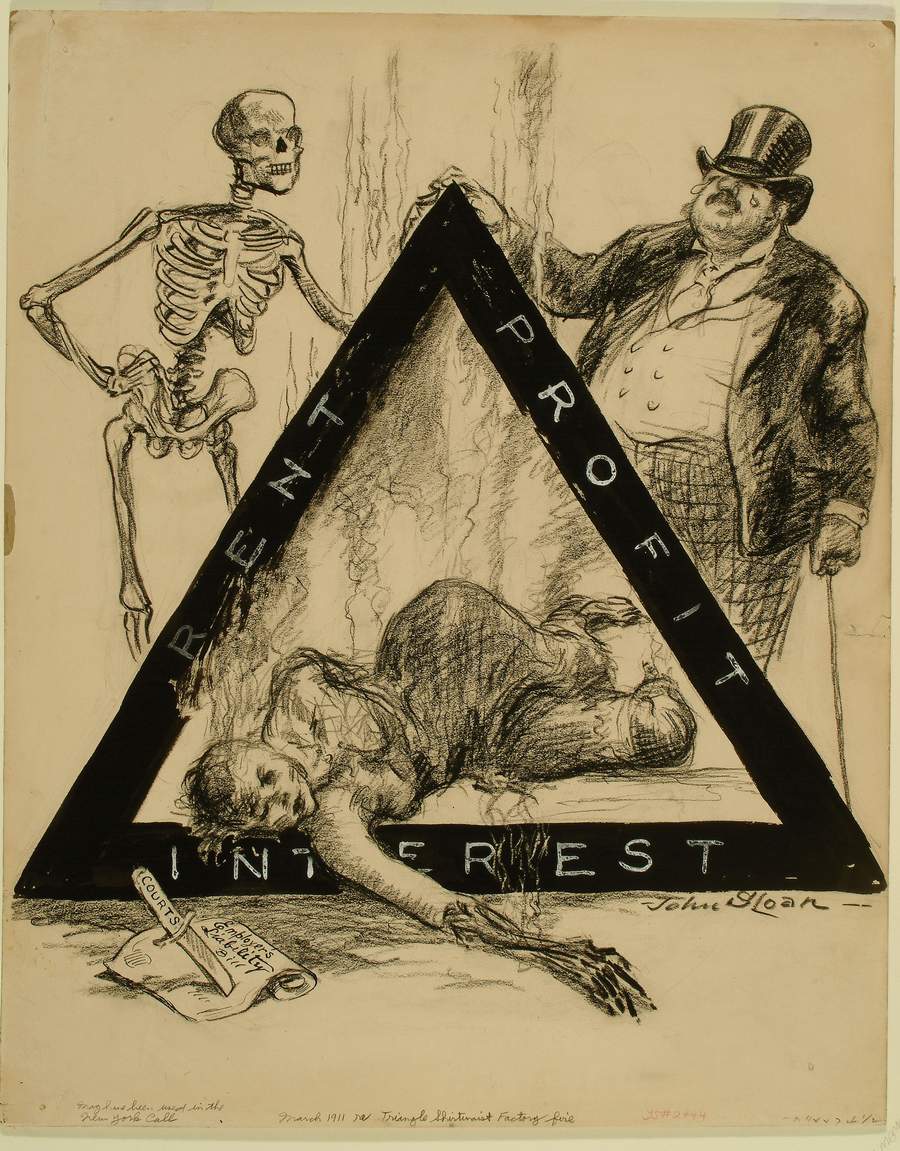
In 1911, some 600,individuals, mostly women, were working at the Triangle Garment Company, owned by Max Blanck and Isaac Harris, and located in the Greenwich Village district of Manhattan. The company occupied the top three floors of the ten storied Asch Building (now the "Brown Building"). For the time, the building was often billed as being "fireproof" (like the unsinkable Titanic in 1912 I guess).

The women, mostly young and recent Jewish and Italian immigrants, were engaged in manufacturing of women's blouses, an industry declining in popularity. The women worked 9 hours a day and earned between $7 and $12 a week conditions were stifling.  Windows were often kept shut and typically management required all doors to be closed and locked from the outside (a supervisor had the key).

On the late afternoon of March 25th, a fire mysteriously broke out in a rag bin and quickly spread. As all the doors were locked from the outside, the only options were burning alive, smoke inhalation, or jumping out the windows to certain death. Many chose the latter. 146 individuals---123 women and 23 men---perished in what was one of the worst disaster in the history of the garment industry.

Although sued by family members, with no safety regulations, the two owners were found innocent. Meanwhile, their insurance company paid Harris and Blanck $60,000 for the loss of their business. That equates to $75 per life lost, of which the families never saw a dime (it was never determined if the fire was accidental or not, but it's worth noting that the two owners had been found guilty on four occasions previously of insurance fraud by arson). OSHA would not be founded for another 60 years when, after intense union pressure, it was signed into law by then President Richard Nixon.

In company owned towns (which were common in and around mines and lumber mills) reprisals for union organizing may include refusal of service at company owned grocery stores (workers weren't paid in U.S. currency, but in company script which was worthless anywhere else), evictions from company owned housing, the rape of wives and daughters, expelling their children from company run schools, and verbal condemnation at company approved churches (attendance was often mandatory). If the "problem" couldn't be resolved "in-house", the company would often employ "other measures".

"Other measures" often took the form of militias or recruited vigilantes, private security companies (like the Pinkertons), hiring  (aka bribing) local cops to break up protests as brutally as possible. If that failed, company presidents would use their influence to get the governor (who was usually in their back pocket anyway) to call out the National Guard and "restore order" and detain ring leaders.
Since many of the workers were Black, German, Irish, Scots, Welsh, Jewish, Asian (predominantly Chinese) or Italian, there was no shortage of hate groups willing to inflict as much violence as possible and get paid for it! Arson or the use of dynamite were often employed as "tools of anti-union trade" and when those tactics didn't work, it sometimes came down to cold blooded murder.

The result was decades of bloody "wars" between companies and their employees from the steel mills of Pittsburgh, the docks of New York, the  coal mines and hollows of Appalachia, and the automobile factories of the Northeast. Ultimately, the workers won, at least in the short term.

Unions were finally officially recognized thanks to the passage of "National Labor Relations Act of 1935"  (aka "The Wagner Act") on the heels of the Great Depression and signed into by President Franklin D. Roosevelt.  FDR was perhaps the most labor friendly president in our country's history.      

His long time friends and opponents, mainly on Wall Street, often called him a "traitor to his class", and perhaps he was. The aim of the "Wagner Act" was to mediate differences between labor and management in order to prevent strikes and work stoppages which weaken an already struggling economy. But the fighting between workers and owners needed to stop for the sake of the nation's economic health (ultimately is wasn't the recognition of unions which saved the economy, but World War II).  

Eventually Big Business was able to claw back many of their concessions. There was no way they were going to allow the political clout of organized labor to stand. In 1949, with bipartisan support, the 80th Congress went over President Harry Truman's head and enacted the "Taft-Hartley Act".  

The act restricted many of Labor's actions against employers, specifically  wildcat strikes, political strikes, solidarity strikes and secondary boycotts. It prohibited discrimination against  non-union members, and additional rights such the right to vote out a union and the right of companies to vote on a union's demands, but it didn't stop there.

In 1959, Congress enacted the Landrum-Griffith Act which was made law with President Dwight Eisenhower's signature.  Also known as the "Labor Management Reporting and Disclosure Act", the law was primarily geared to protect union members from any corrupt activities of union officials may be engaged in. This was the era of organized crime's takeover of a number of unions, notably the "big four",  the International Longshoremen, the International Brotherhood of Teamsters, Laborers International of North America, and Hotel Employees and Restaurant Employees International. 

It made union participation or involvement in racketeering, bribery, extortion, misuse of union funds, intimidation of workers illegal. Anyone found guilty could be removed from their union position and race fines or even jail time. It also created a "Bill of Rights" for union members (which was later extended to include non-union employees as well). 

It should bear mentioning that the Landrum-Griffith Act was passed during the era of "McCarthyism",  "the red Scare", and the "Cold War". The importance of this and how it relates to unions is that many of the early union leaders admitted to being socialist or Communist. Perhaps the best known of these was Robert Le Follett, A. Phillip Randolph, Mary Harris "Mother" Jones,  Eugene Debbs and Samuel Gompers.

Some of the unions which had a large socialist or Communist membership included the CIO and AFL, the UAW, International Union of Electrical Workers,  International Workers of the World ("Wobbles"), the Transport Workers Union, the Longshoremen, and the United Steelworkers.
In addition, many of the laws passed in the 1930's like Social Security, unemployment, the right to unionize and strike were all labeled as "anti-American", "socialist" and "Communist". Nevertheless, most of these laws are not just still with us, but have become institutionalized as a "national right".

Unions are said to have created the middle class, which may very well be true, but it's not been all wine and roses. I voluntarily joined the NWU. I wasn't coerced into joining. It offered me an advantage and I felt I had something I could offer the union. I was honored to have been the liaison on behalf of my fellow employees for 34 years. We accomplished a great deal for ourselves and the company's bottom line. Lastly, while I support unions and the right to organize and bargain for better pay and work conditions, I also believe in free choice and not being compelled into joining any organization.

However, those individuals who decline to join should not expect to receive all of the benefits that their fellow union employees do. That's the trade off. It's called personal responsibility. For me, it's just that "something" about being told I "must" do or participate in something without being given a choice that irks me to the core. I bet no one is surprised to read that! We also have to remember the years of corruption and crime which has smeared the reputation of organized labor, perhaps forever. 

Finally, unions refuse to think outside of the box, or to be more accurate, outside of the hip pocket of  the Democratic Party which, like the Republicans, greedily serves Wall Street. Union leadership has consistently failed to protect the best interests of its members by not making the major parties or candidates compete for its support. Labor must look elsewhere, even if it means forming it's own political party (we're the only industrial nation without a Labor party) or face eventual extinction.  

So, that's a brief history of Labor Day and why you get a three day weekend marking the last "official" holiday of the Summer, but remember the high price others paid for you to have that one extra day off.


 If you enjoyed the article, please consider passing it along to others and don't forget to subscribe. It's free! Lastly please be sure to "like" us on whatever platform you use to read anotheropinionblog.com. It helps beat the algorithms and keeps our articles in circulation. Thank you!


The Haymarket Affair


Lists of worker deaths in United States labor disputes


No union mines left in Kentucky, where labor wars once waged


Union busting


History of union busting in the United States


Triangle Shirtwaist Factory Fire


USERRA: A Guide to the Uniformed Employment or ReemploymentAct


What Is The Taft-Hartley Act?


1959 Landrum-Griffin Act


Communist Party USA and the American labor movement (1919 -1937)


Communist Party USA and the American labor movement (1937 -1950)


Saturday, June 11, 2022

The Great Resignation: Lots of Jobs But No Takers


Recently, while on my way home from an appointment a few days ago, I came to one of those innumerable stoplights. As I waited patiently for the light to turn green, I noticed a weathered looking man who appeared be in his 50's. His clothes were worn. Dusty but not ratty. His shirt was the cleanest part of his appearance, but it too had seen better days. His look suggested someone who hadn't seen a shower in several days, but he didn't look like he had missed many meals or happy hours.

What caught my eye was the cardboard sign he was holding---"Veteran Down on Luck. Anything Would Help". A few motorists handed him what appeared to be spare change; perhaps a dollar or two found their way into his dirt stained pockets. I felt a bit sorry for him. After all, I'm a disabled veteran, and the "but for the Grace of God" and all that. Yet, I couldn't help but wonder why he wasn't able to find a job. It seems everywhere I turn I see "Help Wanted" signs (he was actually standing a few feet from one).  

In speaking with store managers and employees, I hear the same, now well worn story about no one wanting to work. Those hired stop showing up after a few days or quit the same day. Several employers have doubled or even quadrupled their starting hourly salary. Some are even offering prospective employees same day pay! Never did I think there would be such a demand for workers. Employers are literally begging for employees.

In the interim, partially stocked shelves have become the norm. Not enough stockers, and those who will work, do so during business hours, meaning that finding what you're looking for is as much catch as catch can than not, especially in drug or grocery stores. Some businesses are closing early or not open during times which would have been their busiest. They can't do that for long and stay in business.

Strangely, as I sit there at the light, patiently waiting for it to turn green, I hear the latest news on the radio tell me about high unemployment. It doesn't make sense. How can we have high unemployment when every business is desperate for employees. What gives?

The U.S. economy had been chugging along nicely for several years under Trump. Unemployment had dropped to around 3.5%. The GDP was 2.5%, production was up, no inflation. Then came Covid-19 and everything changed. Covid inspired fear not just in America, but throughout the world. The media played it up like it was the second coming of Black Plague which had nearly wiped out 2/3 of Medieval Europe or the Spanish Flu which added a deadly punctuation mark to end of WWI with over 50 million dead worldwide.

We were urged to home quarantine. We were paternally warned not to venture outside unless it was an emergency, such as a trip to the doctor or hospital.  Elsewhere, run to the grocery store were only for the healthiest of us to go and only if we wore masks and used sanitizer whenever we touched something.  It was as if the world had become toxic. I half expected needing a note from the mayor.

We had daily "infection rate and death counts" on television which seem like a macabre infomercial. We were prohibited to visit anyone admitted to the hospital, or  worse yet, from being with friends and loved ones as they struggled to breath their last. Even the dead weren't immune from the isolation being imposed on us. Then the shortages came.

The quarantine imposed by government covered all but the most essential of workers, who, ironically, were the lowly hourly workers that most everyone ignores. There were shortages of nearly everything. The result of a badly fractured supply chain, missing workers, and made all the more worse by hoarders (there will be a special place in Hell waiting for them by the bottled water section).  Walking around in the frozen food aisle amusingly made me think of "The Andromeda Strain" for some reason.

Employees were ordered home. Some took their work with them and at least earned a paycheck. Most didn't get anything but unemployment. Thankfully, the government came to the rescue right on queue with multiple "tax free" stimulus checks. However, "free money" is never free.  Schools closed long enough for departments of education to find ways for students to study from home, enabling schools systems to collected their tax dollars and keeping teacher unions happy.

The government mass produced  not just one, but three main vaccines. This would normally take years, if not decades, to develop, test and get FDA approval, but they did it in a matter of months! No wonder some were hesitant. People waited in line for hours to "get the jab". Businesses, hospitals, and doctors began demanding proof of your vaccination before allowing your admittance. It was all surreal like some dystopian Sci-Fi movie...or Nazi Germany.  Ihre Unterlagen bitte! ("your documentation please!").

If you had any faith in the compassion of your community, it was surely put to the test by then. But like everything in life, Covid has all but passed. I think we're on booster shot #6 now. Sporadic shortages remained, and America was left more divided than before. The shortages have forced prices upward while employees, who were furloughed during the pandemic or who worked from home, didn't seem all that anxious to rush back to their cubicles.  Thus began what has been called "The Great Resignation".

While Covid eventually passed from page one, and life generally returned to normal, one key component was missing. The workers. The government had selectively forced businesses to close but not others. Only the smaller "mom and pop" and local businesses closed while the government allowed the big mega stores to remain open. Couldn't have anything to do with their political clout could it?

The result was fewer businesses to return to, reminiscent of the years immediately following the Great Depression. It also, by implication, meant that there should have been more workers available for a limited number of jobs. Simple economics dictates that higher demand for fewer jobs should result in lower wages and a reduction of benefits. Somehow, that didn't happen, but why?

Of the estimated 8.4 million who were technically "unemployed", there still remained 10 million job vacancies. That didn't include those who were underemployed, overqualified for the job they had, or who were employed but quietly looking to switch jobs, or had simply dropped off.  Prior to Covid, there was little choice when it came to having a job and paying the bills. That all changed.

Between 2021, just as things started easing back to normal, and now, we reached a 20 year high in the number of people who quit their jobs. 63% of those who walked away from their jobs cited low pay as the primary reason.  As an aside, did you know that if the minimum wage had been tied to the rate of productivity (how much income someone generates in an hour), the minimum wage would currently be $26.00 by now?

Another 63% indicated a lack of opportunities to advance. 57% said they felt "disrespected" at work or unappreciated by their bosses and fellow employees. Ironically, more women quit than men. 20% compared to 18%. When it came to race, 24% were Hispanic and Asian. 18% were black while 17% were whites. The majority, 22%, had no more than a high school education. 24% were low income. 18% were middle income. Finally, there was evidence of worker blowback and all it took was a pandemic.   

Prior to Covid, most people felt they had little hope of being able to do much about their employment situation. Namely, try to find another job (which may be just as bad or worse than the one they have, even if the pay was slightly better), try to improve their educational status part time or quitting and going full time (45% said they had no or little say in choosing their hours, which made returning to school a tough choice). Either way meant more debt and added stress.

48% quit over childcare issues, stating their employer was unwilling or unable to work with them and forcing them into a no-win choice. Interestingly, 18% said they quit because their employer required they provide proof of a Covid vaccine, which remains a contentious issue with conservatives.

Meanwhile, a large segment decided to cash out of their investments, such as their 401k, stocks, and savings accounts to prolong their protest. Some opted to sell their homes for rental property in order to avoid rising property and other taxes. Others lived off credit cards which were soon maxed out. Those able to moved back home with their parents or other relatives, while some consolidated their living accommodations into defacto dorms. A few turned to existing government programs and charities to help with clothing, rent, medical care, or food.

But perhaps it was the fear that the government and media so skillfully implanted in people's mind which changed their priorities. Polling would seem to indicate it was. In recent polls, many stated they had used their time off to rethink what they wanted out of a job, especially those in the service industry who had been demanding higher wages and better working conditions pre-Covid.

However, the trouble with their demands  is that many, if not most of these jobs were never intended to be long term. They were meant to be part time and temporary jobs for those just getting started in the job market or students picking up some extra cash. Entry requirements were fairly basic with the emphasis being primarily on reliability, good people skills, and a willingness to follow direction.

But with the declining academic performance of high school graduates, an increase in dropout rates, and rise in the number of single parents with no work experience needing a job, that all changed starting in the 1970's. Unable to secure higher paying jobs, many turned to minimum wage entry level jobs as family sustainable jobs. These often required longer shifts and/or multiple jobs to make ends meet. Workers began to demand middle class pay and benefits for what were entry level employment.

To accomplish that, employers would have to double or triple their prices, which would drive off customers. But with an abundance of pre-Covid  applicants, why bother? Now that pool of applicants (as well as existing employees) were gone, employers saw no choice. The result was higher wages and better benefits for workers, but also a cutback in  hours, early closures, and  existing employees doing more.  For some employers, that wasn't a solution.

Some companies turned to automation to remove their dependence on these temperamental workers. However, their capitalist mindset dictated passing the cost of automation on to their customers. Higher prices means less demand. Less demand means fewer employees doing more. So merry-go-round turns.

The pandemic has changed the face of the economy. It enticed older workers, mainly baby boomers, to hang it up earlier than planned, leaving Millennials to pick up the slack and opening the door for the emerging Gen Z workforce; many of whom just graduated from high school.

Initially they'll have plenty of jobs to choose from, but with rising prices, fewer of small businesses (which have historically been the economic backbone of America), and increased automation, they'll need to get some diverse experience under their belts as quickly as possible. Post-Covid years will surely be remembered as the Age of Diminished Realizations.

The pandemic also, for better or worse, resulted in a selloff of homes for apartments or condos. Some have moved downtown for convenience sake, assuming downtown is safe and can provide the necessities they need like grocery stores, pharmacies, and good schools for their kids, and adequate shopping and entertainment.  Others have opted for smaller communities for similar reasons.

But what will happen as those who cashed out of society begin to run out of money, as surely many are by now? Having exhausted their private safety nets, they have little if anything to fall back on. Federal Covid relief is a thing of the past. Most states have long since cut off unemployment benefits beyond just a few weeks given the abundance of available jobs. But those jobs will soon vanish as the recession and rising prices takes hold. Then what?  Already 11.4% of Americans live in poverty. When combined with those who live near the poverty line, that figure jumps up to 32% or one in three Americans.

Prices are already shooting up at unprecedented rate. Gas, utility, and food prices are quickly outstripping income, especially for those on fixed incomes. Our usual political infighting and bungling isn't helping.  The system has intentionally been broken in favor of the 1%. Reform won't cut it. How much longer will we tolerate this? How much longer can we tolerate this?

Oh, that panhandler I mentioned at the beginning? In several polls, many panhandlers admitted that they could make as much or more money standing on a corner begging money than working most entry level jobs. Incidentally, many panhandlers work in teams, giving each other breaks, looking after each other's stuff, and splitting their earnings. Has this the image of the new American entrepreneur? 


If you want to know more, please take a look at the links below. If you enjoyed the article, please consider passing it along to others and don't forget to subscribe. It's free! Lastly please be sure to "like" us on whatever platform you use to read A/O. It helps with the algorithms and keeps our articles in circulation. Thank you!  


Majority of workers who quit a job in 201 cite low pay, noopportunities for advancement, feeling disrespected


Minimum wage would be $26 dollars an hour if it had grown inline with productivity


These two demographic trends are driving the 'Help Wanted' inside so many business windows


'Help Wanted' signs indicate lack of decent job offers, not people unwilling to work


13 reasons that help explain labor shortage


'Help Wanted' signs are everywhere. Where did all the workers go?


Does half of the U.S. live "in or near" poverty?


Wednesday, July 08, 2009

Employee Free Choice Act---The Pope Says So!

Here's an interesting article I came across on the AFL-CIO News Blog site. A few weeks ago, a coalition of Philadelphia-area rabbis and rabbinical students, along with the Philadelphia Jewish Labor Commitee, called on the former Republican and current Democrat Arlen Spector to support the EFCA. Now comes the Pope! Enjoy the article.

Papal Encyclical: Workers’ Rights to Form Unions Must Be Honored
Posted By Seth Michaels On July 8, 2009 @ 9:55 am In Legislation & Politics

In a new [1] encyclical released yesterday by Pope Benedict XVI, the leader of the Catholic Church discusses the challenges of a global economy. He notes that workers’ ability to form a union and bargain is at risk and makes it clear it’s a matter of moral imperative to preserve that freedom.

Here’s what the pope has to say on the need for workers to have the freedom to form unions:
Through the combination of social and economic change, trade union organizations experience greater difficulty in carrying out their task of representing the interests of workers, partly because Governments, for reasons of economic utility, often limit the freedom or the negotiating capacity of labor unions. Hence traditional networks of solidarity have more and more obstacles to overcome. The repeated calls issued within the Church’s social doctrine, beginning with Rerum Novarum, for the promotion of workers’ associations that can defend their rights must therefore be honored today even more than in the past, as a prompt and far-sighted response to the urgent need for new forms of cooperation at the international level, as well as the local level.

The [2] Vatican and a wide variety of Catholic leaders have continued to express support throughout the year for workers’ freedom to form unions, and many Catholic [3] scholars and organizations like the [4] Catholic Labor Network and [5] Catholics for Working Families have come out in support of the [6] Employee Free Choice Act.

Article printed from AFL-CIO NOW BLOG: http://blog.aflcio.org
URL to article: http://blog.aflcio.org/2009/07/08/papal-encyclical-workers-rights-to-form-unions-must-be-honored/


Homes Still Cost Too Much
By John F. Wasik,
Author of Cul-de-Sac Syndrome: Turning Around the Unsustainable American Dream

You would think with home prices still dropping like hailstones in most areas, that homes would be bargains.

The present buyer's market obscures a key fact about the housing crisis though: millions sought the refuge of cheap credit, subprime and adjustable loans during the boom because they were the easiest routes to homeownership in a time when house prices far outpaced income growth.

The sad fact is that the Great American Dream is still out of reach for far too many and it was the declining affordability of decent houses that was one of the triggers of the housing bust.

It's not that home prices haven't plummeted as banks unload foreclosed homes at fire-sale prices. The national median home price fell to $169,000 in the first quarter, according to the National Association of Realtors. Bank-owned properties are selling at 20-percent to 50-percent discounts.

"Contrary to popular belief," says Jeffrey Lubell, executive director of the Center for Housing Policy, "the recent decline in home prices has not resolved the nation's housing affordability problem."

Homes cost too much even before the bubble, so home buyers were willing to do anything to get into the domicile of their dreams. After all, homeownership is an American birthright, or at least that promise was sold to Americans starting in 1946. "Buy as much house as you can afford!" That's what the bankers and real estate agents were telling us for generations because of generous tax breaks and easy, often government-guaranteed financing.

Unfortunately the cost of land, homebuilding, taxes and homeownership far exceed what millions of households are able to cover with nearly stagnant personal income growth in this century. Inflation simply ate away at wages that just weren't enough to pay ever-rising bills for property taxes, maintenance, health care, education and energy.

Even at the height of the boom, Harvard researchers at their Joint Center for Housing Studies found that almost 18 million households were paying more than half of their incomes for housing (about one-third is considered reasonable). They were also hit hard by rising energy costs, which rose twice as fast as total spending from 2004-2006.

That wasn't always the best advice. The Harvard group last year found that "nowhere in America does a full-time minimum wage job cover the cost of a modest two-bedroom rental at 30 percent of income." Those stranded in the low-wage service economy, left behind by the technological revolution of the 1990s, could barely afford to rent a decent place in most cities, much less buy.

Those families who are paying more than half of their budget for housing have little to nothing left over for healthcare, food, clothing and education. That hurts more than 14 million children living in low-income households, whose families had less than $600 per month on average for other essential expenses.

So was anyone surprised when brokers and subprime lenders targeted minority and low-to middle-income neighborhoods then walked away when they sold trillions of these mortgages to Wall Street and the largest banks? They were selling the American Dream!

From sparkling new suburbs in the Sun Belt to inner cities, cheap money and neutron-bomb adjustable loans meant nobody had to be house poor -- at least for a year or two. Then the explosion hit and we're still feeling the aftershocks.

Further exacerbating the affordability crisis was the tendency for municipalities to favor upscale, sprawling home developments over middle- and low-income housing. Since home values are directly fueling property tax income in most places, nearly every community can get more money for schools and public services. When you base property tax revenue on home valuations, bigger price tags translate into better-equipped schools, fire stations and libraries.

Yet building McMansion subdivisions only inflated the housing bubble and reduced the stock of affordable homes. From 2002-2005, home prices soared 45 percent in areas restricted to upscale building, versus 24 percent in unrestricted areas. Moreover, by creating these "spurbs," sprawling urban areas unconnected to transportation and city centers except by endless highways, homeowners costs rose to catch up with needed infrastructure, schools and other public services.

The housing crisis has given us a rare opportunity to re-evaluate and re-invent the American Dream. As I note in my new book The Cul-de-Sac Syndrome, if we're to increase the homeownership rate, government will have to create incentives to build more affordable housing.

We'll also have to find a way to de-link property taxes from funding local services to reduce the number of overpriced homes in a handful of areas. Perhaps even eliminating tax breaks for mortgage interest would keep prices at realistic levels because you wouldn't be subsidizing ever-larger mortgages.

Ultimately, though, the American home and community will have to be re-invented. Houses will need to be ultra-energy efficient to reduce long-term ownership costs and even produce their own energy. This can be done with factory-built, green homes.

Then we'll have to build -- or re-build -- high density, walkable communities that are close to jobs and retail outlets. This is already happening throughout the U.S., although building and zoning codes need to change to allow this to happen on a large scale. Even more federal incentives are needed for green building.

We've just experienced a great teaching moment in history. The American Dream as we know it was not sustainable. Now we have the chance to make it affordable, ecologically sound and socially beneficial. It's a rare opportunity.

©2009 John F. Wasik, author of Cul-de-Sac Syndrome: Turning Around the Unsustainable American Dream

Author Bio
John F. Wasik, author of Cul-de-Sac Syndrome: Turning Around the Unsustainable American Dream, is a personal finance columnist for Bloomberg News and the author of several books. His most recent book, The Merchant of Power, was praised by Studs Terkel and well reviewed by the New York Times. Wasik has won more than fifteen awards for consumer journalism including the 2008 Lisagor and several from the National Press Club. He has appeared on such national media as NBC, NPR, and PBS. He lives in Chicago. For more information please visit www.johnwasik.com

Poll Results

I asked you how we should deal with rouge nations such as North Korea (which launched a seventh missile and may be behind the recent cyber assault on US and South Korean business and government sites). 12% said of you said the best thing to do was to ignore them (kind of like the classroom showoff I suppose). 37% of you thought we should talk with them. Perhaps they can be reasoned with. I guess that comes from Neville Chamberlain School of Diplomacy. Interestingly, none of you thought we should talk with them and cave into their demands, which is exactly what the US government has been doing for years now. And an amazing 50% of you, however, thought we should remove theses bullies from power. Good idea. Now make nice boys…or else!

Sunday, July 24, 2005

A Mega Union: Really?

The AFL/CIO is meeting this week to discuss basically the future of the mega-union. However, there are huge fissures in the union movement today. Labor rank and file seems to understand the current political and economic landscape much better than Labor leadership does. They understand their economic realities and the oft confusing distinctions between the two parties, while leadership is in a perpetual catch up mode. 

The rank and file knows not every Democrat coming down the pike is necessarily pro-union, and not all Republicans are anti-worker. They understand that for unions to be successful (12% of the workforce now compared to 37% in 1960); they must reach out and support pro-labor candidates where ever they can find them. They know that Labor needs friends on both sides of aisle just like corporations, who have friends on both sides. You can’t fight with only one arm. Why should unions be expected to?

Case in point, I am the state chair of small union affiliated with UAW and AFL/CIO, the National Writers Unions. I belong to the Central Labor Council. My wife is a retired Teamster. We both belong to the Retiree Local 89. I am also Republican. I ran against a conservative non-union "good ole boy" Democrat with a poor Labor voting record, I received no support from Labor leadership, and yet just under half of my volunteers (approximately 15 people) were active or retired union members. 

Look at the Governor’s race. Here in Kentucky, all of the union leadership endorsed Democrat Ben Chandler on behalf of their union, while the majority of union membership voted vote for Republican Ernie Fletcher. it would have been less embarrassing to have allowed the members to vote without intimidation or manipulation and gone with their choice. The same story is repeated everywhere throughout the country, especially in the Northeast.

Until unions have a political party of their own (as every other Western nation does), it must look pass the letter behind a person’s name. They must look at whether or not the candidate supports the basic tenets of the union movement. If the candidate is or has been in office, then examine their voting record regardless of their party affiliation. Don’t assume anything. 

If it’s predominantly pro-labor, then support that individual. If not, then find someone else who is. Unions aren’t an arm of the Democratic Party and shouldn’t be treated that way by either party. And never should the union vote be taken for granted. As for me, I believe in and trust the rank and file to make the right decisions over union "leadership" any day of our hardfought 40 hours workweek.