Showing posts with label teachers. Show all posts

Wednesday, May 17, 2023

Gun Control and Race: Taking Responsibility

 Former President Barack Obama recently said, in a interview with "CBS Mornings" on May 16, 2023, that the debate about gun control “has become sort of a proxy for arguments about our culture wars. You know, urban versus rural. Race is always an element in these issues.” He added that the debate over gun control has become an "ideological issue and partisan issue in ways it shouldn't".

Well, in a sense, the former President is correct. It has become an ideological and partisan issue in that the solution for Democrats and those on the Left is circumvent the 2nd Amendment in every way possible. They would like to make it illegal to own certain types of rifles simply because their stock has a military design such as the AR 15.

The media would have you believe that this is some sort of military grade firearm that somehow magically made its way into the hands of the public. For the record, an AR 15 doesn't stand for "Assault Rifle"  or "Automatic Rifle". It stands for "ArmaLite Rifle", the name of the original manufacturer, which is modeled after a military M-14 rifle.

The AR 15 is a semi-automatic rifle, the kind of which that have been around for decades and commonly for hunting or target shooting. Pretty much every manufacturer produces some sort of semi-automatic rifle. The only real difference here is the design of the stock which is intended to give it more of a "wow" factor.

The Left is also wanting to make it much more difficult to purchase handguns of all makes and models, if not outlaw them altogether.  There has even been some discussion by Democrats in Congress to require active duty and former military as well as law enforcement members to undergo special psychiatric exams  before being allowing to purchase any firearms, especially handguns.
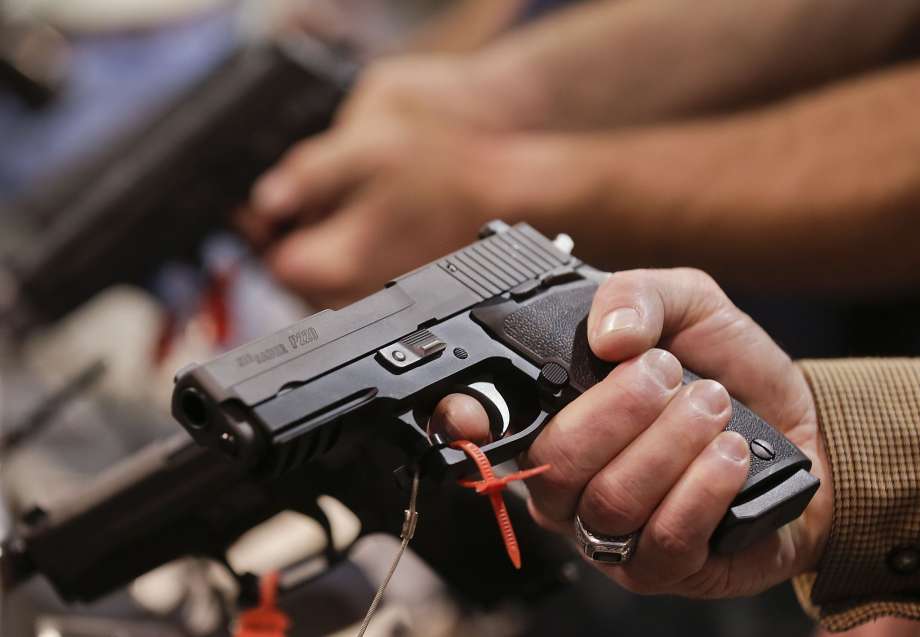
Conservatives, as expected, deeply oppose any additional restrictions to gun ownership. They see it as an attempt to do away with gun ownership in piecemeal fashion until the average citizen is no longer able to own any firearms. They believe that the 2nd Amendment guarantees the right of all citizens to own a firearm, whether it be for hunting, target shooting, self-protection or no particular reason at all. But more so, as a bulwark against a tyrannical government as expressly stated by the Founding Fathers.

To paraphrase the likes of George Washington, Thomas Jefferson, and James Madison on the subject, a unarmed and unprepared populace is no longer a nation of citizens. It is a nation of subjects. They feared that any government, including the one they just created, could become despotic just as they feared the creation of political parties.  As Benjamin Franklin said, "Democracy is two wolves and a lamb voting on what to have for lunch. Liberty is a well armed lamb contesting the vote".

However, what this actually comes down to is, as Obama suggests, a matter of urban versus rural and ultimately, one of race.  The truth is that Black youth are five times more likely than any other racial group to be murdered. They are also more likely to be murdered by another Black person than they are a white, Hispanic, or Asian. Whites and Hispanic youths are killed at a rate of 2.3 per 100,000. The percentage for Asian deaths is .90 per 100,000, while for black youth it's 11.8 per 100,000.

Statistics from a 2018 FBI report shows that 16% of white victims were killed by Black attackers while 8% of Black victims had white attackers. However, in crimes in general, in 80% of the cases where the victim was white, the perpetrator was also white. When it came to Black victims, the perpetrator was Black in 89% of the cases. Among Black youth, 8 out of 10 deaths by gun were homicides. The majority of which were committed by another Black individual.

A 2016 study conducted by the American Journal of Preventive Medicine examined 812 deaths in 17 states from 2009 through 2012 which involved law enforcement. The study showed that white individuals were more likely to be the victim of a police shooting than not. In fact, whites represented 52% of the deaths. Black deaths by a law enforcement officer represented just 32.4%, making white deaths 2.8% higher than that of blacks.

It should be pointed out that in 83% of the time, the victim was armed when shot by law enforcement. Black victims, however, were most often reported to be unarmed---18.4%---of the time compared to white victims, who were unarmed just 9.4% of the time. In addition, the report mentioned that black males were killed by law enforcement 2.5 times more often than their white counterparts. Black females were killed at a rate of 1.4 times more often than white females.

Could this be part of the cultural issue Obama spoke of? There is no question that Hispanics tend to avoid law enforcement. Many come from countries that have a long history of brutal and corrupt law enforcement officials where rape, extortion, bribery, and even murder are not unknown. Asians too have a fear and distrust of law enforcement for much the same reasons. Of course, in both cases, language differences add another layer of mistrust.

For whites, it's different. Most police officers and law enforcement officials are white. In fact, 60% of police officers are white. Historically, that number has been much higher. Hispanics make up about 18.2% while 12.9% of  police officers are Black and just 3.3% are Asian. Native Americans make up only 1%.

 As an aside, the number of white officers has declined since roughly 2019 while Hispanic officers have increased slightly since 2020, which also marks the same point where the number of Black police officers started to decline. The number of Asian and Native American officers has remained consistent.  

It's worth pointing out that males comprise 83.2% of all police officers while females make up 16.8%. Also, female officers earn, on average, just 94 cents for every dollar her male counterpart earns. The average salary for a male officer is $54,340 and $51,038 for female officers.

But what about Black culture? Why do blacks have higher percentage of arrests and fatalities when it comes to their dealings with law enforcement? Are they just unlucky and get caught more readily? The short answer is "no". While Asians and Hispanics have keenly developed distrust of law enforcement, both cultures have a strong appreciation for authority and authority figures in general. The same can be said of whites.

All three groups were historically taught from a young age to respect and follow authority figures, which was often reinforced at home. It was common when I was growing up to seek out a police officer or fireman if you were lost or in trouble. Neighbors would watch out for trouble and thought nothing of calling your parents to rat you out if you did something wrong. Churches and other religious institutions were another source of reinforcing the concept of authority. Schools too practiced strong discipline and misbehavior of any sort wasn't tolerated. 

However, this same level of compliance toward authority seems to be missing within the Black community. What happened? Part of the reason is due to the fact that typically white, Asian, and Hispanic households included two parents, and often grandparents, aunts, uncles, and lots of kids! It wasn't uncommon for extended family to live nearby and often visited. So, there was at least a stable family life. 

In Black households, this wasn't always the case. In 2011, 72% of Black households consisted of single mothers. In 2016, 48% of all non-Black households were married while just 28% of Black households were. According to one telling statistic, in 1925 Harlem New York, 85% of Black households had two parents. By 1965, following the introduce of various welfare programs, out-of-wedlock births had increased 25% among Blacks.  

By 1991, that figure was 68%.  As of 2017, it was 77.3%, the most of any racial demographic. This meant that Black children were disproportionately growing up without a father figure in their lives. It also means that most had little adult supervision during critical stages in their lives. While schools and other institutions attempted to fill the gap, they are no substitute for the traditional two parent family.
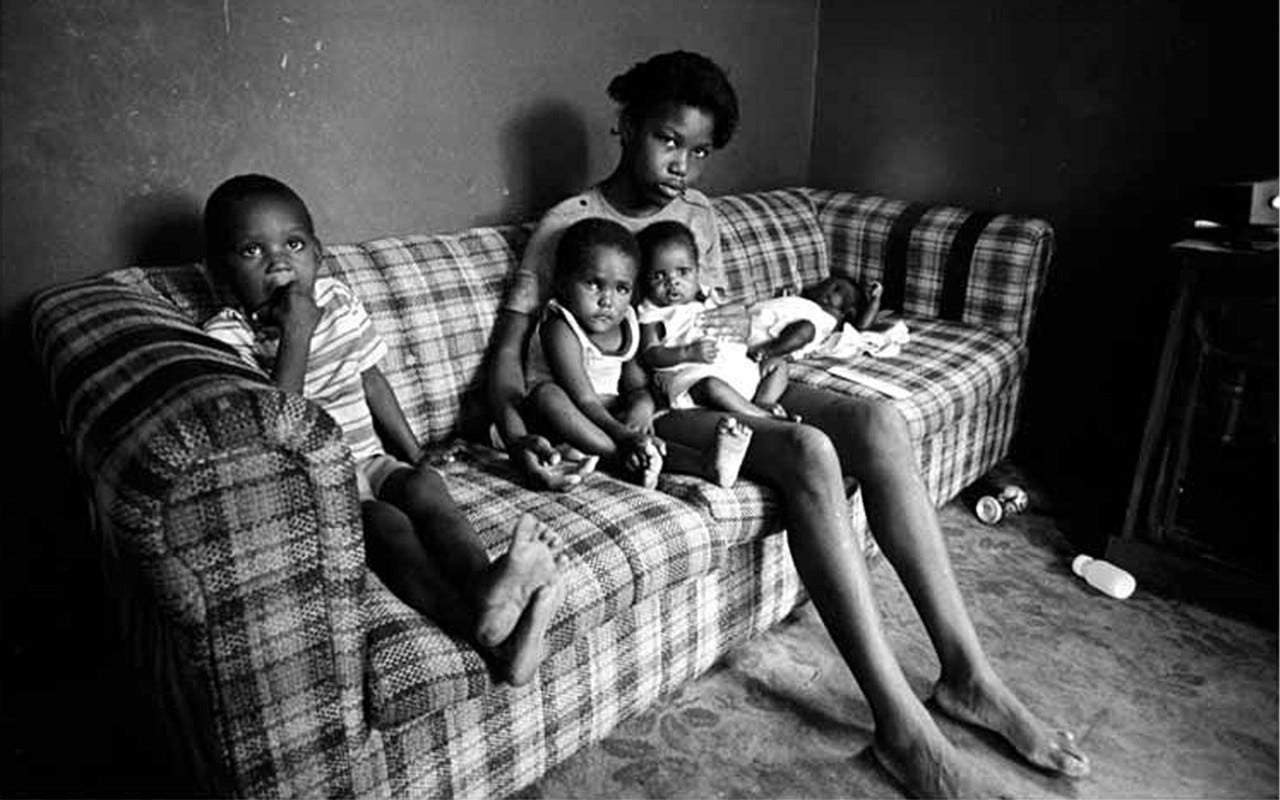
39% of Black children do not live with their biological father. 28% have no male role model in their lives, compared to 15% of white children. 32% of Black fathers have never visited their biological children as opposed to 11% of white fathers. As a result, black children lack a key stabilizing factor in their lives.

As an aside, 50% of Blacks have never been married compared to 33% of all other racial groups. Black males, interestingly, were also more likely--15%---to marry non-black women compared to just 7% of Black women who married outside their race. 

It's also worth nothing that single parent households are quickly on the rise among Hispanic women in the United States despite a history where out-of-wedlock births carried a strong religious and societal stigma. In Latin America for instance, the trend is spreading in spite of its strong Catholic traditions. 84% of births in Columbia are out-of-wedlock. Mexico, Chile, and Argentina have similar percentages. However, this doesn't mean the absence of a father figure, which remains a key element in Hispanic culture. Meanwhile, this trend has yet to appear in the Asian community.

Another key factor contributing to gun violence among the Black community, especially as it relates to the police, is a toxic culture toward institutional authority in general, and toward law enforcement in particular. It can even be found in some of the music Black youth and young adults tend to listen to (mainly "gangsta rap") which often glorifies guns, drugs, rape, and murder, especially of police officers.

Certain rap performers also promotes what is termed as "savage" or extreme rude behavior toward authority figures. This is often reinforced through peer pressure, which can be quite powerful among teenagers. It can be seen in schools, in malls, neighborhoods and reinforced in movies and video games, while the media (mainstream and Black oriented) has been persistently promoting a subculture of entitlement or victimhood coupled with the creation of "identity politics", a term which developed out of a 1977 statement made by the Combahee River Collective, a black feminist lesbian socialist group.

Identity politics creates false sense of separateness as if one particular group stands uniquely alone with its problems and thus develops a "us vs. them" mentality which pits them against everyone else.  At the same time, the media has sought to create a corresponding culture of subservience, manufactured "guilt", willfully ignoring or excusing the "savage" behavior by other racial groups. The media also tends to underreport or downplay certain acts of violence or inappropriate behavior in order to create a false sense of normalcy. 

Former President Obama is correct in his assessment. The rise in deaths among Black youth, and indeed, the increase in Black related crime and violence, is indeed as cultural as it is racial or ideological. We essentially have two competing cultures which are, at their core, the product of fractured families, the result of the unintended failure of various government programs, and a taught sense of distrust of authority figures, which is reinforced through misguided media, plus a glorification of anti-social behavior and "political correctness". Even in public schools, academic achieving black students are often harassed verbally or physically for "acting white".

So, what does all this mean? It means that Blacks experience a higher rate of gun related deaths any other racial group. It also means they are more likely to be the victim of a crime where the perpetrator also happens to be Black as well. They are also more likely to be the victim of law enforcement related deaths than not, particularly if they're male. Percentage wise, they have highest number of individuals behind bars, largely based on drug or felony. The media has perpetuated a sense of persecution and entitlement while excusing anti-social behavior.

 Nevertheless, the issue of gun control is, at its heart, aimed at controlling the spread of gun related violence. On one hand, gun control advocates believe that by taking guns out of the hands of all citizens, criminals would also voluntarily surrender their guns or obtaining guns would be more difficult to acquire. The end result would be a reduction crime in general. They believe that the 2nd Amendment is outdated and/or misconstrued. By forgoing this unnecessary freedom, it would be a small price to pay in order to create a less violent society. A case of sacrificing one freedom for the greater good of all.

Those who are pro 2nd Amendment, however, believes that the greater good is best served by creating as few potential victims as possible. They argue that if more people are armed or has access to guns, criminals would go elsewhere. After all they point out, criminals are, at their core, cowards. They seek out the opportunities where they're most unlikely to get caught or get hurt. By equaling the odds, gun related violence would decline. They also believe, like the Founding Fathers, that government is not to be trusted.

There a substantial distrust of government on both sides of the political spectrum. In a 2022 Pew Report, only 22% of those polled said they trusted the government. When broken down by race, Asians trusted the government most with 37% as did 29% of Hispanics. Just 24% of Blacks had confidence in the government compared to only 16% of whites. Democrats and Liberals in general expressed the greatest amount of trust with 26% while only 7% Republicans and Conservatives did! Independents also polled at 29%.

Another indicator of the divide is a survey conducted by Quinnipiac University and published in the February 16, 2023 edition of The Hill. According to the poll, 62% of respondents said trusted the police in most or all cases to do the right thing, which may sound good until you look as the responses by race.

72% of whites surveyed said that had confidence in law enforcement to do what was right at least most of the time. 49% of Hispanics agreed (Hispanics are the second largest demographic in the U.S.). However, 66% of Blacks expressed little or no trust in the police to do what was right! Asian responses were too small to tabulate.

That 66% represents 40.1 million people or about 12.1% of our total population. That is a substantial amount, especially when we member that they are affected more by gun related deaths than any other group. They also make up 38.5% of the total prison population. Whites and Hispanics comprise 57.5%. Native Americans are 2.6% and Asians are 1.4%. Nevertheless, Blacks incarceration rates are statistically higher given the percentage of their total population.  

We have to find a balance between reducing gun related violence and protecting ourselves. We require gun registration, age requirements, and waiting periods. Certain types of ammunition and gun modification kits (such as "bump stocks") are already banned. Schools used to offer gun safety classes which have long been discontinued. Law enforcements provide gun safety locks free of charge for anyone who asks.

What else can we do? We can reintroduce gun safety classes for first time purchasers of firearms or require periodic gun safety recertification for all gun owners. This can readily be done through the NRA and Gun Owners of America. In many states, certification classes are required to obtain carry and conceal permits. However, some states have done away with those, citing an infringement of their 2nd Amendment rights.

Currently, there is no registration requirements, background checks, or licenses required to purchase used firearms. Obviously creating a perfect venue for criminals. Perhaps extending the same requirements to buy new firearms should be applied to purchasing used firearms.

Efforts are underway to allow individuals to sue gun manufacturers for a gun related death. That makes as much sense as suing a car manufacturer in death of someone killed or injured in a automobile accident or suing a knife maker for cutting your finger. It's a complete abrogation of personal responsibility in my opinion.

Meanwhile, respect for law enforcement and authority figures such as teachers needs to be reintroduce. It means removing the graphic violence seen in video games which conditions young minds to devalue life. It means moving away the focus on anti-social behavior by reintroducing a sense of respect and responsibility of one's own actions and ending the sense of entitlement.

Guns are essentially a tool. They can be used for a multitude of purposes, most are good but some aren't. Either way it's the intention of the user not the tool that is at fault regardless of their race, religion, or ethnic background. We can reduce accidental shootings by using common sense such as gun safety training and keeping them away from children. But removing guns from law abiding citizens will have no affect on those who intend on harming others. Criminals don't care a whit about laws or restrictions. In fact, I dare say that criminals are the biggest supporters of gun control.


If you want to know more about this article's topic, please check out the links below. If you enjoyed the article, please consider passing it along to others and don't forget to subscribe. It's free! Lastly please be sure to "like" us on whatever platform you use to read anotheropinionblog.com. It helps with the algorithms and keeps our articles in circulation. Thank you! 


Alarming rise in youth gun deaths breaksdown differently by race


Gun Quotes From 20 of America's Founding Fathers --- 2nd Amendment


Fact Check: Rates of white-on-white and black-on-black crimeare similar


Police Officer Demographics and Statistics In The U.S.


All Across Latin America, Unwed Mothers Are Now The Norm


Hispanic Family Values?


African-American Family Structure


The Origins of the 'Acting White' Charge


Public Trust in Government 1958 - 2022


Bureau of Prisons: Inmate Race


62 percent in new survey trust police to do what is right all or most of the time


Friday, May 27, 2022

Another School Shooting: What--If Anything---Can We Do?

Here we go again. Another school shooting. That the 27th time so far this year. This time 19 students and two adults dead with just days to go before the end of the school year. Many, no doubt, looking forward to carefree summer vacation with trips to Big Bend National Park, one of the many beach on the Gulf Coast, or just staying home and playing with neighborhood friends and help out around the house.

But that's not to be. Not just for those murdered, but for all the students, their parents, their families, and their friends. That Tuesday will forever be seared in their individual and collective memories. It was the day...the moment they had their childhood innocence stolen from them.

That Tuesday, which should have been an ordinary school day like any other, the children of Robb Elementary School in the small town of Uvalde Texas joined an exclusive but growing club of victims of school violence. 

There's nothing special about Robb Elementary or Uvalde Texas. Perhaps it was its very ordinariness which stands out.  Uvalde has a population of just over 15,000. The town (it hardly qualifies to be called a "city") occupies just 7.6 square miles.  It's closer to Mexico, which is just 53 miles away, than to just about anywhere. The closest actual city is San Antonio, which is 80 miles away.

The largest demographic is Hispanic, which make up just over 78% of the population. Whites comprise 19% while Native Americans make up 11%. Blacks or other races barely show up on census record statistics. Voting records shows Uvalde has consistently voted for a Republican president since 1952. The only exception was 1964, when it voted for Democrat and fellow Texan, Lyndon Baines Johnson. 

It's claim to fame are a couple of Old West gunslingers, a few sports personalities, celebrities Dale Evans (wife of Roy Rogers) and Mathew McConaughey, Apollo 12 astronaut Pete Conrad, and former Speaker of House and Vice President under FDR, John Nance Garner.  It's also, according to the magazine, Outdoor Life,  one of the best places in the world to hunt whitetail deer.  

Now it will be remembered alongside Sandy Hook (2012), Virginia Tech (2007), Stoneman Douglas High School (2018), Columbine High School (1999), and some ten other schools known for being the deadliest school shooting in the United States. But, it appears no place is truly safe, not even in locations not known for violence (and especially gun violence).

In 2002, Erfurt Germany, a former student targeted his former teachers among others and murdered 17 before committing suicide. In 1996, a 43 year old man in Dunblane Scotland killed 17 children and one adult, while wounding 15 others before killing himself.

Between 2008 and 2009, 37 students, teachers, and adults were killed in school related shootings (two in Finland, one in German, and one in Greece. In Kerch Crimea Ukraine, in 2018, 20 college students were murdered while 50 were injured. From 2004 and 2020, 15 individuals died in 20 attacks on schools in Mexico. In South America, between 2001 and 2013, six school attacks resulting in approximately 20 deaths.

 In most cases, the perpetrators used handguns. A few used homemade explosives, crossbows, knives, and hatchets. A handful used semi-automatic rifles (which typically get misidentified by the media as "assault rifles") or pump action shotguns. The assailants typically chose self inflicted death or "suicide by cop" rather than surrendering to law enforcement. Only a few were captured by the police.

Excluding incidents which involved former students or adults who had no connection to the school, most of the students involved in the shootings ranged in age from 12 to 16. The majority were male. They tended to be loners, non-physical, or were subject to constant bullying.  Psychologists reported that many were more immature than most of the same age group. They often acted out of emotion, tending to be more impulsive and aggressive.

In 1994, Congress passed the "Gun Free Schools Act" which called for greater school safety plans and adoption of a zero tolerance gun policy, which was generally expanded to include weapons of any sort including knives.

The act was part of the "Improving America's Schools Act", signed by President Bill Clinton, and required school districts to adopt a gun-free policy in exchange for federal funds. A similar law was signed by President George H.W. Bush in 1990 called the "Gun Free Zones Act of 1990" as part of the "Crime Control Act of 1990". 

The purpose of both acts was to create a gun (and weapon) free area in and around schools in order to provide for a safer learning environment. This included hiring full or part-time security guard, prohibiting admission during school hours (except through a specially designated entrance), adding metal detectors, security cameras, and a mandatory one year suspensions of any student caught with a weapon on school property. In some cases, school districts also included mandatory home visits and/or counseling of the students in order to head off any potential issues.

Some school districts went further and included additional training for teachers which included methods to prevent forced entry into classrooms, extra locks on doors and windows, methods for contacting authorities, and even allowing some teachers or administrative personnel to covertly carry firearms (with proper training and appropriate licenses). The identity of these individuals was restricted to a few administrative personnel to ensure security.

Politically, the topic of classroom safety became the hot topic de jure, usually following some tragic incident, making gun control efforts more successful given the public's mood at the moment. Those on the Left typically call for total banning of certain types of firearms while increasing restrictions on the purchase of firearms along with limiting the sale and type of ammunition.  

Specifically, the Left wants to limit or (ideally) prohibit the sale of semi-automatic rifles (which, based on the design of the stock, are incorrectly labeled "assault" weapons). The availability of actual military grade weapons are already regulated.

The sale of specific types of ammunition such as those designed to penetrate body armor or metal (except to law enforcement and military personnel) which were restricted in 1995. Calibers in excess of .50 are in most cases also prohibited. "Dragons Breath" or "Hell Fire" incendiary shotgun shells (which shoot 200+ yards), hollowpoints, flechette darts, elephant slugs, "flash bang" shotgun shells, or anything containing depleted uranium, radioactive, or poisoned shells are illegal too in many states. 

Following the mass shooting at the Mandalay Bay in Las Vegas in 2017 in which the alleged shooter, Steve Paddock, used a "bump stock" which in effect, converted a semi-automatic rifle into a de facto full automatic, were banned for general sale and reclassified as a "machine gun", which requires the appropriate licensing. The way the bump stock worked was by using the natural recoil of the weapon to eject, reload, and fire as long as the trigger remained suppressed.

After a series of court hearings, the Department of Justice was successful in getting "bump stocks" re-categorized and banned as of March 19, 2019. It should be noted that in 2017, following the Mandalay Bay shooting, 72% of voters agreed with the decision, of which 79% were Democrats and 62% were Republicans. In 2018, that number increased to 81% of registered voters. The shooting left 60 individuals were killed with another 867 wounded. No motive was publicly disclosed.

While the Left has been pretty unanimous in their call to prohibit or at least restrict many types of gun or ammo, the Right has been a little less unified. Many conservatives are generally in agreement that certain restrictions are necessary, such as prohibiting the sale of armor piercing ammo or availability of certain types of guns and accessories such as the "bump stocks", "sawed off" shotguns (under 18"), or 10+ magazines.  

However, others are of the opinion that the Second Amendment is not open to judicial or political interpretation. The Founding Fathers wrote it with the intention of providing a means for citizens to protect themselves and others from a government bent on overreach and ultimately tyranny.  Therefore, the citizenry should have every means of defense available to them bar none.

They interpret that to mean no registration of guns, ammo, or other weapons, which they see as a thinly disguised attempt at restricting ownership through both intimidation and as providing a handy readymade list of everyone who might resist.

Of course, the primary reason for owning guns is self-protection. Few can argue that crime isn't a persistent and growing problem, and the chief source for school children intent on causing harm. Security locks for most firearms are available for free from various law enforcement agencies or even some pro Second Amendment groups.

It's worth noting that some of the Left would like to see firearms either voluntarily or mandatorily surrendered to the government and destroyed. Their position is that if there are no guns, there will be no shootings. However, that would be equivalent to the position taken by some during Prohibition; if there's no booze, there will be no drinking.

Reality was differently. Liquor became illegal and criminals became rich. If gun ownership was illegal, criminals would still acquire them. Those without guns would simply become potential victims. As the expression goes, when seconds count, the police are minutes away.

We need to accept the fact that we can't prevent violent crime, and that includes school shootings despite our best of intentions. All we can do is mitigate the likelihood of them happening. That means schools need to step up with additional preventative measures.

Metal detectors, security cameras, additional or reinforced locks are good. So are discreetly armed security guards (no one, especially kids, want to feel they are in prison instead of school). So is the barring entry points (save one primary entrance) during school hours. But these only protect those inside of the school, and to a limited measure.

They don't protect from homemade bombs, poisons (which have been used in several instances), or from physical assaults. They don't help on the playground or going to or from the school bus. Nothing will protect everyone from a determined individual, especially if they feel they have nothing to lose.

Therefore more attention needs to be given to students displaying any of the key warning signs like subtle destructive behavior such as "cutting" or are withdrawn (or students who act out through bullying, gang activity, or are persistently disruptive). They could be potential perpetrators of school violence, however, they are just as likely to be victim of someone they routinely pick on.

More parent/school contact is needed. Parents can't just assume that schools are "dealing with the problem". Typically schools aren't aware of the home situation, which are often a contributing factor.  That means everyone, from the bus driver to the principal, needs to make an personal investment in the wellbeing of the students.

Discipline too is often lacking, with the extremes of abuse (including over-prescribed medication in lieu of firm guidance) and total neglect on the other end, as well as physical, emotional, and psychological abuse must be avoided. Children, and especially teenagers, require a balance of support, encouragement, and a gradual loosing of guidance as they age. The "anything goes" attitude does more harm than good.   

Non-abusive ways of securing parent or regular adult involvement are critical. I think the return of art and music classes could help as a way for kids to express they're feelings. Not everyone plays sports. Encouraging academic success shouldn't be viewed as a "white thing" by minorities, who often ridicule "smart" kids who are minorities, resulting in frustration, depression, and acting up in order to fit in.

Households with guns need to ensure their weapons are secure (including periodic checking). They need to pay attention to the video games and sites their child have access to. Personally, I think video games which glorify violence (including killing zombies) are a key factor in youth violence in and out of school. They desensitize killing and accustom the individual to violence and gore. But in real life, once you pull the trigger, there's no "reset button".  No one comes back to life. Saying you're sorry counts for nothing.


If you want to know more, please take a look at the links below. If you enjoyed the article, please consider passing it along to others and don't forget to subscribe. It's free! Lastly please be sure to "like" us on whatever platform you use to read A/O. It helps with the algorithms and keeps our articles in circulation. Thank you!  


Do countries with stricter gun laws really have less crimeor homicides?


U.S. Gun Policy: Global Comparisons


How gun control works in America, compared with 4 other richcompanies


27 school shootings have taken place so far this year


Saturday, February 23, 2019

Education: America vs. the World---Where Do We Stand? Pt 3 of 3 of Our "Where America Ranks" Series


The Greek inventor Archimedes once said that given a lever long enough and a fulcrum on which to place it, he could move the world. If knowledge is the fulcrum, then education is the lever which can move the world. Education can open doors as well as minds. It is not only the measure of success of the individual, it's the measure of success for a nation. Unless its properly nurtured, a nation will stagnate and eventually decay economically, politically, and societal. So, where does America stand in terms of quality of education when compared to the world? How does our students compare to other developed nations in the areas of math, science, and reading?

As we've examined in our previous two articles of this series, much of what we're told about America doesn't gel with the published facts. We have one the worst healthcare systems of any developed nation; in some areas such as prenatal care, number of beds, and availability of healthcare professionals we actually rank in the second tier along with second world economies and crippling income inequality which puts us near the bottom tier among developed nations. In terms of freedom, we again rank only in the second tier in several areas, and even overall, we're nowhere near the top. So much for being the "leader of the free world". Now, according to a 2018 report by Business Insider, the US ranks 27th overall in education; down from sixth place in 1990 (their report also ranks the US in 27th place in terms of healthcare).

The 2018 "World Top 20 Project" which focuses solely on education and its affect on each nation's economy, the top ten nations are South Korea, Finland, Norway, Russia, Hong Kong, Japan, Estonia, Latvia, Israel, and Sweden. The United States came in 24th out of the 201 nations examined. While that places the US in the top 25%, we still fell behind nations like Kazakhstan (15th), the former Soviet Republic of Georgia (17th), China (20th), Croatia (22nd), and Saudi Arabia (23rd). Why is that?

One explanation cited in the reports is the decline in spending by 3% while student growth increased by 1% between 2010 and 2014. Meanwhile, Turkey increased its spending on education by 76% along with similar growth in spending in China and Brazil. According to the Program for International Student Assessment (PISA) which measures 15 years students in developed and developing nations, the US ranks 38th out of 71 countries in math, and 24th in science and reading; all of which placing the US well in the second tier. Interesting, the top nations were Singapore (which topped all three categories), along with Japan, Estonia, Taiwan and Finland in Science; Hong Kong, Macao, Taiwan and Japan in Math; and Hong Kong, Canada, Finland, and Ireland in reading. What makes this so interesting is that these countries were all ranked higher than the US in terms of overall freedom and/or healthcare. As an aside, the top ranked US schools according to US News and World Report's 2018 edition, which are in Massachusetts, New Jersey, Utah, New Hampshire, and Iowa still fall far behind all the top Asian and several of the European schools (Kentucky, by the way, was ranked 34th while Indiana was 35th).

In terms of higher education, Masters and More, which publishes a ranking of the best countries to pursue a post-bachelor's degree based a Pearson, a multinational education and publishing company, the top nations are South Korea, Japan, Hong Kong, Singapore with Finland coming in fifth. Rounding out the rest of the top ten are the UK, Canada, the Netherlands, Ireland, and Poland. The US came in 14th out of the 40 countries represented and just behind Russia and ahead of Australia. The report looked at the primary and secondary school systems (which lays the foundation for higher education) as well as the colleges and universities. According to Pearson's CEO, Jon Fallon, the rankings "strongly reflect the economic growth of the countries", meaning that there is an obviously correlation between the quality of education and the economic success of each nation. But just how true is that?

The US spends more per student than any other country according to a Organization for Economic Cooperation and Development (OECD) report. The report says that the average amount spent per student from primary through high school is $10,759. However, the US spends $16,268 per student. As pointed out earlier, the US is, however, on the decline in spending per child by an average of 4% between 2010 and 2014. Meanwhile, the other OECD nations have increased their spending an average of 5%. Of course, that still means the US is currently spending more per child yet getting worse results than those who spend less.

The report suggests that one reason it that teachers in the US are seen as individuals who were unable to doing anything else whereas in other countries teachers are viewed as "professionals" on par with doctors, engineers, or lawyers. Accordingly, not only are they more respected in society, they are also better paid. American school teachers make on 65% of what their peers in other countries earn. The highest paid teachers are in South Korea, followed by Canada, Finland and Germany. In fact, US school teachers actually fall below the OECD average.

Another explanation is that the requirement to getting into a teaching program in other countries is much tougher than the US. Prospective teachers are expected to have higher GPA out of high school and do better on their college entrance examinations that their American counterparts. In Finland, it's easier to get into law or medical school than a teaching program. In addition, foreign students in teaching programs are required to take much more academically rigorous courses. They are also required to take continuing education courses, like their American peers, however, the courses are considered much tougher and more on par with other professionals.

Also discipline is far more strict in international school systems than they are in the US. Unlike the US, there is a zero tolerance for any bad behavior, back talk, profanity, sloppy dress (uniforms are the norm), and needless to say, violence against teachers or other students---even bullying---is a non-starter. These school systems expect---insist---that parents instill respect and discipline in their children and that carries over to the schools where physical punishment, though rare, can be enforced. Parents are also expected participate in any school functions. Failure to do so will usually warrant the attention of school administrators. I strongly suspect that excuses aren't tolerated.

Some have argued that bad behavior results from low income or "disadvantaged" children, especially among minorities, yet according to OCED, there are 37 other countries with are economically poorer and have fewer resources than the US yet they consistently outperform the US academically. One possible reason it that schools in Europe, and especially Asia, set and demand higher academic standards that American schools, and that translates into discipline in school. In fact, it's their official academic policy and practices. Children in Singapore for instance, are given a thorough assessment prior to first grade in order to determine if they meet the minimum grade criteria. If they fall below the bar, they must first be brought up to speed before being allowed to start.

Students are also regularly tested in ensure they meet minimum grade criteria before being passed to the next grade unlike many American school systems which "fail forward" students out of fear that parents will complain or allege "discrimination". American schools seem to have adopted the Washington solution to dealing with problems which amounts to kicking the can down the road and letting someone else deal with it. The end result is students graduating with a high school diploma but having only a functional eighth or ninth grade education or less in terms of reading.

In Germany, which is noted for its academic excellence, students are tracked academically as well as to their interests. In Germany, students may be tracked for higher education or for one in the trades, which is another key difference. In the US, it's assumed that all individuals are destined for college regardless of whether they are so inclined. As a result, you see students racking up crippling debt and ending up with useless degrees. It also artificially raises the bar for getting a job.

The majority of employment opportunities should require no more than a high school degree or perhaps even a six month or two year technical certificate. Meanwhile, critically needed trade jobs, which require less education and are far cheaper, go unfilled. In addition, these jobs typically pay much better than the average four or six year degree and have better benefits. In Germany (and the rest of the world), there is no stigma between someone in the trades and some with professional degree, which can't be necessarily said of the US.

So, in terms of education the US is no better off than when we looked at its ranking on freedom or healthcare. At best, the US education system is well out of the top ten list and typically falls towards the middle of the second tier. The main reasons do not include the amount of money spent on each child (we top the list), but on attracting less the best into the teaching profession. This is due to both the perception that a career in education is somehow inferior, therefore the criteria is lowered, and that teachers are poorly paid when compared to their peers elsewhere.

The second reason is that expectations for students are set lower for US students than elsewhere, and that includes discipline. Respect should be a given, not something we bargain for in order to avoid violence in the classroom. We've allowed ourselves to become so focused on meaningless labels as part of a group rather than on our potential as individuals. Students should be individually tracked and constantly monitored as to their performance. Parents must be made a part of the solution rather they expecting teachers to serve as their glorified, if underpaid, babysitters. Lastly, students should be expected to perform and not "flunked through" or "failed forward". They either meet minimum expectations and move on or their they don't. If they don't, they must be held accountable and meet the criteria before moving on. A high school diploma must be made to mean something again. Also, I believe way too much emphasis is placed on sports, especially at the Jr High School and High School levels rather than on academics. Only a tiny percentage make it into professional or even semi-professional sports but everyone needs critical thinking skills and know how speak and write properly along with how to read and
do math.

The third key reason is attempting to herd students through a system where they may or may not fit. Not everyone is college material and not every job needs someone with a college degree. If a high school diploma is restored to its former value, most graduates can handle the majority of jobs out there. Technical and trade schools are an excellent option for many students. They pay well, have great benefits and they're in high demand. They also can be earned quicker and at a fraction of the cost of a four year degree. Students who do chose to attend college should be strongly encouraged to obtain degrees which have some market value (ie: requiring a Art History or Minority studies degree to also have a mandatory dual major in business, accounting, or computer science). Coming out with a worthless degree and tens of thousands of dollars in debt makes no sense at all and creates additional financial problems down the road.

A nation's overall success depends on the quality of its citizens. A uneducated populace is a little better than herd of sheep waiting to be led to slaughter. It's one of the key reasons---if not the key reason---democracies and republics fall. For the tyrant, an educated populace is dangerous. They know the limits of government. They understand and will defend their rights. An educate citizenry also provides the best opportunities for a strong economy, and that means job growth and economic stability. It also means a better quality of life for everyone, and who doesn't want that? As our readers know, America is an Oligarchy now, run by a professional political class of plutocrats who think they know better than us. One can almost track their rise alongside our decline in education, and with it, our standing as a nation of free people. The only question we need to answer is this---what are we prepared to do about it? Lastly, I would like to thank you for reading and your comments. I hope you've enjoyed this three part series about how America ranks with the rest of the world in the areas of freedom, healthcare, income inequality, and education, which are at the core of every nation's success or eventual downfall.


The US was once the leader in healthcare and education--now ranks 27th in the world

US students' academic achievement still lags that of their peers in many other countries

World Top 20 Project: International Education Database

40 Top Education Systems in the World

The US spends more on education than other countries. Why is it falling behind?

US News and World Report: Education Rankings


Saturday, May 05, 2018

The State of America's Education System: How Low Can You Go?


I've always been a strong proponent of education. Education, as far as I'm concerned, is the linchpin to society. An educated populace is a productive populace; capable of doing a vast variety of work. This attracts businesses which generates taxes (both direct and indirect), as well as attracts other peripheral businesses, and so it continues. The result is often a community which offer a wide range of amenities, such as parks, museums, restaurants, as well as a strong social and structural infrastructure, from up-to-date sewer systems, electrical grids, clean water to adequate and well trained police, EMS, and firefighters. It should also include not just well paid teachers, but teachers who are as well respected and appreciated as some sports coach.

Without a strong educational foundation, nothing in society works (or at least very well). If you have a well educated population, you should have a society of individuals capable of critical thinking skills, an understanding of history, geography, political science and Civics; who have a general appreciation of world literature as well as the ability to perform basic mathematical computations, the sciences, and diagram sentences in order to write and speak properly. 

I would add that a well rounded graduate of high school should have completed an art or art appreciation, music class, or theater class. Kids that take what they want, without being intellectually challenged leave school underserved by not just the teachers, but the entire school system as well. Many are simply "flunked through" because of pressure by parents and the school system not to hold students back out of concern that it will "damage their self-esteem", not to mention how it makes the school system look to voters.

As a result, both the student and society often end up paying the price. The student-now-adult often finds that their nonchalant attitude in school now makes them virtually unemployable. Many take low paying and unrewarding jobs. Some end up in criminal gangs, which eventually leads to prison and/or the cemetery. 

 For the girls, they often end up pregnant and more often than not, on their own since their boyfriends end up being more immature and irresponsible "boys" than men. Either way, an significant portion end up on public assistance (tax supported charity in truth). The same goes with those who just want to concentrate on sports. Fewer than 1 in a 1000 every actually make it into professional sports and make the obscenely big money. That's some pretty poor odds.

Those who do succeed need more than athletic ability. They need the intellectual ability to think critically, to hold a reasonably intelligent (and intelligible) conversation. Most of all, they need to be able to properly interact with others; non-jocks like lawyers, financial advisors, team agents, owners, managers, the media, and other players. Far too often we see student-jocks coming out of high school (or even college) who aren't smart enough to do basic manual labor.

One of America's big failures in terms of education, has been "dumbing down" the academic expectations of students (this is a big problem in some communities where academic success is seen as a "betrayal" of one's race or cultural identity). 

The idea has been that create some misplace notion of "parity", as if all students are somehow intellectually equal, or that one group may fail disproportionately to another group. As a result, everyone gets punished. 

 Instead, students should be allowed to advance based on their own ability. Meanwhile, slower students should be allowed to progress at their own pace. Perhaps more advanced students could serve as teaching aides and help individual students in exchange for extra credit.

Another big problem in many school systems are those who cause discipline problems. Typically these are academic failing students, many of whom are insecure emotionally, who are determined to cover up their shortcomings by trying to keep other students from learning. I guess that somehow makes them feel better about themselves. 

In recent years, we've seen an increase in students attacking teachers. Hand-in-glove with this, we've seen an attempt by public schools to engage in a form of appeasement by allowing students to take what classes they want, lowering standards and grading requirements, providing "cooling off" rooms, etc.

Meanwhile, teachers aren't suppose to strike back or defend themselves. At best, the student might be suspended for a brief period. In a few cases, the student might be arrested, but there is usually a lot of pressure brought to bear not to press charges out of concern that it may have a negative impact on the student. 

We certainly don't want to see them forced to take responsibility for their bad behavior now would we? As for suspended students, they end up getting what they want---out of school and free to go do whatever they want, which eventually turns out bad for them and occasionally for society too. Students with a repeating pattern of this type of behavior need to be dealt with in specific manner.

Instead of suspending these students, they need to be placed in special schools designed to modify their behavior. Here the rules have to be different. Emphasis has to be on engaging the student directly, and if necessary, responding to violent outbreaks with appropriate responses.

 Bullies (and these often tend to be bullies who haven't been taken down a pig or two previously), need to be confronted. In addition, these individuals need to be assigned to these type of schools for a minimum of a month---24/7. Their personal behavior and academic performance dictates the length of their stay. 

Parents and selected friends can visit, but they can't leave. It can be a tough punishment, but their behavior brought it on themselves and it's better that they learn to take responsibility for their action now than down the road and end up in prison or dead (as an aside, America leads the world by far in terms of percentage of imprisoned population).

Speaking of school, I also want to stress that while there is a strong emphasis on going to college, college is not only not for everyone, it's really not necessary for most jobs (especially if high school had properly prepared the individual for life after school). Not every manager or supervisor needs a four or six year degree. Trade and vocational schools are often a much better option than college. 

First off, they prepare individuals for entry into the workplace much faster than college. They are also far cheaper so you don't rack up the massive school debt, and you often can start working in the field of your choice while still in school. They pay is generally excellent, as are the benefits. For experienced individuals, it's usually a short step to go into business for yourself.

For those who do decided to go to college, it's important to think realistically about what you want to major in. It's nice (or idealistic) to think about getting a degree in gender or racial culture studies, or in some other obscure topic, but will it give you a job when you graduate? Will taking a course in "Star Wars vs Star Trek" actually help you land a job? Is the degree you end up with enough to pay off a $100,000+ school debt? You have to think in practical terms.

College is about learning to think more critically. It's about learning to appreciate different opinions without not necessarily having to agree with or feel threatened by those opinions. It's about being able to express your ideas in a well thought out and reasoned manner. It's about using reason and logic to analysis an argument or situation. 

College is not about shouting down those you disagree with. It's not about forcing them off the stage or destroying property when you don't get your way. It's not about having a "safe space", nor is it about getting coddled or trying to make everyone happy. It about making an informed and well reasoned argument in a respectful manner using critical thinking skills. If you can't do that, then you need to consider what you need to do grow up emotionally. Perhaps you should consider a stint in the military. I guarantee you'll grow up there in a hurry.

So, with that said, how does America stack up academically compared with the rest of the world? According to the site "Ranking America", their latest study from 2015 ranks American public schools 14th overall academically in the world. South Korea, Japan, Singapore, Hong Kong, and Finland, in that order, make up the top five. 

The best performing school systems in America, Vermont and Massachusetts, can't compete with students in countries like Taiwan, South Korea, Hong Kong, or Singapore in subjects like math and science.

Speaking of science, the school systems in Alabama and Mississippi are closer in academic performance to countries like Kazakhstan and Uzbekistan, while the school system in the District of Columbia is the academic equivalent of Bahrain. Overall, America's academic performance among its public school resemble those of third world countries. 

Countries like China, India, Pakistan, and Japan far out produce the US in graduates with medicine, engineering, robotics, and computer science degrees, especially at the masters and PhD levels. Ironically, the US spends more on education than most countries--6% of its gross domestic product---which is on par with countries like Ghana, New Zealand, Saudi Arabia, and Morocco. Interestingly, it's also far more than countries like Korea, Taiwan, and Japan, who outperform us, spend.

Finally, in terms of teacher pay, apparently US teachers are about average in terms of pay with an average of $43,600 per year for a primary school years with 15 years of experience compared to an average of around $39,000 for other teachers in economically developed nations with the same experience. 

Thus, American school teachers are paid roughly equivalent to teachers in the UK, Australia, and Holland. As an aside, the highest paid teachers are those in countries like Luxembourg, South Korea, Switzerland, and Germany.

However, American school teachers spend a lot more time teaching compared to other teachers around the world. US teachers spend, on average, 1089 hours teaching compared to 794 hours in primary education, 709 hours in lower secondary education, and 653 hours in upper secondary education. 

Thus, it appears that while US teachers spend more time actually teaching, they aren't equally compensated for the time they spend in the classroom. Of course, I should point that it's not uncommon for teachers to pay for school supplies out of their own pockets to make up for shortfalls in schools budgets (which often ends up in the salaries of administrators, who tend to be to numerous for most school systems).

So, there you have it. This is the state of American schools, where bright students often find themselves held back in underperforming schools; where even average students find the academic process disruptive and their academic opportunities short changed. In college, students aren't properly taught critical thinking skills and instead of being taught the true meaning of liberal arts, they become narrow minded and provincial. 

 Our teachers aren't paid bad, but neither are they paid for the work they actually do. We are continuing with our downward trend academically compared to the rest of the world, which may soon render us just another second tier nation with large swath with more in common with third world nations than not; a faded world power like so many who came before us. Meanwhile, America's military budget, at the direction of the ruling Oligarchy, continues to expand at the expense of our infrastructure, and ultimately, our children. The only real question is what are we going to do about it?


 If you enjoyed the article, please consider passing it along to others and don't forget to subscribe. It's free! Lastly please be sure to "like" us on whatever platform you use to read anotheropinionblog.com. It helps with the algorithms and keeps our articles in circulation. Thank you!  

Saturday, March 24, 2018

Protesting to Stop Gun Violence: The Solution is Closer to Home/Book Review: Crashing The Parties


Apparently there are dozens of "anti-gun" protests happening all over America this weekend (March 24/25 2018) under the banner of 'March For Our Lives". Literally hundreds of thousands of individuals, most of them junior and high school age as well many who are in college, are showing up in towns, cities, and even the cesspool known as Washington DC to protest gun violence. I wouldn't be surprised to the final count is well over 1 or 2 million.

Being a child of the 1960's and 70"s, it brings warm cockles of my heart to see so many people take to the streets to protest for something they believe in. I grew up watch the Civil Rights marches; the anti-war protests, and later on, marches against gender discrimination. Most of the those marches were peaceful, or at least started out as peaceful, but ended up becoming violent when they clashed with the police or occasionally, the National Guard. Thus far, these protests against gun violence has been peaceful, which they should be quite proud of.

Nevertheless, my main concern over the marches is the issue itself and the proposed solutions being tossed around. There is no question that gun related violence is on the increase, especially with regards to attacks in schools. Many (if not all) of the attacks have come from a fellow student (or students). From all that I've read, these individuals were usually marginalized by their fellow classmates; treated as "odd" or "weirdoes" or whatever. They tended to be excluded from normal school events and functions. They had little positive interaction with their teachers too. They, in effect, went through school largely unnoticed, and when noticed, it was almost always in some negative way.

It's not uncommon for schools, and society in general to treat these individuals as being "mentally ill", which they're not; not really. They are simply different. Perhaps if this "difference" was channeled in another direction, these same would-be mass murders who, instead, become artists, designers, or even writers. Instead, they're drugged in order to control their behavior when in reality, it's simply so their parents or teachers don't have to deal with them.

Speaking of parents, another thing these kids have in common is that they tend to come from middle class or upper middle class families and are often left on their own. In fact, it's the parent who are often most surprised to see their child's picture and/or name of the TV screen as being the prime suspect, and their first remarks often include phrases like "we gave them everything", "we gave him his own space", and so forth. What, in reality, they are saying is that they were so focused on their own lives or those of their other children, those who needed their attention the most were ignored.

Many of these kids look elsewhere for some form of validation. They tend to embrace the negativity of which they're accused. A few emerge themselves into a "Gothic" persona. Some dive headfirst into the darker aspects of Heavy Metal or go the into a completely different direction such as fantasy, role-play. Hopefully, this will be limited to concerts or "Cosplay" events where they interact with like minded individuals who are often a marginalized. While this isn't ideal, it does help create some personal bonds and relationships which is much better than being alone and feeling like an outcast. I can't think of many things worse than being a teenager, and all that involves, and having no one of your own age to talk to. The lonesomeness and isolation would be crushing.

A few of these same kids also look to history (I believe the demonic duo at Columbine High School were guilty of this). The kids (and they really are still "kids") look to people like Adolf Hitler, Heinrich Himmler, Joseph Stalin, or some other demented individual like Jeffery Dahmer, John Wayne Gacy, or some fictional characters like "Jason" or "Freddie Kruger" for inspiration. As crazy as it sounds to us, it makes perfect sense from their perspective. After all, most of the people were outcasts themselves. They were misfits; marginalized or ignored, yet they went on to command the world's attention.

The "how" aspect doesn't really matter to them, nor does the "why"; not really. All that matters is the results (and as we all know, mostly from personal experience, teenagers and even young adults don't always think things through to a logical conclusion). This really isn't about revenge, although I'm sure that comes into play if the opportunity represents itself. For a brief moment, they can garner the respect (or fear, it's the same thing to them) they've longed for, even if it means they must die in the accomplishment of it. I suppose them old adage than "any attention, even bad attention, is better than no attention" holds true here.

So, while I applaud the hundreds of thousands to young men and women taking to the streets to oppose gun violence, especially in schools, I don't think banning guns is the answer, although I agree that the system has to often failed to do proper background checks. So instead of demanding tighter controls on gun purchases, how about enforcing the ones already on the books? Also, instead of trying to regulate what kind of firearms someone has, how about focusing on requiring gun safety training so they know how to properly use them? Besides, we all know that even if guns suddenly were outlawed tomorrow, criminals would still have them and we'd look like a flock of sheep to a bunch of hungry wolves. Of course, the government would see us the same way!

I think the solution to gun violence in schools lies much closer to home; it lays in the way they treat their fellow students. It lies in the way that bullying---physical, psychological, and cyber--- is still allowed to happen without recourse. Yes, it's "illegal" but so what? So is stealing but it happens anyway, and no amount of signs is going to change that. The worse tolerance of bullying still comes from the kids themselves who allow it among themselves. They know who is doing it, yet they say nothing and do nothing, and then pretend to be so surprised when someone commits suicide...or shoots up the school.

Sometimes a solution is so simple it's overlooked. People, usually in desperation, tend to "paint with a wide brush" when a small one would do just as well or better. Stop the bullying and intimidation in schools, especially the cyber-bullying. Don't accept cliquish behavior; don't be a part of it. Don't ignore "gangbangers". Report them. Call the police if necessary. These are the purveyors of violence in society. They have no place in school or anywhere near schools, playgrounds, parks, or kids in general.

Lastly, don't tolerate attacks on teachers by some loser of a student, and don't allow them to interrupt the class. If they don't want to learn and want to remain woefully ignorant, so be it, but let them do it elsewhere. Students have a powerful voice in stopping this behavior. Teachers and parents need to take an active interest in everyone as much as possible. Don't assume drugging your child, even if a teacher or counselor, recommends it, at least not without a second or even third opinion; and be open to alternatives.

Let's start demanding that federal, state, and local officials in charge of reviewing gun applications actually do their jobs, and that means having the resources and proper training to do their jobs. Too many of these incidents are the result of someone in the chain dropping the ball. Lastly, taking personal responsibility to ensure their firearms are properly secured. Also, let's make sure those who own firearms are properly trained in their usage, including maintaining and cleaning them as well as gun safety. I think these steps will go a long way to cutting back on gun violence, be it in the schools or in general.


BOOK REVIEW

Crashing The Parties: A Proposal for a Populist Centrist Party That Can Break The Left-Right Divide and Save America
By M.D. Couturier

As many of you all know, one of the perks of this job is getting to review books, usually on current events, history, theology, and naturally, on politics. I've reviewed hundreds of books over the years on behalf of various publishing companies, as well as a few on my own. Some have been pretty good; a few were quite enlightening, and some not so much. Regardless, I try to make sure you get an honest assessment.

I was asked to take a look as Mr. Couturier's book, "Crashing The Parties"; a populist and centrist oriented booklet. I had the distinct advantage of long being a proponent of Centrism (and perhaps the best known Centrist activist and writer in Kentucky), so I was keenly interested in Mr. Couturier's booklet, which is only about 15 pages long. The book itself is very well written and obviously a quick read. Mr. Couturier does an excellent job in addressing a wide variety of topics in short but concise statements. The booklet starts off listing and then defining the three main tenets of American Populist Centrism, which includes the nation, the government, and the American People. He then delves into some well thought out tenants comprising his alternative to the antiquated Left/Right paradigm that we face today.

These include controversial topics such as immigration, jobs and the economy, and education. I am particularly pleased to see Mr. Couturier, a native of South Korea and now a US Citizen, address the issue of illegal immigration and once again re-embrace the concept of America as a "melting pot", and the need to make English our official national language. Mr. Couturier also addresses the need for election reform (such as ending gerrymandering) as well as national security and ending the role of permanent alliances, perpetual wars, and America as the world's policeman. He goes on to address many other hot issues, such as abortion, the role of prayer in schools, gun control, healthcare, the economy, taxes, and the need to revitalized labor unions in order to breathe life back into what's left of the middle and working classes. For all of these, Mr. Couturier should be applauded, but his treatise goes much further. I can't say that I completely agree with everything Mr. Couturier says (nor would I expect to), but he provides does provide for some well reasoned perspectives.

For anyone interested in current events from a fresh perspective, I encourage you to read Mr. Couturier's "Crashing The Parties". The read will be short, but the takeaway will be immense, especially if you're tired of the old retread ideologies of the corporate owned Democrats and Republicans or the bankrupt Left/Right paradigm. I think you will enjoy his ideas and his writing style, which are clear and to the point and more in line with the majority of Americans. I know I did.

"Crashing The Parties: A Proposal for a Populist Centrist Party That Can Break The Left-Right Divide and Save America" by M.D. Couturier is available from Goodreads and Amazon.