Showing posts with label American Exceptionialism. Show all posts

Sunday, December 13, 2015

The American Dream: A Reality Check


The American Dream. It was built on innovation, determination, ingenuity and a willingness to take calculated risks. It created the most economically successful nations in the history of the world. Our success also required freedom of thought and a balance between freedom of action and creating a balanced playing field whereby everyone was given the same opportunity to succeed, or to fail---and get up and try it again and again if necessary. We've battled not just foreign powers but the greed of some here at home which sought to corner markets and enslave us economically. We fought back, not just through legislation, but also by banding together to create unions and worker associations. In doing so, we created a nation of abundance and what powered our national success was the middle class. It was open to everyone, and it allowed every man and woman to climb the economic ladder as far as their drive would take them. Nowadays, that's no longer the case.

America is no longer the freest nation on earth. We're not even in the top ten (we rank 21st in the world. just behind Portugal and ahead of Spain) We're not the most economic successful nation either. We rank 12th. Education is considered perhaps the most important determent of a nation's future. How do we far compared? Well, we rank 36th overall out of 60 nations. Schools have gone from a place of acquire knowledge and develop critical thinking and socialization skills to glorifed babysitters, abusive, undisciplined and sometimes dangerous students, not to mention teachers having sex with students (given the ages of some of the students, it borders on pedophilia).
According to a recent Gallup Poll report, American confidence in our institutions remain at below historical lows, at 28% (only the military and small businesses remain above high with 72% and 67% respectively). Even in terms of leadership, America is falling behind. The US President has ranked first in the world for decades. However, over the past couple of years, we've dropped to second, behind Russia's Putin. This year, we dropped to third, behind Putin and Germany's Merkel. So what happened?

Well, it appears what happened was that the vehicle which droved and protected the working and middle classes, the unions, declined. Unions were essential to protecting worker rights; for ensuring they had safe jobs; for making it possible to buy homes and to save for "rainy days" as well as their children's education by striking for a livable wage as well as kept our children out of the labor force and in school. They kept us healthy by demanding that employers provided health care, and gave us time off to relax (by the way, Americans are ranked 37th in the world for overall health in case you're wondering). Yes, Labor did have it faults. There was corruption. There was greed, especially in the upper echelons where Labor presidents and staff earned as much as the corporate presidents and board members they were suppose to protect the workers from, and yet the employees still gained more than they lost.
These days, unions are about gone in private sector with about 6% unionized and basically survive only in the private labor market (comprising roughly 1/3 of all government employees), albeit much more clipped than in previous years. In addition, corporations began exporting jobs, especially production jobs, to undercut unions and above average paying jobs and take advantage of pennies on the hour workers with no benefits as well as child and prison labor and a no strike guarantee labor force; all while continuing to get taxpayer based subsidies and tax breaks.

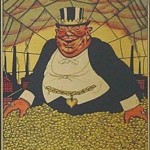
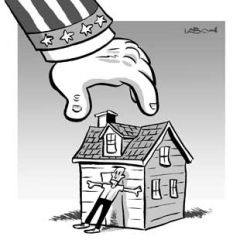
About two years ago, there was an major academic study which confirmed what the public had understood for decades, that government no longer represented ordinary Americans. The heavily documented study confirmed that the government---legislative, judicial, executive and the supporting bureaucracy---primarily serve the interests of the top economic 1%, which included the major transnational corporations and banks. Most of us had intuitively known this for decades, but even for the doubters, the illusion was shattered when the Obama Regime bailed out Wall Street and several failing companies with taxpayer money despite the public outcry. The reason wasn't some economic catastrophe. It was old fashion greed plain and simple. An ongoing attempt to bilk customers out of billions and it failed. So, with pressure from the government's corporate overlords, Obama authorized billions of our money and yet no one went to jail. In fact, some of our money actually went to pay millions in bonuses for these crooks in their stripped three piece suits who should have been wearing stripes of a different kind.

This study went on to confirm that, thanks to corporate money, the business-government revolving door, the working and middle class have little or no impact in US policy---domestic or foreign, or in US laws. This was verified again when the not-so-supreme Supreme Court affirmed Citizens United which declared that corporations were, in fact, "people" and as such, entitled to the same rights as flesh and blood people were, with one key exception. The High Court also ruled that money equated to free speech, and while you and I are capped as to how much "free speech" we are allowed to contribute to political campaigns, these "Frankensteins" aren't restricted in what they can give. That means they can buy who they want out in the open.

At the time of this study, the top 1% controlled approximately 40% all wealth. Now, comes a second study, this time by the Pew Research Center and the news isn't good. As of 1971, 61% of Americans fell with the parameters which defined the middle class. Now, according to the study, less than 50% of Americans qualify as middle class while the number of poor or working poor has steadily risen to the current 20%, up from 16% in 1971. While no specific cause was mentioned, there were several contributing factors, among them NAFTA, CAFTA, and of course, the Citizens United misruling. The super secret Trans Pacific Agreement will no doubt makes matters worse as it comes into play. Meanwhile, while income levels for ordinary Americans rapidly decline, the pay for CEOs has risen 937% since 1973; some 300 times more the pay of the average employee. Is it any wonder that with the US making up just 5% of world's population, it has 46% of the world's wealthiest individuals? So, add to this rising prices from everything from food to clothing to rent (of which seniors comprise the largest bloc), as well as the wildly fluctuating fuel prices, electricity, water, sewage and garbage costs, and non-essentials such as cell phones and internet plans, and you have the makings of some serious economic trouble and political instability (and this doesn't even include the wars in the Middle East, illegal immigration, and terrorism. Good thing we have the "Patriot Act" and government surveillance, a perpetual push for gun confiscation, a ruling oligarchy and the militarization of the police huh?).

As if all this wasn't bad enough (and it is), there's some more news on the economic front. As I told you earlier, the 1% control not just the federal government and a significant amount of the wealth, a new study shows that globally, the top 1% controls just under 50% of all the world's wealth---48%, which wasn't supposed to happen until sometime in 2016. That equals around $218 trillion dollars (yes, trillion with a "T").
The report was made public by the Swiss investment bank, Credit Suisse. The report goes on to say that the top 10% owns 87.7% of the world's wealth, which leaves everyone else---90% of the world's population---a paltry 12.3%. Is it any wonder why there's been such a revised interest in democratic socialism and libertarianism? The report concluded by saying that by the end of the decade, the world's top 1% will control more wealth than the entire remaining 99%. Needless to say, this is not acceptable. So dear reader, I put it in your hands. What should we do?


Pew Research: The American Middle Class Is Losing Ground
http://www.pewsocialtrends.org/2015/12/09/the-american-middle-class-is-losing-ground/

America's Middle Class Is Getting Squeezed Out
http://www.usnews.com/news/blogs/data-mine/2015/12/10/the-middle-class-is-shrinking-and-the-rich-are-getting-richer-pew-report-says

Middle-class families, pillars of the American dream, are no longer a majority, study finds
http://www.latimes.com/nation/la-fi-middle-class-erosion-20151209-story.html

Pew Study: Middle Class Declining, No Longer Majority
http://www.breitbart.com/big-government/2015/12/09/pew-study-middle-class-declining-no-longer-majority/

The Top 1% Now Owns 50% Of World's Wealth
http://anonhq.com/top-1-now-50-worlds-wealth/


US Confidence in Institutions Remain Below Historical Norms
http://www.gallup.com/poll/183593/confidence-institutions-below-historical-norms.aspx

Tuesday, August 25, 2015

America: Still the Home of the Brave and Land of the Free?


America. Home of the Brave and the Land of the Free. These ideals have been the hallmark of every American's socialization since childhood. Americans see themselves as strong, hardy and innovative; an individualistic "up by your own bootstraps" kind of people. In many ways, the ideals of our pioneer past have never left us: reinforced by our cultural myths and made tangible by countless books, plays, and the magic of Hollywood. There's no doubt that the US military is second to none. Not just in the world but in history. We have the best equipped, the best trained, the best fed, and the best motivated military in the world. Quite simply, American military presence can reach out and touch anyone anywhere in the world at a moment's notice 24/7/365 with the most extreme prejudice. They can also build schools and hospitals. But what about the second half of that statement---Land of the Free. Surely, we as Americans are free...aren't we?

Americans certainly think of themselves as being free, or at least most of us was brought up with that notion. We've always considered the US President to be the "Leader of the Free World". However, it seems that few still do nowadays. Certainly in the world, America doesn't carry the prestige it once did. The image of the "Ugly American", first popularized in the early 1970's as a stereotype of the occasionally rude, often patronizing and arrogant American who thought, rightly or wrongly, that the world should be made over in the American Image---whether they wanted it or not---as part of the belief in our own Exceptionalism. So then, how do we stack up when it comes to freedom?

According to the 2015 Index of Economic Freedom published annually by the Heritage Foundation, the top three most economically free economies belong, in order, to Hong Kong with a 89.6 rating out of 100. Next is Singapore at 89.4 followed by New Zealand with a rating of 82.1 (Australia and Switzerland round out the top five with 81.4 and 80.5 respectively. The United States placed 12th, between Denmark and the United Kingdom with a rating of 76.2. European powerhouse Germany ranked 16th with a 73.8 rating while Japan was 20th with a 73.3.

In terms of fiscal spending, the US ranked a 66.2 out of 100 while tiny Bahrain received a rating of 99.9. Norway had a 52.1 while Mexico's was 77.8. Russia had a rating of 86.1. Things were much improved for the United States when it came to labor freedom despite the decline in organized labor. Here the rating was an impressive 98.5. Saudi Arabia had a rating of 72.7. Russia was 58.9 while China had an unexpected rating of 63.0. The UK's ranking for labor freedom was 75.6. No other country ranked as high as did the US in this category. What about personal freedom?

In terms of property rights, New Zealand ranked first in the world with a score of 95.0. Numerous countries were tied for second with a rating of 90, including The Netherlands, Canada, Iceland and the Scandinavian countries, the UK, Singapore, and Australia. As for America, it came in with a rating of only 80.0. In terms of financial freedom, the highest marks went to Australia and Hong Kong with a rating of 90.0 each. There were numerous countries with ratings in the 80.0 range including the Czech Republic, Estonia, and the United Kingdom. As for the US, it ranked a 70.0 along with second tier nations like Panama, Columbia, El Salvatore, and Hungary as well as some leading countries such as Poland and Germany. For the record, China and Russia received a score of 30.0 while Saudi Arabia rated a 50.0. So, it's quite obvious America is not quite as free as we would like to believe it is. If you're ever looking for the real Leader of the Free World from an economic freedom perspective, you might try Leung Chun-ying. He's the Chief Executive of Hong Kong. Now, what about education?

I've always thought that the single most important investment government can make was in the quality of its education system, which only makes sense. A society which produces a well rounded graduate is going to see a more productive and innovative individual. This in turn grows businesses, which adds jobs and produces more tax revenue to improve the quality of life for the community or nation. The policy of "flunking forward" by passing kids who've underperformed all out of concern over their self-esteem does no one any good. Yes, it gets them through the system but it produces uneducated graduates who then become someone else's problem, usually society's in terms of higher crimes rates, incarceration costs, more public dollars for social services like food stamps, housing, medical care, and generational poverty. At the same, employers are stuck with unqualified workers, lower productivity, higher medical costs, and higher turnover. As a nation, we find ourselves unable to compete effectively which feeds the downward economic spiral. With that in mind, let's take a look at how we stack up with the rest of world.

According to a May 13, 2015 report by the BBC, Asia seems to have lock on world's brightest minds. In terms of math and science (15 year olds), Singapore came in tops followed by Hong Kong and South Korea. Japan and Taiwan were tied at fourth. Vietnam was 12th. The highest European nation was Finland, which ranked 6th. Estonia was 7th with Switzerland and Holland taking eighth and ninth place
Canada came in tenth. Eleventh place with to Poland. The United States was tied with Italy in the 28th spot, coming in just ahead of Portugal.

In the area of reading, top honors went to South Korea. Finland was second with Canada, New Zealand and Japan--just beating Australia--rounding out the top five. The United States came in 14, splitting Iceland and Sweden. Great Britain was 20th and Mexico was dead last in 34th place. With such poor rankings, you would think that we need to spend more money on our failing educational system. Well, you'd be wrong. America already ranks first in dollars spent per student in the world with an average of just over $15,000 spent on each student (K - 12). Nevertheless, the 2013 report released by the Organization for Economic Cooperation and Development (OECD), American teachers made about $7000.00 more a year than the other educators ($38,000 vs. $31,000). If academic success is an indicator of a nation's economic success, then clearly the US is in serious trouble.

While I'm sure there are multiple explanations for this, such has overpaid administrators and teacher unions more concerned with maintaining their political clout and protecting teacher seniority rather than improving the methodology of teaching, I think it's essential that educators need to be left to teach rather than being overpaid babysitters. First and foremost discipline must be restored and enforced with a zero tolerance for bad behavior. We must stop excusing wrong behavior and we must stop drugging students. Second, kids need to be taught at an early age the need for critical thinking skills and developing their intellectual creativity. Third, teachers should teach only in the areas they're qualified for. Lastly, teaching is critical and should be rewarded as such, both financially and in terms of respect. They shape the futures of individuals and indirectly, the future of communities and nations. However, I want to qualify that by saying incentives should be based on individual classroom performance. Gifted children should be given every tool possible to excel, even if segregated. To many students graduate from High School with a sixth or eight grade reading level and no problem solving skills. That's completely unacceptable and the school and school system must be held accountable; financially if necessary. While more emphasis must be placed on math, science, and reading comprehension, we can't overlook the arts, history and civics even if the school year needs to be lengthen.

I know life is tough. Most parents work at least one job; many work two. While I don't believe it takes a village, nevertheless, the parent has a responsibly to take an active role in their child's academic performance. Every parent and someone from the school must meet regularly. No exceptions. Personally, I like the German academic system whereby children are tested as to their abilities and interests and encouraged in that direction. And let's be honest---not everyone should or needs to go to college. Not all jobs require an advanced degree when a technical certificate will do. Therefore, I strongly recommend bringing back trade schools. We don't need more lawyers, we need more carpenters and plumbers.

One last topic I'd like to address. Respectability. It's critical for our own individual success. It's also critical for our national success since it attracts not just tourists and students, but foreign investments as well as helps build alliances. I started off discussing "the Ugly American". How do we stand these days? According to a 2015 report from Forbes, the most respected country in the
world is Canada. Norway and Sweden came in second and third. As pointed out by the report, Finland and Scandinavia have consistently ranked in the top ten for the last six years, along with Holland, Australia, and Switzerland. As for the United States, we ranked 22nd, just behind military junta ruled Thailand. Isn't that special? One of the reasons cited by the report for America's dismal showing was the Citizens United ruling by the Supreme Court which added more evidence of our broken political and economic systems. I would add that the 2014 report verifying that America was no longer a functional democratic-republic, but an oligarchy serving the interests of leading corporations and the top 1% was a strong contributor as well.

There you have it. While we are not the freest country in the world by any measure, we're not the worse off either. Most certainly, we're a far cry from what our Founding Fathers intended. Academically, we're in serious trouble when compared to the rest of the world; especially our economic competitors. We've lost our Republic when we became an oligarchy with a rising police state (these, by the way, are not signs of "creeping socialism". Quite the opposite, despite the rhetoric of some Rightwing groups. These are signs of fascism. It's not Italian or German fascism. It's not Franco's Spanish fascism or Peron's Argentine fascism, nor the fascism found elsewhere. Fascism adapts. It draws from the Left and Right based the customs, traditions and history of each country. There are two things they always have in common though. One is to demonized whatever they fear the most and secondly, they advance in increments; two steps forward and one step back. A step to the Left and a step to the Right. Probing. Always testing the resolve of the People. So, what do you think they've found here? Is there resistance or is there complicity from indifference? Is this the free America you expected?


2015 Index of Economic Freedom
http://www.heritage.org/index/explore


Asia tops biggest school rankings
http://www.bbc.com/news/business-32608772

World education rankings: which country does the best in reading, maths, and science?
http://www.theguardian.com/news/datablog/2010/dec/07/world-education-rankings-maths-science-reading


The World's Most Reputable Countries, 2015
http://www.forbes.com/sites/susanadams/2015/07/15/the-worlds-most-reputable-countries-2015/


How America Became an Oligarchy
http://www.commondreams.org/views/2015/04/06/how-america-became-oligarchy

Saturday, June 13, 2015

We Interrupt this National Decline...

It was once said that that all roads led to Rome. It was true figuratively and as well as literally. With some 100,000 miles of road, it provided direct access for the Roman legions to any hotspot within the empire. It established trade routes throughout the empire and eventually even connected to the Silk Road to the Near Eastern nations, India, and finally to China. But, as goes another old saying, as Rome's roads went, so went the Roman Empire and its ability to defend the empire and its trade routes, and with that, along with the decline in political stability thanks to the ineptitude and corruption of the political class and the financial elites, taxes, decline of the water systems, agriculture, decline in innovations, quality of the fight forces, increases in pirates and illegal immigration who didn't integrate, the rise of the poor amid the decline of middle and business class, ever more successful foreign invasions, devaluation of its currency, and a host of other factors---some major but most subtle, the glory and the might that was Rome gradually faded over the course of about 300 years until it became but it memory.

Much the same has been said America. Certainly, we face many of the same factors. Like Rome, we went from rule by a monarchy to a Republic and now to an oligarchy; controlled by transnational corporations which have no loyalty to either a nation or national ideals. Wealth--- economic and political control---is the hands of the top 1%. Our Middle Class is all but nonexistent while not the ranks of the poor increase, some communities and cities look like they belong to some third world nation, as social services decrease due to expense. We too experience a debt that not only can we never hope to pay, but is actually unsustainable. We too are being invaded by illegal immigrants looking for a better life, but few are finding it. They too are refusing to assimilate. While are military remains strong (though, like Rome, there is talking about incorporating illegal immigrants as an avenue to citizenship), it is ever more dependent on technology, which makes it vulnerable to shortages of those able to operate and maintain it as our educational system continues to decline.

Like Rome, we face a decline in social morals and a sense of community values in the name of "inclusion", or as we would say, "political correctness". Our roads, dams, electrical grids, bridges, and highways are crumbling too, and again, like Rome, a public reluctance to paying for repairs through higher taxes (they often did so out of the pocket of a government official, usually seeking higher office). Trade and often innovation has steadily shifted overseas, not for lack of resources, but avoidance of labor costs or in some cases taxes, and then reshipped back into America by these stateless corporations. Meanwhile, public funds are often diverted to pay costs they incurred or for poor management while local businesses struggle or are forced to close.

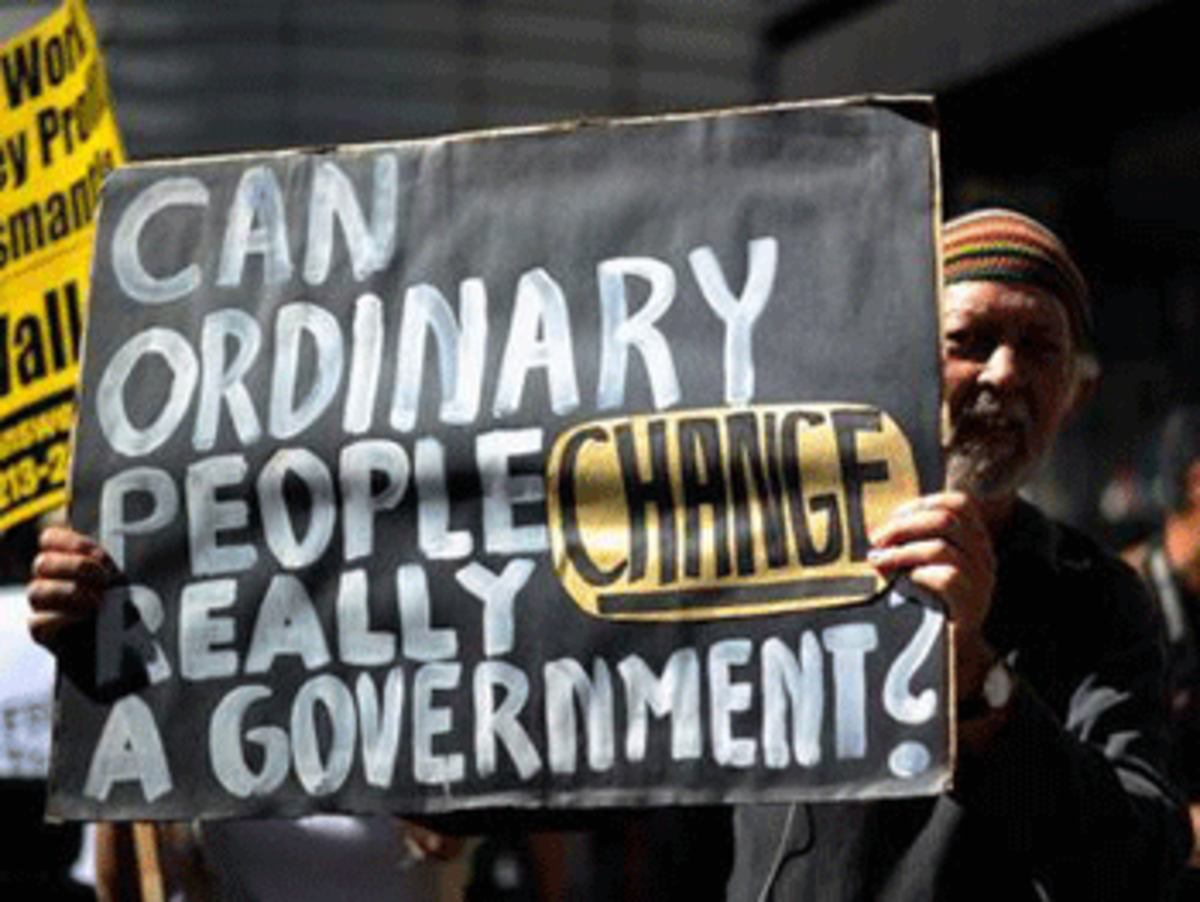
I could go on and on, but we all get the picture. It doesn't matter if you lean politically Right, Left, or like the majority of Americas, to the center and increasingly independent. We've all witnessed the rise of the Occupy Movement which opposes the economic and political control of Corporate America and the 1% while others, such as the Tea Party, opposed to over reach and intrusion of a growing federal government clamber for a return to the original intent of the Founders. Therefore, it seems to me that it's time that we refocus the discussion. We see what's wrong with America, though we may have different solutions. Perhaps it's time for changing America and move away from mere criticisms. The powers that be hold power largely because they've been successful in dividing us, which is ironic if you accept that we largely want many of the same things. We---as individuals and communities---have allowed ourselves to be pitted against each other across artificial divides. As long as we argue and fight each other we fail to see those who are not just the source of our misery, but profiting off of it.

Maybe it's time we reconsider if we want this to remain a single nation? Perhaps we time we go our separate ways. Or, as some contend, the Constitution (largely usurped already) is outdated; made obsolete by technology and societal changes unforeseen by our Founding ancestors? Perhaps a democratic socialist state which serves the needs of all equally is what we should strive for (and no, we aren't "socialist" now despite the talking heads on the Right. We are, however, increasingly fascist---corporation rule per its creator Benito Mussolini) or should we rely on our innate abilities embrace libertarianism as espoused by Jefferson? Some would argue that we've advance to far as society for that---an ideology best suited for small agrarian societies.

The demise of the oligarchy and restoration of the Middle Class are givens I think. How about freedom? How much do we want? How much can we stand? What kind of freedom to we want? China calls itself "free" and so does Holland. What form of government do we want now that we no longer have a democratic republic? Do we return to a democratic republic but with greater restrictions? Certainly ending gerrymandering, adding term limits, real finance reform and reversing "Citizens United" I hope; perhaps too, revising federal judicial appointments, including federal judgeships and the often out-of-touch Supreme Court. What about proportional representation like the other limited democracies have or mandating voting? Regardless, let's consider the America we want and not the one Washington is giving us.

The elites control us by controlling our ability to communicate. Did you know that only six corporations control our public media?
They attempt to mold and manipulate what we think and how we act. Mao Tse-tung once said that power came from the barrel of gun. Nowadays, it's more likely to come from the click of mouse. Within little more than a decade, we've witnessed how social networking and the Internet has brought down military dictatorships, theocracies and other corrupt governments. It's little wonder nations, including the United States, have banded together in an attempt to control, regulate, or monitor the Internet. The idea of people exchanging ideas and find a commonality brings fear to those who try to inspire fear and intimidation to their people. This may yet prove to be more powerful than Mao's bullets. This then is our best tool to molding a nation or perhaps a world into what we want. As has been said, people don't want wars. Governments and banks do.

And speaking of the world, we, as Americans, must understand and accept that we have no obligation or even right to impose our values, beliefs, or even our form of government on any nation or any people. All individuals have a natural right as human beings, to chose freely the form of government they want irrespective of what their neighbors desire them to have. Though not alone, America has interfered and attempt to impose its concept of Americanized government or worse, violent militarized juntas on people for the sake of economic profit and corporate control. If we demand freedom for ourselves, they we should do less than allowing others the right to chose their own governments whether we agree with it or not.

In our present military situation, our response to 9/11 was to find and bring to justice those responsible (and accepting, however painfully, the reasons why 9/11 took place). Beyond that, we proceeded for the sake of economic---corporate greed--while claiming the virtues of "freedom". Kuwait was not liberated for "freedom of Kuwaiti People" or even Royal promises of social, political or "gender" equality---none of which never materialized, but for influence and control of assets. The invasion of Iraq wasn't required. Saddam Hussein's Iraq was already impotent militarily and politically. It wasn't done for the sake of the Kurdish People who we've promised much and delivered little. It was for the sake of controlling Iraqi oil and gas. What it did, thanks to an incomplete and unrealistic occupational plan, was open an Pandora's Box that has costs the lives of thousands of brave military personnel while at the same time providing a gold mine for lobbyists, contractors, the WTO, the IMF, and others, not to mention a perfect sandbox for testing the military's latest toys.

The adoption of the never-ending "war on terror" and a terrorist or potential terrorist behind every tree mentality has also provided
a perfect excuse to impose restrictions on our freedoms which we never would have previously tolerated; surveillance of all/threat by few/denial for your own good is our new mantra, and a way to cover-up a weak economy racked by unsustainable debt and greed through a never ending supply of recruits to keep the employment numbers down and keeping the economy running on a artificially inflated "war economy". This too is something we must address since this conspiracy, which is not of the making of a few extremist crack pots, but adopted by both parties as cover for the oligarchs who now run our country. Meanwhile, endure those who have a visceral hatred of this country; who attempt to make profane the American Ideal and its symbols while pursuing every recourse to weaken and belittle this nation.

These are things we each see and mostly agree on. The powers that be will continue to obfuscate, distract, divide, frighten, or if necessary, threaten. It is also quite capable deceit, lies, of manufacturing evidence or worse. The question I repeat, is not to continue to debate the merits of what we all see, but to agree that we must begin to find ways of addressing them. Whether the status quo agrees is irrelevant. Ultimately the only real power it has is the power we cede to it.

Saturday, March 28, 2015

What do you believe?

How religious is America? What would be your best guess? According to a survey taken in August of 2014 on behalf of the Religion News Service, America is in the midst of a "great decline" among the mainstream churches. In 1994, 94% of those who attended church identified with that church. Today, that is about 85%. Church membership is down from 69% ten years ago to approximately 59%. Speaking of church attendance, that's down to about 53% in 2014 compared to 62% in 1994.

The role of religion has declined too. In 1994, 88% said religion was important in their lives. Today, only 78% say it's important. In terms of relevance, that too has declined, albeit not significantly, from 79% to 70%. However, what may actually be a more important indicator is the result of five Gallup polls averages which shows that overall religious importance has declined from 78% to 69%. That is significant. According to a recent Gallup Poll, 53% of those surveyed said they were satisfied with religion's role in public life. While that is a majority, its certainly isn't a commanding majority, especially when you consider than in January 2001, that number was 64%, and a year later, in 2002, that number was 68%.

How does that break down along demographic lines? This is an important question given that religion has been interwoven into the
fabric of America since Jamestown, and religion is still reflected in the voting booths. 9 in 10 Americans believe in God; that's 92%. Going back to "the Greatest Generation" of the WWII era, that number was 96%. Between 1953 and 1967, it was incredible 98%. Women tend to believe in God more than men (94% to 90%). Older Americans too believe in God more than those between 19 and 29---94% to 84% (perhaps older populations are simply covering their bases!). The most interesting aspect of the poll was how the percentages changed when the respondents were asked if they believed in a "Universal Spirit" or a "higher power". That number jumped by 12%. This would seem to mean that while there's a strong belief in a Creator, fewer identify with the more dogmatic version of organized religion.

Millennials (ages 18 to 33) are the next big demographic wave to hit as we've often discussed on this blog. With 50% of them self-identifying as independent, Millennials have no love for the current social/economic/political system. This includes the two party duopoly, the corporate capitalist economic system, with a split between small "L" libertarianism and democratic socialism (with the later getting the slight nod), as well as discrimination of any sort, including gay marriage, or interracial mixing. They are the most diverse of all the generations (43% are non-white). They tend to vote Democrat, though they are not aligned with the Democrat Party; they just like the more liberal stance of Democrats on social issues than the GOP (for instance, 68% favor gay marriage while 69% support legalization of marijuana). So it should come as no surprise that Millennials have little positive to say about religion; at least organized religion. Millennials have proved to be both optimistic about the future and on the whole, willing to roll of their sleeves and get to work when they find an issue or cause that's important to them. They are also the most technologically connected of any generation. They've never known a time without handheld electronics, computers, or social networks. They are also more inclined to delay marriage and have the largest percentage of debt (mostly school loans).

When it comes to religion, 36% say they consider themselves as religious, with almost 30% say they are not affiliated with any religion (read "organized religion"). This compares to 21% of Gen X (ages 34 to 49), 16% of Boomers (ages 50 to 68) and 9% of the Silent's (69 to 86) who say they aren't religious. When they are affiliated with a religion, few are members of conservatives churches since the majority are liberal to very liberal on social issues. 58% of Millennials say they believe in God, while 28% say they believe, but they're not entirely sure actually exists, and 11% say they don't believe in God at all. Compare this with 69% of their older Gen X brethren, 73% of their Boomer parents or 74% of their Silent generation grandparents.

So, what's the takeaway here? I think it's the realization that religion---particularly mainstream organized religion---will likely decline as Silents and the first wave Boomers (those born between 1945 and 1964) age out. Non-organized religions, especially non-traditional faiths like those which emphasis spirituality (Native American, Wiccan), as well as Buddhism or even moderate Islam will continue to take hold due to the increased internationalization of the average American continues amid the decline of the once dominate WASP (with the increase of Hispanics, remember most are Catholic and while some are embracing Protestant churches, most remain, at least nominally, Catholic). What is expected to remain stable is the traditional mostly conservative and socially active black churches such as the Baptists, and AME.

In addition, Millennials do not support church activism when it comes to politics. Again, I think we can, therefore, expect the
role of the religious Right to decline inasmuch as their influence on political matters. For some, this will be viewed as a very bad thing, however, with the largely left of center and even somewhat democratic socialist ideals held by Millennials, the conservative Right as we know it now may become marginalized to a more localized role and off the national stage as a key player. The only way they can avoid this is by adjusting their political plank on social issues to the middle or even slightly center left. This will certainly mean a complete overhaul of the Republican and/or Tea Party as well as a strong commitment the ideals of the Constitution which, at least, the libertarian Millennials support. However, at present, with the near stranglehold the far Right has on the Republican Party (and increasingly on the Tea Party), change may not be possible until the GOP and/or Tea Party accepts that its ideals are out of touch with most Americans. Therefore, the strategy has to be adapt, change or die (as an aside, please recall that America is now governed by a oligarchy comprised of the 1% and a few key corporations, so that too will have to be addressed regardless of all other considerations).

On another level, religion, regardless of denomination, has served as a basic foundation to establishing and maintaining a moral foundation for most Americans. America was founded on Judeo-Christian values along with ideals from the Enlightenment. Religion laid out a set of broad guidelines or boundaries of behavior; or what's acceptable and what's not, which was usually reinforced by our parents and the schools we attended. Americans have always turned to religion when times were rough, either personally or for the nation as a whole. It has been a guiding light or safe harbor. It's also provided inspiration for us individually and for us as a nation. How does the decline in religion impact this? First, I think it's instrumental in defining our moral compass. Just look around you or watch the television and you'll see what happens when people lose their moral guideposts. I guess you can say that this system of Judeo-Christian values and ideals of the Enlightenment helped to create the American character.

Because of the all the trauma and societal betrayals by the government, legal system, education system, and churches, we've lost the ability to trust our institutions. In fact, there is very little institutionally speaking that we have any faith in (perhaps our military is all that's left). That's not to say America is becoming atheist. We still crave a spiritually rudder. That's clearly shown by the nominal levels of those who claim to be atheists as shown in the surveys, not to mention the strong numbers of those who are looking outside of mainstream religions. I think too that the expanse of science has played a part. The more knowledge we as a species acquires, the further back we push back the veils of superstitions and myths, and yet, we still cling to the idea if not the belief in God, and I think we always will. Personally, I find God in the beauty and complexity of life; from the simplest of life forms to the vastness of the Cosmos. I also think that because of the cross pollination of ideas and cultures through technology and globalization, we're gradually learning to accept that there is more than one path to reach what we commonly refer to as God, and that can only be a good thing. Ultimately, we are one species; more similar in our aspirations, emotions, and fears than not. We will either evolve together or we shall perish together.


5 Signs of the 'Great Decline' of Religion in America
http://tobingrant.religionnews.com/2014/08/01/five-signs-great-decline-religion-america-gallup-graphs-church/

U.S. Satisfaction With Religion Settling at Lower Levels
http://www.gallup.com/poll/181532/satisfaction-religion-settling-lower-levels.aspx

Poll: 9 in 10 Americans Still Believe in God
http://www.huffingtonpost.com/2011/06/06/belief-in-god-poll_n_872059.html

Millennials in Adulthood
http://www.pewsocialtrends.org/2014/03/07/millennials-in-adulthood/

Generation Atheists! Millennials to religion--get out of politics!
http://www.salon.com/2013/11/04/were_raising_a_generation_of_atheists/


Monday, July 21, 2014

Barack his Rocker: What Makes Obama Tick?


Ok, let's make this clear from the get-go. I'm not a psychologist, but I do have a pretty good understanding of human nature, and something isn't quite right here. Why is it that every time there is a crisis, Obama finds a reason to avoid serious discussion and more often than not, a reason---preferably fundraising or playing golf---to get out of town until things settle down? Obama seems unwilling or simply unable to play in the big leagues, especially in situations he helped create.

While our technology has changed down through the millennia, Man himself really hasn't changed much. The same things which motivated us 10,000 years ago still motivates us now, just as the same types of things which inspired fear, confidence, hatred, compassion, love, selfishness and all our other emotions---voluntary and involuntary---are still with us; they've been hardwired into our collective psyche since we dropped out of the trees; or arrived as a slave race for aliens; or was pieced together out of Mesopotamian mud, depending on your personal beliefs. Each of us also has a "flight or fight" gene. We can even be tested for it (I was, and not unexpectedly, I tested positive for the "fight" variant, but then again, that could just be my overabundance of Irish and Scots ancestry too).

Nevertheless, could it be that Obama has the "flight" gene and an internal need to run away when confronted from a situation beyond his control? Could this have been reinforced by his acknowledged "troubled" childhood, or even his need to overcompensate? Numerous professional book reviewers of presidential and presidential hopefuls have cited numerous inconsistencies in his books, and more than a few troubling statements about feeling socially and/or racially inferior, even in terms of his early Moslem upbringing. His professional lack of experience, either in the business arena, the military, or even in politics has left him woefully unprepared for the type of serious and often immediate decision making a president is required to make; often with inadequate or incomplete information.

We know that many of the claims made Obama's supplicants , especially regarding his academic prowess, either simply never happened or somehow, he was omitted from some of the nation's most prestigious academic records and his classmates have come down with a serious case of amnesia (or were they blinded from his brilliance?). In fact, intellectually, the guy isn't really all that sharp despite an incredible and magnetic speaking ability...with a teleprompter. But speaking, with or without a teleprompter does not an effective president make.

In an era where just about everything a potential candidate ever did, from their birth (hell, conception) to their present moment in time is analyzed and reanalyzed ad nauseam. We hear from their kindergarten teacher, earliest playmates, babysitters, coaches, friends, neighbors, tailors, until we'd rather switch channels and watch infomercials instead. We learn in minute detail about their family, their eccentric aunts and uncles, cousins, family heritage, and so forth. And yet, we know next to nothing about Obama's, and what we think we know is often full of contradiction or are simply a blank. How's that possible? Those things we do have a reasonable certainty about are, frankly, troubling, especially his participation in clearly Marxist or communist organizations, associations with black racists, or with 60's era terrorists. His own comments regarding race, particularly about whites, are especially disconcerting. It makes me think of someone who has a fragile inner sense of security---not the same as self-confidence mind you---and with it, a internalized hatred of all things which "hurt" him as a child; which causes him to feel inadequate and propelles a need to appear superior; a persecution mentality now given an opportunity for revenge. I read once where Bill Clinton had a sense of insecurity stemming with his birth and an abusive relationship with his father and the need to protect not just himself, but his mother as well. This supposedly lead to both a drive to excel and a constant need for validation, be it the cheers of the crowds or his extra martial affairs.

All of this brings me back to Barack Obama the Man. Why does he seemingly make these inflated public statements following a crisis event which often sound phony or makes promises/threats which nobody, especially the intended party, takes seriously? As President, there is much Obama can do about the illegal immigration situation for instance, and yet despite constant threats to use executive orders (his "magic pen" as he's called it), nothing happens. He knows (as does Congress) that the American People want---demand---that the southern border with Mexico be secured, militarized if necessary (in all fairness, George W Bush was keenly aware of this too and failed to act), yet not only does he not act, he's repeatedly done just about everything in his power to make the situation worse. Now, faced with a major crisis, he further refuses to take action. When he went to Texas recently, it wasn't to access the border situation, it was for another fundraiser. It's like a child who refuses to look at the mess they made as if by not acknowledging it, the mess doesn't exist. When the assault on Benghazi was underway, Obama was at fundraiser. When the US military command was a go in dispatching mass murderer Osama Ben Laden, Obama was found on the golf course. During the operation itself, some individuals in the situation room said that Obama was beside himself; second guessing himself. In dealing with situations in the Middle East, especially those involving the terrorists groups, he has continually shown himself as weak and that's usually a fatal mistake.

More recently, the military situation in Gaza and the downing of the MH17 has shown Obama again out of his depth. His statements are characterized as worthless; unbelievable. Our allies, especially Israel, have good reason not to feel confident in the Obama Administration, although I think they can completely count on the American People having their back. Meanwhile, our adversaries, or former adversaries, can barely contain their contempt for the man. I dare say that even many of our allies feel the same way. American economic and military power, along with our political prestige continues to flounder, not necessarily because we are weak economically (though we are much to debt heavy and we have all but lost our middle class while becoming officially an oligarchy whereby the government represents primarily the top 1%), and we still the best trained, equipped, and dedicated military in the world, it's because the government and its leaders (notice I didn't say "our" leaders) like the President, his Administration, and Congress are perceived globally as inept and ineffectual. As in advertising, image in politics, especially global power politics, is everything.

Obama retreats to fundraisers, golf courses, lengthy vacations, or ineffectual press conferences because they're safe. He understands them. He feels safe. He believes he can control the situation; perhaps things will sort themselves out or someone will devise a way out for him. Regardless, the distance from the "real world" and the one of illusion which he has created for himself throughout his life, is intact. The ultimate problem is that the world is spinning out of control at an unparallel rate. The world needs America despite their occasional claims to the contrary. We are not the world's policeman, but we are its best, and perhaps ultimate hope for continued survival like it or not. In the absence of our leadership, those who desire to enslave of the human mind and soul see only encouragement to crush Humanity's Will. Our adversaries will press forward with the own agendas while the shadow of tyranny will continue to stretch over and quickly darken the light of freedom which we represent. Barack Obama has serious flaws, but I'm not explicitly speaking of the man---we all have our own failings and I would be the last to cast the first stone---and historically, America has made some terrible mistakes in judgment. We're not perfect, but we try. America needs a dedicated and serious leader it can count on, and the world needs to know that we have its back. Against evil, failure is not an option.

Shrink: Very Concerned Over Obama's Mental Stability
http://govtslaves.info/shrink-concerned-obamas-mental-stability/

Is Barack Obama Mentally Stable: More Questions
http://www.truthandaction.org/is-barack-obama-mentally-stable/

Networks Ignore Criticism of Obama Attending Fundraisers Amid International Crises
http://m.newsbusters.org/blogs/kyle-drennen/2014/07/18/networks-ignore-criticism-obama-attending-fundraisers-amid-internation

A Frustrated Obama Constrained
https://www.nrcc.org/2014/07/21/frustrated-obama-constrained-mundane-matters-nowhere-found-crises-break/

Obama takes heat from both sides for skipping border on fundraising trip
http://www.foxnews.com/politics/2014/07/09/obama-takes-heat-from-both-sides-for-skipping-border-on-fundraising-trip/

SICK: Obama Will Do 2 Fundraisers Today After 23 Americans Die in Crash
http://conservativetribune.com/obama-fundraisers-today-after-americans-die-crash/

Saturday, July 19, 2014

Socialism or Fascism: Which Way America?

I keep reading articles or hearing people, mostly on the Right, speak about the Obama Regime or Democrats in general leading us down the road to socialism's perdition. When George W Bush was in office, the Democrats and those on the Left kept comparing "Dubya" with Hitler and the Nazis. First off, there's no way those in power on the Left or Right would allow this country to become "socialist"; they simply are not going to give up their wealth or power and neither will Wallstreet or the banks. As for National Socialism, this means basically a "one man/one party" rule and there's too many primadonnas in Washington for that to ever happen. In addition, National Socialism meant a partnership of sorts between the government and Big Business with the latter assuming a junior role, and we all know Wallstreet would never go for that today, and by the way, the "socialism" part of National Socialism didn't mean what most people today assumes it meant. For them, it meant a community of likeminded people or "Volk". So then, let's talk about just what road we are going down.

Socialism means that the people essentially own everything, including the corporations. Power and the control of wealth is in their hands. I don't see that happening do you? I don't see the Wallstreet or K Street lobbyists becoming weaker. Certainly that's not what the "Citizens United" or "McCutcheons" decisions by the Supreme Court did. Under communism, which is often---though incorrectly--- used interchangeably with socialism, there are again no privately own properties, especially corporations. The State owns everything. Do you see corporations surrendering their power and wealth to Washington? So, what is it that America is morphing into? The answer is fascism. Fascism is, as its founder Benito Mussolini said, more accurately described as "corporatism". Specifically, Mussolini said this “Fascism should more appropriately be called Corporatism because it is a merger of state and corporate power”. Novelist Upton Sinclair called fascism "capitalism plus murder" while Vladimir Lenin referred to fascism as "capitalism in decay".

Politically, it borrows some of its goals and techniques from the Left and some from the nationalistic right, including militarism. But it's objective is corporate control, plain and simple. The role of government is to serve as the junior partner and "middleman" between the "elites" and everyday people. It's objectives are to serve the rich. The corporation is everything. The individual is nothing. Under fascism, there is little to no middle class. There's the insanely rich and then there's everybody else. Sound familiar? Can you see the one percenters giving up their money; their penthouses; their private planes and yachts? Under socialism, they'd have to; the same under communism.

Consider this too, Unions exist under fascism, but are weak and fairly ineffective. Their prime purpose to keep the masses in their place---on the job and off the strike line---while generally backing the decisions of the corporate bosses. They serve the interests of the corporation, even if it means cutting benefits, pensions, and hours. Under communism, the State is the union and you automatically belong to it. But again, no strikes and no complaining. Under socialism, there is no rich or poor; everyone is equal, so there's really not much need for unions, but if there were, everyone would be a member at birth.

So, what would it be like to live in a socialist country? Actually, not all that bad. Yes, taxes would be near 100%, but then social services would cover nearly everything, and they would be offered in sort of a smorgasbord or al-a-carte format. The emphasis of government would be on a very active participatory democracy; there would be little if any "mandating" of anything and a strong emphasis on the individual. Companies would be run more in a co-op fashion, with the focus on needs and social uses rather than artificial want and profit. Financial institutions would be similar to credit unions, whereby members have a say in the company's policies; that is if there's even a need for money. There would be a strong emphasis on the long term approach to maintaining infrastructure too. Personally, I would have no problem with a socialist government, but unfortunately, the world has never actually had a socialist government. Greed and power always seems to get in the way. Scandinavia has gotten close; consistently ranking as the happiest and healthiest and best educated places to work and live with some of the longest life expectancies in the world, and the most environmentally friendly as well. What's not to like? Let me tell you.

Sadly, the EC's mandatory "open door" policy to immigration has cause these once idyllic nations to come to their collective breaking points as immigrants fail (intentionally it would appear) to adopt to the same work ethic as the native populations which believe in sharing the work (and taxes) while sharing the obvious benefits too. Instead, the immigrants, mostly from poorer and less educated nations in Africa, believe in simply enjoying the perks of Scandinavian life without contributing back to society. This stress has nearly broken the back of their socialistic democrat forms of government, but that's another story for another time. The question as to whether America is becoming "socialist" under Obama and Democrats, the answer is a profound "no" (and a hearty chuckle).

So in reality, we are morphing into a corporate fascist State. Corporations, using the government, previously pushed us to the Right and now is pushing us toward the Left, but the ultimate goal is to diminish the power of the individual while increasing our dependence on the State, which in turn, is controlled by Wallstreet and the corporate elite. In short, we're to become economic serfs with the government serving as the manager and corporations as the owners of us all. Of course, the "big prize" is the creation of a single interlocking global corporation. That means creating and using global organizations to serve as the intermediaries on global projects and national one's on more regional projects.

National governments, like Washington, become much more pervasive in role of overseer while local and state governments become weaker. This role also enables the corporations to use taxpayer money to acquire resources for their uses rather than their money, while at the same time, shielding their intentions behind the illusion of a sovereign government. They also can have the national government take other actions on their behalf, like wars, trade agreements, or treaties, to enhance their wealth and power on the taxpayer's dollar rather than theirs. In further defining corporatism, its founder, Benito Mussolini said, “Fascism, the more it considers and observes the future and the development of humanity, quite apart from political considerations of the moment, believes neither in the possibility nor the utility of perpetual peace.” . What he's talking about is the concept we're now experiencing, that of perpetual war---like the "war on terrorism"---to maintain control over the population and the exploitation of resources by corporations, be those natural resources, national resources, or the individual. Sound familiar? Now, what are you going to do about?

Thursday, July 03, 2008

The 4th of July

With the 4th of July upon us, I thought it would be interesting to take a historical look at our Founding Fathers. Everyone knows the “big stuff” like Washington crossing the Delaware, Paul Revere’s ride (by the way, he didn’t actually say “the British are coming”. At the time, we were still the British. He said “the troops are advancing”), the winter at Valley Forge, and especially the myths which always seem to grow up around greatness. Personally, I’ve always found the historical person much more interesting, and especially the mundane; those things which make these larger than life individuals more human, and therefore, more accessible. Since everyone seems to associate greatness with height, I thought that would be a nice place to start.

Our first president, George Washington was a towering six feet two inches (he was believed to weigh approximately 175 pounds). An impressive height for both then and now. John Adams was 5’6” and said to be stocky in his youth and became “portly” with age. If you thought Washington was tall, Thomas Jefferson was taller at six feet two and half inches with a medium built. James Madison was the shortest of all the presidents. He was five feet four inches and weighed only 100 pounds!

As for some of the other Founding Fathers, Aaron Burr was only 5’6” while Alexander Hamilton was 5’7”. Samuel Adams (yeah, the “beer guy” and Father of the American Revolution) was about 5’6”. Thomas Paine was a little taller at about 5’8”. Benjamin Franklin was closer to 5’10”. Nathan Hale was approximately 5’7” as was John Paul Jones (Father of the US Navy not the Led Zeppelin bass player and keyboardist). John Hancock was fairly tall at just under six foot along with Patrick Henry. So, all in all, apparently height played little importance with the heights these men reached.

As for their ethnic background, most of the Founding Fathers were Scots-Irish or Scots-English (damn Scottish trouble makers). Several descended from English nobility. George Washington descended on his paternal side King Edward II. On his mother’s side, Jefferson descended for King David I of Scotland, while James Madison came up short (sorry, couldn’t resist). His ancestors were mainly craftsmen and planters. As an aside, the ancestry of all the presidents to date can be limited to German, English, Irish, Scottish, Welch, Dutch, and Swiss.

The subject of religion among the Founding Fathers has been quite divisive recently as some groups argue for a “return to the Christian values” of the Founding Fathers, while others argue that no such values existed. Well, the majority of all the Founding Fathers were Episcopalian, which was the counterpart to the Church of England. Most were very well schooled in theology, but equally too, they were well versed with the writers of the Enlightenment, especially Voltaire, Spinoza, Burke, Kant, Hume, Rousseau, John Locke, and Adam Smith. It was this “Age of Reason” which was to later give birth to the modern concepts of democracy, capitalism, and the natural or innate rights of Man (which, in turn, would lead to idea of equality and inequity of slavery, univeral suffrage and anti-discrimination laws).

As a result, many of the Founding Fathers, such as Thomas Paine, Jefferson, Revere, James Monroe, Franklin, Adams, Washington became “Deists”, or what we would consider Unitarian Universalist today. Others, such as Madison, took a more “enlightened” approach to religion, though remained Episcopalian (in fact, more US presidents have been Episcopalian than any other religion). A close second, both then and now, was Presbyterian followed by Methodist. Quakers too were an important and influencial group in Colonial American politics.

When it came to earning their “daily bread”, they again showed they were a diverse lot. Before becoming president, Washington was a surveyor (some say, a rather unscrupulous one to boot. He allegedly would survey and sell the piece of property to several folks before moving on). John Adams was lawyer and schoolteacher, while his cousin Samuel Adams, was a merchant and barkeep (though unsuccessful), and finally found his niche as a writer and political provocateur. Thomas Jefferson was a planter, lawyer, inventor, writer, and architect. Madison was a lawyer and political theorist (i.e.: troublemaker). Thomas Paine was a writer and provocateur (I’m beginning to like this occupation). Paul Revere was, as everyone knows, a coppersmith. Benjamin Franklin was a writer, inventor, and publisher (to which one could add a “ladies man” as well). Hamilton was a soldier, political theorist, economist, while Patrick Henry was a lawyer and writer.

So, with this being the 4th of July and all that, what would our Founding Fathers think of the America today? Well, that would depend on who you asked. As a group, all of the Founding Fathers believed that a continuing union with England wasn’t happening (while approximately 1/3 of the population supported a break with Mother England, 1/3 of the population did not and favored England, and the remaining 1/3 was undecided. Many of those decided in favor of independence once the war was in full swing. With some 83% of the present American population disenchanted with the Federal Government and the way we’re headed as a country, I often wonder what the future holds for us).

Most of the Founding Fathers opposed the creation of political parties. It was their belief the parties would ultimately divide the nation and would become the tool of special interest groups who would, in turn, come to dominate the government and essentially force the people out of the political decision process (nah, could never happen). Out of that, the ideas of Federalism and Anti-Federalism emerged. The Federalists, led by Alexander Hamilton, Washington, and John Adams, supported a strong federal form of government with weak states, while the Anti-Federalist, led by Jefferson, Mason, Patrick Henry and James Mason wanted strong local representation and a much weaker federal government (in fact, Henry and Mason refused to ratify the Constitution because they feared it would lead to a centralized government like England’s). Ultimately, the Civil War decided the issue in favor of the Federalists in 1865. So, Hamilton would be very pleased with the form of government we’ve evolved into while Jefferson would shake his head in sad disbelief.

On the subject of religion, most of the Founding Fathers would agree that Judeo-Christian beliefs played a central part in the formative thought of the nation; it was not the sole influence however. The great thinkers of the Enlightenment played a key role as did the great thinkers of Classical Greece and Rome. They feared a theocracy, much like the one that once held Europe in it's iron grip. Indeed, they feared the very concept of the state religion like England and most of Europe had. However, they would agree to one's right of belief, any belief or none at all, so long as it didn’t impinge on anyone else’s (you might say, one's freedom of and from religion). Thus on school prayer, they would have supported a moment of silence to do as you pleased. On the display of religious items on public property, they wouldn’t care so long as every religion had the same right. The display of the Ten Commandments would have been a given since it was part of the foundation of our concept of equality and justice.

There would have been no question about the right to bear arms. It was a key element in their minds to a maintaining a free people because it afforded the people the ability to defend themselves not just from crooks and invaders, but from the government as well. They knew that an unarmed people were an enslaved people. They would have unquestioningly believed in securing our borders and would have been dumbfounded at the idea we were even considering a dual language. We were to be one people out of many (see your dollar bill---E Pluribus Unum), and that meant one nation with one language.

On gay rights and gay marriage, the majority of the Founding Fathers would have supported the right of adults to engage in a mutually acceptable relationship. They would not, however, have supported the concept of gay marriage which in their eyes was for the procreation of life and the stability brought about by a husband, wife and family unit as the cornerstone of civilization. Elective abortion would have been seen as an affront to their understanding of the sanctity of life. Abortion to save the life of the mother would have been another matter.

The death penalty was in effect in Colonial America, and remained so. Actions have consequences just as freedom has responsibilities. They would have opposed our so-called “nation building” efforts as well as our invasion of Iraq. It was their belief that they were starting anew. They wanted no part of the “entanglements” of Europe. However, unprovoked attacks on America or Americans should be responded to quickly and mercilessly. Most would have supported protecting American jobs above all. They would have been appalled at our dependence on foreign oil and foreign investments to prop up our economy. Independence meant not just political and religious independence, but national economic independence as well.

Lastly, taxes. I suspect our Founding Fathers would flip their collective powdered wigs at our tax structure and how citizens are “nickeled and dimed” to death. The main reason for our revolt from Mother England was taxes; a lesson our politicians today have forgotten. And we’re taxed not just by government, but by corporations as well in the forms of service charges, late fees, user fees, handling fees, and other charges they don’t even bother to tell us about (our garbage bill just went up
$5.00. It seems that not only do we have to pay for pick up and disposal, we now have to pay for their gas too! Gee, silly me. I thought their cost of business was included in the bill to begin with).

Our Founding Fathers hoped we would become a nation of independent minded people living in mutual respect and economic cooperation. They envisioned a country free from government restrictions and dependence; free from excessive taxation. What we’ve become is a nation adrift in crushing national debt with jobs being exported in the name of profit while those same companies continue to get taxpayer financed tax breaks. We’re a country addicted to foreign countries financing our domestic debt and energy dependence like a crack junkie is to dope. We’ve been sold by special interests groups into a corporate servitude with the blessing of government. Enslavement takes many forms. This alone would make them wonder what became of our will to be free. As the great Roman statesman Cicero once said, “The cure for democracy is more democracy, not less”.

Here’s another interesting article from Peter Navarro. Peter wrote a terrific and timely book entitled “The Coming China Wars”. I thought you might enjoy this article as much as I did.

FBI Confidential and
"The Coming China Wars" by Peter Navarro

According to a leaked secret FBI document, Chinese counterfeiters have sold close to $75 million of fake Cisco Systems routers to the U.S. military. While this revelation has been largely ignored by the mainstream media, it raises troubling questions about both the integrity of U.S. defense cyber networks and the possible motives of a foreign government with a long rap sheet for military espionage and cyber hacking.

Routers are specialized computers that provide the virtual “pipes” to move millions of information packets through the world wide web, and it’s no accident that China is counterfeiting Cisco designs. Cisco not only holds about 80% of the world’s router market. It also outsources a significant share of its router production to China. Of course, once an American company outsources to China, the likelihood that its technology will be stolen and then reproduced for sale into world markets is extraordinarily high.

In fact, China is the counterfeit capital of the world. It accounts for two thirds of all the world’s pirated and counterfeited goods and fully 80% of all counterfeit goods seized at U.S. borders. The long list of purloined products includes everything from auto parts, baby food, and cigarettes to prescription drugs like Viagra and Lipitor and high tech equipment like routers and switches.

In each case, Chinese counterfeit products pose significant health and safety risks. For example, fake Viagra jazzed with strychnine or “Lipitor” with no active ingredients can both cause heart attacks. Counterfeit brake pads made from inferior materials can lead to deadly crashes. Cigarettes laced with cadmium and lead make one of the most efficient killers in the world even more deadly.

In this particular case, one obvious danger with America’s national cyber defense system being run through fake inferior routers is system failure at critical junctures. However, the more subtle – and far more disturbing – problem identified by the FBI is this:

At least some of China’s fake routers may be specially designed to provide Chinese hackers with undetectable “back doors” into the highest echelons of classified information throughout the defense department bureaucracy. That this possibility is closer to science fact than science fiction is bolstered by the work of scientists from the University of Illinois who recently demonstrated how it is possible to alter a computer chip to provide such undetectable access.

This specter of a virtual Chinese Trojan Horse deep in the bowels of the Pentagon raises an even bigger question, likewise posed by the FBI report: Are China’s sales of fake Internet equipment to America’s defense industry driven purely by the profit-seeking of rogue Chinese entrepreneurs? Alternatively, are these sales the result of state-sponsored cyber-terrorism specifically designed to penetrate U.S. defenses – and perhaps disable those defenses in time of conflict?

In support of the profit motive, there is this salient fact: According to FBI data, a typical router made by Cisco costs about $1400 to make while the inferior counterfeit can be knocked off for a little over $200. That allows for a bigger mark-up than even drug trafficking – which is why counterfeiting is such big business in China. That said, anybody who believes that China’s counterfeiters “come in peace” merely to make a quick buck needs to read some of the strategic tomes on cyber warfare generated by China’s military think tanks.

Exhibit A in the state-sponsored terrorism case is the work of Chinese Air Force Colonels Qiao Ling and Wang Xiangsui. They have written that “the first rule of unrestricted warfare is that there are no rules, with nothing forbidden.” They go on to describe a scenario in which China “buries a computer virus and hacker detachment in the opponent’s computer system … so that the civilian electricity network, traffic dispatching network, financial transactions network, telephone communications network, and mass media network are completely paralyzed.” Their overriding goal is to “cause the enemy nation to fall into social panic, street riots, and a political crisis.”

These are sobering dangers indeed, particularly in light of how easy it seems to be to dupe even America’s defense establishment into buying counterfeit goods. But what is ultimately so disturbing about all of this may well be how little attention either our government or the American people or the American media seem to want to pay to America’s growing China threat.

Peter Navarro is a business professor at the University of California-Irvine, a CNBC contributor, and author of The Coming China Wars. For more information, please visit http://www.comingchinawars.com.

Poll Results

I asked you if you could afford the cost of gas was to high. 54% of you wanted to "who can afford gas?" while 30% thought it was barely affordable. The rest of you thought that price was too high...big time. With the recent increases, I wonder where the breaking point is. Thanks for voting!

Saturday, November 26, 2005

What's in a Name?

“What’s in a name? That which we call a rose by any other word would smell just a sweet”, or so said William Shakespeare in his play, Romeo and Juliet (II, ii, 1-2). I thought I’d have a little fun with this edition of A/O, and answer a couple of the most often asked questions I get, “how do you pronounce your name” and “what is your name’s origin”. Well, I have to admit, it’s a rather unusual name. In fact, there are only about 140 or so of us in North America. So, I guess the best place to start, as they say, is at the beginning, with a little history.

In the 1600's, the family appeared at Gravenhage (The Hague), Amsterdam, and Liden in the Netherlands. There is some indication they came France to Walloon/Belgium as Huguenots. Most were converting to the “New German Church” or the "Reform Church". Various spellings in the records included Hosiea, Hossea, Hoesse, Hose', Hoose, and Hossee. The family were mainly religious themed artisans and craftsmen and maybe have been active in the religious community. In 1680/90, Clement Hosse was invited by the Protestant Duke of Berg, to Solingen Germany (Clement's brother August Hosse, went to Halle, and became the Artisan-in Residence at Martin Luther’s Halle-Wittenberg University while Johann went to the Court at Magdeburg as a teacher). The duke was at odds with his Catholic brother, the Archbishop of Cologne, who was sponsoring Catholic artisans and craftsmen and we wanted to start a community of non-Catholic artisans.

The family was given a large tract of land in Hohenschild, just outside of the mostly Catholic Solingen, located in Westphalia, Germany, which formerly belonged to the Abby of Altenburg. The property was promptly renamed “Hof des Hosse” (this also enabled the family to avoid paying "pew taxes" which everyone did regardless of their religion). The family became premier artisans to the Lutheran Church and Protestant nobility throughout Northern Europe. By 1771, they created a community of artisans and craftsmen, and Hof des Hosse was renamed “Hossenhaus” (House of Hosse), which remained a family owned hamlet or village for independent artisans until 1921, when it merged with Solingen. Several of the houses remain (though some were damaged or destroyed by Allied bombing during WWII). Our family has been honored by the City of Solingen with a street called “Hossenhauser Strasse” (there is also a street named after the family in Magdeburg and August Hosse has been honored by the University of Halle). Most of the family today remain active in the arts and is still quite renown for their craftsmanship. Another tradition of the family has been to serve a theologians, ministers or lay ministers.

In Gascony and Aquitaine France, there are Hossegor and LaHosse, where the letter “f” is replaced with an “h” and means a trench, canal, or branch/shoot, also known as a “fosse” which then becomes “hosse”, although the “h” isn't pronounced. In Normandy France there is Hosseia, which was founded in the 10th Century, which mean a "holly grove". In Walloon (modern Belgium/Holland) the name appears to be a variant for Joseph and in common language means "to add". In Germany, "hasse" means “hatred". There are some other locations which has "Hosse" as part of its name, none are related. However, for the sake of research, there is Hosseia in Normandy, near Roen. The name supposedly comes from a French Norman word meaning "thistle-like" or "prickly" grove. The community today is known as La Houssaye in the Department Seine-et-Marne. The Norman family of Hussey and DeHosse or DeHose originated from there. There is a small tourist community, Hossegor, located on a small inlet on the French coast in the Aquitaine Department. There is also a very small farming community in the French Department of Pyrenees-Atlantiques. In both cases, the name derives from the word "fosse" where the local Gascony dialect changes the "f" to an "h". Either way, it means a trench, pit, abyss, or even a branch or shoot. In the Galilee portion of Israel, there is another small farming community named "Hossen" which means "strength". Chossen or chosse, by the way, in Yiddish, means a "bridegroom", while "Hossah" means a "seer". In Buddhism, a "Hosse" is some who teaches about dharma. In Islam, "Hosse" is often spelled "Hosseini" and comes from the name of Mohammad's grandson, Husain ibn Ali.

The name, in German is properly pronounced “Hoss-er” with a soft “r” or “Hoss-uh” as in the German words “bitte” or “danke”. For more formal matters, our family used the ennobled “n” as in Hossen since they were part of the landed gentry or Herrschaft of the time. On occasion, you would see in various documentation “des Hossen” or say, “Karl Wilhelm Hosse des Hossenhaus” ("des" means "of the"). During WWI, anti-German fever ran high in Great Britain and the United States. Folks were beaten and jailed for anything that remotely appeared German, and our family was very associated with the German community of Nashville, Tennessee (having founded the First Lutheran Church, brought over the first Evangelical Lutheran minister, co-founding the German-American Club and Oktoberfest in Nashville). Many families changed the spelling of their names or the pronunciation (Lord Battenberg became Lord Mountbatten for instance, and many a Schmidt became Smith and a Zimmerman a Carpenter), and ours was no exception.

Part of the family, including mine, began putting the emphasis of the “e”, which then became “Hoss-see”, while one branch wanted to sound more Southern, and changed the emphasis on the “o” and the “e”, so it became “Hose-see”. After the war, a few of the families gradually began to revert back to the former spelling and pronunciation. That is, until a little event called World War II came along. After that, few changed back.

Today, many folksin America have become more aware of their heritage. Many have either reverted to their original spellings or pronunciation, or have adopted names which reflect their ancestry. Suddenly, it’s become cool to have an ethnic sounding name, especially given the influx of minorities from Russia and Eastern Europe, as well as Mexico, Cuba, and Central and South America. Of course, I am forever amazed at the horrible butchering the five simple little letters of my name has to endure. I hear, on a regular basis such pronunciation as “Hoss”, “Jose”, “Hoos”, “Huss”, “Hose”, “House”, and my personal favorite, “Horse”. Amazing isn’t it?

Perhaps this says as much about our ethnic isolationism as anything. Still, I am proud of my European heritage, which extends to other lines too. I have often thought about using the correct pronunciation out of respect for my forefathers (any thoughts?). However, I do not in any way consider myself to be a “hyphenated American” to use the phrase of one of my political heroes, Teddy Roosevelt. Like TR, I believe we owe a loyalty to America. It doesn’t matter how or when we arrived, or if we became citizens by virtue of birth or naturalization. We are first and foremost, Americans. This is not to say, “My country right or wrong”, but rather, it’s our country and as citizens, we have the right to discuss and debate freely and openly without fear and to collectively guide our nation in the right direction.

Saturday, July 30, 2005

When Did America Stop Being a Melting Pot?

For a society to grow and remain strong, it must have certain things in common. It must have shared values. America, for instance, shares a Judeo-Christian heritage (Moslems also share in our common “Jewish Roots”), as well as a strong work ethic and a roughed measure of independence. It should have a shared sense of history. We are primarily a nation of Europeans it is true, but also we are a nation of immigrants. America is no less than a micro-cosmism of the world. We have representatives from every nation, every ethnic group and race, and every religion living and working side by side without the hatred that in other parts of the world would be impossible. That is not to say we don’t have our conflicts, we do. But, we don’t have the genocides common in some nations either. It should have a shared sense of direction or goals. There must be an openness of opportunities. People came to America to be free.

Some define freedom as a type of anarchy; the absence of control or governmental interference. Some define freedom as the absence from want, as in a welfare or communistic utopian state. But that’s not why people flocked to these shores. They came because America offered freedom to believe, or not, believe in religion. In some countries, they were required to belong to this or that religion in order to participate in politics, own property, or practice a trade. Here their religion offered no barriers. Others came to start life anew. To acquire land or to start a business and see where their ingenuity and perseverance would take them. These were our common goals and directions we shared.

America was a melting pot. People from all walks of life came together and cultures began to meld. People intermingled and naturally intermarried. If some combination could be imagined, I’m sure it happened. Sure, there were problems. Chinese, Irish, Catholics, and Italians weren’t welcomed at first. The older wave of immigrants resented the newer wave. Some are still having trouble fully intergrading. Still, no one can argue that tremendous strides take could have only been made here in America.

But something has happened. Something that could have terrible consequences. Somewhere along the line we stopped becoming a melting pot and started becoming a multicultural nation. Cultures opted out of our great mosaic. They began staying to themselves. Once, an immigrant boasted with pride that they could speak English. Now, we’ve had to “adapt” to those who come here but won’t learn the language. We, the taxpayers, spend billions modifying forms, labels, educational formats, hiring special teachers because parents refuse to have their children learn English (seriously, I know folks like this). We have whole communities across the country where no one speaks English. There are no signs in English. No one understands English. There is nothing that lends itself to the feeling that you’re in America. And that, my friends is wrong.

Language is the thread that holds a people together. Once broken, we drift apart. We become a separate people. We become a balkanized nation. My family spoke German at home, in Church, and within their own community. But they knew that to become fully Americans, they had to learn English. They were also businessmen. It only made good business sense to speak the language of your customers. If we went anywhere else in the World, would they make these same changes for us just because we refused to learn their language? Hardly.

English should be made the national language of America just as every nation has its own national language. We should stop spending money to accommodate and instead spend the money to educate. Every immigrant coming to America must take and pass a Basic English language class. What they speak at home, in their communities, or places of worship doesn’t change. Just as Latin once held the ancient world together, English now plays a key role in connecting the world. Let us allow a common tongue to reconnect us again.