It's ironic that nearly every election is billed as the "most
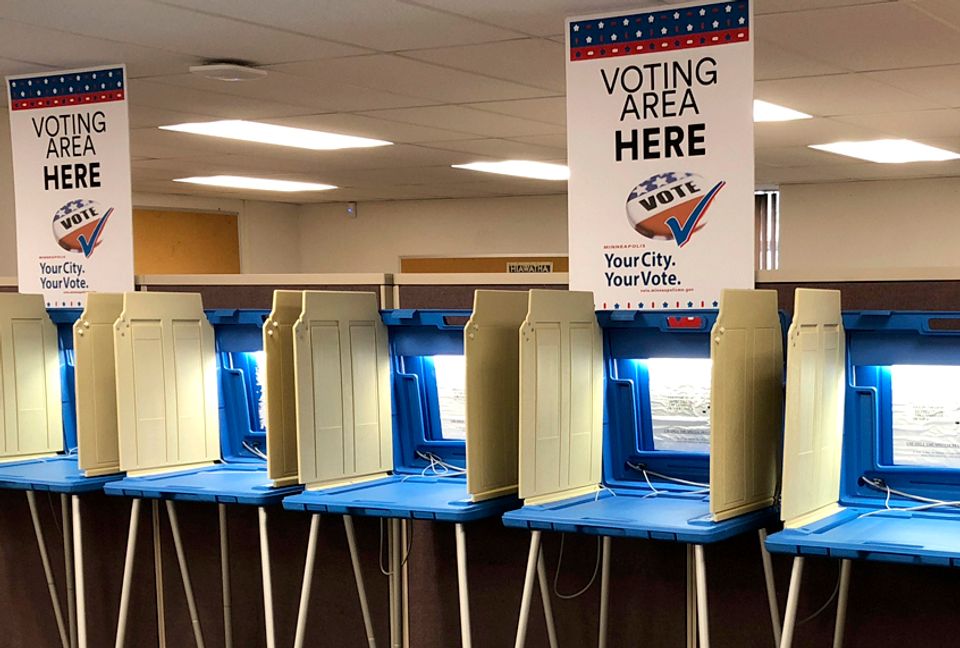
important" to our democracy, and yet voter turnout in the United States is
among the lowest of any democracy. I remember when I first ran for a seat on
our newly created Metro Council, voter turnout in my district was between 5%
and 7%. You would think there would be more interest for electing representatives
to a newly created local metro government council (we had just merged city and
county governments), but nope!
Other democracies have a far greater percentage of voter
turnout that we do (we're ranked 31st in the world). For many people it means trudging on foot for miles enduring all kinds of terrain and weather, through dangerous areas
controlled by drug cartels, terrorists, corrupt police and military
troops, all trying to intimidate voters. But Americans, it seems we will stay home at
the drop of a hat. Any ole excuse will do. Is it that we just don't care anymore?
Who does show up to vote? Let's look at the numbers.
Voter turnout in the United States in the 2020 presidential
election was 66.1%. Of the eligible 240 million voters, 158,427,986 bothered to
show up (and of that, an estimated 5% of the votes were cast by illegal
immigrants). Colorado, Maine, Minnesota,
Wisconsin, Washington State and Oregon had the highest percentage of turnout
with 75% or better of eligible voters
showing up at the polls. Hawaii, Oklahoma, Tennessee, Missouri, and West
Virginia had the lowest turnout---under 55%---of registered voters.
Historically, voter turnout for presidential elections has
been in the neighborhood of 55%. The lowest turnout since 1932 was in 1996 when just 49% of the
voting age population showed up to decide between between Bill Clinton, Bob
Dole, and Ross Perot. Clinton won with 49% of the vote, Dole received 40.7%
and Ross Perot got 8.4%.
As an aside, the lowest voter turnout in U.S. history was
the 1792 presidential election between George Washington (seeking a second
term) and John Adams. The turnout was
just 6.3% (or 28,000 voters out of a population of 3,919,023). Of course, there
were only 15 states back then. Apparently being "Father of the Country" didn't
count for much.
Women weren't allowed to vote until 1920, following the
passage of the 19th Amendment and the hard work of suffragettes. The last state
to approve the amendment was Tennessee on August 18, 1920 (incidentally, my great
grandmother was one of those suffragettes. She lived in Nashville).
The highest voter turnout at the polls was in 1876 when
82.6% of eligible voters showed up to vote for Rutherford Hayes or Samuel Tilden. This
was one of the earliest elections to allow former slaves to vote following the
passage of the 15th Amendment in 1870.
Although America has had a wide variety of political parties
since 1790, the two main parties nowadays are the Republicans and Democrats,
although there are several strong third parties which include the Libertarian
Party, the Green Party, and the Constitution Party (according to a October 4, 2023 Gallup report, support for third parties is up 63%, the highest increase since 2003).
Nevertheless, both of the two major parties have been hemorrhaging
voters, especially since the Supreme Court upheld the "Citizens
United" ruling in 2010 which effectively gave over control of the U.S.
political system to corporations by declaring they had "personhood" and basic civil rights.
It also declared money was "free
speech", and without a cap on
donations, they could give what they wanted. That meant the few would have more
"free speech" than the many.
For about the last 10 or so years, voters have shifted away
from the growing extremism of either corporate owned party and becoming
Independents or joining third parties. Today, registered Independents make up about 41% of all
registered voters with the Democrats and Republicans comprising 28% and 31%
respectively (Independents were as high as 51% in June 2024).
There are currently 244 million
eligible voters in the U.S.. Of that, there are 168.31 million registered
voters. As we said above, the majority of voters are registered as Independent,
followed by Republican and Democrat. When it comes to gender, women tend to
vote more often than men. In fact, according to the Center for American Women
and Politics, there were 7.4 million more female voters in 2022 than men. To
rephrase it, 68.4% of registered women voted compared to 65% of men.
According to a Pew survey, in 2020 48% of registered male
voters who showed up voted Democrat compared to 55% of females. 50% of registered
Republican males voted while 44% of Republican women did. In 2022, a
presidential off year, 44% of male Democrats voted as did 51% of Democratic
women. So, in both instances, Republican males showed up more than Democratic
males. Among females, the opposite was true. More female Democrats voted than Republicans.
The survey left out the political majority---Independents
(does that subtlety imply a measure of partisanship I wonder?), which is
interesting given that Independents made up over a quarter of all voters who
showed up at the polls in 2020. Independents tend to lean conservative when it
comes to the economy and taxes and lean liberal on most social issues.
Independents are, to frame them, typically moderates. They oppose the extremism
of the prevailing duopoly.
When it comes to
voting, Independents look at individual candidates and their positions on
specific issues compared to their partisan counterparts who tend to vote along
party lines (even if it means holding their noses to do so). For instance, in
2022 Democrats voted for Democratic candidates 96% of the time with just 3% refusing
to walk in lockstep.
It wasn't any different among Republicans which had the same
percentages. Independents, however, tilted more for Biden in 2020 than Trump
(54% to 41%) because of the latter's perceived unpredictability and the
extremism of the Republican Party. In 1994, more Independents backed President Bush
than Bill Clinton by 18 points because he was a unknown factor with a
questionable past.
What does this mean? In 2022, 74% of voters disapproved of
how Biden was handling (or mishandling as the case may be) of the economy.
Given the lockstep mentality of both parties, and their near dead heat in voter
registration, it will be the Independents who may decide the 2024 election and
do so into the future. The question is which, if any, of the two corporate
owned parties can pull in the Independent voter? Independents are political "free agents" and the
Democrats and Republicans aren't the only game anymore.
According to a CNN poll, Democratic voters between ages 18
and 29 and 30 to 39 turned out in heavy percentages---63% and 51% respectively---then
the percentages drop off significantly to the mid and lower 40% range. Among Republicans, the inverse was true. The
percentages for the same age brackets were 35% and 47%. Ages 40 and older saw the
numbers jump to about 55%.
Married Republicans voted 58% of time compared to 39% who
are single. For Democrats, just 41% of married couples voted. But if you're
single, that percentage jumps to 59%! So, in looking at these two sets of
statistics provided by CNN, young single Democrats are more likely than not to
show up at the polls. On the other hand, older married Republicans are most
likely to be dedicated voters.
Looking backward, although the historical affiliation among
the youth vote has been Democrat, it has been by decreasing margins coming
forward. If Pew had included Independents, the data would have shown that the
general trend among the youth in both parties are deserting the two corporate
parties in droves and becoming Independent. As an aside, almost 50/50% favor
some form libertarianism or type of
social democracy. Support for traditional capitalism is also in decline.
When it comes to race, 92% of Black voters voted for
Democrat in 2020 compared 8% who voted Republican. In 2022, 93% voted Democrat
while 5% backed the GOP. In looking at the 2020 white vote, 43% went Democrat
in contrast to 55% who voted Republicans. in 2022, 41% of white voters voted
Democrat while 57% went Republican.
Hispanics, who are now the second largest population in the
U.S., voted 61% Democrat in 2020. 36% backed Republicans (most were of Cuban
descent). Those number changed slightly in 2022 when 60% voted Democrat and 39%
when Republican. Asians weren't much different. 70% voted Democrat in 2020 compared
to 30% Republican. 2022 saw 68% going Democrat and 32% voting Republican.
If we look at race and gender, 60% of white males voted Republican in 2022.
38% voted Democrat. Among white females, 55% voted for the GOP in 2022 while
44% sided with the Democrats. Among Black males, 93% backed Democrats while
just 6% supported the Republican Party. Black women were nearly identical with
the male counterparts. 93% went Democrat and 5% back Republicans.
Among Hispanic males in 2022, 43% sided with Republicans.
56% back the Democratic Party (one reason may be for the perceived leniency toward
illegal immigration and less willingness to deport compare to the Republicans).
It appears that 64% of Hispanic females agree. 34% side with the Republicans.
Unfortunately, there was no data for Asians.
In the 2022 election,
individuals with a high school or less level of education leaned Republican by
a margin of 59% to 39%. Those with an associate degree favored the GOP by 54%
to 44%. However, those with a four year degree favored Democrats to Republicans,
albeit narrowly, 51% to 48%. For those with a Master's degree or better, 61% voted
Democrat versus 37% went for the Republicans.
Does this mean that the more educated you are the more
liberal you become or is it the longer exposure to a liberal infused education?
Higher education is supposed to be about encouraging critical thinking skills and
enhancing the ability to reason rationally and without bias based on facts
right? But what if the "facts" are tainted?
A 2023 study showed that 26% of professors
considered themselves conservative while 17% said they were moderate. But, 50% admitted
they were liberal.
When it comes to income, more lower income families are
registered Democrat than Republican, and they're also more likely to vote. 58%
compared to 36%. Among upper middle class voters, 52% will turn out for
Republicans compared to 46% for Democrats. Meanwhile, the very wealthy actually
show up for Democrats over the Republicans 53% to 46%. It appears that the
average Republican voter is someone with a lower middle to upper middle class
(the very class which is decreasing the rapidest).
As an aside, union members are more likely to be registered
Democrat (59%) than Republican (39%) although the Democratic Party depends on
corporate dollars. Among non-union voters, it's almost a even split with 48%
Democrat and 49% Republican. Most renters are Democrat compared to Republican
(64% to 32%) whereas most homeowners vote Republican (51%) as opposed to
Democrat (45%).
When it comes to military service, 63% of veterans vote
Republican while 51% of non-military tend toward the Democrats. 72% of white
veterans lean Republican but 82% of Black veterans are Democrat. Similar
numbers hold true for those who attend church regularly. The majority of white
churchgoers---59%---tend to vote Republican while Black churchgoers vote
Democrat in near equal numbers.
So, there you have a snapshot of the average American voter.
Women are more likely than men to show up at the polls to vote. The older the
voter, the more likely they'll vote. Higher education doesn't equate to more conservative
voting. Those with a high school (or trade school degree) are more likely to
turn out to vote than someone with bachelor or higher degree.
Among race, whites and Hispanics are more likely to vote
than Asians or Blacks. The excuses varied. It could range from getting away to vote, a lack of convenient transportation, no ID or simply a lack
of interest. Ultimately, the missing factor appears to be a lack of motivation to
show up. But regardless, the result is the same. No vote no voice no b*tching.
The voters of 2024 won't be much different from the voters
of 2022, except that turnout will likely be higher. Right now the polling
numbers show a virtual dead heat. Will it be who can get their side out in
numbers that stands the best chance of winning? Is it who can swing the
Independent vote that will win? Personally, I think Joseph Stalin had it right
when he allegedly said "those who vote decide nothing. Those who count the
votes decide everything", but then that's a problem we've been experiencing with greater frequency isn't it
Thank you
for reading Another Opinion! We hope you enjoyed this article and will
pass it along. Please don't forget to subscribe. It's free! Lastly, please
"like" us on whatever platform you use to read anotheropinionblog.com. It helps beat the
algorithms and keeps our articles in circulation. Please find below the links
we consulted in researching this article.
Voting Patterns in the 2022 Elections
Voter turnout in United States presidential elections
Gallup: Party Affiliation Week of October 1, 2024
Citizens United vs. FEC
Women's Suffrage in the United States
Gender Differences in Voter Turnout
Independent Voters Have the Final, and Future, Say
Conservative Faculty are Outliers on Campus Today
Partisanship by family income, home ownership, unionmembership, and veteran status
Most White Americans who regularly attend worship servicesvoted for Trump in 2020
Turnout in U.S. has soured in recent elections but by somemeasures trails that of many other countries
Support for Third U.S. Political Party Up to 63%