Home of the Militant Middle, Another Opinion ("A/O") is an Independent oriented "OpEd" blog for those looking for unbiased facts free of partisan drama and who are willing to question the Status Quo.
Showing posts with label 13th Amendment. Show all posts
Saturday, June 29, 2019
Reparations: Sins of the Father or Simple Extortion?
It seem that the issue of reparations is one of the subjects which never quite goes away. However, it hasn't been until just fairly recent that it's been seriously considered. It was most recently raised as an issue in the recent 2020 Democratic Presidential debates with several candidates coming out in favor of some form of compensation for what transpired more than a century and a half ago. But first, some history.
Representative John Conyers (D-MI) proposed a bill (HR 40) every single year, starting in 1989 until he resigned in 2017 that addressed the issue of reparation. In 2016, a United Nations' committee, the "Working Group of Experts on People of African Descent", urged the US Congress to re-examine HR 40 and to pass it. They pointed out that there is a lingering legacy of racial discrimination, resulting from slavery and Jim Crow laws which continues to "negatively impact the civil, political, economic, social and cultural rights" of black Americans.
Rep. Robert Francis "Beto" O'Rouke (D-TX), Senators Kamala Harris (D-CA), Elizabeth Warren (D-MA) and Cory Booker (D-NJ) all support some form of compensation while Rep Tulsi Gabbard (D-HI) has already reintroduced HR 40, of which she is a co-sponsor, to formally set up a committee to review the possibility of reparations. Meanwhile, Bernie Sanders (D-VT) has said that while he favors some type of compensation, added that there has to be a better way than "writing a check".
Back in 1999, black activist, lawyer, and founder of an black advocacy organization called "Transafrica", Randall Robinson, stated that as a result of riots, lynchings and institutional discrimination, has cost blacks incurred $1.4 trillion dollars in damages. Dr. Robert Browne, an economist and black activist, also stated that every black individual in America should be entitled to around $142,000 each. He argued that reparations were justified in order to "restore the black community to the economic position it would have if it had not been subject to slavery and discrimination". As an aside, while Dr. Browne proposed $142,000 per person or roughly $1.4 to 4.7 trillion , others have estimated that the total amount owed is as much as $17.1 trillion.
Also in 1999, the "African World Reparations and Repatriation Truth Commission" demanded that West pay African nations $777 trillion dollars within five years (obviously that didn't happen). In 2001, the UN sponsored the "World Conference Against Racism, Racial Discrimination, Xenophobia, and Related Intolerance". The result was a statement calling on the West to pay Africa compensation resulting from the slave trade. It was also stated that Africa's current economic problems are the result of the slave trade.
Starting in 2007, various politicians in the Caribbean have joined the fray and demanded that the West pony up with some form of reparation because of the slave trade. This also applied to the former colonial nations such as the UK, France, and Holland. Today, 15 Caribbean nations have demanded that the US and European nations provide some form of financial compensation as well as repatriation to Africa. In addition, they have demanded free educational programs to teach individuals about Africa's cultural and religious heritage as well as to provide free medical and mental health care to all those of African descent.
While there's no doubt that the black community in America was severely affected by slavery and the subsequent era of Jim Crow, we have to ask ourselves whether or not the black community has already been compensated by various changes in the laws down through the years, and whether the US Government is fully responsible. We should also address whether other groups may be entitled to some form of compensation as well. There are also other factors such as whether every black American is, in fact, a descendant from a slave and what about the ongoing issue of slavery in today's world.
Before we examine these demands, we need to acknowledge the fact that slavery has been a part of the human condition practically from the beginning of civilization. In the majority of the world's religious texts (such as the Christian Bible, the Jewish Talmud, and the Muslim Koran), slavery is not only condoned, but there are even specific requirements imposed on both the slave and their owner.
In this "New World" the notion of slavery came along with the earliest explorers; the Italians, French, Dutch, English, and Spanish. It was simply part of the society's mindset. However, it just wasn't the Europeans. It was common throughout the Middle East, Asia, and even in Africa. In fact, it still today occurs in these regions. Even in the Americas, slavery was just as institutionalize among the native populations as anywhere else. So, not only did Europeans take slaves, so did the native peoples who had so for centuries. Let's also not forget, that the slaves who were shipped to America and elsewhere were captured by other African tribes and taken to seaports to be sold to the slave traders, some of whom were Europeans while the majority of them were Arab who resold them.

It should be pointed out that in addition to slavery, there was the condition known as a "indentured slavery" or "indentured servitude" which was barely one step removed from actual slavery. The only real difference between the two was that an indentured servant had a signed contract which legally ended his misery, often with the promise of perhaps a certain sum of money or piece of land after a period of time (another difference was that the contract was, technically, entered into voluntarily, although in truth, there was really no other alternative except starvation).
However, the work and living conditions was often so brutal, that many never reached term of their contract. As an aside, the holder of the contract sometimes lied about the time served so that someone who agreed to work for 10 years may, in reality, have actually worked 12 or 13 years. In addition, there were those who were sold into a form of indentured servitude which had no expiration date. This was particularly common among the poor Irish, Welsh, and Scots, and among those who didn't speak or understand English (this happened to a couple of my ancestors).
Prior to the Revolutionary War (1775 - 1783), Great Britain was the largest slave trade nation in the world thanks to its navy; surpassing the Spanish, Dutch, Portuguese, and Italians. During the war, all of the colonies agreed to suspend the importation of slaves from any country for the duration of the war. After the war, the Southern States gradually began to resume the importation.
On March 24, 1794, Congress passed the Slave Trade Act, which prohibited the making, loading, outfitting, equipping, or dispatching of any ship used in the trade of slaves. This essentially limited the practice to foreign ships. The importation of slaves ended in the United States in 1808, which was the earliest date allowed by the Constitution. In 1800, the Slave Trade Act prohibited any investment in by private citizens in the trade, as well as employment of any US citizens on foreign ships engaged in the transportation of slaves. As a side note, Parliament passed a law in 1807 prohibiting the slave trade within the British Empire. It should also be noted that the West--Europe and America-- were the first to abolish the institution of slavery while it contained to thrive in the rest of the world.
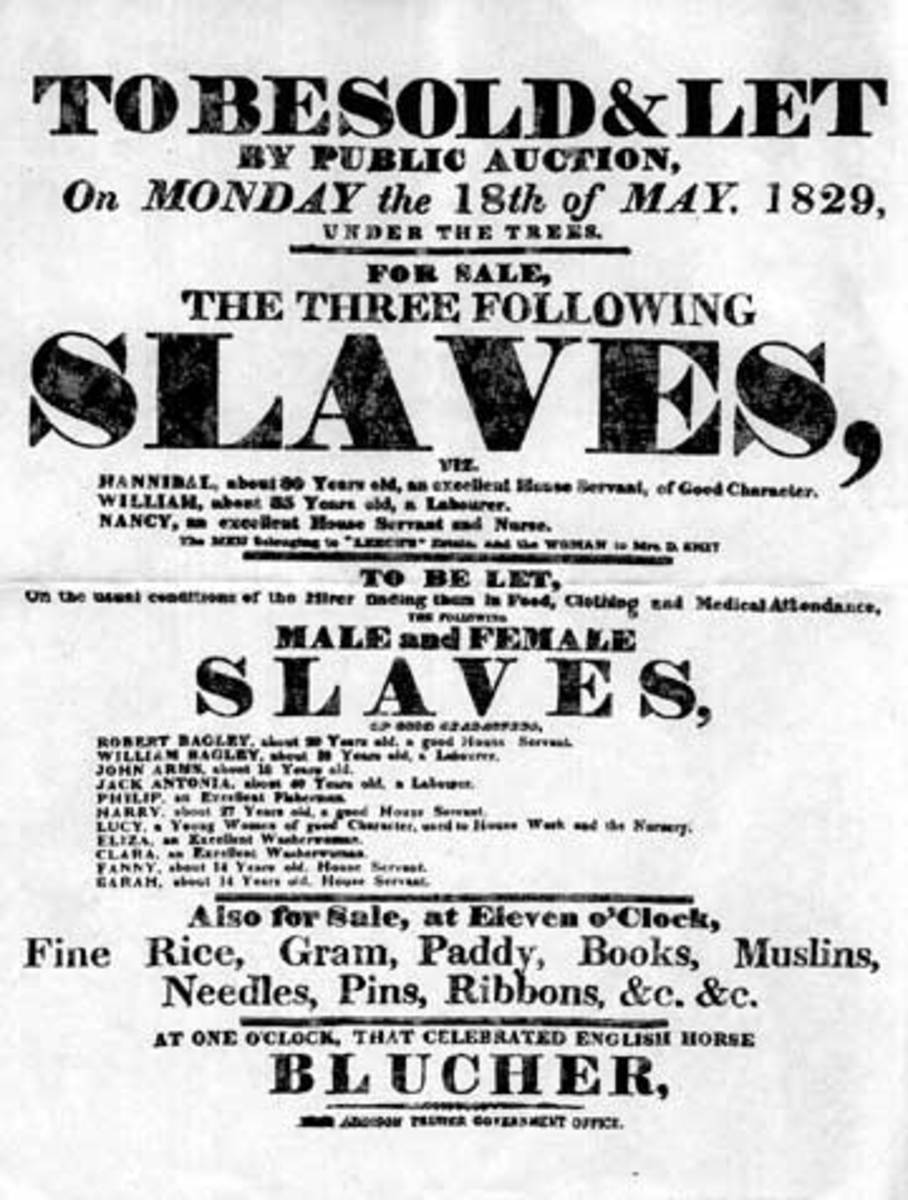
Although mostly a popular myth, many believe that the American Civil War was fought over the sole issue of slavery. In truth, the bloodiest war in American history was fought over a variety of issues, mostly economic, of which slavery was just a part. It's worth noting that in the South, only around 5% or less of the total population owned any slaves (the average was three, whereby their owner often worked side by side with them. The stereotypical plantation owners made up just around 2% of population).
Nevertheless, the issue of slavery came to forefront with Lincoln's "Emancipation Proclamation" following the carnage at Gettysburg. While President Lincoln had previously stated on several occasions that he would not interfere with institution of slavery provided that it preserve the union, the battle at Gettysburg drove home the point that war would drag on indefinitely so long as the South's economy continued to hold.
Thus, his famous address was aimed at undercutting the South by (illegally) freeing the slaves throughout those states which had seceded from the Union (but not those states which remained). It wasn't until the passage of the 13th Amendment in December 1865 that the institution of slavery officially end in the US. It was also the first of the Reconstruction Amendments to be adopted following the war's end. What eventually followed was a series of so-called "Jim Crows" throughout many of the former Confederate states. These were all ultimately ruled unconstitutional. The Civil Rights Movement was instrumental in making this happen.
The Civil Rights Movement got its start in the mid 1950's, but really took off in the early 1960's thanks to Reverend Dr. Martin Luther King Jr, A. Randolph Scott, Roy Wilkins, Whitney M. Young, Bayard Rustin, and Reverend Ralph Abernathy, along with others such as the "Freedom Riders, which included a number of whites. However, there could have been no progress without the support of key political leaders including Presidents Eisenhower, Kennedy, Johnson, along with a majority of Republican Congressional leaders and a large segment of Congressional Democrats (who were strongly opposed by Southern "Dixiecrats").
In short, the Civil Rights movement was lead by black leaders but supported by powerful politicians, resulting in the passage of the Voting Rights Act of 1964, the creation of the EEOC, Affirmative Action, and other programs, agencies, and laws down through the years aimed at ending inequality. In addition, there was the introduction of various programs designed to relieve poverty (such as the Community Action Agency), urban renewal which was implemented to revitalize decaying inter cities, low interest loans and professional assistance from retired business leaders to help create and support minority businesses, not to mention obtaining government contracts. We've also saw the creation of the NAACP, the Urban League, among others.
Meanwhile, states have continued to pour millions of taxpayer dollars into education for minority (predominately black) schools and after-school programs. Some of these have been successful, while others such as court ordered desegregation (aka forced busing) have been less so. Nevertheless, there are now dozens of avenues available to young black Americans obtain access to higher education (including minority only scholarships and apprenticeships), and launching new minority owned businesses (Asians, Native Americans, and Hispanics also have programs solely aimed at their particular demographic).
In terms of culture, the black experience is alive and vibrant! There are numerous highly successful black entertainers (Oprah Winfrey, Samuel L Jackson, Lawrence Fishburne, and Morgan Freeman immediately come to mind). There are black only award shows, magazines like Ebony and Jet, television networks and TV shows as well as radio stations dedicated to the black community, not to mention musical genres as well as movies made by black producers and directors and directed at black audiences. This includes the NAACP Image Award, Black Reel Awards, BET Awards, Miss Black America, AAFCA, and many more. There are even books written specifically for a black readership.
The fashion industry has its own niche in the black American marketplace. There are professional associations and awards for the black professional. It's not uncommon to see specialty shops aimed at the black customer, or Hispanic and Asian for that matter. The same goes for the Hispanic and Asian communities. I need to point out that while these are aimed exclusively at their racial or ethnic community, they also participate in mainstream programs which are not race or ethnic group oriented such as the Oscars, People's Choice Awards, MTV Music Awards, and have achieved great success.
In other areas such as sports, black athletes have done amazingly well, not just in terms of their athletic performance, but also in terms of their salaries and endorsements. Black politicians have also done extremely well in this country at all levels of government...including the presidency and Supreme Court. There are black oriented churches such as the AME Methodist. I would be remiss not to point out that mixed race couples, while not the societal norm, are also not uncommon.
Lastly, I should point out that the Latino and Asian communities share many, if not most of these same professional, social/cultural, and economic outlets which cater to their specific demographic, the white community does not. Instead, they share the stage with these other groups who, as I previously stated, participate in both the broader arena as well as their own demographic specific outlet (but, of course, we're not suppose to mention this).
So, while there remains some race oriented problems (and perhaps there will always be), racism is not the issue the corporate owned media tries to make it out to be. Much of it, I dare say, is manufactured or played up. Other issues such as poverty continue to exist, but it is not and has never been the result of race only. On a personal note, I believe, as Dr King once said, that a person should be judged by content of their character, not the color of their skin. In terms of education, the door is wide open to anyone who wants to put forth the effort to take advantage of the opportunity. The same goes for starting a business or moving up the corporate ladder. As a side note, it should be pointed that to disagree with the accepted narrative these days will often earn you the moniker of "racist", whether justified or not.
Where does that leave us? I think the black community has come a long way. It's possible for any black child to go anywhere and to achieve anything their racial opposite can achieve, provided they are willing to put forth the same effort. To expect to be handed everything on a silver plate is not only naive, but even insulting, not just to the rest of America, but to the black community itself. It's like they're saying the black man or woman is incapable of making it on their own, so let's, as a society, do it for them. I think society has done much to provide the black community with the opportunities it needs to succeed which is in itself reparation enough.
For those "demanding" some sort of financial payment, I think they're simply looking for a handout while making another excuse for their own continued failures. By promising "free money" in order to enlarge the number of their accomplices behind the facade of "slavery" they've revealed themselves for the con artists they are. I think much of what has held back black success has come from within the black community itself such as a subculture that academic achievement is seen as "acting white", or the prevalence of drugs, booze, and gangs, unstable homes and broken families with absent fathers.
Finally, perhaps the best "reparation" is the fact that their distant ancestors end up in the United States of America where they have a far better quality of life and more opportunities than they would have if their ancestors had remained in Africa. They say that success is the best revenge. Maybe success is the best form of reparations too.
Reparation for slavery
Reparations For Slavery: Just More Symbolism over Substance
Initiatives Help African American Entrepreneurs Gain Training and Access To Capital
Black America Net: Black Award Shows
Saturday, September 03, 2016
What's the Truth Behind Republican Claims of Supporting Black Civil Rights?
I tend to get a lot of political advertising from all sides. With what I do, it's to be expected. Lately though, I've been receiving one in particular from different groups claiming to be "non partisan", but clearly they are toeing the Republican Party line. Each claim certain historical accomplishments often attributed to the other party, which made me a bit curious, and so I decided to check each of them out. The claims, in various formats, basically read as follows, the 13th Amendment to abolish slavery represented 100% of Republicans supported this while only 23% of Democrats did. The 14th Amendment, which gave citizenship to freed slaves. 94% of Republicans supported this while no Democrats did. The 15th Amendment, which gave the right to vote to all native born had 100% of Republican support and no Democrat. Finally, the Affordable Care Act (aka "Obamacare"), which had no Republican support but did have 86% of Democrat support. The obvious implication here is that while the Democrats usually get the credit, it was the Republicans who actually deserve the kudos. So, let's examine these to see what the truth is.
The 13th Amendment to the US Constitution declared "...neither slavery nor involuntary servitude, except as a punishment for crime whereof the party shall have been duly convicted, shall exist within the United States, or any place subject to their jurisdiction", and thus formally ended slavery in the United States, which had previously been enshrined in Article 1 Section 2 of the Constitution, aka the "Three Fifths Compromise" of 1787 (the compromise was to keep Southern States from having too much influence on the presidency). The 13th Amendment was passed by the Congress on January 31, 1865, and ratified by the States on December 6, 1865. Many attribute the amendment as a response to Lincoln's 1863 "Emancipation Proclamation" following the Battle at Gettysburg Pennsylvania which, despite popular myth, only freed slaves in the States which had seceded, while leaving slaves held in the Border States and elsewhere in bondage. The proclamation was viewed as illegal since the Confederate States were at independent coalition, and thus Lincoln's edicts held no legal or binding authority. Secondly, the reason for the proclamation was to make the slaves leave the fields and force Confederate troops to leave the front lines and tend to fields in order to prevent mass starvation, especially of their family, friends, neighbors, and yes, even the slaves. But who actually supported it?
There were 183 members of Congress present. It would take 122 "aye" votes for the bill to pass however, eight decided not to vote and abstained. That meant 117 was needed to pass the bill. Of the Republicans present, all of them voted in favor along with 16 Democrats. The final count was 119 to 56; just enough to pass. President Lincoln signed the resolution of February 1, 1865 (he would be assassinated on April 14, 1865. His Vice President, Andrew Johnson, followed him as President). Several states did not ratify the amendment until years later (Kentucky, for instance, was a slave holding border state which didn't ratify the 13th Amendment until March 18, 1976---yes, 1976). So how about the 14th Amendment?
The purpose of the 14th Amendment was to insure that all former slaves were given the right to vote. The law would be passed by Congress on July 9, 1868, during the so-called "Reconstruction Era" which sought to impose economic punishment on the South. Previously, Congress had pass the "Civil Rights Act of 1865" which gave full citizenship to anyone regardless of race, color, previous condition of either slavery or indentured servitude as an effort to incorporate all former slaves into the Union. Mostly moderate Republican encouraged President Johnson to sign the bill, but Johnson vetoed it on March 27, 1866. The reason given for the veto was that freed former slaves weren't accounted for in 11 of the 36 states (these represented former the Confederate States. However, Johnson favored rapid reentry of Southern States back into Union without or without any protective rights being given to former slaves). Nevertheless, three weeks later his veto was overridden and the measure became law. However, the 14th Amendment did not include Native Americans. They wouldn't be given citizenship until the Indian Citizenship Act of 1924. Again, not all the States ratified the amendment, but a sufficient number did to ensure passage (eventually most all of the States would pass the amendment with Kentucky being the last with its ratification on March 30, 1976...seriously). The Civil Rights Act of 1866 was enacted prior to the passage of the 14th Amendment on April 9, 1866, also under the Johnson Presidency, in order to insure the rights of all former slaves and those held in bondage were protected.
So, the answer is that yes, the majority of Republicans supported the passage of the 14th Amendment, however, there was a group known as "Radical Republicans", led by Lincoln's Secretary of State, William Seward, Horace Greenly, Thaddeus Stevens, John Fremont, and Ulysses S. Grant. The liberal leaning Radical Republicans were strongly opposed to slavery but were not abolitionists. They led the Reconstruction against the South and were often opposed to the moderate Lincoln Clique and the more conservative Johnson. The Democrats were largely opposed to the 14th amendment, partly because many were Southern sympathizers , and opposed some of the more ambiguous language concerning the nature of the citizenship and equality clauses (we continue to struggle with the language of this and the next, the 15th, amendment. Individuals have often hidden behind the wording and obtained citizenship through the use of "anchor babies").
The 15th Amendment, the last of the so-called "Reconstruction Amendments", was ratified on February 3, 1870. It too sought to convey the right to votes on all citizens despite race, color, or previous conditions of slavery or servitude. With the election of Republican (and leader of the liberal "Radical Republicans") Ulysses S. Grant as President, the GOP had determined that their future was tied to the fate of black voters, who had registered primarily as Republicans by this point while the Democratic Party continued to have deep roots in the "unreconstructed" South and where Democrat legislatures remained opposed to many of the changes imposed on the South through the Republican led "Reconstruction", especially as it related to full black citizenship and voting rights. The 15th Amendment was a compromise between the moderate and liberal Republicans on one side and the more reactionary Democrats on the other regarding issues voting rights. The amendment further banned any restrictions pertaining to race, color, and nature of a person's pervious servitude, but was ultimately adopted on March 30, 1870 (Southern legislatures would, starting around 1890 and continuing through the first decade of the Twentieth Century, begin implementing a series of "hoops" for blacks to jump through such as literacy tests and poll taxes, while poor whites would be often exempted through a "Grandfather Clause" incorporated into the law. Again, while hard numbers appear to difficult to find, it appears that moderate and "Radical" liberal Republicans were the key backers while Democrats mostly opposed the amendment as they had the others.
Moving forward in time over a century and a half, we come to the Affordable Care Act or as it's more commonly known, "Obamacare". There has been previous attempts at providing some form of nationalized healthcare going back decades (even Republican President Eisenhower had discussed it) which had been repeatedly shot down thanks to primarily to hospital, doctor, and insurance lobbyists. While they applied their "advise" and money most liberally, the Republicans were most open to their arguments ( In 1993, the Sunlight Foundation published a report documenting the tight ties between Washington politicians of both parties and the healthcare industry). In 1993, under President Bill Clinton (D), a committee headed up by his wife, Hillary Clinton, attempted to push through passage of a universal healthcare reform bill which was soundly defeated by a Republican House, although Senate Republicans submitted their own version which required individuals, but not employee, to purchase insurance with a fine for non-compliance. A bipartisan compromise bill which protected some transferability of existing healthcare coverage for those who had lost or change their jobs. Under President Obama (D), the proposed law was repeatedly dealt setbacks by leading Republicans. However, in November 2009, the AFA resulted in several "DOA" counter proposals and a filibuster. The Senate voted 69 - 39 to end debate on the bill and to the filibuster. The bill then passed, also 60 - 39, with all Democrats and two Independents voting in favor (Kentucky's Jim Bunning did not vote). It then passed on to the House where it passed by a vote of 220 - 215 with the passing vote being led by Democrats. 34 Democrats votes "Nay" with the rest, 134 votes, being comprised of House Republicans (four Senate members didn't vote). President Obama signs the bill in March 2010 with an effective start date of January 1, 2014.
Republicans opposition to the AFA continued along with others. Unions (such as the Teamsters, AFL/CIO, Unite-Here, United Food and Commercial Workers International Union, Laborers' International Union of North America) opposed it as well for being "unfair to marketplace competition" . The Tea Party, business and healthcare associations as well as other conservative groups opposed the bill as well (the conservative Heritage Foundation had originally proposed a "Single Payer Plan" which was popular among who opposed the AFA). However in November 2011, in a most unusual measure, 26 States and the National Federation of Independent Businesses brought the matter before the Supreme Court based on arguments that elements of the AFA are unconstitutional. However, the Supreme Court upholds major provisions of the bill (if interpreted and applied as a tax).
So, what do we have here? How accurate is the claim that the Republican Party supported major civil rights legislation over the heads of Democrats, while opposing the Affordable Healthcare Act? Well, based on the information available, it seems to be fairly accurate and generally happened "as advertised". However, there are a few provisos that must be factored in as well. First of all, the so-called Civil Rights Act of 1864, which included the 13th, 14th, and 15th amendments all took place during the Civil War and during the Reconstruction Era. The Republican Party was nearly brand new; a coalition of the former Whigs and other third parties. Politically, it consisted of liberal (or "radicals"), moderate/centrists, and conservative members. Lincoln and his clique were moderates. Johnston, who followed Lincoln, was conservative leaning (he later got in trouble with his party as moderate and liberal Republicans as he became the first president to be impeached. He would be acquitted by one vote), and "Radical" Republican U.S. Grant. This is a very different party from today's Republicans who successfully purged all liberal and moderate Republicans (who they sarcastically called "RINOs, "Republicans in Name Only", starting in the 1980's under Ronald Reagan. Today, there's not enough "RINOs" to drown in a teacup (the Democrats, who also purged their moderates, calling theirs "DINOs, Democrats in Name Only) . So, while the overall argument is true, we're comparing cherries to sour grapes (or would you prefer plums to prunes?).
The Republicans who opposed Obamacare (AFA), were more of the modern breed. They ranged from very conservative to hyper conservative/Religious Right. Most of those who opposed Obamacare but supported a Single Payer Plan were among the last of the moderates. Also, the moderate and liberal Republicans of the Lincoln Era, grouped around their party chief, but they also voted for what they believed was best not just for their party, but what was best for the nation. The more modern Republican (and Democrat) parties still tend to support their party boss, and thus vote along partisan lines with little regard to the needs of the country. But just as importantly (perhaps more so), they vote in accordance with wishes of their paymasters---the lobbyists who are employed by corporations. Over time, we've gone from our democratic republic as bequeath to us by our Founding Fathers to a defacto Oligarchy; the elite 1% and their corporate interests. The Republicans or Democrats can pretend (as they do during elections) that they are "arm-in-arm" with ordinary Americans. They aren't. If they are "arm-in-arm, we need to watch our backs for the knife in their hand. The majority of Americans, mostly former moderate Republicans and Democrats, are now registered as Independents and they make up the largest voting bloc in the country, followed by Democrats and lastly, Republicans (within the next 10 years---if not sooner---there will be more Indies than Democrats and Republicans combined).
There you have it. Question authority, always think for yourself, and then speak up and speak out. By the way, I hope to provide you in a upcoming article with information regarding both parties support of more recent bills, such as Women's Suffrage, the right to organize, the Civil Rights Act of 1964, and the Clean Air and Clean Water Acts.
The 13th Amendment to the U.S. Constitution
http://www.loc.gov/rr/program/bib/ourdocs/13thamendment.html
The 14th Amendment to the U.S. Constitution
http://www.loc.gov/rr/program/bib/ourdocs/14thamendment.html
A Short History of the 14th Amendment
http://www.scpr.org/blogs/multiamerican/2011/01/06/7518/a-short-history-of-the-14th-amendment/
Background of the 15th Amendment
http://www.u-s-history.com/pages/h415.html
The Affordable Care Act history
http://affordablehealthca.com/history-affordable-care-act/
The 13th Amendment to the US Constitution declared "...neither slavery nor involuntary servitude, except as a punishment for crime whereof the party shall have been duly convicted, shall exist within the United States, or any place subject to their jurisdiction", and thus formally ended slavery in the United States, which had previously been enshrined in Article 1 Section 2 of the Constitution, aka the "Three Fifths Compromise" of 1787 (the compromise was to keep Southern States from having too much influence on the presidency). The 13th Amendment was passed by the Congress on January 31, 1865, and ratified by the States on December 6, 1865. Many attribute the amendment as a response to Lincoln's 1863 "Emancipation Proclamation" following the Battle at Gettysburg Pennsylvania which, despite popular myth, only freed slaves in the States which had seceded, while leaving slaves held in the Border States and elsewhere in bondage. The proclamation was viewed as illegal since the Confederate States were at independent coalition, and thus Lincoln's edicts held no legal or binding authority. Secondly, the reason for the proclamation was to make the slaves leave the fields and force Confederate troops to leave the front lines and tend to fields in order to prevent mass starvation, especially of their family, friends, neighbors, and yes, even the slaves. But who actually supported it?
There were 183 members of Congress present. It would take 122 "aye" votes for the bill to pass however, eight decided not to vote and abstained. That meant 117 was needed to pass the bill. Of the Republicans present, all of them voted in favor along with 16 Democrats. The final count was 119 to 56; just enough to pass. President Lincoln signed the resolution of February 1, 1865 (he would be assassinated on April 14, 1865. His Vice President, Andrew Johnson, followed him as President). Several states did not ratify the amendment until years later (Kentucky, for instance, was a slave holding border state which didn't ratify the 13th Amendment until March 18, 1976---yes, 1976). So how about the 14th Amendment?
The purpose of the 14th Amendment was to insure that all former slaves were given the right to vote. The law would be passed by Congress on July 9, 1868, during the so-called "Reconstruction Era" which sought to impose economic punishment on the South. Previously, Congress had pass the "Civil Rights Act of 1865" which gave full citizenship to anyone regardless of race, color, previous condition of either slavery or indentured servitude as an effort to incorporate all former slaves into the Union. Mostly moderate Republican encouraged President Johnson to sign the bill, but Johnson vetoed it on March 27, 1866. The reason given for the veto was that freed former slaves weren't accounted for in 11 of the 36 states (these represented former the Confederate States. However, Johnson favored rapid reentry of Southern States back into Union without or without any protective rights being given to former slaves). Nevertheless, three weeks later his veto was overridden and the measure became law. However, the 14th Amendment did not include Native Americans. They wouldn't be given citizenship until the Indian Citizenship Act of 1924. Again, not all the States ratified the amendment, but a sufficient number did to ensure passage (eventually most all of the States would pass the amendment with Kentucky being the last with its ratification on March 30, 1976...seriously). The Civil Rights Act of 1866 was enacted prior to the passage of the 14th Amendment on April 9, 1866, also under the Johnson Presidency, in order to insure the rights of all former slaves and those held in bondage were protected.
So, the answer is that yes, the majority of Republicans supported the passage of the 14th Amendment, however, there was a group known as "Radical Republicans", led by Lincoln's Secretary of State, William Seward, Horace Greenly, Thaddeus Stevens, John Fremont, and Ulysses S. Grant. The liberal leaning Radical Republicans were strongly opposed to slavery but were not abolitionists. They led the Reconstruction against the South and were often opposed to the moderate Lincoln Clique and the more conservative Johnson. The Democrats were largely opposed to the 14th amendment, partly because many were Southern sympathizers , and opposed some of the more ambiguous language concerning the nature of the citizenship and equality clauses (we continue to struggle with the language of this and the next, the 15th, amendment. Individuals have often hidden behind the wording and obtained citizenship through the use of "anchor babies").
The 15th Amendment, the last of the so-called "Reconstruction Amendments", was ratified on February 3, 1870. It too sought to convey the right to votes on all citizens despite race, color, or previous conditions of slavery or servitude. With the election of Republican (and leader of the liberal "Radical Republicans") Ulysses S. Grant as President, the GOP had determined that their future was tied to the fate of black voters, who had registered primarily as Republicans by this point while the Democratic Party continued to have deep roots in the "unreconstructed" South and where Democrat legislatures remained opposed to many of the changes imposed on the South through the Republican led "Reconstruction", especially as it related to full black citizenship and voting rights. The 15th Amendment was a compromise between the moderate and liberal Republicans on one side and the more reactionary Democrats on the other regarding issues voting rights. The amendment further banned any restrictions pertaining to race, color, and nature of a person's pervious servitude, but was ultimately adopted on March 30, 1870 (Southern legislatures would, starting around 1890 and continuing through the first decade of the Twentieth Century, begin implementing a series of "hoops" for blacks to jump through such as literacy tests and poll taxes, while poor whites would be often exempted through a "Grandfather Clause" incorporated into the law. Again, while hard numbers appear to difficult to find, it appears that moderate and "Radical" liberal Republicans were the key backers while Democrats mostly opposed the amendment as they had the others.
Moving forward in time over a century and a half, we come to the Affordable Care Act or as it's more commonly known, "Obamacare". There has been previous attempts at providing some form of nationalized healthcare going back decades (even Republican President Eisenhower had discussed it) which had been repeatedly shot down thanks to primarily to hospital, doctor, and insurance lobbyists. While they applied their "advise" and money most liberally, the Republicans were most open to their arguments ( In 1993, the Sunlight Foundation published a report documenting the tight ties between Washington politicians of both parties and the healthcare industry). In 1993, under President Bill Clinton (D), a committee headed up by his wife, Hillary Clinton, attempted to push through passage of a universal healthcare reform bill which was soundly defeated by a Republican House, although Senate Republicans submitted their own version which required individuals, but not employee, to purchase insurance with a fine for non-compliance. A bipartisan compromise bill which protected some transferability of existing healthcare coverage for those who had lost or change their jobs. Under President Obama (D), the proposed law was repeatedly dealt setbacks by leading Republicans. However, in November 2009, the AFA resulted in several "DOA" counter proposals and a filibuster. The Senate voted 69 - 39 to end debate on the bill and to the filibuster. The bill then passed, also 60 - 39, with all Democrats and two Independents voting in favor (Kentucky's Jim Bunning did not vote). It then passed on to the House where it passed by a vote of 220 - 215 with the passing vote being led by Democrats. 34 Democrats votes "Nay" with the rest, 134 votes, being comprised of House Republicans (four Senate members didn't vote). President Obama signs the bill in March 2010 with an effective start date of January 1, 2014.
Republicans opposition to the AFA continued along with others. Unions (such as the Teamsters, AFL/CIO, Unite-Here, United Food and Commercial Workers International Union, Laborers' International Union of North America) opposed it as well for being "unfair to marketplace competition" . The Tea Party, business and healthcare associations as well as other conservative groups opposed the bill as well (the conservative Heritage Foundation had originally proposed a "Single Payer Plan" which was popular among who opposed the AFA). However in November 2011, in a most unusual measure, 26 States and the National Federation of Independent Businesses brought the matter before the Supreme Court based on arguments that elements of the AFA are unconstitutional. However, the Supreme Court upholds major provisions of the bill (if interpreted and applied as a tax).
So, what do we have here? How accurate is the claim that the Republican Party supported major civil rights legislation over the heads of Democrats, while opposing the Affordable Healthcare Act? Well, based on the information available, it seems to be fairly accurate and generally happened "as advertised". However, there are a few provisos that must be factored in as well. First of all, the so-called Civil Rights Act of 1864, which included the 13th, 14th, and 15th amendments all took place during the Civil War and during the Reconstruction Era. The Republican Party was nearly brand new; a coalition of the former Whigs and other third parties. Politically, it consisted of liberal (or "radicals"), moderate/centrists, and conservative members. Lincoln and his clique were moderates. Johnston, who followed Lincoln, was conservative leaning (he later got in trouble with his party as moderate and liberal Republicans as he became the first president to be impeached. He would be acquitted by one vote), and "Radical" Republican U.S. Grant. This is a very different party from today's Republicans who successfully purged all liberal and moderate Republicans (who they sarcastically called "RINOs, "Republicans in Name Only", starting in the 1980's under Ronald Reagan. Today, there's not enough "RINOs" to drown in a teacup (the Democrats, who also purged their moderates, calling theirs "DINOs, Democrats in Name Only) . So, while the overall argument is true, we're comparing cherries to sour grapes (or would you prefer plums to prunes?).
The Republicans who opposed Obamacare (AFA), were more of the modern breed. They ranged from very conservative to hyper conservative/Religious Right. Most of those who opposed Obamacare but supported a Single Payer Plan were among the last of the moderates. Also, the moderate and liberal Republicans of the Lincoln Era, grouped around their party chief, but they also voted for what they believed was best not just for their party, but what was best for the nation. The more modern Republican (and Democrat) parties still tend to support their party boss, and thus vote along partisan lines with little regard to the needs of the country. But just as importantly (perhaps more so), they vote in accordance with wishes of their paymasters---the lobbyists who are employed by corporations. Over time, we've gone from our democratic republic as bequeath to us by our Founding Fathers to a defacto Oligarchy; the elite 1% and their corporate interests. The Republicans or Democrats can pretend (as they do during elections) that they are "arm-in-arm" with ordinary Americans. They aren't. If they are "arm-in-arm, we need to watch our backs for the knife in their hand. The majority of Americans, mostly former moderate Republicans and Democrats, are now registered as Independents and they make up the largest voting bloc in the country, followed by Democrats and lastly, Republicans (within the next 10 years---if not sooner---there will be more Indies than Democrats and Republicans combined).
There you have it. Question authority, always think for yourself, and then speak up and speak out. By the way, I hope to provide you in a upcoming article with information regarding both parties support of more recent bills, such as Women's Suffrage, the right to organize, the Civil Rights Act of 1964, and the Clean Air and Clean Water Acts.
The 13th Amendment to the U.S. Constitution
http://www.loc.gov/rr/program/bib/ourdocs/13thamendment.html
The 14th Amendment to the U.S. Constitution
http://www.loc.gov/rr/program/bib/ourdocs/14thamendment.html
A Short History of the 14th Amendment
http://www.scpr.org/blogs/multiamerican/2011/01/06/7518/a-short-history-of-the-14th-amendment/
Background of the 15th Amendment
http://www.u-s-history.com/pages/h415.html
The Affordable Care Act history
http://affordablehealthca.com/history-affordable-care-act/
Subscribe to:
Posts (Atom)