Showing posts with label working class. Show all posts

Thursday, August 28, 2025

Why Is There A Labor Day?


Welcome to the last “official” long weekend holiday of the summer!  It typically marks the closing of pools, the beginning of the school year, and the last quick vacation. But what is Labor Day really? Simply a day marking the end of summer or something more?

 Labor Day was established on June 28, 1894 and reluctantly signed into law by President Grover Cleveland, making the first Monday of each September a federal day set aside to celebrate the efforts of organized labor and the gains---financial and social--- it has made on behalf of  organized labor and the working class. Before then, there was something of  a “unofficial” day set by various unions, the date varying from place to place.

 It bears mentioning that organized labor, and those pushing for a day of recognition for organized labor were regarded as “socialist”, and indeed, they were. Most of those who belonged to labor unions were affiliated with various socialist political parties including the Socialist Party of America. Also, unions tended to become popular in jobs sectors with a history of abusing its employees such as mining, the auto industry, the garment industry, and shipping (train and cargo ships) and employed mostly immigrants and minorities.

 Later on, various other laws such as Social Security, minimum wage, 40 hour work week, child labor laws, women’s right to vote, job safety and the creation of OSHA, worker’s compensation, unemployment, and welfare were all labeled as “socialist” (or even “communist”) and vigorously opposed by Big Business.

Not long after the first Labor Day parade was held on September 5, 1882 in New York City, the New York State legislature began work to introduce a bill to formally recognize organized labor. However, it was Oregon which was first sign into law a bill establishing a day honoring labor on February 27, 1887.  Later that same year, four other states, New Jersey, Massachusetts, Colorado, and New York signed into law bills which not just acknowledged organized labor but also established them as state recognized holidays.

By 1890, Nebraska, Pennsylvania, and Connecticut join the growing list of states to celebrate organized labor. Four years later, 23 states  passed laws to honor working men and women. Finally, on June 28, 1894, Congress decided to get on the act, thus establishing Labor Day as an official federal holiday.

While this was a major victory for the working class, who was the first person to propose a day recognizing labor? Not surprisingly, the answer isn’t so clear cut. However, there are two individuals most often cited. The earliest records show that in 1882, Peter J. McGuire, the son of poor Irish Catholic immigrants and general secretary for the United Brotherhood of Carpenters and Joiners as well as the co-founder of the American Federation of Labor (“AFL”) first suggested setting aside a day to honor the working class.

The other contender was Matthew Maguire, another child of Irish immigrant parents. Maguire was the secretary of Local 344 of the International Association of Machinists and Blacksmiths located in Paterson, New Jersey. He made the proposal in 1882 while serving as the recording secretary of the Central Labor Union in New York. Maguire was also a New York alderman.

Additionally, the New Jersey Historical Society reported that according to an editorial in the Paterson Morning Call newspaper, “Alderman Maguire” President Cleveland should give Maguire a ”souvenir pen”.  As an aside, in 1896, Maguire ran as the vice presidential candidate for the Socialist Labor Party of America alongside the presidential candidate, Charles H. Matchett.

 Labor membership continued to growing, reaching almost 1/3 of the workforce by the end of the 1950’s, although in terms of actual numbers, it reached its highest point in 1979, hitting 29 million dues paying members. Nevertheless, union membership began its decline in the 1960s, accelerating in the 1980’s under President Ronald Reagan as companies began closing plants and exporting jobs overseas.

The once powerful public sector unions have also lost much of their clout following the infamous 1981 strike by the Professional Air Traffic Controllers Organization (PATCO) which resulted in the firing of some 11,000 striking air traffic controllers over pay, hours, and job safety issues by President Reagan, which, among other things, prohibits public unions from striking.  

 Another reason for the decline of union membership is growing trend of “Right to Work” legislation., which stems from Section14(b) of the 1947 Taft-Harley Act which gives state the authority to prohibit mandatory union membership even in a closed (or union) shop. Under “Right to Work”, employees may elect not to join a union and thus are not required to pay union dues.

 However, these employees still benefit from any and all collective bargaining agreements, including the use of a shop steward to assist them with any employment issue. The result is a drain on union resources. Currently there are 27 "Right to Work" states which include Kentucky, Texas, Florida, Alabama, Georgia, and Indiana. 

 Today, organized labor makes up roughly 10% of the workforce or about 14.3 million workers, with public unions comprising the bulk of union membership (33%) compared to just 6% who belong to private unions. The states with the highest union membership is Hawaii with 26.5% of its workforce belonging to a union. Hawaii is followed by New York with 20% and Alaska with 17.7%.

 Education and protective services such as teachers, police, EMS, and fire have the highest percentage of union membership. Black employees are most likely to belong to a union, more so than Hispanics, Whites, Asians, or Native Americans.  Meanwhile, men are slightly more likely to belong to a union than women (10.5% to 9.5% respectively).

I guess I've always tended to support unions, employee owned workplaces. and employee initiatives. Most of my relatives belonged to unions, especially mining and railroad. I've worked primarily for several non-union companies. Most were decent, but some seriously "used and abused" their employees. 

This resulted in high employee turnover, sloppy work, very low morale, heated outbursts, and hostile work conditions amid poor management skills. In fact, they were so bad, I used them as examples in the undergraduate and graduate classes I taught. Amusingly, few of my students believed the examples were from a real---albeit unnamed---company!  

In every place I worked, I was asked by fellow employees to serve as the employee representative. I'm not sure why I was repeatedly chosen. Perhaps they thought I'd be fair and balanced or perhaps it was because I wasn't bashful about challenging authority figures. Regardless, I was always honored by the trust and confidence my fellow employees had in me to take on management.

My last position before retiring was that of "Special Coordinator to the President for Special Projects". Basically, this was an assistant vice president position which functioned similar to my previous roles as an employee/management liaison (some saw it as a “non-union shop steward”). I provided a comprehensive report to the company president and the Regional Vice President with recommendations for the improvement of company morale and productivity (in addition to my role as Senior Legal Manager).

In addition to serving on several non-profit boards, I was appointed state chairperson of a national writers union (UAW/NWU 1981) where I served for 11 years. I handled state based issues and served on the local labor council. I was elected as the National Vice Chairperson of the At Large Chapter and served on several national committees. I also liaised with several labor oriented organizations and served on the Greater Louisville Central Labor Council.

Equality and fairness in the workplace has always been a historically important union issue. Unions backed social causes like the Women's Suffrage Movement, Civil Rights, and the Chicano Movement of migrant farm workers and sharecroppers for fair wages, not to mention the Family Medical Leave Act,  and the Uniformed Services Employment and Reemployment Rights Act (USERRA) which guaranteed returning military personal their old job back or paid training for a similar job in the event their earlier job or place of employment was gone. Many also unions opposed President Clinton's "NAFTA", which turned out to be a disaster for many American businesses as well as the working class.

Unions are said to have created the middle class, which may very well be true, but it's not been all wine and roses. If you look at countries with no or weak unions, you tend to find a weak middle class and widespread poverty. Of course, that isn’t to say unions are the answer to every social or economic problem, nor are unions always applicable to every job sector, but they aren’t the villain they are often made out to be by Big Business.

Additionally, unions have faced a lot of problems over the years, externally and internally. One of which is their refusal to think outside of the box, or to be more accurate, outside of the hip pocket of the Democratic Party which, like the Republicans, greedily serves Wall Street, leaving unions to “manage” the employees on behalf of management rather than represent them.

Union leadership has consistently failed to protect the best interests of its members by not making the major parties or candidates compete for their support. Labor must look elsewhere, even if it means forming its own political party (did you know that we're the only industrial nation---and one of the few nations period--- without a Labor party?) or face eventual extinction. It’s not a question of “if”, but “when”.

So, as you and yours do whatever you do on this last long weekend of the summer, take a moment to remember what Labor Day is all about---the working class of America.


Thank you for reading "Another Opinion", the Op/Ed blog page for the "militant middle".  Here at "A/O" we truly value our readers. At A/O we seek the facts as they exist, not partisan talking points.  We hope you find our articles informative and engaging. Comments are welcome, provided they are not vulgar, insulting or demeaning.  Another Opinion is offered without charge and is directed toward all independent and free-thinking individuals. We ask, however, that you "like" us on whatever platform you found us on in order to keep our articles available for free to others. Lastly, in order to keep costs down, we depend on passive marketing, and therefore, depend on our readers to please forward our posts along. Below you will find links to the sources we used in writing this article. Thank you. 


Labor Day


History of Labor Day


Right To Work—What It Is And More Importantly, What It Isn’t?


Labor unions in the United States


Unions, Workers, And Wages At The Peak Of The AmericanLabor Movement


US labor union membership slips in 2024 to record low


Right to Work


The Consequences Of Reagan Breaking The 1981 Air TrafficControllers Strike


Matthew Maguire


Charles H. Matchett


Peter J. McGuire


AFL-CIO: Peter J. McGuire


Socialist Labor Party of America


Friday, August 30, 2024

Labor Day: A Day for the American Worker


Labor Day was established in 1894 and signed into law by president Grover Cleveland  to make the first Monday of each September a federal day set aside to celebrate the efforts of organized labor and the gains---financial and social--- it has made on behalf of all workers, union and non-union.

I guess I've always tended to support unions, employee owned workplaces. and employee initiatives. From the time I got out of the Navy in 1979 to when I retired at the ripe old age of 55 in 2013, I've worked for several non-union companies. Most were decent, but some seriously "used and abused" their employees and left much to be desired. This resulted in a lot of employee turnovers, sloppy work, very low morale, hostile outbursts, and some unnecessary tense work conditions.

In every place I worked, I was asked by fellow employees to be the employee representative. I'm not sure why I was repeatedly chosen. Maybe they thought I'd be fair and balanced or perhaps it was because I wasn't bashful about challenging authority figures! Regardless, I was always honored by the trust and confidence my fellow employees had in me to take on the role of employee/management liaison.

My last position before retiring was that of "Special Coordinator to the President for Special Projects". Basically this was a assistant vice president position which functioned similar to my previous roles as a employee/management liaison. I was to provide a comprehensive report to the company president and the Regional Vice President along with recommendations for the improvement of company morale and productivity (in addition to my role as Senior Legal Manager, where I oversaw around 30 contract attorneys and managed a receivables portfolio of some $15 million dollars).

In addition to serving on several non-profit boards, I was appointed state chairperson of a national writers union (NWU 1918) where I served for 11 years. I handled state based issues and served on the local labor council. I was elected as the National Vice Chairperson of the At Large Chapter and served on several national committees. I also liaised with several worker oriented organizations.

Did you know organized labor has been chiefly responsible for establishing the 40 hour work week, health and other benefits, paid vacations and personal time, job safety (resulting in the creation of OSHA), an end to child labor (children as young as 8 years old were often working in mines),  fiscal accountability of hours worked and wages earned? They promoted Social Security, unemployment insurance and worker's compensation for work related injuries.

Equality and fairness in the workplace has always been a historically important union issue. Unions backed social causes like the Women's Suffrage Movement, Civil Rights, and the Chicano Movement of migrant farm workers and sharecroppers for fair wages, not to mention the Family Medical Leave Act,  and the Uniformed Services Employment and Reemployment Rights Act (USERRA) which guaranteed returning military personal their old job back or paid training for a similar job in the event their earlier job or place of employment was gone. But these gains didn't come easy. They opposed President Clinton's "NAFTA", which was a disaster for American industries and blue collar workers.

It's estimated that at least 1100 individuals died fighting for worker rights (many murdered by "enforcers" hired by company bosses). Thousands more were injured. Some badly. Others permanently. Companies used every form of intimidation imaginable, from reducing hours for hourly employees (or overloading them with hours and no breaks or rest time), ostracizing employees (and anyone who associated with them) to outright firing them. A lot of blood was spilled for these "concessions".

Since the advent of the modern Industrial Age, countless workers, mostly women, worked for low wages in the textile industry, often in hot and unsafe conditions. Many were maimed or killed. With no daycare, the women often brought their children with them, tucking infants and small children under chairs or beside their machines. Not surprisingly injuries or some other mishap wasn't uncommon among the children, such as lung disease, hearing loss, or the loss of a finger.

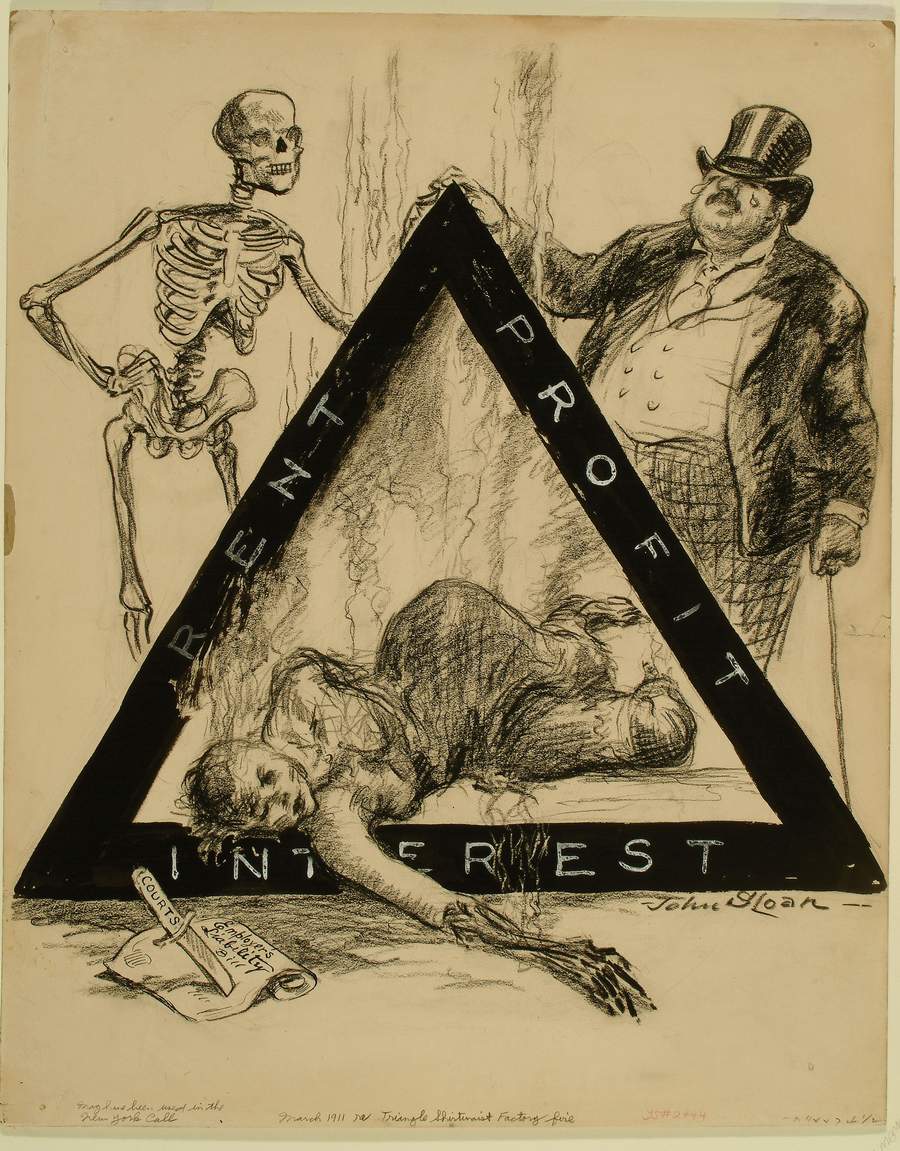
In 1911, some 600,individuals, mostly women, were working at the Triangle Garment Company, owned by Max Blanck and Isaac Harris, and located in the Greenwich Village district of Manhattan. The company occupied the top three floors of the ten storied Asch Building (now the "Brown Building"). For the time, the building was often billed as being "fireproof" (like the unsinkable Titanic in 1912 I guess).

The women, mostly young and recent Jewish and Italian immigrants, were engaged in manufacturing of women's blouses, an industry declining in popularity. The women worked 9 hours a day and earned between $7 and $12 a week conditions were stifling.  Windows were often kept shut and typically management required all doors to be closed and locked from the outside (a supervisor had the key).

On the late afternoon of March 25th, a fire mysteriously broke out in a rag bin and quickly spread. As all the doors were locked from the outside, the only options were burning alive, smoke inhalation, or jumping out the windows to certain death. Many chose the latter. 146 individuals---123 women and 23 men---perished in what was one of the worst disaster in the history of the garment industry.

Although sued by family members, with no safety regulations, the two owners were found innocent. Meanwhile, their insurance company paid Harris and Blanck $60,000 for the loss of their business. That equates to $75 per life lost, of which the families never saw a dime (it was never determined if the fire was accidental or not, but it's worth noting that the two owners had been found guilty on four occasions previously of insurance fraud by arson). OSHA would not be founded for another 60 years when, after intense union pressure, it was signed into law by then President Richard Nixon.

In company owned towns (which were common in and around mines and lumber mills) reprisals for union organizing may include refusal of service at company owned grocery stores (workers weren't paid in U.S. currency, but in company script which was worthless anywhere else), evictions from company owned housing, the rape of wives and daughters, expelling their children from company run schools, and verbal condemnation at company approved churches (attendance was often mandatory). If the "problem" couldn't be resolved "in-house", the company would often employ "other measures".

"Other measures" often took the form of militias or recruited vigilantes, private security companies (like the Pinkertons), hiring  (aka bribing) local cops to break up protests as brutally as possible. If that failed, company presidents would use their influence to get the governor (who was usually in their back pocket anyway) to call out the National Guard and "restore order" and detain ring leaders.

Since many of the workers were Black, German, Irish, Scots, Welsh, Jewish, Asian (predominantly Chinese) or Italian, there was no shortage of hate groups willing to inflict as much violence as possible and get paid for it! Arson or the use of dynamite were often employed as "tools of anti-union trade" and when those tactics didn't work, it sometimes came down to cold blooded murder.

The result was decades of bloody "wars" between companies and their employees from the steel mills of Pittsburgh, the docks of New York, the  coal mines and hollows of Appalachia, and the automobile factories of the Northeast. Ultimately, the workers won, at least in the short term.

Unions were finally officially recognized thanks to the passage of "National Labor Relations Act of 1935"  (aka "The Wagner Act") on the heels of the Great Depression and signed into by President Franklin D. Roosevelt.  FDR was perhaps the most labor friendly president in our country's history.      

His long time friends and opponents, mainly on Wall Street, often called him a "traitor to his class", and perhaps he was. The aim of the "Wagner Act" was to mediate differences between labor and management in order to prevent strikes and work stoppages which weaken an already struggling economy. But the fighting between workers and owners needed to stop for the sake of the nation's economic health (ultimately is wasn't the recognition of unions which saved the economy, but World War II).  

Eventually Big Business was able to claw back many of their concessions. There was no way they were going to allow the political clout of organized labor to stand. In 1949, with bipartisan support, the 80th Congress went over President Harry Truman's head and enacted the "Taft-Hartley Act".  

The act restricted many of Labor's actions against employers, specifically  wildcat strikes, political strikes, solidarity strikes and secondary boycotts. It prohibited discrimination against  non-union members, and additional rights such the right to vote out a union and the right of companies to vote on a union's demands, but it didn't stop there.

In 1959, Congress enacted the Landrum-Griffith Act which was made law with President Dwight Eisenhower's signature.  Also known as the "Labor Management Reporting and Disclosure Act", the law was primarily geared to protect union members from any corrupt activities of union officials may be engaged in. This was the era of organized crime's takeover of a number of unions, notably the "big four",  the International Longshoremen, the International Brotherhood of Teamsters, Laborers International of North America, and Hotel Employees and Restaurant Employees International. 

It made union participation or involvement in racketeering, bribery, extortion, misuse of union funds, intimidation of workers illegal. Anyone found guilty could be removed from their union position and race fines or even jail time. It also created a "Bill of Rights" for union members (which was later extended to include non-union employees as well). 

It should bear mentioning that the Landrum-Griffith Act was passed during the era of "McCarthyism",  "the red Scare", and the "Cold War". The importance of this and how it relates to unions is that many of the early union leaders admitted to being socialist or Communist. Perhaps the best known of these was Robert Le Follett, A. Phillip Randolph, Mary Harris "Mother" Jones,  Eugene Debbs and Samuel Gompers.

Some of the unions which had a large socialist or Communist membership included the CIO and AFL, the UAW, International Union of Electrical Workers,  International Workers of the World ("Wobbles"), the Transport Workers Union, the Longshoremen, and the United Steelworkers.

In addition, many of the laws passed in the 1930's like Social Security, unemployment, the right to unionize and strike were all labeled as "anti-American", "socialist" and "Communist". Nevertheless, most of these laws are not just still with us, but have become institutionalized as a "national right".

Unions are said to have created the middle class, which may very well be true, but it's not been all wine and roses. I voluntarily joined the NWU. I wasn't coerced into joining. It offered me an advantage and I felt I had something I could offer the union. I was honored to have been the liaison on behalf of my fellow employees for 34 years. We accomplished a great deal for ourselves and the company's bottom line. Lastly, while I support unions and the right to organize and bargain for better pay and work conditions, I also believe in free choice and not being compelled into joining any organization.

However, those individuals who decline to join should not expect to receive all of the benefits that their fellow union employees do. That's the trade off. It's called personal responsibility. For me, it's just that "something" about being told I "must" do or participate in something without being given a choice that irks me to the core. I bet no one is surprised to read that! We also have to remember the years of corruption and crime which has smeared the reputation of organized labor, perhaps forever. 

Finally, unions refuse to think outside of the box, or to be more accurate, outside of the hip pocket of  the Democratic Party which, like the Republicans, greedily serves Wall Street. Union leadership has consistently failed to protect the best interests of its members by not making the major parties or candidates compete for its support. Labor must look elsewhere, even if it means forming it's own political party (we're the only industrial nation without a Labor party) or face eventual extinction.  

So, that's a brief history of Labor Day and why you get a three day weekend marking the last "official" holiday of the Summer, but remember the high price others paid for you to have that one extra day off.


 If you enjoyed the article, please consider passing it along to others and don't forget to subscribe. It's free! Lastly please be sure to "like" us on whatever platform you use to read anotheropinionblog.com. It helps beat the algorithms and keeps our articles in circulation. Thank you!


The Haymarket Affair


Lists of worker deaths in United States labor disputes


No union mines left in Kentucky, where labor wars once waged


Union busting


History of union busting in the United States


Triangle Shirtwaist Factory Fire


USERRA: A Guide to the Uniformed Employment or ReemploymentAct


What Is The Taft-Hartley Act?


1959 Landrum-Griffin Act


Communist Party USA and the American labor movement (1919 -1937)


Communist Party USA and the American labor movement (1937 -1950)


Saturday, October 21, 2023

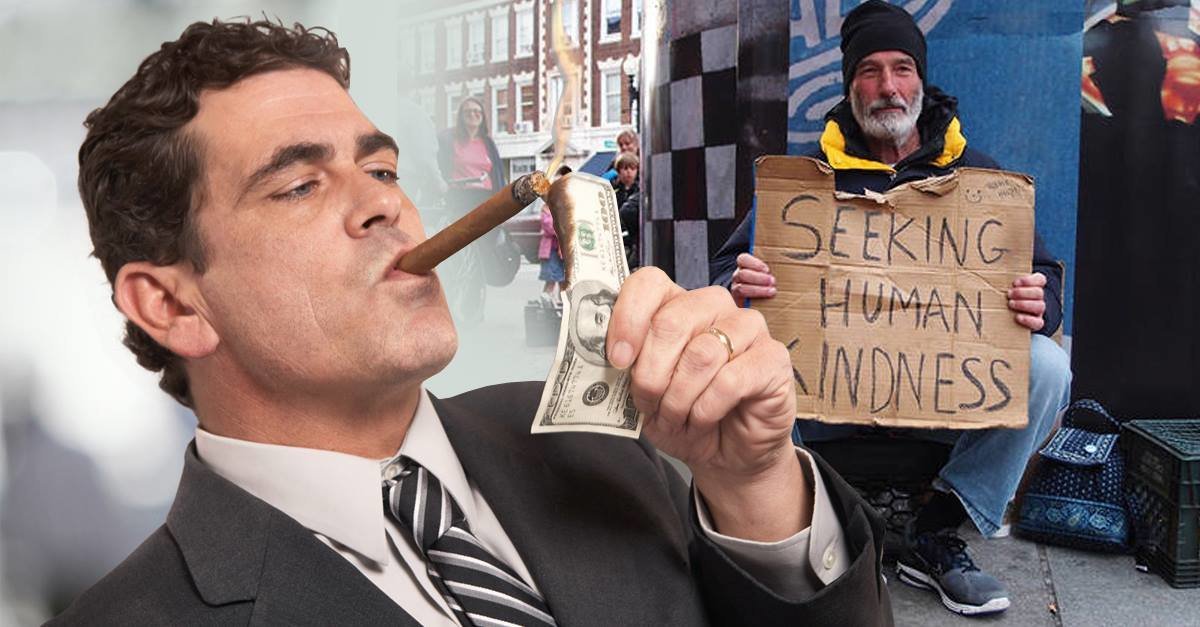
A Nation Out of Balance: Wealth Inequality in America

Did you know that the top 400 richest individuals in America are worth a combined $4.5 trillion dollars? Of those, the top four are worth about $1.9 trillion dollars. Do you think you have what it takes? Just to make it into the top 400 you'll need a minimum net worth of $300 billion dollars. In addition, the top 20 are worth 30% more than they were this time last year. So, who are these modern day descendents of King Midas?

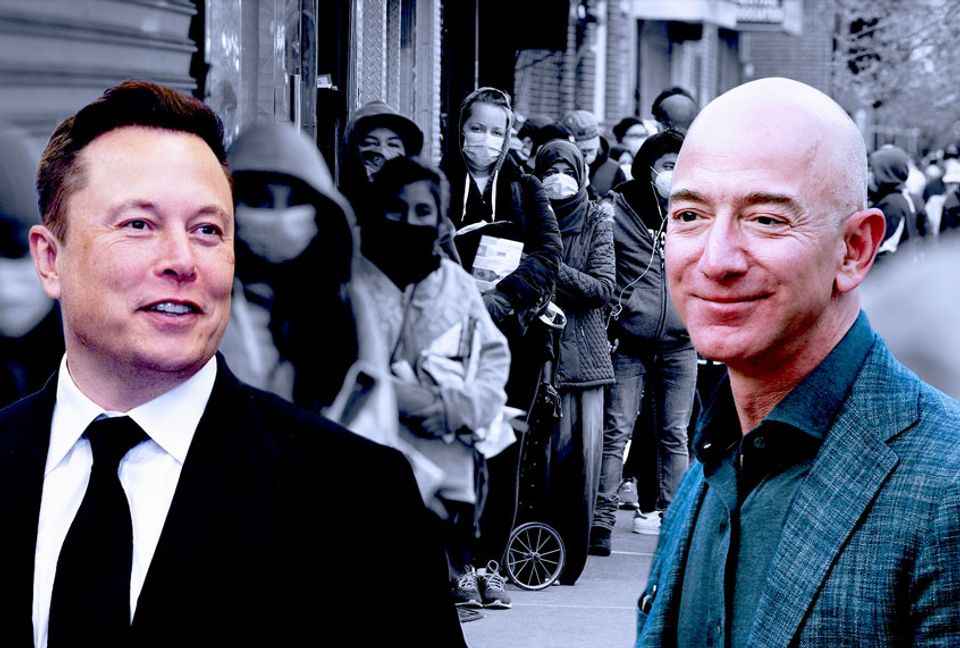
The top five wealthiest individuals are Elon Musk ($180b) at the top, followed by Jeff Bezos ($114b), Bill Gates (135.8b), Larry Ellison ($119.5b), and Mark Zuckerberg ($117.5). Zuckerberg is also the youngest at 39. Warren Buffet is the 7th richest person and Charles Koch ($54.2b), the villain of liberals everywhere, is 17th. Julia Koch ($54.2b), widow of Charles' brother, David, is 18th, making her one of the wealthiest women in the world.  

As an aside, these are the richest individuals in America. Globally, Bernard Arnault of France is the second wealthiest person, behind Musk with a net worth of roughly $174 billion. The balance of the list is the same, making the top 9 out of 10 richest Americans.

Meanwhile, Michael Bloomberg ($69b), the bane of conservatives, is actually much richer, clocking in at 10th place.  Of course, these figures are approximate. By the time it took just to type the figures, they already grew several hundred thousands of dollars. And for those who like to gloat, former President, Donald Trump, is no longer among the top 400 wealthiest. According to Forbes, "The Donald's" wealth has dropped from $3.2 billion to $2.6 billion. While that puts him about $300 million dollars shy of the top 400, I doubt Melania is having to clip coupons.

But what about us ordinary Americans? How do we stack up? As of 2022, the "official" poverty rate in the United States was 11.5% or around 37.9 million people. The number of children living in poverty as of 2022 was 12.4%, up from 5.2% in 2021. However, the actual poverty rate of Americans is much higher, especially when you consider that 49% of Americans are dependent in some matter on government services. That translates to roughly $1.19 trillion dollars or 20% of the federal budget.   

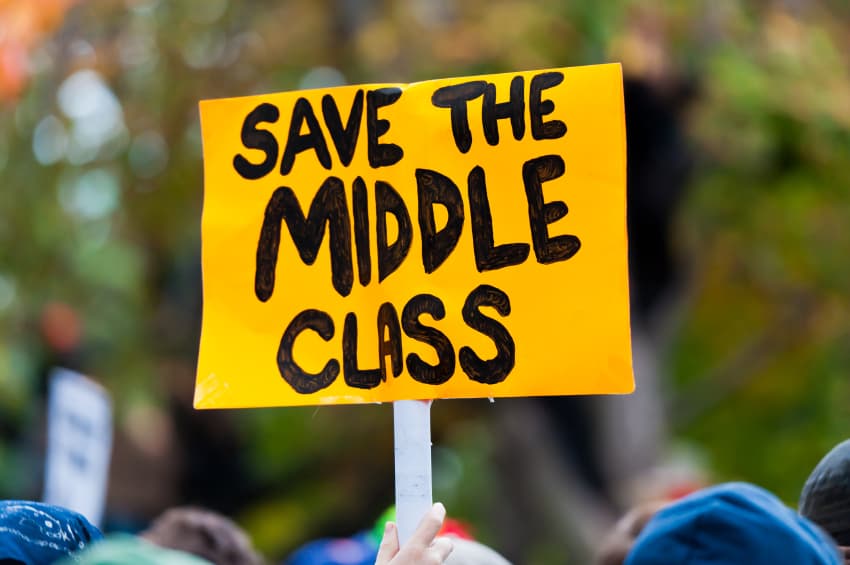
Historically it's been the middle class which has provided the economic and social structure to society. The middle class provides the overall stability which keeps capitalist democracies afloat. Ideally, a society should have a relatively small upper class and a small lower class with a large center. However, that's not the case anymore.

In 1971, 61% of Americans were middle class. By 2021, it was just over 49%.  To make matters worse, those in the upper third of the middle class dropped significantly to middle income while many of those previously in middle portion either remained the same or dropped into the lower middle class, thus making the lower middle class the largest of all the economic classes.

Minorities, which had struggled for decades to reach a middle or upper middle class lifestyle (reaching their zenith in the 1980's) have dropped to middle or lower middle income. The decline of the middle class coincided with the closure of factories and exportation of good paying, and mostly union jobs overseas in the name of improving shareholder profitability and staving off corporate raiders.  

The decline of the middle also coincided with growth of the lower class which increased to 25% of the population (some studies put the figure closer to 29%). Of that 13% were classified as "working poor" while 12% were defined as "underclass". Note that none of this takes into consideration those who are under employed or have simply given up looking for employment.

I should also mention that the rate of homelessness has also grown along with the decline of the middle class. Currently 22% of the homeless are categorized as "chronic", meaning they are unable to be find regular shelter. 5% of the homeless have children with them (defined as those under age 25).  6% of the homeless are veterans. The majority of homeless, 21.5%, are men. 13.3% are women.  

When we take a look at wages, the situation becomes more dire. As of 2022, the average company CEO made a whooping 670 times more than the average employee---not the lowest paid employee mind you, but the middle income earning employee. That means for every dollar the average employee earns, the CEO gets $670. In 2021, that ratio was 399-to-1. By 1989, it was 59-to-1, and in 1965 CEO's made $29 dollars for every dollar the average employee made. 

Between 1979 and 2022, the pay of senior company executives went up 1209.02% while the average worker's compensation went up 15.3%. It's worth noting that since 1975, prices overall have increased by 361.41%, or to rephrase it by saying that it would take $5.72 in 2022 to buy the same amount a dollar in 1975 would. Thus when adjusted for inflation, the purchasing power of a dollar relative the rise in wages, which helps to explain, at least partially, the decline of the middle class.

When we look at the situation globally, the picture is much the same. The upper 10% take home 52% of the income while the poorest 50% has just 8%. In terms of overall wealth, the top 10% control 85% of all wealth while the bottom 90% control 15% with the poorest segment owning a mere 2%. The top 1% control 50% of the world's wealth.  

Compare that with the U.S. where, according to the Federal Reserve, as of 2021, the top 1% controlled 32.3% of the total wealth while the bottom 50% controlled just 2.5%. As of the end of the second quarter of 2023, the Federal Reserve said that the top 10% control 69% of the total wealth while the lowest 50% had just 2.5%. The top 1% controlled just over 1/4 of the total wealth in the U.S..  

Globally speaking, the United States has the fifth worse level of income inequality out of the top 35 industrialized nations. Only Bulgaria, Turkey, Mexico, and Costa Rica were worse off. The U.S. also still had the highest disparity between CEOs and workers by a large margin. The next closest was Switzerland where the wage disparity between CEO's and workers was 148%, followed by Germany at 147% and Spain at 127%.

As an aside, it should be pointed out that the COVID-19 pandemic contributed to the growing wage disparity since senior executives continued to receive their full compensation while the majority of the workforce was at home receiving next to nothing beyond unemployment and a couple of small government handouts (aka "stimulus checks").  

Also don't forget about their considerable investments in pharmaceuticals,  healthcare, and medical research. During the pandemic, Jeff Bezos, Mark Zuckerberg, Elon Musk, and six other billionaires made $360 billion dollars during the deadly outbreak. 

From March 5, 2020 through March 5, 2021, the height of the pandemic, Elon Musk's wealth increased by $118 billion dollars. Jeff Bezos saw an increase of $58 billion while Larry Paige and Sergey Brin saw their wealth grow by $33 and $32 billion dollars respectively. Mark Zuckerberg's portfolio increased by $29 billion, while Larry Ellison's grew by $28 billion. Bill Gate's financial worth blossomed by $24 billion. Two other billionaires, Steve Ballmer and Michael Dell saw their wealth grow by $23 billion and $18 billion. Money begets money, and they have a lot of money to beget! 

The ever expanding wealth inequality has effectively created a two tier society both in the United States and abroad. The middle class has historically been the glue which held capitalist democracies together. Even during feudal times, it was the well-to-do peasant class which helped prop up the monarchies. The middle class has provided an incentive for the lower classes to try to achieve economically and socially while providing a social barrier for the upper classes.

It has been said that the middle class is the only thing protecting the rich from being murdered by the poor. However, if the middle class no longer has as much to protect, then there is no reason it shouldn't make common cause with the lower class which has happened previously in history. If that should occur, there would be a complete upheaval in society.

The choice, therefore, that we all must accept is either fundamental and real change in how society functions economically and politically, including possibly a defacto cap on individual wealth and a minimum corporate tax, or face a real threat of more radical changes at home and globally.

There is no longer a middle ground. Attempts by politicians or the corporate media to divert our attention with another "crisis de jure" or even their blatant refusal to protect their financial interests just aren't going to cut it anymore. It's past time that we took charge of this country again.  

In addition to the links below which explain the statistics mentioned above in greater detail, I've also include two short videos below which illustrate what we've discussed more entertainingly. We hope you enjoy them and will let us know what you think about the decline of the middle class and bifurcation of society politically and economically.


Video: Wealth Inequality in America: Visualizedfor 2023 (13:19)

Humphrey Yang


Video: Wealth Inequality in America (6;23)

politizane


If you enjoyed the article, please consider passing it along to others and don't forget to subscribe. It's free! Lastly please be sure to "like" us on whatever platform you use to read anotheropinionblog.com. It helps with the algorithms and keeps our articles in circulation. Thank you!


List of wealthiest Americans by net worth


Donald Trump drops from the Forbes 400 list of richest Americans. Here's what changed


For most U.S. workers, real wages have barely budged fordecades


Wage gap between CEOs and US workers jumped 670-to-1 lastyear, study finds


These charts show the growing income inequality between the world's richest and poorest


OCED: Income Inequality


State of Homelessness: 2023 Edition


Saturday, September 02, 2023

Labor Day and its Socialist Origins

 Labor Day. That three day weekend holiday which marks the "official"  (more or less) end of Summer. It typically means picnics, last trips to the lake, beach, or public pools before they're all closed.  For many it marks the beginning of another school year while for others it's all those Labor Day sales! Although nothing beats "Black Friday" or "Cyber Monday" in terms of sales and deep discounts, Labor Day is considered by retailers to be the third biggest retail shopping day in terms of sales volume.  

But what is "Labor Day" really? Well, it was intended to be a day to honor the working men and women, particularly those belonging to a union, who built this nation and kept it running. Labor Day was signed into law by President Grover Cleveland on June 28, 1894 establishing the first Monday of September as a national holiday, and yet despite its 129 year history, so few of us know the full story of Labor Day or its socialist beginnings.

Yes, you read that right. Labor Day was established essentially as a socialist holiday. The origins of Labor Day began starting in the 1880's with the rise of trade unions and the labor movement, primarily in response to dangerous working conditions, poor wages, long hours, a lack of healthcare, and miserable housing. Working women had it just as bad as the men, which was pretty bad. Even children as young as six or seven were often pressed to working in conditions well beyond their years.

Some employers, like Ford, even required workers to follow a certain moral code or social guidelines like no drinking, smoking or mandatory church attendance (of the employer's choice) just to remain employed! Company inspectors made routine visits to ensure compliance while others were required to live in so-called "company towns" and were paid in "script", thus attaching them to their employer.

Work related injuries, respiratory diseases like black lung, and premature deaths were common, and yet there was no legal recourse with the employer or state. The misery and coarseness of everyday life can't be stressed hard enough because in today's world such misery can hardly be imagined. These were just some of the conditions which led to workers slowly organizing into unions and associations whose governance was based on the majority vote and "an injury to one is an injury to all" mentality. 

 The origins of Labor Day can ultimately be traced to two individuals, Peter J. McGuire and Matthew Maguire. Peter was born in New York City in 1852, the son of a poor Irish Catholic immigrants. He was the co-founder, along with German immigrant Gustav Luebkert, of the United Brotherhood of Carpenters and Joiners of America in 1881.

McGuire later joined with Austrian born Adolph Strasser, the president of the Cigar Makers Union, to found the Socialist Democrat Workingman's Party of North America (Strasser, along with Samuel Gompers, would later found the American Federation of Labor or AFL).  The unions sought to merge social democracy with improving living conditions of the masses.

McGuire, by now a vice president of the AFL, is generally credited with being the first to propose the creation of a national day recognizing the labor movement in America after an earlier visit to Toronto Canada to see the May Day celebrations ("May Day", celebrated on May 1st, is also known as the International Day of the Worker) at a convention of the Knights of Labor in 1882. 

The other individual given credited with helping to establish Labor Day is Matthew Maguire. Matthew was the general secretary of the Central Labor Union of New York, Brooklyn and New Jersey (or known simply as the CLU), which later merged with what became the AFL-CIO. The union, which was strongly Marxist, was originally founded in 1867 in New York and ultimately spread to Philadelphia.

The union was closely tied to the United Labor Party, a combination of a number of unions and organizations such as the Socialist Labor Party, the Knights of Labor, the Central Labor Union  and another 113 similar unions and labor associations.

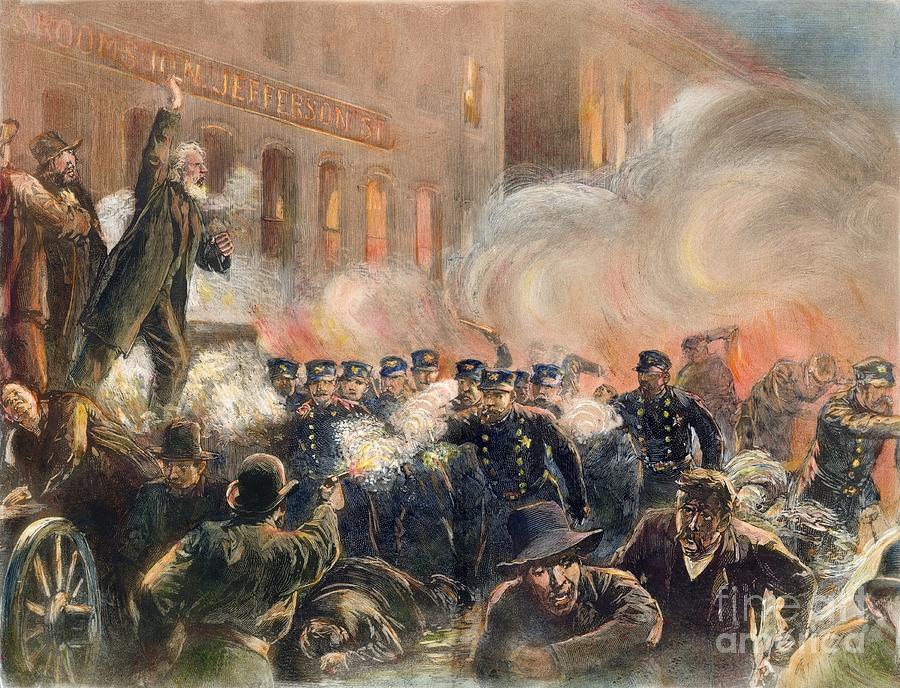
The party, which was formed following the Haymarket Riot of 1886, promoted  free trade, the secret ballot, a single tax on all private property, ending child and convict labor, and promoting low fares on public transportations and discounts on public utilities for low income families. 

It is alleged by some that Matthew Maguire had first suggested setting aside a day to honor working men and women to CLU leadership, and after some discussion, the suggestion was approved. Others, however, suggest that Matthew was merely given credit for the suggestion since he was the general secretary. Nevertheless, the CLU is believed to be the first union to begin promoting parades, festivities and so forth to honor working men and women of the labor movement.

The popularity of the labor holiday quickly spread from city to city and state to state, becoming either an official holiday or a de facto one with parades, picnics, speeches, and so forth. By 1894, 30 of the 44 U.S. states had made it an official holiday. In that same year, Congress (obviously recognizing a winning issue with labor) proposed a bill making it a federal holiday. It was signed by President Grover Cleveland in June, and was to go into effect that September. It should be pointed out that the new law pertain only to federal employees and it took until the 1930's before the holiday was legally celebrated everywhere.

Ironically, the first Labor Day came immediately following the infamous "Pullman Strike" which was two closely related strikes involving members of the American Railway Union led by Eugene V. Debs, the Pullman Palace Car Company, the producer of railroad cars, and unorganized workers living in the company town of Pullman. 

These individuals were demanding the right to organize and protesting their living conditions, overpriced food sold by the sole company owned store, excessive utility and water rates, and low pay (employees were also paid in "script" which made it all but impossible to go somewhere else) while others were protesting a recent wage cut and working conditions. 

Pullman cited declining revenue following the financial Panic of 1893 as the reason for cutting wages. Within four days of the strike, 125,000 railroad workers were involved. It ended with  57 injured, 70+ dead, and 4 arrested.

As an aside, Eugene V. Debs, who was born in Terre Haute, Indiana, was a member of the Brotherhood of Locomotive Firemen and an ardent democratic socialist and labor activist. He was elected to the Indiana State House of Representatives in 1885 and ran for president four times under the Social Democrats and Socialist Party banners. He co-founded the International Workers of the World (IWW or aka "The Wobbles"). 

Because of the socialist convictions, Debs was arrested in 1918 on ten counts of alleged sedition (he had been urging workers to resist the draft). Sound familiar? Debs was stripped of his right to vote for life and was sentenced to ten years in prison. Nevertheless, he continued to run for the presidency behind bars!  Debs still received 914,919 votes. The Pullman Strike would later become known as "The Debs Rebellion". 

In researching this article I came across four very informative and entertaining videos pertaining to Labor Day and other events mentioned here. I'm providing a link below. Most are fairly short in duration, but quite educational nevertheless. Hope you enjoy and have a great Labor Day weekend.

If you enjoyed the article, please consider passing it along to others and don't forget to subscribe. It's free! Lastly please be sure to "like" us on whatever platform you use to read anotheropinionblog.com. It helps with the algorithms and keeps our articles in circulation. Thank you! 


Video: The History of Labor Day (2:18 minutes)


Video: Labor Day's Violent Beginnings (2:34 minutes)


Video: The Haymarket Tragedy (5:51 minutes)


Video: The Pullman Strike (5:31 minutes)


Saturday, April 25, 2020

Do You Want Fries with Your Pandemic? Global Famine on the Heels of COVID-19


It seems we've entered into a phase where we just can't catch a break. A month or so ago, I read an article where parts of the Middle East were being affected by locust swarms of biblical proportions. California, as everyone knows, was hit by a series of massive wildfires, which were, in part, the result of faulty power lines belonging to PG&E while others were intentionally, as was Australia. Globally, there has been a series of volcanic eruptions and upticks of earthquakes, especially in South America and Asia along the so-called "ring of fire", which is an area with the most active volcanoes along the Pacific Rim.

Of course, we've been locked into a debate for over a decade as to whether we are experiencing climate warming which, if true, could have catastrophic consequences on the planet for decades or centuries to come. Meanwhile, others argue that there is no proof of global warming. What changes that are taking place are ordinary changes like the Earth has been experiencing for thousands or millions of years. A sizeable minority maintain that there are no changes happening whatsoever, and then there are those who even claim we may actually be entering a brief period of global cooling!

Nowadays, we facing a pandemic which some experts say could cause hundreds of thousands of deaths. Fortunately, no one is predicting that the current flu-like virus will have the same numbers of the 1918 Spanish Flu which killed an estimated 20 to 50 million people worldwide (that's more than who died during World War One) while infecting at least 500 million.

As an aside, Ebola, which isn't a respiratory disease like MERS, the Bird Flu, or COVID-19, has killed approximately 11,300 people and infected some 28,000 (mostly in Africa) according to the World Health Organization (WHO) as of 2016. Meanwhile, the AIDS pandemic, which began around 1981 and continues today has caused 35 million deaths. The Swine Flu of 2009/2010 infected 1.4 billion people according to the Center for Disease Control (CDC). While the exact number of deaths are unknown, the CDC estimated that somewhere between 151,700 and 575,400 people died from complications resulting from the Swine Flu. MERS killed around 100 people and the Bird Flu killed approximately 400.

Now, the corporate media is starting to report that as result of the business closures triggered by the COVID-19 outbreak and resulting global economic decline in trade, food production and distribution may become affected. If this occurs, these same news outlets are predicting that there could be a food shortage worldwide, which could become severe or catastrophic in some places.

I'm sure most of us have heard about dairy farmers having to throw out thousands of gallons of milk while produce farmers are allowing equal amounts crops to rot in the field, yet the demand for food in food banks, homeless shelters, and other facilities which cater to those who are food insecure has dramatically increased thanks to the virus situation. Why are we allowing all this to go to waste? Before we address that question, let's look at the food situation globally and nationally first, and who are the most vulnerable.

According to the United Nations, approximately 812 million people do not get enough food to meet basic nutritional needs. That's roughly one in nine individuals globally who go to sleep at night hungry. Asia is the worst affected, followed by Africa (mainly the Sub-Saharan region). Poor nutrition is listed as the prime cause of death among 45% of all children under five years of age. That's about 3.1 million children. One in four are stunted while one in six are underweight. 66 million children globally go to school hungry.

In addition, the lack of proper nutrition also affects their mental development. It also leaves them with a weakened immune system and chronically poor health which often affects them for life. This also affects prenatal women who are typically undernourished in these regions as well. An interesting side note, due to religious and cultural traditions, women are often not permitted birth control. Incidentally, women farmers are not allowed the same resources as the men when it comes to farming for the same reasons. If they were, an estimated 150 million additional people could be fed annually.

In the United States, the "land of plenty", nearly 38 million people live in poverty. An estimated 78% of Americans live from paycheck to paycheck according to a survey done by CareerBuilder in 2019. Three in four are in debt and expect to remain in debt. 45% of Americans have no savings or money set aside for emergencies (72% have less than $1000 set aside). An average of 25% of workers have no money put aside toward retirement. Credit card debt alone in this country is a one trillion dollar issue.

Of the 38 million people living in poverty, 37 million are "food insecure" which is a polite euphemism for not knowing where or when their next meal is coming from. Of this number, 11 million are children. 12.3% are considered the "working poor". 60% of seniors routinely have to decide between food, medicine, and expenses every month. The majority depend on some form of outside assistance such as a food bank, shelter, church, or similar organization. The children of those in poverty depend on school provided meals. Often it's the only meal they can actually count on.

With the COVID-19 pandemic upon us, it only compounds the situation. People aren't working and unemployment will only get you so far, even with small extra government provided "perks" such as the stimulus checks. Meanwhile, with people not working and businesses idle, no revenue is being produced, which means no taxes being generated to keep governments functioning. Yes, governments and businesses can borrow money, but that's just delaying the inevitable (plus the added interest). The result is an economy slowing down and the likely advent of a recession the longer we remain in quarantine, which brings us back to the topic of hunger.

In the best of times, global famine remains a serious issue. With this pandemic, it's only going to get worse. While in most countries, especially the highly industrialized nations, such as Russia, Germany, South Korea, Japan, France, or the UK, it's doubtful it will come to that. However, getting food is becoming an increasing problem, especially in the poorer countries, but also here at home.

There are already growing reports of people lining up in line for hours to get basic food packages only to find out that they "just" ran out. Food banks, as I said earlier, are reporting a significant increase in demand. So, why are there crops in the field being allowed to rot while thousands of gallons of milk go down the drain literally?

Dawn Thilmany, an agricultural economist from Colorado State University, said that normally 50% of all food produced go to commercial use (restaurants, institutions, etc). Because of the quarantine, 75% of that business is gone. The remainder is what's being picked up by the drive-thru and home delivery businesses still open and by institutions who buy in bulk.

In addition, farmers have to cope with the ban prohibiting ten or more individuals gathering out of fear of spreading the virus. A typical farming operation can involve dozens of people. There is also the freshness issue. As general rule, crops will remain fresh for just two weeks (not to mention eggs). Even if they could harvest the crops, food banks, churches, and other organizations which feed the poor couldn't afford the cost the farmers would have to charge just to cover their labor costs, let along make even a small profit. Unfortunately, it's cheaper to let the crops rot in the field, at least in the short run.

The quarantine issue and worker safety is also at the heart of several meat processing and packing plants being shut down. So, that means that animals normally sent to slaughter will get a short reprieve. However, that also means they will continue to have to be fed and cared for. That costs money, and with no money coming in from the sale of the cows, pigs, chicken, and fish, it presents a serious financial problem.

Another agricultural economist, Andrew Novakovic of Cornell University, said that typically the dairy industry loses approximately. 0.3% of product as a result of fluctuating demand. However, because of the COVID-19 virus and the shutdowns (such as schools), demand is down around 15%. As a result dairy farmers are dumping upwards of 10% of the milk produced.

The reason is pretty much the same. There isn't as much demand for dairy based products such as cheese, butter, or sour cream. Therefore, less demand means less production. However, since the "production" is coming from cows rather than production lines, it's simply dumped. Meanwhile, the cows can't be laid off. They can't draw unemployment. That still have to be fed and milked, and that's money out of the farmer's pocket. The end result may be a selloff of dairy cattle and fewer dairy farms, which, in turn, will result in higher prices for dairy based products.

Farmers and meat producers don't, as a rule, make a whole lot of money. Most do pretty well, but it's the large commercial operations which dominate the market. They are the ones which can endure long shutdowns and absorb the costs. Farmers, meanwhile, are expected to lose around $688 million dollars in sales due to the shutdown. With those numbers, the average "mom and pop" or independent operation can't last, at least not for long.

The end result is that we may see significantly fewer independent operations. We'll also likely see higher prices due to the decline in the number of producers and the extra costs associated with the feeding and sheltering of all those pigs, chickens, and hamburgers on the hoof has cost which will be passed to the consumer.

So, we sit and wait. Maybe the government will step forward with a plan to save the small dairy farmer and meat producer similar President Roosevelt's Agricultural Adjustment Act of 1938 which paid farmers a subsidy not to grow crops in order to dry up surpluses and increase prices, thus keeping more farmers in business. Then too, maybe farmers will allow people to come out and pick crops (like fruits and vegetables) rather than let it rot in the fields along the lines of the biblical notion of "second gleanings" (Leviticus 19:9). They could even let churches, food banks, the homeless to come out. At least it would feed some of the hungry.

Virus or not, there is no reason anyone in this country of ours should go hungry, be it in good times or bad. We should be thankful for those individuals who show up and stock the shelves, who work the drive-thru or making home deliveries, the truck drivers or those who are still on the job filling our prescriptions, along with all the nurses, doctors, police, EMS, firefighters, the postal workers, the men and women of the military, the garbage men, housekeeping, those making sure we have clean water and electricity, and of course, the farmers who make it possible for us to put food on the table. Want to know more? Check out our links below.


ISGlobal: Ebola: Two Years and 11,300 Deaths Later

20 of the worse epidemics and pandemics in history

Global hunger continues to rise , new UN report says

Why farmers are forced to let food rot during the shutdown while others go hungry


California farmers are forced to let crops rot and thrown away milk while food band demand soars