Labor Day was established in 1894 and signed into law by
president Grover Cleveland to make the
first Monday of each September a federal day set aside to celebrate the efforts
of organized labor and the gains---financial and social--- it has made on
behalf of all workers, union and non-union.
I guess I've always tended to support unions, employee owned
workplaces. and employee initiatives. From the time I got out of the Navy in
1979 to when I retired at the ripe old age of 55 in 2013, I've worked for
several non-union companies. Most were decent, but some seriously "used
and abused" their employees and left much to be desired. This resulted in
a lot of employee turnovers, sloppy work, very low morale, hostile outbursts,
and some unnecessary tense work conditions.
In every place I worked, I was asked by fellow employees to be
the employee representative. I'm not sure why I was repeatedly chosen. Maybe they
thought I'd be fair and balanced or perhaps it was because I wasn't bashful
about challenging authority figures! Regardless, I was always honored by the
trust and confidence my fellow employees had in me to take on the role of employee/management
liaison.
My last position before retiring was that of "Special
Coordinator to the President for Special Projects". Basically this was a
assistant vice president position which functioned similar to my previous roles
as a employee/management liaison. I was to provide a comprehensive report to
the company president and the Regional Vice President along with
recommendations for the improvement of company morale and productivity (in addition
to my role as Senior Legal Manager, where I oversaw around 30 contract
attorneys and managed a receivables portfolio of some $15 million dollars).
In addition to serving on several non-profit boards, I was
appointed state chairperson of a national writers union (NWU 1918) where I served
for 11 years. I handled state based issues and served on the local labor
council. I was elected as the National Vice Chairperson of the At Large Chapter
and served on several national committees. I also liaised with several worker oriented
organizations.
Did you know organized labor has been chiefly responsible
for establishing the 40 hour work week, health and other benefits, paid
vacations and personal time, job safety (resulting in the creation of OSHA), an
end to child labor (children as young as 8 years old were often working in
mines),
fiscal accountability of hours
worked and wages earned? They promoted Social Security, unemployment insurance
and worker's compensation for work related injuries.
Equality and fairness in the workplace has always been a
historically important union issue. Unions backed social causes like the
Women's Suffrage Movement, Civil Rights, and the Chicano Movement of migrant farm workers and sharecroppers for fair wages, not to mention the Family Medical Leave Act, and the Uniformed Services Employment and
Reemployment Rights Act (USERRA) which guaranteed returning military personal
their old job back or paid training for a similar job in the event their
earlier job or place of employment was gone. But these gains didn't come easy.
They opposed President Clinton's "NAFTA", which was a disaster for
American industries and blue collar workers.
It's estimated that at least 1100 individuals died fighting
for worker rights (many murdered by "enforcers" hired by company
bosses). Thousands more were injured. Some badly. Others permanently. Companies
used every form of intimidation imaginable, from reducing hours for hourly
employees (or overloading them with hours and no breaks or rest time),
ostracizing employees (and anyone who associated with them) to outright firing
them. A lot of blood was spilled for these "concessions".
Since the advent of the modern Industrial Age, countless
workers, mostly women, worked for low wages in the textile industry, often in
hot and unsafe conditions. Many were maimed or killed. With no daycare, the
women often brought their children with them, tucking infants and small
children under chairs or beside their machines. Not surprisingly injuries or some
other mishap wasn't uncommon among the children, such as lung disease, hearing
loss, or the loss of a finger.
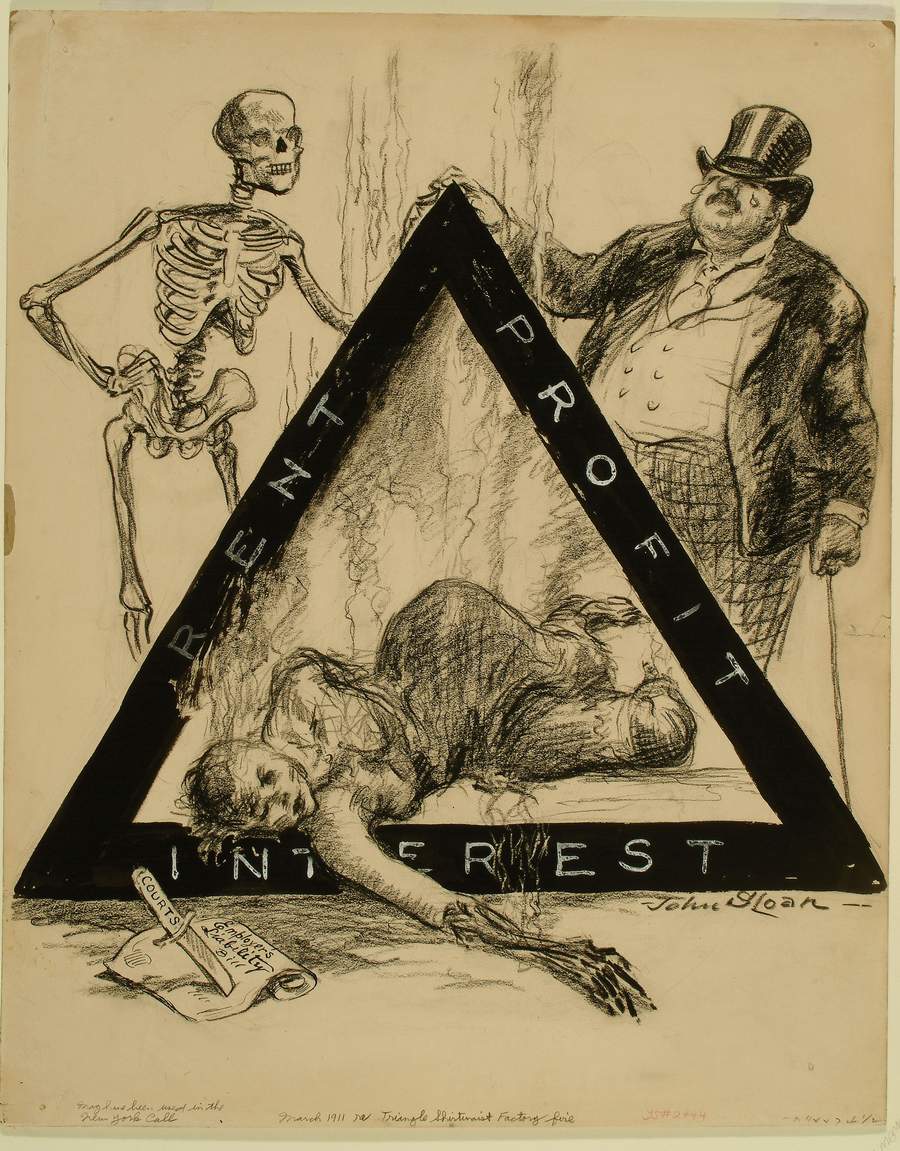
In 1911, some 600,individuals, mostly women, were working at
the Triangle Garment Company, owned by Max Blanck and Isaac Harris, and located
in the Greenwich Village district of Manhattan. The company occupied the top
three floors of the ten storied Asch Building (now the "Brown
Building"). For the time, the building was often billed as being "fireproof"
(like the unsinkable Titanic in 1912 I guess).
The women, mostly young and recent Jewish and Italian
immigrants, were engaged in manufacturing of women's blouses, an industry
declining in popularity. The women worked 9 hours a day and earned between $7
and $12 a week conditions were stifling.
Windows were often kept shut and typically
management required all doors to be closed and locked from the outside (a supervisor
had the key).
On the late afternoon of March 25th, a fire mysteriously
broke out in a rag bin and quickly spread. As all the doors were locked from
the outside, the only options were burning alive, smoke inhalation, or jumping
out the windows to certain death. Many chose the latter. 146 individuals---123
women and 23 men---perished in what was one of the worst disaster in the
history of the garment industry.
Although sued by family members, with no safety regulations,
the two owners were found innocent. Meanwhile, their insurance company paid Harris
and Blanck $60,000 for the loss of their business. That equates to $75 per life
lost, of which the families never saw a dime (it was never determined if the
fire was accidental or not, but it's worth noting that the two owners had been
found guilty on four occasions previously of insurance fraud by arson). OSHA
would not be founded for another 60 years when, after intense union pressure,
it was signed into law by then President Richard Nixon.
In company owned towns (which were common in and around
mines and lumber mills) reprisals for union organizing may include refusal of
service at company owned grocery stores (workers weren't paid in U.S. currency,
but in company script which was worthless anywhere else), evictions from
company owned housing, the rape of wives and daughters, expelling their children
from company run schools, and verbal condemnation at company approved churches
(attendance was often mandatory). If the "problem" couldn't be resolved
"in-house", the company would often employ "other
measures".
"Other measures" often took the form of militias
or recruited vigilantes, private security companies (like the Pinkertons),
hiring (aka bribing) local cops to break
up protests as brutally as possible. If that failed, company presidents would
use their influence to get the governor (who was usually in their back pocket
anyway) to call out the National Guard and "restore order" and detain
ring leaders.
Since many of the workers were Black, German, Irish, Scots,
Welsh, Jewish, Asian (predominantly Chinese) or Italian, there was no shortage
of hate groups willing to inflict as much violence as possible and get paid for
it! Arson or the use of dynamite were often employed as "tools of
anti-union trade" and when those tactics didn't work, it sometimes came down to cold
blooded murder.
The result was decades of bloody "wars" between
companies and their employees from the steel mills of Pittsburgh, the docks of
New York, the coal mines and hollows of
Appalachia, and the automobile factories of the Northeast. Ultimately, the
workers won, at least in the short term.
Unions were finally officially recognized thanks to the
passage of "National Labor Relations Act of 1935" (aka "The Wagner Act") on the heels
of the Great Depression and signed into by President Franklin D. Roosevelt. FDR was perhaps the most labor friendly
president in our country's history.
His long time friends and opponents, mainly on Wall Street,
often called him a "traitor to his class", and perhaps he was. The aim of the "Wagner Act" was to
mediate differences between labor and management in order to prevent strikes
and work stoppages which weaken an already struggling economy. But the
fighting between workers and owners needed to stop for the sake of the nation's
economic health (ultimately is wasn't the recognition of unions which saved the
economy, but World War II).
Eventually Big Business was able to claw back many of their
concessions. There was no way they were going to allow the political clout of
organized labor to stand. In 1949, with bipartisan support, the 80th Congress
went over President Harry Truman's head and enacted the "Taft-Hartley
Act".
The act restricted many of Labor's actions against
employers, specifically
wildcat strikes,
political strikes, solidarity strikes and secondary boycotts. It prohibited discrimination
against
non-union members, and
additional rights such the right to vote out a union and the right of companies
to vote on a union's demands, but it didn't stop there.
In 1959, Congress enacted the Landrum-Griffith Act which was
made law with President Dwight Eisenhower's signature. Also known as the "Labor Management
Reporting and Disclosure Act", the law was primarily geared to protect
union members from any corrupt activities of union officials may be engaged in.
This was the era of organized crime's takeover of a number of unions, notably
the "big four", the International
Longshoremen, the International Brotherhood of Teamsters, Laborers International
of North America, and Hotel Employees and Restaurant Employees
International.
It made union participation or involvement in racketeering,
bribery, extortion, misuse of union funds, intimidation of workers illegal.
Anyone found guilty could be removed from their union position and race fines
or even jail time. It also created a "Bill of Rights" for union
members (which was later extended to include non-union employees as well).
It should bear mentioning that the Landrum-Griffith Act was
passed during the era of "McCarthyism", "the red Scare", and the "Cold
War". The importance of this and how it relates to unions is that many of
the early union leaders admitted to being socialist or Communist. Perhaps the
best known of these was Robert Le Follett, A. Phillip Randolph, Mary Harris
"Mother" Jones, Eugene Debbs
and Samuel Gompers.
Some of the unions which had a large socialist or Communist
membership included the CIO and AFL, the UAW, International
Union of Electrical Workers,
International Workers of the World ("Wobbles"), the Transport
Workers Union, the Longshoremen, and the United Steelworkers.
In addition, many of the laws passed in the 1930's like Social
Security, unemployment, the right to unionize and strike were all labeled as
"anti-American", "socialist" and "Communist".
Nevertheless, most of these laws are not just still with us, but have become
institutionalized as a "national right".
Unions are said to have created the middle class, which may
very well be true, but it's not been all wine and roses. I voluntarily joined the NWU. I
wasn't coerced into joining. It offered me an advantage and I felt I had
something I could offer the union. I was honored to have been the liaison on
behalf of my fellow employees for 34 years. We accomplished a great deal for ourselves
and the company's bottom line. Lastly, while I support unions and the right to
organize and bargain for better pay and work conditions, I also believe in free
choice and not being compelled into joining any organization.
However, those individuals who decline to join should not
expect to receive all of the benefits that their fellow union employees do. That's
the trade off. It's called personal responsibility. For me, it's just that
"something" about being told I "must" do or participate in
something without being given a choice that irks me to the core. I bet no one
is surprised to read that! We also have to remember the years of corruption and crime which has smeared the reputation of organized labor, perhaps forever.
Finally, unions refuse to think outside of the box, or to be more accurate, outside of the hip pocket of the Democratic Party which, like the Republicans, greedily serves Wall Street. Union leadership has consistently failed to protect the best interests of its members by not making the major parties or candidates compete for its support. Labor must look elsewhere, even if it means forming it's own political party (we're the only industrial nation without a Labor party) or face eventual extinction.
So, that's a brief history of Labor Day and why you get a
three day weekend marking the last "official" holiday of the Summer,
but remember the high price others paid for you to have that one extra day off.
If you enjoyed the article,
please consider passing it along to others and don't forget to subscribe. It's
free! Lastly please be sure to "like" us on whatever
platform you use to read anotheropinionblog.com. It helps beat the algorithms and keeps our
articles in circulation. Thank you!
The Haymarket Affair
Lists of worker deaths in United States labor disputes
No union mines left in Kentucky, where labor wars once waged
Union busting
History of union busting in the United States
Triangle Shirtwaist Factory Fire
USERRA: A Guide to the Uniformed Employment or ReemploymentAct
What Is The Taft-Hartley Act?
1959 Landrum-Griffin Act
Communist Party USA and the American labor movement (1919 -1937)
Communist Party USA and the American labor movement (1937 -1950)