Showing posts with label blue collar. Show all posts

Friday, August 30, 2024

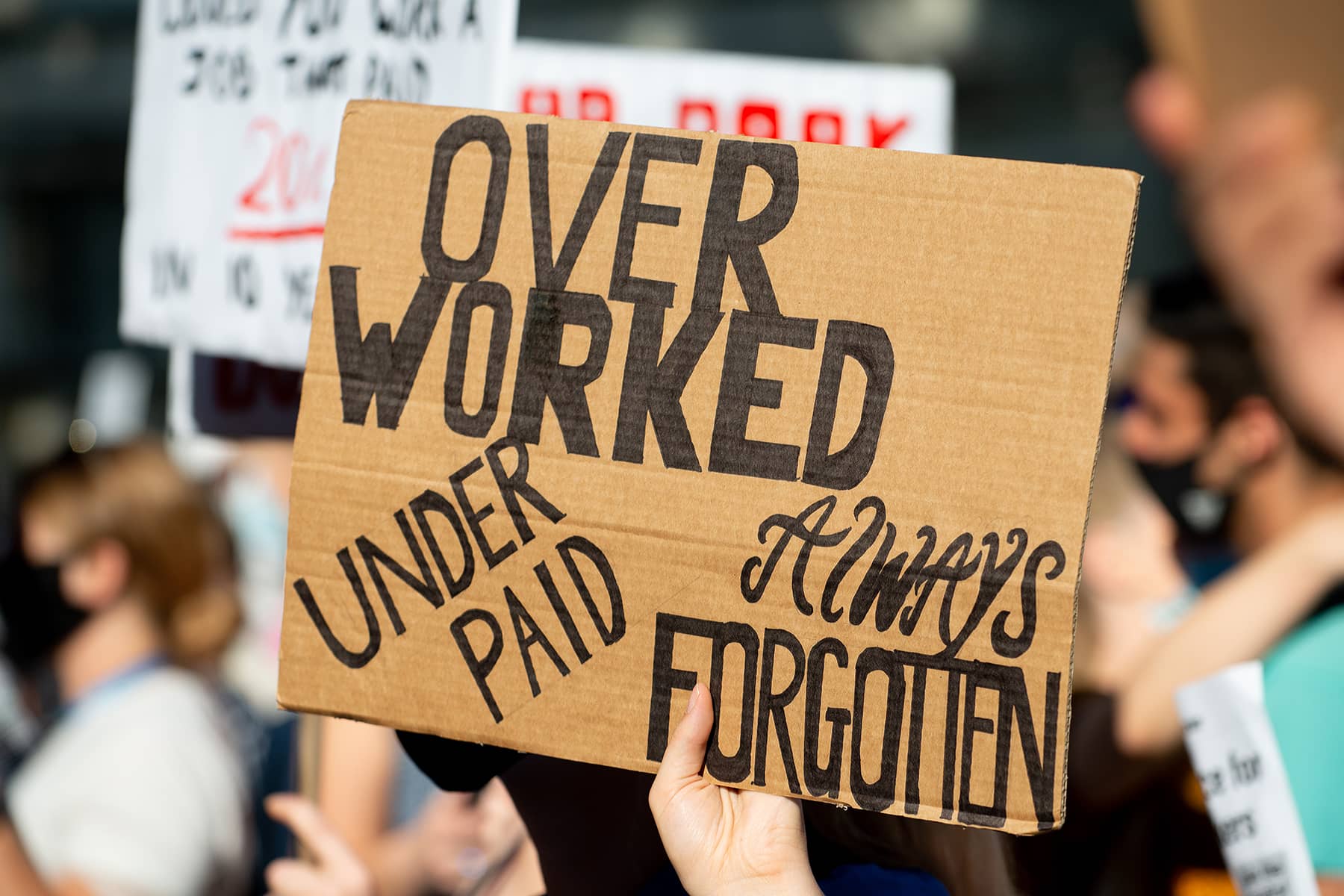
Labor Day: A Day for the American Worker


Labor Day was established in 1894 and signed into law by president Grover Cleveland  to make the first Monday of each September a federal day set aside to celebrate the efforts of organized labor and the gains---financial and social--- it has made on behalf of all workers, union and non-union.

I guess I've always tended to support unions, employee owned workplaces. and employee initiatives. From the time I got out of the Navy in 1979 to when I retired at the ripe old age of 55 in 2013, I've worked for several non-union companies. Most were decent, but some seriously "used and abused" their employees and left much to be desired. This resulted in a lot of employee turnovers, sloppy work, very low morale, hostile outbursts, and some unnecessary tense work conditions.

In every place I worked, I was asked by fellow employees to be the employee representative. I'm not sure why I was repeatedly chosen. Maybe they thought I'd be fair and balanced or perhaps it was because I wasn't bashful about challenging authority figures! Regardless, I was always honored by the trust and confidence my fellow employees had in me to take on the role of employee/management liaison.

My last position before retiring was that of "Special Coordinator to the President for Special Projects". Basically this was a assistant vice president position which functioned similar to my previous roles as a employee/management liaison. I was to provide a comprehensive report to the company president and the Regional Vice President along with recommendations for the improvement of company morale and productivity (in addition to my role as Senior Legal Manager, where I oversaw around 30 contract attorneys and managed a receivables portfolio of some $15 million dollars).

In addition to serving on several non-profit boards, I was appointed state chairperson of a national writers union (NWU 1918) where I served for 11 years. I handled state based issues and served on the local labor council. I was elected as the National Vice Chairperson of the At Large Chapter and served on several national committees. I also liaised with several worker oriented organizations.

Did you know organized labor has been chiefly responsible for establishing the 40 hour work week, health and other benefits, paid vacations and personal time, job safety (resulting in the creation of OSHA), an end to child labor (children as young as 8 years old were often working in mines),  fiscal accountability of hours worked and wages earned? They promoted Social Security, unemployment insurance and worker's compensation for work related injuries.

Equality and fairness in the workplace has always been a historically important union issue. Unions backed social causes like the Women's Suffrage Movement, Civil Rights, and the Chicano Movement of migrant farm workers and sharecroppers for fair wages, not to mention the Family Medical Leave Act,  and the Uniformed Services Employment and Reemployment Rights Act (USERRA) which guaranteed returning military personal their old job back or paid training for a similar job in the event their earlier job or place of employment was gone. But these gains didn't come easy. They opposed President Clinton's "NAFTA", which was a disaster for American industries and blue collar workers.

It's estimated that at least 1100 individuals died fighting for worker rights (many murdered by "enforcers" hired by company bosses). Thousands more were injured. Some badly. Others permanently. Companies used every form of intimidation imaginable, from reducing hours for hourly employees (or overloading them with hours and no breaks or rest time), ostracizing employees (and anyone who associated with them) to outright firing them. A lot of blood was spilled for these "concessions".

Since the advent of the modern Industrial Age, countless workers, mostly women, worked for low wages in the textile industry, often in hot and unsafe conditions. Many were maimed or killed. With no daycare, the women often brought their children with them, tucking infants and small children under chairs or beside their machines. Not surprisingly injuries or some other mishap wasn't uncommon among the children, such as lung disease, hearing loss, or the loss of a finger.

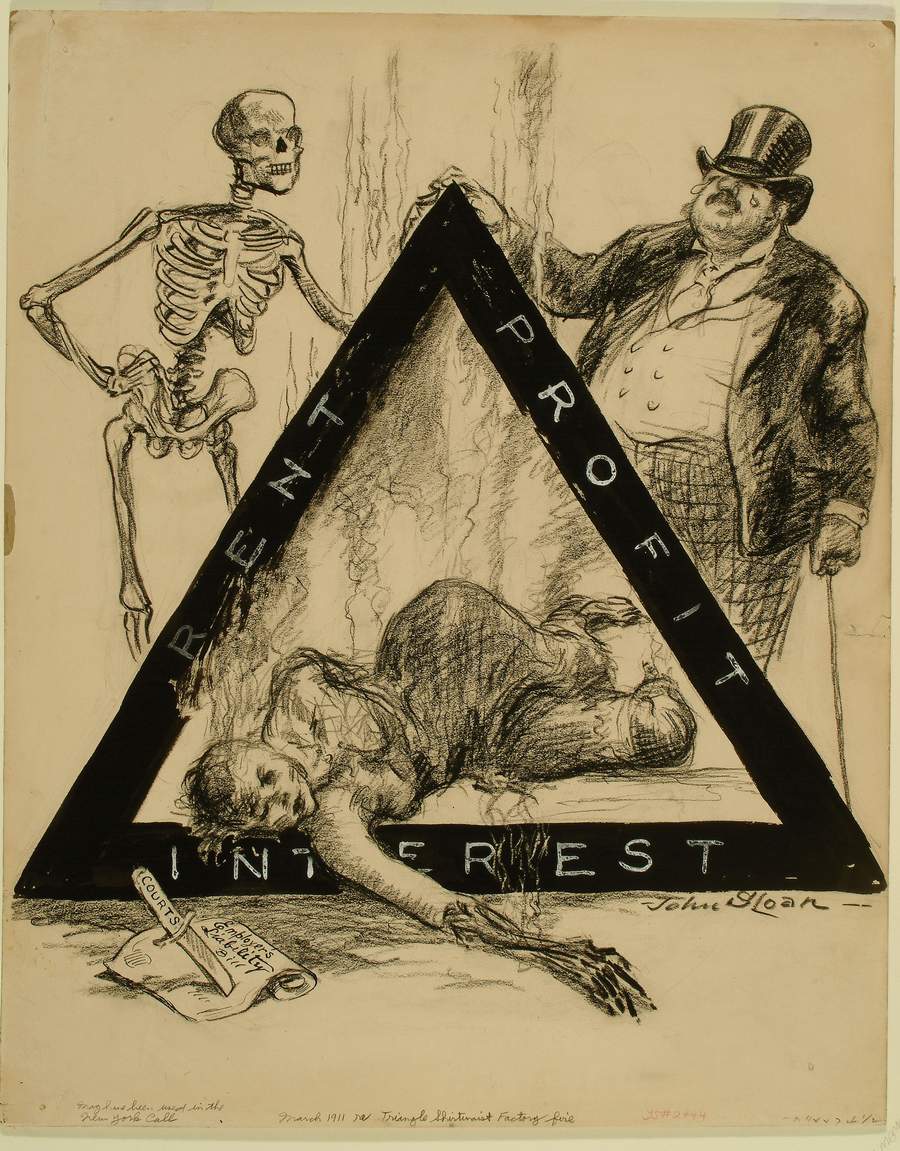
In 1911, some 600,individuals, mostly women, were working at the Triangle Garment Company, owned by Max Blanck and Isaac Harris, and located in the Greenwich Village district of Manhattan. The company occupied the top three floors of the ten storied Asch Building (now the "Brown Building"). For the time, the building was often billed as being "fireproof" (like the unsinkable Titanic in 1912 I guess).

The women, mostly young and recent Jewish and Italian immigrants, were engaged in manufacturing of women's blouses, an industry declining in popularity. The women worked 9 hours a day and earned between $7 and $12 a week conditions were stifling.  Windows were often kept shut and typically management required all doors to be closed and locked from the outside (a supervisor had the key).

On the late afternoon of March 25th, a fire mysteriously broke out in a rag bin and quickly spread. As all the doors were locked from the outside, the only options were burning alive, smoke inhalation, or jumping out the windows to certain death. Many chose the latter. 146 individuals---123 women and 23 men---perished in what was one of the worst disaster in the history of the garment industry.

Although sued by family members, with no safety regulations, the two owners were found innocent. Meanwhile, their insurance company paid Harris and Blanck $60,000 for the loss of their business. That equates to $75 per life lost, of which the families never saw a dime (it was never determined if the fire was accidental or not, but it's worth noting that the two owners had been found guilty on four occasions previously of insurance fraud by arson). OSHA would not be founded for another 60 years when, after intense union pressure, it was signed into law by then President Richard Nixon.

In company owned towns (which were common in and around mines and lumber mills) reprisals for union organizing may include refusal of service at company owned grocery stores (workers weren't paid in U.S. currency, but in company script which was worthless anywhere else), evictions from company owned housing, the rape of wives and daughters, expelling their children from company run schools, and verbal condemnation at company approved churches (attendance was often mandatory). If the "problem" couldn't be resolved "in-house", the company would often employ "other measures".

"Other measures" often took the form of militias or recruited vigilantes, private security companies (like the Pinkertons), hiring  (aka bribing) local cops to break up protests as brutally as possible. If that failed, company presidents would use their influence to get the governor (who was usually in their back pocket anyway) to call out the National Guard and "restore order" and detain ring leaders.
Since many of the workers were Black, German, Irish, Scots, Welsh, Jewish, Asian (predominantly Chinese) or Italian, there was no shortage of hate groups willing to inflict as much violence as possible and get paid for it! Arson or the use of dynamite were often employed as "tools of anti-union trade" and when those tactics didn't work, it sometimes came down to cold blooded murder.

The result was decades of bloody "wars" between companies and their employees from the steel mills of Pittsburgh, the docks of New York, the  coal mines and hollows of Appalachia, and the automobile factories of the Northeast. Ultimately, the workers won, at least in the short term.

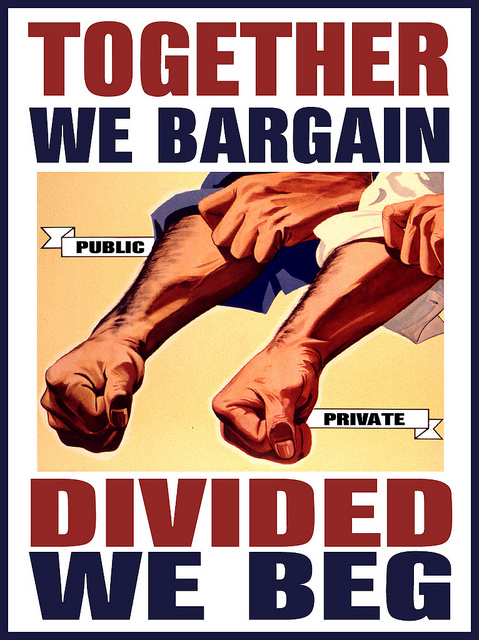
Unions were finally officially recognized thanks to the passage of "National Labor Relations Act of 1935"  (aka "The Wagner Act") on the heels of the Great Depression and signed into by President Franklin D. Roosevelt.  FDR was perhaps the most labor friendly president in our country's history.      

His long time friends and opponents, mainly on Wall Street, often called him a "traitor to his class", and perhaps he was. The aim of the "Wagner Act" was to mediate differences between labor and management in order to prevent strikes and work stoppages which weaken an already struggling economy. But the fighting between workers and owners needed to stop for the sake of the nation's economic health (ultimately is wasn't the recognition of unions which saved the economy, but World War II).  

Eventually Big Business was able to claw back many of their concessions. There was no way they were going to allow the political clout of organized labor to stand. In 1949, with bipartisan support, the 80th Congress went over President Harry Truman's head and enacted the "Taft-Hartley Act".  

The act restricted many of Labor's actions against employers, specifically  wildcat strikes, political strikes, solidarity strikes and secondary boycotts. It prohibited discrimination against  non-union members, and additional rights such the right to vote out a union and the right of companies to vote on a union's demands, but it didn't stop there.

In 1959, Congress enacted the Landrum-Griffith Act which was made law with President Dwight Eisenhower's signature.  Also known as the "Labor Management Reporting and Disclosure Act", the law was primarily geared to protect union members from any corrupt activities of union officials may be engaged in. This was the era of organized crime's takeover of a number of unions, notably the "big four",  the International Longshoremen, the International Brotherhood of Teamsters, Laborers International of North America, and Hotel Employees and Restaurant Employees International. 

It made union participation or involvement in racketeering, bribery, extortion, misuse of union funds, intimidation of workers illegal. Anyone found guilty could be removed from their union position and race fines or even jail time. It also created a "Bill of Rights" for union members (which was later extended to include non-union employees as well). 

It should bear mentioning that the Landrum-Griffith Act was passed during the era of "McCarthyism",  "the red Scare", and the "Cold War". The importance of this and how it relates to unions is that many of the early union leaders admitted to being socialist or Communist. Perhaps the best known of these was Robert Le Follett, A. Phillip Randolph, Mary Harris "Mother" Jones,  Eugene Debbs and Samuel Gompers.

Some of the unions which had a large socialist or Communist membership included the CIO and AFL, the UAW, International Union of Electrical Workers,  International Workers of the World ("Wobbles"), the Transport Workers Union, the Longshoremen, and the United Steelworkers.
In addition, many of the laws passed in the 1930's like Social Security, unemployment, the right to unionize and strike were all labeled as "anti-American", "socialist" and "Communist". Nevertheless, most of these laws are not just still with us, but have become institutionalized as a "national right".

Unions are said to have created the middle class, which may very well be true, but it's not been all wine and roses. I voluntarily joined the NWU. I wasn't coerced into joining. It offered me an advantage and I felt I had something I could offer the union. I was honored to have been the liaison on behalf of my fellow employees for 34 years. We accomplished a great deal for ourselves and the company's bottom line. Lastly, while I support unions and the right to organize and bargain for better pay and work conditions, I also believe in free choice and not being compelled into joining any organization.

However, those individuals who decline to join should not expect to receive all of the benefits that their fellow union employees do. That's the trade off. It's called personal responsibility. For me, it's just that "something" about being told I "must" do or participate in something without being given a choice that irks me to the core. I bet no one is surprised to read that! We also have to remember the years of corruption and crime which has smeared the reputation of organized labor, perhaps forever. 

Finally, unions refuse to think outside of the box, or to be more accurate, outside of the hip pocket of  the Democratic Party which, like the Republicans, greedily serves Wall Street. Union leadership has consistently failed to protect the best interests of its members by not making the major parties or candidates compete for its support. Labor must look elsewhere, even if it means forming it's own political party (we're the only industrial nation without a Labor party) or face eventual extinction.  

So, that's a brief history of Labor Day and why you get a three day weekend marking the last "official" holiday of the Summer, but remember the high price others paid for you to have that one extra day off.


 If you enjoyed the article, please consider passing it along to others and don't forget to subscribe. It's free! Lastly please be sure to "like" us on whatever platform you use to read anotheropinionblog.com. It helps beat the algorithms and keeps our articles in circulation. Thank you!


The Haymarket Affair


Lists of worker deaths in United States labor disputes


No union mines left in Kentucky, where labor wars once waged


Union busting


History of union busting in the United States


Triangle Shirtwaist Factory Fire


USERRA: A Guide to the Uniformed Employment or ReemploymentAct


What Is The Taft-Hartley Act?


1959 Landrum-Griffin Act


Communist Party USA and the American labor movement (1919 -1937)


Communist Party USA and the American labor movement (1937 -1950)


Saturday, April 04, 2020

What Have We Learned Since the COVID 19 Outbreak?


Viruses and diseases have been with us since time immemorial. Wherever we've gone, it's been right there with us, in our food or water, on our clothing, our pack animals, or in our boats. Now it comes with us by plane. Some want to curtail or even stop our trade with China; claiming that we're to dependant on the Chinese. Perhaps that's true.

It would certainly be to our advantage to return many of our manufacturing jobs back to America but China isn't the only place where our jobs went (Mexico, India, and South Korea come to mind). However, that won't stop the development and spread of viruses or other diseases. Besides, as economically integrated as the world is, it would be impossible to separate from other countries without severely impacting every economy, including ours.

Some claim that the COVID-19 virus is a biological weapon sent here by the Chinese. After all, they claim, China may be a trading partner; even a important trading partner which just so happens to own much of our national debt, it is also a major economic and political competitor. China has long been on a quiet spending spree to buy up key natural resources to fuel its own phenomenal economic development, albeit at the price of destroying or polluting its own environment. And while it has embraced a certain amount of capitalism, it remains a politically close society; a Communist country whose swore goal is the overthrow of Western democracy and the suppression of freedom in whatever form that takes, including religion---any religion---for the sake of political conformity.

It's true that the virus originated in the Wuhan Province of China, which just so happens to be where a military bio-lab is located (we were told as you'll recall that it originated there as a result of someone eating contaminated "bat soup" as you'll recall). Perhaps it was a strain which accidently escaped from a lab, but then again, perhaps not. Now the Chinese government is trying to blame it on the CIA; an infected tourist who may or may not have knowingly carried the virus. The fact of the matter is that we'll never know for sure.

Another fact is that China has been just as heavily impacted as everyone else (if not more so) whatever the origin of the virus. In tracking the origin of diseases and viruses, it's often near impossible to determine the actually starting point since the first symptoms may not occur for weeks or months after the original exposure, and by then the original person infected ("patient zero") could be hundreds or thousands of miles away, infecting who knows how many others. So, practically speaking, what do we know? What have we learned since this outbreak?

We learned what are considered "essential" jobs and who are "essential" employees, and to the surprise of many, it not upper management. It isn't, for the most part, jobs which required four year degrees. In fact, the majority of these "essential" job didn't require any higher learning at all. I'm talking about garbage men (and women) who pick up our trash every week. I'm talking about the farmers and farmhands who grow our food or those who insure we have clean water.

I'm talking about those who work in fast food restaurants cooking the food and working the drive through windows as well as those who bring food to our door. I'm also talking about those who stock the shelves not just at night, but are currently doing it all through the day just so we'll have something for our families. We can't forget the cashiers either, nor those who make sure we have electricity to cook our food, watch TV, surf the internet, or charge our smartphones so we can play video games all day.

I'm also talking about the all important trucker who is busting their hump to make sure that the stores receive what we need. Without truckers, most of America doesn't eat. It doesn't get the cleaning supplies, clothes, sheets, medicine, or whatever else we need to survive. It includes those working in warehouses, and stockrooms, as well as those working on some production line turning our sanitizers or masks.

We still depend on the police, the firefighters, EMS, and hospital workers---from the doctors, nurses, and lab workers to those doing the laundry and housekeeping who provide clean sheets and sanitary rooms and those working in the kitchen and making sure everyone eats, and on those who are filling our prescriptions.

We're finding that with schools being closed, the most essential individual in any child's education is still the parent. Yes, teachers are important, but without the parent's contribution, it's often a wasted effort. Perhaps home schooling will play an even more important role in the future. We're also rediscovering that with churches being closed, that faith doesn't reside in a building but within each of us.

We are learning all over again about just how dependant we are on each other. We are reminded that we are social animals; that politics, religion, or other self imposed barriers matter little in the long run, and this virus is a harsh reminder that we, as a species, are in this for the long run. We've learned that it's the ordinary worker, the ones we give little thought to, who are keeping us going.

Thanks to this virus, we've also seen Humanity at its selfish and greedy worse. We've seen people hoarding paper towels, toilet paper, sanitizers, and cleaning products, not to mention OTC medicines. It would be one thing if they were buying it to help others, but they're not. They are buying it for the sole intent of taking advantage of the disadvantaged such as seniors, the handicapped, and those unable to get out to shop.

They are in affect stealing from others by creating an artificial shortages, which in turn causes everyone up the supply chain to work longer and harder to replenish stock, which ultimately drives up prices for everyone. Of course, they will be more than happy to sell their hoarded products for a handsome profit to the very people who can afford it the least. I find no sense of honor, let alone compassion in this. The noblest thing we can do is to help those who are unable to help themselves, especially in time of crisis, even if that means not buying more than we think we need.

We've also learned something negative about our "social" nature. Despite repeatedly being warned to stay indoors as much as possible and the emphasis on social distancing, we are witnessing individuals doing just the opposite. Just recently we had thousands of high school and college students head to the beaches for an extended Spring Break. Many of them openly dismissing the warnings; claiming that "this is our time".

Well, perhaps it is "their time". Now that communities have closed all the usual Spring Break hot spots, a number of these self-centered "young adults" have become infected. Better yet, they're now demanding to be treated first. Frankly, too bad. Youth may be known for its zeal, but not necessarily for its intelligence (which typically improves with experience).

But it's not limited to youthful ignorance. It cuts across all age groups just as it does all races, religions, and (most) income brackets. We've seen people enmasse show up to watch the docking of the USS Comfort Hospital ship, going to the park, and at other events with large crowds. If we're to slow this spread of this virus down, we're going to have think about how we interact with others for their protection as well as ours.

We've also seen as unessential Washington can be. We've seen how partisan politics continues to influence something as basic as putting together a relief package for the nation. Be it sneaking in money for illegal immigrants, funding the Kennedy Center, or providing more corporate welfare, and neither party is more guilty than the other.

This should send a clear and unmistakable message to the American People that Washington doesn't represent our best interests (as if we actually need yet another reminder right?). It serves the needs of the very wealthy; the special interest groups who make up the ruling Oligarchy and finance modern politics.

The only reason we got anything out of this so-called "relief package" was the knowledge that the American People might... just might...actually stand up and doing something about a relief package for the elites only (I'm thinking of a repeat of Obama's 2008 Wall Street bailout), and yet special interest groups still made out like bandits. Now, another relief package is being considered and Congress is again looking at ways to reward its special interest benefactors with our money.

We've also seen some of our greatest fears as Americans starting to take shape. For years there has been those who've warned about the slow development of a surveillance state; the forerunner of a police state. We've witnessed the development of technology, which many have welcomed with open arms while not considering its other, possible nefarious, uses. We've assumed that "our" politicians, regardless of their party, were immune to the clarion call of dictatorship which has crumbled countless other nations throughout time. After all, we have a constitution to protect us.

However, recent events, mostly at the local or state level, have shown that politicians, regardless of party, are just as drawn to the allure of absolute power as any other tyrant down through history, and no would be dictator would ever dream of wasting a perfectly good crisis! We know we're already an Oligarchy. The government is not run for our benefit. It serves the needs and wants of a very small group of wealthy individuals and corporations. For them, it's always been about control, be it assets, resources, or the populace.

Whether or not we take the next and perhaps final step into a full fledge police state, there can be no doubt that there's no going back to what we were pre-virus. The government, and those who control the government, have been taking careful note about how we've reacted to this crisis; who obeyed and who were the ones who spoke out. They've seen how we've responded. What were the strengths and weaknesses to our social system, especially our supply chain. How much did we depend on social media as opposed to corporate mainstream media or just how prepared the average American is for a crisis.

They already know that most Americans---80%---live from paycheck to paycheck. They've seen that there was no outcry or even whimper when the primary elections were temporarily suspended (there was more of an outcry when the baseball and basketball seasons were postponed). They have taken note of our restrained reactions to seeing National Guard troops out, to curfews and to restricted travel.

As Lewis Carroll's "Alice" in Alice in Wonderland said, "It's no use going back to yesterday, because I was a different person then". We are all different than we were before this crisis. The question is what we, "the People" will learn from this crisis, be it the tendency of politicians, businesses, ourselves, and each other.

Saturday, March 21, 2015

Do You Have a Right to Work?


Let's say that you like working on cars. Cars are your life. There never has been any question of where you wanted to work---the local auto plant in town. The money and benefits are great, and what's better, they're hiring. So you fill out an application. After a few days, you get a phone from the plant's human resource department and set up an interview. She wants to hire you. An appointment is made to come down and see the company physician for a quick physical. The human resources manager asks you to come back in for an orientation.

At the orientation, you go over the various procedures like safety issues, clocking in and out. Then comes the shocker. You're told that you are required to join a union in order to work there, but you're not interested in joining a union. You're told that the plant is a "closed shop", meaning that in order to secure employment there, you have to join the union. You tell her you're not interested in a union; you just want to work on the car or truck assembly line. At that point, a union representative is brought in to talk with you.

You politely listen as she explains that the union has been in place since the 1950's; that the union would protect your job in case something should happen; that they would provide you with a shop steward in the event of performance issues or any hearings; the union would negotiate on your behalf---collectively---pay raises, health and other benefits, your hours, and job safety issues. All you need do is sign the union card and agree to have the union dues automatically deducted from your salary. Easy peasy.

After the union representative finishes speaking, you politely explain that you don't have any interest in joining a union. You are aware of your responsibilities, and as an adult, take full responsibility for your actions. Furthermore, you are quite capable of speaking for your self should you get into any trouble. The representative explains that without their steward, you could run the risk of being taken advantage of (implying that you couldn't trust the company).

The union representative reminds you that unions have been at the forefront of child labor laws, women's suffrage, job safety, voter
registration, and even the Civil Rights movement. Those were all powerful and important issues, but each has been addressed by the federal government and are now laws. What about wages and benefits? Unions have been out in front in protecting wages, limiting hours, and securing benefits for their members. That's true, however, those too have been largely addressed by various federal laws. As for negotiating wages, over the past decade or so, unions across the country, have negotiated away much of benefits they had fought for over years, which has also included pay cuts, reductions in worker seniority and are only just now getting some of those back. Besides, the company has offered a retirement package before the company unionized, and offers a similar package at its non-union plant.

At this point that the union representative is getting agitated. She adds that the union also has a political education committee which would act on your behalf by endorsing candidates and making political contributions. Where does that money came from you ask, and she says that it is automatically deducted from your paycheck. Ok then, who selects which candidate or issues your money gets directed to? As it turns out, it isn't you. The committee would make that decision for you. What about the candidates they endorse, do you get a say? Not directly, but you do get a vote. However, the final decision is made by the committee. In some cases, only the political election committe makes the decision and in others, only the union president decides. But, you explain, you aren't partial to either of the two parties, but who were some of the candidates they endorsed in the past?

As it turns out, all were of a specific political party, and few if any of them, support the same issues as you. Accordingly, you point out that it made more sense if you donated to whom you wanted rather than have a portion of your salary going to individuals you didn't agree with. Besides, it didn't make any sense to dig deeper into your pocket to donate to those candidates you agree with; it was like you were working against yourself.

After a few polite closing remarks, you're informed that either you sign the union card or don't get the job. At that point she leaves. Funny, you think, wasn't that the company's decision to make? You could see her speaking with the HR manager outside the door. A few minutes later, the HR manager enters and asks if you have any questions, otherwise you were free to leave. You told you can start as soon as you turn in the signed union card. You mention that you did have a couple of questions.

How is it that you answered a company job announcement; filed out an company application; interviewed with company personnel; went to a company doctor; but in order to accept a job that you really wanted--- that you had studied hard for in school---spending countless hours after and before school; that would hopefully be your life's work---you had to join an organization that you weren't the least bit interested in, not to mention an organization which would not support your views politically in order to work there? In fact, you're told that they, not the company, decides who works there based on whether you sign the union card or not. Two words---closed shop. A closed shop means simply that in order to work there, you had to join the union whether you wanted to or not, and you have to abide by their rules and pay their dues.

Closed shops came about during the heyday of union membership---the late 1940's and early 1950's. Within the past few decades, many companies have sought to circumvent closed shops by moving the company to either states which had "right-to-work" laws, meaning that individuals can't be compelled to join unions, or the plants were closed and work shipped off to countries where workers are paid sweat shop wages with no benefits and they had little or no rights whatsoever.

So there you have it folks. Although the story was entirely fictional, the situation is real. Is it better to join the union, where the jobs of everyone is more or less protected, or take a chance? Some can certainly fight back or negotiate their own pay, but many can't. In some cases the costs of wages, benefits, and protecting unproductive workers have proven to be too much and companies have closed or moved. Unions essentially negotiated themselves out of a job. Many companies have retirement or 401k programs. Much of what unions championed down through the years are now laws, with workers having recourse through OSHEA (including its "Whistleblower Program"), the Labor Department's Wage and Hour division, the Equal Employment and Opportunity Commission (EEOC), plus various State and local agencies.

On the political side, instead of looking for themselves, unions have been in bed with one political party since the 1930's instead of playing each party off each other. Also, instead of supporting the best candidate for the rank and file, they nearly automatically endorse just the one party's candidate even if that particular individual doesn't even support unions! And let's not forget that in many cases, the member doesn't even have any say so where their money goes, which is often on issues or individuals they completely disagree with, meaning they have to dig deeper in their pockets to support the cause or candidate they want, and heaven help them if they actively support then non-union endorsed candidate or even put out their yard sign! Currently, some unions are pushing for amnesty for illegal immigrants since many are employed in mow skill and mostly unionized jobs. Amnesty would open the door for them to join the unions, and thus add desperately needed dues to the union's coffers. However, the influx would create more demand for jobs than there are available jobs, thus driving down wages and benefits while driving up unemployment.

What do you think? As corporations have become more feudalistic and some, like banks and oil companies, have essentially taken over governments like ours, have unions become passé? Have they outlasted their usefulness? Certainly big business would like for to think so. Unions have traditionally balanced the scale of power. Of course, unions aren't perfect. Some became corrupt through their Mafia involvement while for others, it became hard to distinguish union management from corporate management, especially when looking at their salaries! Unions have been at the apex in many social issues that we now take for granted. They were responsible for a vibrant middle class and growing economy, and as unions have declined, so as the middle class and so has America overall; so much that we face the largest disparity in income since just before the Great Depression, but then this isn't 1929 and the American economy is no longer the largest or strongest.

There are of course alternatives to unions, such as worker owned companies (co-ops), employee associations, employee-managements boards where employees and management elected representatives to a special board on a rotating membership basis which deals with employee related issues such as work conditions, complaints, and worker innovations. In addition, there's been a trend in business to create a more horizontal hierarchy and empowering employees, not to mention occasional outings, ongoing surveys, and workshops. I served as an employee liaison with management at several companies where I worked, including in an Assistant Vice President role working on projects to improve morale, productivity, and efficiency; a happy workplace is a productive workplace, at least that was the idea.

Right now, certain groups (primarily conservative and pro-business) are pushing for "Right to Work" laws, with Wisconsin having just recently enacted such a law. Proponents claim that "Right to Work" makes companies more competitive and gives workers more options, which they cite as being critical in today's global marketplace. Opponents, however, refer to the effort as "Right to Work for Less" and claim that without union representation, workers will be taken advantage of, have less job security, and will eventually be forced to take cuts in pay and benefits without any recourse except walking out and trying to find another job when jobs are hard to come by. In addition, unions point out that in "Right to Work" states, they'll be forced to cover non-union employees which they can't financially afford to do; such a move could ultimately bankrupt many unions. Unions are already having to compete, directly and indirectly, with companies and workers overseas who aren't unionized and earn pennies on the dollars and often without any benefits or even basic health and safety regulations while management and Wallstreet investors pocket the difference. Proponents, however, cite lower costs of living standards which justify the lower wages and benefits aren't something workers don't deemed as important.

Many on the political Right look at unions as "communist" or "socialist" (their two favorite terms) and champion the idealistic individual concept of popular Americana myth, while those on the Left see unions as an entre into the middle class, a better life for themselves and their children, along with the possibility of a college education. This is especially true among minorities. They see unions as a means to having good health care and providing for a decent retirement while working in a safe environment. Some of the principal goals unions have fought for, such as safe jobs or a means to fight against employer harassment or discrimination, are now federal laws and give workers some legal recourse. Certainly popular opinion has swung against unions in recent decades. Historically, union participation peaked in the early 1950's and has been in a steady decline ever since with only 11.3% of the workforce being unionized (about 6.6% of private employees and approximately 35.9% of public employees). Running near parallel, the purchasing power of the middle class has declined as union membership has dropped.

So, what do you think dear reader? Do you have an unobstructed "right to work" or is their strength in numbers? In which direction does the future look brightest for ordinary individuals amid the global marketplace and increasing competition for fewer jobs, Citizens United and the demise of our democratic republic, the 1% oligarchy versus a declining middle class and the widening income disparity?


Unionfacts.com
https://www.unionfacts.com/cuf/vitals

Saturday, September 13, 2014

Tyranny and Television


It seems that we're increasing, as Americans, attempting to embrace the past rather than the future or even the present. There was a time when we looked to the future in our home lives (The Jetsons, Star Trek) and in our public lives (NASA, World's Fair, sound barriers, moon landings, etc). Nostalgia television is more popular than when most of these shows aired originally. Now, it seems we're lost. We stuck living our lives vicariously through other people's lives (so-called "reality" TV); various talk shows where we watch "celebrities" babbling out their opinions on various, sometimes trivial or useless issues that are none of our business to begin with (and in doing so, implicitly inferring what we should think too) instead of us coming to our own opinions; or watching complete strangers airing their dirty laundry while we ogle, incite, and judge; idiotic "court" TV like divorce court, small claims court, or whose-the-daddy court, and so on. Basically shows about people who've made some really stupid decisions or asses out of themselves while we set back and amuse ourselves at their expense. Look at Saturday morning lineup for kids. What a bunch of junk. At least we had cartoons and shows which made sense, and where the production quality was pretty decent. We wouldn't have wasted ten minutes on any of these shows today. What happened?

Have we dumbed down not just the quality of our kid's education but network television too? Here's a thought. Grab a schoolbook---math grammar, science, history from, say, 1955, from any ole high school, and compare it to one today. Which one is more difficult? The answer should be obvious, and they didn't have calculators or computers. Yeah, we may have access to more information but that's useful only if we know what we're looking for, and what to do with it once we have it, and that goes back to what kids aren't taught today which are critical thinking skills. Some would call it common sense. Kids graduating today from high school can barely spell. Most are on an eighth grade reading level. Their math skills aren't much better, and forget about history, science, and geography. American students tend to rank near the bottom when compared to other countries.

In a 2013 international academic test, the PISA, US students scored below average in math and science and slightly above average in reading while most of the Asian countries scored at the top (with China coming in on top). Germany ranked 12th while the US was 28th, just behind tiny Denmark and just ahead of Spain. Countries like Estonia, Vietnam, Ireland, Finland scored higher than America. Poland came in 9th place, so I guess they're now sitting around telling jokes about us for a change. And while poor countries and poor students scored poorly as expected, money didn't seem to make much difference. Countries which spent less per student didn't necessarily do worse than countries which spent more per student as the result showed. The key results seem to have been better early preparatory time, better trained teachers, adaptability to the student's ability, and, oh yeah, discipline.

Maybe that's why everyone wants a college degree these days. Not because of the higher education and more developed knowledge and thinking skills, but a BA or BS degree will generally get you something equivalent to a high school degree from the 1950's. And another thing, not every kid needs to go to college. Yeah, it's great for certain individuals, especially those pursuing certain disciplines like economics, English, or engineering, but for others, they would be better off pursuing a career in the trades, and there is nothing wrong with a "blue collar" degree. First off, most of fields in the trades are in high demand. We need carpenters, welders, electricians, plumbers, and the like. Secondly, they pay well. Damn well. In many cases, an experienced plumber or electrician can earn more than a lot of individuals with BA or BS degrees (or in some cases, more than some with a Masters degree) and they can do it in less time and way cheaper (imagine 1/3 of the school debt and same or better earning potential).

Perhaps there's a stigma in this country against those in the trades. Not so in other countries, especially Germany. Germany has a highly developed to track educational system which directs students either into the trades or into university based on ongoing academic and aptitude tests as well as personal interest. Germany also has one the world's best developed apprenticeship programs in the world whereby students spend part of the day working on theory and the rest of the day doing hands on work, often at the sites of potential employers. The result is one the most successful academic system in the world, as well as maintaining the most powerful economic engine in Europe, and third overall in the world. German students, by the way, tend to rank near the top academically, regardless of which track they're on.

Back to television, how many shows are actually intellectually stimulating? Most are nothing more than commonplace formula based writing with names or genders, or (occasionally) the professions differing, but little more. Most of this can barely hold the attention of the average 10 year old (perhaps that's why they spend so much time with the faces buried in their IPods). Most of today's television shows leaves us in a mental stupor. How much real "news" are we really getting and how much is just so much tripe? It's a wonder we all don't walk around with a glazed look in our eyes and drool dripping down our chins. Is this then what we've become? Has our educational system so dumbed us down that today's "opiate", to borrow from Marx, is designed to perpetuate the process?

Of course, the best way to control a population is to keep them occupied and uneducated. Is that not, perhaps, what's actually going on here? Are we intentionally being kept busy with, as the Roman's would say, "bread and circuses"? Most of us are so overworked; so overwhelmed with the day's events; so concerned with just keeping the job we have, that all we want to do is come home and turn on the "boob tube" or "idiot box" as we used to call it, stick some food in our mouth and "tune in and turn off". After all, if we're so exhausted from the day's work; so fearful of our job being off shored or losing our insurance or pension or 401k; and we feel so powerless by what we're seeing or reading in the corporate news, that all we want to do is be mind numbed until we blissfully fall asleep in our recliners or couches, what does government or corporations have to fear from its citizens? And if a government doesn't fear its citizens, then its citizens will soon come to fear their government. Sounds like control to me, albeit a subtle and somewhat indirect form of control, but control nevertheless. What do you think?

I wish I could say that I was the first to think of this, but I'm not. It's been said a thousand different times in a thousand different ways since time immemorial. However, I think the very best expression of this idea was said by one of History's most evil tyrants, France's Maximilien Robespierre. Robespierre was the one of the leaders---perhaps the single greatest leader---of France's Great Revolution. He started off with good intentions as most tyrants do---freedom, liberty, and brotherhood and the end of a bloated and corrupt monarchy. He is remembered as the originator of the "Great Terror" which took thousands of lives (along with the assistance of the crooked grin of "Monsieur Guillotine") and precursor of the rise of Napoleon, whose reign claimed the lives of millions. It's from Robespierre, we are warned that, "(t)he secret of freedom lies in educating people, whereas the secret of tyranny is in keeping them ignorant". With polls showing an 85% disapproval rating of Congress---a near consistent rating for the last several years and lower than head lice and cockroaches I should add with my own smirk---most countries would be sweating bullets (take that anyway you want) if their disapproval rating gets above 15%, I have to ask: what will it be America? What will you chose to do?


US scores stagnant, other nations pass by us in latest international test
http://edsource.org/2013/u-s-scores-stagnant-other-nations-pass-by-in-latest-international-comparison/52052#.VBOlEZtAKzU

Top US students fare poorly in international PISA test scores
http://educationbythenumbers.org/content/top-us-students-fare-poorly-international-pisa-test-scores-shanghai-tops-world-finland-slips_693/

Congress somewhere below cockroaches, traffic jams and Nickelback in America's esteem
http://www.publicpolicypolling.com/main/2013/01/congress-somewhere-below-cockroaches-traffic-jams-and-nickleback-in-americans-esteem.html