Showing posts with label United States. Show all posts

Thursday, September 04, 2025

Education in America: Sowing the Winds of Our Future


Here in the United States, Labor Day marks the “official” end of summer, although you’d hardly notice. The public pools are closed. The leaves on trees gradually turn their vibrant reds, yellows, and oranges. There’s the faint crunch of the few which have already fallen; soon to be a chorus in just a few more months. The nights are becoming a little cooler and rain is becoming a little more frequent than before. You occasionally have to pause to decide whether you need a jacket, but the warmth summer’s days remains, at least for now.

Labor Day is when states, especially in the South, have their state capstone fairs with venders hawking their wares and rides from practically everywhere. You can sign up to get your blood pressure tested, a mammogram, buy shoe inserts, and buy new gutters all within just a few feet of each other.

 It’s where you’ll find an abundance of friendly (mostly) competition for the best porch whistlers, dancers, cake bakers, quiltmakers, best quality livestock, and where hundreds will come out to watch the well-heeled bid phenomenal amounts of money for best cured ham…all for charity of course (the top ham sold for $10 million dollars this year).  Communities have the first of their local craft and art fairs. But for many Labor Day weekend means just one thing---the end of summer vacation and the start of a new school year which is the subject of this week’s article.  

Education is typically the best barometer to measure a nation’s future potential, after all, the students they graduate are the nation’s economic, technological, political, and cultural future. They are the ones who will develop the newest medicines, the next generation in technology, our new engineers, and will be the makers and enforcers of laws. Many say this represents the new battleground for global domination. So, how does America rank?

When determining where a country ranks, be in education, military spending, medical care, and so forth, they are measure against a bar  or standard. This “standard” is the average of 38 members of  the Organization for Economic Co-Operation and Development (aka the “OECD”). The OCED, which is comprised of developed or “first tier” nations, who work together to promote economic growth and cooperation, sustainability, establish standards, and common policies.

According to OCED, Luxembourg, Norway, and the United States spend the most money per student of any nation (in that order) along with South Korea and Switzerland (especially at the secondary school level).  In terms of percentage of their Gross National Product (“GDP”), top honors go to the Marshall Islands and the nations of Oceania, followed by the U.S., France, and Austria.

U.S. protectorate of American Samoa for instance spends 14.7% of its GDP on education.  Compare that to Cuba, which is one of the few countries with a near 100% literacy rate, which spends about 9.4% of its GDP on education or Sweden, which ranks near to top in nearly every positive measure. It spends approximately 7.6% (the same as Bolivia) while the nation of Batswana spends roughly 8.1%.

As an aside, the World Population Review, which uses a slightly different set of metrics, have some different, albeit similar numbers. According to the WPR, the United States spends 5.4% on education in general while it’s neighbors, Canada and Mexico, spend 4.1% and 4.2% respectively. America’s top economic competitor, China, spends 4% while Russia invests 4.1% on education. Germany spends 4.5% while France does a bit better at 5.4%.

Who then spends the most on the nation’s education? The African nation of Namibia spends a whooping 9% of its GDP on education. Neighboring Botswana invests 8.!%. Bolivia and Sweden both spend 7.6% on education. Iran only spend 2.9% on education, but then again, they only educate half of their population. India invests 4.1% on its future. The tiny nation of Bhutan spends 5.8%. Turkey invests just 2.9% in its future compared to 3.2% for Japan and 5.8 for the mini-nation of Tajikistan.

Pew Research posted a report in April of 2024 which showed that the U.S. was 28th out the 37 OCED countries. Japan was the highest along with several other Asian countries placing near the top along with Finland. The lowest score went to Columbia. In science, the U.S. place 12th out of the 37 OCED nations tested. Again, Japan ranked first while Mexico was last.

However, a more recent study from May 2025 conducted by Data Panda, indicates that the Iceland has the best educational system in the world. It’s followed by Germany, Norway, and the United Kingdom. Next in line was Denmark in fifth place. New Zealand and Finland were tied for sixth. Then came Switzerland, Sweden and Australia were tied. The U.S. was 15th,  just behind the island nation of Palau and ahead of Canada. Hong Kong was 18th.  Ireland was 22nd. Singapore and Austria were tied for 30th while Japan was 35th.

Another test from 2025, based on OCED scores, showed that in terms of literacy, the U.S. far outperformed the OCED average, 504 to 476. While that’s impressive, drilling a little deeper in the scoring indicated that while 14% of those tested outperformed the average, they were a majority of White students while the balance, mostly minority students, significantly underperformed with strong indications that they may require remedial instruction.

In terms of math and science, which are essential for medical and technological innovation and advancement (part of the “STEM” or science, technology, engineering, and mathematics curriculum), the U.S. seriously underperformed. 465 to the OCED average of 472, with several Asian and European nations far out scoring the American students. Once again, the scores reveled major failures among 15th years, especially minorities with over 1/3 being underperformers and just 7% representing top scorers.

 Once again, Asia had the top academic performers. It was noted that this may be indictive of a potential decline in America’s leadership in the area of technology and related fields unless immediate and significant improvements in the educational system aren’t made.

In terms of science, the U.S. did a bit better. The U.S. was 16th of the 37 national participants, scoring 499 against the OCED average of 485. Asia nations, including Japan, Singapore, Hong Kong, and Macau, made up the majority of those outperforming nations. However, while the U.S. did well, it was due primarily to just 11% of its top scoring students while 22% did poorly.

It's also worth nothing that in terms of the best educated populations, Ireland has the highest number of individuals was a bachelor’s degree based on percentage of population at 54.4%. Switzerland and Singapore are next with 45.6% and 45% respectively. Belgium and the UK complete the top five with 44.1% and 43.5%. The United States is 12th with 40% and just beating out Australia with 39.8%.  

Of the Middle East, Israel ranks the highest with 39.7%. Argentina, Chile, and Brazil are the top three in South America with 23.7%, 22.9%, and 21.5% respectively. China and India are among the lowest with 6.9% and 14.2%. There were no African countries out of the top 36 nations.

What does all this mean? The United States ranks third globally in what it spends per student, however, we’re toward the middle of the pack when it comes what we spend on education in general based on our GDP. In terms of what we are getting for our money is definitely no bargain. In terms of math scores, are well below average. Our collective science scores are good, but not great. With regards to literacy (reading and comprehension), we are doing well.

The problem, however, is that our achievements overall aren’t evenly distributed. It seems that where we we’re doing well is reliant on primarily private schools and a white student population. Meanwhile, public schools are generally underperforming, especially in schools where the majority student population are comprised of minorities.   

This is particularly a problem in terms of the future as the high achieving White student population continues to shrink and America heads for “majority minority” status. Our current immigration is only making matters worse more quickly with new immigrates coming from countries with a history of underperforming academics. 46% of arriving adults have no education beyond high school---if that! Only around 41% have a bachelor’s degree while few are certified in the trades.

Additionally, those from Latin America and Africa are less likely to possess a high school degree or equivalent whereas those from Europe, Asia, and Oceania are more likely to possess at least a bachelor’s degree. Those entering with a technical or trade certification face stringent hurdles to get their credentials approved which, given the critical shortage of plumbers, electricians, and so forth, needs to change.

Lastly, unless something is done now, such as changing our focus on immigration and focus our school curriculums more on STEM courses and less on “sports” and low/no demand degrees, we are likely to lose our lead in the sciences, medicine, and technology, making increasingly dependent on other nations, particularly in Asia, or to put it another way, we will reap what we’ve sown.


Thank you for reading "Another Opinion", the Op/Ed blog page for the "militant middle".  Here at "A/O" we truly value our readers. At A/O we seek the facts as they exist, not partisan talking points.  We hope you find our articles informative and engaging. Comments are welcome, provided they are not vulgar, insulting or demeaning.  Another Opinion is offered without charge and is directed toward all independent and free-thinking individuals. We ask, however, that you "like" us on whatever platform you found us on in order to keep our articles available for free to others. Lastly, in order to keep costs down, we depend on passive marketing, and therefore, depend on our readers to please forward our posts along. Below you will find links to the sources we used in writing this article. Thank you. 


OCED


WPR: Education Spending By Country 2025


Data Panda: Education Rankings By Country


U.S. Education Rankings: Global Comparison Performance


Charted: The World’s Educated Countries


Friday, July 25, 2025

Ours is Bigger Than Yours: The World's Military and the Ultimate Outcome

There’s no question that the Untied States spends more on its military---$886 billion---than the next nine nations combined. That includes China ($296B), Russia ($109B), India ($84B), the UK ($75B), France ($61B), and Germany ($67B). That’s 40% of all military related expenditures in the world by just one country---the U.S.. But is it the largest military?

America has 1.328 million men and women in uniform. India has 1.455 million active duty personnel. Russia has 1.13 million. North Korea has 1.28 million active duty personnel. Nevertheless, the largest military in the world belongs to China. Their Peoples Liberation Army has 2.04 million.

However, these numbers are a bit deceiving. Although China has the largest number of active duty troops, when reservists and paramilitary are included, China has only the fourth largest military in the world  with a grand total of 3,045,000. India’s military jumps up to third place with 4,246,000 which includes 1,155,000 reservists and 1,616,050 paramilitary units (compared to China’s 510,000 reservists and 500,000 paramilitary).

Russia has a total of 3,203,000 under arms including 1,500,000 reservists and another 569.000 paramilitary. As an aside, Ukraine has only 990,000 individuals in uniform of which 730,000 are regular military with no reservists and 260,000 paramilitary (not including those forcibly conscripted).

The world’s largest military is actually North Korea which has essentially militarized its entire military age population! It has 1,280,000 regular troops, 600,000 reservists, and a whopping 5,7 million paramilitary personnel, bring its total to 7,580,000 men and women under arms. By comparison, South Korea has 3,100,000 reservists and 3,013,000 to augment its regular military of 500,000, bringing its total to 6,613,000, making it the second largest.  

As for the United States, we have 1,315,000 active duty personnel in addition to 797,200 reservists, bringing our total up to 2,112,00 individuals in uniform. While the U.S. doesn’t officially have a “paramilitary”, we just might have something a little bit better and that’s the millions of U.S. citizens who come packing.

There’s an old expression that America could never be invaded because behind every rock, tree, and bush, will be someone with gun. Although there are no official numbers,  estimates are that approximately 32% of Americans own at least one gun. That’s about 82 million gun toting Americans.

Of those, some 14.4 million classify themselves as active hunters, meaning they’re probably a pretty good shot (additionally, some 25.87 million Americans has hunted at least once and those numbers don’t included the number of individuals who shot skeet, target shoot, and enjoy “plinking”  (shooting homemade targets like garbage can lids, bottles, cans, and the occasional speed limit sign).  

Broken down by individual household, guns can be found in 44% of households. While other countries, like Switzerland and Serbia, have high gun ownership, no other nation even comes close to the U.S. in terms of gun ownership.

As an aside, Montana has the largest percentage of gun owners of any state with 66.3% of residents owning at least one firearms followed by Wyoming with 66.2%. It’s 60% in Idaho and 59% in West Virginia, while around the Ozarks, it averages 56% of households. In Kentucky, it’s just over half with 54.6% of the population owning at least one firearm. Texas is surprisingly low, with just 46% of the population own a gun, which is less than in Maine where 47%  and Vermont at 51% owning a firearm.

In New York, despite its reputation for gun related violence, just 20% of the population legally own a pistol or rifle while in nearby Connecticut it’s 24%.  In California, 28% of it residents legally own a gun, matching Illinois. New Jersey and Massachusetts has the least with about 14.9% of the population own a gun. Finally, despite being a “Southern” state, gun ownership in Florida is only 35%. It must be due to all those Yankee carpetbaggers.

Another factor to consider, like it or not, is that guns are a part of the American persona. They go hand-in-hand with freedom and independence.  It’s just not part of our history, it’s part of our culture and our collective American mythology as a nation from the frontiersmen and “mountain men” to the Wild West and our very founding as a nation.

Firearms and the notion of self-defense from a tyrannical government was seen as so important, ownership of firearms was built into our Constitution.  As long as Americans own firearms, this country will never be invaded. But there is more to national defense than just pistols and rifles.

Who has the largest air force? In terms of most modern and powerful, that goes hands down to the United States with roughly 14,486 manned and unmanned aircraft. Russia is ranked second in the world with approximately 4,211 aircraft while China possesses 3,304. Next on the list comes India with 2,296, Japan with 1,459, and Pakistan following closely behind with 1,434. South Korea has 1,171 aircraft compared to North Korea which possesses just 951.

 It bears mentioning that the individual branches of the U.S. military have more airplanes, helicopters, and drones than the entire air forces of most countries!  For example, the U.S. Army has some 5,714 aircraft compared to entire Russia military which has a total number of planes and helicopters of 4,211. Of course, being former Navy, I have to mention that the best pilots in the world are U.S. Navy pilots.

Speaking of the Navy, who has the world’s largest seagoing fleet? In terms of numbers, the largest fleet belongs to Russia. Once virtually landlocked due to a lack of warm water ports, Russia now has a fleet of some 781 ships. It’s worth noting too that Russia built the largest submarine ever as part of “Project 941---Akula”, a nuclear powered Typhoon class “boomer” with a displacement of 48,000 tons and a length of 574 feet and a width of 75 feet, it is truly a leviathan.   

 China is second with 730 deep water ships, including two operational aircraft carriers (and a third on the drawing board) along with three helicopter carriers. As an aside, China also has the most modern military navy in the world, turning out more new ships than any nation. 70% of its ships were built after 2010 compared to just 25% of the U.S. Navy.

Third place belongs to North Korea with 505 ships, though analysis question their operational status given shortages of replacement parts. North Korea also doesn’t possess any aircraft or helicopter support ships (South Korea has 200 military ships). Next, in fourth place, is the United States Navy with 11 aircraft carriers and nine support helicopter carrier ships.  

The U.S. Department of Defense published a report in 2024 noting that the Navy was badly in need of a total fleet overhaul; everything from drydocking its fleet for a refit to retiring some of its submarines, destroyers, and even a carrier or two (the DoD was also critical of the wartime capabilities of the U.S. Air Force and U.S. Army. Only the Marines were said to be a proper fighting strength).

Following the U.S. is Sweden, which has traditionally been a seagoing nation for centuries. Sweden currently has 353 deep water naval vessels, followed by Indonesia with 333 military ships. Italy has 309 while India and Thailand have 294 and 293 respectively. The largest navy in South America is Columbia which stands at 237 followed by Mexico with 194. In Africa, Algeria has the continent’s largest navy with 213 ships. Egypt is second with 140 ships.

Speaking of submarines, at 70, all nuclear, submarines, the U.S. Navy possesses the world’s largest submarine fleet. Second place belongs to Russia with 63 nuclear and conventional submarines. The Chinese have 61, which includes nuclear and electric diesel. Their emphasis is primarily the Indian and Pacific oceans.  

In fourth place is Iran which operates 25 conventional attack and miniature submarines throughout the Persian Gulf.  Egypt has the largest submarine fleet in Africa with eight Type 209  conventional subs it acquired from Germany (who know a few things about submarines). Algeria has six and South Africa has three, also Type 209.

Lastly, nukes. What nation has the most? Russia is believed to have 5,500 nuclear tipped missiles in various stages of readiness. The U.S has some 5,000 nuclear armed missiles, also in varying stages of readiness. China too has nuclear missiles  (around 600) as does France (290), the UK (225), India (180), Pakistan (170), and Israel (90).

North Korea claims to have around 50 while Iran is desperately trying to become the newest member of “global damnation club”.  It deserves mentioning that in terms of missiles in general, Russia is also thought to possess the largest number of missiles, especially Intercontinental Ballistic Missiles or “ICBMs”, both nuclear and conventional. China is also busily expanding its missile capabilities. 

All told,  there are approximately 12,331 nuclear weapons at play, down from about 70,000 during the Cold War. These range from so-called “tactic”  or low yield warheads which have a explosive capability 20 times that of what was used as Hiroshima and Nagasaki up to a three stage thermonuclear warhead (the Soviet era “Tsar Bomba”) whose explosive output is 1,570 times that which was used on the two Japanese cities. Anyway, you look at it, in a nuclear exchange only cockroaches would survive.

Other missiles systems being made operational include hypersonic missiles which travel at Mac 5 or five times the speed of sound (and thus may be able to evade various anti-missile defense systems) as well as GBU 7a/b “bunker buster” which can penetrate 200 feet into the earth or through 20 feet of solid concrete. The EMP” of electro-magnetic pulse bomb which disrupts or destroys anything electronic or electrical  such as power grids, communication systems, computer systems, electrical circuits, and so forth.

In the final analysis, we seem to be pretty good at developing ways to kill each other. In a world where poverty, hunger, and disease is on the rise, and budgets funding social safety nets are being cut, the budget for the “defense” is virtually unlimited. We kill to gain access to and protect resources or global markets. Besides, war is profitable.

War artificially stimulate economies and reduces unemployment and regulates “excess” populations. Most of our scientific and medical advances are byproducts of weapons research (but then, so are many of our new diseases). It pits us against each other in order to protect the “haves” from the “have nots”. Hell, we’ll even kill each other over whose god or prophet is the most benign. Many of us pray for a divine or even alien intervention to put a stop to our species based insanity. But the sad truth is that no one or nothing is coming from the sky or anywhere else to save us. We’re on our own babies.


Thank you for reading "Another Opinion", the Op/Ed blog page for the "militant middle".  Here at "A/O" we truly value our readers. At A/O we seek the facts as they exist, not partisan talking points.  We hope you find our articles informative and engaging. Comments are welcome, provided they are not vulgar, insulting or demeaning.  Another Opinion is offered without charge and is directed toward all independent and free-thinking individuals. We ask, however, that you "like" us on whatever platform you found us on in order to keep our articles available for free to others. Lastly, in order to keep costs down, we depend on passive marketing, and therefore, depend on our readers to please forward our posts along. Below you will find links to the sources we used in writing this article. Thank you. 


The World’s Largest Armies


Mapped: US States With The Most Guns


Largest Air Forces in the World


U.S. Military Working on Rebuild Readiness and Modernize


Military Readiness


Why the U.S. Military is in Serious Trouble


Top 10 countries with the largest submarine fleets in 2025


Project 941 submarine


Which countries have nuclear weapons?


Thursday, February 27, 2025

Never Trumpers? Not Quite: What the World Thinks About America and Trump

 In 2016, the liberal left governments of the world were stunned as Hillary Clinton, the Democratic heir apparent to Barack Obama, was forced to conceded her candidacy for president. How was this possible, that a brash businessman and political outsider had denied Hillary her long awaited “coronation”  that the Left believed was all but inevitable?

For the next four years, Donald Trump proceed to dismantle the Status Quo. Nothing and no one was safe. Even the “Deep State’s” hold on government was threatened. Few of Americas allies and trading partners felt safe. Even military alliances felt threatened as Trump began demanding that allies start picking up more of the costs for their own defense.

Up to then, the burden fell largely on the United States while they redirected money to their economies. Then came the 2020 election, and the Status Quo was back in power, and their nightmare was over.  It was time to restore order. But that wasn’t all that happened, the 2020 election displayed for the world to see just how deeply divided Americans were.

To make matters worse, it showed the extent the Status Quo was willing to go to retain its power by propping up a man in obvious mental decline and expecting everyone to play along. This was “The emperor has no clothes” writ large for all the world to see. Confidence in American was now in a freefall.

 President Biden’s approval rating  averaged just 42%. His Vice President, Kamala Harris, was polled as the worse VP in U.S. history (and then the Democratic Party had audacity to put her up as their presidential nominee!). By the time Biden and Harris left office, America’s allies and trading partners had serious concerns. It seemed that nearly everyone was talking about America’s power in the past tense.

We left Afghanistan, after 20 years of war, worse off than when we arrived. Iraq wasn’t doing so great either, and our regional “arch-nemesis”, Iran and all its “baby vipers” like Hamas, Al Qaeda, ISIS, and Hezbollah, were feeling more emboldened than ever. China was now viewed as the new world economic superpower, and it wasn’t being shy backing it up. Not since WWII has nations in the Pacific felt so endangered.

We found ourselves butt deep in the shenanigans that triggered the war between Ukraine and Russia and even threatened the integrity of NATO over promises and deals which should never had been made.  Illegal immigration was out of control and our politicians lacked the will to stop it. But, as the expression goes, “history doesn’t often repeat, but it does rhyme”.

On November 7, 2024, Donald Trump accomplished what few---here at home or overseas--- thought was possible. He defeated the “swamp”, despite years of attempts to financially break him, attacking him and his supporters criminally, and constant political propaganda by the “impartial” mainstream media (cue sinical laughter). They even literally tried to assassinate him.  In Europe as well as Asia, Latin America, and Africa, friend and foe alike did their best to villainize  or humiliate him or anyone who openly supported “The Donald”.

It’s been written by biblical scholars that God would often consigned his chosen prophets to the desert wilderness, to be scourged by the blistering hot winds and sand, the blazing sun, the barren landscape, and constant thirst in order to prepare them for their chosen task ahead.

While no one (especially me) is claiming that Trump has been chosen by any other deity for anything, there’s no question that he has been purged of any doubts or illusions about who he is up against or what it will take to defeat an oligarchy which has destroyed the Republic and substituted in its place, a neo-fascist corporatocracy.  Perhaps more importantly, it has shown who has Trump’s back, both individually and globally.  So, where does the world stand?

Let’s start with Europe, which has traditionally been the focus of our interests for over 200 years. We were settled by Europeans and our country was founded on the ideals of the European Enlightenment and on the model of ancient Rome and Greece.  

Twice now we’ve bailed Europe out of two devastating world wars. We left some of our bravest behind, buried in European soil. Through the Marshall Plan, we invested billions to help raise the continent up from the ashes in which it found itself. We were also instrumental in saving western Europe from the clutches of communist tyranny. We’ve been there ever since, forging close partnerships politically, economically, and militarily.

According to a Visual Capitalist survey from January 2025,  40% Europeans generally are undecided about Trump’s second bite at the presidential apple (a Pew poll shows a 31% approval rating for Trump). While 38% see Trump’s presidency as a potential disaster of global proportions and 22% believe that it may herald in a new American “golden age” which could affect the world. Compare those numbers with that of President Obama where 53% had a positive opinion about him.

The UK is among those with a low opinion of Trump. Despite being our closest ally, 54% disapprove President Trump. 31% are on the fence and just 15% support Trump. As an aside, approval for Trump in Canada is a chilly 28% while the Aussie’s 35% positive rating.

In Germany, Trump’s confidence level is just 13% with 85% having low or no confidence in him. In Sweden it’s 81% no confidence. France and Spain both give Trump a thumb’s down with a negative 78% each. The Dutch and Greeks have only 25% approval rating for Trump. Among the Swiss, 44% are undecided while 23% like Trump, but 34% don’t.

The only place in Europe where Trump actually received positive numbers was in Poland with a 51% confidence level and Ukraine (which is heavily dependent on the U.S. for aid) which gave Trump an approval rating of 44%.  Still, 37% of Ukrainians had no confidence in Trump. As for Russia, 67% had a negative opinion about Trump with only 20% having a positive view of him.

Turning to Asia, only India and the Philippines had a positive impression on “The Donald”. In India it was 56% while in the Philippines that number was 77%. In South Korea, which is heavily dependent on U.S. military support, Trump’s confidence level was 46% with 52% have a negative opinion. In Japan, another country which depends heavily on the U.S., just 36% are confident in Trump and 61% aren’t. Lastly, in Indonesia, polling shows a 30% positive confidence level for Trump and a 40% negative.

In looking at Africa and the Middle East, our main ally, Israel has 71% approval rating of Trump. Israel’s neighbor, Lebanon, things were different. 67% voiced no confidence in Trump.  Nigeria, and Kenya do as well with a  58% and 65% positive approval respectively, whereas Turkey, a key NATO and EU ally, has an 84% negative level of confidence in President Trump. In Tunisia, just 12% said they had trust in Trump (75% didn’t).

In looking at three of the largest economies in Latin America, 89% of Mexicans reported no confidence in Trump (much of that, no doubt, coming from his crackdown on illegal immigration). Only 8% said they could trust Trump. In Brazil, President Trump’s positive confidence level was only 28%. 60% said “no”. Meanwhile, in Argentina, it was worse. 69% turned down Trump. 28% said “si”. It bears mentioning, that of the last five U.S. Presidents, Obama has had the highest global approval rating. First term Trump was the lowest.

It shouldn’t come as a surprise to anyone that those on the political Right had the highest levels of confidence in President Trump. In Israel it was 86%. 55% in Australia and 50% in Italy. In Hungary, Trump polled a 57% positive rating. It was 58% among conservatives in South Korea. Among the Poles, it was a plus 61% for Trump.

Interestingly, however, among the Dutch and Spanish Rightwing parties, Trump’s numbers weren’t that high. Just 35% of conservative Dutch approved of Trump while 31% of the Spanish conservatives did. Conservative Germans had only a 21% positive opinion of him while it was just 21% among conservative Argentinians.

Looking at another poll, this one done by the European Council on Foreign Affairs, the question was posed as to whether Trump was a good thing for the American People, 69% of those surveyed in Saudi Arabia said “yes”. So did 50% in China, 59% in Russia, and 85% in India. Ukraine and Indonesia weren’t so sure. Just 37% of Ukrainians said “yes: as did 38% of those in Indonesia.

Interestingly, when it came to Europe in general, only 34% of those polled thought that President Trump would be a good thing for Americans in general. England polled the lowest with only 24%.

The same poll also showed that 75% of Indians felt that Trump’s reelection was going to be good for the world in general. However, from there the numbers quickly drop. Just 49% of those surveyed in Saudi Arabia agreed as did only 35% of Russians. In China it was 34% and 29% in Turkey.

Once again, Europeans displayed their low opinion of “The Donald”. 22% saw Trump’s second term as positive for the world. 15% of the English agreed with 50% a hard “no”. However, a paltry 13% of South Koreans were looking forward to Trump 2.0. It bears mentioning that 48% weren’t sure. 15% were sure…that Trump needs to go.

In a related poll, this one from June 2024 by Pew, respondents in 34 countries were asked their overall opinion of the United States. In general, 54% had a positive view of U.S. while 31% held a negative opinion. In looking at those with the highest opinions of the U.S., Poland had the highest with 86%. Ghana and Kenya were tied with 78%. They were closely followed with Israel, South Korea, and Thailand with 77% each.

In looking at the countries with the highest negative opinion of America, we have Tunisia with 87%. Our NATO partner, Turkey, was second with a 77% negative view of the U.S. Malaysia had a 65% negative opinion of the U.S. followed by Australia at 60% and Singapore showing a 50% negative opinion of the United States.  As an aside, just one in five Europeans regard America as an ally.

There’s no question that Donald Trump is a polarizing figure. Most people, whether here in the U.S. or abroad, either like him or hate him. There are very few in the middle or with no opinion. With America’s influence waning, confidence in the American Presidency could have a serious impact on global relations no matter how much saber rattling there is. In the high stakes game of global politics, the only thing worse than being disliked is being ignored like Trump's predecessor was. 

Trump has proven to be an excellent business negotiator despite (or because of) his bravado and unpredictability. That’s good for America. But in our highly integrated world, success has to be viewed from a position of a mutual win for all concerned. Furthermore, we have to accept that we are no longer the “big dog” on the block. Might alone doesn't make right. We sometimes have to allow others their time in the sun. Is Trump capable of that? I don’t know. Only time will tell.


Thank you for reading "Another Opinion", the Op/Ed blog page for the "militant middle".  Here at "A/O" we truly value our readers. At A/O we seek the facts as they exist, not partisan talking points.  We hope you find our articles informative and engaging. Comments are welcome, provided they are not vulgar, insulting or demeaning.  Another Opinion is offered without charge and is directed toward all independent and free-thinking individuals. We ask, however, that you "like" us on whatever platform you found us on in order to keep our articles available for free to others. Lastly, in order to keep costs down, we depend on passive marketing, and therefore, depend on our readers to please forward our posts along. Below you will find links to the sources we used in writing this article. Thank you. 


Europe’s Concern Over Trump Isn’t a Universal Opinion


What People Around the World Like and Dislike --- About theAmerican Society and Politics


In a new poll, Europeans express little faith in America’sfuture influence


Why is the World Betting Against American Democracy?


Alone in a Trumpian World: The EU and global public opinionafter the US elections


Pew: Views of the U.S.


Friday, January 10, 2025

The Rise of the Chinese Dragon and Decline of the United States

Somehow its seems appropriate that the Chinese astrological symbol for 2025 is the Snake, specifically the wooden snake, The Snake is sometimes referred to as the "Little Dragon" which follows the Dragon symbol in the Chinese astrology, and is associated with Earth (it's also occasionally called the "Serpent") and is the sixth of the twelve zodiac signs. The Snake, it is said, is intelligent, cunning, and patient. At the same time it can be narrow minded, judgmental, vain, sneaky, and petty. Why is that significant?

Well, in the world of mythology, which not so surprisingly, still exerts a influence, albeit mostly symbolic, on our lives. We name pieces of technology, procedures, and even name planets after mythological gods and goddesses. Many of us still read our horoscope with at least a passing curiosity. Even when we go out on dates we often get asked "what's your sign" in the hopes that it will reveal a possible compatibility. 

As anyone who follows politics, economics, or current events should know, China has become a major economic power. In 2022, we imported $536.3 billion dollars worth of goods from China. That represents 16.5% of all U.S. imports. Most of that ranges from cheap toys, tools, and miscellaneous items to sophisticated technical hardware, computer chips and processors, computers, batteries (especially lithium), display monitors, and video games. 

Meanwhile, we ship some $195.5 billion dollars in goods back to China, accounting for 7.5% of China's total imports.  We are indebted to China to the tune of just over $1 trillion dollars. That's roughly 7% of our national debt. Still, the United States still has the largest economy in the world, larger than China's by nearly a third. However, among the top industrial nations, China has the fastest growing economy, and may surpass the U.S. in ten or so years.

 Our Gross Domestic Product (GDP) is currently $30.4 trillion compared to China's with $19.6 trillion. While much is made of Chinese ownership of U.S. farmland, in fact China owns just under 1% of American farmland (Canada owns the most). That accounts for about 380,000 acres.  

However, there's another key factor to be considered. Along with having the fastest growing economy in the world among the top industrialized nations, China is also rapidly expanding its economic reach. China has been aggressively buying up control of natural resources around the world, exceeding that of the United States. 

China has been acquiring rights not just to farmland, but mineral rights as well, especially strategic minerals used in computer and missile technology like cobalt and platinum.  However, perhaps one of the most essential of resources, potable water, has been high on China's "buy" list. With 20% of the world's population, it has just 6% of its drinking water. In addition, because of its rapid "hellbent" economic growth, minimizing pollution has not been high on the government's list of things to do. 

According to a study done by the Lowy Institute, somewhere around 85% of China's groundwater is not fit for consumption (over 40% of the groundwater in Beijing is unusable). Worse still, nearly half of China's groundwater isn't safe to be used in the production of crops. On the upside (if there is one) is that China's water pollution isn't the worse. India's is.  What this means is that the two most populous countries on the planet have critical need for scarce usable water, making it perhaps the single most critical natural resource. Many military strategists believe that useable water may become valuable than gold or oil, and thus making its control of primary importance, especially given climate change. What cannot be bought or bartered for will be taken by force as a matter of national survival.   

Another serious factor has been China's growing aggressiveness over control of the South China Sea, which has traditionally been used as a international shipping lane. However, China is now claiming territorial control of the channel, and threatening to use force to hinder or stop all international shipping, including the passage of U.S. military ships. China has even threatened to fire on or seized any vessels traversing the channel. Why the sudden interest in control of a waterway which has long be seen as open?

One possible explanation could be China's recent growth in its navy and its ability to protect whatever it claims. By the end of 2025, China is expected to have 395 ships, including three aircraft carriers, and 435 by 2030. as of 2024, China possessed 234 warships compared to 219 belonging to the U.S. Navy, which makes the Chinese navy this largest---and most modern---in the world. It's should be noted that not only are China's navy newer, it has more shipyards and drydocks than the U.S.. In addition, several recent wargame scenarios have shown China's navy as the victor. This is due to both the newness and quantity of their ships (meaning China's navy can afford to lose more than the U.S. can). 

China has been making use of its new found naval power not only in the South China Sea, but also reenforcing its claim of expanded territorial fishing rights in areas once considered international waters, as well as impinging on waters now claimed by South Korea, Japan, Philippines, Indonesia, and even India. China has also been stepping up it claim of national sovereignty over the island nation of Taiwan in addition to strengthening its ties with North Korea and Iran. 

A Pentagon report on U.S. military readiness didn't help. According to the report provided to the Department of Defense, the United States military was in serious need of a general overhaul, running the gambit from rifles and bullets to tanks, personnel carriers, artillery to aircraft, combat and support ships. In its present condition, according to the Pentagon, the military wasn't capable of fighting a sustained conflict on multiple fronts. 

Thanks to the 20 year war in Afghanistan and Iraq, as well as propping up the Zelensky regime in Ukraine and U.S. support of Israel, the U.S. military is also running critically low levels on spare parts, and technicians to maintain and operate various systems. This is due to the massive hemorrhage of personnel getting out of the military (many of whom have done numerous deployments). For instance, in 2022, the Army missed its infantry recruitment goal by 50%. 

Since 2013, the number of males enlisting has dropped 38%. Enlistment from 1980 through 2020 dropped 59%. To make matters worse, according to the DoD, 77% of individuals of military age (17 - 24) are unfit to serve due to issues like obesity, drug use, mental or other physical reasons. As of November 2023, the Navy was 20% of it annual recruitment goal. The Army was 23% short, and the Air Force was 11% shy of its recruitment goal. Only the Marines and Space Force reached their recruitment numbers.  

Another issue facing the military is the Defense industry's focus on weapon systems that are either not wanted or needed. Following Nazi Germany's example toward the end of WWII, many of the weapons systems have become overly complex and prohibitively expensive (the Wehrmacht adopted equipment which were so complex, they were difficult to maintain such as the "King Tiger" tank or V2 rocket, plus the expense resulted in the production of relatively few numbers).

Per the "2024 Index of U.S. Military Strength"  published by the Heritage Foundation, China is listed as a "formable" threat in Asia  along with Russia. North Korea is considered worth watching. So, how does our military stack up? Again, according to the "Index", the U.S. Army's capacity for waging war is categorized as "weak".   Its capability is listed as "marginal", while its readiness is excellent. Overall, it's rated as "marginal". The Air Force faces similar problems. Its capacity and capability are both "marginal" while its readiness is "very weak" as is its overall rating. 

The U.S. Navy, facing reduction in the number of ships and shipyards, had a capacity rating of "very weak". It capability is rating is "marginal". As for its readiness and overall ratings, both are "weak". As an aside, its projected that with the growth of the Chinese navy, the U.S. Navy will likely not recover its previous naval dominance for at least the next decade. The Marine Corps has a  "weak" capacity rating, while capacity, readiness, and overall score were all "strong".  

The newest member of the military services, the U.S. Space Force, is still looking for its mission. It has yet to establish its fighting credentials (perhaps if aliens invade...). Nevertheless, it maintains satellites, drones, and related technology which are still emerging as unique military systems. But, they're not quite there yet. The U.S. Space Force was rated "marginal" across the board.   Next is our nuclear abilities. In terms of stockpile, delivery modernization, and "allied assurance" the rating was "very strong". 

When it came to delivery platform reliability, warhead modernization (heck, slap a coat of paint on there. Truth me, it won't matter), lab technicians, and weapons complex, the score was "marginal" as was the overall rating.  So, when we add it all up, the U.S. military came out with a overall score of "weak". The question then, is this good enough of a deterrent to stop China, North Korea, Iran, Russia, or a outside player, such as ISIS or Al Qaeda?   

There's no question China is playing the long game. While its economy is growing rapidly, it has also been promoting the Yuan as the alternative currency to the U.S. dollar (or even a possible replacement) which is unlikely, at least in the near future. It has joined Russia, India, South Africa, and Brazil as one of the principal members of "BRICS", which is poised to become a serious competitor to the U.S. dominated "New World Order". While BRICS has aways to go yet, its already showing promise as the number of applicants, especially among less developed countries, continues to grow.  

China's military, like its economy, has been growing and exerting its influence ever wider. With a weakening United States internally and externally, there is a quiet but growing question starting to be asked in serious but hushed tones throughout the nations of Asia, Africa, and even South America, and that question is whether they should continue to place all their political and economic eggs into one "Made in America" basket or is it time to accept the new role of the Chinese "Dragon" as we being the year of "Snake", or as it's also known, the "Little Dragon"?  


 Thank you for reading "Another Opinion", the Op/Ed blog page for the "militant middle".  Here at "A/O" we truly value our readers. At A/O we seek the facts as they exist, not partisan talking points.  We hope you found our articles informative and engaging. Comments are welcome, provided they are not vulgar, insulting or demeaning.  Another Opinion is offered without charge and is directed toward all independent and free thinking individuals. We do ask, however, that you be sure to "like" us on whatever site you found us on in order to keep our articles available for others, and that you please pass our post along. Below you will find links to the sources we used in writing this article. Thank you. 


China's Ownership of US Federal Debt


China's dominance of strategic resources


How Much U.S. Farmland Does China Really Own? More Than Bill Gates ---And Less Than 17 Other Countries

The Top Ten Largest Economies in the World in 2025


The Global Impact of China's Water and Related Environmental Problems


How Does Water Security Affect China's Development? 


Executive Summary of the 2024 Index of  U.S. Military Strength


CFR: What Is the BRICS Group and Why Is It Expanding?


Is military enlistment down?


Our Military Is in a Dangerous Decline and This Is the Reason Why


Friday, December 20, 2024

Is the United States Undergoing a Marxist Revolution?

Recently, I had a reader ask me if the U.S. was surreptitiously becoming a "Marxist" country. The reader pointed to presence of  Left wing groups like Antifa. LGBTQ, and Black Lives Matter (which have gone quiet lately) and the hesitance of government officials (especially Democrats) to act, not to mention the politicization for the Justice Department and law enforcement agencies such as the FBI. They also wondered if the comically misnamed "January 6th Insurrection" was part of it, perhaps a "false flag" designed to rally the Left and shine the spotlight on Right winger agitators and leaders.

While there's no doubt the protest of January 6th was out of years of pent-up frustration, triggered by what many saw as a "stolen election", it was by no means a "false flag". It was genuine anger, and as the last four years has borne out, a justifiable anger.  The Biden Administration hasn't done America any favors domestically or overseas. So, is America on the road to Marxism? Here's my response. I hope you find it informative.

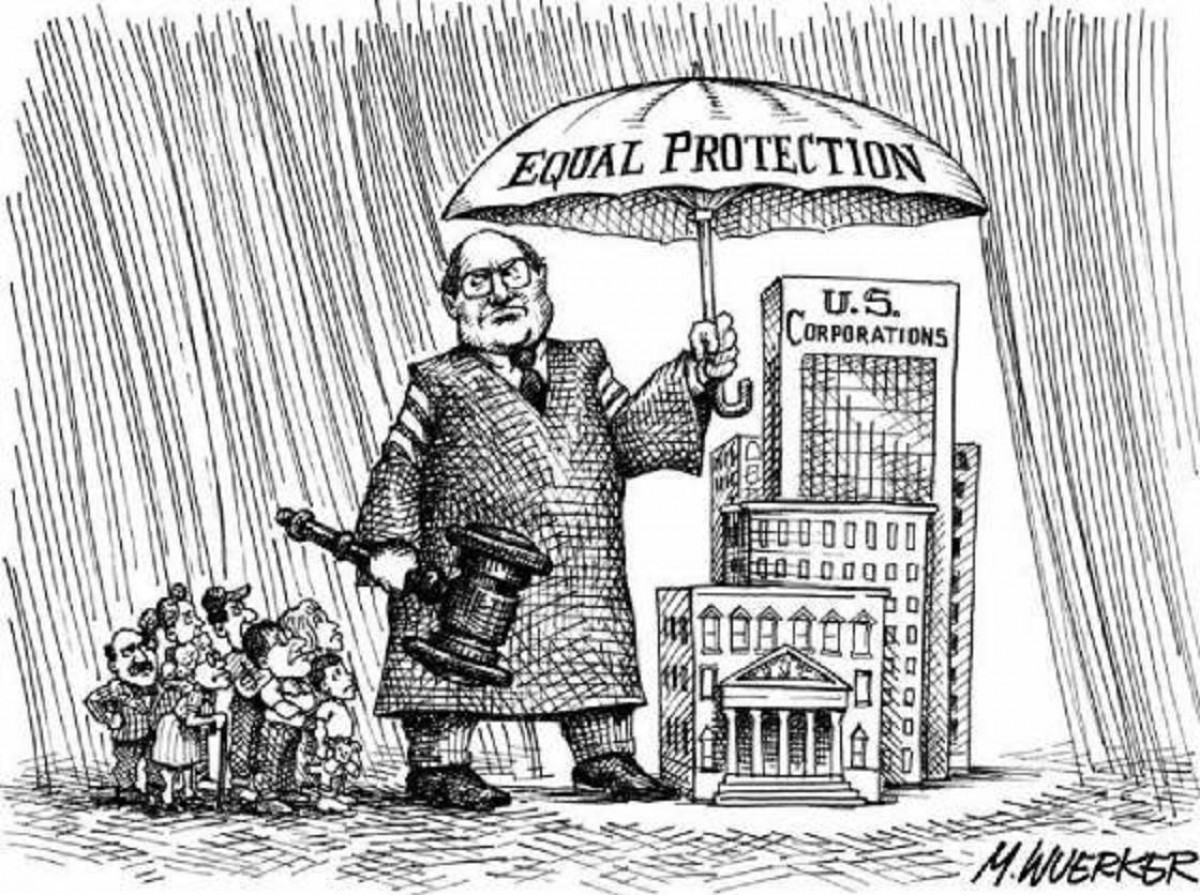
Is the U.S. becoming Marxist? Hardly. In fact, we’re aren't in the midst of a revolution of any sort (at least, not yet).  However, the United States is and has been undergoing a corporate coup in slow motion for some time now. Wall Street has been growing its power and influence over politics in the U.S. ever since the “Citizens United” blunder in 2010 by the Supreme Court, which effectively removed the ordinary citizen voter from any meaningful impact on elections.

Citizens United declared that corporations, which are nothing more than legal fictions, have the same rights as you and I while employees are denied many of the basic rights they have outside of the business. It means that not only does the artificial entity itself have a voice in a election, but so to does the individuals who control the company. In addition, the Supreme Court blunder said that money is equivalent to free speech.

It also said corporations can donate what they please while we’re still capped in what we can donate, not that it matters. Corporations can give millions which far exceeds anything the average citizen voter can ever hope to give. These corporations even donate more than unions by a 10 to 1 margin.

Thus, corporations can buy the candidate of their choice. They also underwrite the two principal parties, the Democrats and Republicans (what in truth we have is simply two competing corporate cliques with many corporations giving to both parties). They also fund so-called “leadership PACs” which are basically slush funds for politicians to use as they please.

There are literally hundreds of lobbyists per legislator (who often call on the senior staff as well). How many lobbyists represent “Joe and Jane Public? you ask? Virtually none, and what does exist can’t come close to matching what Wall Street gives.

In addition, because politicians don’t have the time or staff to read every bill coming across their desk, corporate lobbying firms do have the time and staff to reading incoming bills, as well as provide summaries and recommendations on how to vote. On many occasions, this is done strictly for the party leadership, who then pass their marching orders down the line. As an aside, legislators typically spend the majority of their day fund raising for the party and party leadership as well as themselves.

Corporate lobbyists help legislators to research and/or write bills (and have been known to write the bills in their entirety) and then help shepherd them through the maze of committees (albeit often quietly picking up some "riders' (better known as “pork”) along the way.

Now, if that’s not enough, corporate lobbyists provide all sorts of perks, ranging from the use of private planes, boats, beach houses, “investment advice”, and vacations (typically under the heading of a “seminar” or something educational). In addition, the majority of legislators leaving office find themselves working for one or more of these lobbyist firms and/or Wall Street corporations making ten times what they did in Washington (many under the moniker of <wink wink> “consultant”).

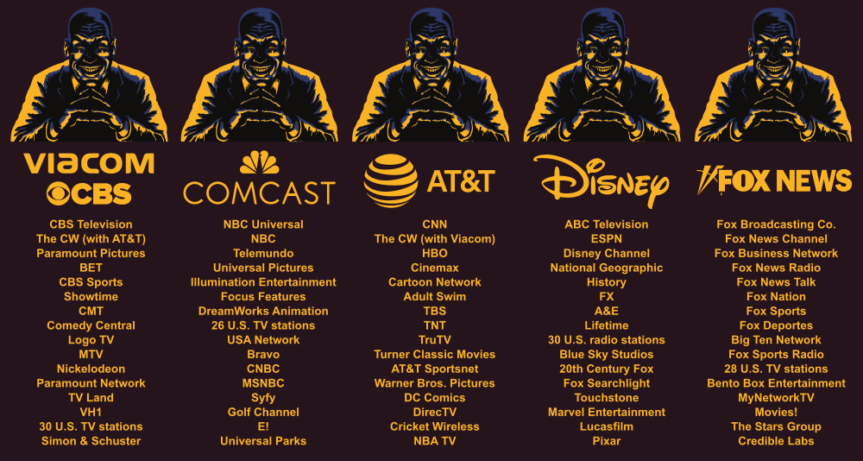
Just five corporations now control 96+% of all media—-print, electronic, internet, television and radio. They determine what you hear and see (until recently it was six). They decide what you should know and how it’s to be presented. They also entertain you with regular programming (some with a political slant and some not), sports, video games, talk shows, magazines, and so forth. Some of it is obvious but most of it isn’t. It’s barely noticeable and subtle. Bread and circuses made new.

So, does any of that sound like “Marxism” to you? Most political scientists agree that the United States is nowadays a neo-fascist Oligarchy. The debate has become over which term best describes the nature of our servitude --- a “plutocracy”, "oligarchy", or “kleptocracy”, but does it matter? The end result is the same. We've ceased being citizens. National pride is passé, even frowned upon. Nowadays, we are global consumers loyal to some soap or deodorant. 

America is no longer a Republic, although the illusion will continue to be perpetuated for a bit longer just as it was under the early Roman Caesars shortly after the fall of the Roman Republic. The Caesars offered security and economic stability in exchange for power, wealth, and the freedom of the Roman people. 

The United States has become a corporatocracy through a process known as "gradualism"; shot incremental steps which, while appearing to go backwards here and there, steadily advances elsewhere. Sometimes it makes giant bold moves while at other times its movements through the halls of government are so subtle as to be barely noticeable.   

We've devolved into a surveillance state where privacy has become a quaint notion of a bygone age, where democracy is parceled out, and our freedoms are managed for our own good. Any government which has taken upon itself the power to a lot you any measure of freedom can just as easily take that freedom away without civil recourse. Government should serve the people, not serve them up on a platter. 

There are literally dozens of books, articles and videos about our metamorphosis from a democratic Constitutional Republic into “USA Inc”. I’ve provided just a sprinkling of links below to whet your curiosity. I do hope you will check them out.


Thank you for reading "Another Opinion", the Op/Ed blog page for the "militant middle".  Here at "A/O" we truly value our readers. At A/O we seek the facts as they exist, not partisan talking points.  We hope you found our articles informative and engaging. Comments are welcome, provided they are not vulgar, insulting or demeaning.  Another Opinion is offered without charge and is directed toward all independent and free thinking individuals. We do ask, however, that you "like" us on whatever site you found us on, and that you please pass our post along. Below you will find links to the sources we used in writing this article. Thank you. 


The Media Oligopoly: How a Handful of Companies Control Nearly All of the Media in the U.S.


The Myth of U.S. Democracy and the Reality of U.S. Corporatocracy


The Corporate Takeover of American Politics


How the US Became an Oligarchy


The American Oligarchs Have Arrived to Destroy US Democracy | Common Dreams


Friday, November 22, 2024

America's Global Economic Performance and Our Failing Schools


Many of the things we took for granted when we were in school back in the 1950's, 60's, and '70's are not considered "politically correct" these days. It seems that the emphasis is more on not "offending" anyone or promoting a culture where nearly everything is acceptable, no matter how irrational. Kids can't tell time using a analog clock or write cursive but they get to pick which gender they want to be and no one has to even tell their parents! You send "Johnny" or "Mary  to elementary school in the morning and they come home as "Johanna" or "Mark"! What the hell?  I was happy if I got to pick out my shirt for school let along my gender! Besides, everyone knew girls had cooties. 

Today kids have story time read to them by individuals dressed like they belong in some sort of John Waters' movie.  They can now choose what they want to study (or not) based on their racial or gender identity.  Disrupting class isn't at all uncommon and often excused as being a part of their "learning culture" or symptomatic of some attention disorder we never heard of when we were kids in school.

 Assaulting teachers while trying to teach class or enforce discipline isn't unusual (and woe unto the teacher who physically responds). Teachers in their 20's or 30's getting caught having sex with kids barely in puberty happens so often it's barely news worthy.  Professional ethics aside, what about simple  morality?

 I personally happen to support saying the Pledge of Allegiance (if you don't want to participate, fine. Just don't interfere with those who do). Strict discipline in the classroom, active participation of the parent or guardian, and teaching civics are essential. If they don't understand the function of government and their role in society as citizens, how can they protect their freedoms? Volunteering 90 days at the end of senior year performing some civic service such as Habitat for Humanity, helping out at the VA hospital, Meals on Wheels, participate on a police or firefighter advisory board, helping seniors or working as an election officer should be mandatory before graduating. 

 I am especially keen on learning being the focus of education. Anything beyond that (sports, band, cheerleading, or whatever) should be a privilege for maintaining good grades. Poor grades or disciplinary issues and the privileges are suspended until the grade or behavior situation is corrected. Repeated offenses and they're revoked. Period.

Some individuals and groups want to promote the introduction of their agenda a denominational prayer in public school and teaching creationism in public school either alongside evolution or to the exclusion of evolution all together. If that's want you want for your child, great. Send them to a parochial school.

 I have no problem with a minute of silence to get yourself mentally ready for the day ahead. If you want to quietly say a little prayer (or have a little prayer circle), have at it. If you want to do a quick mediation, or some late minute cramming for the test you forgot about or get your homework in order, that's fine too. Just be respectful of others. I do not support the notion of mandatory participation in someone else's religious expressions unless it's part of a comparative religions class examining all faiths.

Another key issue is the emphasis on higher education. I also don't believe college is for everyone or necessary for every or even most jobs. Sure, there are some occupations where higher education is needed because of the intellectual nature of the work. However, there are jobs where someone with a proper high school education should be able to do quite well. One reason employers ask for a college degree is just to get a qualified applicant at what would otherwise be the high school  equivalent.

 I've seen high school "graduates" barely function on a 8th grade grammar or reading level or can do math much beyond a 6th or 7th grade level. You can all but forget about basic geography and history (but boy oh boy do they known or video games!).  One resulting outcome is the lowering of colleges and universities minimum admission standards to create an artificial parity based on race or gender rather than academic performance. This is nothing more than a quota system based on discrimination.  

Far too often, teachers and school administrators "fail students forward" rather than hold them back out of fear of being accused of racism, genderism, or whatever the victim card du jure happens to be.   The most common excuse is that failing little "Brad" or "Babs" hurts their self esteem. I think saddling them with a worthless education or bleak employment opportunities is worse than bruised feelings.

Is it any wonder that the United States consistently performs in the lower half of the second tier globally? The U.S. ranked 16th out of 81 industrial countries according to a 2022 test of 15 year olds as administered by the Organization for Economic Cooperation and Development (OECD). We placed 16th in science among the same 81 countries. When it came to mathematics, we were 34th. The top five highest scores all belonged to Asian nations with Japan, Taiwan, Singapore and Macao consistently being among the top performers. 

These are some of our current and future economic competitors for high paying jobs and market shares, which affects employment levels, quality of life, and other key metrics.  If we think of education as an investment in human capital or part of our economic national security, we're losing the battle.

Although the U.S. spends more taxpayer money per student than other countries, we are obviously not getting our money's worth. Incoming President Trump is putting together an advisory committee---the deceptively named "Department of Government Efficiency" (it's not an actual government agency)  led by Elon Musk and  Vivek Ramaswamy. Their job is to review various government projects, programs, and departments and find a way to make them work better and within budget.

 I suggest they start with our school system and find ways to improve our performance. After all, everything starts with education (there are some who, since the 1990's,  have been calling for the disbandment of the Department of Education and a return of educational authority back to the states). As an aside, the Department of Education was elevated to a cabinet level position in October 1979 by President Jimmy "Peanut" Carter (D-GA).

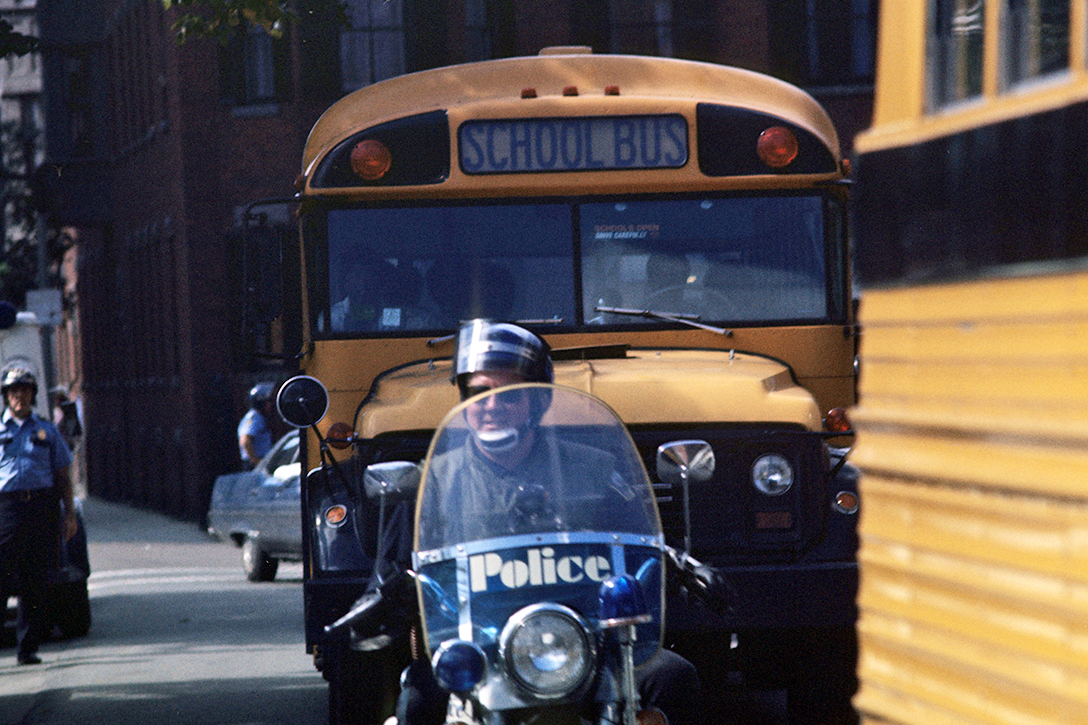
This was just four years after the advent of the disastrous court ordered  fiasco known as "forced busing" which effectively eliminated neighborhood schools. Students as young as six and seven years old, were put onto school buses and shipped all over town for hours at a time each way. This implementation of "social engineering" was intended to create balance in the schools academically and racially.

What it accomplished was a general lowering of academic performance which continues to this day. A better option would have equalizing the money spent on each student and rotating teachers. However, that would have produced a battle with the powerful teacher unions. So, what can we do about it?    

One potential solution is to weed out not just the academically unprepared, but also  redirect individuals who lack the interest or aptitude for higher education. One option would be to adopt a system similar to Germany's where students are tested periodically throughout years K - 8, and channeled into programs which lead to two years degrees, trade or technical schools, or on to higher education. It's one of the reason's Germany has one of the world's most advanced economies in the world.  Of course, the final decision belongs to the student (and parents) who may choose the academic path of their preference.

Students unprepared academically are re-immersed back into the subjects they poorly performed on via in person or online tutoring while extracurricular actives such as sports are put on hold. Students may be required to attend before or after school instruction. In some cases, this may take place during the summer. Until they can pass those courses, they should remain  suspended from  any non-academic events.  

The result is that the abilities and interests of the student is targeted  instead of trying to funnel them onto a path where they have little or no ability or interest. Trade or technical school is one such option. Unlike Europe, America faces a serious shortage of carpenters, welders, plumbers, electricians, glaziers, construction equipment operators, cyber security specialists, and other skills. It's a economic sector where there are real shortages and great opportunities. Making six figures annually isn't unheard of. Neither is owning your own business, where income opportunities can be even higher.

In a 2023 survey, there was a shortage of approximately 374,000 skilled workers in construction. The Association of General Contractors of America had a 70% positive response rate about concerns over the availability of skilled contractors and subcontractors in the upcoming years. 80% of those surveyed said they were worried about unfilled positions long term in the construction industry.

Between now and 2023, the renewable energy industry alone will need 1.1 million more workers worldwide and another 1.7 million to operate the equipment. According to a January 2024 U.S. Bureau of Labor report, the manufacturing industry in the U.S. has a staggering 584,000 unfilled job openings.

Among the reasons for the critical shortage of skilled workers is that the current workforce is slowing but steadily aging out. Almost 70% of supervisors in just the electrical trades are Babyboomers who are quickly reaching or passing retirement age.  More individuals are retiring and leaving than are replacing them. Another explanation is the push by school counselors, college recruiters, and a negative public perception about blue collar workers in general.

The truth is that training for a career in the trades is far shorter and cheaper than getting a Bachelor degree from a college or university. Training, on average, is two years or less plus a short apprentice period which may start simultaneously while being paid with benefits (the average apprentice earns roughly 50% of a skilled worker's salary). It takes about three weeks to qualify for your CDL license needed to be a long haul truck driver (the average salary--with experience--is just over $78,000 yearly).

Typically the cost of attending a trade or technical program can range from just a few thousand dollars to roughly $30,000 with an average cost of $15,000. Many of those attending a trade program are often hired before graduating (some start work will still attending school).

Compare that with the cost to obtain a four year degree. The current average is approximately $10,490 per year for in-state students. For out out-of-state students, that cost can jump to as high as $24,000 per year. If you plan on attending one of the top schools, the cost can be a lot higher. There are a few cheaper options (like attending a unaccredited institution), but remember that you get what you pay for and that's nowhere more true than in education.

Then there's the debt. On average, 61% of those who graduate from a public university leave with diploma in one hand and a bill for $31,960 in the other hand. Over their four years, the majority of students will occur a debt of at least $30,000 by the time they leave. The average federal student loan debt is $37,853 dollars. If you pursue a Masters degree, the costs and debt will be substantially higher.

It used to be that many American workers graduated from high school with a functional degree and would get a good paying job with benefits down at one of the local manufacturing companies. They'd join a union for job security and they were pretty much set. For a large percentage of the country, it was a near guarantee to their entry into the Middle Class. It wasn't uncommon for this path to be multigenerational, but those days are long gone.

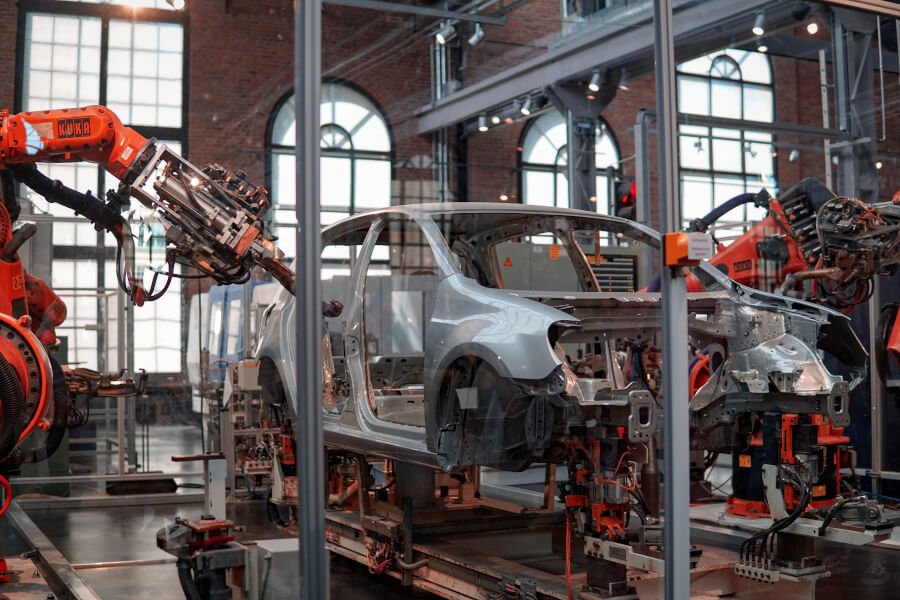
Starting in the late 1970's American began transitioning out of manufacturing and largely into the lower paying (and the less secure non-union) service industry. What industry remained has become more automated, replacing most positions. The only ones with job security and a good paycheck are the ones who repair or program the production line robot. But that's not the half of it.

Our parents and grandparents didn't have to face is the level of competition we do. Today, workers not just compete with each other for scarce well paying jobs, nor is their competition in the next town or state. Today's employee faces competition for work thousands of miles away, in countries like India and China where unions don't exist and people will work for next to nothing (and forget about benefits. They're happy just to have a job!). This is where America is losing ground, and when we look back at math and science score of our students, the future doesn't look to bright for the U.S..

When  it comes to technology, the world leader is Japan (Japan is also the world's most literate nation). Second is South Korea followed by China which has a knack of acquiring, studying, and adapting U.S. and global  technology. You don't have to look much further than the America's F-35 and China's J35A stealth fighter jets for proof.

In fourth place the good ole U.S. of A. Behind us is Germany, a country the size of Wisconsin and with a reputation for high quality engineering and efficiency thanks to their excellent dual avenue academic system which puts the trades on equal ground with higher education without the stigmatism as we mentioned earlier. Of course, we wouldn't expect anything else from the Germans.  As an aside, Russia graduates the most engineers of any country followed by the U.S. and Iran according to UNESCO.

 Singapore, a former British colony, is next (remember at the beginning of this article where I mentioned that the top five nations in academic math and science among 15 year olds were all Asian?). Coming in seventh place is Russia. Another country with a "gift" of mimicking U.S. technology. Great Britain, the United Arab Emirates (UAE), and Switzerland round out the top ten.

The key to the future is innovation. It's where tomorrow originates. So, who leads the world when it comes to innovation? That honor goes to Switzerland which dominates its second place competitor, Sweden. The United States has dropped to third place and is just ever so barely ahead of Singapore and the UK. For now, this may get us by, but not for long. Not at the pace the world is changing. How long can we hold on? Only time will tell. But one thing is for certain. If we don't do radically improve our school system and the quality of graduates, we may be facing a bleak future as the world's largest Banana Republic.


Thank you for reading Another Opinion! We hope you enjoyed this article and will pass it along. Please don't forget to subscribe. It's free! Lastly, please "like" us on whatever platform you use to read anotheropinionblog.com. It helps beat the algorithms and keeps our articles in circulation. Please find below the links we consulted in researching this article. 


Department of Government Efficiency


U.S. Education Rankings Compared to Other Countries


Tradespeople wanted: The need for critical trade skills inU.S.


These countries have the most technological expertise