Showing posts with label population. Show all posts

Friday, August 01, 2025

What Do You Believe? The Future of Religion in the World


I don’t know about you, but of late my news feed has been inundated with stories about religion of all varieties, but especially expansion of radical Islam (now being called “Islamic Imperialism”). Typically, my focus is on politics, economics, and history. Topics such as religion are a little outside of my usual bailiwick despite coming from a very long line of minsters, theologians, reformers, founders, crusaders, and so on. Nevertheless, with all the posts I've been receiving, it's made me curious about the trend of religion throughout the world. 

Since the end of World War II religion (particularly the militant kind) has increasingly with politics and affected global trade, war, climate change (when discussing oil and gas), population replacement, and what some are calling the “conquest with babies” of the West and Asia. What is the current state of organized religion in the world and in the United States, and what does the future look like?

In America’s post WWII “golden years”, the economy was booming. Suburbia  was booming. Everyone had a good paying job (and only dad had to work. Mom got to stay home and run things there. Housing, food, electricity, and medical care was affordable. If you lived downtown, as many Americans did, public transportation was plentiful and cheap.

If you lived out in one of the new sprawling suburbs, everyone had at least on car, although most had access to a bus line. It seems that nearly everyone could afford to take a vacation to some state or national park. And over half of every household attended religious services on a regular basis.

This was the American Dream that many of us remember or have heard stories about. We could still trust the news and government. Television was entertaining and never contained overt violence, sex, or foul language. Even cartoons were funny and didn't require parental supervision.

From the start of the 1950’s, church attendance accounted for 57% of the population and rose to 63.3% by 1960 (prior to WWII, just 37% of households attended church on a regular basis (as a disclaimer, when I discuss topics such as attending “church”, I am not specifically referencing Christianity. I am referring to any organized religious service be it Protestant, Catholic, Jewish, or other).

All that changed on a sunny afternoon in Dallas Texas on November 22, 1963, in a place named Daley Plaza at 12:30 PM. If there was a demarcation or transition point in society, that was it. It’s where our confidence and trust in the media and government was first called into question. It was the day “America’s Camelot” came to an end. It was the day when President John F. Kennedy was murdered and the coverup began.

November 7, 1963 marked the beginning of the turbulent 1960s, with the mass protests,  some violent and some not. It marked the beginning of fundamental changes in society from the civil rights movement, the “Freedom Riders”, boycotts, desegregation,  the murders of Rev. Martin Luther King Jr and Bobby Kennedy, the Vietnam War, Women’s liberation, the decline of unions, and so much more. It also marked the beginning organized religion’s decline in America.

By the late 1960’s, weekly attendance had dropped from 63.3% in 1960 to 39% by the start of the 1970’s. It also saw the rise of so-called “alternative” religious and spiritual movements such as the "Moonies", Buddhism, yoga, Transcendental meditation blossomed along with  the "Flower Power" generation. There was a return to Native America spirituality and nature based religions of old. Today, roughly 40% of U.S. households attend services on a regular basis. 

So, what is the health of religion today? What does religion look like globally and in America? What faith is growing and what’s not, and what might it look like just a few decades down the road? To answer those questions, we need to look at how many people identify with some sort of religion.

According to most polls, roughly 84% of the world’s population claim to identify with one or more religion or faith. Of that 84%, approximately 77% self-identify as a Christian, Muslim, Hindu, or Buddhist. Out of that 77%, the largest organized religion in the world is Christianity (which includes Western with Protestantism and Catholicism as well as Eastern with denominations such as Orthodox and Coptic) represents 31% of the world’s religiously affiliated. As of 2020, there were roughly 2.3 billion Christians in the world, an increase of 121.6 million from 2010.

Christianity’s largest growth is now to be found in Sub Saharan Africa who has grown by 30.7% from 2010 to 2020. In Latin America, it has declined slightly, from 24.8% to 24.1% over the same period, and in Europe it’s dropped from 25.8% in 2010 to 22.3% ten years later. In Asia and the Pacific Rim, Christianity has remained the same with 11.8% while here at home in North America, its dropped from 12.4% to 10.5% as of 2020.

Islam, with its various sects, is the second largest with about 2 billion followers as of 2020, which represents an increase of 346.8 million since 2010, making it the fastest growing religion in the world and is nearly a quarter of the world’s population at 25%. It’s fastest growing areas are mainly in the Middle East.

Hindus are the next largest organized religion with 1.2 billion adherents, up 126.3 million from ten years earlier. That’s 15% of global population. Incidentally, India, the home of the majority of the world’s Hindus, also has the world’s largest population, having recently surpassing China.

Next on the list is Buddhism with 7% of world’s population. They make up just 0.3 million believers. Since 2010, their numbers have dropped18.6 million. Judaism comprises just 0.2% of the global population with about 14.8 million, an increase of 1 million since 2010.  Other religions such as Zoroastrianism, Taoism, Sikhs, Baha, and Shintoism comprise roughly 0.9 billion believers, which as grown 18.1 million over the previous decade.  So, is that it? Well, no, it isn’t.

While the survey looked at those who were religiously affiliated, it also examined a new and growing trend. Snuggled in between Islam and Hinduism is another group, those who fall outside of established norms. This group doesn’t identify with any particular faith or follow some deity. It’s the “unaffiliated” and according to the survey, there’s 1.9 billion of them and they’ve seen the second largest growth---270.1 million---of any group.

Who are the “unaffiliated”? They are individuals who’ve chosen different paths away from organized religion. Many say they are “spiritual”. They may dabble at being Wiccans, pantheists, or pagans. They may explore traditional paths such as shamanism (such as the Asian “Tengrism”), ethno-centric such as Celtic, Slavic, Norse, as well as African based (like Afro-Caribbean Voodoo and Hoodoo), or Native American type spirituality. They may have created their own paths such as through meditation and/or yoga (bear in mind that often these “unaffiliated” individuals are sometimes grouped into a “other” category as well just as Independents are sometimes mislabeled as "leaning" Democrat or Republican).

However, the largest segment of “unaffiliated” are simply those with no religious attachments (often saying they're “nothing in particular”). They may be agnostics or even atheist. Regardless of how they describe themselves, they aren't buying what organized religion is selling no matter how many times they change the packaging. Nevertheless, whatever path they’ve chosen to follow, they are the third largest group in numbers and the second fastest growing group. Keep them in mind, we’ll come back to them shortly.

So, let’s dig a little deeper into the unaffiliated. As pointed out above, the majority say they don’t belong to any specific religion. The largest number of unaffiliated are those who have left Christianity for some reason. Some may claim some form of spirituality, while most claim to be agnostic or atheist. China has the largest number of unaffiliated with 1.3 billion so self-identifying though they have their own private beliefs. This is roughly 90% of China’s population. The large number could be due to China’s long policy of discrediting religion since the Communist came to power under Mao in 1949.

The United States, which doesn’t have any similar policy, has the second largest number of unaffiliated---101 million---with the largest number coming from Christianity (due to the fact that Christianity is the nation’s largest religion).  Various projections show that by the year 2070, the U.S. could have 46% to 41% majority Christian to unaffiliated or a reverse of 48% to 39% unaffiliated to Christian ratio while other religions (most notably Islam)  reaches 12% of the population, mostly in large cities and among minorities.

 Aside from the United States, people moving from Christianity to unaffiliated is happening worldwide. As of 2020, they are no longer the majority in the UK (49%), Australia (47%), France (46%), or Uruguay (44%). Note too that both France and Uruguay were once heavily Catholic. In addition, Uruguay now has a majority unaffiliated population (52%). 

Netherlands now has an unaffiliated majority of 54%. In New Zealand, 51% identify as unaffiliated. Other countries with an unaffiliated majority (aside from China), include North Korea and Vietnam (which have a similar “no religion” policy), the Czech Republic, Macao, and Japan with the fastest growing number of individuals adopting the “none of the above”, which I find both interesting and a bit sad given its long history of Shintoism and devotion to ancestors. In countries where Islam, Hinduism, Buddhism, or Judaism were the majority, there were no changes in their majority positions.

So, globally speaking, what does this mean? The short answer is that Christianity is losing numbers to those who seek answers outside of the religious Status Quo. They no longer want inner guidance from those with a vested interest in the answer, especially without historical proof. Religious intermediaries no longer need apply. 

 While Islam is growing (particularly outside the U.S.) the number of “none of the above” are growing rapidly everywhere around the world while Islam is growing only in certain areas. Islam will not be able to keep pace. It will, of course, try to enforce adherence, especially through intimidation and violence as it historically has done, but as long as they are unable to control what people think or feel, they’re facing a losing battle. I will add that, in my opinion, any system, secular or religious, which demands absolute obedience through fear and intimidation cannot be divinely inspired and therefore acts out of moral weakness.

Hinduism may face a similar fate as Christianity in that it will find itself confronted with the very same science based rational used by the much of the unaffiliated that it has embraced to save its economy.  This is more so when you consider that people will turn more and more to AI for their social, political, economic, and perhaps ultimately, spiritual answers.

Buddhism, as a religion, is losing numbers. That trend is likely to continue, however, Buddhism is unique in that it can be applied as either a religion or as a philosophy, and it is in the latter that it may find its own redemption since it can be applied unilaterally to the religious, spiritual, or unaffiliated akin to the teachings of Chinese philosopher, Lao Tzu or that of Confucius. Meanwhile, the growth of other non-traditional belief systems will also likely continue to grow as people turn from outside sources to more internal way of spiritual growth.


Thank you for reading "Another Opinion", the Op/Ed blog page for the "militant middle".  Here at "A/O" we truly value our readers. At A/O we seek the facts as they exist, not partisan talking points.  We hope you find our articles informative and engaging. Comments are welcome, provided they are not vulgar, insulting or demeaning.  Another Opinion is offered without charge and is directed toward all independent and free-thinking individuals. We ask, however, that you "like" us on whatever platform you found us on in order to keep our articles available for free to others. Lastly, in order to keep costs down, we depend on passive marketing, and therefore, depend on our readers to please forward our posts along. Below you will find links to the sources we used in writing this article. Thank you. 


The Four Largest Religions


How the Global Religious Landscape Changed From 2010 to 2020


How U.S. Religious Composition Has Changed in Recent Decades


Projecting U.S. religious groups’ population shares by 2070


Modeling the Future of Religion in America


Church Attendance Has Declined in Most U.S. Religious Groups


Friday, July 25, 2025

Ours is Bigger Than Yours: The World's Military and the Ultimate Outcome

There’s no question that the Untied States spends more on its military---$886 billion---than the next nine nations combined. That includes China ($296B), Russia ($109B), India ($84B), the UK ($75B), France ($61B), and Germany ($67B). That’s 40% of all military related expenditures in the world by just one country---the U.S.. But is it the largest military?

America has 1.328 million men and women in uniform. India has 1.455 million active duty personnel. Russia has 1.13 million. North Korea has 1.28 million active duty personnel. Nevertheless, the largest military in the world belongs to China. Their Peoples Liberation Army has 2.04 million.

However, these numbers are a bit deceiving. Although China has the largest number of active duty troops, when reservists and paramilitary are included, China has only the fourth largest military in the world  with a grand total of 3,045,000. India’s military jumps up to third place with 4,246,000 which includes 1,155,000 reservists and 1,616,050 paramilitary units (compared to China’s 510,000 reservists and 500,000 paramilitary).

Russia has a total of 3,203,000 under arms including 1,500,000 reservists and another 569.000 paramilitary. As an aside, Ukraine has only 990,000 individuals in uniform of which 730,000 are regular military with no reservists and 260,000 paramilitary (not including those forcibly conscripted).

The world’s largest military is actually North Korea which has essentially militarized its entire military age population! It has 1,280,000 regular troops, 600,000 reservists, and a whopping 5,7 million paramilitary personnel, bring its total to 7,580,000 men and women under arms. By comparison, South Korea has 3,100,000 reservists and 3,013,000 to augment its regular military of 500,000, bringing its total to 6,613,000, making it the second largest.  

As for the United States, we have 1,315,000 active duty personnel in addition to 797,200 reservists, bringing our total up to 2,112,00 individuals in uniform. While the U.S. doesn’t officially have a “paramilitary”, we just might have something a little bit better and that’s the millions of U.S. citizens who come packing.

There’s an old expression that America could never be invaded because behind every rock, tree, and bush, will be someone with gun. Although there are no official numbers,  estimates are that approximately 32% of Americans own at least one gun. That’s about 82 million gun toting Americans.

Of those, some 14.4 million classify themselves as active hunters, meaning they’re probably a pretty good shot (additionally, some 25.87 million Americans has hunted at least once and those numbers don’t included the number of individuals who shot skeet, target shoot, and enjoy “plinking”  (shooting homemade targets like garbage can lids, bottles, cans, and the occasional speed limit sign).  

Broken down by individual household, guns can be found in 44% of households. While other countries, like Switzerland and Serbia, have high gun ownership, no other nation even comes close to the U.S. in terms of gun ownership.

As an aside, Montana has the largest percentage of gun owners of any state with 66.3% of residents owning at least one firearms followed by Wyoming with 66.2%. It’s 60% in Idaho and 59% in West Virginia, while around the Ozarks, it averages 56% of households. In Kentucky, it’s just over half with 54.6% of the population owning at least one firearm. Texas is surprisingly low, with just 46% of the population own a gun, which is less than in Maine where 47%  and Vermont at 51% owning a firearm.

In New York, despite its reputation for gun related violence, just 20% of the population legally own a pistol or rifle while in nearby Connecticut it’s 24%.  In California, 28% of it residents legally own a gun, matching Illinois. New Jersey and Massachusetts has the least with about 14.9% of the population own a gun. Finally, despite being a “Southern” state, gun ownership in Florida is only 35%. It must be due to all those Yankee carpetbaggers.

Another factor to consider, like it or not, is that guns are a part of the American persona. They go hand-in-hand with freedom and independence.  It’s just not part of our history, it’s part of our culture and our collective American mythology as a nation from the frontiersmen and “mountain men” to the Wild West and our very founding as a nation.

Firearms and the notion of self-defense from a tyrannical government was seen as so important, ownership of firearms was built into our Constitution.  As long as Americans own firearms, this country will never be invaded. But there is more to national defense than just pistols and rifles.

Who has the largest air force? In terms of most modern and powerful, that goes hands down to the United States with roughly 14,486 manned and unmanned aircraft. Russia is ranked second in the world with approximately 4,211 aircraft while China possesses 3,304. Next on the list comes India with 2,296, Japan with 1,459, and Pakistan following closely behind with 1,434. South Korea has 1,171 aircraft compared to North Korea which possesses just 951.

 It bears mentioning that the individual branches of the U.S. military have more airplanes, helicopters, and drones than the entire air forces of most countries!  For example, the U.S. Army has some 5,714 aircraft compared to entire Russia military which has a total number of planes and helicopters of 4,211. Of course, being former Navy, I have to mention that the best pilots in the world are U.S. Navy pilots.

Speaking of the Navy, who has the world’s largest seagoing fleet? In terms of numbers, the largest fleet belongs to Russia. Once virtually landlocked due to a lack of warm water ports, Russia now has a fleet of some 781 ships. It’s worth noting too that Russia built the largest submarine ever as part of “Project 941---Akula”, a nuclear powered Typhoon class “boomer” with a displacement of 48,000 tons and a length of 574 feet and a width of 75 feet, it is truly a leviathan.   

 China is second with 730 deep water ships, including two operational aircraft carriers (and a third on the drawing board) along with three helicopter carriers. As an aside, China also has the most modern military navy in the world, turning out more new ships than any nation. 70% of its ships were built after 2010 compared to just 25% of the U.S. Navy.

Third place belongs to North Korea with 505 ships, though analysis question their operational status given shortages of replacement parts. North Korea also doesn’t possess any aircraft or helicopter support ships (South Korea has 200 military ships). Next, in fourth place, is the United States Navy with 11 aircraft carriers and nine support helicopter carrier ships.  

The U.S. Department of Defense published a report in 2024 noting that the Navy was badly in need of a total fleet overhaul; everything from drydocking its fleet for a refit to retiring some of its submarines, destroyers, and even a carrier or two (the DoD was also critical of the wartime capabilities of the U.S. Air Force and U.S. Army. Only the Marines were said to be a proper fighting strength).

Following the U.S. is Sweden, which has traditionally been a seagoing nation for centuries. Sweden currently has 353 deep water naval vessels, followed by Indonesia with 333 military ships. Italy has 309 while India and Thailand have 294 and 293 respectively. The largest navy in South America is Columbia which stands at 237 followed by Mexico with 194. In Africa, Algeria has the continent’s largest navy with 213 ships. Egypt is second with 140 ships.

Speaking of submarines, at 70, all nuclear, submarines, the U.S. Navy possesses the world’s largest submarine fleet. Second place belongs to Russia with 63 nuclear and conventional submarines. The Chinese have 61, which includes nuclear and electric diesel. Their emphasis is primarily the Indian and Pacific oceans.  

In fourth place is Iran which operates 25 conventional attack and miniature submarines throughout the Persian Gulf.  Egypt has the largest submarine fleet in Africa with eight Type 209  conventional subs it acquired from Germany (who know a few things about submarines). Algeria has six and South Africa has three, also Type 209.

Lastly, nukes. What nation has the most? Russia is believed to have 5,500 nuclear tipped missiles in various stages of readiness. The U.S has some 5,000 nuclear armed missiles, also in varying stages of readiness. China too has nuclear missiles  (around 600) as does France (290), the UK (225), India (180), Pakistan (170), and Israel (90).

North Korea claims to have around 50 while Iran is desperately trying to become the newest member of “global damnation club”.  It deserves mentioning that in terms of missiles in general, Russia is also thought to possess the largest number of missiles, especially Intercontinental Ballistic Missiles or “ICBMs”, both nuclear and conventional. China is also busily expanding its missile capabilities. 

All told,  there are approximately 12,331 nuclear weapons at play, down from about 70,000 during the Cold War. These range from so-called “tactic”  or low yield warheads which have a explosive capability 20 times that of what was used as Hiroshima and Nagasaki up to a three stage thermonuclear warhead (the Soviet era “Tsar Bomba”) whose explosive output is 1,570 times that which was used on the two Japanese cities. Anyway, you look at it, in a nuclear exchange only cockroaches would survive.

Other missiles systems being made operational include hypersonic missiles which travel at Mac 5 or five times the speed of sound (and thus may be able to evade various anti-missile defense systems) as well as GBU 7a/b “bunker buster” which can penetrate 200 feet into the earth or through 20 feet of solid concrete. The EMP” of electro-magnetic pulse bomb which disrupts or destroys anything electronic or electrical  such as power grids, communication systems, computer systems, electrical circuits, and so forth.

In the final analysis, we seem to be pretty good at developing ways to kill each other. In a world where poverty, hunger, and disease is on the rise, and budgets funding social safety nets are being cut, the budget for the “defense” is virtually unlimited. We kill to gain access to and protect resources or global markets. Besides, war is profitable.

War artificially stimulate economies and reduces unemployment and regulates “excess” populations. Most of our scientific and medical advances are byproducts of weapons research (but then, so are many of our new diseases). It pits us against each other in order to protect the “haves” from the “have nots”. Hell, we’ll even kill each other over whose god or prophet is the most benign. Many of us pray for a divine or even alien intervention to put a stop to our species based insanity. But the sad truth is that no one or nothing is coming from the sky or anywhere else to save us. We’re on our own babies.


Thank you for reading "Another Opinion", the Op/Ed blog page for the "militant middle".  Here at "A/O" we truly value our readers. At A/O we seek the facts as they exist, not partisan talking points.  We hope you find our articles informative and engaging. Comments are welcome, provided they are not vulgar, insulting or demeaning.  Another Opinion is offered without charge and is directed toward all independent and free-thinking individuals. We ask, however, that you "like" us on whatever platform you found us on in order to keep our articles available for free to others. Lastly, in order to keep costs down, we depend on passive marketing, and therefore, depend on our readers to please forward our posts along. Below you will find links to the sources we used in writing this article. Thank you. 


The World’s Largest Armies


Mapped: US States With The Most Guns


Largest Air Forces in the World


U.S. Military Working on Rebuild Readiness and Modernize


Military Readiness


Why the U.S. Military is in Serious Trouble


Top 10 countries with the largest submarine fleets in 2025


Project 941 submarine


Which countries have nuclear weapons?


Friday, July 12, 2024

The Importance of Getting it Right: America's Domestic Dilemma

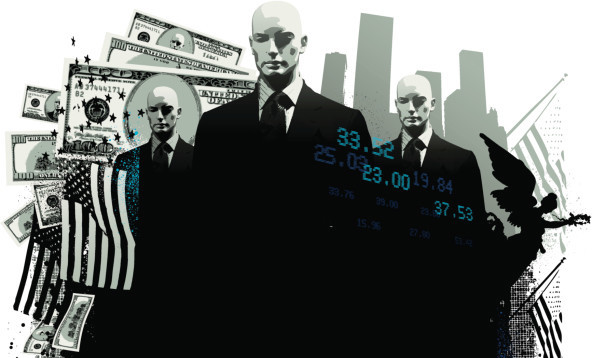
Right now there are some very powerful groups working non-stop around the clock to pit us against each other every way possible. They manipulate what we watch, listen to, or see as much as possible. After all, just 5 mega corporations own 96+% of all media. They've totally ignored the fact that nearly half the country is registered Independent---43%. Nearly half the country wants nothing from the corporate own uniparty.

Remember this too. The Nazis came to power under the banner of "law and order" and national security with just 43% of the total vote. Lacking a majority, the Nazi's were compelled into a coalition government with industrialist Alfred Hugenberg's conservative German National People's Party (DNVP) in order to take power.  But once the Enabling Act was in place by March 23,1933, the ill-conceived  response to the February 27th Reichstag fire allegedly started by "Communists agitators", the German Republic was all but over.  And it took Hitler just 52 days.

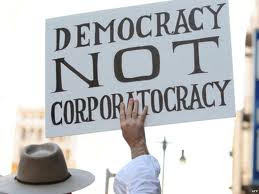
The Democrats and Republicans are both minority parties with roughly 25% of registered voters each. but you wouldn't know it from the media or how the country is run. They've created a two tier legal system and a political class system. They've quietly overthrown our Republic at the behest of a neo-fascist corporatocracy led a super rich oligarchy (or kleptocracy if you prefer, it really doesn't matter. The results for us are the same), and while we were busy playing on our "smart phones" or watching some reality show.

Freedoms are routinely and gradually  suppressed in the name of "national security" in order to protect the populace from scapegoat enemy.  Historically it's been the "Jews", Protestants or Catholics, blacks, Chinese, the Irish, and so on. But, it need not be a group, it can just as easily be a abstract idea; a "catch all" if you will. For instance, "socialism" and Communism" are typically bandied about as if they're one and the same, which they're obviously not. But none of that really matters as long as you're made afraid of it. Why?

The corporate state will always employ a "us versus them" mindset using every resource they have available in order to make and keep you afraid of something. They will use that fear to justify their existence. It will be the foundation of their control.

Let me ask you a question. What do the following laws all have in common? The Fair Labor Standards Act of 1938 which, among other things, prohibited the use of child labor, created the 40 hours work week, and provided for a minimum wage, the National Labor Relations Act, of 1935 (aka "the "Wagner Act") or the Social Security Act of 1935. Any guesses?

What about Title VII  of the Civil Rights Act of 1964, which prohibits discrimination based on age, race, gender, national origin, religion, or sexual orientation, or the 19th Amendment (passed in 1919) giving women the vote?  How about the Federal Unemployment Act of 1935 which provides unemployment benefits to out of work employees or the Indian Mineral Leasing Act of 1938 which gave Native American tribes more control of the extraction of natural resource on tribal land. Give up?

Every single one of them were labeled either "socialist" or Communist. Every. Single. One. Most of these were passed during Franklin D. Roosevelt's administration, which didn't go unnoticed by the powerful industrial elites of the time who ridiculed Roosevelt as a "traitor to his class" (he came from a wealthy upper New York family), as a closet socialist or Communist (take your pick). Wall Street did everything it could (legal or not) to defeat, or at least delay these laws, but ultimately failed. But, can you honestly say your life would be better off without most or all of these laws?

But it doesn't end there. Not by a long shot. The Civil Rights Act of 1964, and "War on Poverty" initiative  signed by the Democratic President, Lyndon B Johnson, was vilified as being a Communist plot to destabilize the country as was the creation of Medicare and Medicaid in 1965.  The Consumer Product Safety Act, Clean Air and Clean Water acts on 1972, all of which were signed by Republican arch conservative Richard Nixon, were also hailed as being "socialist". Of course, "Obamacare"  which help provide critical medical care for those without any (in many cases because their employer couldn't afford to offer any).  

 It's the same in every totalitarian government.  Different actors. Same script.  As Nazi propagandist genius, Joseph Goebbels, once advised "publicly accuse your enemy of doing what you're already secretly doing". Our "Enabling Act" arrived  in 2001 under the flag waving title of "The Patriot Act" and  we've never looked backed despite the slow transformation of the U.S. into a surveillance state. Fascism, in all its incarnations---populist, traditional, benevolent, or religious, all ends the same. It's about control.  

Fascism, which is really just another name for corporatism, can declare itself as  being "liberal" (China, North Korea, East Germany, North Vietnam, Somalia, Yemen, and others were labeled as "Democratic Republics"). The famous quote (erroneously attributed to author Sinclair Lewis) said that fascism, when---not if--- it comes to America, "will be wrapped in the flag  and waving a cross" as well as "American fascism, when it eventually arrives, will be government of, by, and for profits." Sounds a lot like today's Oligarchy doesn't it?

Echoing that statement, James Waterman Wise Jr , author of numerous books including "Our Bill of Rights: What it Means To Me" and "Thomas Jefferson: Then and Now" penned in the  Feb. 5, 1936 edition of Christian Century (considered the flagship magazine of mainstream Protestantism since 1900). He remarked, "If fascism comes, it will not be identified with any 'shirt' movement, nor with an insignia, but it will probably be 'wrapped in the American flag and heralded as a plea for liberty and preservation of the constitution".

These "friendly fascists" might claim to know the "Will of God" and promise to return us to time of more traditional family values. Such is "friendly fascism". It may claim to be socially conservative if that is what it takes to get your compliance just as easily as it claims to be "all inclusive". But regardless of its outward message, Fascism will always ultimately insist on your total and unwavering compliance.

The assault on our nation has been a gradual one. It creeps forward in one place and makes a strategic  but temporary retreat in others areas, but overall, their agenda always advances. It's a process known as "incrementalism" or "gradualism". Notice for instance how the educational system have been "dumb down". Did it happened over a month or even a year? Nope. It's been happening over decades.

Schools have gone from teaching critical thinking skills to teaching "Critical Race Theory". Some of these same schools are now encouraging "gender selection" by kids who barely know what "gender" means! Worse still is that the parents don't even have to be notified. Schools and libraries are trying to ban certain American classics such as "Huckleberry Finn", "Tom Sawyer" , "1984" and "Animal Farm", "Of Mice and Men", "To Kill a Mockingbird", and "A Farewell to Arms" . Even "Little Riding Hood" and Anne Frank's "Diary of a Young Girl" have fallen to censors!

Meanwhile, liberals claim that books about race (especially those placing certain racial minorities in a positive light), history books offering a different perspective of events, as well as books about sexual orientation and gender are being banned by schools and libraries at the same rate.

This, of course, raises the question as to where books should be banned at all? Perhaps we should go back to the age specific criteria for children is strictly enforced just as all decisions made about students should involve the parent.  After all, isn't the ultimate objective to encourage kids to read, develop their critical thinking skills, expand their intellectual horizons and help make them responsible citizens?

People are expected (and in some places, mandated by law) to play along with other people's fantasies by referring to a biological male  who "identifies" as a female as "she/her" or by female who believes they're a male as "he/him". Even more oddly, some don't even want to be referred by a gender specific pronoun since they're "gender fluid" and want to be known as "them/they", but it gets weirder.

There are those individuals who "self-identify" as animals---dogs, cats, whatever---and they want to be treated that way. Some even show up in school dressed as the animal of their delusion...err..choice... and wants act, be talked to, and even fed from a bowl at lunch  (I wonder if they go outside to the restroom, sniff other people's butts, or if they've figured out how to lick their privates yet?).  

Anyway,  I don't care who or what someone believes that are, although much of this I believe is a cry of attention or simply a mental illness. It's really none of my business, but why must I have to reinforce their self-delusion and play along? What about my moral compass?

In the long run, all the corporate state cares about are workers just smart enough to do their jobs, but not smart enough to challenge their authority, and certainly not individuals who think for themselves. Those people are dangerous.

If we're are pitted against each other, then we won't be paying attention to what they're doing. In a short order, the mask will slip and then drop completely and you can bet they won't bother even asking for our support or anything else.   They will demand and you will comply.

In that same instant, when they finally stop pretending to care about rising gas and food prices, the environment, unemployment, high taxes, or having an open border, you will have to decide for yourself, for your family, and for grandchildren yet unborn if it's better to stand on your feet and take a unmovable stand as a free man or women to fight for democracy and a return of our Republic, or to live forever on your knees having never knowing freedom ever again.  Remember, no decision is still a decision by default. But for those who come after you, it will be far too late. The decision will have already been made for them by your inaction.

As  Dr. Klaus Schwab of the globally powerful and influential World Economic Forum recently said, when speaking about the WEF's "Great Reset Initiative", that "you will own nothing and be happy". Another aspect of the "Great Reset" is to create a more "sustainable planet" by promoting greater economic deregulation of businesses, and in particular large transnational corporations (of the corporatocracy type) and  giving them a greater role in global governance "at the expense of government".  Does that sound like "socialism" or "Communism"? Not to me. In fact, it's almost the textbook definition of fascism.

There's no question that America has slipped into a corporatocracy under the leadership of a group of mega-rich oligarchs. They thrive on creating chaos and promising us order. Their sole goal is control, be it assets, resources, or us as their economic serfs, forever chained to debt. Our "worth" determined by our credit rating and to afraid to speak up for ourselves for fear of losing our jobs.  A roadmap is already being laid out for us and those who follow who will "own nothing and be happy". Will you willingly go down that road or will you fight to preserve our democracy and for a return of our Republic? We have to get this right the first time.  


If you enjoyed the article, please consider passing it along to others and don't forget to subscribe. It's free! Lastly please be sure to "like" us on whatever platform you use to read anotheropinionblog.com. It helps beat the algorithms and keeps our articles in circulation. Thank you!


Dept of Labor: Summary of Major Laws of the Department ofLabor


The Sinclair Lewis Society


World Economic Forum


openDemocracy: Conspiracy theories aside, there's something fishy about the Great Reset


Great Reset


25 of America's most unexpectedly banned books


Independent Party ID Tied for High; Democratic Party for NewLow