Showing posts with label China. Show all posts

Thursday, September 11, 2025

Are You Smarter Than You An Eighth Grader? Population Intelligence From Around the World

Have you ever watched a world leader and thought that they were some sort of a buffoon or wondered how on earth they managed to become a head of state? Russia’s Boris Yeltsin is a good example. Not only was he a heavy drinker, but he always acted like he didn’t have a lick of sense as we say in the South. France’s Emmanuel Marcon is another example of someone who seems to be out of his league, but he’s far from the only one. 

Another individual was George “Dubya” Bush. He seemed to mess up nearly everything he did. Bush managed to graduate with a so-called “Gentleman’s C” which typically means a C-/D+. Barack Obama wasn’t exactly stellar either.  Not exactly what you’d expect for a U.S. President.

Congress is full of such individuals, and increasingly, we’re finding judges, governors, mayors, and local officials so lacking in intelligence that they shouldn't be out in public unsupervised or be allowed to hold sharp objects!

Are our euphemistically named “leaders” a reflection of the people they’re supposed to lead? Like me, I’m sure you’ve worked some place where those in charge were dumber than a box of rocks. Unfortunately, however, we are now living in a society where mediocrity is the norm. Anyone who excels or stands out is viewed with suspicion. 

Kids are routinely placed in sub-par schools where conformity is encouraged. Everyone is equally dumbed down so as to not “offend” lower performing students. As in sports, where everyone gets a trophy, so now in academics everyone gets a diploma whether they actually earned one or not. How else do you explain kids graduating high school with an 8th grade reading and literacy level, a 7th grade knowledge of history, geography, or civics, or that just 37% were academically prepared for entry level college math and science?

At work, we try to do “just enough” and to keep our heads down. We just want to get through the day, collect our paycheck, and go home. If we can somehow slip through without the boss knowing our name, that’s celebrated as a personal victory. Questioning authority is seen as making waves or labeling you as a troublemaker.

Your fellow employees don’t like it because it brings unwanted attention their way and your supervisor doesn’t like it because it means they may  address yet another problem. If the average workplace had a color, it would be dull gray. Is it any wonder then that when we graduate so many underachievers we find ourselves in a milquetoast society?

The Nobel Prize was seen at the epitome of excellence (their prestige was damaged when they started focusing on political correctness over achievement as in the case of President-elect Barack Obama who was awarded the prize for…well…nothing actually). Nevertheless, the United States has the most laureates at 420. The next closest is the United Kingdom with 142 and Germany at 115. India has won 13. China has 8. Russia has 30, and Japan has 31.

The reason for America’s dominance has been well-funded research (mainly by the military and corporations), historic academic freedom, and our emphasis on mathematics and the hard sciences, the very areas where our schools are struggling today. As an aside, do you know which ethnicity has won the most Nobel awards? The answer is Jews. One in ten of all Nobel Prize recipients have been Jewish.

What nation owns the most patents? That honor goes to China according to the World Population Review. They report that China has some 798,347 patent grants. The majority of these are in the areas of digital communications, artificial intelligence, and computer technology (China has 70% of AI patent applications). Two other areas with a high number of patents filed are medical and renewable energy technology.

As for the United States, we have a distant 323,410 of all patents granted. Japan and South Korea are next at 201,420 and 135,180 respectively. India rounds out the top five with 30,490.  It bears mentioning that Asia leads the world with the number of patents filed, accounting for 68.7% of all patents filed globally.  Of that, 70% came from China. It also holds the majority of the world’s trademarks. Not shabby China. Not shabby at all.

In addition, women account for 17.7% of the inventors as indicated on the patent applications, up from 10.9% in 2009. Most of their inventions pertain to the biotechnology and food chemistry industries. It's odd then that some countries view women as third class citizens; as being inferior and therefore makes it criminal for them to be educated or try to reach their maximum potential. 

Given the aging population, especially in the West, another question of interest is which countries have the most number of medical doctors per capita. At first blush, you would think the U.S., China, or India given their population density. Well, you’d be wrong. The nation with the most doctors based on percentage of their population is Cuba which has almost 94 doctors per 10,000 residents. In fact, Cuba is very well known for sending its physicians abroad, especially to poor and developing countries.

Sweden has almost 72 doctors per 10 thousand individuals while Belgium has 64. Greece has just over 63 doctors per 10,000 people. Norway has roughly 52. By comparison, Russia has 38 physicians for every 10 thousand. In India, the world’s largest populous country, its only 7.27. It’s 25 in Canada and just slightly better in Mexico with 25.6. In the United States, the number is 35 physicians for every 10 thousand.  Lastly, in Africa it’s mostly under 10 physicians for every 10 thousand with the majority of countries having under 2 doctors per 10 thousand.

As a side note, the U.S. Northeast has the most number of active doctors with New York producing the most. The majority of doctors in the U.S. are White or Asian. The fewest number are Black. Most of the applicates to medical school are foreign born, with most coming from India, Pakistan, the Caribbean, the Philippines, and Mexico.

Finally, the overwhelming majority of doctors come from upper income families. 75% of doctors comes from families whose incomes are in the top 40%, and of those, 30% are from families in the top 5% income bracket! The high cost of a medical degree (and subsequent debt) make it nearly impossible for applicants coming from poor or working class backgrounds----just 5%---to succeed.  Maybe that explains the “God complex” some seem to have.

All of what we’ve discussed so far presupposes one thing---intelligence. So, what countries tend to have the highest IQs? It’s long been said that education is the key to success. However, that’s just one factor. Opportunity and financial means are also critical. However, none of it matters unless you have the intellectual aptitude.

The average IQ score is 100, be it an individual or a nation. These results are only “best guess” averages, extrapolated from a percentage of the population since, after all, you can’t test everyone in a nation! Secondly, since we’re dealing with entire populations, obviously no country will measure as “genius” or “gifted”, but some are certainly above average.

China has the highest overall IQ of any country with a national average of 107.19, which would be pretty decent for an individual. South Korea was second with 106.43, just beating out Japan with 106.40. Surprisingly, Iran was fourth. It’s average was 106.3. Singapore was fifth with an average national IQ of 105.14.

Russia came in sixth with an estimate national IQ of 103.16. Mongolia, Armenia, and Australia were nearly tied at 102.86, 102.58, and 102.57 respectively. Canada was 101.65 while Thailand’s average IQ was 101.52. Luxembourg had the global average IQ of 100, followed closely by Iceland at 99.99.

Vietnam’s national IQ average was 100.12. Greece was 100.07. The United States came in 30th place with a national IQ of 99.74, just barely beating out Czechia which had an estimate national IQ of 99.73. The UK’s was 99.68. Germany’s average IQ was 99.64. As an aside, the national IQ for France was 101.42, putting them in 17th place (yes, we got beat by the French!). Mexico's was 95.52.

The highest estimated IQ in the Middle East belongs to Lebanon with 99.39, putting them in 37th. Israel was next, in 45th place, with an average IQ of 99.07, tying Turkey. Other Middle Eastern countries were the UAE with an average of 96.8. India was 99.08. Egypt’s average national IQ was 97.21, Kuwait was 95.02, and Algeria had an estimated IQ of 97.01.

Among the nations of South and Central America, Uruguay’s and Ecuador’s national IQs were near identical at 95.01 and 95.00 respectively. Chile’s was 95.38. Argentina’s IQ was an estimated 94.39 and Brazil’s was 92.92 with an IQ of 93.17 for Columbia. 

In Africa, South Africa had the highest with an estimated national average of 94.11. Kenya ‘s IQ was 91.22. Zimbabwe was 90.21 compared to Ghana with 90.25. The Ivory Coast was 88.42, Senegal’s average national IQ was 88.27 and the Congo was 88.01. Angola’s estimated national IQ was 85.33, and in last place at 126 was Gabon, whose average IQ was 85.08. The average IQ for a sub-Saharan African is 80.

It should be mentioned too that overall, IQ scores worldwide have been on the decline, reversing a trend of rising scores throughout much of the 20th century thanks to better nutrition and healthcare, more access to schools, quality education (and discipline) better qualified teachers, and generally secure environments needed to foster learning. This decline (known as the “Reverse Flynn Effect”) first started appearing in the late 1970’s and accelerated in the 1990’s.

The most notable regions of decline has been in Scandinavia, which had long been noted for producing a highly intelligent population. The UK, France, and the United States has also seen a decline in IQ scores. Latin America has remained largely stable while Africa has seen some improvements. Asia, on the other hand, has experienced stable IQ scores or in some cases, a significant rise.

Studies have shown that the decline in IQ scores have been most prevalent in the areas of mathematics, logic, and verbal reasoning. The significance of this is that these are the very areas needed for an advanced technological society as well as in medicinal research. Spatial reasoning, however, has actually improved. Could that be from playing so many video games?

It should come as no surprise that Asia’s dominance in academic testing and it’s rising IQ scores correspond to its growing dominance economically, especially in the areas of AI, technology, and communications. If the West is to remain competitive, it must reverse this trend by demanding academic excellence from its schools, including restoring discipline in the classroom and an emphasis on academic rigor. Excuses will no longer cut it. Additionally, we must accept that not every job requires a college degree. Most only need individuals who had 12 years to master the basics. Trades schools are another area seriously lacking our attention despite high demand, good pay, and low debt.  

Countries like South Africa and Iran have made serious social blunders while Europe is caught in an ever tightening spiral downward thanks to political weakness (that can be said of Canada as well). Africa has the resources but it lacks the infrastructure and leadership thanks to petty graft and prejudices.  Latin America has the potential, but does it have the will? That remains to be seen. In the interim, it appears that the Sun is rising ever higher in the East.  


 Thank you for reading "Another Opinion", the Op/Ed blog page for the "militant middle".  Here at "A/O" we truly value our readers. At A/O we seek the facts as they exist, not partisan talking points.  We hope you find our articles informative and engaging. Comments are welcome, provided they are not vulgar, insulting or demeaning.  Another Opinion is offered without charge and is directed toward all independent and free-thinking individuals. We ask, however, that you "like" us on whatever platform you found us on in order to keep our articles available for free to others. Lastly, in order to keep costs down, we depend on passive marketing, and therefore, depend on our readers to please forward our posts along. Below you will find links to the sources we used in writing this article. Thank you. 


Nobel Prize by Country 2025

https://worldpopulationreview.com/country-rankings/nobel-prizes-by-country


Patents by Country 2025

https://worldpopulationreview.com/country-rankings/patents-by-country


Here’s the top 10 countries who filed the most patents globally

https://www.patentrenewal.com/post/herere-the-top-10-countries-who-filed-the-most-patents-globally


AI Patents by Country Revealed: The Top 15 Countries Dominating the 2025 Landscape

https://arapackelaw.com/patents/ai-patents-by-country/


Doctors per Capita by Country 2025

https://worldpopulationreview.com/country-rankings/doctors-per-capita-by-country


Average IQ by Country (2025 Update)

https://www.thecaliforniacourier.com/average-iq-by-country-2025-update/


American IQ Scores Have Rapidly Dropped, Proving the ‘Reverse Flynn Effect’

https://www.popularmechanics.com/science/a43469569/american-iq-scores-decline-reverse-flynn-effect/


American IQs rose 30 points in the last century.  Now they may be falling

https://thehill.com/policy/technology/3922608-american-iqs-rose-30-points-in-the-last-century-now-they-may-be-falling/

Friday, July 25, 2025

Ours is Bigger Than Yours: The World's Military and the Ultimate Outcome

There’s no question that the Untied States spends more on its military---$886 billion---than the next nine nations combined. That includes China ($296B), Russia ($109B), India ($84B), the UK ($75B), France ($61B), and Germany ($67B). That’s 40% of all military related expenditures in the world by just one country---the U.S.. But is it the largest military?

America has 1.328 million men and women in uniform. India has 1.455 million active duty personnel. Russia has 1.13 million. North Korea has 1.28 million active duty personnel. Nevertheless, the largest military in the world belongs to China. Their Peoples Liberation Army has 2.04 million.

However, these numbers are a bit deceiving. Although China has the largest number of active duty troops, when reservists and paramilitary are included, China has only the fourth largest military in the world  with a grand total of 3,045,000. India’s military jumps up to third place with 4,246,000 which includes 1,155,000 reservists and 1,616,050 paramilitary units (compared to China’s 510,000 reservists and 500,000 paramilitary).

Russia has a total of 3,203,000 under arms including 1,500,000 reservists and another 569.000 paramilitary. As an aside, Ukraine has only 990,000 individuals in uniform of which 730,000 are regular military with no reservists and 260,000 paramilitary (not including those forcibly conscripted).

The world’s largest military is actually North Korea which has essentially militarized its entire military age population! It has 1,280,000 regular troops, 600,000 reservists, and a whopping 5,7 million paramilitary personnel, bring its total to 7,580,000 men and women under arms. By comparison, South Korea has 3,100,000 reservists and 3,013,000 to augment its regular military of 500,000, bringing its total to 6,613,000, making it the second largest.  

As for the United States, we have 1,315,000 active duty personnel in addition to 797,200 reservists, bringing our total up to 2,112,00 individuals in uniform. While the U.S. doesn’t officially have a “paramilitary”, we just might have something a little bit better and that’s the millions of U.S. citizens who come packing.

There’s an old expression that America could never be invaded because behind every rock, tree, and bush, will be someone with gun. Although there are no official numbers,  estimates are that approximately 32% of Americans own at least one gun. That’s about 82 million gun toting Americans.

Of those, some 14.4 million classify themselves as active hunters, meaning they’re probably a pretty good shot (additionally, some 25.87 million Americans has hunted at least once and those numbers don’t included the number of individuals who shot skeet, target shoot, and enjoy “plinking”  (shooting homemade targets like garbage can lids, bottles, cans, and the occasional speed limit sign).  

Broken down by individual household, guns can be found in 44% of households. While other countries, like Switzerland and Serbia, have high gun ownership, no other nation even comes close to the U.S. in terms of gun ownership.

As an aside, Montana has the largest percentage of gun owners of any state with 66.3% of residents owning at least one firearms followed by Wyoming with 66.2%. It’s 60% in Idaho and 59% in West Virginia, while around the Ozarks, it averages 56% of households. In Kentucky, it’s just over half with 54.6% of the population owning at least one firearm. Texas is surprisingly low, with just 46% of the population own a gun, which is less than in Maine where 47%  and Vermont at 51% owning a firearm.

In New York, despite its reputation for gun related violence, just 20% of the population legally own a pistol or rifle while in nearby Connecticut it’s 24%.  In California, 28% of it residents legally own a gun, matching Illinois. New Jersey and Massachusetts has the least with about 14.9% of the population own a gun. Finally, despite being a “Southern” state, gun ownership in Florida is only 35%. It must be due to all those Yankee carpetbaggers.

Another factor to consider, like it or not, is that guns are a part of the American persona. They go hand-in-hand with freedom and independence.  It’s just not part of our history, it’s part of our culture and our collective American mythology as a nation from the frontiersmen and “mountain men” to the Wild West and our very founding as a nation.

Firearms and the notion of self-defense from a tyrannical government was seen as so important, ownership of firearms was built into our Constitution.  As long as Americans own firearms, this country will never be invaded. But there is more to national defense than just pistols and rifles.

Who has the largest air force? In terms of most modern and powerful, that goes hands down to the United States with roughly 14,486 manned and unmanned aircraft. Russia is ranked second in the world with approximately 4,211 aircraft while China possesses 3,304. Next on the list comes India with 2,296, Japan with 1,459, and Pakistan following closely behind with 1,434. South Korea has 1,171 aircraft compared to North Korea which possesses just 951.

 It bears mentioning that the individual branches of the U.S. military have more airplanes, helicopters, and drones than the entire air forces of most countries!  For example, the U.S. Army has some 5,714 aircraft compared to entire Russia military which has a total number of planes and helicopters of 4,211. Of course, being former Navy, I have to mention that the best pilots in the world are U.S. Navy pilots.

Speaking of the Navy, who has the world’s largest seagoing fleet? In terms of numbers, the largest fleet belongs to Russia. Once virtually landlocked due to a lack of warm water ports, Russia now has a fleet of some 781 ships. It’s worth noting too that Russia built the largest submarine ever as part of “Project 941---Akula”, a nuclear powered Typhoon class “boomer” with a displacement of 48,000 tons and a length of 574 feet and a width of 75 feet, it is truly a leviathan.   

 China is second with 730 deep water ships, including two operational aircraft carriers (and a third on the drawing board) along with three helicopter carriers. As an aside, China also has the most modern military navy in the world, turning out more new ships than any nation. 70% of its ships were built after 2010 compared to just 25% of the U.S. Navy.

Third place belongs to North Korea with 505 ships, though analysis question their operational status given shortages of replacement parts. North Korea also doesn’t possess any aircraft or helicopter support ships (South Korea has 200 military ships). Next, in fourth place, is the United States Navy with 11 aircraft carriers and nine support helicopter carrier ships.  

The U.S. Department of Defense published a report in 2024 noting that the Navy was badly in need of a total fleet overhaul; everything from drydocking its fleet for a refit to retiring some of its submarines, destroyers, and even a carrier or two (the DoD was also critical of the wartime capabilities of the U.S. Air Force and U.S. Army. Only the Marines were said to be a proper fighting strength).

Following the U.S. is Sweden, which has traditionally been a seagoing nation for centuries. Sweden currently has 353 deep water naval vessels, followed by Indonesia with 333 military ships. Italy has 309 while India and Thailand have 294 and 293 respectively. The largest navy in South America is Columbia which stands at 237 followed by Mexico with 194. In Africa, Algeria has the continent’s largest navy with 213 ships. Egypt is second with 140 ships.

Speaking of submarines, at 70, all nuclear, submarines, the U.S. Navy possesses the world’s largest submarine fleet. Second place belongs to Russia with 63 nuclear and conventional submarines. The Chinese have 61, which includes nuclear and electric diesel. Their emphasis is primarily the Indian and Pacific oceans.  

In fourth place is Iran which operates 25 conventional attack and miniature submarines throughout the Persian Gulf.  Egypt has the largest submarine fleet in Africa with eight Type 209  conventional subs it acquired from Germany (who know a few things about submarines). Algeria has six and South Africa has three, also Type 209.

Lastly, nukes. What nation has the most? Russia is believed to have 5,500 nuclear tipped missiles in various stages of readiness. The U.S has some 5,000 nuclear armed missiles, also in varying stages of readiness. China too has nuclear missiles  (around 600) as does France (290), the UK (225), India (180), Pakistan (170), and Israel (90).

North Korea claims to have around 50 while Iran is desperately trying to become the newest member of “global damnation club”.  It deserves mentioning that in terms of missiles in general, Russia is also thought to possess the largest number of missiles, especially Intercontinental Ballistic Missiles or “ICBMs”, both nuclear and conventional. China is also busily expanding its missile capabilities. 

All told,  there are approximately 12,331 nuclear weapons at play, down from about 70,000 during the Cold War. These range from so-called “tactic”  or low yield warheads which have a explosive capability 20 times that of what was used as Hiroshima and Nagasaki up to a three stage thermonuclear warhead (the Soviet era “Tsar Bomba”) whose explosive output is 1,570 times that which was used on the two Japanese cities. Anyway, you look at it, in a nuclear exchange only cockroaches would survive.

Other missiles systems being made operational include hypersonic missiles which travel at Mac 5 or five times the speed of sound (and thus may be able to evade various anti-missile defense systems) as well as GBU 7a/b “bunker buster” which can penetrate 200 feet into the earth or through 20 feet of solid concrete. The EMP” of electro-magnetic pulse bomb which disrupts or destroys anything electronic or electrical  such as power grids, communication systems, computer systems, electrical circuits, and so forth.

In the final analysis, we seem to be pretty good at developing ways to kill each other. In a world where poverty, hunger, and disease is on the rise, and budgets funding social safety nets are being cut, the budget for the “defense” is virtually unlimited. We kill to gain access to and protect resources or global markets. Besides, war is profitable.

War artificially stimulate economies and reduces unemployment and regulates “excess” populations. Most of our scientific and medical advances are byproducts of weapons research (but then, so are many of our new diseases). It pits us against each other in order to protect the “haves” from the “have nots”. Hell, we’ll even kill each other over whose god or prophet is the most benign. Many of us pray for a divine or even alien intervention to put a stop to our species based insanity. But the sad truth is that no one or nothing is coming from the sky or anywhere else to save us. We’re on our own babies.


Thank you for reading "Another Opinion", the Op/Ed blog page for the "militant middle".  Here at "A/O" we truly value our readers. At A/O we seek the facts as they exist, not partisan talking points.  We hope you find our articles informative and engaging. Comments are welcome, provided they are not vulgar, insulting or demeaning.  Another Opinion is offered without charge and is directed toward all independent and free-thinking individuals. We ask, however, that you "like" us on whatever platform you found us on in order to keep our articles available for free to others. Lastly, in order to keep costs down, we depend on passive marketing, and therefore, depend on our readers to please forward our posts along. Below you will find links to the sources we used in writing this article. Thank you. 


The World’s Largest Armies


Mapped: US States With The Most Guns


Largest Air Forces in the World


U.S. Military Working on Rebuild Readiness and Modernize


Military Readiness


Why the U.S. Military is in Serious Trouble


Top 10 countries with the largest submarine fleets in 2025


Project 941 submarine


Which countries have nuclear weapons?


Thursday, February 27, 2025

Never Trumpers? Not Quite: What the World Thinks About America and Trump

 In 2016, the liberal left governments of the world were stunned as Hillary Clinton, the Democratic heir apparent to Barack Obama, was forced to conceded her candidacy for president. How was this possible, that a brash businessman and political outsider had denied Hillary her long awaited “coronation”  that the Left believed was all but inevitable?

For the next four years, Donald Trump proceed to dismantle the Status Quo. Nothing and no one was safe. Even the “Deep State’s” hold on government was threatened. Few of Americas allies and trading partners felt safe. Even military alliances felt threatened as Trump began demanding that allies start picking up more of the costs for their own defense.

Up to then, the burden fell largely on the United States while they redirected money to their economies. Then came the 2020 election, and the Status Quo was back in power, and their nightmare was over.  It was time to restore order. But that wasn’t all that happened, the 2020 election displayed for the world to see just how deeply divided Americans were.

To make matters worse, it showed the extent the Status Quo was willing to go to retain its power by propping up a man in obvious mental decline and expecting everyone to play along. This was “The emperor has no clothes” writ large for all the world to see. Confidence in American was now in a freefall.

 President Biden’s approval rating  averaged just 42%. His Vice President, Kamala Harris, was polled as the worse VP in U.S. history (and then the Democratic Party had audacity to put her up as their presidential nominee!). By the time Biden and Harris left office, America’s allies and trading partners had serious concerns. It seemed that nearly everyone was talking about America’s power in the past tense.

We left Afghanistan, after 20 years of war, worse off than when we arrived. Iraq wasn’t doing so great either, and our regional “arch-nemesis”, Iran and all its “baby vipers” like Hamas, Al Qaeda, ISIS, and Hezbollah, were feeling more emboldened than ever. China was now viewed as the new world economic superpower, and it wasn’t being shy backing it up. Not since WWII has nations in the Pacific felt so endangered.

We found ourselves butt deep in the shenanigans that triggered the war between Ukraine and Russia and even threatened the integrity of NATO over promises and deals which should never had been made.  Illegal immigration was out of control and our politicians lacked the will to stop it. But, as the expression goes, “history doesn’t often repeat, but it does rhyme”.

On November 7, 2024, Donald Trump accomplished what few---here at home or overseas--- thought was possible. He defeated the “swamp”, despite years of attempts to financially break him, attacking him and his supporters criminally, and constant political propaganda by the “impartial” mainstream media (cue sinical laughter). They even literally tried to assassinate him.  In Europe as well as Asia, Latin America, and Africa, friend and foe alike did their best to villainize  or humiliate him or anyone who openly supported “The Donald”.

It’s been written by biblical scholars that God would often consigned his chosen prophets to the desert wilderness, to be scourged by the blistering hot winds and sand, the blazing sun, the barren landscape, and constant thirst in order to prepare them for their chosen task ahead.

While no one (especially me) is claiming that Trump has been chosen by any other deity for anything, there’s no question that he has been purged of any doubts or illusions about who he is up against or what it will take to defeat an oligarchy which has destroyed the Republic and substituted in its place, a neo-fascist corporatocracy.  Perhaps more importantly, it has shown who has Trump’s back, both individually and globally.  So, where does the world stand?

Let’s start with Europe, which has traditionally been the focus of our interests for over 200 years. We were settled by Europeans and our country was founded on the ideals of the European Enlightenment and on the model of ancient Rome and Greece.  

Twice now we’ve bailed Europe out of two devastating world wars. We left some of our bravest behind, buried in European soil. Through the Marshall Plan, we invested billions to help raise the continent up from the ashes in which it found itself. We were also instrumental in saving western Europe from the clutches of communist tyranny. We’ve been there ever since, forging close partnerships politically, economically, and militarily.

According to a Visual Capitalist survey from January 2025,  40% Europeans generally are undecided about Trump’s second bite at the presidential apple (a Pew poll shows a 31% approval rating for Trump). While 38% see Trump’s presidency as a potential disaster of global proportions and 22% believe that it may herald in a new American “golden age” which could affect the world. Compare those numbers with that of President Obama where 53% had a positive opinion about him.

The UK is among those with a low opinion of Trump. Despite being our closest ally, 54% disapprove President Trump. 31% are on the fence and just 15% support Trump. As an aside, approval for Trump in Canada is a chilly 28% while the Aussie’s 35% positive rating.

In Germany, Trump’s confidence level is just 13% with 85% having low or no confidence in him. In Sweden it’s 81% no confidence. France and Spain both give Trump a thumb’s down with a negative 78% each. The Dutch and Greeks have only 25% approval rating for Trump. Among the Swiss, 44% are undecided while 23% like Trump, but 34% don’t.

The only place in Europe where Trump actually received positive numbers was in Poland with a 51% confidence level and Ukraine (which is heavily dependent on the U.S. for aid) which gave Trump an approval rating of 44%.  Still, 37% of Ukrainians had no confidence in Trump. As for Russia, 67% had a negative opinion about Trump with only 20% having a positive view of him.

Turning to Asia, only India and the Philippines had a positive impression on “The Donald”. In India it was 56% while in the Philippines that number was 77%. In South Korea, which is heavily dependent on U.S. military support, Trump’s confidence level was 46% with 52% have a negative opinion. In Japan, another country which depends heavily on the U.S., just 36% are confident in Trump and 61% aren’t. Lastly, in Indonesia, polling shows a 30% positive confidence level for Trump and a 40% negative.

In looking at Africa and the Middle East, our main ally, Israel has 71% approval rating of Trump. Israel’s neighbor, Lebanon, things were different. 67% voiced no confidence in Trump.  Nigeria, and Kenya do as well with a  58% and 65% positive approval respectively, whereas Turkey, a key NATO and EU ally, has an 84% negative level of confidence in President Trump. In Tunisia, just 12% said they had trust in Trump (75% didn’t).

In looking at three of the largest economies in Latin America, 89% of Mexicans reported no confidence in Trump (much of that, no doubt, coming from his crackdown on illegal immigration). Only 8% said they could trust Trump. In Brazil, President Trump’s positive confidence level was only 28%. 60% said “no”. Meanwhile, in Argentina, it was worse. 69% turned down Trump. 28% said “si”. It bears mentioning, that of the last five U.S. Presidents, Obama has had the highest global approval rating. First term Trump was the lowest.

It shouldn’t come as a surprise to anyone that those on the political Right had the highest levels of confidence in President Trump. In Israel it was 86%. 55% in Australia and 50% in Italy. In Hungary, Trump polled a 57% positive rating. It was 58% among conservatives in South Korea. Among the Poles, it was a plus 61% for Trump.

Interestingly, however, among the Dutch and Spanish Rightwing parties, Trump’s numbers weren’t that high. Just 35% of conservative Dutch approved of Trump while 31% of the Spanish conservatives did. Conservative Germans had only a 21% positive opinion of him while it was just 21% among conservative Argentinians.

Looking at another poll, this one done by the European Council on Foreign Affairs, the question was posed as to whether Trump was a good thing for the American People, 69% of those surveyed in Saudi Arabia said “yes”. So did 50% in China, 59% in Russia, and 85% in India. Ukraine and Indonesia weren’t so sure. Just 37% of Ukrainians said “yes: as did 38% of those in Indonesia.

Interestingly, when it came to Europe in general, only 34% of those polled thought that President Trump would be a good thing for Americans in general. England polled the lowest with only 24%.

The same poll also showed that 75% of Indians felt that Trump’s reelection was going to be good for the world in general. However, from there the numbers quickly drop. Just 49% of those surveyed in Saudi Arabia agreed as did only 35% of Russians. In China it was 34% and 29% in Turkey.

Once again, Europeans displayed their low opinion of “The Donald”. 22% saw Trump’s second term as positive for the world. 15% of the English agreed with 50% a hard “no”. However, a paltry 13% of South Koreans were looking forward to Trump 2.0. It bears mentioning that 48% weren’t sure. 15% were sure…that Trump needs to go.

In a related poll, this one from June 2024 by Pew, respondents in 34 countries were asked their overall opinion of the United States. In general, 54% had a positive view of U.S. while 31% held a negative opinion. In looking at those with the highest opinions of the U.S., Poland had the highest with 86%. Ghana and Kenya were tied with 78%. They were closely followed with Israel, South Korea, and Thailand with 77% each.

In looking at the countries with the highest negative opinion of America, we have Tunisia with 87%. Our NATO partner, Turkey, was second with a 77% negative view of the U.S. Malaysia had a 65% negative opinion of the U.S. followed by Australia at 60% and Singapore showing a 50% negative opinion of the United States.  As an aside, just one in five Europeans regard America as an ally.

There’s no question that Donald Trump is a polarizing figure. Most people, whether here in the U.S. or abroad, either like him or hate him. There are very few in the middle or with no opinion. With America’s influence waning, confidence in the American Presidency could have a serious impact on global relations no matter how much saber rattling there is. In the high stakes game of global politics, the only thing worse than being disliked is being ignored like Trump's predecessor was. 

Trump has proven to be an excellent business negotiator despite (or because of) his bravado and unpredictability. That’s good for America. But in our highly integrated world, success has to be viewed from a position of a mutual win for all concerned. Furthermore, we have to accept that we are no longer the “big dog” on the block. Might alone doesn't make right. We sometimes have to allow others their time in the sun. Is Trump capable of that? I don’t know. Only time will tell.


Thank you for reading "Another Opinion", the Op/Ed blog page for the "militant middle".  Here at "A/O" we truly value our readers. At A/O we seek the facts as they exist, not partisan talking points.  We hope you find our articles informative and engaging. Comments are welcome, provided they are not vulgar, insulting or demeaning.  Another Opinion is offered without charge and is directed toward all independent and free-thinking individuals. We ask, however, that you "like" us on whatever platform you found us on in order to keep our articles available for free to others. Lastly, in order to keep costs down, we depend on passive marketing, and therefore, depend on our readers to please forward our posts along. Below you will find links to the sources we used in writing this article. Thank you. 


Europe’s Concern Over Trump Isn’t a Universal Opinion


What People Around the World Like and Dislike --- About theAmerican Society and Politics


In a new poll, Europeans express little faith in America’sfuture influence


Why is the World Betting Against American Democracy?


Alone in a Trumpian World: The EU and global public opinionafter the US elections


Pew: Views of the U.S.


Friday, January 17, 2025

The Reckoning: Taking Back the American Dream

The Greek philosopher, Plato, said in his two famous political works, "The Republic" and "Laws", that unchecked economic inequality was a principal reason for the fall of democracies and the rise of demagogues.

But as History has repeatedly shown it's not only democracies, but nearly every form of government which will eventually collapse under the weight of economic inequality, which typically brings about political failure, from the ancient empires of Sumer and Babylon to Pharaonic Egypt, Rome, and up to modern times.   

Today, economists and political scientists are looking at the strain that climate change, rising prices and taxes, population migration, aging populations, crumbling infrastructures, rising public and private debt, public apathy, and failing school systems as symptoms of an increasingly unstable United States and Western Europe. Even China, India, and other nations along the Pacific Rim are seeing cracks in their economies as monies are diverted more and more to critical services.

The gap in quality of life between the top 20% and the remaining 80% has grown along every measurable statistic for the last 30 years. The cost of an average house has risen approximately 817% between 1970 and 2024, which is higher than the average rate of inflation (4.19% for housing compared to an overall inflation rate of 3.94%), All items, excluding food, rose 627% between 1967 and 2024. 

Using data from the Center For Economic and Policy Research (CEPR), between February 2020 and November 2023, average wages rose 19.4%. For individuals in production and non-supervisory roles, 21.9%, while for high demand non-technical positions such as hotel and restaurant workers, their wage shot up 31.6% (note that these jobs represent 80% of the job market). While an average increase in wages of 19.4% is pretty good, the Consumer Price Index, which measures the overall change of prices, went up 18.8% for the same period. 

Starting with the COVID pandemic in 2020 and continuing through November of the following year, the price of food jumped 24.7%, exceeding the average growth of wages by 5.3%.  So, if you're seeing the content of your grocery cart getting smaller while the amount at the checkout counter getting higher, it's not your imagination or because you're unnecessarily splurging. For instance, the price of a loaf of bread has increased 28.8% since the pandemic while the cost of eggs have jumped 24.7%. 

While the consumption of red meat has been steadily declining, it still remains a staple for many U.S. households. Since COVID-19, the price of beef went up 30.3%, with the highest jump in price occurring in 2020 during the peak of the lockdown. Interestingly, the cost for chicken rose by the same percentage (driven up, in part, by the arrival of the "Bird Flu"). Milk, another staple found in most homes, saw a 20.4% increase per gallon. The good news (if there is any), is that the prices of milk and milk related products (such as cottage cheese, sour cream, and butter) are showing signs of stabilizing and in some instances, even dropping.   

As an aside, most Americans tend to struggle with their weight. Americans are notoriously overweight according to the National Institutes of Health (NIH), which say that one in three Americans are over their optimal weight. Just over one in three men (or about 34.1%) are considered obese while about one in four women (27.5%) are "chubby" while 42.4% of both genders are considered seriously overweight. This, of course, is part of the reason for the explosion in diabetes and heart disease. 

While some individuals are overweight due to genetic or other medical conditions, most are tubby due to their lifestyle. One common recommendation from physicians to deal with our weight problem is a combination of regular exercise and adopting a healthy diet. However, the NIH reports that the cost of many diet suggested foods, such as vegetables, fruits, and oils, have risen in price by an average of 17.9% since the pandemic. Ironically, Unhealthy foods have seen an increase in price of just 9%!  The single exception was the price of fast food, which rose 14.7% between 2019 - 2022.  It should be mentioned too that since 2000, the cost of medical care, including prescriptions, increased by 121.3%. 

Based on data from the United States Department of Agriculture (USDA), the price of fruits increased 9.5% between 2021 and 2022 while the cost of fresh veggies rose by 7.9% over the same period. Even the cost of eating out has jumped in price. On average, restaurant food prices have risen 7.1%. Of course getting to and from the grocery store, local eatery, work or just about anywhere else requires a vehicle of some sort. So, what about the cost of gas?

Under President Donald Trump, the average price of gasoline ranged from a high of $2.81 a gallon in 2018 to a low of 2.26 in 2020 (equaling President Obama's low in 2016). Under President Joe Biden, gas was $3.10 a gallon for regular in 2021 and rose to a high of $4.06 for a gallon in 2022. This is higher than the three previous presidents, Trump, Obama, and George W. Bush. However, in looking at the broader picture, from 2020 through the end of 2023, gas prices have risen by a astonishing 30.4%, thus outpacing wage growth for all but a few.

Despite the increase the cost of living for practically everything, not everyone is feeling the pinch. According to a recent study, conducted on behalf of Bank of America in 2024, roughly 30% of American households are living paycheck to paycheck (a similar study reported by CNN put that percentage at 35%). Another 20% or so percent can't afford to miss anymore than one paycheck before their financial house of cards begin to fold.  

What's meant by the expression "living paycheck to paycheck"? According to the Bank of America study, living "paycheck to paycheck" means spending 90% or more of your income strictly on necessities such as rent/house payments, food, utilities, or medical bills. 27% of all Americans have no money in savings. 27% of those over 50 years of age are in the same boat. On top of that, 40% of Americans have less than $1000 set aside for emergencies according to the American Bankers Association. Of that, 49% have $500 or less available while 36% said they have just $100 for emergencies (and yet, we can afford to send $64.1 billion dollars to prop up the Zelensky regime in Ukraine to fight a war that we encouraged). 

So, while the average American struggles to keep a food on the table and roof over their head (13.7% of Americans are food insecure while 14% of Americans have experienced homelessness at some point), the federal government lets approximately $92 billion dollars in corporate welfare annually slid by. Corporate welfare includes tax credits, give backs, preferable regulatory treatment, no bid contracts and automatic contract renewals, debt write-offs, deep discounts, bailouts, low or no interest loans, public grants, public-private partnerships (public money financed ventures), subsidies, and more.   

 From 1980 through 2021, the level of income for the Top 1% rose by 574%. For the Bottom 20%, it was just a paltry 31%. For the Top 0.01%, their wealth grew 832%. The Top 1%---about 12,000 households--- are 139 times richer the Bottom 20%. According to the Organization of Economic Co-Operative Development (OECD), a international economic and social policy forum, the United States has one of worse levels of income inequality among its 100 nation members. 

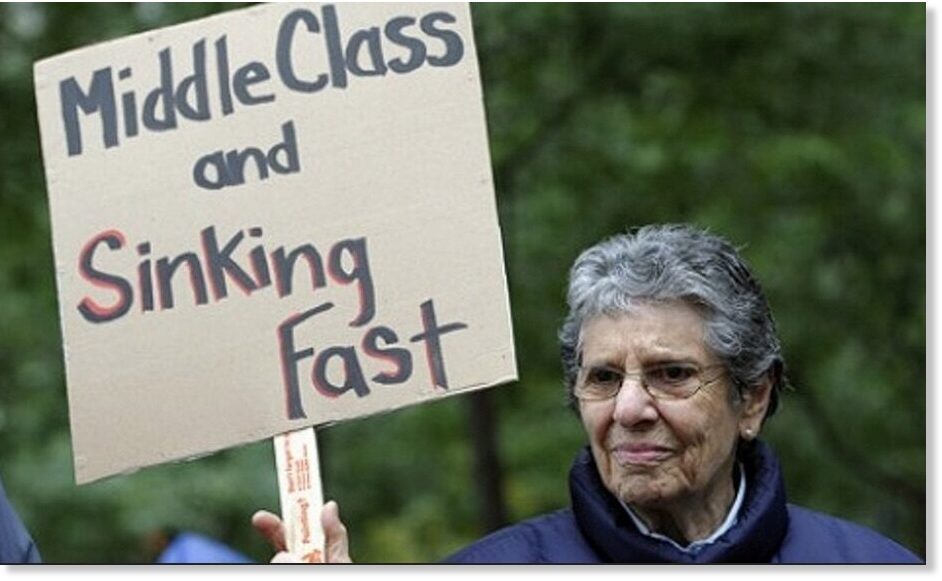
In 1971, 61% of American families made up the Middle Class. Today, that percentage ranges from 46% to 55% and declining. 50 million Americans now fall below the poverty threshold, and yet the federal government is doing little to stop the millions of illegal immigrants, the majority of whom falling into the poverty category, into the United States. Of course, we can't forget that women, on average, still earn just 82% of what men earn despite being mandated by federal legislation. 

One other factor to look at is the wage inequality between CEOs and their employees. In 1965, the average CEO made roughly 21 times that of their employees, which sounds reasonable. As of 2023, that percentage is 290 times more than their employees (there are 58 companies where that ratio is 1000 to one).. To put it another way, between 1978 and 2023, the pay of the average worker (wage and benefits) rose by 24%. Over that same time period, pay and benefits for CEOs and senior officers went up 1085%. The median pay for a CEO in 2023 was $16.3 million dollars according to a report published by the Associated Press (the data was comprised by Equilar). 

Can the United States continue with this level of income inequality? Ever since the decline of organized labor in the late 1950's, the income ratio between the working class and corporate leadership has been expanding, in part because the composition of their compensation package has changed to include more stock options and performance incentives. 

Meanwhile, similar types of incentives for employees have been reduced or cut, not to mention wage and/or benefits through so-called "voluntary give backs" out of fear that their jobs would be eliminated or the facility closed and sent overseas. Is this cost cutting measures to protect the business's profitability or merely a form of extortion? 

Since 1967, the Middle Class has been on a downward spiral, nearly matching the decline in public union membership. This decline of the union rank and file has meant a decline of union and non-union bargaining power and political clout which by extension, has directly affected the Middle Class. A strong working class, union or not, tends to mean a vibrant and financially healthy Middle Class. 

As mentioned at the beginning of this article, economic instability, coupled with public apathy, demagoguery and a well educated citizenry are a greater factor in the fall of democracies as well as empires, second only to severe and sustained climate events, than all other reasons. We have those in spades. 

Right now, we're facing not only extreme income inequality, but a strain on the economic elasticity of our social safety net, made all the worse by an defacto invasion, albeit non-military (at least at this point) of hoards of poor, largely poorly educated people who are interestedly solely in economic opportunities with no desire to contribute to their new homeland .

A people seeking to migrate or seek refuge will adopt to their new homeland's values and traditions. They will adapt to the laws and find ways to contribute. They will pay for public services through taxes. They will learn their adopted country's language.

 An invading army will do none of these things. Their objective is to supplant everything they can by any means available. They'll establish exclusive enclaves, turning them into semi-automatous zones of occupation, daring their hosts to enter. They will pervert the laws of their hosts. They will plead for tolerance when their numbers are small but offer none when there number have grown. 

Distrust in the government and media are at all time highs and have been that way for decades. Mediocrity at all levels of society, especially politics, are accepted as the norm. Excellence is often mocked if not actively discouraged. Herd mentality is the rule. 

The good news to all this is that there's a growing resistance to the ruling Status Quo. People are walking away from the Corporate imposed partisanship.  People are not just questioning so-called "authority", they're challenging it. The scripted narrative is no longer accepted. 69% of the public has little or no trust in the corporate media.

Increasingly, we're waking up to being played by the ruling class. The approval rating of Congress is laughable 17% We're refusing to accept the artificial divisions they want us to play. It's time we stop playing by their rules and start working to build a society which can benefit everyone. Not by mandating equal outcomes, but by ensuring equal opportunities. We need a society that our Founding Fathers would be proud of.   


 Thank you for reading "Another Opinion", the Op/Ed blog page for the "militant middle".  Here at "A/O" we truly value our readers. At A/O we seek the facts as they exist, not partisan talking points.  We hope you found our articles informative and engaging. Comments are welcome, provided they are not vulgar, insulting or demeaning.  Another Opinion is offered without charge and is directed toward all independent and free thinking individuals. We do ask, however, that you be sure to "like" us on whatever site you found us on in order to keep our articles available for others, and that you please pass our post along. Below you will find links to the sources we used in writing this article. Thank you. 


Average Gas Prices Under The Past Four Presidents


Wages and Prices: Who Is Keeping Up with What? 


Healthy Food Prices Increased More Than The Prices of Unhealthy Options during the Covid-19 Pandemic...


Nearly Half Have less than $500 in Savings


Survey: One in Four Americans Have Less than $1000 in Savings


The typical CEO makes nearly 200 times more than their workers


Friday, January 10, 2025

The Rise of the Chinese Dragon and Decline of the United States

Somehow its seems appropriate that the Chinese astrological symbol for 2025 is the Snake, specifically the wooden snake, The Snake is sometimes referred to as the "Little Dragon" which follows the Dragon symbol in the Chinese astrology, and is associated with Earth (it's also occasionally called the "Serpent") and is the sixth of the twelve zodiac signs. The Snake, it is said, is intelligent, cunning, and patient. At the same time it can be narrow minded, judgmental, vain, sneaky, and petty. Why is that significant?

Well, in the world of mythology, which not so surprisingly, still exerts a influence, albeit mostly symbolic, on our lives. We name pieces of technology, procedures, and even name planets after mythological gods and goddesses. Many of us still read our horoscope with at least a passing curiosity. Even when we go out on dates we often get asked "what's your sign" in the hopes that it will reveal a possible compatibility. 

As anyone who follows politics, economics, or current events should know, China has become a major economic power. In 2022, we imported $536.3 billion dollars worth of goods from China. That represents 16.5% of all U.S. imports. Most of that ranges from cheap toys, tools, and miscellaneous items to sophisticated technical hardware, computer chips and processors, computers, batteries (especially lithium), display monitors, and video games. 

Meanwhile, we ship some $195.5 billion dollars in goods back to China, accounting for 7.5% of China's total imports.  We are indebted to China to the tune of just over $1 trillion dollars. That's roughly 7% of our national debt. Still, the United States still has the largest economy in the world, larger than China's by nearly a third. However, among the top industrial nations, China has the fastest growing economy, and may surpass the U.S. in ten or so years.

 Our Gross Domestic Product (GDP) is currently $30.4 trillion compared to China's with $19.6 trillion. While much is made of Chinese ownership of U.S. farmland, in fact China owns just under 1% of American farmland (Canada owns the most). That accounts for about 380,000 acres.  

However, there's another key factor to be considered. Along with having the fastest growing economy in the world among the top industrialized nations, China is also rapidly expanding its economic reach. China has been aggressively buying up control of natural resources around the world, exceeding that of the United States. 

China has been acquiring rights not just to farmland, but mineral rights as well, especially strategic minerals used in computer and missile technology like cobalt and platinum.  However, perhaps one of the most essential of resources, potable water, has been high on China's "buy" list. With 20% of the world's population, it has just 6% of its drinking water. In addition, because of its rapid "hellbent" economic growth, minimizing pollution has not been high on the government's list of things to do. 

According to a study done by the Lowy Institute, somewhere around 85% of China's groundwater is not fit for consumption (over 40% of the groundwater in Beijing is unusable). Worse still, nearly half of China's groundwater isn't safe to be used in the production of crops. On the upside (if there is one) is that China's water pollution isn't the worse. India's is.  What this means is that the two most populous countries on the planet have critical need for scarce usable water, making it perhaps the single most critical natural resource. Many military strategists believe that useable water may become valuable than gold or oil, and thus making its control of primary importance, especially given climate change. What cannot be bought or bartered for will be taken by force as a matter of national survival.   

Another serious factor has been China's growing aggressiveness over control of the South China Sea, which has traditionally been used as a international shipping lane. However, China is now claiming territorial control of the channel, and threatening to use force to hinder or stop all international shipping, including the passage of U.S. military ships. China has even threatened to fire on or seized any vessels traversing the channel. Why the sudden interest in control of a waterway which has long be seen as open?

One possible explanation could be China's recent growth in its navy and its ability to protect whatever it claims. By the end of 2025, China is expected to have 395 ships, including three aircraft carriers, and 435 by 2030. as of 2024, China possessed 234 warships compared to 219 belonging to the U.S. Navy, which makes the Chinese navy this largest---and most modern---in the world. It's should be noted that not only are China's navy newer, it has more shipyards and drydocks than the U.S.. In addition, several recent wargame scenarios have shown China's navy as the victor. This is due to both the newness and quantity of their ships (meaning China's navy can afford to lose more than the U.S. can). 

China has been making use of its new found naval power not only in the South China Sea, but also reenforcing its claim of expanded territorial fishing rights in areas once considered international waters, as well as impinging on waters now claimed by South Korea, Japan, Philippines, Indonesia, and even India. China has also been stepping up it claim of national sovereignty over the island nation of Taiwan in addition to strengthening its ties with North Korea and Iran. 

A Pentagon report on U.S. military readiness didn't help. According to the report provided to the Department of Defense, the United States military was in serious need of a general overhaul, running the gambit from rifles and bullets to tanks, personnel carriers, artillery to aircraft, combat and support ships. In its present condition, according to the Pentagon, the military wasn't capable of fighting a sustained conflict on multiple fronts. 

Thanks to the 20 year war in Afghanistan and Iraq, as well as propping up the Zelensky regime in Ukraine and U.S. support of Israel, the U.S. military is also running critically low levels on spare parts, and technicians to maintain and operate various systems. This is due to the massive hemorrhage of personnel getting out of the military (many of whom have done numerous deployments). For instance, in 2022, the Army missed its infantry recruitment goal by 50%. 

Since 2013, the number of males enlisting has dropped 38%. Enlistment from 1980 through 2020 dropped 59%. To make matters worse, according to the DoD, 77% of individuals of military age (17 - 24) are unfit to serve due to issues like obesity, drug use, mental or other physical reasons. As of November 2023, the Navy was 20% of it annual recruitment goal. The Army was 23% short, and the Air Force was 11% shy of its recruitment goal. Only the Marines and Space Force reached their recruitment numbers.  

Another issue facing the military is the Defense industry's focus on weapon systems that are either not wanted or needed. Following Nazi Germany's example toward the end of WWII, many of the weapons systems have become overly complex and prohibitively expensive (the Wehrmacht adopted equipment which were so complex, they were difficult to maintain such as the "King Tiger" tank or V2 rocket, plus the expense resulted in the production of relatively few numbers).

Per the "2024 Index of U.S. Military Strength"  published by the Heritage Foundation, China is listed as a "formable" threat in Asia  along with Russia. North Korea is considered worth watching. So, how does our military stack up? Again, according to the "Index", the U.S. Army's capacity for waging war is categorized as "weak".   Its capability is listed as "marginal", while its readiness is excellent. Overall, it's rated as "marginal". The Air Force faces similar problems. Its capacity and capability are both "marginal" while its readiness is "very weak" as is its overall rating. 

The U.S. Navy, facing reduction in the number of ships and shipyards, had a capacity rating of "very weak". It capability is rating is "marginal". As for its readiness and overall ratings, both are "weak". As an aside, its projected that with the growth of the Chinese navy, the U.S. Navy will likely not recover its previous naval dominance for at least the next decade. The Marine Corps has a  "weak" capacity rating, while capacity, readiness, and overall score were all "strong".  

The newest member of the military services, the U.S. Space Force, is still looking for its mission. It has yet to establish its fighting credentials (perhaps if aliens invade...). Nevertheless, it maintains satellites, drones, and related technology which are still emerging as unique military systems. But, they're not quite there yet. The U.S. Space Force was rated "marginal" across the board.   Next is our nuclear abilities. In terms of stockpile, delivery modernization, and "allied assurance" the rating was "very strong". 

When it came to delivery platform reliability, warhead modernization (heck, slap a coat of paint on there. Truth me, it won't matter), lab technicians, and weapons complex, the score was "marginal" as was the overall rating.  So, when we add it all up, the U.S. military came out with a overall score of "weak". The question then, is this good enough of a deterrent to stop China, North Korea, Iran, Russia, or a outside player, such as ISIS or Al Qaeda?   

There's no question China is playing the long game. While its economy is growing rapidly, it has also been promoting the Yuan as the alternative currency to the U.S. dollar (or even a possible replacement) which is unlikely, at least in the near future. It has joined Russia, India, South Africa, and Brazil as one of the principal members of "BRICS", which is poised to become a serious competitor to the U.S. dominated "New World Order". While BRICS has aways to go yet, its already showing promise as the number of applicants, especially among less developed countries, continues to grow.  

China's military, like its economy, has been growing and exerting its influence ever wider. With a weakening United States internally and externally, there is a quiet but growing question starting to be asked in serious but hushed tones throughout the nations of Asia, Africa, and even South America, and that question is whether they should continue to place all their political and economic eggs into one "Made in America" basket or is it time to accept the new role of the Chinese "Dragon" as we being the year of "Snake", or as it's also known, the "Little Dragon"?  


 Thank you for reading "Another Opinion", the Op/Ed blog page for the "militant middle".  Here at "A/O" we truly value our readers. At A/O we seek the facts as they exist, not partisan talking points.  We hope you found our articles informative and engaging. Comments are welcome, provided they are not vulgar, insulting or demeaning.  Another Opinion is offered without charge and is directed toward all independent and free thinking individuals. We do ask, however, that you be sure to "like" us on whatever site you found us on in order to keep our articles available for others, and that you please pass our post along. Below you will find links to the sources we used in writing this article. Thank you. 


China's Ownership of US Federal Debt


China's dominance of strategic resources


How Much U.S. Farmland Does China Really Own? More Than Bill Gates ---And Less Than 17 Other Countries


The Top Ten Largest Economies in the World in 2025


The Global Impact of China's Water and Related Environmental Problems


How Does Water Security Affect China's Development? 


Executive Summary of the 2024 Index of  U.S. Military Strength


CFR: What Is the BRICS Group and Why Is It Expanding?


Is military enlistment down?


Our Military Is in a Dangerous Decline and This Is the Reason Why