Showing posts with label American Dream. Show all posts

Friday, January 17, 2025

The Reckoning: Taking Back the American Dream

The Greek philosopher, Plato, said in his two famous political works, "The Republic" and "Laws", that unchecked economic inequality was a principal reason for the fall of democracies and the rise of demagogues.

But as History has repeatedly shown it's not only democracies, but nearly every form of government which will eventually collapse under the weight of economic inequality, which typically brings about political failure, from the ancient empires of Sumer and Babylon to Pharaonic Egypt, Rome, and up to modern times.   

Today, economists and political scientists are looking at the strain that climate change, rising prices and taxes, population migration, aging populations, crumbling infrastructures, rising public and private debt, public apathy, and failing school systems as symptoms of an increasingly unstable United States and Western Europe. Even China, India, and other nations along the Pacific Rim are seeing cracks in their economies as monies are diverted more and more to critical services.

The gap in quality of life between the top 20% and the remaining 80% has grown along every measurable statistic for the last 30 years. The cost of an average house has risen approximately 817% between 1970 and 2024, which is higher than the average rate of inflation (4.19% for housing compared to an overall inflation rate of 3.94%), All items, excluding food, rose 627% between 1967 and 2024. 

Using data from the Center For Economic and Policy Research (CEPR), between February 2020 and November 2023, average wages rose 19.4%. For individuals in production and non-supervisory roles, 21.9%, while for high demand non-technical positions such as hotel and restaurant workers, their wage shot up 31.6% (note that these jobs represent 80% of the job market). While an average increase in wages of 19.4% is pretty good, the Consumer Price Index, which measures the overall change of prices, went up 18.8% for the same period. 

Starting with the COVID pandemic in 2020 and continuing through November of the following year, the price of food jumped 24.7%, exceeding the average growth of wages by 5.3%.  So, if you're seeing the content of your grocery cart getting smaller while the amount at the checkout counter getting higher, it's not your imagination or because you're unnecessarily splurging. For instance, the price of a loaf of bread has increased 28.8% since the pandemic while the cost of eggs have jumped 24.7%. 

While the consumption of red meat has been steadily declining, it still remains a staple for many U.S. households. Since COVID-19, the price of beef went up 30.3%, with the highest jump in price occurring in 2020 during the peak of the lockdown. Interestingly, the cost for chicken rose by the same percentage (driven up, in part, by the arrival of the "Bird Flu"). Milk, another staple found in most homes, saw a 20.4% increase per gallon. The good news (if there is any), is that the prices of milk and milk related products (such as cottage cheese, sour cream, and butter) are showing signs of stabilizing and in some instances, even dropping.   

As an aside, most Americans tend to struggle with their weight. Americans are notoriously overweight according to the National Institutes of Health (NIH), which say that one in three Americans are over their optimal weight. Just over one in three men (or about 34.1%) are considered obese while about one in four women (27.5%) are "chubby" while 42.4% of both genders are considered seriously overweight. This, of course, is part of the reason for the explosion in diabetes and heart disease. 

While some individuals are overweight due to genetic or other medical conditions, most are tubby due to their lifestyle. One common recommendation from physicians to deal with our weight problem is a combination of regular exercise and adopting a healthy diet. However, the NIH reports that the cost of many diet suggested foods, such as vegetables, fruits, and oils, have risen in price by an average of 17.9% since the pandemic. Ironically, Unhealthy foods have seen an increase in price of just 9%!  The single exception was the price of fast food, which rose 14.7% between 2019 - 2022.  It should be mentioned too that since 2000, the cost of medical care, including prescriptions, increased by 121.3%. 

Based on data from the United States Department of Agriculture (USDA), the price of fruits increased 9.5% between 2021 and 2022 while the cost of fresh veggies rose by 7.9% over the same period. Even the cost of eating out has jumped in price. On average, restaurant food prices have risen 7.1%. Of course getting to and from the grocery store, local eatery, work or just about anywhere else requires a vehicle of some sort. So, what about the cost of gas?

Under President Donald Trump, the average price of gasoline ranged from a high of $2.81 a gallon in 2018 to a low of 2.26 in 2020 (equaling President Obama's low in 2016). Under President Joe Biden, gas was $3.10 a gallon for regular in 2021 and rose to a high of $4.06 for a gallon in 2022. This is higher than the three previous presidents, Trump, Obama, and George W. Bush. However, in looking at the broader picture, from 2020 through the end of 2023, gas prices have risen by a astonishing 30.4%, thus outpacing wage growth for all but a few.

Despite the increase the cost of living for practically everything, not everyone is feeling the pinch. According to a recent study, conducted on behalf of Bank of America in 2024, roughly 30% of American households are living paycheck to paycheck (a similar study reported by CNN put that percentage at 35%). Another 20% or so percent can't afford to miss anymore than one paycheck before their financial house of cards begin to fold.  

What's meant by the expression "living paycheck to paycheck"? According to the Bank of America study, living "paycheck to paycheck" means spending 90% or more of your income strictly on necessities such as rent/house payments, food, utilities, or medical bills. 27% of all Americans have no money in savings. 27% of those over 50 years of age are in the same boat. On top of that, 40% of Americans have less than $1000 set aside for emergencies according to the American Bankers Association. Of that, 49% have $500 or less available while 36% said they have just $100 for emergencies (and yet, we can afford to send $64.1 billion dollars to prop up the Zelensky regime in Ukraine to fight a war that we encouraged). 

So, while the average American struggles to keep a food on the table and roof over their head (13.7% of Americans are food insecure while 14% of Americans have experienced homelessness at some point), the federal government lets approximately $92 billion dollars in corporate welfare annually slid by. Corporate welfare includes tax credits, give backs, preferable regulatory treatment, no bid contracts and automatic contract renewals, debt write-offs, deep discounts, bailouts, low or no interest loans, public grants, public-private partnerships (public money financed ventures), subsidies, and more.   

 From 1980 through 2021, the level of income for the Top 1% rose by 574%. For the Bottom 20%, it was just a paltry 31%. For the Top 0.01%, their wealth grew 832%. The Top 1%---about 12,000 households--- are 139 times richer the Bottom 20%. According to the Organization of Economic Co-Operative Development (OECD), a international economic and social policy forum, the United States has one of worse levels of income inequality among its 100 nation members. 
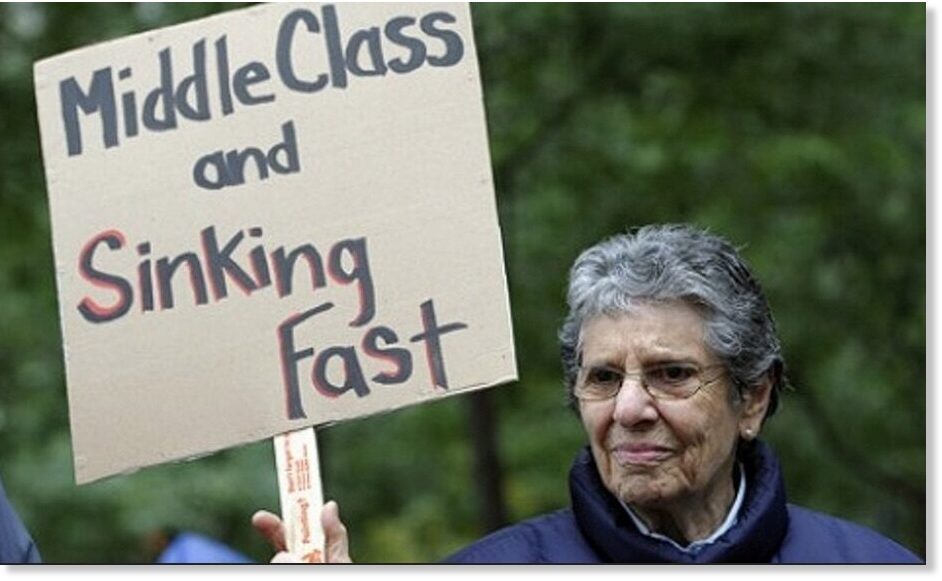
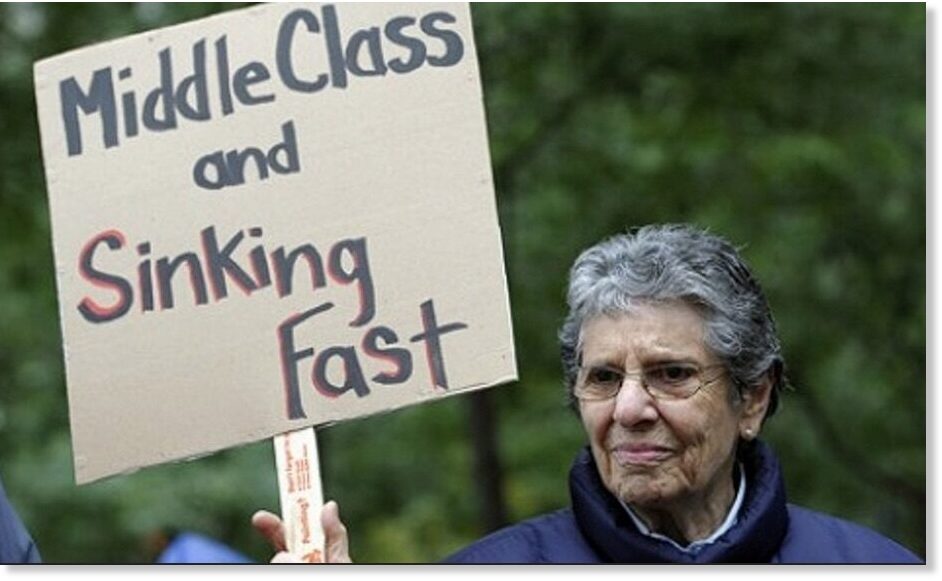
In 1971, 61% of American families made up the Middle Class. Today, that percentage ranges from 46% to 55% and declining. 50 million Americans now fall below the poverty threshold, and yet the federal government is doing little to stop the millions of illegal immigrants, the majority of whom falling into the poverty category, into the United States. Of course, we can't forget that women, on average, still earn just 82% of what men earn despite being mandated by federal legislation. 

One other factor to look at is the wage inequality between CEOs and their employees. In 1965, the average CEO made roughly 21 times that of their employees, which sounds reasonable. As of 2023, that percentage is 290 times more than their employees (there are 58 companies where that ratio is 1000 to one).. To put it another way, between 1978 and 2023, the pay of the average worker (wage and benefits) rose by 24%. Over that same time period, pay and benefits for CEOs and senior officers went up 1085%. The median pay for a CEO in 2023 was $16.3 million dollars according to a report published by the Associated Press (the data was comprised by Equilar). 

Can the United States continue with this level of income inequality? Ever since the decline of organized labor in the late 1950's, the income ratio between the working class and corporate leadership has been expanding, in part because the composition of their compensation package has changed to include more stock options and performance incentives. 

Meanwhile, similar types of incentives for employees have been reduced or cut, not to mention wage and/or benefits through so-called "voluntary give backs" out of fear that their jobs would be eliminated or the facility closed and sent overseas. Is this cost cutting measures to protect the business's profitability or merely a form of extortion? 

Since 1967, the Middle Class has been on a downward spiral, nearly matching the decline in public union membership. This decline of the union rank and file has meant a decline of union and non-union bargaining power and political clout which by extension, has directly affected the Middle Class. A strong working class, union or not, tends to mean a vibrant and financially healthy Middle Class. 

As mentioned at the beginning of this article, economic instability, coupled with public apathy, demagoguery and a well educated citizenry are a greater factor in the fall of democracies as well as empires, second only to severe and sustained climate events, than all other reasons. We have those in spades. 

Right now, we're facing not only extreme income inequality, but a strain on the economic elasticity of our social safety net, made all the worse by an defacto invasion, albeit non-military (at least at this point) of hoards of poor, largely poorly educated people who are interestedly solely in economic opportunities with no desire to contribute to their new homeland .

A people seeking to migrate or seek refuge will adopt to their new homeland's values and traditions. They will adapt to the laws and find ways to contribute. They will pay for public services through taxes. They will learn their adopted country's language.

 An invading army will do none of these things. Their objective is to supplant everything they can by any means available. They'll establish exclusive enclaves, turning them into semi-automatous zones of occupation, daring their hosts to enter. They will pervert the laws of their hosts. They will plead for tolerance when their numbers are small but offer none when there number have grown. 

Distrust in the government and media are at all time highs and have been that way for decades. Mediocrity at all levels of society, especially politics, are accepted as the norm. Excellence is often mocked if not actively discouraged. Herd mentality is the rule. 

The good news to all this is that there's a growing resistance to the ruling Status Quo. People are walking away from the Corporate imposed partisanship.  People are not just questioning so-called "authority", they're challenging it. The scripted narrative is no longer accepted. 69% of the public has little or no trust in the corporate media.

Increasingly, we're waking up to being played by the ruling class. The approval rating of Congress is laughable 17% We're refusing to accept the artificial divisions they want us to play. It's time we stop playing by their rules and start working to build a society which can benefit everyone. Not by mandating equal outcomes, but by ensuring equal opportunities. We need a society that our Founding Fathers would be proud of.   


 Thank you for reading "Another Opinion", the Op/Ed blog page for the "militant middle".  Here at "A/O" we truly value our readers. At A/O we seek the facts as they exist, not partisan talking points.  We hope you found our articles informative and engaging. Comments are welcome, provided they are not vulgar, insulting or demeaning.  Another Opinion is offered without charge and is directed toward all independent and free thinking individuals. We do ask, however, that you be sure to "like" us on whatever site you found us on in order to keep our articles available for others, and that you please pass our post along. Below you will find links to the sources we used in writing this article. Thank you. 


Average Gas Prices Under The Past Four Presidents


Wages and Prices: Who Is Keeping Up with What? 


Healthy Food Prices Increased More Than The Prices of Unhealthy Options during the Covid-19 Pandemic...


Nearly Half Have less than $500 in Savings


Survey: One in Four Americans Have Less than $1000 in Savings


The typical CEO makes nearly 200 times more than their workers


Saturday, July 22, 2023

Living the (Broken) American Dream: Rebuilding the Middle Class

The middle class in the United States is in serious trouble. The aggregate earnings of the middle class has been in decline since 1970. The same goes for those at the lower end of the economic ladder while the upper 10% have seen a steady rise in their wealth. Even with 59.8% of two parent families both holding down full time jobs, it's not enough.

It used to be that a high school education was enough to guarantee you a comfortable living, usually in some blue collar job, a high school diploma nowadays would barely get you  beyond an entry level position somewhere. Even a four year college degree is no assurance of middle class lifestyle.

Of course, most of the good paying blue collar jobs have been exported overseas where corporations can exploit the need for jobs at any price while avoiding those pesky unions and OSHA requirements. Where for every opening there are literally thousands waiting in line to be hired.

It doesn't help that the quality of public schools have significantly declined over the decades to the point where many graduates have the academic equivalent of an eighth grade education.  America was ranked 11th of 79 countries in science.  While we ranked 30th in math,  the top five ranked countries in math were all Asian. But, we're still tops when it comes to basketball!

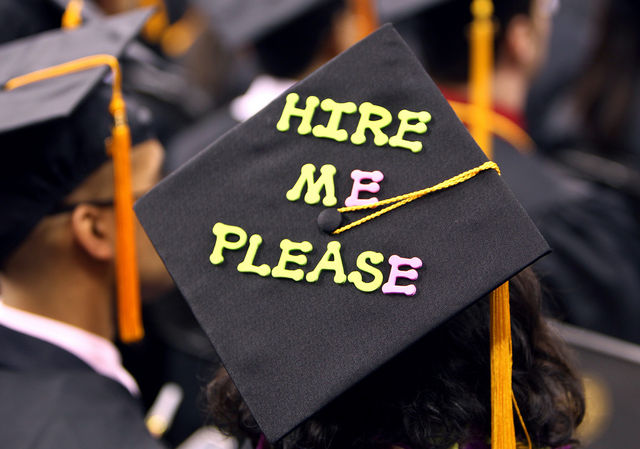
A typical college graduate with four year bachelor degree hit the street looking for a job with an average debt of over 30,000. For a professional degree, like from medical or law school, the average debt is around $250,000 and $160,000 respectively.  It takes the average college graduate 21 years to pay off their college loan debt. 

The downside is that a substantial minority chose majors with little or no job demand, leaving them stuck with a huge financial burden and no way to pay it off. These and other graduates are now wanting taxpayers to pick up the tab  under the misleading term of "forgiving" or "canceling" their academic debt. Why? We didn't pick their major. We didn't sign their loan papers or accept responsibility for their debt. That's their responsibility. It's called being an adult. 

But it doesn't end there. With all the additional expenses of simply "living"  amid rising prices and stagnate wages, the average American household debt is $101,915 as of the end of 2022. The total national household debt is $17 trillion dollars as of the end of the first quarter of 2023. That effectively makes the majority of Americans literally indentured serfs. They are literally working to pay off a debt owed to someone else, which is almost always a corporation.

As an aside, 60% of Americans are living from paycheck to paycheck, including 49% of those with an income of over $100,000 along with 70% of millennials, and it looks like Gen Z is trending the same way.  30% of Americans have enough money in savings to cover an emergency for no more than 30 days. 22% have no financial safety net which includes 27% of those 59 and older. 

Once they find a job, it's worth noting that wage inequality between genders remains a problem. Women are still earning, on average, just 82% of every dollar their male counterpart earns, which makes me curious about those who "identify" as transgender in the workplace. I wonder if they're going to be satisfied with their reality of their smaller paychecks?

Meanwhile, those at the top of the corporate ladder seem to be doing just fine. The CEO-to-worker compensation ratio was 399-to-1 as of 2021. That means that for every dollar a average employee earns, a top executive will get $399.  From 2010 through 2021, wages grew by 31%, which sounds pretty good. However, thanks to the rate of inflation, wages have lost on average 4.5% of their purchasing power.

As if that's not bad enough, the top richest 1% own twice as much as the bottom 99% of the entire world's population! To put it another way, they've acquired over half of all the new wealth created over the last decade while the poorest half own just 0.75% of the wealth.  

In the United States, the top 1% own over one third of the nation's total wealth. Did I hear someone say "let them eat McDonalds"? Meanwhile the bottom 90% control just 30.2% of the wealth. In 2021, the top one percent's wealth grew by $6.5 trillion dollars...just in that one year! Their total stock portfolios were worth $23 trillion dollars.

As wealth increasingly becomes concentrated in the hands of fewer and fewer individuals and their corporations, so too does their political power. There have already been several academic studies showing America's shift to a government of, by, and for the oligarchy (or kleptocracy if you prefer). Wall Street's mega corporations now so controls Washington that we've become a defacto neo-fascist corporatocracy. 

It shouldn't need pointing out, but we've also become a surveillance state thanks to the knee jerk reaction of Congress following 9/11 and its failure to read or comprehend the "Patriot Act" in 2001. We need wonder no more how or why the Germans succumbed to Hitler and the Nazis following the passage of the "Enabling Act" by members of the Reichstag on the heels of Reichstag fire in 1933.  

Thanks to the Supreme Court's 2010 "Citizens United" blunder, Big Money literally owns the Democratic and Republican parties. They not only underwrite the two parties and their political candidates, they've pushed the cost of running for office almost entirely out of reach of the average citizen, thus making politics the virtual domain of the very rich.

Congress isn't about "the business of the people" as Speaker Nancy Pelosi so caustically said following the January 6th protest, as corporate lobbyists now routinely write or help draft legislation and advise legislators on how to vote on which bills.

Consider this too. Millionaires, who make up just three percent of the total U.S. population, overwhelmingly control all three branches of government, including the Presidency, regardless of party affiliation. Middle and working class office holders have never dominated any branch of the federal government and are increasingly becoming rare at the state level.

Members of the Supreme Court together are worth an estimated $24 million dollars, and at least six of the nine Justices are multimillionaires. Even most federal judge positions are occupied by individuals who are at least in the top 5% financially. Of course, these positions come with their wealthy and powerful connections, making it even more difficult for the ordinary American to get a fair shake.

So, regardless of whether you vote Democrat or Republican, the wealthy win. It's just a matter of whether it's the blue corporate clique and their agenda or the red corporate clique and their agenda.

So, where does all this leave us? Historically, it's been the middle class which has held democracies together. The Founders  envisioned  the United States as a nation of  yeomen farmers and small businessmen. Ideally, a democratic society should be shaped like two inverted diamonds---narrow at the top and bottom and wide in the center with a relatively few at the top and bottom with the majority of individuals located somewhere in the middle.

Of course, that's not what we have today. The United States used to be a majority middle class country. In 1971, over 61% of the nation was middle class. Today, just under half are. The lower middle class comprise approximately 25% of the population with another 25% making up the working poor and perpetual unemployed. In 2022 just 11.3% of workers were unionized. In 1960 it was almost one third of the country--31.9%. By 1975 it was 26.3% as technology replaced some workers and employers began sending other jobs overseas.  

America also used to be the place where someone could start from scratch, start a business, and through hard work make their way up into the middle class. It was part of the "American Dream". It's what many newly arrived immigrants hoped for. According to the U.S. Bureau of Labor Statistics, the "American Dream" may now be just that---a dream.

 20% of all new businesses fail within their first two years of operation. 45% within their first five years, and 65% within ten years. Just 25% survive beyond that. The main reasons? A lack of cash flow, poor management, a lack of organization, and inadequate marketing.   

When a society's economic system becomes unbalanced and where wealth and power are concentrated in the hands of small minority, social unrest is almost always the result, be it revolutions, civil wars, coups, or whatever. This is especially true when approval levels drop below 55% for any length of time, again, such as in the United States. 

Currently, Congress has an approval rating of just 20%, or to put it another way, a disapproval rating of 76% with 4% having no opinion. In fact, the last time Congress had a positive approval rating over 50% was 2001---22 years ago!

As an aside, 77% of those surveyed said that the current members of Congress should not be reelected again, and yet thanks to corporate funding and partisan gerrymandering, some 95% of them will be reelected.  The Supreme Court has an approval rating of roughly 40% and 66% of Americans have little or no confidence in the mainstream media to provide fair, honest and balanced news.

This is what a broken political  and economic system looks like, especially if you're one of few Americans clinging on to their middle class status. Rising prices, stagnant wages, the widest income disparity of any industrialized nation, poor healthcare (we're ranked 21st in the world with the highest infant mortality rating of any developed nation), a underperforming educational system.

 At 76, our life expectancy is among the worse of any industrialized nation, coming in 40th in the world. In Japan it's 84. We have the world's highest national debt rate at $31.4 trillion. To put it another way, our national debt exceeds the next four countries---China, Japan, France, and Italy---combined, which as most economist will agree, is unsustainable, and yet we spend more on the military than the next ten nations combined.

Is there anything the American middle class can do? Maybe. Although the United States is in decline, perhaps terminally, we can still alter the existing political system to make it more responsive to the needs of its citizens and get corporate money and control out of politics.

We can bring jobs sent overseas back home or penalize those who don't. Let's make it more expensive to ship jobs overseas than to build it here. We can raise the tax rates on the wealthiest individuals and impose a minimum tax on big businesses. No more mega corporations earning more than some countries paying zero federal taxes or billionaires paying less taxes than fast food store manager.

We can increase our investment in R&D projects and cut the red tape on new businesses, especially in the area of technology. We can---and must---improve our education and healthcare. We need to reduce our military budget to free up more money for social services and infrastructure.  We need to put focus on all Americans, not just an elite few, and that means rebuilding the middle class once again.


If you enjoyed the article, please consider passing it along to others and don't forget to subscribe. It's free! Lastly please be sure to "like" us on whatever platform you use to read anotheropinionblog.com. It helps with the algorithms and keeps our articles in circulation. Thank you! 


Average American Household Debt in 2023: Facts and Figures


Average Student Loan Debt


U.S. Education Rankings Are Falling Behind the Rest of theWorld


Two Working Parent Households 2023: A Look at the Statistics


How the American Middle Class Has Changed in the Past FiveDecades


At Least 6 Supreme Court Justices Are Multimillionaires,Report Reveils


These 19 Fortune 100 Companies Paid Next To Nothing---orNothing At All---in Taxes in 2021


Saturday, November 10, 2018

Veterans Day and Why it Should be Special

A repost from November 10, 2018

82 million. That's the number, give or take a few hundred thousand here or there. 82 million. Written out, it's just an eight and a two followed by six zeros. A really big number, but not overly impressive in a day and age where we talk about a Gross National Product (GDP) of $20.3 trillion dollars, or a national debt of $21.6 trillion dollars or a national revenue of $3.6 trillion dollars. But those are financial numbers; figures so large that it's hard for the average American to wrap their head around. However, the 82 million I mentioned, while smaller, is perhaps an even more significant number than the national debt or rate of unemployment or interest or whatever else.

So, just what is this 82 million that makes it so special? Simply this. It represents the number of American military personnel who've died in the defense of this country. It represents individual lives lost do to war and the anticipation of war. It represents individuals dreams, hopes, and aspirations lost forever. It represents lost smiles, laughter, and conversations. It represents lost potentials; potentials which could have created jobs, make new discoveries, or cured diseases. The 82 million also represents the lost of fathers, brothers, sisters, sons, wives, and daughters, not to mention aunts and uncles. Its represents a lot of lonely days, nights, months, and years, and doesn't even begin to cover the number of tears shed for each one of those lives. The sad or perhaps profound thing about that number is that it's only an approximation; a "best guess" since it doesn't cover those who suffered daily for years from the injuries suffered in war, either physically or mentally; individuals who died as a result of diseases, chemicals, or unsuccessful surgeries. It also doesn't include the disabled who, while alive, continue to suffer their entire life for service to this country.

Yes, it's true that they receive a modest amount of monetary compensation and somewhat reasonable medical care (varying greatly from medical facility to medical facility). In fact, thousands die annually just for waiting for medical care. A 2005 Veterans Affairs report from the Inspector General estimated that some 300,000 veterans died while waiting for medical care. At a single VA facility in Los Angeles, 100 former servicemen and women died while awaiting treatment...in 2017. That was 43% of those on the waiting list.

Auditors found that 82% of veterans waited a month or longer for an appointment, with the average wait time being three months. Given the ages and health condition of many of these veterans, that's simply longer than they have (almost 50% of all veterans are 75 or older). Worse is that incorrect or fraudulent record keeping have kept some veterans from seeking medical care from civilian doctors or treatment centers.

In the United States we have approximately 130,000 and 200,000 homeless veterans existing in the streets on any given night. According to the National Coalition for the Homeless, that represents in the area one quarter of all homeless individuals. While veterans comprise just of 1/3 of the total US population, homeless veterans comprise 43% of all homelessness. That figure doesn't cover those who are able to obtain short term temporary shelter. To make matters worse, the Veterans Administration predicts that at least 400,000 veterans will experience homelessness during the years.

Ninety seven percent of homeless veterans are men. 46% are 45 years of age or older with 41% being between the ages of 30 and 50. While just 3% of homeless veterans are women, they are more likely to be married and to suffer from some sort of mental illness. 46% are white males while 45% are black or Hispanic. 47% are Vietnam Era veterans; 15% are pre-Vietnam while 17% are post-Vietnam. 67% served three or more years in the military while 89% earned a Honorable Discharge. 85% have a high school diploma or GED compared to just 56% of the general population. Lastly, and more tellingly, 76% of all homeless veterans suffer from drug, alcohol, and/or mental illness; of these, many are unable to get or keep the help they need as a result. 18% of all adult suicides are a veteran.

In terms of general demographics, there are approximately 18.5 million veterans in the US today with three states, California, Texas, and Florida have over one million veterans each. 1.6 million of these are women. 6.7 million are Vietnam War veterans. 78% of all veterans are white, white 11.6% are black. 6.1% are Hispanic and 1.6% are Asian. 0.7% are Native American with the remainder being some other race. There are 4 million service connected disabled veterans (including yours truly).

Veterans Day grew out of Armistice Day which marked the end of World War One. Of the 4,743,826 Americans who served in that war, none are alive today. Of the 16 million US service personnel who served in World War II, only 496,000 remain (they are all in their 80's or older), and we're losing around 348 every day. Let that sink in for a minute or two. Those young men and women you see in those documentaries are all in their 80's and 90's. They were the "Greatest Generation" in every sense of the word, and yet we're losing them at a rate of just over 14 "heroes" (in my opinion) an hour...every single day.

Let's look at another interesting figure for a moment. There has been a few politicians of late calling for or encouraging violence while blaming the other side for not being "civil". The result has been a serious increase in acts of violence and intolerance of differing opinions. In some cases, there have been threats of physical harm (or death), acts of vandalism, mass shootings, and so forth. In short, the US is starting to look like the era just preceding the Civil War. In fact, historians and political scientists will tell you that American is more broadly and more deeply divided at any time since the late 1850's. We are being divided at every possible point while politicians and various faux groups are fanning the flames (thank you Citizens United). Do we really want that; another Civil War? I don't think so.

A lot of Americans don't realize that the Civil War (1861-1865) was the bloodiest war that the US has ever fought. The Korean war cost 36,516 American lives. The Vietnam War took 58,209. WWI claimed 116,516 souls, while WWII resulted in the deaths of 405,399 American servicemen and women. Yet, the American Civil War, which ended over 153 years ago, still holds the record with 620,000 died, not including those who died of disease or injury later, and we are still feeling ramifications from that war all these years later. We're suddenly seeing the destruction or defacing of monuments and memorials, the removal (and prohibition) of Confederate flags and symbols, as well as the dropping of mascots and changing of school names, streets, and the rewriting of American history all in the name of political correctness.

Why, after all these decades and all these generations is this happening? It wasn't an issue at the end of the war when feelings were running high. It wasn't an issue during Reconstruction. It wasn't an issue when the 13th Amendment was enacted. It wasn't an issue during the Spanish-American War, World War One, World War Two, the Korean War, or even Vietnam. It wasn't an issue during the Civil Rights Era, with the Freedom Riders or any of the great Civil Rights leaders, during the Watts riot or the Chicago Police Riot of 1969. It wasn't an issue during the latter 1960's or 1970's either. It wasn't even an issue during the mid 1970's and forced busing. In fact, by the late 1970's race relations were actually pretty decent overall.

The point, of course, is that these calls for violence, intolerance, restrictions on free speech (not everyone's, just certain groups and individuals), protests, vandalism, all organized and paid for by shadowy political organizations, the media, and various politicians, have the potential to ignite a war which would surpass the Civil War. Do we really want that? So far, the ideological Right and Center have been very quite while the far Left has been on "hate-fest". These are mostly naive young adults who are full of themselves and determined to impose their views and ideas on everyone else, even if it means various forms of domestic terrorism, all dressed in their black hoodies and hiding behind masks. Aren't they just the cutest?

The corporate owned media seems intent on encouraging them while downplaying or ignoring their actions. That doesn't mean the Right gets off scot-free. They too have been engaged in name calling like accusing the Left of trying to impose "socialism" or Communism which is utter nonsense. As anyone who's bothered to read a history book knows, "socialism" and Communism both prohibit Capitalism, with the rich usually murdered. Now, what do you think the chances of Wallstreet folding are? What do you think the chances of America's ruling financial elite suddenly and willingly giving up their wealth, the power, or their control are? Yeah, see my point?

At the same time, the Left likes to call President Trump "Hitler" or anyone on the Right (or whom they disagree with) for that matter a "Nazi", which is just as silly. They also accuse anyone they disagree with as being a "Fascist", yet they are the ones engaging in Brownshirt behavior. However, even if it were slightly true, then they wouldn't be any one of them not in prison, in a concentration camp, or simply stood up against a wall an shot. In short, they wouldn't be afforded the opportunity to peacefully protest or verbally attack anyone.

America is, as you know by now, an Oligarchy whose ruling elite are a small percentage of very wealthy individuals and corporations. Their goal is control pure and simple. They already control business, the media, the government, both political parties and their politicians. They use the US military as their personal enforcers to ensure governments and groups fully "cooperate" and that everyone remains on the Petrodollar which keeps the US economy afloat. What they need from us is chaos. They need to divide us every way possible and to create a situation to bad that we demand the government "do something", and trust me they will, but not in the way you hope or expect.

In truth, we are in a new war. Not quite a Marxist "class" war, or a race war. It's not a gender war, or one of religion, a war to subvert our laws, or even of "American" vs. "non-American". It's a war to fictionalize us at every step; to break our moors from family, Faith, community, ancestral, regional and even national pride until we have no one left to turn to but the State. The State will provide for us, protect us, educate us, nurture us, and even bury us. All is requires is our obedience and submission. To put it another way, the Left wing of the ruling Oligarchy wants to impose a softer and kinder form of Fascism with us becoming their serfs. The Right wing of the ruling Oligarchy wants to impose a more restrictive form of Fascism with us becoming their serfs. See the difference?

The war were engaged in now, whether we acknowledge it or not, is for the present and future of America; whether we return to a Constitutional Republic or continue down the road to some form of Fascism (for comparison, read up on the late Roman Republic). 82 million Americans gave their lives for our freedom. Countless others have given their minds and bodies. Many more struggle through their own private hell. We should honor them on more than just one or two days a year. We owe them this country and our freedom for all they've done. Don't let a handful of greedy individuals, politicians, and special interest groups take it away from them...or us.


IG report: 300,000 Veterans Died While Waiting for Health Care at VA

Inaccurate VA wait times preclude thousands of vets from getting outside care, probe finds


National Coalition for the Homeless: Homeless Veterans


National Coalition for Homeless Veteran: FAQ About Homeless Veterans


Sunday, December 13, 2015

The American Dream: A Reality Check


The American Dream. It was built on innovation, determination, ingenuity and a willingness to take calculated risks. It created the most economically successful nations in the history of the world. Our success also required freedom of thought and a balance between freedom of action and creating a balanced playing field whereby everyone was given the same opportunity to succeed, or to fail---and get up and try it again and again if necessary. We've battled not just foreign powers but the greed of some here at home which sought to corner markets and enslave us economically. We fought back, not just through legislation, but also by banding together to create unions and worker associations. In doing so, we created a nation of abundance and what powered our national success was the middle class. It was open to everyone, and it allowed every man and woman to climb the economic ladder as far as their drive would take them. Nowadays, that's no longer the case.

America is no longer the freest nation on earth. We're not even in the top ten (we rank 21st in the world. just behind Portugal and ahead of Spain) We're not the most economic successful nation either. We rank 12th. Education is considered perhaps the most important determent of a nation's future. How do we far compared? Well, we rank 36th overall out of 60 nations. Schools have gone from a place of acquire knowledge and develop critical thinking and socialization skills to glorifed babysitters, abusive, undisciplined and sometimes dangerous students, not to mention teachers having sex with students (given the ages of some of the students, it borders on pedophilia).
According to a recent Gallup Poll report, American confidence in our institutions remain at below historical lows, at 28% (only the military and small businesses remain above high with 72% and 67% respectively). Even in terms of leadership, America is falling behind. The US President has ranked first in the world for decades. However, over the past couple of years, we've dropped to second, behind Russia's Putin. This year, we dropped to third, behind Putin and Germany's Merkel. So what happened?

Well, it appears what happened was that the vehicle which droved and protected the working and middle classes, the unions, declined. Unions were essential to protecting worker rights; for ensuring they had safe jobs; for making it possible to buy homes and to save for "rainy days" as well as their children's education by striking for a livable wage as well as kept our children out of the labor force and in school. They kept us healthy by demanding that employers provided health care, and gave us time off to relax (by the way, Americans are ranked 37th in the world for overall health in case you're wondering). Yes, Labor did have it faults. There was corruption. There was greed, especially in the upper echelons where Labor presidents and staff earned as much as the corporate presidents and board members they were suppose to protect the workers from, and yet the employees still gained more than they lost.
These days, unions are about gone in private sector with about 6% unionized and basically survive only in the private labor market (comprising roughly 1/3 of all government employees), albeit much more clipped than in previous years. In addition, corporations began exporting jobs, especially production jobs, to undercut unions and above average paying jobs and take advantage of pennies on the hour workers with no benefits as well as child and prison labor and a no strike guarantee labor force; all while continuing to get taxpayer based subsidies and tax breaks.

About two years ago, there was an major academic study which confirmed what the public had understood for decades, that government no longer represented ordinary Americans. The heavily documented study confirmed that the government---legislative, judicial, executive and the supporting bureaucracy---primarily serve the interests of the top economic 1%, which included the major transnational corporations and banks. Most of us had intuitively known this for decades, but even for the doubters, the illusion was shattered when the Obama Regime bailed out Wall Street and several failing companies with taxpayer money despite the public outcry. The reason wasn't some economic catastrophe. It was old fashion greed plain and simple. An ongoing attempt to bilk customers out of billions and it failed. So, with pressure from the government's corporate overlords, Obama authorized billions of our money and yet no one went to jail. In fact, some of our money actually went to pay millions in bonuses for these crooks in their stripped three piece suits who should have been wearing stripes of a different kind.

This study went on to confirm that, thanks to corporate money, the business-government revolving door, the working and middle class have little or no impact in US policy---domestic or foreign, or in US laws. This was verified again when the not-so-supreme Supreme Court affirmed Citizens United which declared that corporations were, in fact, "people" and as such, entitled to the same rights as flesh and blood people were, with one key exception. The High Court also ruled that money equated to free speech, and while you and I are capped as to how much "free speech" we are allowed to contribute to political campaigns, these "Frankensteins" aren't restricted in what they can give. That means they can buy who they want out in the open.

At the time of this study, the top 1% controlled approximately 40% all wealth. Now, comes a second study, this time by the Pew Research Center and the news isn't good. As of 1971, 61% of Americans fell with the parameters which defined the middle class. Now, according to the study, less than 50% of Americans qualify as middle class while the number of poor or working poor has steadily risen to the current 20%, up from 16% in 1971. While no specific cause was mentioned, there were several contributing factors, among them NAFTA, CAFTA, and of course, the Citizens United misruling. The super secret Trans Pacific Agreement will no doubt makes matters worse as it comes into play. Meanwhile, while income levels for ordinary Americans rapidly decline, the pay for CEOs has risen 937% since 1973; some 300 times more the pay of the average employee. Is it any wonder that with the US making up just 5% of world's population, it has 46% of the world's wealthiest individuals? So, add to this rising prices from everything from food to clothing to rent (of which seniors comprise the largest bloc), as well as the wildly fluctuating fuel prices, electricity, water, sewage and garbage costs, and non-essentials such as cell phones and internet plans, and you have the makings of some serious economic trouble and political instability (and this doesn't even include the wars in the Middle East, illegal immigration, and terrorism. Good thing we have the "Patriot Act" and government surveillance, a perpetual push for gun confiscation, a ruling oligarchy and the militarization of the police huh?).

As if all this wasn't bad enough (and it is), there's some more news on the economic front. As I told you earlier, the 1% control not just the federal government and a significant amount of the wealth, a new study shows that globally, the top 1% controls just under 50% of all the world's wealth---48%, which wasn't supposed to happen until sometime in 2016. That equals around $218 trillion dollars (yes, trillion with a "T").
The report was made public by the Swiss investment bank, Credit Suisse. The report goes on to say that the top 10% owns 87.7% of the world's wealth, which leaves everyone else---90% of the world's population---a paltry 12.3%. Is it any wonder why there's been such a revised interest in democratic socialism and libertarianism? The report concluded by saying that by the end of the decade, the world's top 1% will control more wealth than the entire remaining 99%. Needless to say, this is not acceptable. So dear reader, I put it in your hands. What should we do?


Pew Research: The American Middle Class Is Losing Ground
http://www.pewsocialtrends.org/2015/12/09/the-american-middle-class-is-losing-ground/

America's Middle Class Is Getting Squeezed Out
http://www.usnews.com/news/blogs/data-mine/2015/12/10/the-middle-class-is-shrinking-and-the-rich-are-getting-richer-pew-report-says

Middle-class families, pillars of the American dream, are no longer a majority, study finds
http://www.latimes.com/nation/la-fi-middle-class-erosion-20151209-story.html

Pew Study: Middle Class Declining, No Longer Majority
http://www.breitbart.com/big-government/2015/12/09/pew-study-middle-class-declining-no-longer-majority/

The Top 1% Now Owns 50% Of World's Wealth
http://anonhq.com/top-1-now-50-worlds-wealth/


US Confidence in Institutions Remain Below Historical Norms
http://www.gallup.com/poll/183593/confidence-institutions-below-historical-norms.aspx

Tuesday, August 25, 2015

America: Still the Home of the Brave and Land of the Free?


America. Home of the Brave and the Land of the Free. These ideals have been the hallmark of every American's socialization since childhood. Americans see themselves as strong, hardy and innovative; an individualistic "up by your own bootstraps" kind of people. In many ways, the ideals of our pioneer past have never left us: reinforced by our cultural myths and made tangible by countless books, plays, and the magic of Hollywood. There's no doubt that the US military is second to none. Not just in the world but in history. We have the best equipped, the best trained, the best fed, and the best motivated military in the world. Quite simply, American military presence can reach out and touch anyone anywhere in the world at a moment's notice 24/7/365 with the most extreme prejudice. They can also build schools and hospitals. But what about the second half of that statement---Land of the Free. Surely, we as Americans are free...aren't we?

Americans certainly think of themselves as being free, or at least most of us was brought up with that notion. We've always considered the US President to be the "Leader of the Free World". However, it seems that few still do nowadays. Certainly in the world, America doesn't carry the prestige it once did. The image of the "Ugly American", first popularized in the early 1970's as a stereotype of the occasionally rude, often patronizing and arrogant American who thought, rightly or wrongly, that the world should be made over in the American Image---whether they wanted it or not---as part of the belief in our own Exceptionalism. So then, how do we stack up when it comes to freedom?

According to the 2015 Index of Economic Freedom published annually by the Heritage Foundation, the top three most economically free economies belong, in order, to Hong Kong with a 89.6 rating out of 100. Next is Singapore at 89.4 followed by New Zealand with a rating of 82.1 (Australia and Switzerland round out the top five with 81.4 and 80.5 respectively. The United States placed 12th, between Denmark and the United Kingdom with a rating of 76.2. European powerhouse Germany ranked 16th with a 73.8 rating while Japan was 20th with a 73.3.

In terms of fiscal spending, the US ranked a 66.2 out of 100 while tiny Bahrain received a rating of 99.9. Norway had a 52.1 while Mexico's was 77.8. Russia had a rating of 86.1. Things were much improved for the United States when it came to labor freedom despite the decline in organized labor. Here the rating was an impressive 98.5. Saudi Arabia had a rating of 72.7. Russia was 58.9 while China had an unexpected rating of 63.0. The UK's ranking for labor freedom was 75.6. No other country ranked as high as did the US in this category. What about personal freedom?

In terms of property rights, New Zealand ranked first in the world with a score of 95.0. Numerous countries were tied for second with a rating of 90, including The Netherlands, Canada, Iceland and the Scandinavian countries, the UK, Singapore, and Australia. As for America, it came in with a rating of only 80.0. In terms of financial freedom, the highest marks went to Australia and Hong Kong with a rating of 90.0 each. There were numerous countries with ratings in the 80.0 range including the Czech Republic, Estonia, and the United Kingdom. As for the US, it ranked a 70.0 along with second tier nations like Panama, Columbia, El Salvatore, and Hungary as well as some leading countries such as Poland and Germany. For the record, China and Russia received a score of 30.0 while Saudi Arabia rated a 50.0. So, it's quite obvious America is not quite as free as we would like to believe it is. If you're ever looking for the real Leader of the Free World from an economic freedom perspective, you might try Leung Chun-ying. He's the Chief Executive of Hong Kong. Now, what about education?

I've always thought that the single most important investment government can make was in the quality of its education system, which only makes sense. A society which produces a well rounded graduate is going to see a more productive and innovative individual. This in turn grows businesses, which adds jobs and produces more tax revenue to improve the quality of life for the community or nation. The policy of "flunking forward" by passing kids who've underperformed all out of concern over their self-esteem does no one any good. Yes, it gets them through the system but it produces uneducated graduates who then become someone else's problem, usually society's in terms of higher crimes rates, incarceration costs, more public dollars for social services like food stamps, housing, medical care, and generational poverty. At the same, employers are stuck with unqualified workers, lower productivity, higher medical costs, and higher turnover. As a nation, we find ourselves unable to compete effectively which feeds the downward economic spiral. With that in mind, let's take a look at how we stack up with the rest of world.

According to a May 13, 2015 report by the BBC, Asia seems to have lock on world's brightest minds. In terms of math and science (15 year olds), Singapore came in tops followed by Hong Kong and South Korea. Japan and Taiwan were tied at fourth. Vietnam was 12th. The highest European nation was Finland, which ranked 6th. Estonia was 7th with Switzerland and Holland taking eighth and ninth place
Canada came in tenth. Eleventh place with to Poland. The United States was tied with Italy in the 28th spot, coming in just ahead of Portugal.

In the area of reading, top honors went to South Korea. Finland was second with Canada, New Zealand and Japan--just beating Australia--rounding out the top five. The United States came in 14, splitting Iceland and Sweden. Great Britain was 20th and Mexico was dead last in 34th place. With such poor rankings, you would think that we need to spend more money on our failing educational system. Well, you'd be wrong. America already ranks first in dollars spent per student in the world with an average of just over $15,000 spent on each student (K - 12). Nevertheless, the 2013 report released by the Organization for Economic Cooperation and Development (OECD), American teachers made about $7000.00 more a year than the other educators ($38,000 vs. $31,000). If academic success is an indicator of a nation's economic success, then clearly the US is in serious trouble.

While I'm sure there are multiple explanations for this, such has overpaid administrators and teacher unions more concerned with maintaining their political clout and protecting teacher seniority rather than improving the methodology of teaching, I think it's essential that educators need to be left to teach rather than being overpaid babysitters. First and foremost discipline must be restored and enforced with a zero tolerance for bad behavior. We must stop excusing wrong behavior and we must stop drugging students. Second, kids need to be taught at an early age the need for critical thinking skills and developing their intellectual creativity. Third, teachers should teach only in the areas they're qualified for. Lastly, teaching is critical and should be rewarded as such, both financially and in terms of respect. They shape the futures of individuals and indirectly, the future of communities and nations. However, I want to qualify that by saying incentives should be based on individual classroom performance. Gifted children should be given every tool possible to excel, even if segregated. To many students graduate from High School with a sixth or eight grade reading level and no problem solving skills. That's completely unacceptable and the school and school system must be held accountable; financially if necessary. While more emphasis must be placed on math, science, and reading comprehension, we can't overlook the arts, history and civics even if the school year needs to be lengthen.

I know life is tough. Most parents work at least one job; many work two. While I don't believe it takes a village, nevertheless, the parent has a responsibly to take an active role in their child's academic performance. Every parent and someone from the school must meet regularly. No exceptions. Personally, I like the German academic system whereby children are tested as to their abilities and interests and encouraged in that direction. And let's be honest---not everyone should or needs to go to college. Not all jobs require an advanced degree when a technical certificate will do. Therefore, I strongly recommend bringing back trade schools. We don't need more lawyers, we need more carpenters and plumbers.

One last topic I'd like to address. Respectability. It's critical for our own individual success. It's also critical for our national success since it attracts not just tourists and students, but foreign investments as well as helps build alliances. I started off discussing "the Ugly American". How do we stand these days? According to a 2015 report from Forbes, the most respected country in the
world is Canada. Norway and Sweden came in second and third. As pointed out by the report, Finland and Scandinavia have consistently ranked in the top ten for the last six years, along with Holland, Australia, and Switzerland. As for the United States, we ranked 22nd, just behind military junta ruled Thailand. Isn't that special? One of the reasons cited by the report for America's dismal showing was the Citizens United ruling by the Supreme Court which added more evidence of our broken political and economic systems. I would add that the 2014 report verifying that America was no longer a functional democratic-republic, but an oligarchy serving the interests of leading corporations and the top 1% was a strong contributor as well.

There you have it. While we are not the freest country in the world by any measure, we're not the worse off either. Most certainly, we're a far cry from what our Founding Fathers intended. Academically, we're in serious trouble when compared to the rest of the world; especially our economic competitors. We've lost our Republic when we became an oligarchy with a rising police state (these, by the way, are not signs of "creeping socialism". Quite the opposite, despite the rhetoric of some Rightwing groups. These are signs of fascism. It's not Italian or German fascism. It's not Franco's Spanish fascism or Peron's Argentine fascism, nor the fascism found elsewhere. Fascism adapts. It draws from the Left and Right based the customs, traditions and history of each country. There are two things they always have in common though. One is to demonized whatever they fear the most and secondly, they advance in increments; two steps forward and one step back. A step to the Left and a step to the Right. Probing. Always testing the resolve of the People. So, what do you think they've found here? Is there resistance or is there complicity from indifference? Is this the free America you expected?


2015 Index of Economic Freedom
http://www.heritage.org/index/explore


Asia tops biggest school rankings
http://www.bbc.com/news/business-32608772

World education rankings: which country does the best in reading, maths, and science?
http://www.theguardian.com/news/datablog/2010/dec/07/world-education-rankings-maths-science-reading


The World's Most Reputable Countries, 2015
http://www.forbes.com/sites/susanadams/2015/07/15/the-worlds-most-reputable-countries-2015/


How America Became an Oligarchy
http://www.commondreams.org/views/2015/04/06/how-america-became-oligarchy

Saturday, April 11, 2015

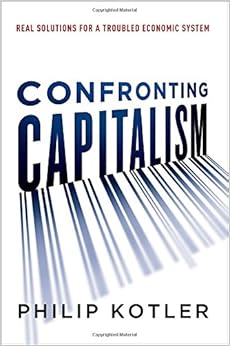
Confronting Capitalism: Real Solutions For A Troubled Economics System by Philip Kotler, PhD: A Book Review


Our current economic system is failing us. We have gone from a prosperous mercantile system based on manufacturing, production, and technology to a debt induced economy dependant on constant consumer consumption financed by rising personal debt. Where banks and other financial markets are deemed "to big to fail" and ordinary taxpayers, struggling to pay their bills amid declining real wages, are forced to pay for the mistakes and greed of others. Meanwhile, government polices continue to take a wrongheaded approach which benefits largely the one percent.

This recent aberration known as a "Corporate Capitalism" has lead us to a near collapse of the economy, the "Great Recession", a massive and unsustainable debt, increased poverty, a nearly decimated middle class, deepening unemployment with little new job growth, and a marked decline in the living standards for millions of individuals. Meanwhile, we're witnessing the largest income gap in American history continue to grow as the rich become even richer while the rest are left clinging by their fingernails to whatever they have left of the "American Dream". The question on everyone's mind is "What can we do about it?"

One of the best explanations comes from economist Dr. Philip Kotler, who has accurately described in everyday language what went wrong, who's to blame, and more importantly, what we can do about it in his latest book, "Confronting Capitalism". Dr. Kotler shines a brilliant light on the corrupting influences affecting our economy without all the usual partisan finger pointing, including a clear explanation of our economic strengths, where our weaknesses lay, and how both impact the global and domestic marketplace.

"Confronting Capitalism" is written for anyone interested in a common sense understanding of today's economic malaise; how we got here, where we're going, and how we can turn this around and return America to its economic preeminence while there is still time.

Saturday, March 28, 2015

What do you believe?

How religious is America? What would be your best guess? According to a survey taken in August of 2014 on behalf of the Religion News Service, America is in the midst of a "great decline" among the mainstream churches. In 1994, 94% of those who attended church identified with that church. Today, that is about 85%. Church membership is down from 69% ten years ago to approximately 59%. Speaking of church attendance, that's down to about 53% in 2014 compared to 62% in 1994.

The role of religion has declined too. In 1994, 88% said religion was important in their lives. Today, only 78% say it's important. In terms of relevance, that too has declined, albeit not significantly, from 79% to 70%. However, what may actually be a more important indicator is the result of five Gallup polls averages which shows that overall religious importance has declined from 78% to 69%. That is significant. According to a recent Gallup Poll, 53% of those surveyed said they were satisfied with religion's role in public life. While that is a majority, its certainly isn't a commanding majority, especially when you consider than in January 2001, that number was 64%, and a year later, in 2002, that number was 68%.

How does that break down along demographic lines? This is an important question given that religion has been interwoven into the
fabric of America since Jamestown, and religion is still reflected in the voting booths. 9 in 10 Americans believe in God; that's 92%. Going back to "the Greatest Generation" of the WWII era, that number was 96%. Between 1953 and 1967, it was incredible 98%. Women tend to believe in God more than men (94% to 90%). Older Americans too believe in God more than those between 19 and 29---94% to 84% (perhaps older populations are simply covering their bases!). The most interesting aspect of the poll was how the percentages changed when the respondents were asked if they believed in a "Universal Spirit" or a "higher power". That number jumped by 12%. This would seem to mean that while there's a strong belief in a Creator, fewer identify with the more dogmatic version of organized religion.

Millennials (ages 18 to 33) are the next big demographic wave to hit as we've often discussed on this blog. With 50% of them self-identifying as independent, Millennials have no love for the current social/economic/political system. This includes the two party duopoly, the corporate capitalist economic system, with a split between small "L" libertarianism and democratic socialism (with the later getting the slight nod), as well as discrimination of any sort, including gay marriage, or interracial mixing. They are the most diverse of all the generations (43% are non-white). They tend to vote Democrat, though they are not aligned with the Democrat Party; they just like the more liberal stance of Democrats on social issues than the GOP (for instance, 68% favor gay marriage while 69% support legalization of marijuana). So it should come as no surprise that Millennials have little positive to say about religion; at least organized religion. Millennials have proved to be both optimistic about the future and on the whole, willing to roll of their sleeves and get to work when they find an issue or cause that's important to them. They are also the most technologically connected of any generation. They've never known a time without handheld electronics, computers, or social networks. They are also more inclined to delay marriage and have the largest percentage of debt (mostly school loans).

When it comes to religion, 36% say they consider themselves as religious, with almost 30% say they are not affiliated with any religion (read "organized religion"). This compares to 21% of Gen X (ages 34 to 49), 16% of Boomers (ages 50 to 68) and 9% of the Silent's (69 to 86) who say they aren't religious. When they are affiliated with a religion, few are members of conservatives churches since the majority are liberal to very liberal on social issues. 58% of Millennials say they believe in God, while 28% say they believe, but they're not entirely sure actually exists, and 11% say they don't believe in God at all. Compare this with 69% of their older Gen X brethren, 73% of their Boomer parents or 74% of their Silent generation grandparents.

So, what's the takeaway here? I think it's the realization that religion---particularly mainstream organized religion---will likely decline as Silents and the first wave Boomers (those born between 1945 and 1964) age out. Non-organized religions, especially non-traditional faiths like those which emphasis spirituality (Native American, Wiccan), as well as Buddhism or even moderate Islam will continue to take hold due to the increased internationalization of the average American continues amid the decline of the once dominate WASP (with the increase of Hispanics, remember most are Catholic and while some are embracing Protestant churches, most remain, at least nominally, Catholic). What is expected to remain stable is the traditional mostly conservative and socially active black churches such as the Baptists, and AME.

In addition, Millennials do not support church activism when it comes to politics. Again, I think we can, therefore, expect the
role of the religious Right to decline inasmuch as their influence on political matters. For some, this will be viewed as a very bad thing, however, with the largely left of center and even somewhat democratic socialist ideals held by Millennials, the conservative Right as we know it now may become marginalized to a more localized role and off the national stage as a key player. The only way they can avoid this is by adjusting their political plank on social issues to the middle or even slightly center left. This will certainly mean a complete overhaul of the Republican and/or Tea Party as well as a strong commitment the ideals of the Constitution which, at least, the libertarian Millennials support. However, at present, with the near stranglehold the far Right has on the Republican Party (and increasingly on the Tea Party), change may not be possible until the GOP and/or Tea Party accepts that its ideals are out of touch with most Americans. Therefore, the strategy has to be adapt, change or die (as an aside, please recall that America is now governed by a oligarchy comprised of the 1% and a few key corporations, so that too will have to be addressed regardless of all other considerations).

On another level, religion, regardless of denomination, has served as a basic foundation to establishing and maintaining a moral foundation for most Americans. America was founded on Judeo-Christian values along with ideals from the Enlightenment. Religion laid out a set of broad guidelines or boundaries of behavior; or what's acceptable and what's not, which was usually reinforced by our parents and the schools we attended. Americans have always turned to religion when times were rough, either personally or for the nation as a whole. It has been a guiding light or safe harbor. It's also provided inspiration for us individually and for us as a nation. How does the decline in religion impact this? First, I think it's instrumental in defining our moral compass. Just look around you or watch the television and you'll see what happens when people lose their moral guideposts. I guess you can say that this system of Judeo-Christian values and ideals of the Enlightenment helped to create the American character.

Because of the all the trauma and societal betrayals by the government, legal system, education system, and churches, we've lost the ability to trust our institutions. In fact, there is very little institutionally speaking that we have any faith in (perhaps our military is all that's left). That's not to say America is becoming atheist. We still crave a spiritually rudder. That's clearly shown by the nominal levels of those who claim to be atheists as shown in the surveys, not to mention the strong numbers of those who are looking outside of mainstream religions. I think too that the expanse of science has played a part. The more knowledge we as a species acquires, the further back we push back the veils of superstitions and myths, and yet, we still cling to the idea if not the belief in God, and I think we always will. Personally, I find God in the beauty and complexity of life; from the simplest of life forms to the vastness of the Cosmos. I also think that because of the cross pollination of ideas and cultures through technology and globalization, we're gradually learning to accept that there is more than one path to reach what we commonly refer to as God, and that can only be a good thing. Ultimately, we are one species; more similar in our aspirations, emotions, and fears than not. We will either evolve together or we shall perish together.


5 Signs of the 'Great Decline' of Religion in America
http://tobingrant.religionnews.com/2014/08/01/five-signs-great-decline-religion-america-gallup-graphs-church/

U.S. Satisfaction With Religion Settling at Lower Levels
http://www.gallup.com/poll/181532/satisfaction-religion-settling-lower-levels.aspx

Poll: 9 in 10 Americans Still Believe in God
http://www.huffingtonpost.com/2011/06/06/belief-in-god-poll_n_872059.html

Millennials in Adulthood
http://www.pewsocialtrends.org/2014/03/07/millennials-in-adulthood/

Generation Atheists! Millennials to religion--get out of politics!
http://www.salon.com/2013/11/04/were_raising_a_generation_of_atheists/


Saturday, January 24, 2015

America: A Paradise Lost?


I admit that I get a lot of emails and articles from individuals and groups from all over the world. Most of it is your ordinary stuff...things they found interesting and forwarded on it me with their comments. Some are suggestions for future articles. Of course, I get a lot from special interests groups---some from the Left and some from the Right---hawking this or that cause and expressing their thanks for my "continued support" for "our victories" (though I may never have heard of them or their cause before), and always asking for money to "continue the fight" lest some dire event transpire.

The ones that get my attention most often, however, are the ones which deal with foreign or economic policy. I've always had an interest in global affairs. I think it's because international politics has always seemed like a cross between a game of chess and a giant puzzle with a few missing pieces (that's where a good foundation in history comes in handy). The America most of us knew---from the "greatest generation", Detroit and big cars, powerful unions and union bosses, and the world we watched nightly on "Leave it to Beaver", "Father Knows Best" or "The Andy Griffith Show" or "The Brady Bunch" have vanished. Superman and fighting for "truth, justice, and the American Way" seem so cliché that an eye roll is almost automatic. We've gone from "I Like Ike" and polls showing that most of us had faith in our institutions---church, school, the military, the media, and the government---to disillusionment following Watergate, Carter, the Contra Cover-up, Clinton's Impeachment and more scandals than I care to count.

Today, there's not much we trust. We automatically assume government is either lying or hiding something. We've become so cynical of the news, most of us watch it just to for the weather...and then look out the window to be sure. We used to hold up sports players like Johnny Unitis, Mickey Mantle, Wilt Chamberlin and the like who played as a team for the love of the sport. Now, all we see are a bunch of self-centered overpaid media driven primadonnas interested only in themselves. Take movies for instance. I still love watching films from the 1930's and '40's, as well as recent ones, but it's mostly the oldies that I enjoy most. Who could not love Randolph Scott or John Wayne in a Western? Who could be any tougher than Edward G Robinson, James Cagney, or my favorite, Humphrey Bogart except, perhaps, Burt Lancaster, Kirk Douglas or Robert Mitchem. Maybe Clint Eastwood if you're lucky...punk. You want sex appeal? You can have your Brad Pitt. I'll take Errol Flynn. George Clooney? Shh...a pale comparison of Cary Grant. Then there's Paul Newman, Clark Gable, Henry Fonda, Gregory Peck, Sean Connery, and way more. You like bad boys? There's few today who could match James Dean, or the aforementioned "In like Flynn" Errol Flynn, the "Rat Pack", but the baddest and savviest of all is still Steve McQueen.

As for the ladies of Hollywood, if you like 'em sassy, how about Katherine Hepburn, May West, Elizabeth Taylor, Betty Davis, Marlene Dietrich, and my favorite, Lauren Bacall? Want classy? How about Grace Kelly, Audrey Hepburn (a real life WWII spy too), Dorothy Dandridge, Ava Gardner or Claude Colbert? Sexy? The Grande dame was May West, but let's not forget Marilyn Monroe, Clara Bow or Veronica Lake, Bettie Paige (the quintessential "pinup" girl whose style is still imitated today) or even Pam Grier? These were gals who could turn it on with grace, style, and could act, sing and dance like they meant it. Most actresses today, including musical performers, depend on to much skin, blatant sexual innuendos, gimmicks and not much else; certainly not talent. That's not to say all of them lack talent. Several actually are, but still, they depend on to much T&A. I'd put up Billie Holliday, Ella Fitzgerald, Bill "Bojangles" Robinson, Gene Kelly, Fred Astaire, Josephine Baker, Frank Sinatra, Bing Crosby, Ginger Rodgers, Donald O'Connor, or Cyd Charisse against just about anyone performing today. Style trumps shtick any day in my book.

While the politicians of those bygone decades weren't any more honest, they were at least more entertaining and ultimately they had the people's interest at heart, especially if they could still make a buck. Heck, even the criminals were way classier...Al Capone, John Dillinger, Frank Costello and Joe Bonanno. America, as a country, seemed to have dreams too. We believed all things were possible. We still believed we could and would do better; that our children would have a better quality of life than we did as would their children; we had good jobs (thanks in no small part to strong unions); We felt proud of who we were as a nation. We weren't doing "world apology tours". We believed in American values of an honest day's wages for an honest day's work; personal honor; looking out for your neighbors, and fair play. We really felt that God was on our side.

Of course things weren't all ice cream and soda pop. There were real problems. Leaders like Ike, JFK, LBJ, RFK, Chavez, and Martin Luther King weren't perfect, but they tried to do the right thing. Women weren't often treated fairly, at home, academically, or in the workplace (and still aren't in some cases). Racism was a big problem as was poverty, but they tried to find ways to work it out. Sometimes it was peaceful. A lot of times it wasn't, but change is rarely easy. Gays were still in the closet----probably reorganizing it by color and season (sorry, couldn't resist), but that was changing too. We didn't worry about being "politically correct". We had an education system that was top notch, especially our trade schools; even in poorer schools, they were better than the best in many countries. Today, as a nation, America is ranked 24th academically---wedged between second tier countries---on average; in some areas ranked even lower. We were taught respect and there was discipline in school. We honored our winners and those who gave it their all. Nowadays, everyone gets to be a winner. We have no losers because we're afraid it will damage their self-esteem. I always thought it made you try harder the next time and built character.

We had our ideological arch-nemesis, the USSR (cue sinister music). They were the "CHAOS" to our "CONTROL"; they had "SPECTRE" while we had "Our Man Flint". Yet, they drove to excel in technology, in medicine, and in space. We went from catching up to Sputnik to landing on moon so many times it almost became routine in just 15 years. That "bad guy" image turned out to be largely of our own creation just as the "bad guys" today are of our own creation. I guess it's just part of our American psyche that we thrive on competition.

But with all this came a certain hubris too. We thought that our way was the only way. We felt that we knew best and we weren't afraid to impose our will---be it with economic domination to the point of exploitation in places like Cuba or overthrowing governments we didn't like in places like Iran, Vietnam, Argentina, Chile, Paraguay, Honduras, Nicaragua, El Salvador, Panama, and others. In almost all these cases, it was done, at least partialy, to benefit certain US corporations, and almost always we installed or helped to install military dictatorships---very brutal and nasty military dictatorships, not to mention numerous political assassinations we engaged in...both overseas and at home. Little wonder we were and still are hated in parts of the world. The phrase at the time, as I recall, was "the Ugly American". Of course, other countries, notably France and England, engaged in their own "regime changes", but not to the extent we did, and this isn't about them. This is about us. Finally, it's worth noting that with all the so-called nation building we engaged in and all the billions of taxpayer dollars that was spent, not a single country chose to emulate ours.

So what happened to us? Where is our drive? Where did the faith in ourselves as Americans go? Why have we allowed (and I do mean "allowed") our democratic republic to be quietly hijacked and replaced by an oligarchy---rule by the elite 1% and underscored by the Supreme Court's "Citizens United" misruling five years ago now. Why have we succumbed to a national debt wherein we've literally sold ourselves, our children, and even our great grandchildren into economic serfdom? With little notice, our nation silently became the second largest economy in the world behind China, the largest single holder of our national debt and current ideological enemy. Why are we no longer the world's top manufacturer of goods---where did the jobs go? Why don't we lead the world any longer in technology? Why do we suffer mediocrity in our schools or in government? There was a time we wouldn't stand for anything less than the best teachers, the best quality education, and despite any ideological disagreements, there would be bipartisan cooperation at the end of day. When did we allow ourselves to become so divided along so many manufactured differences? When did lies become accepted as truths?

Our national transportation system and infrastructure are not only grossly out of date, it's crumbing daily. Once upon a time, we wouldn't have stood for that. We've become so apathetic that nothing seems to bother us anymore. To quote Pink Floyd, "we've become comfortably numb", and yet we wonder why everything seems to be spinning out of control. America, look in the mirror. Washington isn't capable of doing anything. It's up to us, both individually and collectively, to do what's needed. Don't look to government, it's time we accept that we're on our own. We need to start working together to solve the problems around us ourselves. America, in the beginning, was about each other helping each other. It's time to return to that America again.