Showing posts with label college debt. Show all posts

Saturday, July 22, 2023

Living the (Broken) American Dream: Rebuilding the Middle Class

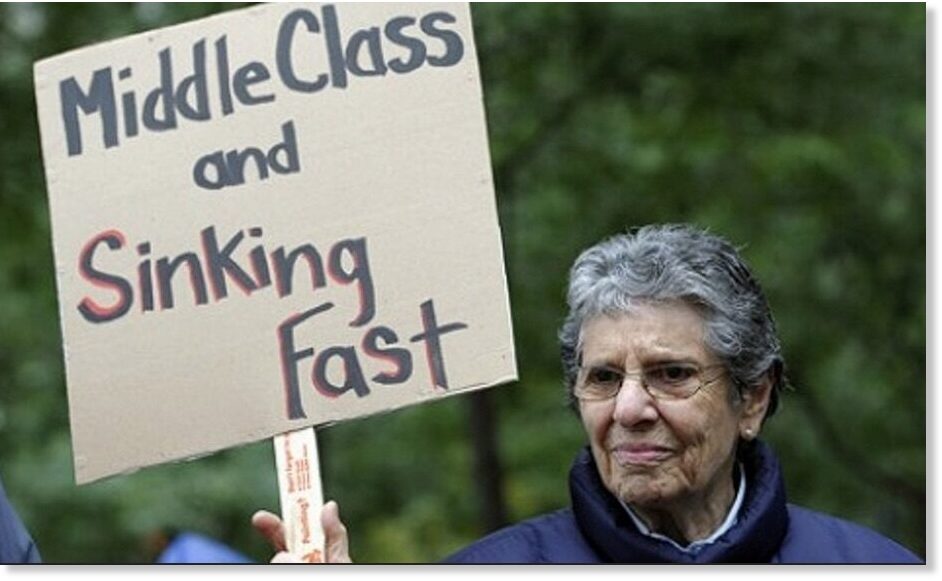
The middle class in the United States is in serious trouble. The aggregate earnings of the middle class has been in decline since 1970. The same goes for those at the lower end of the economic ladder while the upper 10% have seen a steady rise in their wealth. Even with 59.8% of two parent families both holding down full time jobs, it's not enough.

It used to be that a high school education was enough to guarantee you a comfortable living, usually in some blue collar job, a high school diploma nowadays would barely get you  beyond an entry level position somewhere. Even a four year college degree is no assurance of middle class lifestyle.

Of course, most of the good paying blue collar jobs have been exported overseas where corporations can exploit the need for jobs at any price while avoiding those pesky unions and OSHA requirements. Where for every opening there are literally thousands waiting in line to be hired.

It doesn't help that the quality of public schools have significantly declined over the decades to the point where many graduates have the academic equivalent of an eighth grade education.  America was ranked 11th of 79 countries in science.  While we ranked 30th in math,  the top five ranked countries in math were all Asian. But, we're still tops when it comes to basketball!

A typical college graduate with four year bachelor degree hit the street looking for a job with an average debt of over 30,000. For a professional degree, like from medical or law school, the average debt is around $250,000 and $160,000 respectively.  It takes the average college graduate 21 years to pay off their college loan debt. 
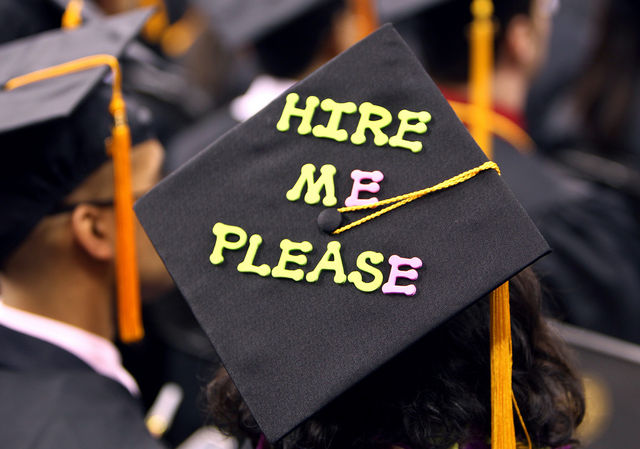
The downside is that a substantial minority chose majors with little or no job demand, leaving them stuck with a huge financial burden and no way to pay it off. These and other graduates are now wanting taxpayers to pick up the tab  under the misleading term of "forgiving" or "canceling" their academic debt. Why? We didn't pick their major. We didn't sign their loan papers or accept responsibility for their debt. That's their responsibility. It's called being an adult. 

But it doesn't end there. With all the additional expenses of simply "living"  amid rising prices and stagnate wages, the average American household debt is $101,915 as of the end of 2022. The total national household debt is $17 trillion dollars as of the end of the first quarter of 2023. That effectively makes the majority of Americans literally indentured serfs. They are literally working to pay off a debt owed to someone else, which is almost always a corporation.

As an aside, 60% of Americans are living from paycheck to paycheck, including 49% of those with an income of over $100,000 along with 70% of millennials, and it looks like Gen Z is trending the same way.  30% of Americans have enough money in savings to cover an emergency for no more than 30 days. 22% have no financial safety net which includes 27% of those 59 and older. 

Once they find a job, it's worth noting that wage inequality between genders remains a problem. Women are still earning, on average, just 82% of every dollar their male counterpart earns, which makes me curious about those who "identify" as transgender in the workplace. I wonder if they're going to be satisfied with their reality of their smaller paychecks?

Meanwhile, those at the top of the corporate ladder seem to be doing just fine. The CEO-to-worker compensation ratio was 399-to-1 as of 2021. That means that for every dollar a average employee earns, a top executive will get $399.  From 2010 through 2021, wages grew by 31%, which sounds pretty good. However, thanks to the rate of inflation, wages have lost on average 4.5% of their purchasing power.

As if that's not bad enough, the top richest 1% own twice as much as the bottom 99% of the entire world's population! To put it another way, they've acquired over half of all the new wealth created over the last decade while the poorest half own just 0.75% of the wealth.  

In the United States, the top 1% own over one third of the nation's total wealth. Did I hear someone say "let them eat McDonalds"? Meanwhile the bottom 90% control just 30.2% of the wealth. In 2021, the top one percent's wealth grew by $6.5 trillion dollars...just in that one year! Their total stock portfolios were worth $23 trillion dollars.

As wealth increasingly becomes concentrated in the hands of fewer and fewer individuals and their corporations, so too does their political power. There have already been several academic studies showing America's shift to a government of, by, and for the oligarchy (or kleptocracy if you prefer). Wall Street's mega corporations now so controls Washington that we've become a defacto neo-fascist corporatocracy. 

It shouldn't need pointing out, but we've also become a surveillance state thanks to the knee jerk reaction of Congress following 9/11 and its failure to read or comprehend the "Patriot Act" in 2001. We need wonder no more how or why the Germans succumbed to Hitler and the Nazis following the passage of the "Enabling Act" by members of the Reichstag on the heels of Reichstag fire in 1933.  

Thanks to the Supreme Court's 2010 "Citizens United" blunder, Big Money literally owns the Democratic and Republican parties. They not only underwrite the two parties and their political candidates, they've pushed the cost of running for office almost entirely out of reach of the average citizen, thus making politics the virtual domain of the very rich.

Congress isn't about "the business of the people" as Speaker Nancy Pelosi so caustically said following the January 6th protest, as corporate lobbyists now routinely write or help draft legislation and advise legislators on how to vote on which bills.

Consider this too. Millionaires, who make up just three percent of the total U.S. population, overwhelmingly control all three branches of government, including the Presidency, regardless of party affiliation. Middle and working class office holders have never dominated any branch of the federal government and are increasingly becoming rare at the state level.

Members of the Supreme Court together are worth an estimated $24 million dollars, and at least six of the nine Justices are multimillionaires. Even most federal judge positions are occupied by individuals who are at least in the top 5% financially. Of course, these positions come with their wealthy and powerful connections, making it even more difficult for the ordinary American to get a fair shake.

So, regardless of whether you vote Democrat or Republican, the wealthy win. It's just a matter of whether it's the blue corporate clique and their agenda or the red corporate clique and their agenda.

So, where does all this leave us? Historically, it's been the middle class which has held democracies together. The Founders  envisioned  the United States as a nation of  yeomen farmers and small businessmen. Ideally, a democratic society should be shaped like two inverted diamonds---narrow at the top and bottom and wide in the center with a relatively few at the top and bottom with the majority of individuals located somewhere in the middle.

Of course, that's not what we have today. The United States used to be a majority middle class country. In 1971, over 61% of the nation was middle class. Today, just under half are. The lower middle class comprise approximately 25% of the population with another 25% making up the working poor and perpetual unemployed. In 2022 just 11.3% of workers were unionized. In 1960 it was almost one third of the country--31.9%. By 1975 it was 26.3% as technology replaced some workers and employers began sending other jobs overseas.  

America also used to be the place where someone could start from scratch, start a business, and through hard work make their way up into the middle class. It was part of the "American Dream". It's what many newly arrived immigrants hoped for. According to the U.S. Bureau of Labor Statistics, the "American Dream" may now be just that---a dream.

 20% of all new businesses fail within their first two years of operation. 45% within their first five years, and 65% within ten years. Just 25% survive beyond that. The main reasons? A lack of cash flow, poor management, a lack of organization, and inadequate marketing.   

When a society's economic system becomes unbalanced and where wealth and power are concentrated in the hands of small minority, social unrest is almost always the result, be it revolutions, civil wars, coups, or whatever. This is especially true when approval levels drop below 55% for any length of time, again, such as in the United States. 

Currently, Congress has an approval rating of just 20%, or to put it another way, a disapproval rating of 76% with 4% having no opinion. In fact, the last time Congress had a positive approval rating over 50% was 2001---22 years ago!

As an aside, 77% of those surveyed said that the current members of Congress should not be reelected again, and yet thanks to corporate funding and partisan gerrymandering, some 95% of them will be reelected.  The Supreme Court has an approval rating of roughly 40% and 66% of Americans have little or no confidence in the mainstream media to provide fair, honest and balanced news.

This is what a broken political  and economic system looks like, especially if you're one of few Americans clinging on to their middle class status. Rising prices, stagnant wages, the widest income disparity of any industrialized nation, poor healthcare (we're ranked 21st in the world with the highest infant mortality rating of any developed nation), a underperforming educational system.

 At 76, our life expectancy is among the worse of any industrialized nation, coming in 40th in the world. In Japan it's 84. We have the world's highest national debt rate at $31.4 trillion. To put it another way, our national debt exceeds the next four countries---China, Japan, France, and Italy---combined, which as most economist will agree, is unsustainable, and yet we spend more on the military than the next ten nations combined.

Is there anything the American middle class can do? Maybe. Although the United States is in decline, perhaps terminally, we can still alter the existing political system to make it more responsive to the needs of its citizens and get corporate money and control out of politics.

We can bring jobs sent overseas back home or penalize those who don't. Let's make it more expensive to ship jobs overseas than to build it here. We can raise the tax rates on the wealthiest individuals and impose a minimum tax on big businesses. No more mega corporations earning more than some countries paying zero federal taxes or billionaires paying less taxes than fast food store manager.

We can increase our investment in R&D projects and cut the red tape on new businesses, especially in the area of technology. We can---and must---improve our education and healthcare. We need to reduce our military budget to free up more money for social services and infrastructure.  We need to put focus on all Americans, not just an elite few, and that means rebuilding the middle class once again.


If you enjoyed the article, please consider passing it along to others and don't forget to subscribe. It's free! Lastly please be sure to "like" us on whatever platform you use to read anotheropinionblog.com. It helps with the algorithms and keeps our articles in circulation. Thank you! 


Average American Household Debt in 2023: Facts and Figures


Average Student Loan Debt


U.S. Education Rankings Are Falling Behind the Rest of theWorld


Two Working Parent Households 2023: A Look at the Statistics


How the American Middle Class Has Changed in the Past FiveDecades


At Least 6 Supreme Court Justices Are Multimillionaires,Report Reveils


These 19 Fortune 100 Companies Paid Next To Nothing---orNothing At All---in Taxes in 2021


Saturday, April 17, 2021

The Babyboomers and Millennials: The Generational and Religious Divide


Last week, I wrote about the decline of organized religion in the U.S.. In addition last week's article looked at how Babyboomers, Millennials, and Gen Z, have influenced this decline which began in the 1960's. This week, we'll get a more specific, starting with the Babyboomers and continuing with the Millennials.

Babyboomers (1946 - 1964) were the product of a society which experienced, on the one hand, one of the most prosperous economies in the country's history, and on the other hand, perhaps America's most violable period.  It was a traditional childhood and youth in one sense but would ultimately led to violent rejection of traditional values, anti-war protests, clashes over race relations and civil rights, which, between 1955 and 1975 took the nation from one which trusted the government to one which had utter contempt for the government.

It was during the 1960's and early 1970's that many Boomers turned their back on organized religion, although there was a brief and intense resurgence as noted by the popularity of musicals like "Godspell" and "Jesus Christ Superstar" which attempted to find a new relevance and interpretation in religion. At the same time, "Fiddler on the Roof" attempted to revive Judaism's historic belief in its traditions and values while plays, like "Hair" and  "Oh! Calcutta!" explored society's changing morality, especially its sexual morals.

The same, or similar expression of disconnect found expression in music, art, and even TV shows like "All in the Family", "The Smother Brothers Comedy Hour", and Rowan and Martin's "Laugh In".  Even network comedies like "Get Smart", "Love American Style", and others carried a anti-establishment undertone. It's not surprising then to expect that religion too would be affected.

Rock groups like The Beatles, The Rolling Stones, among others  had a profound effect on that generation's view of organized religion (in a sense, their "message" came to replace that of the pulpit's).  Groups like these introduced society to the Eastern philosophies, mysticism, yoga, acupuncture, mantras, meditation, holistic and herbal medicine, and Swami whose names we couldn't pronounce.

In addition, first cohort Boomers (1946 - 1954), were largely Left leaning politically. They promoted an idealistic vision of socialism, and began viewing the Cold War as nothing more than propaganda war by Wall Street over who controlled what natural resources and allowed military bases. 

By the late 60's, Boomers started moving to communes as a socialistic experiment and to "get back to nature". They joined small collectives, growing their own food, sharing chores, making their own clothes. Those who, for whatever reason, weren't able to join in, however, started forming neighborhood associations and block watches to take care of their piece of the New American Dream

They also started petition drives and formed boycotts against "unfriendly" or "anti-nature" corporations which wanted to pave over the "bunny fields". From thus the concept of the "NIMBY"---Not In My Backyard was born and remains very much alive today. It was also the birth of consumer advocacy,citizen lobbyists, grassroots environmentalism, and community activism.

The Boomers involvement with protecting the environment, especially air and water, ultimately resulted in the passage of the Clean Air and Water Act and creation of the EPA (1970) just as they had done earlier with the passage of the Civil Rights Act in 1964, which was later expanded in Title VII to include other categories such as gender and age discrimination.

Meanwhile, the second cohort of Babyboomers (1955 - 1964), which embraced many of the same ideals as their older siblings, tended to be less optimistic. They had been more deeply affected by the outcome of the Vietnam War (in part, due to the nightly "body count" on the evening news) and America's failure to secure victory after a nearly 20 year war and the loss of almost 60,000  (mostly young) men and women amid a mountain of lies by the military, Congress, and the Presidency which just seem to grow.

Lies, such as Watergate, caused  Boomers, along with much of America, not just lost its faith in the government and it's institutions, but even its religion was affected as we headed into the 1980's thanks to the rise of the "Televangelist" and the political activism of the "Moral Majority". Sadly, we've never recovered and as I wrote last week, the trend has turned into a death spiral. 

Babyboomers, who rejected materialism in the 1960's went on to be the wealthiest generation up to date, giving us the "Go Go 80's", shopping malls, timeshares, and modern day "greed is good" robber barons like Carl Icahn, T. Boone Pickens, and Ivan Boesky.  Boomers have been behind trends such as healthy eating and fitness craze, disco and mullets (my apologies), McMansions, wine clubs, along with countless others. 

As they age, many of the things Boomers have clung on to will begin to fade (and not just vinyl records or eight tracks). We're talking about traditional brick and mortar businesses (even banks, schools, especially universities are at risk), cable only TV, home ownership, big cars, professional football and, perhaps, boxing (due to head injuries) along with baseball (which is cited by Millennials as "too slow"), and  organized religion just to name a few.

A study by the University of California at Santa Barbara's sociology department indicated that around 42% of Boomers dropped out of organized religion all together, yet 33% never dropped out. Those individuals tended to be conservative, fundamentalist, and were Reagan supporters. However, 25% are slowly returning. Of those, the majority are leaning to liberal and less traditional churches or religious institutions. Their biggest hang-ups? The need for less formality, pro-choice, and LGBT acceptance.

Today, about 88% of Babyboomers describe themselves as "believing in God" or being "pretty sure" God exists (God or some sort of "higher power"). 83% said that religion still had a positive impact on their life. The survey didn't define "religion" as being formal or the same as a less structured "faith system".


When it came to attending some sort of religious service during the year, 71% said they did (but only 38% was weekly). However, when asked if they attended some other religious program (such as bible study or prayer group), 57% said no. When asked if they prayed, 77% said they did; 61% daily and 16% weekly. When asked if they meditated, 56% said they did. Of that, 45% was weekly, while 42% didn't ("prayer" and "meditation" were viewed as being separate from each other)

The same poll asked Babyboomers if they felt a sense of inner peace or spiritual well being. Only 14% said no. 84% did, at least some of the time.  44% also said they didn't read religious scripture of any sort. Just 38% did so weekly while 17% did so occasionally. Of those who did, 35% thought it was literal word of God. 29% said it could be...maybe...or shouldn't take literally. 29% said it wasn't the literal word.

When asked about Heaven and Hell,  74% thought that Heaven existed in some form. 26% didn't think it existed or weren't convinced. As for Hell, 59% believed it existed. 41% didn't think there was a Hell or wasn't sure.  So, how does this compare to the Millennials?

Millennials (1980 - 1996) are, for the most part, the grandchildren of the Babyboomers. They seem to have inherited much of their grandparent's distrust of the government, institutions, and organized religion. However, Millennials are also more dismissive of Boomers (the common Millennial phrase "Ok Boomer" is usually intended to be a polite dismissal of something a Boomer has said or done). 

Many believe that the current social and financial hardships they face as a generation are the direct result of Babyboomers, which they view as greedy and inconsiderate (typical of the "Me Generation). Millennials are the first generation whose quality of life didn't meet or exceed their parents.

Boomers  benefited from their parent's level "living wage" jobs, lifelong employment, employer provided healthcare and retirement (which was often the result of unionization). While Boomers attended college at higher numbers than any previous generation, their debt level was relatively low, especially compared to Millennials, due to many programs which have since been discontinued, including the original GI Bill.

 Millennials are, as we all know, more diverse than Boomers, especially along race, sexual orientation, and ethnic lines, not just as a group, but among their personal relationships. As a group, they tend to have far fewer friends than their grandparents at the same age. They're also more likely to have more health issues like high blood pressure, diabetes, Crohn's, and depression. They are also more likely to have an addiction problems. Millennials are more likely to marry later in life and have fewer children whereas Boomers had more children. Boomers also tend to divorce more often, even as they age.

When it comes to the importance of religion, just 38% of Millennials said it's very important. 29% said it was only "somewhat" important while 33% wasn't impressed with it. 28% attend religious services regularly. 38% did so just a few times a year and 34% said they never do.

Asked about prayer, 36% said no thank you. 39% said they prayed daily while 35% did so occasionally. By contrast, 42% meditated (though only 27% did regularly) while 58% didn't.  When asked if they participated in some sort of religious activity, a whopping 62% said no. Only 18% did on a weekly basis. The remaining 20% was a "hit or miss". 

When asked if they read religious scripture, 53% said no. Only 25% did so weekly. When it came to believing what they read, it didn't fare much better. 20% thought it was the literal word of God while the remaining 80% weren't so sure, which included 44% who said it wasn't. Heaven and Hell? 68% believe in a Heaven; 32% not so much. As for Hell, 56% said yes but the rest didn't think so.

The downward trend of religion seems to have begun in the 1960's, although the seeds were certainly planted much earlier; likely the outgrowth of the private hell brought home by the veterans of WWII and Korea. Babyboomers were said to have been the most spoiled group in recent history; totally devoted to materialism in their childhood yet by their 20's embracing a idealistic form of socialism, and again returning to "conspicuous consumption" and corporate greed by their 30's. Now, once more, returning to the nomadic spiritualism of their youth as they enter their senior years.  

Perhaps it was an attempt by their elders to buy them things they themselves couldn't afford during the Great Depression or during the war years. A vain attempt to buy happiness which left a spiritual void in their children. Maybe the same could be said of the Millennials. They too were spoilt by their parents and grandparents, only to be left feeling hollow inside.  

Millennials have a sense of anger at what they see as misused consumption by their elders, leaving them in no mood to be lectured by a generation which seemed to have had it all and blew it. Now they find themselves adrift financially, politically, and spiritually.  However, with no societal anchor to be found with their parents, grandparents, or great grandparents, the deciding fate of organized religion and perhaps society itself lays with the Gen Z, the new kids on the generational block.


Religious composition of Baby Boomers


Generational cohort by religious group


Why Millennials distaste for Babyboomers is justified


Religious composition of younger Millennials