Showing posts with label incarceration. Show all posts

Wednesday, September 15, 2021

Our Quality of Life and Positives Changes We Can Make


As pointed out in our previous article, one of the ways to judge a country's future is to look at its infrastructure. In our case, it looks pretty bleak. Another indicator of a nation's health is to look at its quality of life.

In terms of freedom and quality of life, America ranks fairly low. According to the "Democracy Index", which is published by the Economist Group, America is defined as a "flawed democracy", which should come as no surprise given that we're an Oligarchic led Corportracy. As an aside, a "flawed democracy" is just one step above a "failed democracy", and the bad news is that social indicators don't show us moving up.

When it comes to overall health and quality of life, Spain and Portugal are one and two. They're followed by Switzerland, Japan, and Iceland. Others in the top ten include Singapore, Norway, and Austria. And the U.S? We didn't do so well. We came in 153 out of 166.  

We also have one of the lowest life expectancies of any industrial nation, with an average of 79.11 years (81.65 for women and 76.61 for men).  We are between Estonia and Panama. The top five belong to Hong Kong  with an average of 85.29, Japan (85.03 avg.), Macao (84.68 avg.), Switzerland (84.29 avg.), and Singapore (84.07 avg.). In fact, everyone in the top 39 positions have an average in the 80's.             

The Conde' Nast Traveler, which provides travelling advice and ranks travel agencies, and so forth, published a report in March of this year of the world's happiest countries. As with previous reports, all of the Scandinavian countries make the top ten, which Finland, Denmark, Switzerland making the top three. The U.S. came in 14th, just behind Ireland and ahead of Canada (in 2019, we were 19th).

Another indicator economists, historians, and other social scientists look at in judging the stability of a country is the percentage of its population which is incarcerated. Unfortunately, we again don't stack up well compared to other countries.

According to the Prison Policy Initiative, about one in one hundred Americans are behind bars at either the federal or state level; 2.3 million people (which includes juveniles as well as adults). Globally, that's one in five of the world's population. To put it another way, while we have just 5% of the world's population, we have 20% of it behind bars.

The next closest country is Communist China, which imprisons 1.6 million. Even Russia and Iran jails fewer people...by far!  So how can we justify calling Russia, China, Iran, Cuba, Rwanda, or Venezuela "tyrannies"  when we imprison a greater percentage of our population people than any of them?

Of course, one answer to that question is that our prison systems outsources to more "for profit" prisons than any other nation. The overwhelming majority of countries utilize state run and financed institutions (through taxes, etc) to house inmates. We tend to emphasis time served rather than focus on reform and other methods to change behavior---even for first offenders.

In doing my research, I came across another interesting statistic. Of the so-called "top tier" or "first world" nations, we are the only ones which still utilizes the death penalty (albeit, it's decided at the state level). Of course, you can expand the definition of "top tier" to include nations like Saudi Arabia, Japan which also employ the death penalty. However, as of 2020, just 53 countries in the world have a death penalty; most of whom are third tier nations.

So, with all the statistics and other data about the United States and how it compares to the rest of the world, what does this tell us? There are a number of takeaways to consider. First, we have to understand that we are not the America our Founders had envisioned. I suspect that if they could see us now, they would have paid that damn tea tax!

Secondly, those elected to handle "the People's business" are actually "doing their business" on the People. We've lost our Republic plain and simple. Perhaps it was while we were busy trying to keep a roof over our heads and food on our tables. Maybe it was while we were distracted by all the "reality" shows, sports programs, video games, and manufactured propaganda masquerading as "news".

Congress represents Big Business, not us. Their lobbyists write the legislation. They help push it through committees and work to get it passed. These bills serve their interests, not ours. Not by a long shot. We get the crumbs.  We don't have lobbyists to represent our interests or to write bills for our wellbeing.

Corporations do their best to evade paying their fair share of taxes, and while the percentage of what we pay isn't the highest in the world, what we get for our money isn't the best either. Corporations are not "people" despite the Supreme Court's misruling. They do not necessarily represent their employees. Their loyalty is to their corporate officers, shareholders, and ultimately, their bottom line.

Corporations should also pay their fair share of taxes, even if that means establishing a minimum tax rate for "Big Business", plus a penalty for off shoring jobs and then shipping product back into the United States tariff free. Corporate lobbyists should never write legislation. Period. If a corporation or its industry is deemed to be essential to national security, it should be regulated if not nationalized in case of national emergences.

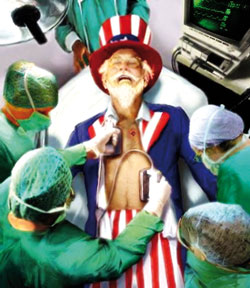
We have the highest incarceration rate in the world. We make the Chinese look like truants! We need to take the profit out of the prison system. We need to focus on reform, especially for first and non-violent offenders. We need to invest in reform and post incarceration support, such as helping with remedial education (GED, etc) and developing employable skills, helping to find stable employment, and periodic follow-up down the road. It's better for all of us in the long run and it's cheaper than building more prisons and housing more prisoners.  

As for the death penalty, I've always supported the "eye for an eye" principal. But, if we're going to take someone's life, let's make damn sure we have the right person. Coming back later and saying "Oops. We're sorry" ain't going to cut it. If there is one iota of doubt, take the death penalty off the table. Let's also make sure we're doing it for the right reasons; that the punishment fits the crime. Let's also make sure that we judge and sentence based on the crime, not on race, gender, income bracket, or other factors.

Prisons should also not be "resorts". A wealthy white collar crook shouldn't be sent to a less restrictive and better quality prison than a poor one trying to survive. Perhaps if the white collar crook had to spend their time with the "common riff raff", it might change their perspective. Everyone should be subject to the same laws and same penalties. No more two tier judicial system; one for the rich and one for the rest of us.

Prisons should be, as much as possible, self sufficient, including growing as much of their own food as possible. All prisoners should be required to take courses in civics and social behavior, and when possible, pay restitution to their victims. Finally, they should not have "state-of-the-art" gyms and weightlifting equipment. The last you should want is murderers and rapists getting bigger and stronger!

But none of this means anything unless we take back our country from the ruling Oligarchs who are taking this Corportracy that used to be our country  down the road to a neo-fascist surveillance dystopia.  Unless we do, the only thing that will change is the speed by which things will get worse.

They tried to frighten us with words like "socialism", which they equate with "Communism" or (wrongly) with Hitler and "Nazism" (a totally different political ideology). Why? It threatens their ability to control. They use these words because they create images which frighten people in lieu of what they actually mean---democracy, which  puts control  in the hands of people, which is their ultimate fear.

Ideally, socialism is control by the people. In practice, however, it's controlled by the state. While I don't consider myself a "socialist" and prefer a low intrusive democratic government, I do believe that there are some things the state should do or can do more effectively, as did some of the Founding Fathers.

There are features which were once considered "socialist" or even "Communist" just a few generations ago which I support such as Social Security, the right to organize and bargain, having a safe work environment, clean water and air, anti-child labor laws, COLAs, women's suffrage, equal rights and equal pay (which still has yet to be obtained), unemployment insurance, and so forth. 

When it comes to a minimum wage, we forget that it was established for entry level jobs and help people get started in the job market. It was never intended to a "living wage" (to support a family for instance). Ultimately, the job market is the best place to establish an acceptable wage. If no one takes a job for the pay you're offering, then maybe you need to do it yourself or offer more.

As an aside, I also like worker co-ops. In many cases, it isn't just a matter of the employees knowing how to run a company at least as well as the former owners, it's a way to keep the company open and people employed. Companies are likely to do better when everyone has a stake in its success.

I think that America, like all other developed nations, should have a minimum national insurance plan. Not all employers can afford insurance for their employees, especially small businesses.  Without one, we often lose the local "mom and pop" businesses to mega corporations.

A basic national insurance plan, like single payer, would help to level the playing field between small companies who can't afford insurance and the larger ones who can. Individuals could purchase additional insurance on the open market to suit their specific needs. I should add that all taxpayer based jobs should be required to have the same insurance as the rest us, including Congress, which is exempt.

I also believe that the Federal Government only has powers designated to it by the states, and not that it has all the powers except those specifically reserved by the states. In other words, a smaller and more decentralized federal government. I believe that the closer you are to the source of a problem, the easier it is to solve. Therefore, we need to focus on solutions at the state and local levels as much as possible.

There are things we can do to reclaim our nation, as I mentioned above, but there are some other things we should push for too. We need to restructure our tax system and adopt either a flat or consumption tax, in addition to establishing a minimum tax for global corporations.

Corporate lobbyists, consultants, or advisors, should not have a hand in writing any legislation or make recommendations about which bills to support. Corporations are not "people" and money is not "free speech". Therefore, we need to rescind Citizens United and remove virtually unlimited corporate funding of elections.

Any tax increase proposals, as well as fee or rate changes, should be subject to a public vote. To paraphrase the TV commercial says, "it's our money and we want a say how".  We need to end partisan gerrymandering. We need to level the election play field by making all election requirements the same regardless of registration. Appointment to boards or commissions should be based on qualifications only, not party control.  Citizen's initiatives and referendums should be a matter of law.

Aside to term limits, Rank Choice voting should also be added to provide a more equitable choice of candidates. Some public offices should be non-partisan such as Treasurer, Secretary of State, County Clerk, County Judge, or  Secretary of Agriculture. For that matter, once elected, politicians should resign their party affiliation. They're there to represent everyone, not just their party, which means everyone else is taxed without representation (proportional representation would fix that).

These are but a few of the things we must do, to restore our country to the American People and make this a top tier nation once again. As it is, America will soon be no different from any other second level nation with pockets of cities and communities which look like they belong to a third world nation than to the United States. It won't be easy, but I think it's a worthy cause. I hope you do too.


OECD Better Life Index


Sustainable Public Transit


World Happiness Report


The Healthiest Places To Live


What Percentage of the U.S. Population is Incarcerated?


Which countries have the death penalty and how many peopleare executed every year?


Life Expectancy of the World's Population


Saturday, February 09, 2019

Where Does American Stand On The World's Freedom Index? The State of American Freedom Pt 1 of 3 of Our "Where America Ranks" Series


Did you watch President's Trump's State of Union address? I watched most of it (including the Pelosi sideshow going on behind the President). I took particular note of how often Trump made reference to America being "great", which has been a central theme of his since the campaign. That made me wonder---just how "great" is America really? As most Americans already know, the United States is an Oligarchy; ruled (as opposed to governed) by a relatively small number of elites. Of course, these same elites and a few others, dominate the rest of the globe, or at least most of it. So, how does the US stack up in terms of overall freedom, income equality and social mobility, and finally, in terms of the quality of our education system? This article will be part one of a three part series which will examine those issues.

The first topic we'll look at is freedom. After all, the notion of "freedom" has been this country's mantra practically since its founding. It's why people from around the world want to come here. But just how "free" are we actually? We already know that the US has become essentially a surveillance state since 9/11, be it government agencies or corporations (as an Oligarchy, the two work in tandem anyway). As I wrote in my last article, the US has adopted a "enhanced" driver's license, which acts as a defacto national ID card, complete with a tracking chip and facial ID capability.

Our cell phones and social media monitors and records us, builds profiles of sites we visit, where we shop and purchased, not to mention even tracks us, and even anticipates our likes. Some people like that. Personally, I find it a little scary. It's too much private information in the hands of other people and computers. Our credit cards are chipped and so are our cars and trucks. Some people have watches which double not just as a time piece but also as cell phone, internet access point, and, of course, a monitoring devise. But these are more incidentals; reflections on the state of our personal freedom amid ever growing technology. What I want to know is how we ranked in terms of our basic freedoms.

One of the most important freedoms that American has been a free press, as covered under the First Amendment along with free speech and freedom of association. According to Reporters Without Borders, they researched the openness, independence, accurately, and self-censorship of the media. Out of 180 countries, the US is now ranked in the 45th spot, dropping two spots since Trump was elected President. This partly the result of a not so subtle propaganda war again the Trump White House and the proliferation of what's often called "fax news".

So, if the US is in 45th place, who came in first for the most honest, accurate, and fair media? That went to Norway, followed by Sweden in second place. Russia was ranked as 148th while China was 176th. In last place was North Korea. No big surprise there! According to the Human Freedom Index, which was compiled by the Cato and Frasier institutes, in terms of personal freedom, economic freedom, and amount of tax and regulations, the US is ranked in the 17th sport; a drop from its usual third place spot. Pretty sad for a country which prides itself as being the "Leader of the Free World" don't you think? The drop started around the time of Bill Clinton, and has continued to decline through the presidencies of George W Bush and Barack Obama, and now, into President Trump's administration.

The top spots went to Switzerland, Hong Kong, New Zealand, Ireland, and Australia. As an aside, Hong Kong was ranked number one in terms of economic freedom and second in personal freedom. In addition, Hong Kong was the top ranked place for innovation, be it technology, business, or government. At the bottom of the list was, starting at 155th place, Egypt, Yemen, Libya, Venezuela, and Syria. Venezuela, prior to Hugo Chavez, was ranked as the wealthiest country in Latin America and one of the most economic and personally freest countries. However, since the adoption of a Marxist version of Socialism, it's economic, social, and political systems has been in a free fall, making it one of the worse countries in the world to live in.

According to the website, Traveller, which is a travel site that rates the best countries and places to visit, the United States ranks 25th in personal freedom. The information came from The "Legatum Prosperity Index for 2018", which looks at a variety of factors such as crime, business environment, health, personal freedom, environment, among other factors. The report listed the US as first in terms of business environment and sixth in social capital. However, we ranked poorly in terms of governance (19th), economic quality (13th), personal freedom and natural environment (23rd each), health (35th), safety and security (43rd). In terms of education, we only made it to the 9th spot.

The top ranked countries (in order) was Luxembourg, Canada, New Zealand, Iceland, Ireland, Uruguay, Netherlands, Finland, Belgium, and Portugal. Also included among the top twenty were all the Scandinavian countries, Slovenia, Australia, Malta, the UK, Costa Rica and Spain. The least most tolerant countries included most of Africa and the Middle East (excluding Israel), along with Iran in the 5th spot, Russia in 9th place, Iraq in at 11th and China at 12th. However, according to the report, coming in first place as the least free country was Afghanistan.

In terms of healthcare, according to the World Health organization, the US ranks 37th in the world, behind countries most all European countries, as well as Canada, Oman, UAE, Saudi Arabia, Greece, Chile, Australia, and Morocco. In fact, the US ranked in between Costa Rica and Slovenia. That's actually pretty embarrassing if you think about it; a country like the US being ranked behind and in the midst of second tier countries.

The top spots went to Italy, France, San Marino, Andorra, Malta, and Singapore. Other nations in the top tier included Japan, all the Scandinavian countries, Spain, the UK, Ireland, Columbia, Saudi Arabia, Canada, and most of Europe. It goes to show that while "Obamacare" did improve overall healthcare in the US, it fell far short when compared to the rest of the world. In terms of healthcare performance, America actually ranks dead last.

The study, conducted by the non-partisan Commonwealth Fund, examined five areas. Namely, Access, Care Process, Administrative Efficiency, Equity, and Healthcare Outcomes. The study showed that while the outspends every other country, we somehow managed to fail three of the five issues with Americans having the highest mortality rate of any country in the study; much higher than their counterparts in Europe. The report cites essentially a lack to adequate quality care as the chief cause. America would have fared far better had it adopted a single payer health system and allowed individuals and companies to purchase supplemental insurance. This would have allowed even small businesses to a means to compete with the larger ones without the extra financial burden or forcing employees to find their own coverage, and for a far cheaper price.

However, the US did come in first place in one key, albeit dubious category. American was ranked number one in terms of incarceration. We imprison more of people than any industrialized nation in the world at a rate of 655 per 100,000. That's more than China, Russia, Cuba, or even North Korea. The closest country to us is El Salvador, which jails 609 per 100,000 and Turkmenistan with prison rate of 552 per 100,000. Cuba jails 510 individuals per 100,000 while for Russia it's 409 per 100,000. The top reason for the imprisonment in the US was due to drugs, possession or sell, followed by felonies of one sort or another.

Well, there you have it. For a nation which fancies itself as the bastion of freedom, it appears the facts don't back up the hype. In most of the studies, the US typically ranks between the middle and the low end of the second tier of whatever category we're looking at with one glaring exception. The problems we face are not partisan issues. This isn't solely the fault of the Democrats or the Republicans. It can't be attributed to the extreme Left or Right. This is a systematic failure in which both sides share the blame equally. This is what the partisan bickering has brought us, not to mention the corporate control of the agenda and the demise of labor unions (say what you want about unions, they at least ensured that their members received good wages and benefits). Our next installment will focus on income inequality. I hope you will join us.


US drops to 45 in countries in ranking of countries based on freedom of the press

US freedom ranking lower than you would think

Freedom around the world: The most (and least) free and tolerant countries

Countries with the most prisoners per 100,000 of the national population, as of July 2018

The Patient Factor: World Health Organization Ranking of World Health Systems


The US Ranks Last in Health Care Systems Performance


Sunday, July 29, 2018

The Changing Face of Latinos in America


In case you've been on a long retreat in Himalayas or living "off the radar" for the past several years, you should know that Hispanics are the second largest population in America right now, although their rate of growth have slacked off in recent years. That position had long been held by blacks, who have fallen to third and may drop to fourth over the next few decades as Asians, the fastest growing demographic in America are starting to catch up (in Canada, they are already the second largest group in terms of population).

Meanwhile, whites, who've long been the largest population since the country's conception, have been in steady decline, despite the surge in births following WWII (the Babyboomers) in terms of overall population. The result of all this is that within the decade or so, the US will be a nation of minorities, with no single group being dominate. How that will play out politically and economically remains to be seen.

Of course, this is pretty much old news as alluded to at the beginning of this article. What I would like to discuss is a new phenomena which has been happening within the Hispanic Community and its possible affects on society. Hispanics have historically been Catholic (Roman Catholic to be more precise), and typically very devout at that. In fact, the Catholic Church as had an impact on Latin America from the moment Columbus planted the Imperial Spanish flag in the sand in what is now the Bahamas side by side with Friar Juan Perez, a Catholic priest of the Franciscan Order (the "Minorites").

The Catholic Church has exerted a powerful impact over the population in Latin America for centuries, some of it for good such as basic education and medical care and some---perhaps much of it---for ill such as working hand-in-glove with the wealthy landowners and government to keep the peasants mostly ignorant, poor, and on the farms (the result, as we've seen in Latin America, has been the slow growth of a educated middle class. Latin America still suffers from a two tier stratification between the very wealthy and the very poor). Attempts to reform society have often meet with violent opposition by the wealthy, and usually with the support of the Church's entrenched hierarchy.

So, it's this mix of admiration and fear of their faith, as well as the government, including its military and police, which has dictated the order of society in Latin America for generations, and it continues as Hispanics have crossed into the United States, legally or illegally. But, there's a subtle change taking place that we should be aware of. Assimilation among Hispanics has largely been slow; perhaps slower than among any other group which has immigrated in mass to the US. That's not to say there hasn't been assimilation, there has, especially among Cubans, Panamanians, and Puerto Ricans. However, among other groups, such as Mexicans and those from Central and South America, it's been slow at best.

Among certain segments, there's actually been a strong resistance; insisting that they not learn or speak English, the historical and de facto "official" national language of the US, as well as a refusal to adopt many of our national traditions. Nevertheless, change has still taken place, among which has been the adoption of other religious faiths. This is particularly true of younger immigrants (regardless of their legal status). 68% of Hispanics identify as Roman Catholic. At present, approximately one-third of all Catholics in the US are Hispanic or of Hispanic origin, with two-thirds of those attending services in Spanish. However, some 18% now identify at Protestant while 8% don't identify with any religion; some that would have been unheard in their grandparent's generation.

Of the 18% who've converted, the majority of them have become members of Evangelical congregations such as Pentecostal, Baptist and Church of Christ. Interestingly still is that many of these churches have started offering services and/or religious classes (like Bible Study) in Spanish. As an aside, many of these converts have also changed their political allegiances a well. While most Hispanics in the US have tended to lean heavily Democrat or politically Left (with the except of Cubans, who've historically been Republican), these converts have increasingly become Republican or vote along conservative lines.

Just for clarification, membership in both corporate controlled political parties has been and continues to be on the decline while Independents, who are now the nation's majority at 44%, continues to rise. Third parties, such as Libertarians, Greens, and Constitutionalists are also showing signs of growth too. So, while these Hispanics have left the Democratic Party, their political switch doesn't necessarily mean they've joined the Republican Party. It means that they've have become more conservative in their political outlook. Thus their change to religious denominations which tend to more conservative, so has their political outlook.

Meanwhile, it's important to note that while Hispanics are showing more willingness to leave their traditional Roman Catholic roots, and while the trend is slowly increasing, Hispanics still make a much smaller percentage of overall membership in Protestant, and specifically Evangelical congregations than whites or blacks (Asians are the smallest group making up Protestant membership). Now, as for the 6% who describe themselves as secular, it's interesting to note that 66% are recent post-high school graduates, meaning that they are still fairly young adults. 63% say that English is the primary language, even if they come from bilingual households.

Almost half were born in the United States, and 41% come from households which bring in $30,000 annually or less. So, this 6% then are native born and assimilated, fairly young, have a basic education and come from relatively poor, likely lower level blue collar homes (there's another Pew Survey which I came across which demonstrates that Latino identity appears to be diminishing over generations, starting with native born children. I'll include a link to that survey as well below). Perhaps that's not too surprising. I think the identification with our ancestral homelands tend to fade across all racial and ethnic groups as individuals become increasingly assimilated. Maybe the last bonding tie will be artificial identifier of the "hyphenated American" such as "Asian-American' which identifies the individual as being racially Asian as well as having Asian ancestry while now being American, which is not a racial description. Hispanic-American is quite different however.

To clarify as briefly as possible, the Federal government defines "Hispanic" as a ethnic group rather than a race, since Hispanics tend to be an admixture of various races. Thus, a "Hispanic-American" may be racially more a central African origin or Native American origin, or even mainly Spanish or Portuguese origin, yet be from a Latin American culture. Black Americans are generally referred to as "African-Americans" although neither "African" or "American" are racial descriptions. The use of the term "African" can include the predominantly northern Arab populations (who are categorized racially as "Caucasians"), the more central Negro populations (which is a race), or the white South African Boars and Afrikaners (who are obviously white). Again, "American" doesn't describe a race, but rather a country and/or culture. Of course, whites are typically referred to by their racial indicator, "Caucasians" rather than as "Euro-Americans" which would be more accurate using the above logic of hyphenation.

So, while Hispanics seem to slowly assimilating despite the efforts of some to stop to reverse this trend, it's likely that in time Hispanics will eventually simply become a mixed bag like the majority of other Americans. Meanwhile, it's probable that Catholicism will remain the dominate religion among Hispanics, its hold will lessen as more chose to explore other faiths (and political allegiances), there is another trend taking place among Hispanics which seems to be often overlooked.

79% of black Americans tend to be primarily Protestants; 14% align with Evangelical churches, like the Baptists, while 53% follow traditional "Black Protestant" faiths such as the United Church of Christ and the African Methodist Episcopal (AME) churches. 5% belong to the Catholic Church while 4% are members of Mainstream Protestant churches such as Lutheran, Methodists, or Presbyterian. An estimated 18% are unaffiliated with any organized religion. However, 2% of blacks in the US are Muslims; mainly followers of the controversial Nation of Islam which has somewhere around 35,000 -45,000 members, which brings me back to Hispanics and religion.

One often ignored trend among Hispanics is that they are the fast growing group converting to Islam, which, given their numbers, could play a serious issue down the road. As present, the numbers are relatively small; approximately 150,000 within the Latino community, but there are signs those numbers may be growing. One reason is that the principal recruiting ground of Islam, especially radical Islam, has long been in US prisons, of which Hispanics represent approximately 33% of all inmates.

According to US Federal Bureau of Prisons, 80% of religious conversions in prison are to Islam, with the majority being blacks, the number among Hispanics has been increasing rapidly. Muslims make up 9% of the total prison population, compared to presenting around 1% to 2% of the general population (in New York's prison system, Islam makes up nearly 20% of the inmates). Combine this with the number of gang members in prison, this could have potentially devastating consequences if this spills over to the drug cartels who adopt Islam in conjunction with their criminal activities (for statistical purposes, blacks comprise 37% of the prison population, compared with 2.2% of Native Americans and 1.6% of Asians, while whites, which includes a portion of Hispanics, make up 58.5%). Terrorists groups like ISIS/ISIL, Boko Haram, and Al Qaeda could look like a bunch of kindergarteners by comparison next to criminal gangs like MS-13, Mexican Mafia, or the Sinaloa Cartel.

America has the largest incarcerated population of any country in the world, 724 per 100,000 people compared to "evil" Russia which has just 581 per 100,000; not a notable distinction for a country which prides itself on being "enlightened" or "advanced" (as an aside, half of the world's incarcerated population are in just three countries---the US, China, and Russia). Given the changes in US demographics, incarcerating the second and third largest populations, can't be good. Meanwhile, we're seeing changes in the political and religious alignment of Hispanics, as well as the increasing assimilation among the younger generations, yet there still runs the potential backlash the mass imprisonment of a specific group brings (generations ago, it was the Irish and Italians as well as the Poles and other Eastern Europeans).

This doesn't excuse the criminal activity of gangs any more than it did the Irish, Jewish, or Italian gangs of the 1920's and 30's, not does it excuse in any way individuals illegally entering the US (which is frowned upon by those of the same group who entered legally). However, we must address the problem we obviously have with incarceration and immigration. As the Roman Emperor Tiberius said of his nephew and future emperor, Caligula, "I'm nursing a viper for the Roman people", so are we laying the groundwork for a potential disaster.


Changing Faiths: Latinos and the Transformation of American Religion

Hispanic Identity Fades Across Generations as Immigrant Connections Fall Away


Is being Hispanic a matter of race, ethnicity, or both?


Muslims in America: Latinos Converting to Islam As US Population Grows


Federal Bureau of Prisons: Statistics