Showing posts with label drugs. Show all posts

Saturday, June 04, 2022

Crime and Punishment: Race and Its Consequences

The U.S. has approximately 102 federal prisons, 1,566 state prisons, 2,850 local jails, 1,510 juvenile facilities, 186 immigration detention centers, 82 Native American/tribal jails, not including military prisons, civil commitment centers, mental health facilities, as well the numerous other correctional and detention centers scattered throughout U.S. territories.  Each operates independently from the other, but generally cooperates with the federal authorities in most situations. The result is a multilayered judicial criminal system.

All told, they hold somewhere around 2 million individuals. The most in the world.  Globally, one out of every five individuals behind bars are likely in a U.S. prison or jail. The majority---1 in 5---are in jail on drug charges. The average cost to house a inmate in a federal prison (in 2020) was $39,158 or about $120.59 per day. Prison, probation and parole generates a $81 billion dollar bill to the American taxpayer (the average salary of a police officer is $55,280 plus benefits or about $85,000).  

It's worth noting that much has been said of  "for profit" prison systems which allegedly attempts to make a profit on each prisoner via taxpayer dollars and use of prisoner labor (which some equate with Nazi or Soviet Era labor camps). However, the "for profit" prisons account for only 8% of all inmates.

About 71,000 are overflow population from state prisons while another 40,000 are being held at the behest of the U.S. Marshal Service and Bureau of Prisons.  Of these, the majority are housed in halfway houses or home incarceration which are being privately supervised and managed.

Approximately 13,000 inmates are outsourced from overcrowded and unsafe local jails. 16,000 are ICE (Immigration and Customs Enforcement) detainees, and 9,000 are youths who would otherwise be held in more expensive public detention centers.

When we look at the three percent of the U.S. population behind bars, we find that federal prisons hold about 208,000 inmates. Of those, the vast majority are being held on drug and immigration charges. 11,000 are for committing a violent crime; 7,000 for property crime, and about 59,000 on some other federal charge.
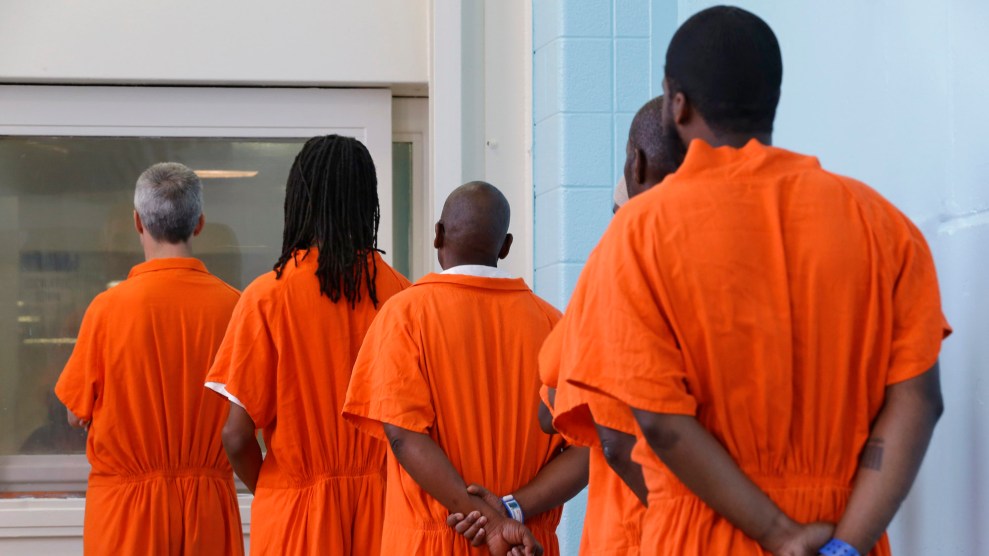
At the state level, which hold the most---roughly 1,042,000---the overwhelming majority (606,000) are imprisoned for violent crimes such as rape, assault, or murder. 159,000 are for property crimes such as burglary, car thief, or acts of vandalism. 146,000 are being held on drug and alcohol charges, including about 18,000 for DWI. Some 124,000 are incarcerated on public order charges which includes certain weapon violations, prostitution, disorderly conduct, or so-called "deviant behavior".

Local jails and detention centers house about 547,000 individuals. About 2/3 of those are awaiting trial while they remain behind bars on charges ranging from drugs, alcohol, assault, theft, burglary, or a public order charge. Typically they are regarded as flight risk or are unable to make bail. 

However, of the remaining 1/3, most are convicted and serving time on a public order charge such as prostitution or disorderly conduct, followed by property crime, which includes car theft (carjacking), burglary, or theft by unlawful taking. Closely behind comes drug and alcohol related charges, and those convicted of committing a violent crime.  A small percentage represents individuals who have violated parole (referred to as a "technical violation") without having been charged with a new crime.

Generally speaking, about 22,000 are held involuntarily due to a mental or psychological  impairment or deficiency.  Juvenile detention accounts for roughly 36,000 youths who are held on a variety of charges. Territorial incarnation includes places like Puerto Rico or Guam, and make up about 10,000 inmates. Tribal jails hold about 2000 individuals, mostly on charges involving prostitution, disorderly conduct, liquor or drugs, while the U.S. military is holding roughly 1000 service members.

As an aside, most accused military members are tried before a military tribunal. Charges typically involve intoxication, drugs, assault, or going AWOL/UA ( aka Absent Without Leave or Unauthorized Absence).  If convicted, they can face a myriad of penalties ranging from verbal or written reprimands, fines, loss of leave time, extra duty assignments, detention, loss of rank, up to a general or dishonorable discharge.

If other charges are involved, they are immediately discharged following competition of any penalties handed down by the tribunal and turned over to the appropriate civilian authorities where they may face additional charges and possible fines and/or jail time.

What about race or gender? Who faces the greatest likelihood of incarceration?  Do more women than men go to jail?  Which race is more likely to serve time in prison?

When it comes to adults (18+), 1 in 15 black males are incarcerated at some level.  It gets worse for black males between 20 and 34 when 1 in 9 are in jail. For Hispanic males, 1 in 54 over age 18 are serving time. As for white males 18+, that number is 1 in 106.

When it comes to women regardless of race or age, 1 in 265 are behind bars. Breaking it down, we find the number for black women between ages 35 and 39, the number is 1 in 100. For Hispanic women in the same age bracket, it's 1 in 297. For white women in the same age range, it's 1 in 355.

What does this tell us? Well, it's pretty obvious that black individuals, regardless of age or gender, are most likely to serve time than either Hispanics or whites (it should be noted that Asian incarceration numbers are low enough to be considered statistically insignificant). 

In fact, blacks are five times more likely to be incarcerated than whites and twice as likely than Hispanics. They are also more likely to serve longer sentences or to face higher bail than anyone else. Why are blacks, especially males, more likely to do time than any other group?

A report published by The Sentencing Project found that in 12 states, more than half of the prison population was black. Also, Hispanics were jailed at a rate of 1.3 times that of whites. Wisconsin, as an aside, had the highest rate of incarceration among blacks. The report revealed that one of every 36 blacks in Wisconsin were behind bars! The same report stated that Hawaii had the lowest racial disparity among inmates, but still jailed blacks at a rate of two to one over whites. What gives?

The majority of blacks arrested and imprisoned results primarily from drug related crimes. These cover everything from simple possession of drugs such as marijuana all the way up to more serious crimes such as manufacturing and sale of crack. It also included peripheral crimes related to drugs such as theft, drug paraphernalia, carjacking, armed robbery, burglary, and prostitution. Some of which involved gang activity associated with these crimes as well. 35% of blacks incarcerated are a gang member. Compare that to 46% of Hispanics and 11% of whites.

It's also interesting to note that while arrest among blacks had been rather consistent from 1920 onward, there was a dramatic upward surge starting in the 1970's and early 1980's, which just so happens to coincide with the second generation of the "War on Poverty", which was launched by President Lyndon Johnson in 1964, coming of age.  

One of the most notable and controversial aspects of the War on Poverty was how the newly created "Welfare State" rewarded single moms with children, thus kicking off the role of "broken" or fatherless homes. Single parents (mainly women) got more benefits and larger subsidies than those where a male was regularly present and contributed to the household income. 70% of criminals and 80% of inmates are from broken or dysfunctional homes. 85% of youths in jail or detention centers came from fatherless homes. Poverty became institutionalized.

Also worth pointing out is that this same period marked the start of forced busing in several states, which took black youth out of their neighborhoods and local schools and placed them in predominately white schools. The intent was to provide "disadvantaged" minority students an opportunity to attend higher performing predominately white schools in hope they would do better.  

In cases where forced busing was implemented, it tended to fail in raising the test scores of minority students while the scores of white students bussed to so-called black neighborhood schools remained equal to or higher than their pre-bussing test results.

As a result, academic standards were quietly lowered across the board, from elementary school through college.  The emphasis was changed from developing critical thinking skills, math, reading, and the sciences to "teaching the test" by which school districts received their funding. That hurts everyone.

 It also marked the period where discipline standards were dramatically lowered and incidents of threats and assaults on teachers and fellow students rose along with vandalism and theft. Interestingly, the average inmate is a high school dropout and can barely read at an eighth grade level. Black male students are three times more likely to be expelled for behavior issues than any other group. 

Lower academic standards naturally equated with less economic opportunities. Jobs, if available, tended to be lower paying, unstable, and with fewer or no benefits. Crimes (and the advent of gang activity) grew based a chance to earn "real money" and feel "respected".  Businesses increasingly relocated to areas with lower crime rates, thus making good jobs harder to find, along with their tax dollars. Cut backs in funding of social programs, plus public transportation, made the situation that much worse.

Meanwhile, the public's growing fear and intolerance of not just rising crime but also that of illegal immigration, which absorbed even more of taxpayer's dollars, forced authorities into making more arrested, imposing higher bail and longer sentences with fewer chances of parole.

Minorities became more dependent on overworked, underpaid, and often inexperienced public defenders with notoriously high conviction rates to defend them. Predominately white and Asian defendants, who were wealthier and better educated (relatively speaking), could afford more competent legal representation, had lower bail and were generally less likely to be convicted.

They are also more likely to obtain stable employment and adhere to parole requirements. Human nature being what it is, those perceived as being less "trouble" are processed out faster and given the most breaks, especially by an underpaid, understaffed and overworked justice system. So much for equal application of the law.

Simultaneously police departments were forced to downsize due by overtaxed citizens, forcing fewer officers to do more with less and adding to the pressure of the job. Increasingly, many police departments depend on federal grants just to operate. Not unexpectedly, the added stress and danger of the job created a "us versus them" mentality which brought the worse as we've seen lately.

Many tried to blame the breakdown of trust between the community, police, and judicial system on systemic racism and a "white superiority" complex. Racism is a factor, but not the key factor it's made out to be. Racism is not a one way street. Every group is capable of racism, which has been around since our beginning. Human beings are innately tribal, and thus racist. It's part of our DNA. It's what enabled us to survive.  However, we have, for the most part, adapted to accept humanity itself as our tribe.

The core of the problem is low academic standards. Those who tend to excel intellectually in most societies are also the ones who are most dominate. They organize society. They control industry. They write and enforce the laws. In organized democratic societies, skin color or other factors are of less importance than economic status, which is largely determined by their level of education.

A system which rewards or makes excuses for low academic performance, poor behavior, encourages a broken family unit (the building block of society) or institutionalizes a dependency or "handout" based society, creates the forces by which poverty, low productivity, and ultimately crime will flourish. The result is a society forced to deal with the mess it has created in ways it cannot sustain in the long run. 


If you want to know more, please take a look at the links below. If you enjoyed the article, please consider passing it along to others and don't forget to subscribe. It's free! Lastly please be sure to "like" us on whatever platform you use to read A/O. It helps with the algorithms and keeps our articles in circulation. Thank you!  


Mass Incarceration : The Whole Pie


Police Officer Salary in the United States


Annual Determination of Average Cost of Incarceration Fee(COIF)


U.S. Incarceration Rates by Race and Sex


The Color of Justice


Schools v. Prisons: Education is the way to cut prisonpopulation


Saturday, January 15, 2022

Big Pharma: A Monopoly in Need of a Cure

 In last week's article we discussed some of the monopolies which dominate the American economy, and by extension, Congress, the Judiciary, and the Presidency.  While powerful, especially the financial sector, perhaps none are currently more powerful than Big Pharma. Just how big and powerful?

While we get to that in just a moment, but consider this. 70% of all Americans are dependant in some way, be it medicine or medical equipment, on what Big Pharma says we need. For the majority of that 70%, what they receive is critical to their overall health and even their very survival.

So, just who is "Big Pharma" anyway? Names such as Bayer, Pfizer, Moderna, or Johnson and Johnson are household names we're familiar with, particularly thanks to the Covid pandemic. However, many others are simply unknown except through their products which are extensively marketed.

 Starting in reverse order with the tenth largest and most influential global pharmaceutical company (all revenue is from 2020) is Sonfi, the French manufacturer of Zantac, Plavix, and Ambien, reported just over $41 billion dollars in revenue. Next is Pfizer, whose revenue was about $42 billion. Bristol Myers Squibb racked up $42.5 billion dollars. GlaxoSmithKline was seventh with $43.5 billion dollars.

In sixth place was Janssen, which is part of Johnson and Johnson. Their revenue in 2020 was $45.5 billion dollars. AbbVie, the maker of Humira, made $45.8 billion dollars. Merck earned a under $48 billion. Novartis, a Swiss producer of drugs such as Ritalin, earned its shareholders $48.6 billion dollars. Second place belongs to Roche Pharmaceuticals (a division of the Roche Group), manufacturer of Valium, and also a Swiss company. It's revenue for 2020 was a staggering $49.5 billion dollars.

Finally, the top earner in 2020 was a state owned Chinese company named Sinopharm, whose revenue was $50.4 billion dollars. Sinopharm is headquartered in Beijing China. It's official name is the China National Pharmaceutical Group Corporation, a holding company for China National Pharmaceutical Corporation, China National Pharmaceutical Industry Corporation, the China National Pharmaceutical  Foreign Trade Corporation, and the China National Medical Device Corporation.

 In 2009, Sinopharm merged with China National Biotec Group. You may be more familiar with their subsidiary---the Wuhan Institute of Biological Products. Sinopharm is known for R&D and the production vaccines, included the widely distributed BIBP vaccine which is being used in the treatment of Covid-19. Other leading companies which didn't make it into the top ten included AstraZeneca (12th), Eli Lilly (14th), Bayer (16th), or Novo Nordisk (17th).

As an aside, Moderna is a pharmaceutical and biotechnology company focusing on RNA therapeutics and vaccines dealing with the immune system. It's only commercial product to date is the Moderna Covid 19 vaccine.

In the U.S., the deepest pockets belong to six companies, Eli Lilly with a market value of $98 billion, GlaxoSmithKline with $103 billion, Merck has a market value of $164 billion, Pfizer $212 billion dollars, Novartis at $273 billion, and Johnson and Johnson with a market value of $274 billion. 

It's worth noting the Big Pharma doesn't spend the majority of its substantial profits on developing on medication or devices. In fact, marketing receives 19 times more funding than development, all to provide you, the customer, with that nice warm and fuzzy feeling you get watching one of those homey  "one of us" commercials on TV, radio, in print, or social media because they care.

Going further, the top 14 U.S. pharmaceutical companies spent a combine $31 million dollars just on lobbying Congress in the first quarter of 2021. Pfizer alone spent $3.7 million.  The trade association, Pharmaceutical Research and Manufacturing spent 8.6 million on Congress for that same quarter.

That doesn't include the millions they spend on wooing doctors, pharmacists, dentists, optometrists, hospitals, nursing homes or rehab centers, nor does it include money spent on medical associations, professional medical unions, colleges, seminars, or trade shows hawking their latest wonder drug or medical devise. After all, where did you think all those "samples" or other medical items (include anatomical displays and posters) you see at the doctor's office come from? 

Lastly, they spend millions yearly cultivating what they call "thought leaders" in the medical and pharmaceutical field. Thought leaders are individuals who widely respected locally, regionally and nationally that are used to promote various drugs or devises to other professionals in the medical industry. This is often the reason physicians recommend one pill or product over another. These "thought leaders" are usually very well compensated for their endorsement with trips to fancy getaways for "seminars" (all expenses paid), honorariums, and other very nice perks.

In 2020, 2/3 of Congress cashed a check from Big Pharma. The majority of money, 7.1 million, went to Republicans while Democrats received 6.6 million, but that's still just part of the story. Big Pharma spent $263 million dollars in 2021 lobbying Congress. Every member of Congress had a minimum of three lobbyists from Big Pharma knocking on their door. What were they trying to buy?

Big Pharma abhors the idea of the Federal Government passing legislation capping prescription prices (and who can blame them with a captive market of 70%?). They equally hate the notion of allowing individuals to shop around for their prescriptions in places like Canada or Mexico (where they often cite a lack of quality or oversight) and elsewhere.

The truth of the matter is that the quality of these drugs, if bought from reputable companies, are the same or better than here in the U.S.. The main difference is that the price of drugs are four times more expensive in the U.S. as they are elsewhere, and that's just the way Big Pharma likes it.

Lobbyists for Big Pharma don't always focus on every legislator. Often, they'll concentrate on key committee members who have the clout to either push through a piece of legislation (which they wrote), or just as importantly, has the ability to keep other pieces of legislation they oppose tied up in committee. This is thanks to Congress's rigid hierarchy, but also to the extensive and always up-to-date research they compile of not just every legislator, but also their key staffers.  They often know beforehand who they can count on and who they can't.

The top influence buyers are Starkey Hearing Technologies, which gave around $564,000 to members of Congress; the majority of which went to Republicans. However, Masimo Corporation (maker of medical devises) gave all of its $533,714 to Democrats. Pfizer split its $487,000 equally between the two parties. RAAS Nutritionals gave all its $400,000 to Democrats.

Other donors included Abbotts Labs which donated slightly more of its $284,000 to the GOP. Johnson and Johnson did just the opposite with its $275,000. Eli Lilly gave most of its $214,000 to Democrats too, as did the remaining top 20 donors.

The top Big Pharma lobbyist for 2021 was the trade association, Pharmaceutical Research and Manufacturers, Inc which gave $22,903.000 (mainly to Democrats), dwarfing the other four leading lobbying organizations, whose donations hovered between $7 and 9 million each.

Big Pharma has fought to keep the conversion of name brand drugs (like Bystolic, which is used for controlling difficult to maintain blood pressure) from becoming generic because that would substantially lower prices and effectively remove that drug from their inventory, which affects their bottom line.

Therefore, pharmaceutical companies make minor changes in their drug patients (in what's called "evergreening") to extend their control over various drugs and keep prices artificially high. "Evergreening" is something some member of Congress would like to see, but not so Big Pharma.

Speaking of generics, it's worth noting the very little new drugs are actually developed in-house by some of the major drug makers. Using a 2017 annual report, STAT, which analyses the biomedical, pharmaceutical, and medical industry, looked at 62 new products belonging to Pfizer and Johnson and Johnson (44 for Pfizer and 18 for J&J).  Out of the 44 new products, only 10 were developed by Pfizer and two of Johnson and Johnson's 18. 

In looking at the drug market in general, 81% of all new developments came from outside sources. Typically one of the big pharmaceutical companies will acquire the rights to the new drug and sit on it without ever developing it for the market or, alternatively, will "lease" out the patent for research purposes.

At this point you are probably wondering who is suppose to keep Big Pharma in check. Well, the answer is (at least theoretically) the Food and Drug Administration (FDA). But all is not as it seems. The role of the FDA is to monitor the pharmaceutical and medical industry while verifying its claims, help regulate prices, and approving any new drugs brought to the public market. Additionally, the FDA is partially funded by this same industry through user and other fees.

However, with decades of cutbacks in funding, the FDA has now come to rely on those it regulates for its operational budget. Big Pharma provides 75% of the FDA's funding of its drug review budget. In effect, since the drug and other companies control the purse strings, the FDA has become all but impotent.

Should the FDA attempt to push back or exert to much control, all the drug companies has to do is reduce, delay, or stop introducing anything which generates a fee in order to have an impact.  As a result, in December of 2021, the House Committee on Oversight and Reform released a very revealing report about the clout of Big Pharma and its influence over the FDA.

For instance, the prices of the top leading 12 drugs used by Medicare recipients increased 250% simply by using various market strategies to avoid conversions to generics to minimize competition as well as "hiding" real profits and extending their monopoly over these drugs by decades. Furthermore, these same 12 drugs are now priced at over 500 times what they were when they were first introduced to the market.   

The same report also discovered that the top 14 drug companies spent $577 billion dollars on stock buybacks and dividends over the last previous five years, which was $56 billion more than was spent on research and development. These same 14 companies also received millions in taxpayer based grants and subsidies designed for the development of new drugs, not to mention huge tax breaks.  

So, what does this mean for you and me? It means simply that the medical industry, like any other industry, is largely confined to a few very wealthy and influential corporations whose first loyalty is its officers and shareholders. It also means that the care of the patient is often secondary to the profit made from some pill or device. A cured patient is a lost customer. Lower prices are lost profits.

Big Pharma will continue to peddle its influence in the halls of Washington, and closer to home in state legislatures while it has a pill for every ill to sell to us, real or imagined. Professional medical associations are often motivated by the bottom line to move patients through like an assembly line.

The more patients seen the greater the billable hours and drugs or whatever else sold. Meanwhile insurance companies second guess doctors in order to minimize costs, overriding recommendations even to the point of harm to the patient.

Western medicine, unlike in the East, is focused mainly on the treatment of symptoms and outcomes, whereas in Eastern medicine the focus is on prevention first. Medical professionals in the West tend to ignore natural or homeopathic cures, which may take a little longer, has fewer (if any) side effects, preferring what some call "controlled poisons" whose potential side effects can be worse than the illness.  Sadly, we can say the same about Big Pharma, whose profit over patient side effects are killing America.  The ancients saw healing as a gift from the gods. Today it's big business and profit.

If you want to know more, please take a look at the links below. If you enjoyed the article, please consider passing along to others and don't forget to subscribe. It's free! Lastly please be sure to "like" us on Facebook or whatever platform you use to read A/O. It helps with the algorithms and keeps our articles in circulation.


Pharma 50: The 50 largest pharmaceutical companies in theworld


STAT: Do large pharma companies provide drug developmentinnovation? Our analysis says no


Pharma campaign Cash Delivered with Surgical Precision


The Biopharmaceutical Industry Provides 75% Of The FDA's Drug Review Budget


OpenSecrets: Pharmaceutical and Medical Products


Saturday, March 24, 2018

Protesting to Stop Gun Violence: The Solution is Closer to Home/Book Review: Crashing The Parties


Apparently there are dozens of "anti-gun" protests happening all over America this weekend (March 24/25 2018) under the banner of 'March For Our Lives". Literally hundreds of thousands of individuals, most of them junior and high school age as well many who are in college, are showing up in towns, cities, and even the cesspool known as Washington DC to protest gun violence. I wouldn't be surprised to the final count is well over 1 or 2 million.

Being a child of the 1960's and 70"s, it brings warm cockles of my heart to see so many people take to the streets to protest for something they believe in. I grew up watch the Civil Rights marches; the anti-war protests, and later on, marches against gender discrimination. Most of the those marches were peaceful, or at least started out as peaceful, but ended up becoming violent when they clashed with the police or occasionally, the National Guard. Thus far, these protests against gun violence has been peaceful, which they should be quite proud of.

Nevertheless, my main concern over the marches is the issue itself and the proposed solutions being tossed around. There is no question that gun related violence is on the increase, especially with regards to attacks in schools. Many (if not all) of the attacks have come from a fellow student (or students). From all that I've read, these individuals were usually marginalized by their fellow classmates; treated as "odd" or "weirdoes" or whatever. They tended to be excluded from normal school events and functions. They had little positive interaction with their teachers too. They, in effect, went through school largely unnoticed, and when noticed, it was almost always in some negative way.

It's not uncommon for schools, and society in general to treat these individuals as being "mentally ill", which they're not; not really. They are simply different. Perhaps if this "difference" was channeled in another direction, these same would-be mass murders who, instead, become artists, designers, or even writers. Instead, they're drugged in order to control their behavior when in reality, it's simply so their parents or teachers don't have to deal with them.

Speaking of parents, another thing these kids have in common is that they tend to come from middle class or upper middle class families and are often left on their own. In fact, it's the parent who are often most surprised to see their child's picture and/or name of the TV screen as being the prime suspect, and their first remarks often include phrases like "we gave them everything", "we gave him his own space", and so forth. What, in reality, they are saying is that they were so focused on their own lives or those of their other children, those who needed their attention the most were ignored.

Many of these kids look elsewhere for some form of validation. They tend to embrace the negativity of which they're accused. A few emerge themselves into a "Gothic" persona. Some dive headfirst into the darker aspects of Heavy Metal or go the into a completely different direction such as fantasy, role-play. Hopefully, this will be limited to concerts or "Cosplay" events where they interact with like minded individuals who are often a marginalized. While this isn't ideal, it does help create some personal bonds and relationships which is much better than being alone and feeling like an outcast. I can't think of many things worse than being a teenager, and all that involves, and having no one of your own age to talk to. The lonesomeness and isolation would be crushing.

A few of these same kids also look to history (I believe the demonic duo at Columbine High School were guilty of this). The kids (and they really are still "kids") look to people like Adolf Hitler, Heinrich Himmler, Joseph Stalin, or some other demented individual like Jeffery Dahmer, John Wayne Gacy, or some fictional characters like "Jason" or "Freddie Kruger" for inspiration. As crazy as it sounds to us, it makes perfect sense from their perspective. After all, most of the people were outcasts themselves. They were misfits; marginalized or ignored, yet they went on to command the world's attention.

The "how" aspect doesn't really matter to them, nor does the "why"; not really. All that matters is the results (and as we all know, mostly from personal experience, teenagers and even young adults don't always think things through to a logical conclusion). This really isn't about revenge, although I'm sure that comes into play if the opportunity represents itself. For a brief moment, they can garner the respect (or fear, it's the same thing to them) they've longed for, even if it means they must die in the accomplishment of it. I suppose them old adage than "any attention, even bad attention, is better than no attention" holds true here.

So, while I applaud the hundreds of thousands to young men and women taking to the streets to oppose gun violence, especially in schools, I don't think banning guns is the answer, although I agree that the system has to often failed to do proper background checks. So instead of demanding tighter controls on gun purchases, how about enforcing the ones already on the books? Also, instead of trying to regulate what kind of firearms someone has, how about focusing on requiring gun safety training so they know how to properly use them? Besides, we all know that even if guns suddenly were outlawed tomorrow, criminals would still have them and we'd look like a flock of sheep to a bunch of hungry wolves. Of course, the government would see us the same way!

I think the solution to gun violence in schools lies much closer to home; it lays in the way they treat their fellow students. It lies in the way that bullying---physical, psychological, and cyber--- is still allowed to happen without recourse. Yes, it's "illegal" but so what? So is stealing but it happens anyway, and no amount of signs is going to change that. The worse tolerance of bullying still comes from the kids themselves who allow it among themselves. They know who is doing it, yet they say nothing and do nothing, and then pretend to be so surprised when someone commits suicide...or shoots up the school.

Sometimes a solution is so simple it's overlooked. People, usually in desperation, tend to "paint with a wide brush" when a small one would do just as well or better. Stop the bullying and intimidation in schools, especially the cyber-bullying. Don't accept cliquish behavior; don't be a part of it. Don't ignore "gangbangers". Report them. Call the police if necessary. These are the purveyors of violence in society. They have no place in school or anywhere near schools, playgrounds, parks, or kids in general.

Lastly, don't tolerate attacks on teachers by some loser of a student, and don't allow them to interrupt the class. If they don't want to learn and want to remain woefully ignorant, so be it, but let them do it elsewhere. Students have a powerful voice in stopping this behavior. Teachers and parents need to take an active interest in everyone as much as possible. Don't assume drugging your child, even if a teacher or counselor, recommends it, at least not without a second or even third opinion; and be open to alternatives.

Let's start demanding that federal, state, and local officials in charge of reviewing gun applications actually do their jobs, and that means having the resources and proper training to do their jobs. Too many of these incidents are the result of someone in the chain dropping the ball. Lastly, taking personal responsibility to ensure their firearms are properly secured. Also, let's make sure those who own firearms are properly trained in their usage, including maintaining and cleaning them as well as gun safety. I think these steps will go a long way to cutting back on gun violence, be it in the schools or in general.


BOOK REVIEW

Crashing The Parties: A Proposal for a Populist Centrist Party That Can Break The Left-Right Divide and Save America
By M.D. Couturier

As many of you all know, one of the perks of this job is getting to review books, usually on current events, history, theology, and naturally, on politics. I've reviewed hundreds of books over the years on behalf of various publishing companies, as well as a few on my own. Some have been pretty good; a few were quite enlightening, and some not so much. Regardless, I try to make sure you get an honest assessment.

I was asked to take a look as Mr. Couturier's book, "Crashing The Parties"; a populist and centrist oriented booklet. I had the distinct advantage of long being a proponent of Centrism (and perhaps the best known Centrist activist and writer in Kentucky), so I was keenly interested in Mr. Couturier's booklet, which is only about 15 pages long. The book itself is very well written and obviously a quick read. Mr. Couturier does an excellent job in addressing a wide variety of topics in short but concise statements. The booklet starts off listing and then defining the three main tenets of American Populist Centrism, which includes the nation, the government, and the American People. He then delves into some well thought out tenants comprising his alternative to the antiquated Left/Right paradigm that we face today.

These include controversial topics such as immigration, jobs and the economy, and education. I am particularly pleased to see Mr. Couturier, a native of South Korea and now a US Citizen, address the issue of illegal immigration and once again re-embrace the concept of America as a "melting pot", and the need to make English our official national language. Mr. Couturier also addresses the need for election reform (such as ending gerrymandering) as well as national security and ending the role of permanent alliances, perpetual wars, and America as the world's policeman. He goes on to address many other hot issues, such as abortion, the role of prayer in schools, gun control, healthcare, the economy, taxes, and the need to revitalized labor unions in order to breathe life back into what's left of the middle and working classes. For all of these, Mr. Couturier should be applauded, but his treatise goes much further. I can't say that I completely agree with everything Mr. Couturier says (nor would I expect to), but he provides does provide for some well reasoned perspectives.

For anyone interested in current events from a fresh perspective, I encourage you to read Mr. Couturier's "Crashing The Parties". The read will be short, but the takeaway will be immense, especially if you're tired of the old retread ideologies of the corporate owned Democrats and Republicans or the bankrupt Left/Right paradigm. I think you will enjoy his ideas and his writing style, which are clear and to the point and more in line with the majority of Americans. I know I did.

"Crashing The Parties: A Proposal for a Populist Centrist Party That Can Break The Left-Right Divide and Save America" by M.D. Couturier is available from Goodreads and Amazon.

Saturday, November 04, 2017

Sanctuary Cities and Crime: A Lethal Combination


"Sanctuary Cities" tend to be a very controversial topic as you may well imagine. After all, it's topic which deals with human lives and our treatment of fellow human beings, the notion of "just" versus "unjust" laws, and economics, which of course, impact everybody in one fashion or another. Many will argue that use of "Sanctuary Cities" is little more than an attempt to usurp Federal authority over immigration laws; laws which some feel are unjust in that it denies individuals the freedom of movement and opportunity to seek self-betterment through economic means. In short, "Sanctuary Cities" revalidate the notion of being an American, such as the pursuit of happiness and individual sovereignty. Opponents , on the other hand, see sanctuary cities and other communities as nothing more than an attempt to circumvent Federal laws by aiding and abetting criminals.

As proof, some point to the unspoken policy of the liberal media to downplay the seriousness of the crime and refer to these individuals as "undocumented" or "unauthorized" immigrants rather than as illegal immigrants, and certainly never as criminals even though technically, although that would be their correct designation. The media also attempts to portray these individuals as simply being hardworking individuals holding down regular jobs trapped by an unjust system and hounded by inbred uneducated genetic throwbacks (a characterization that opponents of illegal immigration would strongly object to).

In addition, some would argue that the use of "Sanctuary Cities" is little more than an attempt to increase Federal aid money, which is based on population counts, as well as to fill low paying and hard to fill jobs. Just another attempt expand the "Nanny State" on the backs of taxpayers. At present, there are some 300 so-called sanctuary cities and towns in the United States with Louisville Kentucky, a mid-size city on the Ohio River, becoming the latest to join its ranks. Best estimated put the number of illegal immigrants currently living in the U.S. at 11.3 million. The majority of these individuals live in California, Nevada, New York, Florida, New Jersey, and Illinois, while other states, including Louisiana, Alabama, Kansas, Georgia, and South Carolina have seen a significant rise in population.

Prior to 2015, the majority of illegal immigrants were from Latin America, with a majority of those being from Mexico. However, an April 2017 Pew Survey indicates that may be changing. Pew's report shows that the number of illegal Mexicans has dropped from a high of 6.4 million in 2009 to 5.6 million as of 2016. So, who is making of the difference? According to the poll, most of the new arrivals are from Asia, Haiti, and Central America. Nevertheless, there hasn't been a significant drop in the overall population of illegal immigration despite the drop of Mexicans crossing the border illegally. This is mainly due to efforts to bringing extended family members into the country to join those already here.
As for employment, Pew's poll indicates that illegal immigrants account for 8 million individuals; mostly employed in low paying positions such as hotel/motel housekeeping, the construction industry, childcare and custodial. The poll also notes that, for the first time, the majority of illegals living in the U.S. have been here for at least a decade, which brings us back to "Sanctuary Cities". It should come as no surprise that the population of illegal immigrants entering "Sanctuary Cities" has increased, and continues to do so. Sanctuary cities and towns tend to provide a wide array of services which helps them find jobs, medical care, housing, educational for themselves or children, and perhaps most important of all, ways to evade law enforcement and circumvent government red tape. However, with the influx of illegal immigrants, also comes the criminal element. As with the turn of the 20th Century, immigrants arriving from mostly poor and patricidal countries such as Italy, Poland, and Russia eventually brought with them the criminal gangs from the Old World, which would adapt and reorganized for the same reasons as before----power, money, and prestige.
Crime in Sanctuary cities usually go unreported. Most of the crimes are petty act of vandalism, panhandling, drunk and disorderly conduct, harassment, and general low level crimes. In most cases, the police let the individual off with a warning (assuming they can be found and identified), while other are briefly held and released. ICE (short for Immigration and Customs Enforcement), the federal agency charged with arresting and deporting those here illegally, are not notified as per the overarching policy of being a Sanctuary City.

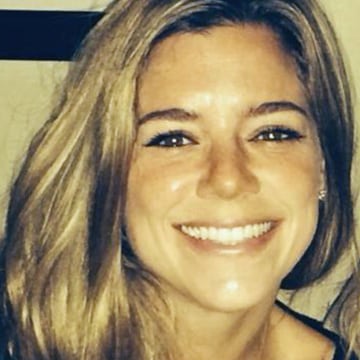
Take this case in point. San Francisco has long been a Sanctuary City, and with it a policy of not reporting the arrest or detention of illegal immigrants and of not cooperating with ICE agents. In July of 2015 Kathryn Steinle, a 32 years old, was walking along the city's famous Pier 39, near Fisherman's Wharf with her father, when she was attacked and murdered by Juan Francisco Lopez-Sanchez, an illegal immigrant with a long rap sheet of mostly petty crimes. However, of note, Mr. Lopez had been deported five times previously until finding "sanctuary" from authorities in San Francisco. Just a few months previous, Mr. Lopez was arrested on drug charges. The charges were (inexplicably) dropped, and despite ICE having learned of his arrest and making a formal request to be turned over to them, Mr. Lopez was released just prior to the arrival of ICE agents. The reason? San Francisco's policy of non-cooperation with federal authorities due to their "sanctuary" status. Had they cooperated, Ms. Steinle would likely still be alive. According to the Center for immigration Studies, of the estimated 8,100 illegal aliens arrest for a crime and subsequently released, 1900 were rearrested within a 9 month period on charges totaling 7500 charges according to a 2014 study.

The U.S. Department of Justice and the U.S. Sentencing Commission reported that as of 2014, that illegal immigrants were convicted and sentenced for committing over 13% of all crime in the U.S. The Justice Department reports that for the same period, 19% or 12,000 criminal cases filed by prosecutors were for violent crimes committed by illegal aliens. 22% or 13,300 were for felony drug charges. The U.S. Sentencing Commission found that 75% of all criminal defendants who were convicted and sentenced for federal drug violations were illegal immigrants. Want more? How about this. The FBI reported that from 2005 to 2008 there were 67,642 murders committed in the U.S., and from 2003 until 2009 there were 115,717 murders. The General Accounting Office indicates that 25,064 of these were committed by an illegal immigrant.

In California alone, which has a prison population of 130,000, 2400 of the inmates are illegal immigrates who had been convicted of murder. Additionally, for every 100,000 illegal immigrants, 92 are imprisoned for a violent crime. Does that sound like a low number to you? Compare it to this. For every 100,000 legal immigrant and citizen, only 74 are convicted for any crime. In Arizona, this number is 64 per 100,000 compared to 54 citizen and legal immigrant. In New York, the number is three times higher. For every 100,000, 169 illegal immigrants are imprisoned compared to 48 legal immigrant and citizen. The numbers are similar across the board and show that despite comprising just 3.8% of the overall population, illegal immigrants are responsible for the majority of violent and drug related crimes regardless of the "sanctuary" status where the crime was committed.
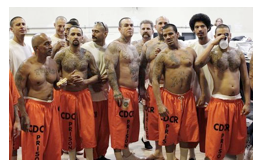
But this isn't the worse it. Not by a long shot. As I stated above, illegal activity by gangs typically follows the migration patterns of their identifying group (ethnic, religious, tribal, etc). During the turn of the 20th Century, and especially during Prohibition, criminal gangs became headline news. Previously relegated to the back page local newspapers, the likes of Al Capone and "The Outfit", "Dutch" Schultz, the Purple Gang, Dion O'Banion and his North Side Gang, "Legs" Diamond. Owney Madden, the Harlem Gang, Murder Incorporated, "Bugsy" Siegel and Frank Costello captivated the public's imagination. The majority of these criminal groups were mostly ethnic, Sicilian/Italian, Jewish, Irish, Black, or German. The gangs today are no different. Some of Russian, Chinese, Japanese, Mexican, Columbian, black, or Bosnian. Today's gangs however, are far more ruthless. While the gangs of the past seem to have a moral compass, at least when it came to "civilians", today's gangs have little regard for human life, and even less of personal property.

The top ranked gangs are often far above the capabilities of local law enforcement. In many cases, they nearly exceed government forces in places like Mexico or Latin America. Here in the U.S. it usually takes the training and resources of federal agencies to gain an handle on the situation, which presents a problem for sanctuary towns and cities who, on one hand, thumb their noses are federal laws, and on the other hand hold it wide open for federal money needed to equip or train police officers or pay for the formation of special units and any overtime. Quite the pickle should Washington opt to play the same game as cock-sure mayors or other local officials, not to mention the inevitable backlash from citizens.

So, who are these gangs? According to federal law enforcement agencies, the most lethal is MS 13, which has about 10,000 members currently in the U.S.; possibly more. MS 13 was found in Salvadorian community in Los Angeles in the 1980s and operate out 40 cities (and yes, most of those are sanctuary cities). Barrio 18 (aka The 18th Street Gang or M 18) is another highly dangerous gang. According to the FBI, M 18 has "tens of thousands" members operating throughout the U.S. which, as with MS 13, includes sanctuary cities. They are active in prostitution, drug trafficking of all types, murder for hire, kidnapping, and extortion.

Barrio Azteca has several thousand member who operate primarily in the South, but also is believed to have operations in Pennsylvania, Texas, Massachusetts, and along the Eastern Seaboard. This gang is affiliated with the powerful Juarez Drug Cartel out of Mexico. They are involved with trafficking cocaine in its various forms as well as murder for hire, especially within the federal prison system and so-called "high profile" killings. The Trinitarios originated in New York City back in the late 1980s. The gang is mostly make up of individuals from the Dominican Republic. In addition to NYC, they gang operates in New Jersey, Connecticut, Rhode Island, Pennsylvania, Ohio, and North Carolina. In addition to specializing in murder for hire, the gang is highly involved in oxycodone, crack cocaine, marijuana, and cocaine.

Chicago has its small mini-gangs (sometimes referred to "splinter" gangs which broke off larger, more powerful gangs like Gangster Disciples and the Hit Squad in the 1980s). These gangs do it all, from drug trafficking, petty crime, murder, prostitution, extortion; you name it. These gangs, which are made up mostly of juveniles (their average age is 14) are responsible for Chicago's massive murder count. An interesting aside, most of these gangs operate out of Al Capone's old South Side. Two other, more recognizable, gangs are the Crips and Bloods. The Crips were originally formed and operate out Los Angeles. This gang is a little different from the other mentioned. They are involved in bank robberies, armored car heists, store robberies, carjacking, armed assault, burglaries and rapes. Their arch rival, the Bloods, started back in the late 1960s and is one of the oldest gangs listed. The Bloods are involved in pretty every form of crime from drugs to murder and armed robbery. Like many of the other gangs, the Bloods and Crips have chapters scattered across the U.S. It should be pointed out that as much as the Crips and Blood dislike each other, they have something else in common besides their criminal activity. Both gangs are utterly despised by the Hispanic gangs already mentioned.

So, this is another plus being a sanctuary city will bring its residents, increased crime and violence, along with turf wars which have no regard life. City governments find themselves constantly trying to play catch-up with the addition costs illegal immigration brings to so-called "sanctuary" cities, just in terms of basic services. The result, thanks to higher taxes, is often local residents moving out as illegal immigrants move in. Local police, no matter how tough they think they are, struggle daily in matching the firepower of these gangs which follow the migration of immigrants, both legal and especially illegal. Meanwhile crime of all sorts increase as the gangs move in. These same gangs have no qualms about shooting cops. We'll cover more of the "bonuses" of being a sanctuary city in later issue.


5 facts about illegal immigration in the U.S.


Map Showing How Many 'Sanctuary Cities' Are Sheltering Illegal Immigrants in the US---And Where They Are


The Truth About crime, illegal immigrants, and sanctuary cities


USDJ: History of Street Gangs in the United States


10 Of The Most Lethal Gangs In America

Monday, April 14, 2014

Crossing the Divide


50 years ago, society attempted to end racial tensions by ending segregation. 40 years ago society tried to put minorities, as well as poor whites, on par with the rest of society by instituting the "War on Poverty", ended "poll taxes" to give equal access to the ballot box everyone, and instituted a hiring quota system---Affirmative Action--- to ensure equal access (some would argue "preferred" access) to certain jobs---individual and commercial. 30 years ago, we instituted forced busing to bring about education parity. We have since introduced "No Child Left Behind", and other various programs, and yet we still have sectional poverty no better than some third world nations, high levels of crime, violence, and unemployment, failed schools and failing students, decrepit neighborhoods, broken homes, taxpayer dependency, and children having children, which only perpetuates the cycle.

We've seen the education performance of students decline as academic rigueur and discipline is thrown out the window. The only thing "common" is equal underachievement for all. Underperforming minority students often threaten and intimidate other achieving minority students for acting "too white" , as if being a societal failure and more often than not, a statistic, is a goal to be proud of. Minority studies have been introduced in various colleges, yet outside academia, they have little economic value, while minority and low income students should instead be encouraged to major in high demand professions which will improve their social and economic standing. Despite federal hiring quotas and spending billions on "urban renewal" to refurbish downtowns over and over again, inter-cities continue to look more like blown out war zones than centers of economic growth.

Among most young adults, and even some older adults who grew up during segregation and the Civil Rights Movement, race has become a nonissue. Close friendships across racial lines is more common than not. Inter-racial dating and marriage, once not just frown upon, but outright illegal, is scarcely even acknowledged. Many individuals, who've survived the bullying by their peers not to succeed in school as the risk of "trying to act white" have entered into professions their grandparents could only dream of, be it corporate, law, medicine, science, entrepreneurship, or academia; many achieving the highest levels in their chosen profession. Today, it's not uncommon to have black, Asian, or Hispanic civil, military, business, or political leaders. America even has a bi-racial president (what is unusual, however, is that despite making up over 50% of the population, we've yet to have our first female head of state in stark contrast to numerous other and less "democratic" nations). The "race card" has been all played out, especially as economic parity improves.

Today, minorities can claim their own TV and radio channels, magazines, movie and music genres, social media sites, awards, pageants, associations, events, and so forth (though whites ironically, are precluded from doing so in the name of "equality"). Still, such promotions seem increasingly little more than quaint holdovers aimed at dividing society--- a commercialized version of "separate but equal"---rather than uniting us as a People. As a friend of mine once said, "the only color that matter is green".

So, the question is "why"? Why the continuing divide? Is it, as once believed, that the races ultimately cannot not long lived side by side; that eventually one will have to emerge as dominate and the others as subordinate or even perish as a race unto itself? Why, after the billions spent rebuilding, are minority dominated areas still poor and crime ridden? Why is alcoholism, single parent households, drugs, and academically failing students (with higher than average dropout rates) considered the norm in low income and minorities communities, along with the imprisonment a large segment of its population ? And, while we're at it, why is academic underperformance considered acceptable when it neither enhances the critical thinking skills of the student nor properly prepares them for life in society? Why is academic mediocrity rewarded while excellence is quietly discouraged out of fear of making someone or some group "feel bad" about themselves? Why is the failed political philosophy of "throw-enough-money-at-it-and -it- will -fix -itself" still pursued ? For that matter, why are individuals allowed or even encouraged to adopt a dependence on federal government handouts to the point of subservience when programs enhancing work skills and self reliance would be more cost effective and personally enriching while peripherally reduce crime, lower unemployment, create more jobs, and ultimately increase the overall tax base?

As the saying goes, "a government big enough to give you everything is big enough to take everything from you". From this writer's perspective, all we've succeeded in doing is to dismantled the family unit, created an economic dependency no less addictive as any drug, destroyed all sense of individual self-worth, morals, or personal responsibility, devalued life, and created a sub-culture which feeds on instant gratification at any cost, while at that time penalized those who continue to seek economic and personal self-worth. It matters little to the slave or serf their master's name except that freedom is denied.