Showing posts with label Gen Z. Show all posts

Friday, July 04, 2025

Where Has the Love Gone? The Future of the American Political Duopoly

 America’s love affair with partisan politics (if there really was one) appears to be over for good. The Democrats, once the harbinger of inclusivity, has found itself mired in mediocrity and lacking in leadership, is able to maintain relevance through Identity politics.  I guess that’s what happens when you run out of ideas and don’t have a very deep bench.

The Republican Party, as a result has benefited, especially in America’s heartland and  in particular, at state and local levels. Yet, its support seems to rest on the last vestiges of a fading demographic white, mostly male, middle class voters, and there is a subtle cold and callous undertone to their call for austerity and “making America great again” by cutting back on social security and the public social safety net but continuing to spend more money on the military than the next ten nations (including China, UK, India, France, and Russia) combined!   

However, neither those who agitate on the Left or Right are satisfied with what their side is offering. The result is an America more deeply and widely divided than at any time since the years proceeding the Civil War.  Some ominously predict a pending revolution while others anticipate a second civil war at any moment, and still others foresee for a “civil divorce”.

Even during our formative years as a nation there were those among our Founding Fathers who questioned whether we were or could ever become a truly “United States” of America. We were fundamentally too different; a multitude of nations.  Over the subsequent decades and centuries, as millions came to our shores, those divisions have only intensified. Regardless, one thing is for sure. This is not the America our Founders intended. So, lets take a look at our political landscape. Perhaps we can even predict an America just a few years or a decade or two down the road.

First, despite the popular belief that America is a “two party” nation, the truth is that it was never established that way. In fact, the majority of the Founders opposed the creation of political parties, fearing that they could become powerful special interest cliques which would in time weaken the political power of the average citizen through deception and corruption and eventually dominate government (nah. That could never happen…could it?).

Secondly, that we’re only limited to just two parties. In fact, we’ve have numerous political parties. Most have either merged with other parties or simply faded away with whatever particular issues they supported. Today, we have two primary parties---Democrat and Republican, although the Libertarian, Green, and Constitutional parties are formable.

 However, despite their public perception of two differing parties, the fact is they’re more similar than not.  For example, they’re both owned by special interests from Wall Street. Wall Street controls the finances of both parties. It funds their campaigns, their leadership PACs, and sets their agenda. It dictates their domestic and foreign policies (which are not overly dissimilar). The corporate media defines their public persona and influences their political message. Both are legal fictions given the rights of the average citizen…and then some.  They are, in fact, a duopoly of Wall Street. Another thing they have in common is that both are actually minority parties.

According to the most recent polling, Independents are the largest political demographic in the United States with just over 43% of all registered voters not aligning with either the Democrats or Republicans. As an aside, did you know that Independents have been the dominate political demographic since 2011? Meanwhile, the two corporate owned parties are roughly equal with 28% each of the electorate making Independents (erroneously called “swing voters” by some) the literal “kingmakers” of today’s politics.

Something else the Democrats and Republicans have in common is that not many people like them. According to a Pew poll, 65% of registered voters, irrespective of registration, disliked Republican polices. 56% felt the same way about Democrat policies.

A 2025 NBC News Stay Tuned Poll, showed that 71% of Independents disapproved of the direction the Republican Party was going. 91% of Democrats agreed as did 13% of Republicans (could they be the nefarious “RINOs” so hated by GOP hardliners?).

When it came to Democrats, 64% of Independents disapproved of where the Democratic Party was wanting to take the country. 93% of Republicans concurred. Interestingly, so did 22% of Democrats (those nefarious “DINOs” this time).  In short, an overwhelming majority of Americans disapproved of both Democrat and Republican policies.

Amusingly, in 1960, 4% of Democrats and 4% of Republicans said they’d be unhappy if their son or daughter married someone outside of their party affiliation. In 2019, nearly half---45%---of Democrats said they’d be unhappy if their child married someone from a different party. Republicans were apparently a little more open minded. Just 35% said they would object. Today, I suspect they’d be disowned.

Another factor affecting both parties is that they’re losing their base. Demographics in America are constantly changing. Historically, America has been a predominate white European nation since its founding while blacks were considered the largest minority, As a result, legislation and funding was directed accordingly. But that’s all changing.

Today, whites are still the largest racial demographic at 58.4% (white males, often viewed as America's political, social, and economic “powerbrokers” are projected by the Census Bureau to become a de facto minority by the early 2040's).  The second largest population are Hispanics, who comprise 19.5% of the population (that number would likely be higher if all illegal immigrates were included. However, it's  only as an estimate). Black Americans make up just 13.7% of the population. Asians are 6.4%. Those claiming two or more races make up about 3.1% of the population (and growing). Native Americans, Pacific Islanders, and others make up under 2%.

Based on projections, sometime in the next 25 years, America will no longer have a majority racial population. Whites and Hispanics are expected to have a near parity. Black percentages are expected to drop while Asians are anticipated to increase along with the number of those of mixed racial ancestry. So, what does that mean?

Well, for starters, it means that limited federal tax dollars are going to be redirected to the group with the most mouths to feed, and that’s going to be Hispanics. So, expect future federal (and likely state) programs will cater more to Hispanics which could increase competition between blacks and Hispanics for federal dollars.

Secondly, there will be an increase in the number of people of Hispanic ancestry being elected to office at all levels as a result of both a growing population and an increased concentration in key districts or dominate state with high electoral votes. So, don’t be surprised to see a Hispanic president in the next 25 years. Also, although historically, there’s been a decrease in ancestral allegiance over generations, that doesn’t seem to be the case when it comes to Hispanics.

 The reason is that historically, immigration came in waves, thus giving time to integrate into American society, aka the proverbial “melting pot”. Note too, this “absorption” was also encouraged by previous immigrants and society in general as well as newly arriving immigrants had a strong desire to become “Americans” as quickly as possible.

That’s no longer the case. First, the arrival of Hispanic immigrants (legal and illegal) are occurring as such regular rate and volume that there’s little time or opportunity to integrate. Secondly, many have no intention or desire in becoming “Americans”. They are here solely for a payday.  These are economic migrations. As a result, few bother to learn English, the laws, or adopt to customs, values, or traditions. They tend to congregate in their own ethnic enclaves. Many regularly support family back home. Therefore, nearly everything about them remain tied to their native country.

Black Americans have faced a series of serious issues since emancipation which the federal government has attempted to correct through legislation and various taxpayer based programs with varying degrees of success. As federal funding for programs and services are reduced or redirected, along with competition for jobs now being taken by Hispanics, black Americans are going to be forced to struggle harder.

Lastly, the percentage of Asians are growing more rapidly than previously. This is due to the influx of Asians from places like China, Philippines, South Korea, Taiwan,  Vietnam, and elsewhere. Another factor is that Asians tend to have large families (as do Hispanics). Thus, in certain areas, especially along the West Coast, Asians could come to represent minority majorities.

This brings us to an interesting question. With Democrats and Republicans shrinking in number, generational dissatisfaction with existing partisan politics (especially among Millennials, Gen Z and facing a declining number of Babyboomers and aging Gen X), what does our political, economic, and social future look like?  Cities, starving for economic  resources, are gobbling up smaller surrounding communities. Corporations are also continuing to gobble up everything they can, thus eliminating or consolidating competition. It already controls the government, and with it, controls funding as well as domestic and foreign policy.

 Technology, especially AI, is already proving to be a double edge sword. It’s provided opportunities for a few while reducing or eliminating jobs thus contributing to the already enormous gulf between the rich and the rest of us. It is also the tool behind our evaporating personal privacy and becoming the ever watchful eye of our emerging surveillance state. It bears mentioning that Millennials and Gen Z, both raised on technology, don’t appear to have the same regard toward privacy as older generations.

As I briefly touched on, the wage/income gap between the elites and the rest of society (which also benefits Congress and others in power) is widening. For instance, did you know that the top 1% control 31% of the nation’s wealth compared to the bottom 50% which controls just 2.6%? From 1979 to 2023, the top 1% saw their wealth grow 182% while the bottom 90% had a growth of 44%. The average CEO makes roughly 334 times that of the average employee.  

Are either of the two corporate owned parties equipped to deal with issues like these over the long term? The Democrats try to maintain power by never saying “no” and kicking the debt can down a short dead end road without a worry about who’s going to pick up the tab. The Republicans hope they can prolong the inevitable by cutting programs affecting the politically weakest and forcing open foreign markets by rook, crook, or rocket. They believe cutting taxes on mega corporations and the wealthy will improve the lot for everyone else.

Neither party are willing or able to make the changes which we need. Besides, it’s not in their vested interests to do so. It’s taken decades crafting the perfect scam. The tune they dance to isn’t the voice of the American voter. It’s sound of vast sums of money played by Wall Street. Corporatism, as under Fascism or Communism, requires a compliant citizenry convinced into surrendering their integrity and wellbeing to a state absent any real accountability, which to me is a lot like an alley cat telling a mouse to “trust me”.  Bon Appetit anybody?


Thank you for reading "Another Opinion", the Op/Ed blog page for the "militant middle".  Here at "A/O" we truly value our readers. At A/O we seek the facts as they exist, not partisan talking points.  We hope you find our articles informative and engaging. Comments are welcome, provided they are not vulgar, insulting or demeaning.  Another Opinion is offered without charge and is directed toward all independent and free-thinking individuals. We ask, however, that you "like" us on whatever platform you found us on in order to keep our articles available for free to others. Lastly, in order to keep costs down, we depend on passive marketing, and therefore, depend on our readers to please forward our posts along. Below you will find links to the sources we used in writing this article. Thank you. 


Political Polarization in the United States


Digging into America’s sour views on both political parties:From the Politics Desk


GOP Holds the Edge in Party Affiliation for Third StraightYear


Wage inequality fell in 2023 amid a strong labor market,bucking long term trends


Corporatism


U.S. Census Bureau: Quick Facts


Partisan Politics drags U.S. towards failed-state status


Friday, February 14, 2025

The Insecurity of Security: The Assault on Privacy and the Surveillance State

The United States was originally founded as a confederation of states. It didn’t take long before this confederation was replaced with a constitutionally driven democratic Republic, which is where it remained, with some slight adjustments via amendments, for 248 years.

Starting sometime after the end of World War II in 1945, when, at its political and economic apex, the country began a slow but determined transition from a republic into what it is now, a neo-fascist corporatocracy under the direction of an extremely wealthy and powerful oligarchy as President Eisenhower warned us in his farewell address (President John Kennedy would later echo the same warning).

Some have likened this to the feudalism of Middle Ages Europe. If you think of global corporations as modern versions of feudalistic fiefdoms it makes sense. Like their feudalistic predecessors,  who quietly influenced rulers, modern corporations exercise a similar control over today’s governments. To be successful requires a strong surveillance apparatus and ability to manipulate the public.

Most surveillance states use a myriad of excuses to acquire their power. But most often it centers on “public safety”. During the early years of the French Revolution in the 1780’s, Robespierre headed the Committee of Public Safety which he used as a steppingstone to the governing National Convention (eventually becoming its President).  

It official purpose was to undercover those hostile to the revolution and its stated goals of  “Liberty, Equality, and Fraternity”, the creation a constitutional republic, ending absolutism and the class system, or establishing equality under the law along with individual rights.  

However, as Lord Acton famously said, “power corrupts, and absolute powers corrupts absolutely”. Thus, it was this Committee of Public Safety under Robespierre which served as the driving force behind the infamous Reign of Terror which introduced as many as 17,000 to bite of “Monsieur Guillotine”.  

Just weeks after Adolf Hitler assumed power in January 1933, the German Reichstag (or “Parliament”) mysteriously caught fired and burned to the ground. Many suspected the Nazis of being behind the blaze, but there’s never been any hard proof. A mentally impaired Dutch communist, Marius van der Lubbe, wondering around the smoldering ruins. He was arrested, tried and convicted.  He was executed by guillotine on January 24, 1934. Both sides alleged a "false flag" attack. 

Nevertheless, not ones to let a manufactured crisis go to waste, the Nazis used the occasion of the fire to request and obtain approval to implement the “Enabling Act” or as it was officially known, the “Law to Remedy the Distress of the People and the Reich”, on March 23, 1933.

The Enabling Act served as the beginning of quick end to the Weimar Republic and with it, democracy in Germany. Of course, it was passed in the name of national security (after all, the symbol of German democracy, the Reichstag, had just been attacked). Like another similar act passed 68 years later, few knew exactly what was in it. But, among other things, it allowed for emergency laws to be implemented without the review or consent of the Reichstag (Article 48). 

Ultimately, all opposition political parties and newspapers were banned. A nationalized security apparatus and secret courts were established, and it granted the Chancellor dictatorial powers which could be renewed every four years (with the death of President Paul von Hindenburg, the offices of Chancellor and President were merged into one.  The new office was that of “Fuhrer und Reichskanzler” or  simply “ Office of the Fuhrer”).

In 2001, Congress enacted the “Patriot Act”, following the cowardly attacks of 9/11. Interestingly, the Patriot Act bore many similarities to the Enabling Act. For instance, the creation of a national security office (“The Office of Homeland Security”), it authorized warrantless widespread “spying” on U.S. citizens via existing intelligence agencies (including keeping secret files), the creation of the secret courts (aka “FISA” courts).

Importantly, it also permitted (some would say “encourage”) certain corporations to monitor customers/users, and employees (this was especially true for internet based companies) and so forth while granting these corporations legal immunity. So, apparently you could break the law as long as you were doing it for the government.

Of course, none of this is new historically. At its peak, during  the reign of Roman Emperor Hadrian, it was said that a young naked virgin could walk the length of the Appian Way at midnight without fear of being accosted.  Why? Because every ten or so feet stood an armed Roman soldier. As an aside, in 49 BC Julius Caesar used the claims of "public safety" and "order" to have himself declared dictator as did the Roman General, Sulla, earlier in 82 BC. 

It was also because there were curfews imposed and restrictions on possessing weapons and punishment of crimes were severe in the extreme. The ancient Romans understood that people will often sacrifice their freedoms for security just as they understood that businesses required order and stability to function, which benefited the state. To me, this begs the question of whether such actions as the Patriot Act, stripped of their nationalism, was more for the benefit of state and big business than the security of ordinary citizen.

Today, we find the internet remains stifled with de facto censorship hidden behind cute euphemisms like “community standards” (which has often left me asking “who monitors the monitors?” and “why are certain comments censored and not others?”).

Governments and corporations are pushing for increased measures not just to track us, but also to monitor our financial transactions. Ideally, they would like to do away with currency and reduced all transactions to a series an electronic blips. Not only would a company be instantly paid (great for the bottom line), but big business and the government (which are increasingly becoming one in the same) can constantly monitor how much money you have, where it came from, what you spent it on, where you’ve been or what sites you’ve visited.

Personally, I don’t think it’s any of their damn business. However, my opinion seems to be increasingly a minority one simply based on age attrition. Millennials and to greater extent, GenZ, don’t have the same sense of privacy as do Boomers or Gen X. Repeated studies have shown that they are more than willing to share personal data, seeing more as a commodity than something to be protected.  

Is that because they are so comfortable with technology, having literally grown up with it? Possibly. Gen X, Babyboomers, and older generations seem to place a greater value on privacy. We’re more likely to protect certain information and who we share it with. We seem to place more importance on our “space”, be it physical or cyber. But then, we’re on the decline while Millennials and Gen Z are ascending politically and economically.

For corporations and the government, ever in search of more data, this is portrayed as a boon. Given this level of access, companies can now “cater” to individualistic buying habits, thus improving their bottom line while the government can more easily calculate exactly what you owe in taxes and then automatically deduct it from your bank account. 

Even your health will be monetized. Imagine coming into the world and the first two things you received are a social security number and a genetic health test in order to determine what markers you’ve inherited and to predict your health cost to employers or society. This health information will be traded between your bank, employer, insurance companies, and even the government to determine an overall health risk score. The lower the score, the lower premiums and taxes you'll pay and the more desirable you are to employers. I'm sure you will be able to buy temporary "high risk riders" for occasional wild and wooly weekend or for vacation. 

Examples would be like,  do you enjoy high risk activities like bungee jumping or motorcycle racing? They’ll rate it on your high risk rider, and you’ll pay higher premiums for it. For those who do it often or professionally, the rider will be permanent. Let's say you require a special diet for a health issue. But try to buy something not on the recommended list and see it declined on your debit card (as well as notated in your health record for not following their guidelines). 

Have inheritable health issues like diabetes, heart disease or high blood pressure? Then could face possible higher tax rates, rejection of insurance, or being prohibited from certain jobs.  In addition to your employment and financial history, your overall “health score” rating will now play a part in your credit worthiness and employability.

In our fast approaching cashless society,  I can even envision the day where credit card companies, retailers, and public utilities will automatically deduct as pre-determined amount from your bank account before you even see it. You’ll get a brief text message alerting you of how much “net money” you have available to live on.

Your friendly taxman or woman will notify you and your bank by text the first of the year advising  of how much was deducted from your account based your income (as reported by your employer) and your personal information on file.  Thinking about deductions? Anything that can’t be electronically verified will be disallowed. There’ll be no more “estimated values”.

Crime rates are often cited as the reason for more cameras on street corners while infrared camera drones are becoming more commonplace. As of 2021, there were 71 million public surveillance cameras in use, an increase of 21% from 2018.  Businesses increasingly use bio-matrix programs to analyze nearly everyone walking in or by the business. It’s not uncommon for private residents to have surveillance cameras to deter would-be criminals.

In the sleepy backwater city of Louisville Kentucky for instance, there are 141 “Flock” cameras being used to read license plate numbers of suspected stolen cars (carjackings are a serious problem and growing) as well other vehicle infractions such as speeding, parking issues, or paying tolls.  Another 139 Flock cameras are expected to be added over the next few months. Louisville Metro Police access the camera’s database an estimated 18,000 per month!

Do you think it will be long before all this information will be tied into some database in the “Cloud” and accessed by government agencies, potential employers, insurance companies, and law enforcement? The Patriot Act has already laid the groundwork. Federal agencies such as the NSA have more than ample resources to carry it out and store it while the Office of Homeland Security would have no trouble managing it.

Wall Street and Washington have a symbiotic relationship already based on the control and consumption of resources, including data. In fact, as we’ve often discussed, there’s abundant research to confirm our former Republic is now a corporatocracy, functioning under the auspices of a tightknit superrich oligarchy (some prefer to call it a kleptocracy or plutocracy, which is just as accurate).

These are issues which may sound as if they belong in the realm of science fiction or won’t arise until sometime in the distant future. The reality of the matter is that these are issues which exists in the here and now thanks to the technology’s exponential advancements and our failure as a society to come to grasp the legal ramifications, let alone the moral implications.

At what point does personal privacy end? How far will we accept so-called “national security "interests into our lives? When does technology stop being a convenience and becomes our master?  Specifically, at what point are corporations or the government entitled to access of our personal information without our consent or is allowed to use it in making decisions about (or for) us?

As I said earlier, they will always have an excuse. Soon they may not need one. From my perspective, this is simply a new form of serfdom. It reminds me of a quote from Russian author, Fydor Dostoevsky, "The best way to keep a prisoner from escaping is to make sure he never knows he is in prison". To preserve our humanity, we should always be in control of our personal information regardless of whether we wish to protect it, sell it, or trade it without fear of retribution or coercion.   


Thank you for reading "Another Opinion", the Op/Ed blog page for the "militant middle".  Here at "A/O" we truly value our readers. At A/O we seek the facts as they exist, not partisan talking points.  We hope you find our articles informative and engaging. Comments are welcome, provided they are not vulgar, insulting or demeaning.  Another Opinion is offered without charge and is directed toward all independent and free-thinking individuals. We ask, however, that you "like" us on whatever platform you found us on in order to keep our articles available for free to others. Lastly, in order to keep costs down, we depend on passive marketing, and therefore, depend on our readers to please forward our posts along. Below you will find links to the sources we used in writing this article. Thank you. 


The Rise of Neo-Feudalism


The Road to Neo-Feudalism


How the Covid-19 Pandemic Reveals American Corporate Feudalism


 Committee of Public Safety


Enabling Act of 1933


How the Patriot Act Compare’s to Hitler’s Enabling Act


Dwight D. Eisenhower’s Farewell Address


Louisville to install more than 100 additional Flock camerasto enhance public safety


The Private Life of Generation Z


Saturday, March 30, 2024

Finding Happiness in a "Brave New World"

Are you happy?  Most people would shrug their shoulders and say something like "I guess so" which isn't really much of an answer.  But for most people, the question needs to be qualified in order to give you a more honest answer. For instance, are you talking about my finances, my work situation, my home life, and so forth?

It would also be relative as to your situation at the particular moment.  As an example, you could say you're not real happy with your work situation, but then you suddenly get a promotion with more pay, and suddenly you're one contended clam. You could have cancer and feeling pretty depressed. Then, out of the blue, you get some news that reports a potential cure and your depression almost instantly goes to euphoria.

Nevertheless, to answer properly someone question about happiness, we need to take into consideration the topic and timing. Well, the World Happiness Report is published in partnership with Gallup, The UN Sustainable Development Solutions Network, Oxford Wellbeing Research Centre, and the WHR Editorial Board, decided they were going to poll the globe to find out.

The report, which is published annually, looks at number of wide ranging factors including age demographics, opportunities, health, population, GDP, political satisfaction, degree of freedom, and environment. So, without further adieu, let's see who's the happiest in the world and who isn't!

Starting with the overall score, Norway came in the fifth spot. In fourth place was Sweden. Third place went to Iceland while second went to Denmark. As for the top spot, that went to Finland...again! In case you didn't notice, but all five overall are Nordic, which isn't unusual. Scandinavia is typically ranked in the top ten when it comes to the best educated, best healthcare system, and best government (strictly based on personal opinion obviously).

When the list is expanded, the Netherlands, Luxembourg, Switzerland, New Zealand  and Australia round out the top ten. Notice who's missing? Yelp. The United States didn't fare to well. In fact, for the first time ever, the U.S. fell from the top tier and landed in the 23rd spot, just ahead of Germany in 24th.  The countries just ahead of included Czechia (18th), Lithuania (19th), the UK (20th) and Slovenia holding down the 21st spot.

It's worth noting the bottom third worst countries to live in are mostly in Africa, although Afghanistan is dead last in the 143rd position (Lebanon is just above it at 142),  With the bottom third being the worst places to live in terms of happiness (not to mention economics and opportunities), it's no wonder that Europe is overrun with "migrants"  mostly from Africa. Unfortunately, most appear to be looking for four star rated accommodations and other freebies rather than a job.

In examining our drop, the report says that among those 30 and under, the U.S. ranked a pitiful 62 place. But for those over 60, the survey said the tenth place was all ours (as an aside, the 30 and under crowd are the Millennials and Gen Z while those 60 and up are mostly Babyboomers and some Gen X.  It also includes those of the Silent Generation and the Greatest Generation).  

Before going any further, I need to break up these groups by date. The Greatest Generation (WWII) comprises anyone born before 1927. The Silent Generation is 1928 - 1945. Babyboomers are 1946 - 1964. Gen X is 1965 - 1980. Gen Y/Millennials 1981 - 1996 . Gen Z is 1997 - 2012 and Gen Alpha is 2013 - ?.

It should be mentioned that among Millennials and Gen Z, political party registration is its lowest and dropping.  Among Millennials, Republicans make up barely 21% of registered voters. Democrats are 27% while Independents are a whopping 52% and growing. Among Gen Z, it's not much different. Republicans are only 17%. Democrats are 31%, and Independents are again 52% and continuing to grow.

When we look at Gen X, Republicans make up 30% compared to Democrats at 27%. However, Independents are 44%. Among Boomers (that's me), Republicans are 35%, Independents are 33%, and Democrats are a close 32%. The Silent Generation is the Republicans core voter group. The GOP makes up 39% while Democrats take up 35% and Independents are 26%. As an aside.

The "World Happiness Report" would seem to back this up as it says those under 30 are increasingly unhappy about pretty much everything, but especially the economy, the environment, and corporate control of politics.

Another way to look at how the percentages by generation will affect voting and the economy is based on generational preference for capitalism (our current system) and some form of socialism (likely similar to the top ranking happy Scandinavians).  The Silent Generation overwhelmingly back capitalism with 77% in favor. The balance is equally split between socialism and no preference.

Baby Boomers like their capitalism too (despite their Che posters). 60% back capitalism. 16% like socialism, while 10% are too high to care. When it comes to Gen X, we start to see a shift. While capitalism still wins out 39%, 14% want socialism. Significantly 22% don't care. When we get into Millennials, the shift becomes a little more noticeable.

Among Millennials, 34% like our current capitalist model, although 20% prefer socialism of some type yet 21% are open. Lastly, let's look at Gen Z. Although mostly in their 20's, only 29% support capitalism while a close 28% back socialism and 19% are willing to go either way. So what does that means?

From my take on the numbers, as the Silent and Boomer generations age out, the new power players will be the Millennials and Gen Z. Given the present situation of the United States (such as need to stay on an artificial war economy to get economy going, growth of illegal immigration, slide as a world power, failing infrastructure, etc), I would expect a change away from our current predatory form of capitalism.

In its place, a more managed economy which may include more regulation, especially of critical resources or industries. The biggest change may be the political system. In place to a corporate controlled duopoly, we may find open primaries, easier entry for third party and Independent candidates into election, real campaign finance reform, and term limits. 

While I question whether our southern border will ever again be secure, I expect Spanish to become our second defacto "national" language. (its essentially that already)  The U.S. will start showing concrete signs of balkanizing into racial and ethnic zones. Maybe the "Reconquista" will happen yet.

Gen Z and Gen Alpha may be the last wholly American generation. The U.S. economy may show short lived signs of the dominance it once had, but we will be in stiff competition with countries like India, China, Mexico, and Brazil (all, incidentally, members of the BRICs union). Other similar economic and military unions will form out of necessity in order to compete and defend trade lanes.

For those of us of the Silent, Baby Boomer, and older Gen X generations, the America we grew up in with all its idyllic collective memories  are gone, never to return expect on late night reruns. The Oligarchs are working hard to build a bulwark against what's coming, not for our sake, but for theirs. Their aim is to minimize choices while making it appear choices are abundant; to create a managed political and economic system.

That also entails more surveillance. For instance, while we'll have more electronic goodies than we can imagine, but ultimately you have to wonder who do they serve---us or someone else. Siri and Alexa have already proven they passively listen and store damn near everything. At what point does the illusion of convenience trump  our right to privacy? 

Will our electronic cars take us only to where we're authorized to go based on our credit rating?  We'll also interact less and less with our fellow human beings. We will start replacing flesh and blood relationships with cyber ones. Even our sex partners may come with off/on switches!  

 Our definition of "happiness" will surely have to change to meet changing technology and global demographics. Even "happy" Scandinavia is rapidly changing.  The so-called "migrants" pouring into the country and demanding to be given their free share of prosperity without contributing. I guess when you import the third world, you get the world.  I bet even Aldous Huxley couldn't have predicted this  "Brave New World".


If you enjoyed the article, please consider passing it along to others and don't forget to subscribe. It's free! Lastly please be sure to "like" us on whatever platform you use to read anotheropinionblog.com. It helps beat the algorithms and keeps our articles in circulation. Thank you!


World's Happiness Report 2024


These are the world's happiest countries in 2024


Finland named the world's happiest country (again) but young people are struggling


Party identification in the United States in 2022, by generation


Millennials,Gen Z Clinging to Independent Party ID


Which U.S.Generation Holds The Most Political Power?


Gen Z willchange capitalism as we know it


Saturday, February 24, 2024

Making Sense Of My Own "Great Reset"


We're all familiar with the term "Great Reset"  of "Great Reset Initiative" and its implied meaning being distilled down to "owning nothing and being happy". The concept, first introduced in June 2020 by World Economic Forum chairperson, Klaus Schwab, is intended to be a "reboot" of society through euphemistic slogans as "responsible" or "measured" capitalism which sounds an awful lot to me as another version of a kinder and gentler form of fascism.

Taking the term at its generally accepted meaning, we can define "Great Reboot" as a momentary shutdown and startup of any system. Accordingly, I guess now if as good as time to discuss my  personal reboot", but first I'd like make mention of a caveat. I typically don't discuss personal matters outside a very small clique of family and very close friends. 

I know Millennials and Gen Z don't have any qualms with sharing damn near anything about themselves for the price of a10% discount on some fountain drink at the nearest gas station (and sometimes, not even that). I guess in this age of rapidly vanishing privacy, I don't want to contribute to the uploading of my data to some sort of "permanent file in the cloud".  So, with that said, let us begin.

On any given day I'm nose deep in researching one topic or another in order to ensure my articles are as timely, accurate, and balanced as possible. But, I do come for air from time to time. January 28, 2024 was one such night. After a day of watching political and historical videos, reading countless economic articles and so forth, I decided it was time for a break. So, roughly around 8:00 PM I decided to call it quits for the day.

So I meandered into the living room  to watch some mostly mind numbing chatter on the aptly named "idiot box" with my wife.  I don't really recall what we watched, but I suspect whatever it was, it was on history, science, or documentary channels. Since retiring in 2013, we don't have any set bedtime. It mostly depends on what's on TV and how tired we were. Nevertheless, I was about 1:00 when we decided to call it a night.

After going through all the usual nighttime rituals, I was back in the bedroom and preparing to put my pajama bottoms on when I heard what sounded for the world like a faint or distant ringing of church bells. I paused to listen, but assuming it was my imagination, decided to continued getting my jammies on. But as did, I heard another set of church bells ringing off in the distance.  I listened a little more intently, but again, was unable to find a source.

Finally, as I finished getting ready for bed, I heard a third set church bells! Just as distant and faint as the others. This time I went throughout the house looking for the origin of this mysterious ringing.  Nothing. Everything was off and ints place. As we are pretty rural, there's no churches closest enough to be responsible. Chalking up to just being tired , I hopped into bed for what I hoped would be some restful sleep. I couldn't have been more wrong.

I don't know what it was that so abruptly woke me up but there I was... unquestionably wide awake. As I lay there trying to come to terms with the situation, it dawned on me that I was on my back spread eagle. Since I normally sleep on my side or stomach, I found this rather disconcerting. What's more was the sensation that I was sinking through the bed as if my mattress had become quicksand.

Needless to say, I sat up in a instant wondering what was going. As I sat there in the dark, looking around.  I listened for any kind of sound that would clue me in on what had happened and what seems to still be happening. After about a minute or two, I headed off to the restroom (why waste the opportunity right?) and then into the kitchen for a sip of water.

As I walked down the hall and into the kitchen , I sensed something that felt like  a finger lightly pressing on an area about 3 inches in from my left shoulder. It wasn't painful. There was no discomfort. It was, as I said, "as if "someone was gently but firmly touching me with the finger.  I felt no pain in my arms, legs, or neck. No headache. No shortness of breath. Nothing which seemed to be an obvious clue. If what I thought was happening was actually happening, then it hadn't given me any clue. No warning shot over the bow.

While in the kitchen, I got my sip of water. I looked outside to make sure everything was okay. I wondered into the living room. Nothing seemed out of order. At that point, I decided I'd go back to bed. As I walked back down the hallway, that curious pressure point seemed to get slowly more intense, but at this point it was little more than a minor irritant. 

Once I made it back to the bed, I sat there on the edge trying to make some sense of what was going on. My brain was running over every possible scenario at lightning speed. So, I slowly got back into bed....for all of about two seconds! The situation suddenly took a turn for the worse. As soon as laid down there was an overwhelming need to set back up instantly. I can't quiet explain it, but it was more like being pulled or pushed up. At that point things started happening quickly in my mind.

In a fast walk I headed into the kitchen again, turning on the light and reaching up to where I keep my 81 mg aspirin.  I've been taking an 81 mg aspirin for decades on the advice of my primary care physician as form of preventative medicine. I've always preferred a preemptive approach now rather than chasing symptoms later.

As soon as I swallowed the aspirin, I headed back down the hall and urgently told my wife that she needed to get up and get dress. I added that I thought we were going to be taking a "road trip" real quick. I added that I'll call 911, but before I did that, I grabbed a bottle of Nitroglycerin tablets which one of my doctors had prescribed for me as a afterthought following a regular visit. I'm glad he did! 

As soon as the grayish-blue pill dissolved under my tongue, I called 911. As I started to speak I quickly noticed something utterly terrifying. I couldn't speak, at least properly. It was as if I had an intense stutter. I was having to focus on every word and then every syllable. I forced myself to speak slow and deliberate so the 911 operator could understand me. However, apparently the lack of understanding wasn't on my end.

Once the emergency operator answered, I slowly gave her my name, my address, my phone number and describe to her as best as I could, the essential details. Apparently that caused a problem. Eventually this operation used a script and absolutely wouldn't deviate from it, meaning I was having to repeat each increasingly difficult word over and over. 

I could feel my frustration mount. I kept thinking 
if she'd just shut up and listen to me"! After what felt like an eternity, I got her to confirm that EMS had been dispatched. Whatever else she had to say was of no importance to me at that point.

At about fifteen minutes after my 911 phone call, an ambulance and fire truck arrived. The crew was very responsive, however, from my perspective they didn't seem to be in as much as hurry as I was! It was during this medical version of "20 Questions" that I noticed that my speech wasn't getting better and to add to the chaos, my left arm was violently shaking, and nothing I did could stop it. I also had sweat pouring down from my forehead. Folks, although I remained quiet calm, I was feeling pretty rough. After taking a EKG, it was decided that a hospital trip was in order.

I asked my wife to make sure she had all the insurance information, which we tend to keep centrally located. I asked to her call my mum and let her know what was happening. She would have to come and get my wife before they could head on over to the hospital. 

Meanwhile, since EMS couldn't get their gurney past our entrance way, I had to walk down the steps and get on the gurney while wearing a pair of pajama bottoms and a sleeveless T-shirt. Oh did I mention it was 35 degrees? I ended up requesting a warm blanket several times. As it turned out they didn't have any warm blankets available so I had to make due with a couple of sheets! I remember feeling to desperately cold. 

Once loaded, I was hooked up to another EKG machine and a few other devises to monitor my pulse, blood pressure, and oxygen. After what felt like an eternity (which in truth was about 10 minutes), we were off for a very bumpy ride to Audubon Hospital. Meanwhile, my stuttering speech pattern and badly quivering left arm continued. Despite being in the back of an ambulance,  I wasn't feeling any easier about this.

Once arriving at the Emergency room, I found myself waiting another 15 minutes or so before I could be checked in and given a room. The reason for the delay, apparently, was due to nursing shortages. Not surprising since the American healthcare system is ranked last among industrialize nations.

From that point forward, it seems that I had been transformed a pin cushion with dozens of viales of blood having been taken every few hours along with repeated chest x-rays, EKGs, MRI, CT, and coronary calcium  scan.  By the time I was released about two weeks later, I had over 190 test performed. 

Everyone who attended me in ER was wonderful. They all exhibited a tremendous amour of compassion and professionalism (except the ER doctor. He never bothered to come in a see me. For updates I had to depended on one of the ER nurses).

Little by little a cardio team of specialists began to form around me. Each bringing their own unique expertise and carefully explaining what their role was going to be. Finally, I met the chief cardiovascular surgeon. He looked more like "Doogie Howser" rather than someone who had been doing this for decades already.  Quite intelligent, and unlike most doctors anymore, he had a great bedside manner and took his time making sure everyone understood what was going on.   

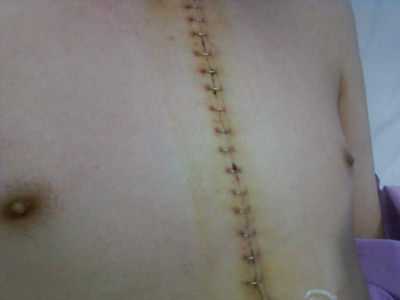
Five days after arriving in the emergency room, I underwent a triple heart bypass surgery (what they call a "three cabbage". The surgery last just over five hours, which must have nearly unbearable for my wife, sister, mum and her boyfriend. The doctors, nurses, and staff were absolutely wonderful in keeping everyone informed, and their follow up care.

The kicker, if there was one, was being informed that my prognosis going in wasn't good. I had what was known a "widow-maker" with three totally blocked arteries, which has only a 12% survivability rate if treated immediately. The good news was that the survivability of a triple bypass is 97% 20 years out from the procedure. Most people, as my cardio team said, would never have call 911 because the symptoms were so mild as to be easily ignored. Most too wouldn't have thought of taking a 81% aspirin and/or taking a Nitroglycerin  tablet. Those individuals sadly would have become statistics.

So, my "Great Reset" now begins. I will embark on a 36 cardio rehab session. There will be modifications of pretty much everything, from diet to stress to regular exercise and weight control. Fortunately, most of these aren't an issue for me. I've always tended to eat, exercise, maintain a good weight, and so on, but there's always something new you can learn.

I hope none of you will need to face your "Great Reset",  but statistically you will.  Each year, over 850,000 Americans have a heart attack, the highest of any industrialized nation. That's one every 40 seconds.  I strongly urge you not to ignore any signs your body gives you no matter how subtle. Get annual physicals, including a stress test.  Regularly check your blood pressure. Try to eat as healthy as possible. It's not always easy or convenient, but try to work something healthy into you daily diet. Keep your weight under control.  

Be sure to exercise, even if it's only going for a daily walk around the block. You can easily buy used gym equipment online cheap so you can work out whenever you're really. Lastly, consider getting healthcare DNA test done. I've done a couple and found them both very useful and entertaining. Family Tree DNA looks at 30 factors affecting your overall health. Armed with this data, it gives you a chance to anticipate  some future health issue and do something about it now.

Another terrific testing company is Ancestry which looks a various traits you've inherited. Both of these sites, FTDNA and Ancestry, give you a starting place to build your health line of defense. As an aside, there is another company, 23&Me, which offers a health and trait tests. While I did one of their tests, I was thoroughly disappointed. The information was inaccurate to the point of being unusable so I can't recommend them. 

To be forewarned is to be forearmed Take charge of your personal "Great Reset". Don't leave it to chance. 


 If you enjoyed the article, please consider passing it along to others and don't forget to subscribe. It's free! Lastly please be sure to "like" us on whatever platform you use to read anotheropinionblog.com. It helps beat the algorithms and keeps our articles in circulation. Thank you!


Widowmaker Heart Attack


The Widow Maker: Each Passing Moment Is Taking Away


Dangers of a Silent Heart Attack


Coronary bypass surgery


U.S. Ranks Last Among Seven Countries Healthcare SystemPerformance Measures


Saturday, December 16, 2023

The Pronoun Wars: The Coming of a New Generational Conflict?


How should you react when you're introduced to someone, such as a potential job candidate, as "Zie", "They", "Hir" or similar salutary title? Are you taken back or perhaps try to suppress an amused smile or smirk? 

What about when you're at a social gathering and refer to someone as a male or female and you're informed that your "gender assumption" is disrespectful. They go on to say that there are 72 genders, not two. You should first inquire to how they identify before assuming they're male or female. How do you react?

In today's labor market, employers are going to find more and more examples like these walking through their doors. Federal and state labor laws have clearly defined your limitations. In today's "politically correct" social environment, you risk the possibility of a lawsuit or social censure ("cancelled")  if you don't handle the situation correctly.

There have been several instances where companies have risked serious damage to their customer base by being labeled "chauvinistic" or "patronizing" over something as innocuous as holding the door or pulling out a chair for a female.  Repairing one's public image can also be highly expense, often involving the services of a specialty PR team equipped with lawyers and social media experts, and a long term endeavor. But in the short term, protests and online campaigns to discredit you or your company can take a significant toll on your bottom line.  

Some groups chalk up the issue of gender identity, along with the so-called "body art" as nothing more than generational rebellion, something which has been going on since the beginning of time. Therefore it will pass and there's no need to really need to take it too seriously. In the 1950's social rebellion often nothing more than "bobby socks", 'ducktales", and customized fast cars.  By the 1960's, it was "make love not war" and "flower power" and "sex, drugs, and rock n roll" in the 1970's.

The message of the rebellion was often transmitted through magazines, newspapers, social interaction, and, of course, word of mouth contact (which typically involved a change of vocabulary to set them apart from the previous generation and create a new sense of identity). Movies and especially music helped with the transformation. Both were essentially, for instance, with the growth of the anti-Vietnam War movement.

It's never changed and likely will never change, and yet employers found ways to adapt, but this seems to be different because of the extreme nature of the "rebellion". Previously, it was mostly just music, cloths, long hair and beards, and a pseudo-primitivism in the form of communes. As they matured, many decided to "clean up" and conform rather than "tune in, turn on, and drop out" of society. Albeit late to adapt, much of their lifestyle went mainstream thanks to the marketing industry looking to cash in.  

Today, technology has evolved to the point where the message can bypass societal buffers or gatekeepers such as newspaper or magazine editors, radio program directors, or music executives. Smart phones, the internet, and so forth can almost instantaneously send images around the world. They can call together protests or "rushes" in minutes. No more need for leaflets and waiting days.      

Tattoos were once the domain of bikers, sailors, construction workers and the seeders aspect of society. Proper society avoided not just tattoos, but even those with tattoos! Today we commonly see not just tattoos on biceps and forearms, but nearly full body tattoos which encompasses hands, legs, feet, neck, the face, plus the ever popular and nearly ubiquitous "tramp stamp"!   

Body piercings aren't just two or three earrings, but giant ear inserts which look more like the hose washers than a piece of jewelry.  Eyebrows, nostrils, lips, and even tongues! A few even go to extremes by trying to change their entire appearance into something akin to a mythical creature.

But unlike simply getting a haircut and a change of clothes, some of these "personal statement" ornamentations aren't going away. Nevertheless, time is not going to be kind to many of these individuals as the body graphics fade and warp thanks to ageing and gravity.  Meanwhile, how are  your client and customer base going to react  to these representatives of your company, be it a cashier, a salesperson, a onsite tech advisor, or a manager?    

Babyboomers (1946-1964) were once most largest customer base out there. They were the ones with the deepest pockets, ran the most businesses or held the most senior positions in companies. They also had the most disposable cash of any generation before or since. However, with the youngest Boomer now age 59, many are quickly closing in on retirement. While Boomers were once the most vocal and rebellious of generations (think Woodstock), the majority have mellowed and become fairly conservative.

According to the latest Gallup poll on the topic, about 44% of Boomers are socially conservative. Another 27% are moderate, while just 17% remain liberal. Older generations, such "the Greatest Generation" (1901-1927) and the "Silent Generation" (1928-1945) remain a economic factor in the marketplace despite their declining numbers.

Perhaps it was the influence of the Great Depression, WWII, or the Korean War, that's the reason  the Greatest Generation and the Silent Generation children are just as socially conservative as ever. 48% identify as conservative while 26% are social moderates. 15% of them still see themselves as liberal (I suspect this the "Dobie Gillis" or Beatnik portion of the Silents).

Currently, the largest demographic are the Millennials (1981-1996), but they aren't the latest. After the Millennials is Generation Z (1997-2012) and the Alpha Generation (2013-2025). Together, these three generations represent not just a future down the road, but the immediate near term. Millennials are already well into the labor market and entering the medical and legal professions.

Many have already started to  run for political office. Alexandra Ocasio - Cortez (D-NY) is perhaps the best known of her Millennial cohort. This is also the generation most responsible for the change in attitude toward socialism,  gender identity, body art, and even race.

While mixed racial relations having been occurring since time immoral, there seems to a growing trend in the U.S.  among these three generations. Mixed races were uncommon in 1940's and 1950's (and in some states, downright illegal), they still happened (the most common was white/European and Native American or Hispanic). Same goes for the '60's, '70's and even into the 1980's, which accounted for just 5% of births,  but then things began to change. As of 2015, 14% of all children born were mixed race. Now, nearly half---48%---of Gen Z is of mixed race.  

The Alpha Generation is still pretty young right now, with the oldest being about 10 years old. In addition, polling has suggested that the majority of mixed race individuals tend to vote Democrats because of perceived bigotry among conservatives and Republicans. Remember too that these three generations are among the largest registered Independent. Ideologically, they're split between their support of democratic socialism and libertarianism.

As an aside, when individuals with Latino and some other race  are factored in, they are projected to be the dominated race by 2050 with their population tripling. Latinos are currently the largest minority in North America, just behind white/Europeans. Blacks, once the largest minority, are currently the second largest minority and expect to fall even further behind. By 2050, they will be only slightly ahead of Asians, although in certain areas, especially on the West Coast, Asians will be the largest. 

These three generations---the Greatest Generation, the Silent Generation, and the Boomers--- are also the least likely to tolerate the gender related changes mentioned at the beginning of this article. So, it appears that we've reached a crossroad, or perhaps impasse among the six generations. The question, therefore, is whether we can cross this divide together or will it fundamentally divide us as we make this generational transition.

Although historically, the first two are the ones most associated with race inequality, they've done remarkably well in adapting, especially given that their great grandparents with the Civil War generation while their great grandchildren are likely to be of mixed race.  They also have had well over half a century of unprecedented social change to get use to.

While the Greatest Generation and the Silents laid the foundation, the Boomers were largely at the forefront in bringing those changes about. Everything from the Civil Rights Movement to the anti-war movement, the women's rights ("women's liberation"), gay rights, and other social movements such as the largely Hispanic led United Farm Worker marches, the environmental movement, Labor activism, the Grey Panther protests, and the Native American "Red Power" movement, did much to bring about not just fundamental social change in this country, but forced us to come to terms with our past and present.  

These movements led to a greater sense of tolerance and cooperation among diverse groups which otherwise would have had little to do with each other. it showed that we could work together to bring about real change. It forced a lethargic Congress to act.  But just how far should change go? Is there a limit to tolerance? As suggested in the beginning, how do you respond to someone insisting there are 72 genders or that they need to be personally address as "em" or some other nearly unintelligible word? 

The use of the term "offended" is often bandied about by Millennials, Gen Z and the Alphas. It seems like anything they disagree with, from a word, an item, an expression to political speech, is labeled as "offensive", requiring an immediate retreat to a "safe space", often free from whites, straights and especially while males,  who all are caustically categorized as "the oppressor class" with the same degree of distain that the Nazis had for the Jews in the 1930's, before the boxcars, the camps, and the ovens. Talk about being "cancelled". Even a glance can be labeled as a "micro-aggression".

Individuals attending Christian oriented schools now demand Christian symbolism be removed as being "offensive" as they cruise through school of a scholarship provided by the same school. They've even employed "Diversity Officers" to enforce compliance. I have to wonder if "papers" will soon be required from all of us.

Today, anyone who self-identifies as a female is supposed to be granted unfettered access to a biological woman's locker room or restroom. They are permitted to play in women's sports, despite inherent and unalterable biological differences. Is that fair (or safe) for natural women? Do we need to make provisions for those who self-identify as trees or cats?  How far are we to go in validating the fantasies of others? Aren't we doing more harm by reaffirming these delusions?

Their "revolutionary" predecessors of the '60's and 70's promoted free speech and expression. The current generations seek to silence those they disagree with "by any means necessary". They block traffic, loot, arson, shoplift enmasse, vandalize, loot, rudely interrupt people  attempting to peaceful dine out or blocking access to restrooms, and then claim their acts are peaceful. They claim to oppose fascism while adopting fascist behavior. They decry "cultural appropriation" instead of understanding it as cultural appreciation while committing the same imaginary crime. 

These same groups speak of diversity while rejecting it (hint: diversity is not ordering a taco at Taco Bell). They freely accuse others of prejudice while not seeing it in themselves. Racism isn't a one way street. It goes both ways. A few claim to demand "justice" for an injustice not done to them and which has long since been paid with interest. The real reason for their failures can usually found in the mirror.

One can be proud of their ancestry and culture while respecting, or even admiring the same of others. Their youthful eyes are yet willfully blind to the brutal truth that all Mankind is equally guilty of the same crimes. The only salvation of our species is our universal acceptance and forgiveness of our collective past transgressions. Such is inheritance of the noble ape.  

Today's would be revolutionaries lack the focus of Chavez's UFW or dedication of Drs. King and Abernathy's "Freedom Marches" which made their point without breaking a single pane of glass (though the same can't be said of their opponents). They certainly lack the bravery of the "Freedom Riders" who didn't commit one act of arson or vandalism although they endured it. The greatest acts of defiance were sitting in a bus seat and lunch counter or boycotting public transportation without impeding anyone else. They know tactics but lack organization. They have passion but not the compassion.

Of these wannabe anarchists, self-imposed outcasts, and social media rebels, I don't doubt they're totally committed to the shock value of their actions, be it outrageously dyed hair, body piercings that look like they were done by an "Iron Lady", being inked from head to toe while accusing others of crimes that belong to the past, opposing fascism with fascism, or self-identifying as a cat, have somehow missed the point.

They've failed to understand that there's nothing new under the sun, nor does the child inherit the sins of the parent. Change comes slowly, and only through planning and dedication. It happens by bringing people together, not driving them apart.  But perhaps it's merely the pride and arrogance of youth which they've mistaken for wisdom as has every generation before them and all those yet to come. 

If you enjoyed the article, please consider passing it along to others and don't forget to subscribe. It's free! Lastly please be sure to "like" us on whatever platform you use to read anotheropinionblog.com. It helps beat the algorithms and keeps our articles in circulation. Thank you!


The Surge of Young Americans from Minority - White Mixed Families & Its Significance for the Future


 Earth Day 1970 was than a protest. It built a movement


United Farm Workers History