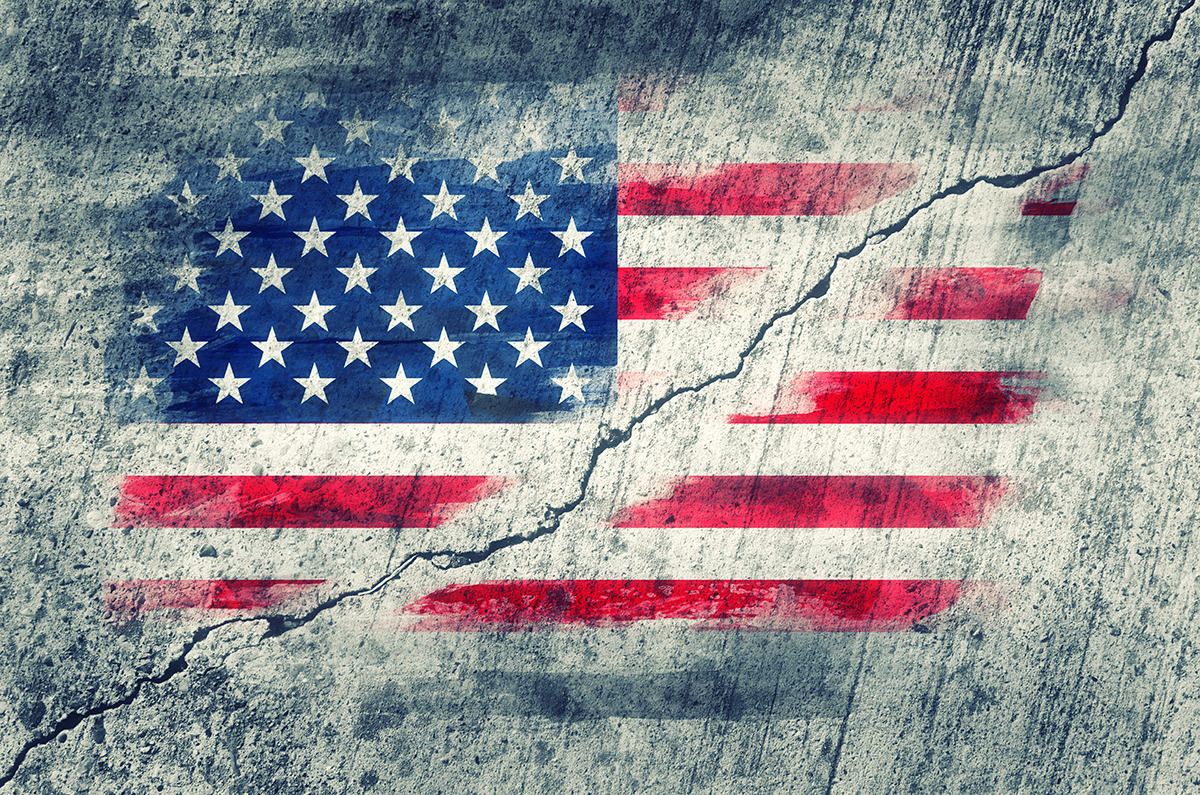
There's no question that the United States is a deeply
divided nation. It seems that we're split along practically every measure one
can think of, from politics to race and ethnic identity to social,
economic/class, and regionalism. Several
studies point out that we as Americans haven't been this deeply or broadly
divided since the 1850's, the decade just preceding the Civil War, which, after
157 years, remains our nation's bloodiest conflict.
While the numbers vary, depending on the study, most
estimates put the death total at around 620,000. That's more than the
Revolutionary War, the War of 1812, the Mexican-America War, the Spanish-American
War, World War I, World War II, and the Korean War combined!
The causes resulting in the Civil War were varied. Certainly
the issue of slavery was part of it, but it was by no means the sole cause. Other
issues such as tariffs, state's rights and sovereignty, taxation, the admission
of new states as "free" or "slaveholding", and so on were
just as important.
One of the principal issues of the Civil War was over the
right of succession with the many of the states (and not just Southern ones)
supporting the idea that states voluntarily joined the union, and with the
consent of its citizens, had the same right to voluntarily leave.
However, many Northern (and some Southern) leaders opposed
the notion of succession, holding that joining the union was essentially a one
way street. This was particularly true with many business leaders on both sides
of the Mason-Dixon Line who had a vested interested in maintaining the union's integrity.
The highly industrialized North also had a far larger
population base to draw on compared to the more sparsely populated agrarian
South. As a result, it was this combination of industrial might and population
which ultimately prevailed at Appomattox
in April of 1865.
Today, the United States is facing a similar dilemma. The
majority of American citizens are sick and tired of being sick and tired of a
corrupt and dysfunctional federal government which, like a plague, is affecting
state and local governments.
Approval ratings for not just Congress and Presidency have
been dismal for decades. However, the approval ratings for America's top ten
institutions---the pillars of the nation---are just a bad. Even the judicial
system, including the Supreme Court, are viewed as part of the problem.
The only key institutions which still has any semblance of popular
support among the people is law enforcement and the U.S. military, although
that support does not extend to the Pentagon which viewed as part of the
government.
Part of the reason for the distrust of the government, which
includes the Democratic and Republican parties, is the fact the overwhelming
majority of Americans believe they are no longer represented (a belief which is
supported by varying surveys). We can't even trust that our own votes are being
counted!
Historically the United Nations sent observers to various
third tier countries to ensure that elections were properly held; where women
and others (mostly minority religious or ethnic groups) would be allowed to
vote. Those observers would ensure that all the votes cast were valid and
properly counted.
Ever since the
election of 2000 and the matter of "dangling chads", we've continued
to have charges of improper elections. Are we looking at the prospect of the
United Nations sending observers to the United States to do the same thing?
America, as most citizens know by now, is no longer a
democratic Republic. We've become a neo-fascist Corporatocracy; a surveillance
state controlled by a super wealthy elite commonly referred to as an oligarchy
or a kleptocracy. For them, it's all
about control, be it of assets, resources, or even us.
Corporate lobbyists write legislation that corporate funded
politicians vote on. Corporations financially underwrite both political
parties, which ensure that Independents and third party candidates are essentially
barred from participating. They control the media which influences everything
we hear, see, or read. They even determine our distractions, which often
include subtle (and not so subtle) political messages embedded in them.
Is it any wonder Americans are looking to break free from
this broken hamster wheel? One way is succession. Polls show an average of 37%
of Americans would like to see their state secede. In some regions it's as high
as 60%! In this article we will look at
a few of the movements looking to break out of this dystopian zoo and start
anew. We'll start with state oriented groups first and then look at other breakaway
groups.
First is the Alaska Independence Party (AIP) which advocates
for self sovereignty. Like the Libertarian and Constitutional parties which are
popular in Alaska, the AIP supports gun rights, home schooling, the
privatization or deregulation of some public institutions such as utilities or prison
management, and a government of limited scope.
As an aside, Alaskans pay no state income tax thanks to
revenue generated from the production and sale of oil and gas. Residents also
get a annual check from the state based on a percentage of the profits
generated by the sale of Alaskan oil and gas. The AIP has been around since
1984, and while it has no elected representatives, has shown a sustained growth
in membership.
California has two separatist groups, the California
National Party (CNP) and the California Freedom Coalition (CFC). The CNP, founded
in 2017, is based on what it calls "California nationalism", social
democracy, and environmentalism. It considers itself to be center left,
progressive and "big tent". Like the AIP, it has no elected members.
The CFC was created in 2017, and has been the more successful
of the two California parties. The CFC is merger of the California Freedom
Coalition Education Fund and the California Freedom Coalition Advocacy Fund. It
also maintains a think tanks which focuses on issues relevant to the state such
as federal overreach, illegal immigration, and taxes.
The Aloha Aina Party is one of the stronger secessionist
groups. It promotes the restoration of the Kingdom of Hawaii or creation of a
Hawaiian Republic. It came into existence in 2015 with the intent in restoring
Hawaii's independence and promoting Hawaiian native culture, religion,
traditions, and language. In 2020 its
state candidates received as much as 20% of the vote. Thus far none of their
candidates have been elected to office.
The Texas Nationalist Movement is all about restoring the
Republic of Texas as permitted in the state constitution (Texas was an
independent nation for nine years before joining the union in 1845). In 2020,
the Texas Republican Party included a plank in its platform which stated that the
state had the right to ignore any laws which infringed on the Tenth Amendment
of the U.S. Constitution and reserved the right to succeed from the union. The
plank passed with a 93% approval rate.
In June 2022, a plank calling on the Texas legislature to
approve a referendum on whether the state should succeed from the union on a
2023 ballot was passed. However, as of the latest poll taken in 2016, support
for succession declined with just 26% in favor. 59% opposed and 15% were
undecided.
Vermont and New Hampshire both have active secessionist
movements. Vermont, which had previously been an independent republic, is
represented by the Second Vermont Republic while New Hampshire has the Free
State Project (FSP).
The Second Vermont Republic was formed in 2003 as a
"non-violent" citizen network and advocacy movement calling for the
full restoration of the formerly independent Republic of Vermont along with the
end of "corporate and federal tyranny" over the state.
New Hampshire's Free State Project is one of the more
interesting separatist movements. Like
Vermont, New Hampshire has a large number of politically independent voters. However,
the FSP is pushing to recruit libertarians to the state in order to create a
state based on libertarian ideals.
The aim is get a minimum of 20,000 libertarians to move to
the state. As of February 2016, the goal was meet with
20,000+ individuals having signed letters of
intent to relocate. By May 2022, about 6200 had moved to the state. In
addition, unlike the other separatist movements, 17 Free State members have
been elected to the state's 400 member legislature. The Free State Project was
created in 2001.
Lastly is the U.S. territory of Puerto Rico. Efforts to make
Puerto Rico the 51st state have been going on for decades now. Each time their
attempts come up short. It seems that Puerto Ricans want to go the other way. In
fact, it has one political party, the Puerto Rican Independence Party, three
advocacy groups, and two military organizations pushing for a independent
Puerto Rico. Efforts to break free of the United States has been ongoing since
1904.
Non-state organizations seeking to create separate entities
within the U.S. are numerous. Most tend to be racial or cultural. The Republic of Lakota is one such group. It's
comprised of Native Americans activists who want to create a completely separate
indigenous nation within the U.S. At one point, the organization was headed by
the leaders of the American Indian Movement (AIM). Currently there are 566
federally acknowledged Native American tribes and 355 official reservations
scattered throughout the United States which already function as semi-anonymous
nations.
Aztlan is a Chicano (Mexican-American) based movement
seeking to reclaim a mythical land it believes was once owned by Chicanos.
Roughly, the area encompasses the central and southern Western states including
Colorado, Wyoming, New Mexico, Arizona, Nevada, Southern California, and Texas.
The movement is supported by a well funded political organization
named "UnidosUS" (aka "La
Raza" meaning "The Race") which was founded in 1968 and has
chapters in five major cities, as well as four Hispanic and Chicano advocacy
groups as well as a paramilitary group known as "The Brown Berets". UnidosUS
has a budget of approximately $59,307,000 along with an endowment of
$142,261,521.
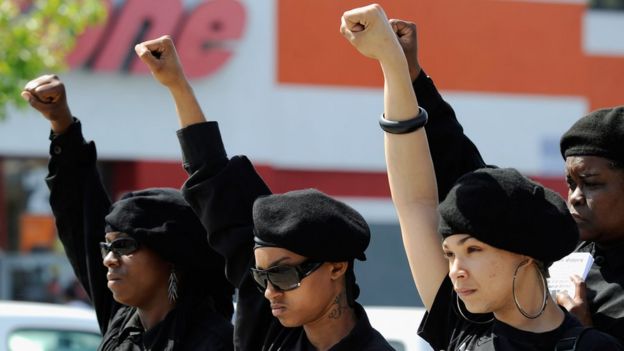
The Republic of New Africa, founded in 1968, is a black
nationalist group which claims Louisiana, Alabama, Georgia, Mississippi, and
South Carolina as the new independent homeland of all black Americans. The idea
of a separate black nation, which is viewed as racist, is supported by the
Nation of Islam and the New Black Panthers.
There is also the League of South (LS) which calls for the
creation of a independent nation comprised largely (but not exclusively) of
former Confederate states which it calls the "Southern United States".
Although typically referred to as being "white nationalist" and
"racist", what is proposed would
be non-racial, conservative, and Christian. The League of the South was formed
in 1994.
In addition to these secessionist or political independence
movements, there are several others such as the bioregional Cascadia, which
includes Oregon, Washington, and the Canadian province of British Columbia, was
originally proposed in 1843. The more recent Northwest Territorial Imperative seeks
to create an exclusive all white European "ethnostate", also in the northwestern
portion of the U.S..
Just as every empire broke into numerous independent
nations, which in turn merged and morphed over time into new countries, there's
little doubt that a similar fate will befall America. Many of the divisions already
exist and the foundations are starting to form. Politically correctness,
reverse racism, and cancel culture with its intolerance to free speech, while popular
in the short term, will only hasten the eventual creation of a new
"Disunited States of America".
If you want to know more,
please take a look at the links below. If you enjoyed the article, please
consider passing it along to others and don't forget to subscribe. It's
free! Lastly please be sure to "like" us on whatever
platform you use to read anotheropinionblog.com. It helps with the algorithms and keeps our articles in circulation.
Thank you!
New Poll Reveals Percentages of Americans Who Want to Secedeby Region
Shocking poll finds many Americans now want to secede fromthe United States
List of active separatist movements in North America
Aztlan, The Mythical Homeland of the Aztec-Mexica
UnidosUS
Are US Black separatists groups on the rise?