Home of the Militant Middle, Another Opinion ("A/O") is an Independent oriented "OpEd" blog for those looking for unbiased facts free of partisan drama and who are willing to question the Status Quo.
Showing posts with label US education. Show all posts
Saturday, February 23, 2019
Education: America vs. the World---Where Do We Stand? Pt 3 of 3 of Our "Where America Ranks" Series
The Greek inventor Archimedes once said that given a lever long enough and a fulcrum on which to place it, he could move the world. If knowledge is the fulcrum, then education is the lever which can move the world. Education can open doors as well as minds. It is not only the measure of success of the individual, it's the measure of success for a nation. Unless its properly nurtured, a nation will stagnate and eventually decay economically, politically, and societal. So, where does America stand in terms of quality of education when compared to the world? How does our students compare to other developed nations in the areas of math, science, and reading?
As we've examined in our previous two articles of this series, much of what we're told about America doesn't gel with the published facts. We have one the worst healthcare systems of any developed nation; in some areas such as prenatal care, number of beds, and availability of healthcare professionals we actually rank in the second tier along with second world economies and crippling income inequality which puts us near the bottom tier among developed nations. In terms of freedom, we again rank only in the second tier in several areas, and even overall, we're nowhere near the top. So much for being the "leader of the free world". Now, according to a 2018 report by Business Insider, the US ranks 27th overall in education; down from sixth place in 1990 (their report also ranks the US in 27th place in terms of healthcare).
The 2018 "World Top 20 Project" which focuses solely on education and its affect on each nation's economy, the top ten nations are South Korea, Finland, Norway, Russia, Hong Kong, Japan, Estonia, Latvia, Israel, and Sweden. The United States came in 24th out of the 201 nations examined. While that places the US in the top 25%, we still fell behind nations like Kazakhstan (15th), the former Soviet Republic of Georgia (17th), China (20th), Croatia (22nd), and Saudi Arabia (23rd). Why is that?
One explanation cited in the reports is the decline in spending by 3% while student growth increased by 1% between 2010 and 2014. Meanwhile, Turkey increased its spending on education by 76% along with similar growth in spending in China and Brazil. According to the Program for International Student Assessment (PISA) which measures 15 years students in developed and developing nations, the US ranks 38th out of 71 countries in math, and 24th in science and reading; all of which placing the US well in the second tier. Interesting, the top nations were Singapore (which topped all three categories), along with Japan, Estonia, Taiwan and Finland in Science; Hong Kong, Macao, Taiwan and Japan in Math; and Hong Kong, Canada, Finland, and Ireland in reading. What makes this so interesting is that these countries were all ranked higher than the US in terms of overall freedom and/or healthcare. As an aside, the top ranked US schools according to US News and World Report's 2018 edition, which are in Massachusetts, New Jersey, Utah, New Hampshire, and Iowa still fall far behind all the top Asian and several of the European schools (Kentucky, by the way, was ranked 34th while Indiana was 35th).
In terms of higher education, Masters and More, which publishes a ranking of the best countries to pursue a post-bachelor's degree based a Pearson, a multinational education and publishing company, the top nations are South Korea, Japan, Hong Kong, Singapore with Finland coming in fifth. Rounding out the rest of the top ten are the UK, Canada, the Netherlands, Ireland, and Poland. The US came in 14th out of the 40 countries represented and just behind Russia and ahead of Australia. The report looked at the primary and secondary school systems (which lays the foundation for higher education) as well as the colleges and universities. According to Pearson's CEO, Jon Fallon, the rankings "strongly reflect the economic growth of the countries", meaning that there is an obviously correlation between the quality of education and the economic success of each nation. But just how true is that?
The US spends more per student than any other country according to a Organization for Economic Cooperation and Development (OECD) report. The report says that the average amount spent per student from primary through high school is $10,759. However, the US spends $16,268 per student. As pointed out earlier, the US is, however, on the decline in spending per child by an average of 4% between 2010 and 2014. Meanwhile, the other OECD nations have increased their spending an average of 5%. Of course, that still means the US is currently spending more per child yet getting worse results than those who spend less.
The report suggests that one reason it that teachers in the US are seen as individuals who were unable to doing anything else whereas in other countries teachers are viewed as "professionals" on par with doctors, engineers, or lawyers. Accordingly, not only are they more respected in society, they are also better paid. American school teachers make on 65% of what their peers in other countries earn. The highest paid teachers are in South Korea, followed by Canada, Finland and Germany. In fact, US school teachers actually fall below the OECD average.
Another explanation is that the requirement to getting into a teaching program in other countries is much tougher than the US. Prospective teachers are expected to have higher GPA out of high school and do better on their college entrance examinations that their American counterparts. In Finland, it's easier to get into law or medical school than a teaching program. In addition, foreign students in teaching programs are required to take much more academically rigorous courses. They are also required to take continuing education courses, like their American peers, however, the courses are considered much tougher and more on par with other professionals.
Also discipline is far more strict in international school systems than they are in the US. Unlike the US, there is a zero tolerance for any bad behavior, back talk, profanity, sloppy dress (uniforms are the norm), and needless to say, violence against teachers or other students---even bullying---is a non-starter. These school systems expect---insist---that parents instill respect and discipline in their children and that carries over to the schools where physical punishment, though rare, can be enforced. Parents are also expected participate in any school functions. Failure to do so will usually warrant the attention of school administrators. I strongly suspect that excuses aren't tolerated.
Some have argued that bad behavior results from low income or "disadvantaged" children, especially among minorities, yet according to OCED, there are 37 other countries with are economically poorer and have fewer resources than the US yet they consistently outperform the US academically. One possible reason it that schools in Europe, and especially Asia, set and demand higher academic standards that American schools, and that translates into discipline in school. In fact, it's their official academic policy and practices. Children in Singapore for instance, are given a thorough assessment prior to first grade in order to determine if they meet the minimum grade criteria. If they fall below the bar, they must first be brought up to speed before being allowed to start.
Students are also regularly tested in ensure they meet minimum grade criteria before being passed to the next grade unlike many American school systems which "fail forward" students out of fear that parents will complain or allege "discrimination". American schools seem to have adopted the Washington solution to dealing with problems which amounts to kicking the can down the road and letting someone else deal with it. The end result is students graduating with a high school diploma but having only a functional eighth or ninth grade education or less in terms of reading.
In Germany, which is noted for its academic excellence, students are tracked academically as well as to their interests. In Germany, students may be tracked for higher education or for one in the trades, which is another key difference. In the US, it's assumed that all individuals are destined for college regardless of whether they are so inclined. As a result, you see students racking up crippling debt and ending up with useless degrees. It also artificially raises the bar for getting a job.
The majority of employment opportunities should require no more than a high school degree or perhaps even a six month or two year technical certificate. Meanwhile, critically needed trade jobs, which require less education and are far cheaper, go unfilled. In addition, these jobs typically pay much better than the average four or six year degree and have better benefits. In Germany (and the rest of the world), there is no stigma between someone in the trades and some with professional degree, which can't be necessarily said of the US.
So, in terms of education the US is no better off than when we looked at its ranking on freedom or healthcare. At best, the US education system is well out of the top ten list and typically falls towards the middle of the second tier. The main reasons do not include the amount of money spent on each child (we top the list), but on attracting less the best into the teaching profession. This is due to both the perception that a career in education is somehow inferior, therefore the criteria is lowered, and that teachers are poorly paid when compared to their peers elsewhere.
The second reason is that expectations for students are set lower for US students than elsewhere, and that includes discipline. Respect should be a given, not something we bargain for in order to avoid violence in the classroom. We've allowed ourselves to become so focused on meaningless labels as part of a group rather than on our potential as individuals. Students should be individually tracked and constantly monitored as to their performance. Parents must be made a part of the solution rather they expecting teachers to serve as their glorified, if underpaid, babysitters. Lastly, students should be expected to perform and not "flunked through" or "failed forward". They either meet minimum expectations and move on or their they don't. If they don't, they must be held accountable and meet the criteria before moving on. A high school diploma must be made to mean something again. Also, I believe way too much emphasis is placed on sports, especially at the Jr High School and High School levels rather than on academics. Only a tiny percentage make it into professional or even semi-professional sports but everyone needs critical thinking skills and know how speak and write properly along with how to read and
do math.
The third key reason is attempting to herd students through a system where they may or may not fit. Not everyone is college material and not every job needs someone with a college degree. If a high school diploma is restored to its former value, most graduates can handle the majority of jobs out there. Technical and trade schools are an excellent option for many students. They pay well, have great benefits and they're in high demand. They also can be earned quicker and at a fraction of the cost of a four year degree. Students who do chose to attend college should be strongly encouraged to obtain degrees which have some market value (ie: requiring a Art History or Minority studies degree to also have a mandatory dual major in business, accounting, or computer science). Coming out with a worthless degree and tens of thousands of dollars in debt makes no sense at all and creates additional financial problems down the road.
A nation's overall success depends on the quality of its citizens. A uneducated populace is a little better than herd of sheep waiting to be led to slaughter. It's one of the key reasons---if not the key reason---democracies and republics fall. For the tyrant, an educated populace is dangerous. They know the limits of government. They understand and will defend their rights. An educate citizenry also provides the best opportunities for a strong economy, and that means job growth and economic stability. It also means a better quality of life for everyone, and who doesn't want that? As our readers know, America is an Oligarchy now, run by a professional political class of plutocrats who think they know better than us. One can almost track their rise alongside our decline in education, and with it, our standing as a nation of free people. The only question we need to answer is this---what are we prepared to do about it? Lastly, I would like to thank you for reading and your comments. I hope you've enjoyed this three part series about how America ranks with the rest of the world in the areas of freedom, healthcare, income inequality, and education, which are at the core of every nation's success or eventual downfall.
The US was once the leader in healthcare and education--now ranks 27th in the world
US students' academic achievement still lags that of their peers in many other countries
World Top 20 Project: International Education Database
40 Top Education Systems in the World
The US spends more on education than other countries. Why is it falling behind?
US News and World Report: Education Rankings
Labels:
academic performance,
academics,
Asia,
colleges,
freedom,
Healthcare,
high school sports,
jobs,
Kentucky,
OECD,
PISA,
school debt,
school violence,
teachers,
trade schools,
US education,
vocational education
Saturday, May 05, 2018
The State of America's Education System: How Low Can You Go?
I've always been a strong proponent of education. Education, as far as I'm concerned, is the linchpin to society. An educated populace is a productive populace; capable of doing a vast variety of work. This attracts businesses which generates taxes (both direct and indirect), as well as attracts other peripheral businesses, and so it continues. The result is often a community which offer a wide range of amenities, such as parks, museums, restaurants, as well as a strong social and structural infrastructure, from up-to-date sewer systems, electrical grids, clean water to adequate and well trained police, EMS, and firefighters. It should also include not just well paid teachers, but teachers who are as well respected and appreciated as some sports coach.
I would add that a well rounded graduate of high school should have completed an art or art appreciation, music class, or theater class. Kids that take what they want, without being intellectually challenged leave school underserved by not just the teachers, but the entire school system as well. Many are simply "flunked through" because of pressure by parents and the school system not to hold students back out of concern that it will "damage their self-esteem", not to mention how it makes the school system look to voters.
As a result, both the student and society often end up paying the price. The student-now-adult often finds that their nonchalant attitude in school now makes them virtually unemployable. Many take low paying and unrewarding jobs. Some end up in criminal gangs, which eventually leads to prison and/or the cemetery.
For the girls, they often end up pregnant and more often than not, on their own since their boyfriends end up being more immature and irresponsible "boys" than men. Either way, an significant portion end up on public assistance (tax supported charity in truth). The same goes with those who just want to concentrate on sports. Fewer than 1 in a 1000 every actually make it into professional sports and make the obscenely big money. That's some pretty poor odds.
Those who do succeed need more than athletic ability. They need the intellectual ability to think critically, to hold a reasonably intelligent (and intelligible) conversation. Most of all, they need to be able to properly interact with others; non-jocks like lawyers, financial advisors, team agents, owners, managers, the media, and other players. Far too often we see student-jocks coming out of high school (or even college) who aren't smart enough to do basic manual labor.
One of America's big failures in terms of education, has been "dumbing down" the academic expectations of students (this is a big problem in some communities where academic success is seen as a "betrayal" of one's race or cultural identity).
The idea has been that create some misplace notion of "parity", as if all students are somehow intellectually equal, or that one group may fail disproportionately to another group. As a result, everyone gets punished.
Instead, students should be allowed to advance based on their own ability. Meanwhile, slower students should be allowed to progress at their own pace. Perhaps more advanced students could serve as teaching aides and help individual students in exchange for extra credit.
In recent years, we've seen an increase in students attacking teachers. Hand-in-glove with this, we've seen an attempt by public schools to engage in a form of appeasement by allowing students to take what classes they want, lowering standards and grading requirements, providing "cooling off" rooms, etc.
Meanwhile, teachers aren't suppose to strike back or defend themselves. At best, the student might be suspended for a brief period. In a few cases, the student might be arrested, but there is usually a lot of pressure brought to bear not to press charges out of concern that it may have a negative impact on the student.
We certainly don't want to see them forced to take responsibility for their bad behavior now would we? As for suspended students, they end up getting what they want---out of school and free to go do whatever they want, which eventually turns out bad for them and occasionally for society too. Students with a repeating pattern of this type of behavior need to be dealt with in specific manner.
Instead of suspending these students, they need to be placed in special schools designed to modify their behavior. Here the rules have to be different. Emphasis has to be on engaging the student directly, and if necessary, responding to violent outbreaks with appropriate responses.
Bullies (and these often tend to be bullies who haven't been taken down a pig or two previously), need to be confronted. In addition, these individuals need to be assigned to these type of schools for a minimum of a month---24/7. Their personal behavior and academic performance dictates the length of their stay.
Parents and selected friends can visit, but they can't leave. It can be a tough punishment, but their behavior brought it on themselves and it's better that they learn to take responsibility for their action now than down the road and end up in prison or dead (as an aside, America leads the world by far in terms of percentage of imprisoned population).
Speaking of school, I also want to stress that while there is a strong emphasis on going to college, college is not only not for everyone, it's really not necessary for most jobs (especially if high school had properly prepared the individual for life after school). Not every manager or supervisor needs a four or six year degree. Trade and vocational schools are often a much better option than college.
First off, they prepare individuals for entry into the workplace much faster than college. They are also far cheaper so you don't rack up the massive school debt, and you often can start working in the field of your choice while still in school. They pay is generally excellent, as are the benefits. For experienced individuals, it's usually a short step to go into business for yourself.
For those who do decided to go to college, it's important to think realistically about what you want to major in. It's nice (or idealistic) to think about getting a degree in gender or racial culture studies, or in some other obscure topic, but will it give you a job when you graduate? Will taking a course in "Star Wars vs Star Trek" actually help you land a job? Is the degree you end up with enough to pay off a $100,000+ school debt? You have to think in practical terms.
College is about learning to think more critically. It's about learning to appreciate different opinions without not necessarily having to agree with or feel threatened by those opinions. It's about being able to express your ideas in a well thought out and reasoned manner. It's about using reason and logic to analysis an argument or situation.
College is not about shouting down those you disagree with. It's not about forcing them off the stage or destroying property when you don't get your way. It's not about having a "safe space", nor is it about getting coddled or trying to make everyone happy. It about making an informed and well reasoned argument in a respectful manner using critical thinking skills. If you can't do that, then you need to consider what you need to do grow up emotionally. Perhaps you should consider a stint in the military. I guarantee you'll grow up there in a hurry.
So, with that said, how does America stack up academically compared with the rest of the world? According to the site "Ranking America", their latest study from 2015 ranks American public schools 14th overall academically in the world. South Korea, Japan, Singapore, Hong Kong, and Finland, in that order, make up the top five.
The best performing school systems in America, Vermont and Massachusetts, can't compete with students in countries like Taiwan, South Korea, Hong Kong, or Singapore in subjects like math and science.
Speaking of science, the school systems in Alabama and Mississippi are closer in academic performance to countries like Kazakhstan and Uzbekistan, while the school system in the District of Columbia is the academic equivalent of Bahrain. Overall, America's academic performance among its public school resemble those of third world countries.
Countries like China, India, Pakistan, and Japan far out produce the US in graduates with medicine, engineering, robotics, and computer science degrees, especially at the masters and PhD levels. Ironically, the US spends more on education than most countries--6% of its gross domestic product---which is on par with countries like Ghana, New Zealand, Saudi Arabia, and Morocco. Interestingly, it's also far more than countries like Korea, Taiwan, and Japan, who outperform us, spend.
Finally, in terms of teacher pay, apparently US teachers are about average in terms of pay with an average of $43,600 per year for a primary school years with 15 years of experience compared to an average of around $39,000 for other teachers in economically developed nations with the same experience.
Thus, American school teachers are paid roughly equivalent to teachers in the UK, Australia, and Holland. As an aside, the highest paid teachers are those in countries like Luxembourg, South Korea, Switzerland, and Germany.
However, American school teachers spend a lot more time teaching compared to other teachers around the world. US teachers spend, on average, 1089 hours teaching compared to 794 hours in primary education, 709 hours in lower secondary education, and 653 hours in upper secondary education.
Thus, it appears that while US teachers spend more time actually teaching, they aren't equally compensated for the time they spend in the classroom. Of course, I should point that it's not uncommon for teachers to pay for school supplies out of their own pockets to make up for shortfalls in schools budgets (which often ends up in the salaries of administrators, who tend to be to numerous for most school systems).
So, there you have it. This is the state of American schools, where bright students often find themselves held back in underperforming schools; where even average students find the academic process disruptive and their academic opportunities short changed. In college, students aren't properly taught critical thinking skills and instead of being taught the true meaning of liberal arts, they become narrow minded and provincial.
Our teachers aren't paid bad, but neither are they paid for the work they actually do. We are continuing with our downward trend academically compared to the rest of the world, which may soon render us just another second tier nation with large swath with more in common with third world nations than not; a faded world power like so many who came before us. Meanwhile, America's military budget, at the direction of the ruling Oligarchy, continues to expand at the expense of our infrastructure, and ultimately, our children. The only real question is what are we going to do about it?
If you enjoyed the article, please consider passing it along to others and don't forget to subscribe. It's free! Lastly please be sure to "like" us on whatever platform you use to read anotheropinionblog.com. It helps with the algorithms and keeps our articles in circulation. Thank you!
Estimated probability of competing in professional athletics
A Long Shot: More than three-quarters of men's Division I basketball players think they will play professionally, but less than 2 percent make it to the NBA
Here's How American Stack Up Against Students In Other Countries
America's Top States For Business 2017
Labels:
academics,
college sports,
Crime,
education,
high school sports,
Millennials,
Oligarchy,
prison,
teachers,
trade schools,
universities,
US education,
useless degrees,
vocational education,
war,
youth
Saturday, March 03, 2018
Gun Confiscation As A Fool's Errand: Realistic Solutions to the Gun Violence
With all this talk about guns and "gun control", raising the age to buy an rifle to 21 (the same age you have to be in order to buy a pistol), as well as all the other discussions made me stop and think for a moment about the violence in the first place. First off, most of these school age mass murderers were on some psychotropic drug for behavior issues. Further investigation seems to indicate a tendency by the parents to leave the child alone a lot; to their own "devises" as it were. Also, the individual was rarely disciplined (parents who made idle threats--counted to three a lot) and children who faced little consequences for their actions.
Another interesting factor is that these children often felt as if they were outsiders; somehow "weird" or ignored; not taken seriously. For them, violence seemed to be their only answer; their only solution if you will. It brought them attention. It rid themselves of those who refused to accept them. As for the suicide at the end, that too seemed fitting. After all, if they felt they "didn't belong", then what was death to them but a quickening of a fate they knew they were destined for anyway. As for the adults, again we see individuals who suffer from some sort of mental illness, usually some type of identity crisis, which is treated with some form of psychotropic drug. I can't explain why this is. I'm neither a psychologist nor someone who treats mental illnesses. However, I am a keen observer of people and of cause and effect. I am also very familiar with history.
"Cry Havoc and let lose the dogs of war!", a phrase uttered by William Shakespeare's Mark Anthony in his play "Julius Caesar" (Act 3 Scene 1), which is perhaps one of the most famous lines ever penned by "The Bard" as Shakespeare is known. Man is both a spiritual being, capable of higher thought, compassion, empathy and a predatory animal; one capable of incredible acts of horror and carnage. Mankind has sought to overcome this most base aspect of His nature, or to find a balance at least in countless religions, ideologies, and philosophies but it's hardwired into our brains.
The ancient Greeks felt that a state at war for too long became immune to it; "drunk on blood" as the saying went (some have argued that was one of the reasons for Sparta's furious reputation. It's population was desensitized to the bloodshed; their famous red capes being the color of blood). We hear of the brutality of the Roman Legions, and indeed, some of the Caesars, which over time, not just desensitized the populace to violence, but actually created a craving for it---"The Games".
No one knows how many thousands, or perhaps tens of thousands died in the so-called "games" held throughout the empire which was riddled with coliseums great and small. The blood sports were stage for "entertainment" of the masses; a release for what's ailing society at the time and a way to blow off steam which might otherwise turn into riots, protests, or revolutions. Most of the time, these games involved animal on animal (often a starving predator and prey or two opposing and hungry predators), man vs a apex predator (it was also a gory but popular and cheap way to rid the prisons of murderers, thieves, rapists, and political prisoners).
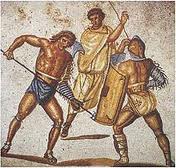
Of course, when most of us think of these games, we think of gladiators, which were the prime reason people attended the games. Most were simply fights--often several happening at the same time---where one wins and one loses. On rare occasions, these fights were to the death (as the empire continued to decline, these type of fights became more popular). It's not surprising really. Rome found itself going from being the conqueror to becoming the conquered; always being attacked or facing a rebellion somewhere within or near its borders. As a result, the legions became more brutal; they became more barbaric than the so-called barbarians that they had come to "civilize". Of course, we can fast forward through history and find pretty much the same thing. The longer a people are subjected to violence, the more they become almost immune to it, and the more it takes to elicit a reaction.
Some professionals will tell you that it's a natural or built-in response, an "off switch" if you will, to protect our psyche. I have no doubt they are right, but at some point what the senses witness simply overwhelms our ability to cope and so we snap. Call it combat "fatigue", "exhaustion", or "shell shock" or PTSD, or even "cowardice" as some claimed (the British High Commission were particularly notorious for this assertion during WWI, resulting in soldiers being imprisoned or even executed), the results are all pretty much the same. Most will agree that the brain is affected in some way which causes a variety of changed behaviors ranging from total withdrawal, uncontrolled crying or laughter, physical shaking, a purposefully lack of hygiene or ability to control bodily behavior, all the way to extreme pacifism or aggressive behavior.
America, perhaps more so than most countries, is a nation of "latchkey" children; children which basically raise themselves, with either both parents working full time jobs while trying to carve out some type of "personal" life to parents in name only. Thus, the kid is left to occupy themselves, which is sometimes when the trouble begins. Meanwhile there are those individuals who were little more than children when they found out they were about to become mothers or fathers themselves. Most are usually poor, willfully uneducated (meaning they blew off school intentionally), come from broken and often abusive homes, and live off the charity of taxpayers, churches, or other social organizations. Rampant drug and alcohol use is commonplace, as is crime and gangs.
As an aside, whenever you watch or listen to an interview of the parent(s), they invariably have some excuse for why they allow their children to do as they please like "they just won't listen to me", "their friends are responsible", "it's the teacher's fault", or even that society is somehow at fault that their child is a thug, junkie or drunk, or whatever. It's this failure to accept and take responsibility that really irks me the most. Someone---the parent---needs to take charge, which means, as often as not, getting their own act together, which many don't want to do. Personally, I think steps should be taken to keep them from having more children (temporarily) which they're unable or unwilling to take care of as long as they're on the taxpayer's dime, but back to the topic at hand.
What does this all have to go with gun violence in our schools (or in society in general)? Several things. First, owning a gun is not the problem. Americans have owned guns from the beginning. At one time, some schools even offered gun safety classes (of course, they also required civics classes too). I do agree that the age limit to buy a rifle and pistol should be same and equal to whatever draft registration age is (if you can carry one on behalf of the government, you can carry one as a citizen too). I think that there should be a mandatory gun safety class with each purchase, and yes, I think civics should be brought back too. Children, especially young adults, need to understand what the Constitution and Bill of Rights are from both a scholastic and practical sense.
Along with this is the need to reestablish discipline in the schools. Teachers are not underpaid babysitters, and no teacher should ever feel threatened or endangered. I know that it's not "PC" to paddle their little butts, but expelling (free time off) sends the wrong message too. Perhaps exposing them to some real life "bad boys" and "bad girls" in prison followed by a "boot camp" environment (with looser rules on how discipline can be applied) is the way to go. However, parents must step up too. Yes, I know everyone is busy these days, from work and attending meetings or going to night school to sitting at home eating Mickey D's and watching Oprah to robbing the local 7-11, doing drugs....or in jail. Whatever.
If you brought a child into this world, then guess what---you're responsible for them. Not strangers. Not your parents or grandparents. Not society. It doesn't take a "village". It takes a active and interested parent. So grow up. Pull your pants up, and step up. Therefore, I think parenting classes should be required to. I don't care who offers it---churches, schools, some social service agency---just as long as everyone attends in order to graduate high school. Perhaps the classes could even start in junior high school---whatever it takes.
Next, and I think is the most critical factor, is that in this country we glorify violence. It's on our TVs 24/7, in our movies, and as often as not, it's in even in the music, and it's on our video games; the more graphic and gorier the better. Kids and young adults are exposed to it constantly. Before the era of "smart phones", they could at least get away from it for awhile, but now they can carry it with them all day and all night. When we were kids the most gore we usually saw was a broken arm, scraped knee or elbow (maybe a bloody nose). We weren't exposed to it constantly. Even cheesy "shtick" violence seemed real enough to us!
Now, these kids and young adults get to blow out brains, decapitate people (or aliens), not to mention commit all sorts of general mayhem, albeit cyber mayhem while eating their Gummy bears or chips and slurping on their sodas. But how long does it take kids with not supervision or control, with no sense of responsibility, who are being drugged in being compliant, to take the step from cyber mass murder to real life mass murder? They already have little or no respect for others---especially differing opinions Given their overexposure, they've already become largely desensitized the violence.
Ultimately, therefore, the increase in gun violence, be it in schools or even by the police, may be the result of a society which has become "blood drunk" like the Romans and other had before us (of course, kids taught to challenge or runaway from the cops doesn't help either). Perhaps we've become immune to seeing violence, real or fake (which is increasingly harder to discern between the two). America has already been at war for longer than at any point in its history, and it shows no signs of abating. If anything, this manufactured "War on Terror" is designed to be nearly as eternal as any government bureaucracy.
Perhaps too this is intentional. In a country with a never-ending need for cannon fodder, it benefits the system greatly if the sheep have been conditioned to administer and accept slaughter. Being desensitized to the carnage certainly fits the bill doesn't it? So what if a few "loose inmates" escape and cause some damage? The occasion can always be turned into a renewed campaign to disarm the public from one thing protecting them from a government run amuck---a means to protect themselves and (most of all) fight back.
People seem to have either forgotten or chosen to ignore the fact that we are not the America our Founders created. We are not a Constitutional or democratic republic, no matter how many times we pretend it is. Wishing it was still so won't bring it back. Sorry folks. America is an Oligarchy; a plutocracy with an ever expanding surveillance/police state. There is "Them" and there is "Us". There are rules and laws for both, but they aren't equal or always just. For the ruling class, treason is laughed off as naive. For us, it's unpatriotic, "Un-American", and criminal. Paying one's "fair share" of taxes is for chumps. Corporations are now people, but only more so. Money is "free speech", especially in politics---except yours and mine are still capped; limited.
Freeing Americans of their guns (or simply stigmatizing anyone with guns or who support the 2nd Amendment) is now seen as a realistic goal. The political/corporate establishment don't see this as a problem, at least not as long as video games, TV (with its uncensored cable and satellite channels), and movies exist. Besides, modern warfare is more technological today anyway. If you can fly a remote cyber or real drone using a remote control stick, then you too can fly a real multi-million dollar drone and watch the bad guys just like on your video games.
Just like your video games, you can strafe the fleeing baddies or even launch missile strikes and blown them to bits, and all in real time and in vivid 3D color! At the end of your shift, you get to go home (possibly playing your latest video game as leave---stop for something to eat with your friends, and then back home. However, there's one key exception. Instead of simply color pixels flashing and disappearing from the screen, real flesh and blood human beings are dying or dead. In this "video game", there is no reset; no "redo". There is no coming back from the dead. While you eat, the buzzards do too. Not a pleasant thought is it?
America spends over 50% of its budget on the military (and I will add, the men, women, and their families, aren't paid or compensated nearly enough for what they do in the name of corporate greed disguised as "patriotism"). America, in fact, spends more than Russia, China, India, France, the UK , and the ten countries on the list. Pax Roma. Pax Americana. Of course, the expenditures are always justified as "protecting global freedom", "national security", or "making the world safe for democracy", when in reality it's about the ability of corporations to extort resources from unwilling countries or indigenous peoples, using the military as their quasi-private "muscle" to enforce polices they helped write, and making the world safe for corporate profit, and all in our name.
I've often wondered what America would be like if part of that 50% went toward schools. After all, a well educated citizenry is critical for the protection of any nation. Maybe additional school programs could be added, like those mentioned earlier, and perhaps others such arts, history, critical thinking, debate, writing, English, as well as more trade schools. Surely these are things which make for a stronger country.
Maybe some of that money could be invested in better training for the police in order to weed out the wannabe "Wyatt Earp" types from the real public servants; more emphasis on reform and less on punishment for non-violent and first offenders. A little toward rebuilding our infrastructure or securing our borders wouldn't hurt either. We need to ensure public safety through better designed roads and bridges (and especially improving public transportation through trains, subways, and trolleys), as well as repairing the ones we have (which, again, is why we need to invest heavily in trade and vocational schools). Shouldn't this be considered "national security" too---safe roads and bridges? Given that we are by far the world's strongest military, and we have alone have enough nukes or other weapons of mind-boggling destruction to turn this world into something that even cockroaches wouldn't want, would they actually miss 10% or even 20% of that---our---money?
The weapons aren't the problem dear reader. They are neither good or bad. Their appearance is neither good or bad. It's the person with their finger on the trigger and their intentions. More often than not, that individual's intentions are benign. When it's not, it's usually for self defense. However, it's those who are planning evil that we hear about, which is to be expected. Death, for the time being, still shocks us. I hope it never stops shocking us.
I would even like to see a time where even hokey "shtick" violence shocks and surprises us again. But that will mean taking responsibility, at home, at school, and as a society regarding the extent of violence we will tolerate, be it on TV, at the movies (with their hypocritical producers, directors, actors and actresses), in music, and video games such as mandatory parental approval for underage children. The beauty of Capitalism is how it responds to money...or the absence of money. Ultimately, it is the parent(s) who should set the ground rules and enforcement them, rather than simply drugging the child to control their behavior. Maybe they should be treated the same way we treat soldiers and civilians who suffer from PTSD as a result of overexposure to violence.
We should also include a basic training in gun safety too with each purchase---new or used. People who own guns should know the proper care and use of every firearm they own, from how to clean it to how to use it, and when. Finally, we must find a way to stop the Oligarchs from using our children, grandchildren, and us as their cannon fodder; of desensitizing us to war, violence, or bloodshed in order to promote their agenda of a unarmed populace living in a heavily armed police state and readymade soldiers willing to whatever enemy the corporate state manufactures in the name of whatever patriotic slogan is popular at the time. The solution starts and ends with us, not by self-limiting or aborgating our rights but by taking them back.
20 companies profiting the most from the war
Another interesting factor is that these children often felt as if they were outsiders; somehow "weird" or ignored; not taken seriously. For them, violence seemed to be their only answer; their only solution if you will. It brought them attention. It rid themselves of those who refused to accept them. As for the suicide at the end, that too seemed fitting. After all, if they felt they "didn't belong", then what was death to them but a quickening of a fate they knew they were destined for anyway. As for the adults, again we see individuals who suffer from some sort of mental illness, usually some type of identity crisis, which is treated with some form of psychotropic drug. I can't explain why this is. I'm neither a psychologist nor someone who treats mental illnesses. However, I am a keen observer of people and of cause and effect. I am also very familiar with history.
"Cry Havoc and let lose the dogs of war!", a phrase uttered by William Shakespeare's Mark Anthony in his play "Julius Caesar" (Act 3 Scene 1), which is perhaps one of the most famous lines ever penned by "The Bard" as Shakespeare is known. Man is both a spiritual being, capable of higher thought, compassion, empathy and a predatory animal; one capable of incredible acts of horror and carnage. Mankind has sought to overcome this most base aspect of His nature, or to find a balance at least in countless religions, ideologies, and philosophies but it's hardwired into our brains.
The ancient Greeks felt that a state at war for too long became immune to it; "drunk on blood" as the saying went (some have argued that was one of the reasons for Sparta's furious reputation. It's population was desensitized to the bloodshed; their famous red capes being the color of blood). We hear of the brutality of the Roman Legions, and indeed, some of the Caesars, which over time, not just desensitized the populace to violence, but actually created a craving for it---"The Games".
No one knows how many thousands, or perhaps tens of thousands died in the so-called "games" held throughout the empire which was riddled with coliseums great and small. The blood sports were stage for "entertainment" of the masses; a release for what's ailing society at the time and a way to blow off steam which might otherwise turn into riots, protests, or revolutions. Most of the time, these games involved animal on animal (often a starving predator and prey or two opposing and hungry predators), man vs a apex predator (it was also a gory but popular and cheap way to rid the prisons of murderers, thieves, rapists, and political prisoners).
Of course, when most of us think of these games, we think of gladiators, which were the prime reason people attended the games. Most were simply fights--often several happening at the same time---where one wins and one loses. On rare occasions, these fights were to the death (as the empire continued to decline, these type of fights became more popular). It's not surprising really. Rome found itself going from being the conqueror to becoming the conquered; always being attacked or facing a rebellion somewhere within or near its borders. As a result, the legions became more brutal; they became more barbaric than the so-called barbarians that they had come to "civilize". Of course, we can fast forward through history and find pretty much the same thing. The longer a people are subjected to violence, the more they become almost immune to it, and the more it takes to elicit a reaction.
Some professionals will tell you that it's a natural or built-in response, an "off switch" if you will, to protect our psyche. I have no doubt they are right, but at some point what the senses witness simply overwhelms our ability to cope and so we snap. Call it combat "fatigue", "exhaustion", or "shell shock" or PTSD, or even "cowardice" as some claimed (the British High Commission were particularly notorious for this assertion during WWI, resulting in soldiers being imprisoned or even executed), the results are all pretty much the same. Most will agree that the brain is affected in some way which causes a variety of changed behaviors ranging from total withdrawal, uncontrolled crying or laughter, physical shaking, a purposefully lack of hygiene or ability to control bodily behavior, all the way to extreme pacifism or aggressive behavior.
America, perhaps more so than most countries, is a nation of "latchkey" children; children which basically raise themselves, with either both parents working full time jobs while trying to carve out some type of "personal" life to parents in name only. Thus, the kid is left to occupy themselves, which is sometimes when the trouble begins. Meanwhile there are those individuals who were little more than children when they found out they were about to become mothers or fathers themselves. Most are usually poor, willfully uneducated (meaning they blew off school intentionally), come from broken and often abusive homes, and live off the charity of taxpayers, churches, or other social organizations. Rampant drug and alcohol use is commonplace, as is crime and gangs.
As an aside, whenever you watch or listen to an interview of the parent(s), they invariably have some excuse for why they allow their children to do as they please like "they just won't listen to me", "their friends are responsible", "it's the teacher's fault", or even that society is somehow at fault that their child is a thug, junkie or drunk, or whatever. It's this failure to accept and take responsibility that really irks me the most. Someone---the parent---needs to take charge, which means, as often as not, getting their own act together, which many don't want to do. Personally, I think steps should be taken to keep them from having more children (temporarily) which they're unable or unwilling to take care of as long as they're on the taxpayer's dime, but back to the topic at hand.
What does this all have to go with gun violence in our schools (or in society in general)? Several things. First, owning a gun is not the problem. Americans have owned guns from the beginning. At one time, some schools even offered gun safety classes (of course, they also required civics classes too). I do agree that the age limit to buy a rifle and pistol should be same and equal to whatever draft registration age is (if you can carry one on behalf of the government, you can carry one as a citizen too). I think that there should be a mandatory gun safety class with each purchase, and yes, I think civics should be brought back too. Children, especially young adults, need to understand what the Constitution and Bill of Rights are from both a scholastic and practical sense.
Along with this is the need to reestablish discipline in the schools. Teachers are not underpaid babysitters, and no teacher should ever feel threatened or endangered. I know that it's not "PC" to paddle their little butts, but expelling (free time off) sends the wrong message too. Perhaps exposing them to some real life "bad boys" and "bad girls" in prison followed by a "boot camp" environment (with looser rules on how discipline can be applied) is the way to go. However, parents must step up too. Yes, I know everyone is busy these days, from work and attending meetings or going to night school to sitting at home eating Mickey D's and watching Oprah to robbing the local 7-11, doing drugs....or in jail. Whatever.
If you brought a child into this world, then guess what---you're responsible for them. Not strangers. Not your parents or grandparents. Not society. It doesn't take a "village". It takes a active and interested parent. So grow up. Pull your pants up, and step up. Therefore, I think parenting classes should be required to. I don't care who offers it---churches, schools, some social service agency---just as long as everyone attends in order to graduate high school. Perhaps the classes could even start in junior high school---whatever it takes.
Next, and I think is the most critical factor, is that in this country we glorify violence. It's on our TVs 24/7, in our movies, and as often as not, it's in even in the music, and it's on our video games; the more graphic and gorier the better. Kids and young adults are exposed to it constantly. Before the era of "smart phones", they could at least get away from it for awhile, but now they can carry it with them all day and all night. When we were kids the most gore we usually saw was a broken arm, scraped knee or elbow (maybe a bloody nose). We weren't exposed to it constantly. Even cheesy "shtick" violence seemed real enough to us!
Now, these kids and young adults get to blow out brains, decapitate people (or aliens), not to mention commit all sorts of general mayhem, albeit cyber mayhem while eating their Gummy bears or chips and slurping on their sodas. But how long does it take kids with not supervision or control, with no sense of responsibility, who are being drugged in being compliant, to take the step from cyber mass murder to real life mass murder? They already have little or no respect for others---especially differing opinions Given their overexposure, they've already become largely desensitized the violence.
Ultimately, therefore, the increase in gun violence, be it in schools or even by the police, may be the result of a society which has become "blood drunk" like the Romans and other had before us (of course, kids taught to challenge or runaway from the cops doesn't help either). Perhaps we've become immune to seeing violence, real or fake (which is increasingly harder to discern between the two). America has already been at war for longer than at any point in its history, and it shows no signs of abating. If anything, this manufactured "War on Terror" is designed to be nearly as eternal as any government bureaucracy.
Perhaps too this is intentional. In a country with a never-ending need for cannon fodder, it benefits the system greatly if the sheep have been conditioned to administer and accept slaughter. Being desensitized to the carnage certainly fits the bill doesn't it? So what if a few "loose inmates" escape and cause some damage? The occasion can always be turned into a renewed campaign to disarm the public from one thing protecting them from a government run amuck---a means to protect themselves and (most of all) fight back.
People seem to have either forgotten or chosen to ignore the fact that we are not the America our Founders created. We are not a Constitutional or democratic republic, no matter how many times we pretend it is. Wishing it was still so won't bring it back. Sorry folks. America is an Oligarchy; a plutocracy with an ever expanding surveillance/police state. There is "Them" and there is "Us". There are rules and laws for both, but they aren't equal or always just. For the ruling class, treason is laughed off as naive. For us, it's unpatriotic, "Un-American", and criminal. Paying one's "fair share" of taxes is for chumps. Corporations are now people, but only more so. Money is "free speech", especially in politics---except yours and mine are still capped; limited.
Freeing Americans of their guns (or simply stigmatizing anyone with guns or who support the 2nd Amendment) is now seen as a realistic goal. The political/corporate establishment don't see this as a problem, at least not as long as video games, TV (with its uncensored cable and satellite channels), and movies exist. Besides, modern warfare is more technological today anyway. If you can fly a remote cyber or real drone using a remote control stick, then you too can fly a real multi-million dollar drone and watch the bad guys just like on your video games.
Just like your video games, you can strafe the fleeing baddies or even launch missile strikes and blown them to bits, and all in real time and in vivid 3D color! At the end of your shift, you get to go home (possibly playing your latest video game as leave---stop for something to eat with your friends, and then back home. However, there's one key exception. Instead of simply color pixels flashing and disappearing from the screen, real flesh and blood human beings are dying or dead. In this "video game", there is no reset; no "redo". There is no coming back from the dead. While you eat, the buzzards do too. Not a pleasant thought is it?
America spends over 50% of its budget on the military (and I will add, the men, women, and their families, aren't paid or compensated nearly enough for what they do in the name of corporate greed disguised as "patriotism"). America, in fact, spends more than Russia, China, India, France, the UK , and the ten countries on the list. Pax Roma. Pax Americana. Of course, the expenditures are always justified as "protecting global freedom", "national security", or "making the world safe for democracy", when in reality it's about the ability of corporations to extort resources from unwilling countries or indigenous peoples, using the military as their quasi-private "muscle" to enforce polices they helped write, and making the world safe for corporate profit, and all in our name.
I've often wondered what America would be like if part of that 50% went toward schools. After all, a well educated citizenry is critical for the protection of any nation. Maybe additional school programs could be added, like those mentioned earlier, and perhaps others such arts, history, critical thinking, debate, writing, English, as well as more trade schools. Surely these are things which make for a stronger country.
Maybe some of that money could be invested in better training for the police in order to weed out the wannabe "Wyatt Earp" types from the real public servants; more emphasis on reform and less on punishment for non-violent and first offenders. A little toward rebuilding our infrastructure or securing our borders wouldn't hurt either. We need to ensure public safety through better designed roads and bridges (and especially improving public transportation through trains, subways, and trolleys), as well as repairing the ones we have (which, again, is why we need to invest heavily in trade and vocational schools). Shouldn't this be considered "national security" too---safe roads and bridges? Given that we are by far the world's strongest military, and we have alone have enough nukes or other weapons of mind-boggling destruction to turn this world into something that even cockroaches wouldn't want, would they actually miss 10% or even 20% of that---our---money?
The weapons aren't the problem dear reader. They are neither good or bad. Their appearance is neither good or bad. It's the person with their finger on the trigger and their intentions. More often than not, that individual's intentions are benign. When it's not, it's usually for self defense. However, it's those who are planning evil that we hear about, which is to be expected. Death, for the time being, still shocks us. I hope it never stops shocking us.
I would even like to see a time where even hokey "shtick" violence shocks and surprises us again. But that will mean taking responsibility, at home, at school, and as a society regarding the extent of violence we will tolerate, be it on TV, at the movies (with their hypocritical producers, directors, actors and actresses), in music, and video games such as mandatory parental approval for underage children. The beauty of Capitalism is how it responds to money...or the absence of money. Ultimately, it is the parent(s) who should set the ground rules and enforcement them, rather than simply drugging the child to control their behavior. Maybe they should be treated the same way we treat soldiers and civilians who suffer from PTSD as a result of overexposure to violence.
We should also include a basic training in gun safety too with each purchase---new or used. People who own guns should know the proper care and use of every firearm they own, from how to clean it to how to use it, and when. Finally, we must find a way to stop the Oligarchs from using our children, grandchildren, and us as their cannon fodder; of desensitizing us to war, violence, or bloodshed in order to promote their agenda of a unarmed populace living in a heavily armed police state and readymade soldiers willing to whatever enemy the corporate state manufactures in the name of whatever patriotic slogan is popular at the time. The solution starts and ends with us, not by self-limiting or aborgating our rights but by taking them back.
20 companies profiting the most from the war
Saturday, February 11, 2017
Sanctuary Cities: Illegal Hideaways for Illegal Immigrants?
In the Judeo-Christian Bible, there are forty-eight cities mentioned as having been allotted to the Tribes of Israel, with the exception of the priestly Levites and Cohen who were spread throughout the land. Of these forty-eight cities, six were set aside as "cities of refuge", Kedesh, Bezer, Romath, Shecham, Hebron, and Golan (Joshua 20:7-8). So, what does that mean exactly? Well, the purpose of these cities were to provide sanctuary to those accused of committing a crime, except an intentional murder. Under the Mosaic Law, an intentional murder was punishable by execution. However, if the accused had accidently caused the death of another or committed another crime, they could seek protection in one of the six cities until such time as a trial could held and a decision was rendered by the congregation.
If the individual was found guilty, they would be punished accordingly to the prescribed law, which was usually stoning. However, if found innocent, they were to remain in the city until High Priest in office at the time of the trial dies, at which time the individual could leave and return home to reclaim his property, go elsewhere and start over, or remain where they were. If they left before the High Priest died, they could be pursued and punished by the offended person(s) up to and including killed. Many other ancient kingdoms and empires offered cities or territories of refuge for individuals, tribes, or occasionally, even entire nations. Case in point was Ancient Egypt, who allowed the Hibiru (or Apiru), a semi-nomadic Semitic people on the verge of famine, to settle in the area around Goshen in exchange for serving as a buffer against other raiding nations such as the Hittites . Yet, in time, their numbers grew and they were forcibly expelled (and possibly providing the origin to the Exodus story). Then there was the Roman Empire which provided points of refuge for Goths and Vandals fleeing the encroaching Huns pushing westward from central Asia. Many, if not most, were starving, sick, and desperate to find safety. While Rome allowed them entry into the Empire in exchange for protecting their Eastern frontier as an auxiliary, Roman treatment was almost as barbaric as that of the Huns. Eventually, the Goths and Vandals took their revenge on Roman for their mistreatment and broken promises. Other nations and empires too provided sanctuary cities or protected areas, usually at the whim of the king or local "lord-in-chief", and as often as not, to tweak the nose of some sovereign. This was especially true during the various religious wars such as Catholics against Protestants, Islam against, well, just about everyone, including Hindus and Buddhists. Groups like the Jews had moving from one protected area to the next down to a fine art while those unable or unwilling to move were either forcibly converted or simply annihilated.
According to the United Nations High Commissioner of Refugees (UNHCR), a refugee is someone who flees their home country due to a "well-founded fear of being persecuted for reasons of race, religion, nationality, membership of a particular social group or political opinion". The UN agency adds that there are, at any given time, approximately 11 - 12 million refugees in the world. The vast majority of these are being persecuted based on their tribal, ethnic or religious identity, while the rest are fleeing because of their political leanings or simply caught between various fighting factions. More often than not, it's some combination of the aforementioned. During the 1950's through the 1980's, there were a number of refugees fleeing countries in South and Central America as a result of brutal military juntas (which, ironically, the US helped to establish and maintain). Other fled their country of origin as a result of severe economic conditions. Only a few left due to direct persecution by their government and those tended to be native inhabitants, descendants of the Mayans, living in Mexico's Chiapas. Ironically, immigration, particularly, illegal immigration from one South or Central American country to another is rare due to the severe penalties imposed on the individual and anyone convicted of aiding them (Mexico's policy for instance calls for a fine equal to 100 days of minimum wage and/or two years imprisonment in a federal penalty for the first offense. Imprisonment can, under certain circumstances be up to ten years. Mexican nationals convicted of providing aid receive the same penalty under the Migration Law of 2011).
The United States is nation of immigrants. Practically everyone now living in the U.S. is an immigrant, the son, daughter or descendent of a immigrant. Most, these days, are from Asia, the Middle East, or Africa, and many it seems are here based on an emergency vista as the result of war, famine, or social chaos in their home county. Meanwhile, tens of thousands have applied for entry into the country, either in order to become a citizen (in which case a working knowledge of reading speaking, and writing English is required along with a basic understanding of American history and laws is required), to attend school or for employment.
However, America has a severe crisis when it comes to those who've decided to bypass international and domestic immigration laws. At present, the U.S. has in the neighborhood of eleven million individuals in this country illegally. The vast majority are here simply to secure employment (some send a percentage of the money earned back sent home) or obtain taxpayer paid health benefits, with no intent on eventually being naturalized or citizenship by pregnancy ("anchor babies"), which is form of fraud. None have had a health screening, which obviously raises the risk of them bring serious and often deadly diseases into the country, and with them routinely moving from state to state, spreading the disease. They rarely speak English or have any understanding of even our most basic laws, which can put them at risk of being exploited by dubious employers. Many live in stay in crowded apartments or homes; often illegally or in violation of various health codes, or even garages! Nevertheless, what healthcare they or their children receive, generally come from clinics and is often erratic. The same goes for any education their children receive, and all of this comes out of the pockets of taxpayers to the tune of near $113 billion dollars annually. Of course, crime in the form of criminal gangs, drugs, break-ins, scams, and robberies has become a problem in itself, resulting in hundreds of deaths.
Despite these issues, the U.S. has at times been lax with enforcing its immigration laws, starting with President Ronald Reagan, who signed an law in 1986 providing amnesty to some seven million illegal aliens, most from Mexico and Latin America, but also a substantial number for Asia and Africa too. Since then many more have crossed our borders. Under President Barack Obama, enforcement of immigration laws came to a virtual standstill through gutting the budgets and authority of the ICE and the Border Patrol. Now under President Trump, ICE and the Border Patrol have been given its proverbial "bullets" back. While many Americans are pleased with the reasserting of our immigration laws, some aren't so happy.
In the U.S. there are 200 so-called "Sanctuary Cities", with several others such as Cincinnati Ohio, Louisville and Lexington Kentucky debating whether or not to join their ranks. Many of these cities already have large populations of illegal residents while others do not. By becoming a "sanctuary city", each location agrees not to cooperate with federal or state authorities to locate or detain anyone here illegally, be it a housewife, factory worker or a mass murderer. In addition, they can refuse to provide any information or other assistance in identifying someone here illegally. In other words, each city enacts a "don't ask/don't tell" policy when it comes to one's immigration status, which extends to personal residency, school enrollment and employment, although taxpayers are still required to pick up the tab for their costs. However, since their actions are in violation of federal immigration laws, each location runs the risk of seeing its federal funds cut off, be it for schools (including public, colleges, universities, and vocational schools), healthcare, road improvements, grants for crime enforcement, police, fire, and EMS equipment and training, programs for alleviating poverty, and so forth. Any shortfalls have to be absorbed by...you guessed it...the taxpayers. The result, as states like California can attest, is an exodus of their tax base, which increases the burden on those remaining. A secondary issue is that it encourages more individuals seeking protection from immigration laws to settle down there, which only worsens the problem. It also attracts gangs, many of whom are illegally here, plus it raises the potential of a health crisis has pointed out previously.
For those who claim "No One is Illegal", "Immigration For All", or that deportation breaks up families, remember that this isn't about restricting or stopping immigration. It's about securing our borders---as every country on the planet has the legal right and obligation to do. It means enforcing existing immigration laws, so while no person is "illegal", their actions are. If they make the decision to commit a crime, which illegal immigration is, they are the one's putting their families at risk. It's no different from what a junkie does when they try to score or robber does when they walk into a store or bank with a gun. It's about protecting people from the possibility of pandemic by requiring basic health checkups of those coming here legally. It's also about protecting individuals from unscrupulous employers; individuals unrestrained by OSHEA or other employment laws. It's also about showing responsibility to those who are doing all the right things to come to this country instead of trying to "jump the line".
Finally, it's about protecting taxpayers so they don't have to support those who are too selfish to do the right thing. It's also about trying to protect Americans from criminal gangs, crimes, and even terrorists coming into the country with the sole intent on doing harm to us (the Border Patrol has already reported detaining dozens of individuals from the Middle East, most notability Iraq, Syria, and Yemen, where they are large numbers of terrorist cells). We need to step up and protect not just our national sovereignty, but our family, friends, and neighbors while encouraging potential immigrants to do it right.
Ancient History Modern Issues
The United Nations Commissioner on Refugees (UNHCR)
Police State: How Mexico Treats Illegal Aliens
The Fiscal Burden of Illegal Immigration on United States Taxpayers
Numbers USA: Map of "Sanctuary Cities"
If the individual was found guilty, they would be punished accordingly to the prescribed law, which was usually stoning. However, if found innocent, they were to remain in the city until High Priest in office at the time of the trial dies, at which time the individual could leave and return home to reclaim his property, go elsewhere and start over, or remain where they were. If they left before the High Priest died, they could be pursued and punished by the offended person(s) up to and including killed. Many other ancient kingdoms and empires offered cities or territories of refuge for individuals, tribes, or occasionally, even entire nations. Case in point was Ancient Egypt, who allowed the Hibiru (or Apiru), a semi-nomadic Semitic people on the verge of famine, to settle in the area around Goshen in exchange for serving as a buffer against other raiding nations such as the Hittites . Yet, in time, their numbers grew and they were forcibly expelled (and possibly providing the origin to the Exodus story). Then there was the Roman Empire which provided points of refuge for Goths and Vandals fleeing the encroaching Huns pushing westward from central Asia. Many, if not most, were starving, sick, and desperate to find safety. While Rome allowed them entry into the Empire in exchange for protecting their Eastern frontier as an auxiliary, Roman treatment was almost as barbaric as that of the Huns. Eventually, the Goths and Vandals took their revenge on Roman for their mistreatment and broken promises. Other nations and empires too provided sanctuary cities or protected areas, usually at the whim of the king or local "lord-in-chief", and as often as not, to tweak the nose of some sovereign. This was especially true during the various religious wars such as Catholics against Protestants, Islam against, well, just about everyone, including Hindus and Buddhists. Groups like the Jews had moving from one protected area to the next down to a fine art while those unable or unwilling to move were either forcibly converted or simply annihilated.
According to the United Nations High Commissioner of Refugees (UNHCR), a refugee is someone who flees their home country due to a "well-founded fear of being persecuted for reasons of race, religion, nationality, membership of a particular social group or political opinion". The UN agency adds that there are, at any given time, approximately 11 - 12 million refugees in the world. The vast majority of these are being persecuted based on their tribal, ethnic or religious identity, while the rest are fleeing because of their political leanings or simply caught between various fighting factions. More often than not, it's some combination of the aforementioned. During the 1950's through the 1980's, there were a number of refugees fleeing countries in South and Central America as a result of brutal military juntas (which, ironically, the US helped to establish and maintain). Other fled their country of origin as a result of severe economic conditions. Only a few left due to direct persecution by their government and those tended to be native inhabitants, descendants of the Mayans, living in Mexico's Chiapas. Ironically, immigration, particularly, illegal immigration from one South or Central American country to another is rare due to the severe penalties imposed on the individual and anyone convicted of aiding them (Mexico's policy for instance calls for a fine equal to 100 days of minimum wage and/or two years imprisonment in a federal penalty for the first offense. Imprisonment can, under certain circumstances be up to ten years. Mexican nationals convicted of providing aid receive the same penalty under the Migration Law of 2011).
The United States is nation of immigrants. Practically everyone now living in the U.S. is an immigrant, the son, daughter or descendent of a immigrant. Most, these days, are from Asia, the Middle East, or Africa, and many it seems are here based on an emergency vista as the result of war, famine, or social chaos in their home county. Meanwhile, tens of thousands have applied for entry into the country, either in order to become a citizen (in which case a working knowledge of reading speaking, and writing English is required along with a basic understanding of American history and laws is required), to attend school or for employment.
However, America has a severe crisis when it comes to those who've decided to bypass international and domestic immigration laws. At present, the U.S. has in the neighborhood of eleven million individuals in this country illegally. The vast majority are here simply to secure employment (some send a percentage of the money earned back sent home) or obtain taxpayer paid health benefits, with no intent on eventually being naturalized or citizenship by pregnancy ("anchor babies"), which is form of fraud. None have had a health screening, which obviously raises the risk of them bring serious and often deadly diseases into the country, and with them routinely moving from state to state, spreading the disease. They rarely speak English or have any understanding of even our most basic laws, which can put them at risk of being exploited by dubious employers. Many live in stay in crowded apartments or homes; often illegally or in violation of various health codes, or even garages! Nevertheless, what healthcare they or their children receive, generally come from clinics and is often erratic. The same goes for any education their children receive, and all of this comes out of the pockets of taxpayers to the tune of near $113 billion dollars annually. Of course, crime in the form of criminal gangs, drugs, break-ins, scams, and robberies has become a problem in itself, resulting in hundreds of deaths.
Despite these issues, the U.S. has at times been lax with enforcing its immigration laws, starting with President Ronald Reagan, who signed an law in 1986 providing amnesty to some seven million illegal aliens, most from Mexico and Latin America, but also a substantial number for Asia and Africa too. Since then many more have crossed our borders. Under President Barack Obama, enforcement of immigration laws came to a virtual standstill through gutting the budgets and authority of the ICE and the Border Patrol. Now under President Trump, ICE and the Border Patrol have been given its proverbial "bullets" back. While many Americans are pleased with the reasserting of our immigration laws, some aren't so happy.
In the U.S. there are 200 so-called "Sanctuary Cities", with several others such as Cincinnati Ohio, Louisville and Lexington Kentucky debating whether or not to join their ranks. Many of these cities already have large populations of illegal residents while others do not. By becoming a "sanctuary city", each location agrees not to cooperate with federal or state authorities to locate or detain anyone here illegally, be it a housewife, factory worker or a mass murderer. In addition, they can refuse to provide any information or other assistance in identifying someone here illegally. In other words, each city enacts a "don't ask/don't tell" policy when it comes to one's immigration status, which extends to personal residency, school enrollment and employment, although taxpayers are still required to pick up the tab for their costs. However, since their actions are in violation of federal immigration laws, each location runs the risk of seeing its federal funds cut off, be it for schools (including public, colleges, universities, and vocational schools), healthcare, road improvements, grants for crime enforcement, police, fire, and EMS equipment and training, programs for alleviating poverty, and so forth. Any shortfalls have to be absorbed by...you guessed it...the taxpayers. The result, as states like California can attest, is an exodus of their tax base, which increases the burden on those remaining. A secondary issue is that it encourages more individuals seeking protection from immigration laws to settle down there, which only worsens the problem. It also attracts gangs, many of whom are illegally here, plus it raises the potential of a health crisis has pointed out previously.
For those who claim "No One is Illegal", "Immigration For All", or that deportation breaks up families, remember that this isn't about restricting or stopping immigration. It's about securing our borders---as every country on the planet has the legal right and obligation to do. It means enforcing existing immigration laws, so while no person is "illegal", their actions are. If they make the decision to commit a crime, which illegal immigration is, they are the one's putting their families at risk. It's no different from what a junkie does when they try to score or robber does when they walk into a store or bank with a gun. It's about protecting people from the possibility of pandemic by requiring basic health checkups of those coming here legally. It's also about protecting individuals from unscrupulous employers; individuals unrestrained by OSHEA or other employment laws. It's also about showing responsibility to those who are doing all the right things to come to this country instead of trying to "jump the line".
Finally, it's about protecting taxpayers so they don't have to support those who are too selfish to do the right thing. It's also about trying to protect Americans from criminal gangs, crimes, and even terrorists coming into the country with the sole intent on doing harm to us (the Border Patrol has already reported detaining dozens of individuals from the Middle East, most notability Iraq, Syria, and Yemen, where they are large numbers of terrorist cells). We need to step up and protect not just our national sovereignty, but our family, friends, and neighbors while encouraging potential immigrants to do it right.
Ancient History Modern Issues
The United Nations Commissioner on Refugees (UNHCR)
Police State: How Mexico Treats Illegal Aliens
The Fiscal Burden of Illegal Immigration on United States Taxpayers
Numbers USA: Map of "Sanctuary Cities"
Subscribe to:
Posts (Atom)