Showing posts with label humanity. Show all posts

Friday, May 02, 2025

Understanding the Role of Religion in Today’s World of Power Politics: Are We the Player or the Played?

Religion, in its various manifestations, is supposed to bring us a measure of comfort and reassurance. It was also intended to explain essentially everything such as the stars, how we got here, why life is so tough, and so forth.  However, it’s institutionalization has simply provided a degree of control and ability of manipulation, promising something which is unmeasurable and illusionary in the “hereafter” for you obedience in the here and now for a handful of individuals.

 Of course, what’s a system of rewards---eternal happiness, meeting up with departed friends and family, singing hymns and playing harps ad nauseum, 72 virgins, and so on without a corresponding systems of punishments---a lake of fire, the smell of sulfur,  eternal torment by demons and pitchforks, endless reruns of “I Love Lucy”, those hymns and harps ad nauseum again, and having to put up with 72 virgins?

It’s always about rewards and punishments. The stick and carrot (or apple I suppose in this case). Countless institutions and individuals have made a pretty good living as this. The Vatican for instance, is one of the richest and most powerful corporations on the planet.  They’ve amassed a level of wealth that would have Jeff Bezos, Elon Musk, Exxon, and Google look like paupers. Most estimates put its wealth at around $10 to $15 billion dollars, plus they pay no---zero---taxes on that wealth, not to mention priceless artifacts and documents. For centuries it’s also been the great keeper of secrets.

This has ranged for the ordinary peasant confessing his or her lust for the neighbor’s crops, cows, or son/daughter all the way up to the plans of princes and princess. Kings and queens have been made to grovel on the bellies to the papal throne. It’s been the power mover behind the scenes in global politics for over 2000 years.

It’s given legitimacy to kings and governments for thousands of years, raising some up and bringing many down. No other institution has welded such power over its fellow human beings.  Of course, that doesn’t mean it hasn’t gone unchallenged. There has been numerous political ideologies which has tried to supplant religion down through the centuries.

Take the Greek Empire under Alexander the Great for instance. He conquered hundreds of nation-states, empires, and tribes during his brief reign. In each instance, he would often leave much of the old government and religion in place with only minor changes. The Roman Empire did much the same, asking only that the Emperor be acknowledged as the supreme secular power. Genghis Khan, who amassed the largest land empire in history, followed pretty much the same political philosophy.

However, there has been numerous schisms, reformations, separatist movements, protests, and so forth which has rejected the institutional power of organized religion such as the “Great Schism” (aka “The East-West Schism”) of 1054, separating the Catholic Church and the Orthodox Church (a fight essentially over power, giving a “holier than thou”  authority of the Bishop of Rome over other Bishops), Martin Luther’s Reformation of 1517, King Henry VIII’s Reformation of 1527 (aka “The English Reformation”), and countless others, There’s the Sunni and Shia split of 632 CE which is still being battled everyday on TV screens and across the internet.

 Hinduism, the third largest religion behind Christianity and Islam, dates back some 4000 years, has experienced four major internal breaks with dozens of subsets. Buddhism, known for its peaceful philosophical doctrine, had its first schism just one hundred years after Buddha died in 483 BC. Christianity at least waited three hundred years before it began purging competing ideologies like the Arians, Gnostics, and so forth.

So, with all the reformations, schisms, and other breaks, how many religions are there today? Although no exact number is possible, there’s an estimated 10,000 distinct religions in the world today. They range from having thousands of deities to alleged having one (or is it three with a subset of hundreds of the lesser divine?) while others have no specific entities, preferring nature or the natural world. Most (though not necessary all) have their sacred texts or spoken traditions, holidays/festivals, morals, values, and mythologies.

Of all of them, Christianity, Islam, Hinduism, and Buddhism are the largest, representing 77% of all religious followers. Broken down by the numbers, Christianity, which represents about 32% of the world’s population, has 2.2 billion adherents. Islam, which has 23% of the global population, has roughly 1.6 billion followers, and is the fastest growing organized religion in the world outside of the Middle East.

Hinduism has about 1 billion followers and makes up 15% of the world’s population. Buddhism has about 500 million followers although the number may be higher since adherents may follow Buddhist teaching as either a religion or as a philosophy.  Lastly, Judaism, which is the smallest of the so-called “Great Religions” and certainly one of the most influential, has about 14 million adherents although many consider themselves as “non-religious” or “not practicing”.  Just 0.2% of the world’s population are Jewish.

It bears mentioning that historically, more people have died in the name of religion than any other cause. So, how many people are we talking about? While there’s no way to provide an exact number of deaths, conservative estimates put the number of dead at over 195 billion in deciding who God loves the most. A few examples include the Crusades which killed an estimated 6 million Muslims and Jews. The Thirty Years War killed some 11 million men, women, and children.

The Congolese Genocide (led by King Leopold II of Belgium) resulted in the deaths of 13 million. The ongoing Islamic War has murdered (since 2000) approximately 150,000 and thousands condemned to slavery (mostly Shia’s, Kurds, Yazidis, and Coptic Christians). About 20 million Native Americans died as a result of continental expansion in the name of “Manifest Destiny” (and disease). The Muslim conquest of India took somewhere around 80 million lives. In Africa, due to Church prohibition of birth control (including condoms), some 30 million Africans died of AIDs.

Of course, about 6 million Jews died in the Holocaust.   The French War of Religion killed some 4 million French Protestants and led to exodus of tens of thousands so-called “Huguenots”. By comparison, 5000 Jews were killed during the Spanish Inquisition (although almost every Catholic country carried out its own inquisition), and these are but a few example.

It bears mentioning that there’s been other, more lethal, causes of human death down through history such as malaria (which is the single cause most responsible for human death), the Black Plague, starvation due to crop failure, drought, and other forms of natural disasters (earthquakes, volcanos, tornados, hurricanes, storms, etc.).  The Spanish Flu of 1918/19 killed over 500 million people worldwide. That’s roughly 1/3 of the global population at the time, making it the deadliest pandemic in recorded human history.

These, however, were largely outside of our control. At best, we could only take precautions. Economic wars, fought for the control of land or resources, are the ones we’re most familiar with (ie: Kuwait or Iraq were fought mainly over the control of oil production) and they often go hand in hand with religious war, which both go to control---political, economic, and social compliance.

According to a 2024 Pew report, religious freedom is in decline. 92% of the 190 countries looked at---183---restricted religious freedom in one way or another. In the 20 countries comprising the Middle East and Northern Africa, there was at least one instance each of religious harassment. The same was true for 43 of 45 European countries as well as 33 of the 35 nations in the Americas, 44 of 48 sub-Saharan African nations, and 43 of 50 Asian/Pacific countries.

The decline of religious freedom was, in fact, the lowest recorded since 2007, when Pew began tracking religious freedom. 55% (or 29% of the total) had “high” or “very high” levels of government imposed restrictions on religious freedom (most of these were in the Middle East and China).  

The countries with the highest rates of religious freedom included Australia, Canada, Japan, Finland, South Africa, and along the western coast of South America such as Peru, Chile, Columbia, Bolivia, Paraguay, and Ecuador and Honduras in Central America.  The United States was listed as being a “moderate” when it came restricting religious freedom.

43% (or 22% of the countries studied) had “high” or “very high” levels of social hostilities against minority religions. These “hostilities” included violence against private individuals and groups, religiously affiliated organizations including schools, as well as religious places of worship. The worst offenders were Egypt, Pakistan, Syria, Iraq, and Afghanistan due to the very high level of religious persecution socially and governmentally imposed.  So, what religious groups were most affected?

According to the 2024 Pew survey, Christians were the most heavily persecuted religious group, despite being the world’s largest faith. Persecution was the worse in predominantly Muslim nations, and in areas where Muslims were in the majority , including in the UK and Europe, which have been historically Christian.

Muslims, the second largest religion in the world, were also the second most religiously harassed population. However, most of that harassment came from other Muslims (such as Sunni vs Shia) or more accurately, Muslims vs. Islamists.

Muslims tend to follow the Koran or teachings of Muhammad while Islamists tend to promote a radicalized political philosophy using the corrupted version of the Koran’s teachings. Islamists tend to not only oppose other Muslims, they oppose Christians, Hindus, Buddhists, and especially Jews. In fact, Islamists pretty much oppose anyone who isn’t them.

The third most harassed group, and the smallest of the “Great Religions”, was Judaism. Jews have long been one of the most hated religious groups in history, regardless of where they live or how much they’ve tried to integrate. Fourth were largely the much smaller religions such as Zoroastrianism (which is the common “grandparent” of most religions including the three Abrahamic religions of Judaism, Christianity, and Islam), the Sikhs, Baha’i, etc.  

They are closely followed the fifth most harassed group, the traditional Chinese and Japanese folk religions such as Confucianism, Shintoism, Taoism, Tengrism, Native American spiritualism,  Australian Aboriginal spiritualism, Wicca and paganism.

The last two most harassed religions were the Hindus and the Buddhists, which, despite their size (third and fourth largest religions respectively), tend to be relatively unbothered, but when they are, it’s mostly in countries with large Muslim populations. Finally, the least harassed group are the non-affiliated. While as a group they tend to be largely left alone, But when they are harassed, it has tended to be by those who are most strongly affiliated with a religion in general rather than any one specific religious group.

Religion, especially organized or “dogmatic” religion, is a fickle thing.  Historically, it has usually sought to justify its existence by claiming or doing one thing while seeking another. I cannot imagine a benevolent deity sanctioning intolerance, hatred, or the horrific acts mentioned above to be committed in their name, nor can I imagine such an entity even creating a species with those attributes. 

Mankind has changed little over time, and like little children, we tend to blame someone else (“I don’t know” did it) rather than except responsibility for our actions. In this case, we blame some invisible entity who we know won’t contradict us, especially if we’ve imbued it with inordinate power. All we have to do is shift the blame when things go bad or take the credit when things work out.

Then again, what if all these wars and atrocities were indeed the wish of some deity? What if Humanity was convinced to play “Risk”  while this entity or entities play a cosmic game of chess and Humanity is their pawn?  What, when the game is over and we exist no more, the deity (or deities) simply moves on to the naïve species somewhere in the galaxy to start a new game? Either way, I don’t care much for either scenario. For some reason, I think it’s time we should light a candle for Mankind.


Thank you for reading "Another Opinion", the Op/Ed blog page for the "militant middle".  Here at "A/O" we truly value our readers. At A/O we seek the facts as they exist, not partisan talking points.  We hope you find our articles informative and engaging. Comments are welcome, provided they are not vulgar, insulting or demeaning.  Another Opinion is offered without charge and is directed toward all independent and free-thinking individuals. We ask, however, that you "like" us on whatever platform you found us on in order to keep our articles available for free to others. Lastly, in order to keep costs down, we depend on passive marketing, and therefore, depend on our readers to please forward our posts along. Below you will find links to the sources we used in writing this article. Thank you. 


Religious Hostilities Hit Six-Year High


Religion


The East-West Schism


Schism


How Many People Have Been Killed in the Name of Religion


Spanish Flu


Muslims vs Islamists


Pew Global Survey Shows Rising Religious Restrictions


Religious Restrictions Around the World


The Global Religious Landscape


Friday, January 03, 2025

2024: A Year in Review and a Look Ahead

There's no question that 2024 was one of the most pivotal years in recent history. It seems that practically everything was happening all at the same time, and the ripples it left with be felt for weeks, months, and even decades from now. In writing this week's article, it was difficult to decide what to include and what to leave out. Much of what we will witness over the upcoming 12 months and beyond have their roots in what we've jointly experienced. Here, then, are our top choices for the most significant events of 2024. 

Hamas and Israel

Perhaps one of the most noteworthy event of 2024 has been the war between Israel and Hamas. Since its founding in 1948, Israel has been involved in 19 wars and conflicts. Beginning with its War of Independence, Israel has faced the combined military might of the Arab world (with Russian and Chinese aid) or financially.   In every encounter (with the exception of one, which was a preemptive strike), Israel has been attacked with little or no prior notice by members of the Arab League. Each time it has prevailed thanks to the support of  the West, and most notably the United States.

On October 7th, members of the Iranian backed terrorist group, Hamas, secretly attacked a group of mostly civilian men, women, and children who had turned out for a concert and family oriented events. The attack was a brutal as it was sudden with over 1700 Israelis viciously murdered. Some were shot in cold blood, while others were raped before being burned alive. Others were taken captive. Beaten and repeatedly rape, they were to be used as bargaining chips to avoid repercussions against Hamas leadership. 

Since then, the Israelis have been relentless in the retaliation, which many have called "justifiable". However, while the Israelis have been winning in ruble of Gaza, they've been losing the public relations war. Hamas and their supporters have been able to portray Israel as the aggressor and guilty of genocide against Palestinian people while Hamas characteristically uses them as human shields and routinely attacking or hijacking relief trucks carrying medicine, food, and fresh water, which they often sell on the black market.  

Israel has seen a serious loss of support globally, and most notably in Europe and among NATO, which has historically backed the Israelis. The situation is so serious that Turkey has subtlety threatening to intervene to prevent the ongoing "genocide" of the Palestinians in Gaza. If that were to happen, how would it affect NATO? Besides having the second most powerful military in NATO behind the U.S., it also serves as a major bulwark, preventing hundreds of thousands of "migrants" from invading. Such a influx could collapse the European economy, which is already teetering on failure. 

Of late, Turkey's President, Recep Tayyip Erdogan, hasn't been shy about threats to throw open its doors to these migrants should NATO or the EU impose any sanctions for its actions against Israel, the Kurds, or Syria. A threat by the way which has all the earmarks of political and economic blackmail. How would a greatly weakened U.S. military and NATO react should Turkey decide to intervene?

Syria, Iran and U.S. Foreign Policy: A Deadly Game of  Political Chess 

Iran, which is behind Hamas as well as Hezbollah in Lebanon, Al Qaeda, the Taliban, and other terrorists groups, has made it crystal clear that it will "wipe Israel off the map" at the first opportunity even if it meant the complete destruction of Iran and all its people. It's no secret that Iran has aggressively been working on a nuclear bomb with the intent of hitting Israel even if it meant that Israel responded in kind. The major stumbling block for Iran has been a delivery platform and defeating Israel's famed "Iron Dome". The fall of Syria may have helped alleviate one portion of that problem.  

It's no secret that U.S. foreign policy has been the control of Middle Eastern oil and gas and transportation lanes as well as destabilizing Russian regional interests and removing Iran as a regional and possible global threat (we've never gotten over the humiliating 1979 "hostage crisis"). Our principal allies, like the Saudi and Kuwaiti royal families, are very nervous about the spread of Iran's radical religious extremism and its threats to destabilize or even topple their governments. 

As a result, Neocons in the U.S. State Department, in conjunction with the Pentagon and intelligence agencies, carefully laid out plans to reshape the Middle East in their image several years ago by first going after Afghanistan, then Iraq, Syria, Lebanon, and lastly, the cherry on top---Iran (of course, the Pentagon and intelligence agencies are all in for any war or conflict. Besides, it's good for business).

Unfortunately, we didn't do so well in Iraq. Not because of any military defeat, but for not properly planning for a post-war government.  In Afghanistan, we lost because our arrogance and failure to learn from history. Everyone from King Cyrus the Great and Alexander to the British Empire and the USSR has failed to conquer Afghanistan. The result, after 20 years of fighting, was a stronger and better armed Taliban, an intact Al Qaeda, and a PR disaster for the Biden Administration.

 Meanwhile, the U.S. has been trying to overthrow the Assad government since 1971 when Hafez al-Assad became president.  His son, President Bashar al-Assad has never been a friend of terrorists and opposed Iran's radical form of Islam. Syria has been the nemesis of our NATO ally, Turkey and our trading partner, Saudi Arabia, yet it was also a buffer to Iranian expansion. 

Most importantly, is that Syria has been a close ally of Russia going back to the early 1950's. The fall of Bashar al-Assad was been on the State Department's and CIA's. "things to do" list for a very long time. During the Syrian civil war, U.S. intelligence agencies have been aiding the Al Qaeda affiliated militia, HTS, and other paramilitary groups in destabilizing Assad's government as part of the efforts. 

Now with Assad out of the way, a number of different militias are poised to battle for the control of Syria, or at least large swaths of it, including ISIS, which stands to benefit greatly from the instability. The leader of the U.S. backed HTS, a spin off of Al Qaeda, Abu Mohmmad al-Jolani, is now downplaying his anti-Western terrorist past in the hope that U.S. aid will buy him a place at the table when it comes time to divide Syria up (either by pen or bullet).  

Meanwhile, as mentioned earlier, Iranian backed militias are now securely in Syria (most notably ISIS). This will allow Iran to extend its influence further, not to mention its missile launchers. ISIS has already launched several rocket and missiles at targets inside Israel. While the fall of Assad benefits U.S. foreign policy interest, at least for the moment, it puts Israel at greater risk. Israel has moved troops pass the Golan Heights buffer zone into Syria while Turkey has extended its reach deeper into northern Syrian territory, pushing the embattled Kurds further into the surrounding hills. Of course, all this sets the stage for even more "migrants" to invade Europe via Lebanon and bypassing Turkey. 2025 should prove very interesting as this situation continues to play out. 

Russia and Ukraine: A Game of Nuclear Chicken

Another event to keep a close eye on is the situation between Ukraine and Russia. The war, which began in February 2014, was thought by most political and military observers, to be over in a matter of months at best, given the easy in which Russia forces seized control of the Crimea. Yet, ten years later and both sides are still slugging it out. For Ukraine, its ability to holdout is due to being heavily supported by the U.S. and NATO members, who are also augmenting American aid with equipment and material of their own.  

Since February 2024, the U.S. has provide Kyiv with some $61.4 billion dollars in military aid according to the U.S. State Department. When other forms of aid are added in, including money to prop up Zelensky's government, American taxpayers have ponied up $106 billion dollars without so much as having say about it. Many analysts believe the goal is to bleed Russia dry militarily, thus removing or at least decreasing its super power status military, and maybe with some luck, even destabilize Putin's government. 

Some former Warsaw pact nations like Poland have become increasingly belligerent toward Russia and are threatening more direct assistance to Ukraine (Poland and Russia have a long and antagonistic history with each other). Putin has urged the Poles and others to seriously rethink their positions and tone down their rhetoric. There has also been hints by the Russians that any such intervention could result in a military response up to and including the use of nukes. 

In a bit of a surprise, North Korea has begun sending troops to support the Russians in exchange for desperately needed economic aid (it must be serious, Kim Jong-Un looks like he's losing some weight). It should be noted that the North Korean soldiers have proven to be mediocre at best. Nevertheless, even as cannon fodder, you can't fault their commitment. Many have chosen suicide to being captured.  

It's unlikely that Putin will allow this drain on his military or economy to continue much longer, That doesn't mean Putin may throw in the towel. Far from it. Putin may go all in, including the possible use of limited tactical nukes in key areas. If so, what then? Will the U.S. and NATO react in-kind or with a all out ground invasion of their own? Sanctions against Russia have proven to be of little use, especially given the rapid growth of BRICs. Since China, a Russia ally and our largest trading partner, is a member of BRICS, sanctions against the U.S. and the EU would have a more profound impact.

The Pentagon has already stated that, following the debacle in Afghanistan, the U.S. military was unable to conduct an effective war on multiple fronts, and with the situation in the Middle East spinning out of control, the rise of the Chinese military and its economic clout, that doesn't leave many options. If we get occupied in the Middle East, that could open door for a Chinese takeover of Taiwan or a North Korean invasion of the South for instance. 

Incoming President, Donald Trump claims to have a good working relationship with Putin, which could result in a ceasefire until a compromise is reached (NATO membership for Ukraine will likely remain off the table). Trump has made similar claims about Israeli President Benjamin Netanyahu and North Korean President, Kim Jong-Un, but is that just ego talking or can he pull it off? 2025 will likely reveal the reality behind the rhetoric.

 Artificial Intelligence and Humanity: Will the Creation Replace its Creator? 

Another huge development in 2024 is the "sudden" rise of artificial intelligence. Many tech heads hail "AI" as the greatest thing since the invention of the abacus. Others see it as the creation of the golem. What was once found only in the pages of Azimov, Herbert, Clarke, and Le Guin, we now have machines capable of analyzing and manipulating genetic conditions, altering manufacturing, serving as our surrogate on far away planets or deep in the ocean. They can manage not just our businesses, but our lives. In many ways I'm remined of movies like "Total Recall", "Blade Runner", and "I, Robot".

We have technology that can monitor and regulate, if needed, practically everything from diabetes, the heart, and kidney functions. We can now grow not just new skin, but organs! Individuals previously unable to walk, can do so now.  Technology can help us overcome a wide myriad of diseases and disorders. Some have proposed linking humans with technology, thus creating real life "Borg".  There are those already proposing that we turn over governments (especially the judicial system) to AI since it presumably could manage society better than we can.  

A few have experimented with linking the human brain with the internet in order to provide near unlimited knowledge. We can strap on exoskeletons which gives us 10x times the strength of the average human.  A growing number of AI developers are promoting the addition of chips into the human body to monitor things like blood pressure or sugar levels, but these chips could also contain our personal information; everything from our employment and medical history to our financial information and credit score. Yes, it could potentially cut down on identity theft, but is it really a good thing for us? 

Banks and other financial institutions are pushing hard to do away with cash. As it is, practically everything can be done electronically, from work to shopping to doctor appointments to banking and paying bills. In fact, businesses are increasingly urging automatically deducted payments. Think about it. You can run your home electronically. You can work from home, get paid automatically directly to your bank account and pay your bills automatically. You can buy your groceries and shop online, and even have them automatically delivered to your door. Plus, while personal information was once private, now everything is stored in the "cloud" and practically any financial institution---or government agency---can gain access to it.

Technology can provide you with all the "adventure" you'd want with highly realistic programs taking you everywhere and allowing you to interact! You'll be able to sense heat, cold, smell, or taste. Games, music, or books, they can already be downloaded to your computer, iPad, or Smartphone. Thanks to AI, and with the level of existing technology, the need for human contact is all but passe'.

Today, the United States has become a virtual surveillance state. Privacy is nowadays a rare commodity and talk about "escaping from the grid" is nearly impossible. You are already watched, monitored, and analyzed nearly everywhere you go. A feature like a chip would simply be one more way to track you. 

However, while chips could be used track us, they could be used to find  children prone to getting loss or adults with diseases like Alzheimer's of mental disabilities who tend to wonder off, especially those in need of special medication. It could be used to monitor former felons on parole. No more "ankle bracelets". Thanks to retina scans, facial and voice recognition software, and the ubiquitous security cameras,  you can be found no matter where you are.  Even drones can be used to find you. Heck, you car even has a tracking device! 

We're developing robots which are nearly indistinguishable from humans in appearance and mannerisms. We have video games which are so accurate they could pass for the real thing.  There are even operational protypes of sexbots! Our military is heavily dependent of AI or related technology to our fight wars in order to minimize human loss and injuries on the battlefield. Yet, without the experiencing the horrors of war, where are the incentives to prevent them?

In the United States and in much of the world, people have become essentially "chained" to their Smartphones. Businesses, like doctor offices or hospitals, expect to be able to text or leave a message for you on your phone. In some countries, such as China, its mandatory that they carry their Smartphones with them at all times. We are increasingly turning over our lives to technology to the point where the line between "master" and "servant" has become almost so blurred as to nearly indistinguishable between the two.

Scientists predict that human level Artificial Intelligence will reach "singularity" or self awareness sometime around 2040. It will exceed human level intelligence within ten years after that and continue to grow exponentially.  Within 20 years following singularity we will have as much in common with AI as we do now with a worm. The question is then what? Will AI seek to serve us or enslave us (for our  safety of course), but  later, seeing us as hopelessly inferior and unwilling or able to change, will it simply replace us? It wouldn't be hard. Will the creator be replaced by its creation? The growth of  AI will be an important issue to watch closely in 2025.

The MAGA Revolution: The Election of Donald Trump

I thought about entitling this section "The Messiahship of 'The Donald' ", but I thought that might be taking it a bit too far. Nevertheless, there's no question that some diehard "Trumpeters" out there  who wouldn't object.  For over ten years, Donald Trump had endured nearly every from of attack the Status Quo could throw at him. They've attacked his character, his businesses, members of his family, and even his friends. They've publicly maligned him at every turn. 

They've tried to break him financially with countless bogus lawsuits, and all without success. Finally, they've managed to create a public atmosphere so poisonous that there have been attempts on life. Never, in the history of our country, has there been a person as loathed by the ruling class as Donald Trump. But who can really blame them? After all, Trump has not only promised publicly to rid the country of the controlling oligarchs, he's promised to restore the Republic and end the neo-fascist corporatocracy. In fact, in his previous term, he tried to back up his words with action. 

However, Trump found out that "draining the swamp" was a lot harder than it first appeared. Our Republic had previously undergone a quiet coup, having been taken over by Wall Street in a approach known as "gradualism". It was slow, happening piecemeal, but it was no less insidious as any other putsch.  It was also through in every detail. It included both political parties, every government agencies and departments, NGOs, and especially the media. 

Nothing was left to chance. What could not be controlled, was made impotent. Those who challenged it was ignored, ridiculed, humiliated, and if necessary, destroyed. What made it worse was the fact that it has been going on for decades. So much so that the corruption has become institutionalized. 

The corruption was given veneer of civility and the weight of law. Wars and conflicts were fought for noble sounding goals just when in truth they were waged for profit. Treaties were nothing more than business contracts designed to benefit the few. Government no longer represented the people. It serves the interests of the controlling elite to the degree where they line separating them has blurred beyond recognition. 

Many consider Trump to be a ego-driven blowhard. Others consider him pompous and volatile, while some even believe him to be dangerous. There is no question that Trump has, at least, some of these qualities, and quiet likely much more than some would consider disagreeable. However, Trump is not part of the Status Quo which we've been made so comfortable with. We've been made afraid of freedom to the point where comfortable servitude is preferable to independence.  

In many ways Donald trump reminds be of Julius Caesar. Caesar was a successful general while Trump is a successful businessman. Both appeared at the end of their respective Republics. Like Caesar, Trump is a political outsider. Caesar sought to restore the Republic, which had become hopelessly corrupt and ineffectually. The Roman Senate promised much but delivered little except bread and distraction in order to buy off its citizens.  

Any real attempts at reform were brutally crushed such as with Tiberius Gracchus and his attempt at land reform around 133 BC as was his brother, Gaius's efforts at agarin reform in 123 BC., and, of course, the Three Servile Wars, made famous by Spartacus in the third war, to end servitude in its many forms. Like the U.S., Rome faced a massive influx of migrants which threatened the stability of the Republic. Efforts to curtail it were half hearted at best. But, as those with a basic knowledge of history should know, each of these individuals were killed in order to preserve the Status Quo. 

Caesar was awarded the title of "dictator" in the hopes that he could be appeased with the title and would leave the rotting Republic and its Senators alone. It failed. Caesar, it's claimed, said that in order to save the Republic, he would have to destroy the Republic, meaning that reversing the level of institutionalized corruption to restore the Republic would take a thorough and unpleasant bit of housecleaning. 

We generally choose to call it "draining the swamp", which is something Donald Trump has repeatedly promised to do. In just a few weeks, he will be sworn in and his second term will begin and then we shall see what his intentions truly are. One thing is for sure, the Status Quo will fight him every step of the way.

As we head into our 20th year, we here at Another Opinion would like to thank each of you, our dear readers, for all your support, encouragement, and comments over the past 12 months. We are deeply appreciative. The articles above are but a small glimpse onto the many exciting and tragic events of 2024 and whose ripples we will feel for weeks, months, and even years to come. No doubt this coming year will be no less eventful. We hope you all have a happy, healthy, and safe 2025.  


Thank you for reading "Another Opinion", the Op/Ed blog page for the "militant middle".  Here at "A/O" we truly value our readers. At A/O we seek the facts as they exist, not partisan talking points.  We hope you found our articles informative and engaging. Comments are welcome, provided they are not vulgar, insulting or demeaning.  Another Opinion is offered without charge and is directed toward all independent and free thinking individuals. We do ask, however, that you be sure to "like" us on whatever site you found us on in order to keep our articles available for others, and that you please pass our post along. Below you will find links to the sources we used in writing this article. Thank you. 


From Syrian jihadist leader to Syrian politician:  How Abu Mohmmad al-Jolani reinvented himself 


Who are the Syrian rebels that have toppled Assad and taken Damascus? 


US sends more troops to the Middle East as violence rises between Israel and Hezbollah


Russia-Ukraine War


U.S. Security Cooperation with Ukraine


Technological singularity 


The new surveillance state


The Trump agenda: Here's what to expect from his second term


The reform movement of the Gracchi (133 - 122 BC)  


Saturday, July 15, 2023

Humanity and Artificial Intelligence: Building The Perfect Beast?


I've often wonder about our future as a species. In fact, I would dare say that it is almost an obsession of mine. Certainly, if you step back and look at what's happening around us---poverty, pollution, wars for profit, intolerance, terrorism, and so on, it doesn't give you a "warm and fuzzy feeling" does it?  We seem to limp from one crisis to another.

Despite being in the first half of the 21st Century, we still struggle with global famine and poverty, a lack of and access to fresh water, decent minimum healthcare for everyone, as well as the availability of a basic education for those who want it (along with facing off with those who believe that education should be available to just one gender, or race, or class).

In many countries people still live on the streets in cardboard boxes.  Children and adults scrounge around garbage dumps for their next meal and you can forget about any type of healthcare. It looms over us like one of those old apocalyptic movies like Metropolis, Blade Runner, Logan's Run, or 1984, but it's all too real.

We still find ourselves fighting and murdering over whose god is more loving and merciful, while some spend less time praying for seniors, the disabled, or children and more time preying on seniors, the disabled and children. Meanwhile, they oppose any kind of birth control, knowing full well that those who are most likely to have more children are those who can afford them the least, thus leading to more poverty. Where's the righteous in that?

Many of today's faiths follow the letter of their scriptures but not its spirit; trying to apply what was written hundreds or even thousands of years ago, for a different time and place to a world as removed from those days as Mankind is from the sun. To me is reeks of self-importance and ignorance.  I can't imagine that the original founders of today's religions being pleased with what's done in their name.  We've evolved from the days where we once thought that the sky was nothing more than fabric and pinholes.

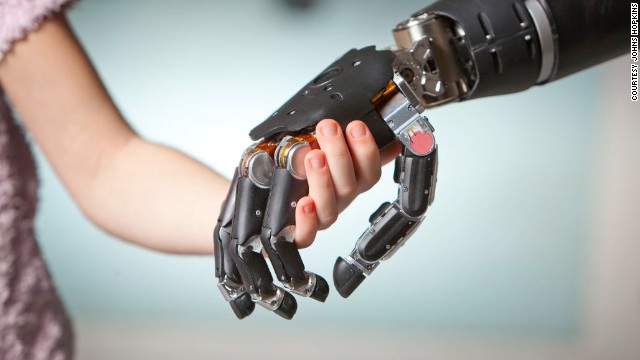
Certainly we have the technology to take us to the next level in our evolution. We can do things in terms of medicine that were only dreamt of a few years ago, from the  quality of prosthetics to manipulating genes and growing new organs. Every one of us has the sum total of Man's knowledge at their fingertips via the internet. Practically everything that is known is available to us in an instant while the  the world's cumulative knowledge grows not just daily or even hourly, but in terms of nanoseconds.   We have the ability to shape our future in ways that would have been impossible a few decades ago. But are we ready for that?

Let's take politics. What if we downloaded everything we know about politics into a supercomputer, including civil and religious laws, history, philosophy, economics, sociology, taxation, and even tradition and values, then ask the "all knowing" supercomputer to create the perfect political (and by extension, economic and social) system for us to live by? After all, we've downloaded pretty much the sum total of Mankind's knowledge into this computer which is capable of making  200 quadrillion calculation per second, so how hard could it be? 

Is it possible that this piece of super advanced  technology could figure out the best form of government for not just Americans but the best government for all of Humanity to live under? Could it do what eons of philosophers, economists, kings, revolutionaries, and statesmen have failed to do?  Perhaps this supercomputer could even work out a system whereby our societies could evolve at a certain pace while at the same time operating in unison.  Creating our new "god" in the image of the beast---Man. 

What sort of political, economic and social system would it come up with I wonder? Although I can hardly imagine it would, but what if it came recommended a modern feudalistic form of government much like our current Oligarchy whereby ordinary people are beholden to a few elites? On the other hand, it could come back with something similar to a democratic socialist system by which everyone is required to contribute in order to eat, be provided with housing or medical care. It could also recommend anarchy as the best form of government, whereby people either cooperate voluntarily in ad hoc groups or simply function on their own and making the best of whatever opportunity presents itself.

I wonder if we, as either a nation or as species would pay any heed to its recommendations? If it came up with something we already had some preconceived bias against, would we reject it out of hand or would be willing to give it go?  My guess is that, knowing Man's historical arrogance and failure to learn from past mistakes,  we would walk away from it.  

No doubt our "cyber-savior" would recommend that we relinquish complete control over all tools for war, both offensive and defensive as well as control over the economy and our resources in order to provide a more equitable distribution. I can't see the arms merchants of the world going along with that just as I can't see the financial powerbrokers giving up their control over the world's economies.

As an aside, I wonder how ordinary people would feel about being required to surrender all their weapons? Mankind is a violent species. We've been making and using weapons of all sorts since we fell out of the trees on some primeval savannah all those millennia ago and we're pretty darn good at it!

Obviously there's no way our benefactor will allow us to keep our guns, especially if it takes control of the world's weapon systems. Of course, it could simply stop manufacturing spare parts and ammo knowing that we'll eventually run out and our guns will become useless. However, I suspect most will be seized used existing data bases of known owners, although a few might slip through. 

What do you think this supercomputer, full of everything we have about religion, from ancient Sumer to today; every sect, every law or commandment, as well as every philosophy would do about a moralistic system? I wonder if it would select one faith over another, or whether it would create some sort of composite religion and/or philosophy. Besides, religion has been responsible the deaths of billions. it obviously has to be controlled. 

Perhaps it would, when comparing what it knows about science (which obviously must be included in its calculations), religion and philosophy would come up with something we've never thought of. I just might tell us that religion has no place in the world of science and technology, however, I somehow doubt that.  Why?

Mankind, as long as we've existed as cognitive or self-aware species, has always require some sort of moral guide. Although common sense should tell us (and perhaps it does) that doing certain things aren't good for us, we've always required a moral authority to be obeyed. Usually these were put forth by a king or queen. However, they lack longevity thanks to wars, coups, and revolutions. As soon as one king dies, another set of moral guidelines are usually imposed. 

However, if the guidelines are said to come from some divine entity and our failure to obey them would result in some dire divine retribution, we tend to take them a little more seriously. Of course, these  moralistic laws usually came with the some proviso like a king or religious institution as the sole arbiter of these divine laws, meaning you have to obey the king and/or priest in this world to stay on the god's good side in the next (but if you think about it logically, how would they know? Perhaps they're merely using the threat of eternal damnation or eternal reward as a tool to maintain control and order in the here and now).

Therefore, would our supercomputer make the pronouncement "Here are the rules by which you'll live by. Failure to comply will result in the suspension or deletion of your bank account, health benefits or food card for your good, the good of society and social order"? Certainly, any system it created or recommend would have to have a penalty clause in it otherwise what use is it? Perhaps too, it would include some form of reward system too. For instance, if you go six months without a social demerit of some sort, you'll get extra health benefits or bonus points on your food card.

That's something else about us humans. We work best when there are rewards and punishments involved. Again, you would think it was common sense for us to act in our own best interest, either as an individual or society, but we just haven't managed to get that down yet.  That's why we just don't have religious pronouncements, but civil ones too which include fines and imprisonment (or even the possibility of death).  Naturally, this would bring up a whole other issue, could our "HAL" (to borrow from the movie, "2001: A Space Odyssey"), also redesign our justice system?

If our supercomputer master is to create a new political/social/economic system, then it logically follows that a judicial system would have to be included.  What would it look like? Would it be incentive based like it is now or would it be more proactive and attempt to deter criminal behavior starting at or near infancy?

Perhaps we would be monitored in such a way as it would insure that certain "markers" are deleted from our DNA or from a environment. to improve the species otr make it more adaptable. I wonder if it would impose any type of physical punishment; maybe something like jail time or even the death penalty (after all, it would have to know about both the history of civil as well as religious forms of punishment since both have been incorporated into our modern judicial system, and some countries still follow religious guidelines as their civil punishment).

Another possible plus would be that this system would cut down on long trial delays, prolonged appeals, and perhaps even improper sentencing. The statistical facts of the accused could be entered such as age, education, race, gender, religion, orientation, as well as profession and/or social class. Both sides could still plead their case.  Since every form of the legal system---secular and religious---from around the world and down through history would have been inputted, the AI would be able to quickly hear proceeding, automatically delete any evidence not applicable, and render a impartial verdict which would equivalent to the defendant's peers in a way which isn't possible today.

Thus, we shouldn't be too surprised if we find that chopping off fingers or hands are back on the table (so to speak) or we're back to the rack and public hangings. Once more, Man has been a slow learner and nothing gets out attention like an example. Besides, these forms of punishments have been use by nearly every society throughout history and so there's commonality to them which could easily be applied. However, it has the added benefit of providing an incentive to follow the law.

So, what would you think of a future whereby we rely on artificial intelligence to set our political, economic, social, judicial, and perhaps even religious/philosophical boundaries? Do you think we, as human beings, would be capable of following the recommendations handed down by a  "gurgling and beeping" machine? After all, it's only processing our information, both historical and individual. It's not making up its own facts. It's using the information that we've created as a society. Are we capable of following its guidelines?  I can honestly say that I don't know, but my gut tells me no, we can't...or won't.

As a society, we've struggled to follow "laws" supposedly handed down to us by some omnipotent entity allegedly responsible for the creation of the cosmos, what makes us think we'll follow the pronouncements of some machine made by IBM or Apple? We've defied kings and queens who've claimed divine providence just as we've defied populists presidents and strong arm dictators.  Surely they represent the level of authority worthy of obeying; at least for the majority of us. So, what would be different about an overgrown calculating machine?

Well, I imagine any system created by this AI, in whatever form it takes, would dictate that everything be electronic. It's simple, fast and efficient. What's not to like? However, it also means that every one of us would be bound by our own personal zeros and ones. Failure to comply could result in being denied just about anything--- or everything. There would be no one to appeal to; no one to take pity on us. Computers aren't capable of that. They just "follow orders" so to speak.

Same goes when discussing religion or the judicial system. It will show absolutely no compassion. It knows only positive or negative. Zeros or ones. Those will be the chains which bind us. Our ability to shown understanding and compassion is what sets us aside as a species; that and our imagination.  The only way a system like the one described above would have to have built in an failsafe which involves human beings who are capable of showing pity or making exceptions, however, those may be exactly the very things which would make any system designed by a computer fail just as they have helped us survive all these millennia.

Artificial intelligence makes for a good servant, but it must never be allowed to become our master. However, as we become increasingly depended on it to organize and run our lives, it will increasingly come to be our masters. No doubt too that we'll start integrating with our technology. In many ways we already have; LASIK, artificial joints, bioartificial organs, tissue engineering, and regenerative medicine. That's simply the nature of the relationship with technology and it will continue to grow and evolve. Perhaps, in time, we will become Borg. Resistance may be less futile and perhaps more irresistible. 

Meanwhile, artificial intelligence can and should advise us. They can make excellent unbiased recommendations, free from personal biases or emotions, but they should never make unchecked decisions for us.  They are no substitute for what we, as human beings, bring to the conversation. However, as our society and our problems become increasingly complex and grows exponentially, we will find ourselves relying on the beast we've created in our image. But it must never be allowed to be the final arbiter of Humanity.   

  If you enjoyed the article, please consider passing it along to others and don't forget to subscribe. It's free! Lastly please be sure to "like" us on whatever platform you use to read anotheropinionblog.com. It helps with the algorithms and keeps our articles in circulation. Thank you!  


Saturday, April 29, 2017

Snippets and Tidbits: A Short Collection of Political Articles and Observations

Writing has never been difficult for me. I can usually sit down and put together a good piece rather quickly. In fact, I'm one of those people who can be doing one thing and simultaneously drafting an article in my head. Later, I'll either sit down and write out the draft or flesh it out into a complete article. Most articles are already written in their entirety in my head by the time I've concluded my research, so it's a lot like simply taking dictation (actually, in some cases the hardest part is picking out the best picture to go along with each paragraph. I suspect this one is going to be a bear!). Of course, I'm also always on the lookout for current topics which I think you, my faithful readers, might enjoy.

Some of these, the snippets and tidbits as I call them, are quite long---two or three pages in length; a few are even longer. Others are just a few sentences or paragraphs. It is these snippets and tidbits that I keep because, well, they're good possible articles, and secondly, I may want to come back to them at some point in the future and expand on them; perhaps turn them into full blown articles or see if the idea has held up since I first wrote it. What follows are a few of these snippets and tidbits, written exactly as I first typed them out over the past weeks or years in some cases. Since I am including several, I've chosen to include just the shorter pieces in order to provide as much variety as possible. I hope you enjoy them. Of course, your comments or suggestions are always appreciated.

What Difference Does It Make?

Let me ask you dear reader, what did you do today; this week; or even this month to help the poor and defenseless? Did you throw a few bucks or spare change towards the symptoms of poverty or did you take action to relieve the causes? One can say that the difference between conservative and liberal is the difference between throwing those few bucks or spare change in a hat or cup in exchange for a pencil and helping them learn the skills needed to make those pencils. Some would say that an education isn't complete without learning critical thinking skills; without learning a trade to support yourself. The difference then is really between helping a person for a single day and helping a person for a lifetime. To the poor or weak, what does it matters if they remain dispossessed by society? What matters is that we take the time to look at the world around us as it really is. It could be said that in the end, it doesn't matter about the wealth we've accumulated, but the difference we made in the lives of others.

The Oligarchy

It doesn't require your agreement, merely your compliance. You must accept its reality. To deny it your willingness to comply; to ignore it, that is the greatest fear of the beast.

That Sense of Uneasiness

Do you sense it? That feeling of uneasiness that seems to everywhere. Nothing seems safe or secure. Nothing feels familiar anymore. We are as if strangers in our own country. Even that which we call sacred has a sense of hollowness to it. Something which we once possessed has gone missing. Is that why old TV shows and movies and even the music of times past have become increasing more popular? Is that why we enjoy looking as old clips of times past with more than a simple sense of nostalgia? Even the old commercials bring with them a fleeting warmth of the familiar.

Corruption in our governments; our schools, our courts; and even our places of worship have become so brazenly commonplace that they barely even register our attention anymore. How often do you hear of a teacher raping a student or a priest or minster raping a child or stealing money from their congregation? We watch on TV stories about such debauchery in the name of religion that their great Khans of old would flinch.

Society is decaying. Our so-called political "leaders" are more concerned with fundraising and appeasing their corporate kingmakers than actually solving problems, which are usually of their making. They focus on the crisis of the moment; one that's usually manufactured to divert the public's attention from the real problems. We've become a nation of political media stars driven by polls rather than a nation of statesmen driven by the public good. People have become stunned into a sense of apathy.

This has become global. There's no chance for a repleve in another city, state, or country. Technology is such that anyone anywhere can be monitored at any time. People seem to have forgotten that instant connection works both ways. The would be conspirator is always being watched or even anticipated. Any attempt at meaningful change, therefore, has to be global in its conception and application while at the same time, actions must be taken locally and coordinated regionally if not globally just as the corporations act globally. Once must, therefore accept and indeed embrace the notion that "democracy" and "freedom" have different meanings to different cultures and no one culture can or should expect to respond exactly as another would. The idea is not to duplicate a response but to allow each to develop its own responses and act accordingly.

Nobility and Folly

How do these great and noble nations allow themselves to fall to their knees and be beaten by weaker, less moral, less noble people? Is it the assumption that all peoples are equal? They are not. We may be all the same in our humanness but we are not equal; not in intelligence, abilities or appearance. Not all peoples are the same either; history, religion, politics and traditions have seen to that. When two peoples are similar, there is growth; a synergy. When there is not, there is confrontation until one falls. History has shown that it has been the more advanced and enlightened nation which collapses first due to the assumption that all peoples are equal and the same.

Our Search

There was a time we believed the gods dwelt deep in the primeval forest silently watching us; somehow responsible for our ills and joys. But when we went in search of them, they had gone. All we found was the expanse of the forest and its many creatures. Then we sought them deep in still waters, but when we dove after them, they vanished among the liquid shimmers. All we saw was the deep teeming with life. Then came a time when we believed them high among the mist covered mountain tops, just out of view but always present. In time, we braved these holy mountains, but the gods vanished with the mists. All we found was the fields and valleys stretching out before us in all directions.

Later, we reasoned that the gods resided higher in the heavens, just beyond the clouds. With time, we learned to soar like the birds high above the earth but once more the gods alluded us. All that was seen was the earth expanding without end below us and the beckoning darkness of distance heavens yet about us. So, we reasoned, we must ascend into the heavens yet deeper in order to converse with our creators. As so we mounted rockets and plunged our mortal selves into the dark vastness but there were no gods. All we found were worlds upon worlds unexplored but then we looked down, we saw our small fragile earth alone. We had sought the gods but found ourselves instead.