Showing posts with label finance. Show all posts

Saturday, November 25, 2023

Rats Jumping Ship: The Congressional Exodus


This article, "Frustrated lawmakers run for the exits: 'DC is broken'"  showed on my AOL feed  Tuesday as I imagine it did yours. Written by Mychael Schnell for The Hill,  the article strangely makes it seem that the level of dysfunction in Washington is somehow new, which it's not and hasn't been for quite some time. Still, it has some interesting points.

A record number of Congressional members--19 Democrats and 11 Republicans--are bailing due to the vitriol level of bitter partisanship and growing inability to solve even the most mundane of issues. However,  the political system isn't "broken" as the author alleges. In fact, Washington is running exactly as it is intended to by the ruling oligarchy (or kleptocracy if you prefer).

Congress, and indeed our entire operating bureaucracy, has been hijacked by a relatively small group of very wealthy individuals, who have managed to get their hands on the key levers of power in this country, and set up barriers to prevent their removal. This group of individuals are there to serve the interests of Wall Street, not the average American citizen.

Corporate lobbyists literally write bills designed to serve the interests of their paymasters, the big banks and wealth managers, technology, medical, and military companies among others. Meanwhile, no one is there to look out over our interests. The system is aimed to reward the wealthy and powerful while offering vague promises of change to the rest of us.

Benjamin Franklin famously said in 1787, at the close of the Constitutional Convention in Philadelphia, that they had been bequeath to us a Republic to keep, if we could. Well, we couldn't. While there has been those chipping away at it from nearly the beginning, it was  the Supreme Court that finally laid our Republic to rest on January 21, 2010.  In its place, we were given a Corporatocracy.
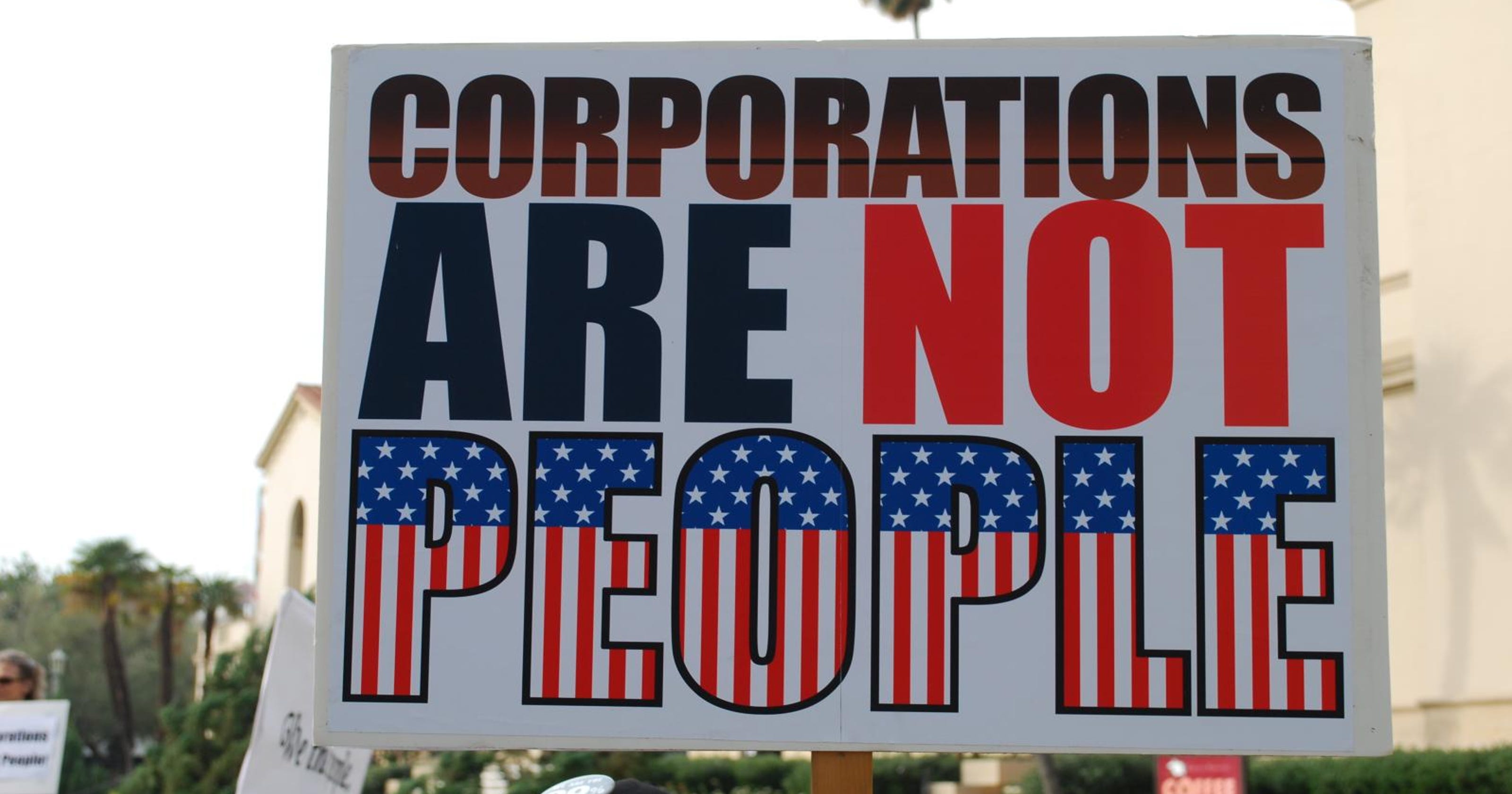
This day, January 21, 2010, was when the Supreme Court, blind in its understanding of modern politics and safely sequestered away in its ivory tower, grossly misunderstood the issue before it, that of money, corporate sovereignty, and politics, upheld Citizens United vs. the Federal Election Commission (FEC) by a margin of 5 to 4.  In doing so, corporations became de facto "people" with all the rights of ordinary citizens, but with one very important exception...free speech.

The court held that money was now the equivalent to "free speech". Corporations were free to spend all the "free speech" they wanted, be it on politicians, campaigns, or political parties, but what about flesh and blood citizens? Were we going to be allowed to spend what we wanted on candidates and campaigns to?

 The answer was "no". The average citizen's financial "free speech" would remain capped, as if uncapping it would matter anyway. Corporations were now free to step out of the shadows. They could drop tens of millions of dollars without blinking an eye. The result was that voters now had a much influence on elections as spit in a hurricane!

As an example, according to the FEC, during the 2019-2020 election cycle, corporations reported spending  $4.1 billion dollars during that 24 month period. In addition, Congressional candidates received $4 billion dollars while the two political parties, Democrat and Republican, were given $3.2 billion dollars. Corporations funded Political Action Committees ("PACs") to the tune of $13.2 billion. Lastly, electioneering communications and general communications reported to the FEC a received a overall total of $55.5 million dollars. Unions give just one dollar for every ten given by corporations.

The impact of Citizens United is all the more made clear when you consider that 96+% of all media---TV, radio, print, social media platforms, etc---are owned by just five corporations. This means that these same corporations can not only essentially underwrite a candidate or political party, but their control of the media allows them additional influence to affect your thinking on any given issue or candidate.

Citizens United also put the cost of running for office out of reach of most citizens. Races have become so expensive that only the wealthy and well connected can afford to run for political office. In 2022 for instance, the average cost to run for a Congressional seat was $8.9 million dollars according to the FEC. Even local offices can easily cost over $100,000 (as an aside, presidential elections are now firmly in the billion dollar stratosphere).  

It's not surprising that members of Congress are opting out, and who can blame them? The few idealists elected to office and thought they could make alliances in order to make a real difference, have found out otherwise.  Bills not favorable to corporate or special interest groups, are typically blocked or watered down to the point of bearing  little resemblance to their original intent.

In addition, it's not uncommon that newly elected members of Congress are often inundated with committees assignments, which are designed to keep them too busy to think about actually fulfilling any of their campaign promises while it indoctrinates  them into the mechanics of the system. They are also expected to spend hours upon hours fundraising for the party, party leadership and attending functions where they meet their new owners. It seems that you can promise whatever you want during the campaign just as long as you don't take it too seriously.

As the idealists (and naive) continue to vacate the halls of Congress, who do you think will fill their seats---more idealists? Perhaps. But in a political system which has intentionally been corrupted to serve the interests of Wall Street and the very wealthy, we're much more likely to see more charlatans running on promises they have no intentions of fulfilling, even if they had really wanted to. Former House Speaker Sam Rayburn (D-GA) summed up the political process in Congress the best when he said "to get along you have to go along".

So is there anything we can realistically  do? Actually, we can still do a lot. We can help elect Independents and third party candidates. After all, Independents have the largest bloc of registered voters with 49%. Meanwhile, the percentage of Democrats (a distant 29%) and Republicans (20%) continue to shrink. Besides, why should two minority parties control our government? If nothing else, we can vote to oust the incumbents. At least it would be a change of faces!

You can run for office or perhaps you could seek out a board or commission position as way to influence local government. We can change voter registration as well. As I said, Independents are the largest bloc and growing. But there are other viable political parties you might consider such as the Libertarians, the Greens, or the Constitutionalists.

There are also a number of issues you can get behind that would make real impact, such as getting behind Rank Choice Voting, Term Limits, or ending partisan gerrymandering. Roughly half of all states prohibit voter referendums. That's where citizens sign a petition to put an issue on the ballot. Once the requisite number of signatures has been reached, the matter is placed on the ballot  and its voted on by the general electorate. That would be a great issue to get behind!

A key issue to consider is working to get some elected or appointed political offices changed for partisan to non-partisan. Why, for instance, should the State Auditor, Treasurer, Agriculture Commissioner, or Secretary of State be a partisan office? They are Constitutional offices. They don't make any laws. They simply enforce existing laws. The same goes for the offices of County Clerk, Circuit Court Clerk, or County Attorney. Why on earth would you want those to be partisan positions?

As an aside, it's worth nothing that the Board of Elections at both the state and local levels have Democrat and Republican Election Officers to oversee the affairs of their respective party as it applies to voting. But why doesn't Independent and third parties? They literally have no representation!

Currently Independents and third party voters are simply dumped in with whichever of the two corporate owned parties are the smallest to boost their overall numbers, and you can bet that their interests are totally ignored.  So why isn't there a third non-partisan election officer looking out for Independent and third party voters? That would be a great issue to get behind. 

You could volunteer to work for some local group on a particular issue of interest to you. Maybe you'd want to serve as a citizen lobbyist to help get support on some particular cause by lobbying you local elected officials. For example, why don't citizens get to vote on increases of taxes, fees, or rates, including any utilities owned by the city? You could help create or join a neighborhood association or block watch.  Finally, you could write letters to the editor of your local newspapers.

Personally, I've been urging voters to ignore endorsements by the news media for over 20 years. The reason is because I believe the media should focus on solely on reporting the news and not trying to influence elections through endorsements in order to promote their private agendas. That's not their job. Instead, their job is to provide the public with a honest accounting of the facts without bias.

At the very least, those doing the interviews and making the endorsements need to disclose their name, their position, and their party registration (or political leaning) in the name of full transparency. Very few news media endorsements do this. They also  need to release the entire unedited transcript of each candidate interview instead of the editors providing excerpts or corrected responses (unedited filmed versions of the interview would be better)

These are just a few suggestions. There are, without a doubt, many more. The point here is to become and exemplify the change you want to see.  But to do that you have to get off your butt to make it happen instead of whining about how things have become. We lost our Republic by sitting on our collective behinds and assuming someone else would protect our nation and preserve our Constitution for us while we played video games or daydreamed our lives away watching so-called "reality" television shows!

There's an old expression which says that a nation gets the government it deserves. I don't know how true that is, but I can't imagine the average American, regardless of their origin, race, religion, ethnic status or gender, wants to see this great nation continue to circle the drain ever tighter. So, what's it going to be? More bitching and moaning or doing what our Founding Fathers did--- taking a stand? It's your call.


If you enjoyed the article, please consider passing it along to others and don't forget to subscribe. It's free! Lastly please be sure to "like" us on whatever platform you use to read anotheropinionblog.com. It helps with the algorithms and keeps our articles in circulation. Thank you!


Statistical Summary of 24-Month Campaign Activity of the2019-2020 Election Cycle


Think: Supreme Court's Citizen United mistake just turned ten years old. It's time to reverse it.


What's Wrong with Citizens United v. FEC


Brookings Institute: What Americans still want fromgovernment reform: 11 takaways


Government Executive: More Americans Want 'Very Major' Government Reform


Saturday, January 08, 2022

Who Wants To Play Monopoly?


I'm sure everyone has played the Parker Brothers board game "Monopoly" and tried to dominate all the properties and garner as much of the money as possible, but I'm not talking about board games. I'm talking about real life monopoly where a handful of individuals or corporations own the lion's share of the marketplace. Have you ever wondered who the real life monopoly players were? Well, if so, read on.

As many of you should know, only six corporations own 90%+ of all media. That includes movies, video games, publishers, magazines, newspapers, TV, cable, and practically all news outlets. That means just six corporations whose political and social agendas shape or influence our opinions on nearly every issue. To put it another way, those six corporations call the tune that we are forced to dance to.

While it's possible to find outside sources, most Americans either don't know where to look or they're too tired from work or just to frustrated to bother. Besides, most "go to" sources out there are biased one way or the other. There are too few non-partisan sources, such as this one, to go to. That means many American's turn to various distractions such at TV, videos or video games, movies, and so on; all of which are owned by those very same six corporations and reflect their political agendas.

So, if we weren't going to watch TV or play video games, what are we going to do? How about heading to the refrigerator for something to eat? Well, hate to break it to you, but you have the same problem. Four corporations control just over 50% of the market representing 79% of the groceries we buy. Not only that, just four companies---Walmart, Kroger, Costco, and Ahold Delhaize (the parent of companies like Food Lion, Giant Food, Stop & Shop, and Freshdirect) control 65% of the retail market.

As an aside, farmers receive only 15 cents of every dollar consumers spend on groceries. The rest goes for processing and marketing. Meanwhile, farmers received approximately $424.4 billion dollars in taxpayer subsidies from 1995 to 2020 (that includes $20 billion just under the Trump Administration). However, the majority of that money didn't go to the average small family farm. It went to the largest 15% of corporate owned farms which typically earn a million dollars or more a year.

In terms of meat processing, four companies---JBS, Tyson, Cargill, and  Marfrig---control  85% of the market while three companies, JBS, Tyson, and Hormel, control 66% of the pork market and four companies---JBS, Tyson, Purdue, and Sanderson Farms--- control 51% of the poultry industry. The same report points out that five corporations control 85% of processed pork market in Germany.

JBS alone received $78 million dollars in taxpayer based subsidies as part of a farm bailout during a trade war with China. JBS is 20% owned by the Brazilian Development Bank. In 2017, Brazilian authorities handed out the highest fines ever against JBS officials on corruption charges, including the bribery of 1,900 government officials. 

In terms of agrochemicals, such as fertilizer, four companies----ChemChina, Bayer, BASF, and Corveta own 65.8% of the market. The same companies, plus Limagrain, dominate 53.2 of the commercial seed market. In the world of "animal pharma", which makes veterinary supplies, medicines, and devices for farm and other animals, 58.3% of the market is controlled by only five companies, Zoetis, Elanco, Boehringer, Ingelheim, and Merck.

While Cargill, a global food company, is privately held, most of the other key players are owned by investment firms, banks, and pension funds; investing to the tune of $478 billion dollars in the meat and dairy market from 2015 to 2020. The major investors are Blackrock, Capital Group, Vanguard, and Norway's government pension fund! By the way, thanks to the blunder which is Citizens United, the food industry spent $175 million dollars lobbying government officials and making campaign contributions during the 2020 election cycle.

When it comes to the tech industry, which impacts nearly everything, just five companies virtually dominate the entire industry. Those companies are Google, Apple, Facebook, Amazon, and Microsoft.

Between them, they control or influence around 80% of the technology we use every day. In fact, their combined wealth makes up 15% of the entire S&P 500. I bet no one is laughing at those high school geeks now! Of course, the tech industry, like everything else, needs electricity to operate. So who dominates the energy market?

The three primary sources of energy for the United States is oil, natural gas, and coal, with oil and gas accounting for 60% of all energy produced and used.  Renewable energy such as wind, hydro, and solar makes up a tiny fraction of America's energy source, and if the leading companies controlling the energy market have any say in it (and they do), renewable sources will never be a major player.

The industrial sector makes use of 32% of all energy produced. This is followed by the transportation sector which uses 29%,  which is closely followed by the residential sector which uses around 20%. The commercial sector, which includes businesses, hospitals, schools, etc., consumes 18%.

When it comes to production of all this energy, the largest global company is ExxonMobil, followed by Royal Dutch Shell, Chevron, Total, and British Petroleum. PetroChina and Sinopec make up the sixth and seventh spots. Others in the top 20 producers include a third Chinese company, CNOOC Limited (15th), Italy's Eni (10th), and Halliburton, a U.S. company, in 20th place. Together these 20 companies nearly dominate the entire energy industry.

You may be interested to learn that the oil and gas industry donated around $8,708,787.00 dollars in the 2020 election cycle. Of that Donald Trump received $3,773,155.00. Joe Biden, the only Democrat to receive money among the top five candidates, got a paltry $1,609,976.

The oil and gas industry gave $63.6 million dollars to the Republican Party while the Democrat Party got just $13.3 million dollars during the 1990 to 2020 election cycles. Thus far in the 2021/22 election, the GOP has received $8 million compared to the Democrat's $2.4 million. How's that for influence buying? 

With all that money, it's got to go somewhere! So, who are movers and shakers in the financial industry? The financial industry is highly diverse. It includes everything from banks, to fund managers, to holding companies, insurance companies (commercial and retail), to lenders and collection agencies. 

However, if we're looking at assets held or controlled, there are roughly 30 or so leading companies which dominate the U.S. financial market. The top ten (from tenth to first) are Blackrock, Citigroup, Morgan Stanley, Wells Fargo, Bank of America, PayPal, MasterCard, Visa, JP Morgan Chase, Visa, and Berkshire Hathaway. Also in the top 30 are Travelers (29th), Capital One (23rd), and Goldman Sachs (13th).

Globally, it's a slightly different story. While Berkshire Hathaway is still number one, the next five companies are all Chinese (Ping An Insurance Group, ICBC Banking, China Construction Bank, Agricultural Bank of China, and China Life Insurance). Next is the German company (and the parent of my old company, Euler Hermes) Allianz, which is a financial conglomerate.  

In eighth place is another Chinese company, Bank of China, followed by JP Morgan Chase, and AXA Insurance. Other companies in the top 30 include 12 American companies, eight Chinese, four French, four English, four Japanese, two German, two Canadian, and a smattering of Indian, Italian, Swiss, Spanish, and Dutch. Notably absent are those from Hong Kong, Australia, Brazil, Mexico, or Singapore.

As we all know, nothing happens in Washington without palms getting greased in one fashion or another. As with any other industry, the financial sector made its presence felt in the 2020 election cycle. Wall Street executives, directly, trade associations, PACs, lobbying, and so forth, spent $2.9 billion on the 2020 election cycle. Of that, $1.9 billion went specifically to candidates running for a federal office. 

47% of that $1.9 billion went to Republican candidates while 53% went to Democrats, with $74 million going to Joe Biden. So much for the Democratic Party being one of the working class! If we were to include money coming from the real estate investors and insurance companies, along with the financial industry, the money spent jumps up to $250 million dollars to support Biden.

 Meanwhile, "The Donald", who made his living in real estate investment and development, received only $103 million from those same industries. Five U.S. senators received a combined $300 million, including Lindsey Graham (R-SC) and Mitch McConnell (R-KY).

The same study showed that lobbying efforts by these same industries spent a whooping $932 million dollars for the same election cycle. Who spent the most? Apparently the top spenders were Blackstone, American Bankers Association, Charles Schwab, Susquehanna International, Bain Capital, and Renaissance Technologies. All I can say is that I hope they got what they paid for (well, maybe not).

Some groups and individuals would have you believe that America is "turning socialist" (or Communist. They use the two different ideologies interchangeably). Obviously if that was true, none of the above would be happening since socialism is the ownership of production by the workers and Communism is the ownership of everything by the state.

America is a Corportracy, a form of fascism, meaning a close partnership or even "hand-in-glove" relationship between corporations and government. As you'll note from the above, that's clearly what we have. Like any system, it has managers or overseers. Those managers are the uber wealthy Oligarchs who own or control these corporations. What they want they get, and it's usually at our expense.

Studies have shown that, on average, the wealthiest 10% of American's typically get what they want from government about 65% of the time. When average American's oppose a policy the super wealthy support (like the Wall Street bailout under President Obama), the rich usually win as they did in that instance.  The same argument can be made when it comes to tax cuts, low/no interest federal loans, bailouts, subsidizes, or foreign policy matters.

This isn't the work of would-be "socialists" or Communists. This is the work of an powerful and unbelievably rich Oligarchy where party means absolutely nothing except a means to divide us. They have an agenda and it's not the restoration of our former Republic or furthering the spread of democracy. This is about power and control. As George Carlin once said, "it's a big club and you and I ain't in it".  It's time we had our own club. It's time we stop playing Monopoly by their rules.

If you want to know more, please take a look at the links below. If you enjoyed the article, please consider passing along to others and don't forget to subscribe. It's free! Lastly please be sure to "like" us on Facebook or whatever platform you use to read A/O. It helps with the algorithms and keeps our articles in circulation.


Companies: dominating the market from farm to display case


America's food monopolies and power imbalances


Just a Few Companies Control the Meat Industry. Can a NewApproach Level the Playing Field?


GAFAM: The Big Five Tech Companies Facts


Lobbying spending of oil and gas companies in the UnitedStates


Disturbing data: The rich and powerful get their policiesadopted even if opposed by most voters


The Top 30 largest US financial companies in 2021


List of the largest financial services companies by revenue


Wall Street execs, employees spent $2.9 billion to influenceWashington during the 2020 election, study shows