Showing posts with label Greece. Show all posts

Saturday, December 23, 2023

Where Did Christmas Come From? Constantine and the Origins of Christmas

 December 25th...Christmas! The day boys and girls the world over most look forward to. It's a time of celebration, of gatherings, of specially prepared foods, decorated trees, and, of course, of presents! There are often special events like parades, the occasional carolers, theme related plays, movies, and television programs (and let's not forget football games too!). 

Of course, it's also the day when Christians celebrate the birth of Jesus, the centerpiece of their religion and immovable cornerstone of their faith. But did you know that December 25th was more or less randomly chosen?

Although its core was centered in Roman occupied Judea and the Galilee (today's Israel), it's primary areas of growth were the far reaches of the Roman Empire, thanks primarily to the missionary efforts of Paul of Tarsus, along with others, who operated principally in Greece, Western Turkey, Syria, and, of course, Rome itself.

The early Christian movement was essentially a messianic Jewish sect, one of many at the time, and came about during a particularly tremulous period of simmering political and social tension as conquered peoples throughout the empire struggled under the yoke of Roman occupation.

Christianity, thus, incorporated fragments of other religions and philosophies; most notably Greco-Roman, which was dominate at the time, as were the teachings of the Jewish sage, Hillel. As such, it shares similarities with other sects like the cult of the Egyptian goddess Isis and the cult of Mithras, which was especially popular among the military class, as was the cult of the sun --- Sol Invictus, also associated with Mithras (collectively these were known as "mystery cults).

Not long after the execution of Jesus in around the Year 33, Judaism in all its forms underwent a profound change when Rome, tired of constant revolts and rebellion, sacked Jerusalem and leveled the Temple complex, and in doing so, destroyed the priestly caste.

This new messianic sect, however, survived thanks in part to their wide dispersal around the empire. However, their survival was a mixed blessing. While they avoided the fate of Sadducees and Pharisees (and perhaps the Essenes), their refusal to acknowledge the divine sovereignty of the emperor, made them a "enemy of the state" for which they would pay a very high price.

They were often harassed or persecuted. They paid additional taxes, they constantly faced possible arrest and imprisonment, or were sold as slaves. Some emperors went so far as to include them as part of the "entertainment" for the Coliseum games, which literally included "feeding them to the lions" (and the tigers and bears...oh my!).

Emperor Nero was known to have them tied to poles, doused with oil and lit them on fire, thus serving as human candles during his nightly parties. Nevertheless, the sect continued to grow, albeit in secret. Meetings were held in secret in people's homes, forests, or in caves and catacombs among the dead.

Finally, in 312 AD, there came Constantine (later known as "Constantine the Great)  and everything changed. Around October 28, 312, then General Constantine was engaged in a battle with Maxentius, the son of the dead Emperor Maximinus and heir apparent, over the control of the empire. It was another of Rome's infamous civil wars signifying a dying empire.  The battle was at the Milvian Bridge (now Ponte Milvio), which spanned the Tiber River, and it would decide the fate of Rome. 

While the troop strength was roughly equal, the odds seemed to favor Maxentius as some of the leading generals, such as Severus, the co-ruler of the empire, defected to Maxentius. Maxentius also had the support of the Rome's senate However, Constantine had the support of Galerius, the emperor of the eastern portion of the empire. So, what happened?

The story that's come down from history is almost assuredly exaggerated, if not just a myth. It says that on the evening before the decisive battle, Constantine, turned his attention to the heavens and begged for divine support (or at least a sign). Accordingly, it was said that he saw a celestial cross in the sky and heard a voice whisper to him "in this sign you shall conquer".

Other stories have this as a dream and still others say that he was looking at the setting sun the day before the battle and saw a cross (this is often called a "sun halo" or a "sun dog"). Also, instead of hearing a voice saying "in this sign....", the voice said "through this sign you shall conquer". Did any of it really happen? Maybe. He did, no doubt, know that many of his officers and soldiers were secretly Christian and he desperately needed their support. Thus, it was said that he ordered a cross to be painted on all the shields, and if he won, he would convert to this new religion.

It's worth noting too that the cross was not then commonly associated with Jesus or Christianity, nor was it a particularly good omen since crucifixion  was still in use.  The more commonly accepted symbol for Christians was the fish (or ichthus). It should be mentioned that at this time Constantine wasn't a Christian. He was a follower of the Sol Invictus---the Invincible Sun.

But regardless of what Constantine saw or heard, he was victorious. Most of Maxentius' men fled. Maxentius drowned in the Tiber River, brought down by his heavy armor as he fell off his horse and into the swift river trying to flee with his troops.  Assuming the sign as being responsible for his victory, all persecution of Christians stopped. Christianity now became the defacto official religion of Rome, which he made official with the signing of the Edict of Milan in 313, just one year after his victory.

The new emperor immediately set about instituting massive reforms throughout the empire. Everything was reorganizing the government, fiscal and other economic reforms, and changes in the military.  However, Constantine is perhaps best known for his organization and consolation of Christianity. 

In 314, Emperor Constantine summoned a council of key Christian leaders or "bishops" to Arles in Gaul (modern southern France). Technically, the meeting was to address the Donatists, a growing Christian sect based in Carthage (Rome's old enemy) and largely outside the control of Constantine. Their intent was to basically destroy this so-called "splinter" group before a irreparable schism could divide the emerging faith. However, the meeting was also to test Constantine's control over the bishops as well as establish precedent in dealing with other "heretical" sects (most notably the Arian and Gnostics).

A few years later, in 325, came the best known and most significant of the meetings, the Council of Nicaea.  This meeting set about formally hammering out Christian doctrine, the organization of the church (which was loosely modeled on the Roman military), deciding on which biblical texts were "canon" and which weren't (and what parts of various texts were to be deleted or changed).

As an aside, Constantine declared the Sabbath would no longer be Friday/Saturday. The Sabbath would now be Sunday in honor of Sol Invictus and would applied to all religions per his decree on March 7, 321.As Christianity grew in popularity, it eventually replaced the other religions and Sunday became its own.  

The Council of Nicaea also sought to clarify the nature of Jesus and establish whether he was divine, semi-divine, or simply an enlightened moral. They also dealt with other issues such as his birth (and thus Mary and her relationship vis-a-vis Jesus), his siblings, Joseph, God, and, of course, the various apostles, the role of women, the nature of sin, and so forth. The human Jesus was to be replaced by the immortal Christ as one of the delegates (an Arian) stated.

Needless to say, those present were not just the best and brightest in Christendom present, but the best and brightest throughout the empire. There was a great deal of disagreement among these distinguished individuals (okay, even some heated yelling matches, shoving, and even a fistfight between St. Nicholas--aka "Santa Claus"--and St. Arius). In the end, the Council of Nicaea laid the foundation for Christianity as an institution and created the core statement of faith known as the "Nicene Creed" (the "Apostle's Creed" would later evolve out of it).

So what does all this have to do with Christmas? Just this. The Council of Nicaea, under the direction of Emperor Constantine, set forth the two central events for all Christians---Easter and Christmas. Easter, which symbolizes the belief in the resurrection of Jesus following his execution, as well as the nature and date of his birth. So, if you ever wanted to know when Christmas (or "Christ Mass") first started, this is it!  

At the time of Nicaea, there were several differing Christian sects. Each had its own religious texts and traditions, which could vary widely. Some had certain books or texts than others didn't which included various stories about Jesus. For instance, some included stories of his birth. Some didn't. A few, but not all, mentioned his brothers and sisters.  Some detailed more of his teachings. Others didn't, and so forth.

 As an aside, the teaching of many of these "non-canonical" or unapproved texts would later be ordered to be discontinued while others were edited or considered as "apocryphal" and "pseudo-apocryphal" books. And yet other texts would be seized and destroyed. In fact, many of the smaller Gnostic sects would be burned as "heretics" along with their books. As a result, many of these sects hide or buried their sacred texts until, hopefully, safer times arrived.

Many of these early Christian sects which had a birth narrative that assumed Jesus was born in the Spring based on lines  like "tending flocks in the field". Thus, March 28th was generally accepted as his birthday or at least, nativity. However, if Christianity was to be the "official" state religion, Constantine would still need to contend with the very popular pagan cults of Isis, Mithras, and Sol Invictus.

The three pagan cults held that the winter and spring solstices were the most sacred (in fact, most pagan religions in general still hold these as sacred). Therefore, Constantine decided these should be merged and celebrated as a way to bring the four religions together (besides, as a follower of Sol Invictus, Constantine, was well aware that the "birthday" of Sol (the sun) was December 25th, the Winter Solstice).

The Spring Solstice, which was celebrated a symbol of the nature's rebirth and fertility, fell conveniently in line to be the date of the resurrection. It was also close to the Jewish day of Passover, which was mentioned in the majority of various Christian texts pertaining to the crucifixion. Other events could (and eventually were) incorporated around these two central pillars of Christianity.  Thus, Constantine brought the four main religions of the Rome Empire together, which he hoped would ease some of the mistrust and competition between them.

Note too that "Christmas" was, strictly speaking, a solemn day of worship. It simply meant "Christ Mass" or Mass of/for Christ". There was no tree or gift giving. The evergreen tree was incorporated from ancient Germanic pagan practices and first introduced in the 1500's. Legend holds that religious reformer (and one of my ancestors), Martin Luther, first placed candles on the trees after a walk in the forest where he saw stars peering through the limbs of snow covered evergreen trees.

The notion of gift giving dates back to ancient Celtic, Germanic, and Roman practices during the winter solstice celebrations. Typically these were inexpensive items such as combs, yarn, and flint. Expensive objects were actually frowned upon. It was believed that simple and practical were in keeping with the spirit of the season. By the late 300s, converted Christians had carried over the practice into their new found faith, which was supported by the gifts brought from the east by the three Magi.

As for Constantine himself and whether he kept his promise to convert to the new religion of Christianity which had secured his victory, that's a matter of debate. Some historians and theologians say that he did immediately after his victory. Others say it was while he was on his deathbed that he fulfilled his promise, and then there are those who say that his "conversion" occurred  shortly after his passing since apparently the bishops attending him could do such things. Regardless, Christmas...and Christianity...all began with Emperor Constantine.  


If you enjoyed the article, please consider passing it along to others and don't forget to subscribe. It's free! Lastly please be sure to "like" us on whatever platform you use to read anotheropinionblog.com. It helps beat the algorithms and keeps our articles in circulation. Thank you!

Tuesday, September 15, 2015

The Suicide of Nations


Recent events in the Middle East have resulted in the largest mass exodus of refugees since the end of World War II. The vast majority of these are Muslims from Syria. The White House announced on September 11th that the United States will take in another 10,000 over the next year. With the US limiting the number of refugees to 70,000 annually, that's still a significant number. Nevertheless, Germany has agreed to accept some 800,000 while tiny isolated Iceland has offered to take in some 100,000. The US State Department has been working the Catholic Counsel of Bishops and the Lutheran Church (which alone has settled over 7600 Somalis in Minnesota while both have become experts on immigration---legal and illegal) to resettle these individuals. States like Kentucky, Vermont, Arizona, Nebraska, Idaho, Michigan, Utah, and both North and South Dakota will get the bulk while South Carolina, Arkansas, Mississippi, West Virginia, Montana, and Wyoming will get the least. Of course, this will put increased pressure on these states, several of which that are struggling to meet current levels of need, to provide housing and employment, not to mention an additional drain on social and health services. In terms of jobs, many of these individuals are low skilled with little knowledge of English, making re-education a first priority. However, their low skill levels will also create a potential conflict with other, mostly illegal, immigrates, who are now holding many of those jobs.

In Europe, this potential for conflict has already come to a head. As I mentioned above, Germany is taking in some 800,000 of these fleeing immigrants. France has agreed to take in around 100,000 despite its already heavily Moslem immigrant population. In total, some 300,000 have already fled Syria and surrounding areas, with approximately 200,000 overwhelming the financially struggling Greece along and around 100,000 making their way into Italy. According to some sources, just over 13 million souls have been displaced in
Syria alone (Afghanistan and Eritrea round out the top three nations most impacted by the violence). Two million, mostly Syrian refugees are holed up along and just in the Turkish border.

While many are calling for a return, or at least an ouster of the refugees from their countries, the 1951 UN "Refugee Convention" requires nations to accept individuals who are fleeing countries where their lives are endangered. In addition, the EU has mandated an open immigration policy, which has already heavily burden nations like Sweden and Norway and has nearly collapsed their once highly successful democratic socialist economic systems. Nevertheless, countries like Sweden have already accepted just under 68,000 refugees (Germany has thus far taken in close to 100,000). Other countries such as Hungary and Macedonia, have closed their borders to the refugees, despite the onslaught. Thus far, the Hungarian Government has been, albeit reluctantly, allowing refugees to pass through the country as they make their way to Austria (which is accepting 80,000 refugees), Germany, and other Western European nations, including the US which has agree to accept up to 10,000. The International Rescue Committee and United Nations has expressed their dismay and anger at the United States for agree to accept 100,000; apparently without consideration of the thousands the US has already accepted and the illegal immigration crisis (unlike Europe, the US is not bound by the same laws mandating acceptance of illegal immigrants---at least not yet).

Nevertheless, things have been unraveling quickly. Refugees and immigrants have been pouring in at higher than expected rates, overwhelming relief efforts with some refugee centers running low on food, water, medicine, and tents (and this doesn't take into consideration clothing, transportation, emergency needs, or sanitation needs). In addition, thousands more from Africa having been
attempting to enter Europe through Spain and southern France. These have typically been the immigrants which have been coming for years since the EU's open door policy has been in effect and have overloaded the social safety networks in many of the host countries. The result has been Germany's efforts to "reinstate" border controls (Germany's Merkel has been urging other frontline European nations to do likewise).

It also looks like many of these refugees and migrants have brought their ethnic and religious hatreds with them. Germany, Italy, and Greece have all reported violent assaults as various opposing groups have come in contact with each other. Other countries, including France and the UK are bracing for similar violent outbreaks. There is little doubt European authorities are ill equipped to handle the level of hatred and open violence that is coming their way. Also, approximately 12 ISIS operatives have been caught crossing into some of the hosts nations so far (in one instance, the suspect was carrying dozens of fake Syrian passports). How many have crossed undetected is anybody's guess, but I think we'll soon get a good idea firsthand.

Lastly, but perhaps more significantly, the overwhelming majority of the refugees entering Europe are Moslem (as have been a significant number of the Africans mentioned earlier). Yet, the most persecuted of the all those in the Middle East has been the Coptic, Assyrian, Chaldean and Syrian Christians. These were the ones whom ISIS attempted to surround and capture as they fled into the mountains with the Kurds. Meanwhile, hundreds, if not more, have been captured, tortured, and ultimately murdered in the most gruesome ways imaginable---men, women, children (including babies), the handicapped, and seniors. Even family pets weren't spared. A few young girls and women have been sold off to become sex slaves before finally being decapitated. However, these Christians seem to be having the hardest time finding sanctuary.

Some towns and communities have expressed a willingness to accept refugees or migrant families, provided they were Christian in order to preserve their local character and culture (and some have mentioned to lessen the likelihood of terrorists).The country of Slovakia, for instance, said it would accept Christian refugees only. Cyprus too has expressed an interest in Christian only refugees. Not unexpectedly, politicians all the way around have condemned this as being "racist" or "discriminatory"; claiming that Christians aren't any less persecuted than other minorities. Hogwash. Of those few Christian families who've at least made it to the refugee camps, many are intimidated, attacked and beaten by their fellow refugees who happen also to be Moslems.

I think the Europe we've always known is vanishing before our eyes. Europe has been inundated for decades by individuals who have little or no education not to mention poor work skills. Some, however, have taken the opportunities afforded them by their hosts countries to educate themselves and learn viable employment skills. However, those have been the minority. Most seem more interested to live in their homogenous enclaves while drawing on the already strained social nets instead of trying to integrate themselves into their new homeland. The once highly successful economic systems of Scandinavia---the socialist democracies so much hated by the corporate capitalists for defying their economics of greed---are failing; not because of ideological flaws, but because these new immigrants lack the education, work skills and yes, the work ethic needed to sustain a system which requires everyone to pitch in equally in order to reap the benefits equally.

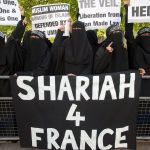
With the decline in religious observance throughout Europe and a birthrate which has been in decline since the end of the Second World War, whole sections of cities, like London, Manchester, York, Paris, Marseille, Hamburg, Dusseldorf, Solingen, and Lisbon have become unwelcoming Moslem enclaves thanks to higher than average birthrates as well as the recent immigration, where Sharia law is enforced. Even non-Moslem women simply walking through are harassed if their heads are uncovered or if they're unaccompanied by a male adult. Pets, especially dogs, are very much unwelcome ("unclean"). Government authorities pretend they maintain control, but in reality they can do little more than lodge complaints with the local ruling council. Meanwhile, churches are being converted into Mosques. Local traditions, foods, and customs are being supplanted. In Germany recently, girls have been instructed not to wear short skirts to schools as to avoid "offending" Moslem students and their parents. School curriculums are being changed to fit with acceptable classes for Moslems. Being overwhelming Christian for centuries, most European schools, hospitals, and so forth often display a Christian cross. Well, that too is changing as they are being asking to remove them. Why? I think you why.

While it's unlikely that any European nation will face a Moslem majority, they will see significant increases in Moslem populations and can expect a ramping up of demands for change as they seek to increase their economic and political influence. Smaller countries like Belgium, the Netherlands, Iceland, as well as Sweden, Norway and Denmark will likely be the most impacted. Nevertheless, the demographics will change. There will be less of the stereotypical fair skinned blond hair blue eyed Northern European or the rosie cheeked English or the freckled red-haired Scot. Even the French will see change. Gone too will much of Europe's culture and traditions I suspect, along with its scandalous "liberal" social attitudes. In place of ringing church bells there will be calls to
prayers from converted Cathedrals. Its economy will likely struggle along while some may fail altogether as Europe will face a steep re-education and training curve while bearing a crushing influx on its social safety net. Europe may also face a healthcare crisis as possible old diseases are re-introduced into society.

Lastly, I think Americans need to pay more attention. While much of what's happening some 5000 miles away, many of these changes will be---and are---on our shores too. We are, as the Greeks are saying, becoming an "occupied" country. We have at least 12 million illegal immigrants here; many if not most of whom having no interest whatsoever of integrating into society. This influx has and will continue to drive down wages and evaporate benefits as we cope with excess demand versus availability of jobs while higher paying jobs are exported to lower pay countries. It has already strained our social net to the max. We will see an even greater entrenchment of ethnic communities as well as an increase in racial, religious, and ethnic conflicts as centuries old hatreds are brought here and the shrinking tax dollar for social services pits one group against the other while a few attempt to goad the more successful into feeling "guilty" for grievances not of their making; assuming that it's better to live off public handouts than accept responsibility for their own lack of effort as others have, starting with taking education seriously. Meanwhile, we have a government that is no longer "ours". So perhaps we are "occupied" after all.

As Bob Dylan once sang, "you don't need a Weatherman to know which way the wind blows" and I'm feeling a chill in the air.


Why Europe's refugee crisis has reached a tipping point
http://news.yahoo.com/asylum-in-europe--the-difference-between-migrants-and-refugees-and-what-s-at-stake-183639355.html


Why is the EU struggling with migrants and asylum?
http://www.bbc.com/news/world-europe-24583286

Archbishop of Canterbury: UK plans to take in 20,000 Syrians discriminates against Christians
https://refugeeresettlementwatch.wordpress.com/category/christian-refugees/

Pew Research Report: The Future Of The Global Moslem Population
http://www.pewforum.org/2011/01/27/future-of-the-global-muslim-population-regional-europe/